Looking forward to tomorrow’s return to Oaxaca, though not sure what I will find. So, in preparation, a little street art, apropos of nothing…

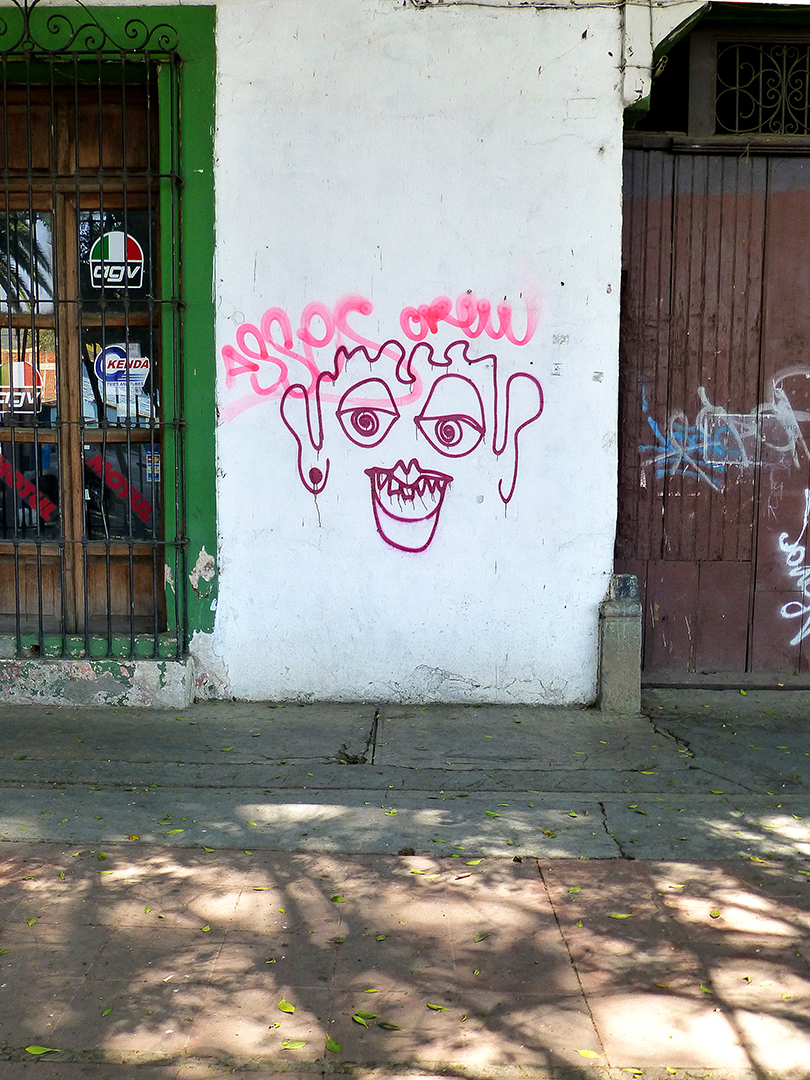
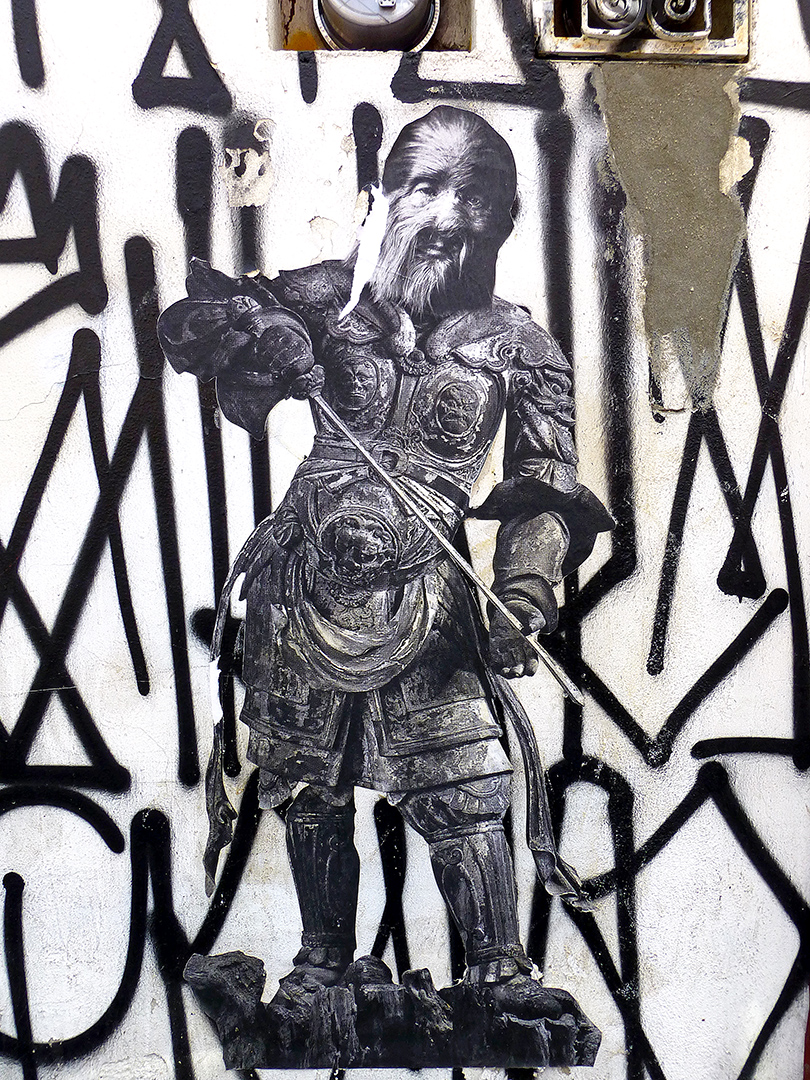

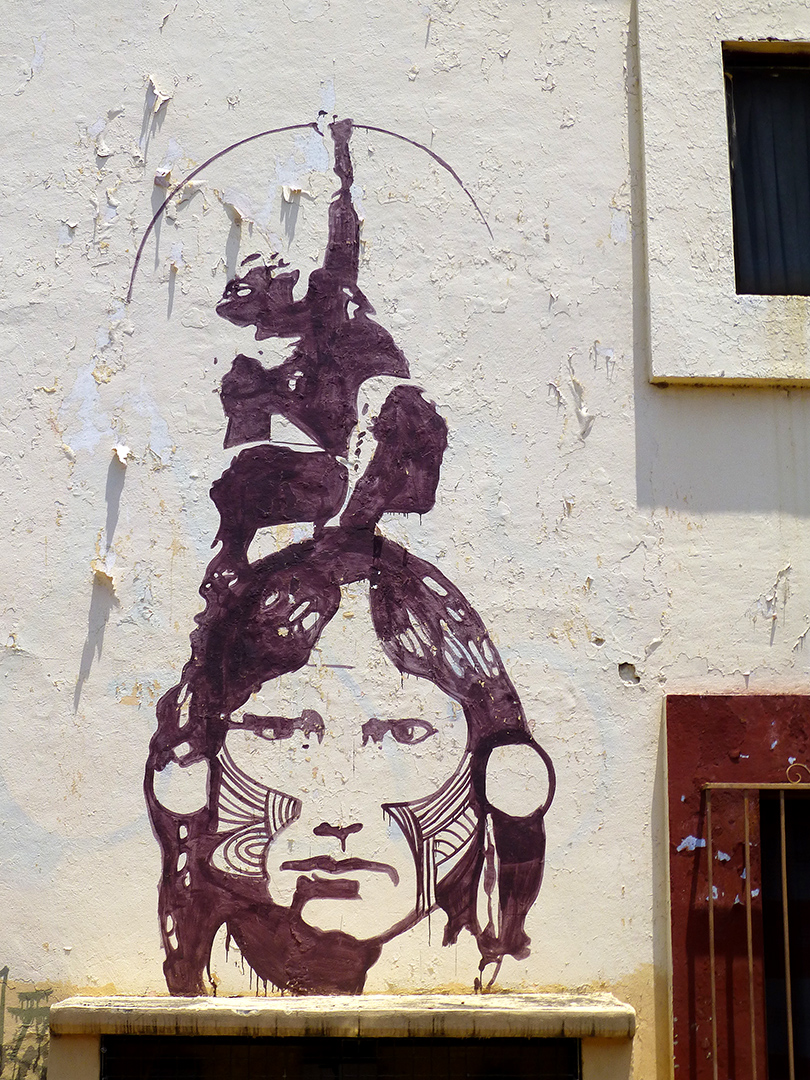
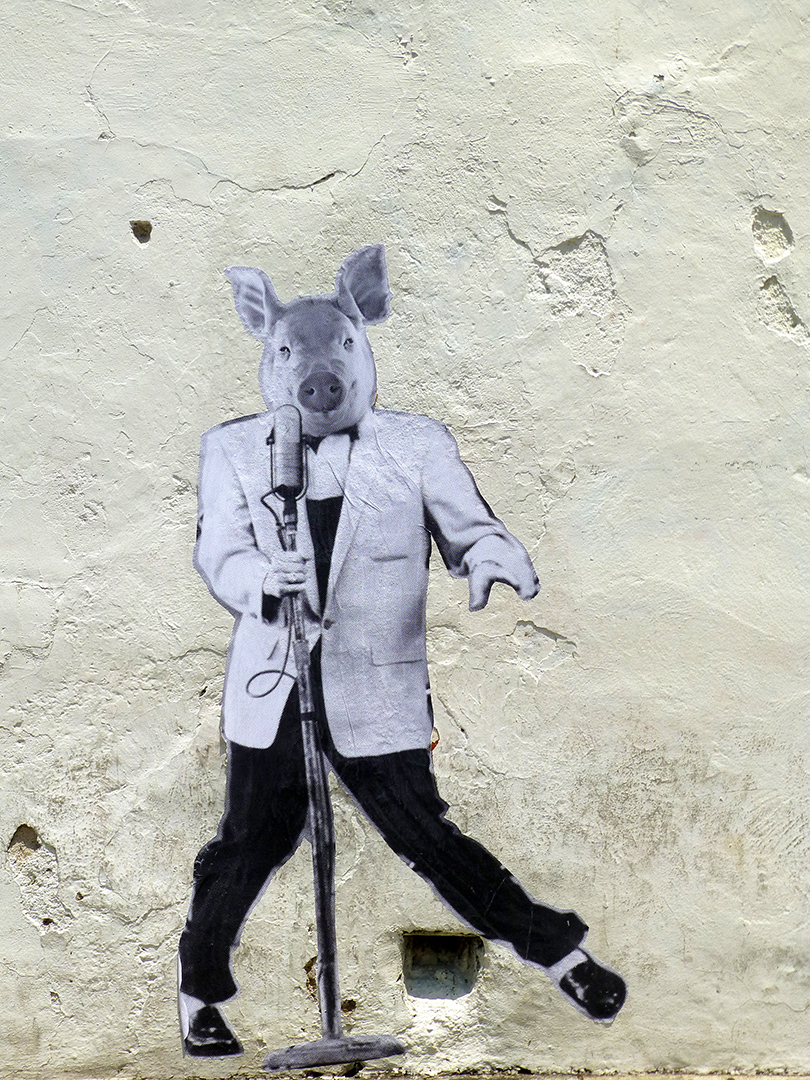
… and everything.
Looking forward to tomorrow’s return to Oaxaca, though not sure what I will find. So, in preparation, a little street art, apropos of nothing…
… and everything.
Posted in Creativity, Culture, Travel & Tourism | Tagged graffiti, Mexico, Oaxaca, photographs, photos, street art, urban art | 4 Comments »
I’m in el norte right now and, for once, I’m content to be 2000 miles from Casita Colibrí. I’m nearing the end of a 3+ week visit to both coasts and usually by this time I’m champing at the bit to return to Oaxaca, but not this time.
Today is election day in Mexico. These elections are, according to Raúl Benítez, a security expert at the National Autonomous University of Mexico, “the dirtiest elections since the advent of democracy in Mexico.” Aljazeera America proclaims, “A mounting body count and widespread disillusion with the govering [sic] elite threaten to mar midterm vote.”
And, two nights ago, under the cover of darkness, the federal government sent in the army, navy, and federal police to occupy Oaxaca and ensure the elections proceed. As I write, accounts and photos are being posted to Reportes en Oaxaca and the Facebook group, bloqueos y accidendes en Oaxaca of helicopters hovering, marches, and ballot boxes being burned el centro.
In the blog post, Oaxaca Occupied, poet, playwright, and friend, Kurt Hackbarth provides some insight into what brought Mexico to today’s state of chaos.
There are no words to describe how sad I feel for the people of Mexico — they deserve so much better.
Posted in Politics | Tagged elections, Mexico, Oaxaca | 5 Comments »
VW Beetles aren’t the only tricked out small vehicles on the road in Oaxaca. While not allowed in the city, tuk-tuks (moto taxis) have become indispensible in ferrying passengers into the villages from bus and colectivo stops along the carreteras and up, down, and around the often narrow and dirt paved streets within villages where cars remain a luxury. You haven’t lived until you’ve ridden one down a rocky embankment, forded a stream, and then climbed back up the bank on the other side — all without tipping over or getting one’s feet wet. Talk about the little engine that could!
Most are utilitarian looking. However, one day these tricked out tuk tuks appeared above the Plaza de la Danza.
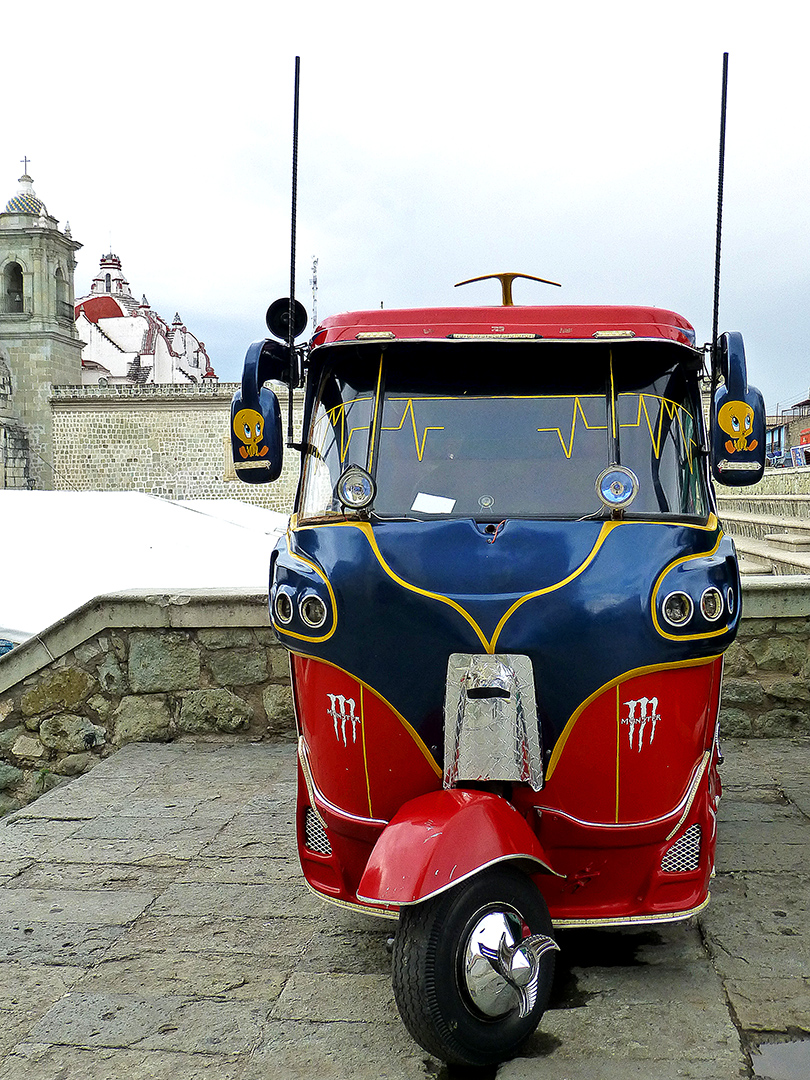

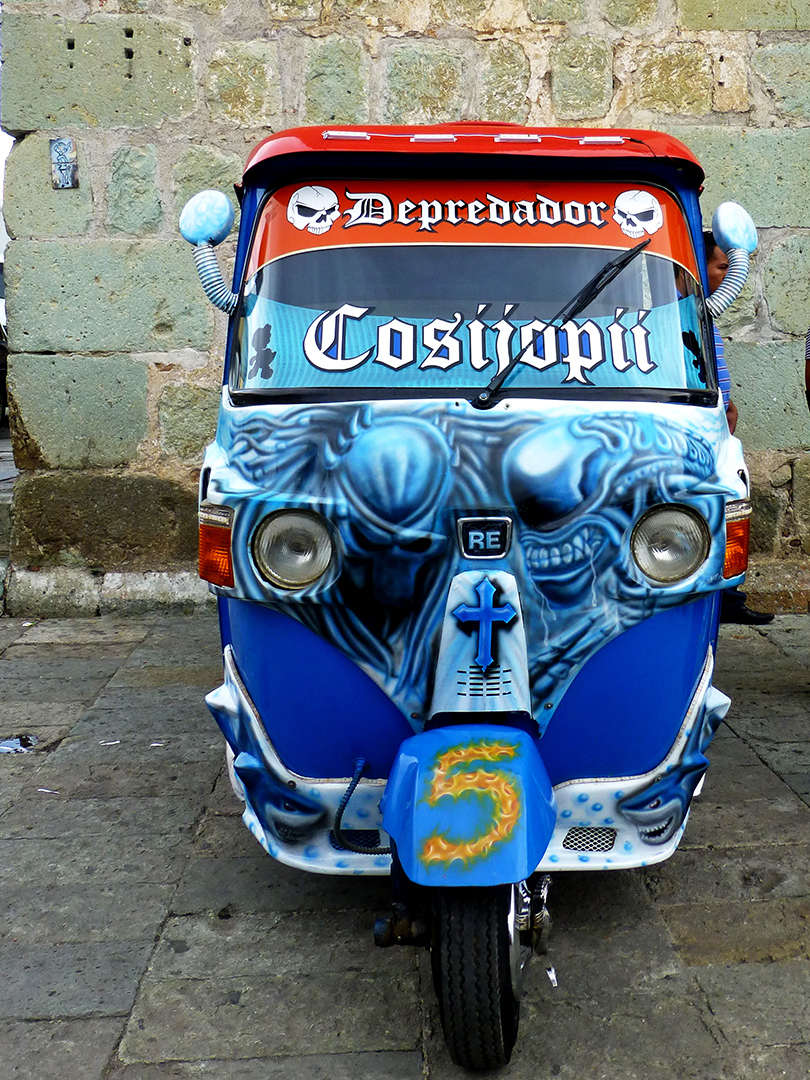
If you’ve got a little money and a large imagination, voilà!
Posted in Creativity, Culture, Transportation, Travel & Tourism | Tagged art, Mexico, moto taxis, Oaxaca, photographs, photos, tuk tuk, urban art | 11 Comments »
High in the mountains of the Sierra Norte, the village of Santa María Tlahuitoltepec sits perched on a ridge top in Oaxaca’s Mixe region. The terrain is rugged and unforgiving; it took rescue crews ten hours, much of it on foot, to reach the municipality following a lethal mudslide at the end of an extremely wet 2012 rainy season. Eight months later, in May of 2013, when blogger buddy Chris and I ventured up there for their Fiesta de Mayo, we still had to detour around the remains of the slide.

Santa María Tlahuitoltepec, May 11, 2013.
Despite the harsh conditions and its remote location, Santa María Tlahuitoltepec is home to the Center for Musical Training and Development of Mixe Culture and it is estimated that 70% of the population can read music and many who can’t, play by ear — a source of great pride.
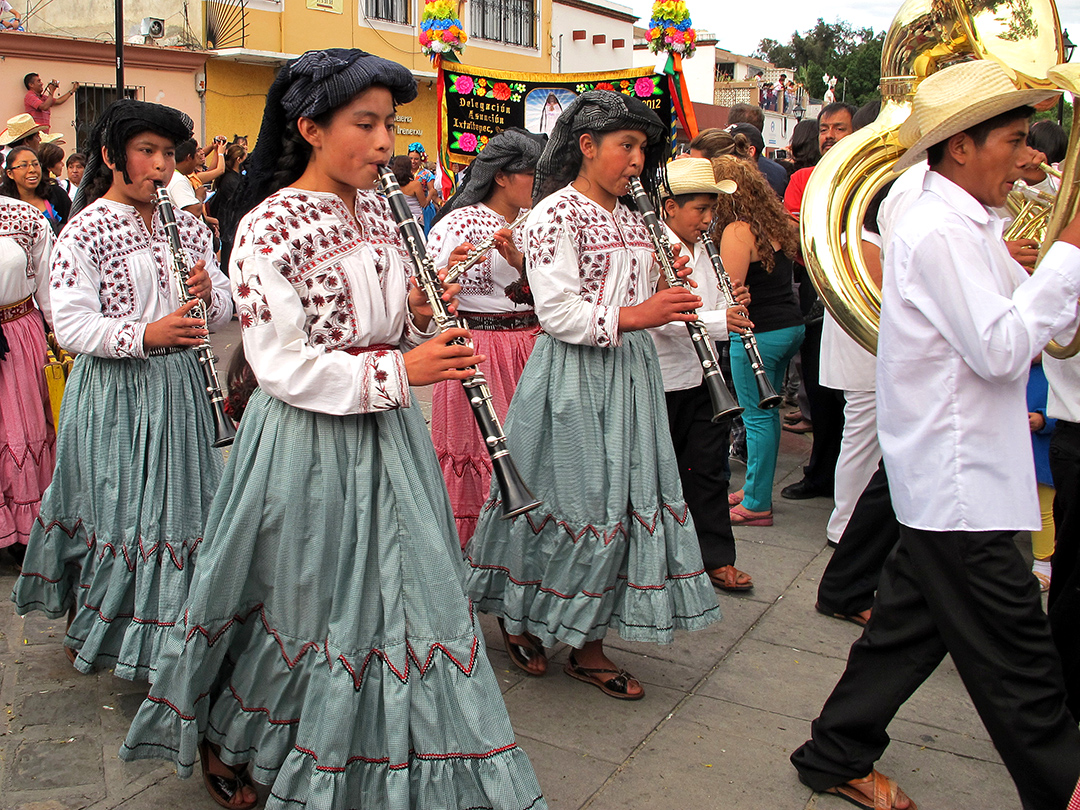
Guelaguetza desfile, July 28, 2012
In addition to the musical talents of its residents, the village is known for the intricately embroidered blouses the women make and wear. The design of both the cut of the blouse and the patterns of embroidery are uniquely Santa María Tlahuitoltepec. If you see someone wearing one on the streets of Oaxaca, you know immediately where it came from. I have a blouse and Chris bought a couple to decorate the walls of his house.
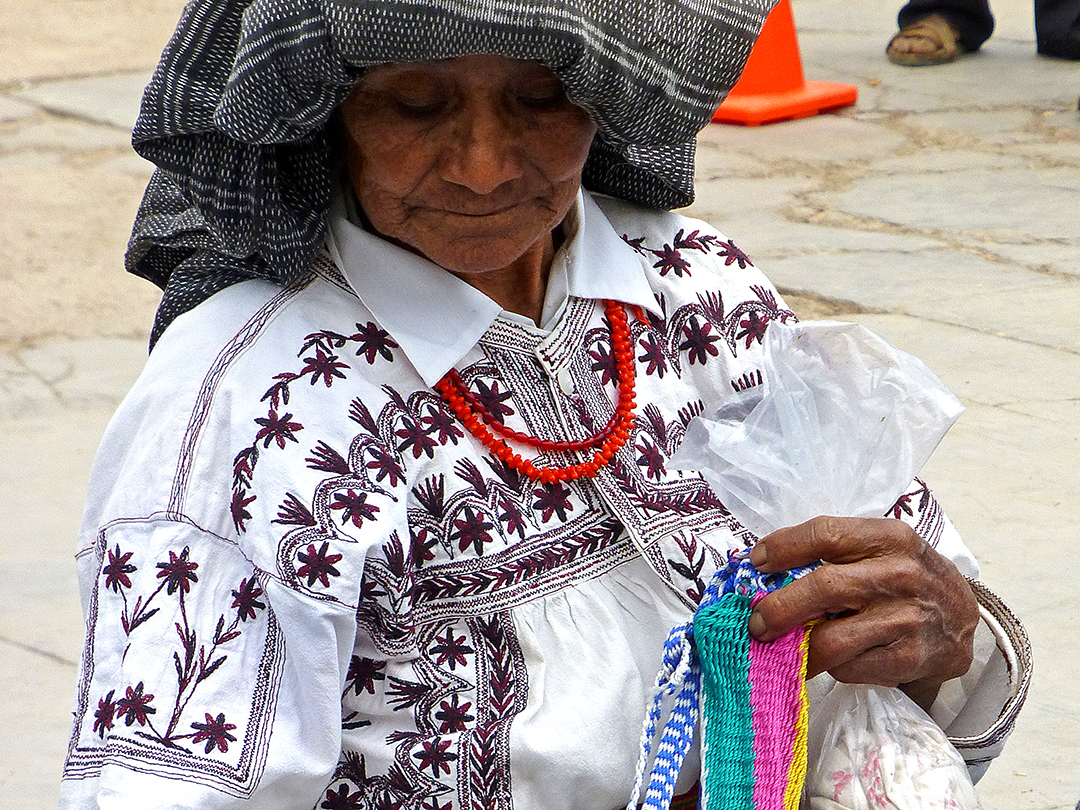
Santa María Tlahuitoltepec, May 11, 2013.
However, in January of this year Oaxaqueña singer Susana Harp raised the alarm when she tweeted her outrage that the exclusive US department store Neiman Marcus was selling identical copies of the blouses of Santa María Tlahuitoltepec for $290 US dollars (six times what the originals cost in Oaxaca) — without even an acknowledgement of the origin of the designs. And, last week ReMezcla (a digital publisher, creative agency, and entertainment company targeting Latino millenials) took up the issue of this kind of cultural appropriation with it’s article, The $290 Isabel Marant Huipil Rip Off That Pissed Off Oaxaca’s Mixe Community noting that, “In the case of Isabel Marant’s new ‘bohemian’ Étoile line, however, it’s hard to even muster a flimsy cultural inspiration defense, since the Oaxacan Mixe culture the clothes were ‘inspired’ by have been completely erased from the narrative.”
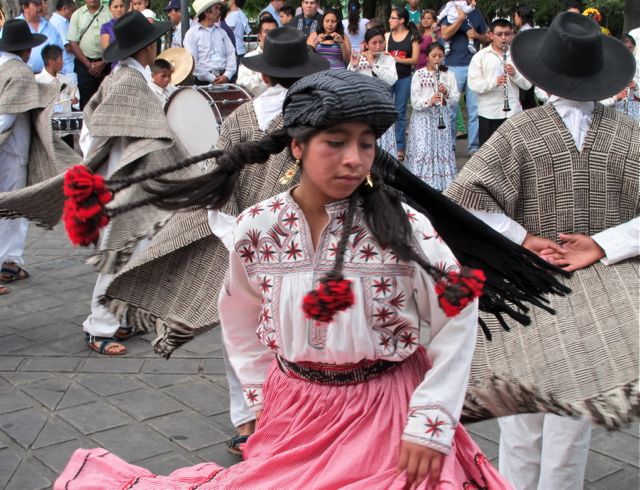
I urge you to forgo these and other high-priced knock-offs. Instead, go to the source and buy originals from the talented artisans who created them. And, a note to ReMezcla, especially given the subject of your article, I would have appreciated credit for your use of my photograph (above) from the Guelaguetza desfile, that I originally posted July 22, 2013.
Update: A press conference by municipal authorities and embroiderers from Santa María Tlahuitoltepec was held on June 3 at at the Textile Museum of Oaxaca protesting the lack of respect by Isabel Marant for the creativity and work by the women of Tlahuitoltepec and the history and worldview that gave birth to their designs.
Posted in Creativity, Culture, Travel & Tourism | Tagged costumes, cultural appropriation, Isabel Marant, Mexico, Mixe, Oaxaca, photographs, photos, popular travel destinations, ReMezcla, Santa María Tlahuitoltepec, Susana Harp, traje | 31 Comments »
Eight months and counting… Tonight, eight months ago, 43 students from the Escuela Normal Rural Raúl Isidro Burgos teachers’ college in Ayotzinapa, Guerrero went missing. I am sadly resigned that marking this horrific anniversary has become a regular feature on my blog. As a mother, a guest resident of Mexico, and someone who believes that the peoples of the world deserve social justice, I can’t ignore this tragedy.
I dare you to leave Carteles por Ayotzinapa, the current exhibition at Instituto de Artes Gráficas de Oaxaca (IAGO), with a dry eye. The 49 posters on display are only a fraction of the over 700 posters submitted to the First International Poster Biennial 2014 Convocation Ayotzinapa, an initiative of Oaxaca’s internationally renown artist, Francisco Toledo. In addition to Mexico, artists from Argentina to Greece; Iran to Lebanon; and Poland to the USA responded to his call, recognizing as Toledo explained, the tragedy of Ayotzinapa has outraged people from beyond the borders of Mexico.

Photo courtesy of Oaxaca Media
Irwin Homero Carreño Garnica, a graphic design student, originally from Ocotlán de Morelos, Oaxaca, was awarded first prize for his heartbreaking work, “México fracturado por Ayotzinapa” (Mexico fractured by Ayotzinapa). As you can see above, it is a map of Mexico in the shape of a skeleton, with a break in the femur, where Ayotzinapa, Guerrero is located. Like the work of the Tlacolulokos, the use of an iconic image (skeleton) and a primary palette of black, white, and greys, increases the emotional impact, much like Picasso’s, “Guernica.”
Second place was won by Damian Kłaczkiewicz (Poland) and third place went to Daniela Diaz (Mexico). The three winning posters will be reproduced for distribution throughout Mexico.
The exhibition runs through June 26, 2015.
Posted in Creativity, Culture, Exhibitions, People, Politics, Tragedy, Violence | Tagged art, Ayotzinapa, buildings, Carteles por Ayotzinapa, Damian Kłaczkiewicz, Daniela Diaz, Excuela Normal Rural Raúl Burgos, Francisco Toledo, graphic arts, IAGO, Instituto de Artes Gráficas de Oaxaca, International Poster Biennial, México fracturado por Ayotzinapa, Mexico, Normal Rural Ayotzinapa, normalistas, Oaxaca, photographs, photos, poster art, student teachers, students | Leave a Comment »
The previously mentioned Tlacolulokos collective has brought their artistry and social commentary to a wall on the upper floor of the Casa de la Ciudad. The mural, “Con el fuego en las manos” shows two young women, almost mirror images of each other or, perhaps, two sides of the same woman.
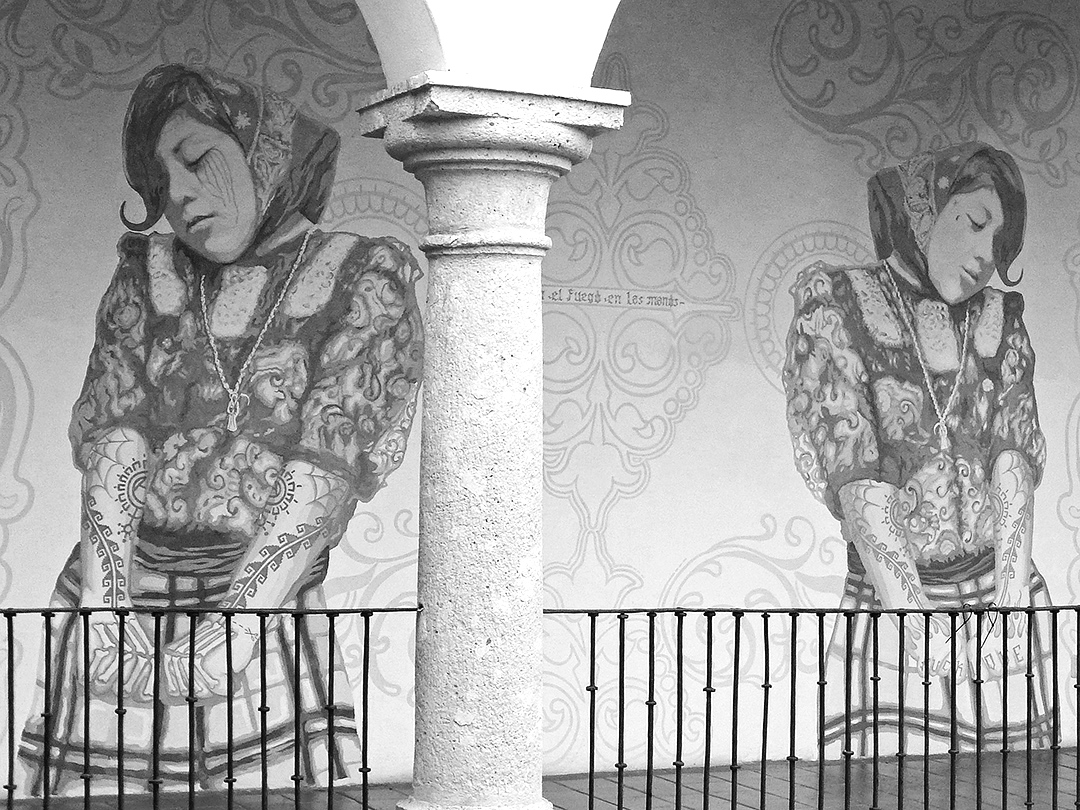
The young women/woman wear the traditional clothing of San Bartolome Quialana, a village near Tlacolula de Matamoros, home of the Tlacolulokos collective. Like communities throughout Oaxaca, much of the male population has migrated to the United States, in search of work leaving the women to carry on alone.


As the introduction to the exhibit on the Casa de la Ciudad website explains, With a critical view towards the current cultural context, Tlacolulokos group, headed by Darío Canul and Cosijoesa Cernas, seeks to question the idealized images of the Oaxacan culture, tourism product discourse, and insights from the reality currently experienced by the people of Oaxaca.


There are elements in her clothing belonging to the Latina culture of the southern United States, as the cholo bandana that she wears on her head, or the tattoos on her arms that add a critical and provocative tinge to this cultural mix, a product of migration. [ Google translation, with a little help from yours truly]


One of the trademarks of the Tlacolulokos group is the power their images acquire and the emotion they elicit by limiting the palette to black, white, and grays. For more background and a better understanding of the mural, a video (en español) of the artists discussing their work can be found here.
“Con el fuego en las manos” is scheduled to run until December 2015 at the Casa de la Ciudad (Porfirio Diaz No. 115, at the corner of Morelos in Oaxaca’s Historic District). Hours are 9:00 AM to 8:00 PM, Monday through Sunday.
Posted in Creativity, Culture, Exhibitions, Immigration, Museums, Travel & Tourism | Tagged artists, Casa de la Ciudad, Con el fuego en las manos, Cosijoesa Cernas, Darío Canul, Mexico, murals, Oaxaca, photographs, photos, popular travel destinations, Tlacolulokos, wall art | 4 Comments »
Situated metaphorically at the busy intersection of imagery and content—and informed by history, mass media, commerce, and pop culture—stickers address both the personal and the political. — Street Art Graphics, The Richard F. Brush Art Gallery, St. Lawrence University.
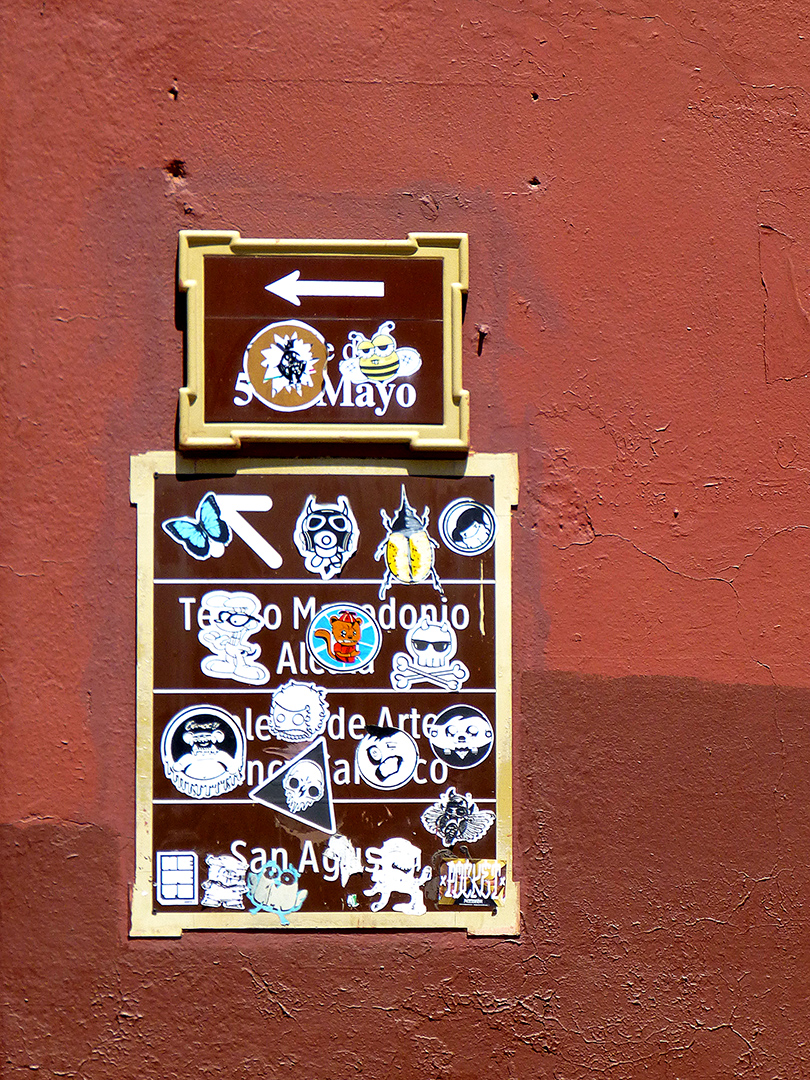
Stick-to-itiveness: the quality that allows someone to continue trying to do something even though it is difficult or unpleasant.

Street art stickers — a metaphor for Mexico, methinks.
Posted in Creativity, Culture, Signs, Travel & Tourism | Tagged art, Mexico, Oaxaca, photographs, photos, popular culture, popular travel destinations, stickers, street art, street signs, urban art | 4 Comments »
Just so you know… The gods are watching you on Tinoco y Palacios, between Morelos and Matamoros.


Hmmm…. sometime between January, when I first photographed the mural and a few days ago, when I returned, an airplane landed on the tongue.


Recently, BBCtrending posted the video, Aztec to urban — Mexico’s street art explosion, highlighting the use of Mexico’s pre-Columbian imagery in contemporary street art. I don’t know the name of the artist who painted the mural above, but seeing the “Dioses Urbanos” of Diego Alvarez (aka, Ocote) in the video, brought it to mind.
Posted in Creativity, Culture, Travel & Tourism | Tagged Diego Alvarez, Mexico, murals, Oaxaca, Ocote, photos, street art, urban art, wall art | 6 Comments »
Long ago, in a land far, far away, I once had a Volkswagen Beetle. It was so old, it didn’t even have a gas gauge, only a reserve tank. My little bug would inevitably begin running out of gas when I was putt-putting up a hill, requiring me to take my foot off the gas pedal to kick over the reserve tank. Needless to say, I would hold my breath and offer up silent prayers that I wouldn’t get rear-ended and that there was, indeed, gas in the reserve tank! But, I loved that car…
So, only a block from Casita Colibrí, how could I resist stopping to admire this beauty?

Made in Oaxaca — or at least, tricked out in Oaxaca.

Ready to rally again on the Pan American Highway? It’s just up the road apiece.
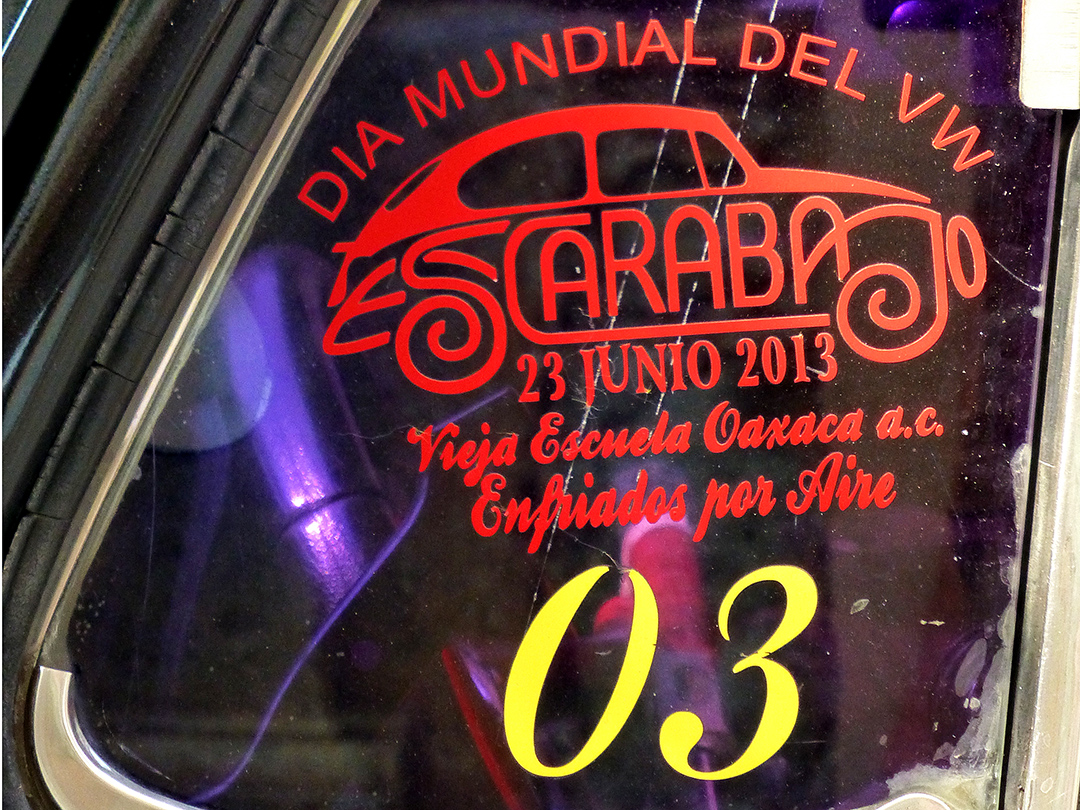
Stay calm… Doing it the old school Beetle way!

Hmmm… last month’s Old VWs never die and now this post. Bugs, of the VW variety, might just have to become a regular feature.
Posted in Creativity, Culture, Transportation, Travel & Tourism | Tagged automobiles, cars, Mexico, Oaxaca, photographs, photos, popular travel destinations, Vocho, Volkswagen Beetle, VW, VW bug | 6 Comments »
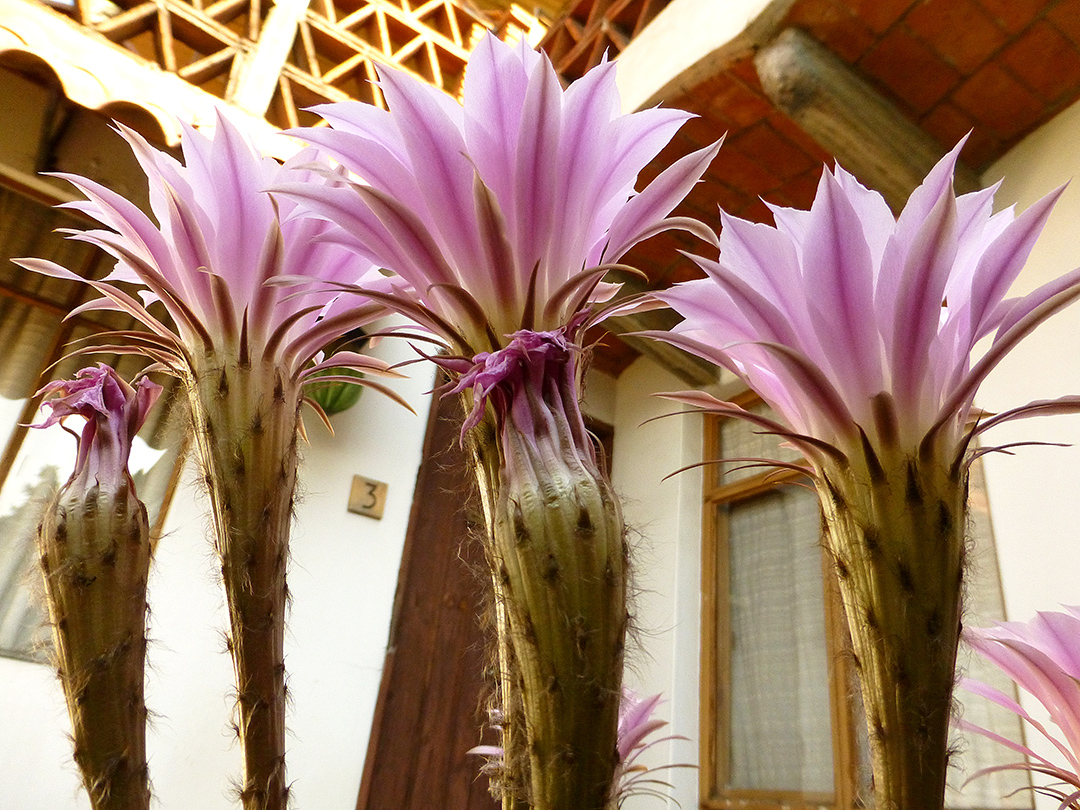
Yesterday, on the terrace of my neighbor, his Echinopsis eyriesii was putting on quite a show…


 Listening to the Putamayo World Music Hour’s tribute to mothers and sending mothers everywhere wishes for peace, justice, love, and much joy.
And, the librarian in me can’t resist adding a couple of Mother’s Day reference sources:
¡Feliz día de la madre!
Posted in Celebrations, Culture, Flora, Gardens, Holidays | Tagged cactus, Día de la Madre, Echinopsis eyriesii, flowers, garden, Mexico, Mother's Day, Oaxaca, photographs, photos, popular travel destinations | 5 Comments »
The sunburned shoulders have turned brown and the leg muscles are no longer sore. I’ve fully recovered from last Sunday’s annual Día de la Santa Cruz (Day of the Holy Cross) hike up Cerro Picacho (in zapoteco, Quie Guia Betz), the sacred mountain in Teotitlán del Valle.

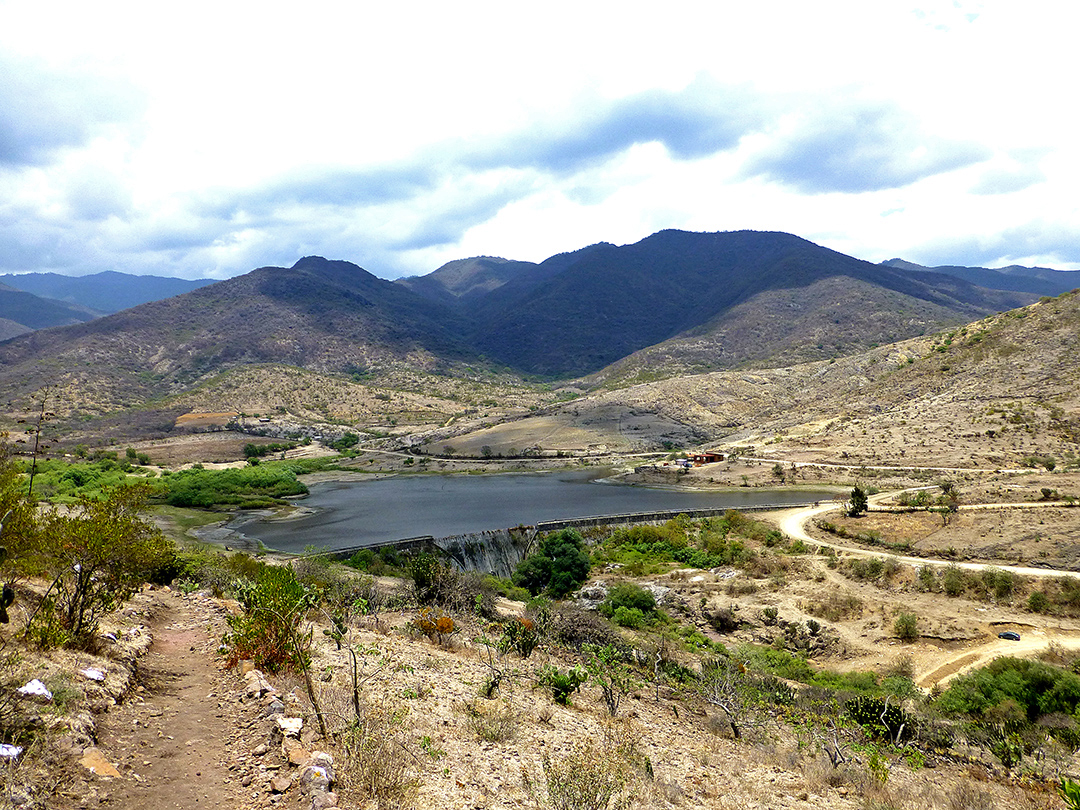
All that remains, are memories and photographs from another lovely, if strenuous, day. The cicadas (cigarras or chicharras, en español) again provided the soundtrack, as we wound our way up the trail from the presa (dam). The climb begins rather benignly but rapidly gets steeper and steeper. That little speck in the lower right of the photo below is the car — and this was less than a tenth of the way to the summit!
At 10 AM, when we began our ascent, it was already hot and experience told us shade trees were few and far between. We were the only extranjeros (foreigners) on the trail and were frequently passed by Teotitecos (people from Teotitlán) going up and coming down and never failing to greet us with “buenos días.” After several rest and water sipping breaks, we eventually reached our destination.

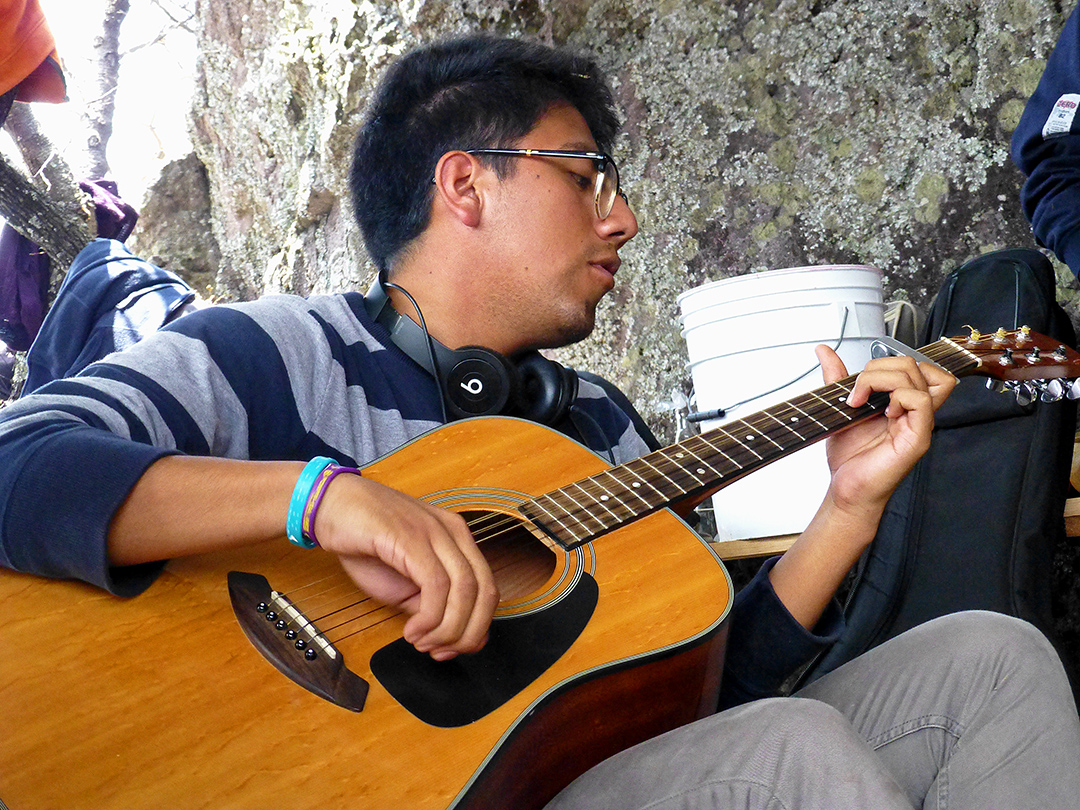
This 2.9 mile (4.7 km) hike took us from 5,750 feet (1,752 meters) to 6,830 feet (2,082 meters). However, once we arrived, we were immediately offered much-needed and appreciated cups of agua de jamaica (hibiscus water) and later we were fed amarillo tamales pulled from steaming pots in the makeshift kitchen. No doubt, the gals in this alfresco cocina appreciated the newly constructed shade structure and counter that had been bolted into the side of the mountain, as I’m sure did the young man who sat down to serenade us.
However, the best was yet to come — the spectacular views of the village and the mountains beyond that unfold when one reaches the summit.

Even more overwhelming is the sense of oneness with the natural world and with generations of Zapotecos who have been climbing and honoring El Picacho for thousands of years.
 As I mentioned at the beginning of this post, May 3 is Día de la Santa Cruz. The committee members who organize Teotitlán’s celebration change from year to year, so each year takes on a slightly different character. This year brought the newly built kitchen space and, unlike last year, no foot race up the mountain and the absence of massive speakers blasting music — for which we were grateful!
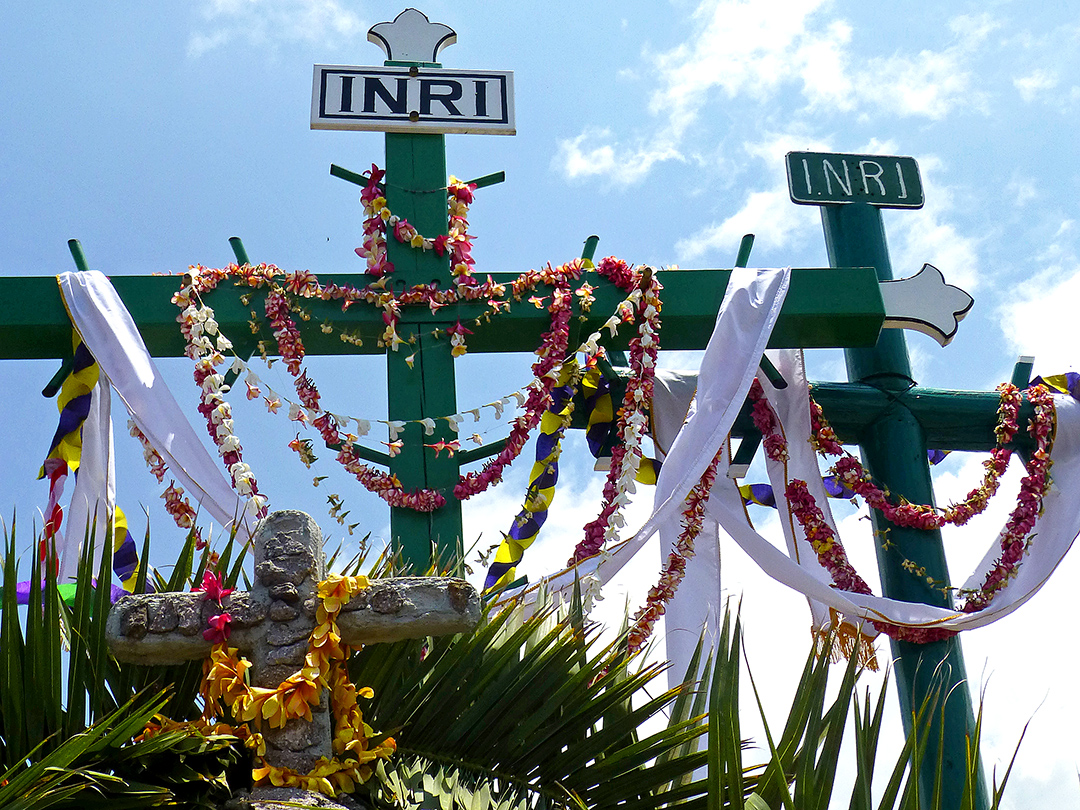
Three permanent crosses can be found atop Picacho and for Día de la Santa Cruz, all were decorated with fragrant garlands of frangipani blossoms. A cross of concrete and stone crowns an altar and two wooden crosses, which I’ve been told were carved in Chiapas, preside above the altar and look out over the valley.
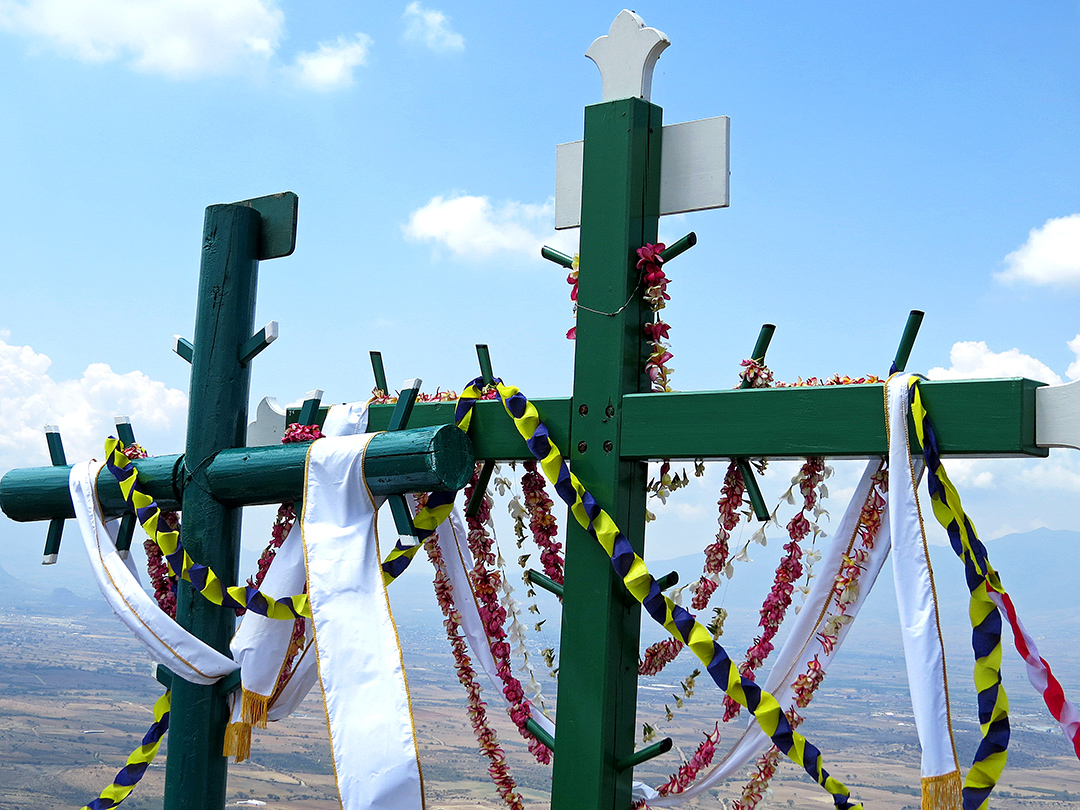
Teotitlán (Teocaltitlán, in náhuatl) means “land of the gods.” Sitting on top of Cerro Picacho, it certainly felt as if I was indeed gazing out at the land of the gods.
Posted in Celebrations, Culture, Holidays, Religion, Travel & Tourism | Tagged Cerro Picacho, Day of the Holy Cross, Día de la Santa Cruz, El Picacho, Mexico, Oaxaca, photographs, photos, popular travel destinations, Quie Guia Betz, Teotitlán del Valle | 6 Comments »
It’s Cinco de Mayo, but in Oaxaca, like most of Mexico, it’s a business as usual kind of day; schools are in session, businesses and banks are open, and deliveries are being made. The cervesas and mezcal may be flowing and guacamole may be served, but no more than usual. Only in Puebla, where the significantly outnumbered Mexican troops defeated the French army in the Battle of Puebla on May 5, 1862, is it a big deal. However, most every city and village has a street named 5 de mayo and in many, like Oaxaca, a street has been named for Ignacio Zaragoza Seguín, the general who commanded the Mexican army at the Battle of Puebla. By the way, he was born in what was the Mexican village of Bahía del Espíritu Santo, now Goliad, Texas, USA.
As the walls of Oaxaca continue to show, it’s the current battles that remain front and center…


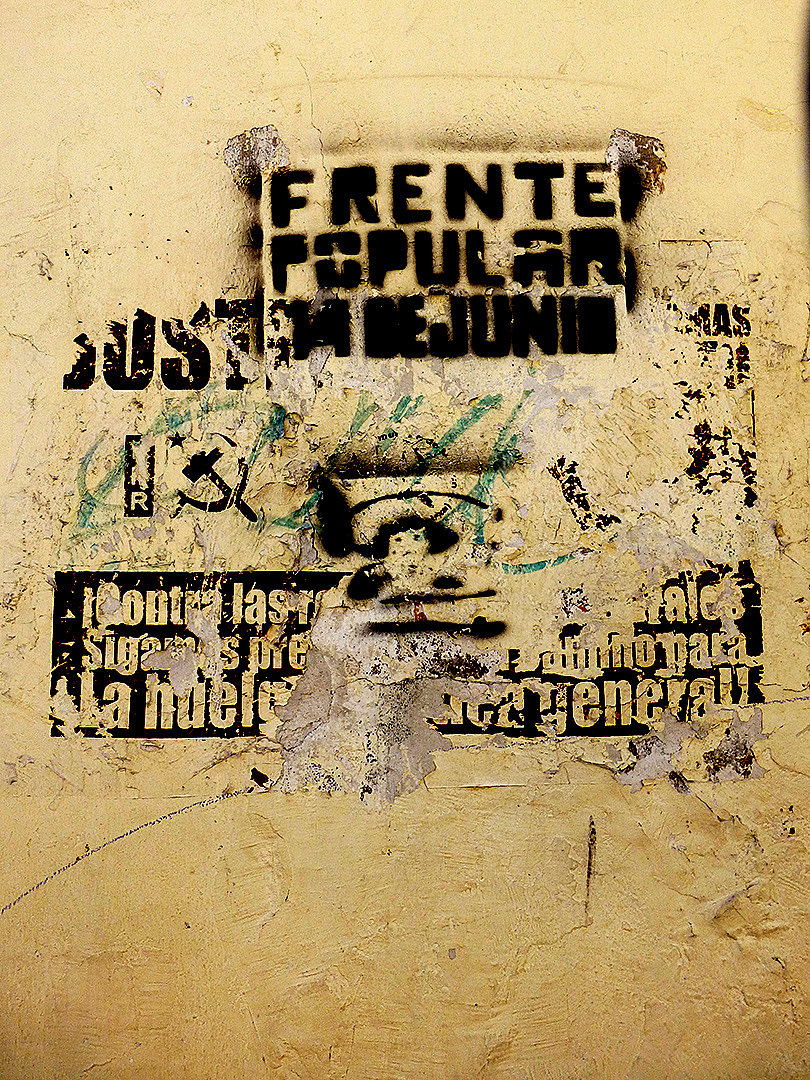
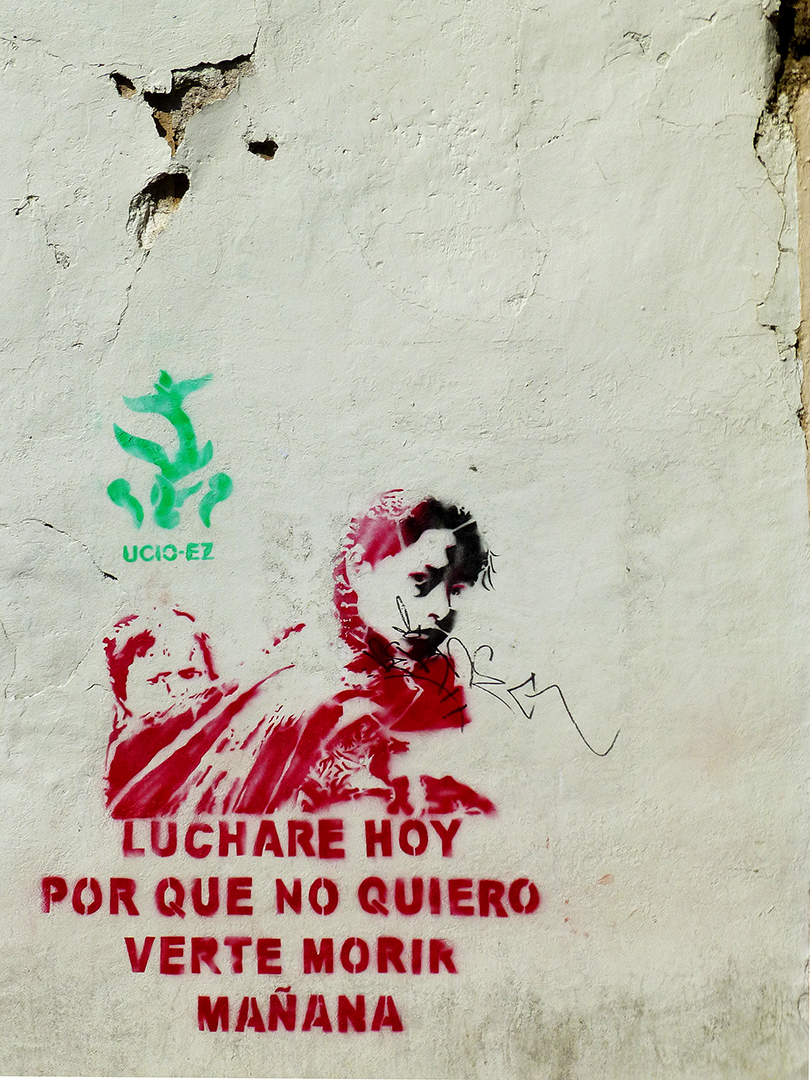 As the mother in the stencil above explains, against the odds like her ancestors 153 years ago, “I will fight today because I don’t want to see you die tomorrow.”
Posted in Celebrations, Creativity, Culture, Holidays, Travel & Tourism | Tagged 5 e mayo, Cinco de mayo, graffiti, history, Mexico, Oaxaca, photographs, photos, popular travel destinations, posters, stencil art, wall art | 7 Comments »
It’s International Workers’ Day and workers all over the globe are marching.
 They march to celebrate past victories; they march to proclaim the dignity of work; they march to defend the right to collective bargaining; they march to demand living wages and safe working conditions; and they march to secure a better future for their children.
 If you have any doubts about why workers in Mexico are marching today: 19.5 Million Mexicans Are Tethered To The Minimum Salary, The Lowest In The Americas. According to the article (translated from the original Spanish by Peter W. Davis),
Mexico has a minimum wage of around 69 pesos a day ($4.50 US), the lowest in Latin America….the Economic Commission for Latin America and the Caribbean placed Mexico as the only country with a minimum wage below the poverty line. Furthermore 14% of employees receive a salary even lower than this minimum.
 It’s no wonder that, as I write, there are marches converging on Oaxaca’s zócalo from points north, south, east, and west. When I was out and about an hour ago, I ran into healthcare workers from as far away as Tuxtepec, in the northeast of the state, and Huatulco, in the southwest.
¡Feliz Día del Trabajo a tod@s! The struggle continues…
Posted in Celebrations, Economics, History, Holidays, Labor | Tagged 19.5 Million Mexicans Are Tethered To The Minimum Salary, Día de los Trabajadores, Día del Trabajo, Día Internacional de los Trabajadores, holiday, International Workers' Day, labor, labor statistics, May Day, Mexico, minimum wage, Oaxaca, Peter W. Davis, photographs, photos, The Lowest In The Americas, workers | 4 Comments »
Feliz Día del Niño (Day of the Child) to children everywhere!


Forever Young
by Bob Dylan
May God bless and keep you always
May your wishes all come true
May you always do for others
And let others do for you
May you build a ladder to the stars
And climb on every rung
May you stay forever young
Forever young, forever young
May you stay forever young.
May you grow up to be righteous
May you grow up to be true
May you always know the truth
And see the lights surrounding you
May you always be courageous
Stand upright and be strong
May you stay forever young
Forever young, forever young
May you stay forever young.
May your hands always be busy
May your feet always be swift
May you have a strong foundation
When the winds of changes shift
May your heart always be joyful
And may your song always be sung
May you stay forever young
Forever young, forever young
May you stay forever young.
Posted in Celebrations, Culture, Holidays, Travel & Tourism | Tagged children, Children's Day, costumes, Day of the Child, Día del Nino, Forever Young lyrics, Mexico, Oaxaca, photographs, photos, popular travel destinations, traje | 3 Comments »
The Flamboyant trees (aka, Delonix regia and Royal Poinciana) have outdone themselves this year. And yesterday, walking home from the market, I was captured and enraptured by their canopy.  On Independencia below the Basilica de la Soledad.
Posted in Flora, Travel & Tourism | Tagged Delonix regia, Flamboyant trees, flamboyantes, flowers, Mexico, Oaxaca, photographs, photos, popular travel destinations, Royal Poinciana, trees | 6 Comments »


 Mexican Peso Converter
 View From Casita Colibrí