Feeds:
Posts
Comments

Archive for the ‘Science & Nature’ Category

One of the things I always notice when in El Norte this time of year is the longer length of the day — and today it’s at its longest.  Light came through the curtains to wake me at 5:45 AM and the sun won’t dip behind Mt. Tamalpais and into the Pacific until 8:30 PM.  The further north one goes, the longer this day lasts.  Of course, the reverse is true in the winter.  No wonder the Summer Solstice is such a big deal in the northern latitudes!

As much as I miss Oaxaca, this really has been a spectacular spring in the Bay Area — perfect for strolling along the San Francisco Embarcadero with a Oaxaca buddy.

The City By the Bay at her best!

Read Full Post »

A recent article from California’s Merced Sun-Star addresses an issue many in Oaxaca’s ex-pat community have been discussing.

Exchange student learns sustainable gardening

By RAMONA GIWARGIS – rgiwargis@mercedsunstar.com

MERCED — In the small town of Mitla Oaxaca in Mexico, a little girl drew inspiration from her grandmother’s colorful garden more than 10 years ago.

Though the family wasn’t very wealthy, the dinner table was always filled with fresh and nutritious foods.

“When I was young, my grandma always had a garden,” said Xochitl Juarez, now 26. “She was really poor, but she always had fresh fruits and vegetables.”

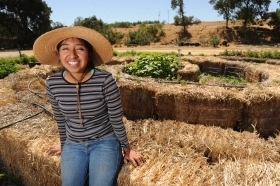
(photo by BEA AHBECK - bahbeck@mercedsunstar.com) Xochitl Juarez of Mexico planted a 10,000-square-foot garden in the shape of a circle because 'everything in life is a cycle,' she said.

(photo by BEA AHBECK – bahbeck@mercedsunstar.com)  Xochitl Juarez of Mexico planted a 10,000-square-foot garden in the shape of a circle because ‘everything in life is a cycle,’ she said.

After falling in love with agriculture at a young age, Juarez sought to help her community learn new farming techniques to become more sustainable.

“A lot of people that come here are from small towns and they have to grow their own food,” she said. “If they have the opportunity to be sustainable, we’ll have a better life with more healthy foods and better nutrition.”

Juarez left her hometown of about 10,000 people and traveled to the United States for the first time as part of the Multinational Exchange for Sustainable Agriculture program.

[Click HERE for full article]

Read Full Post »

On this Earth Day, I thought I’d post photos of the Matria, Jardín Arterapéutico project.  These were taken 3 weeks after my previous visit.  Despite 90+° (F) temperatures since the garden was planted, it is thriving and very few plants have been lost.

The key to the garden’s success?  Megan Glore and her team of volunteers are listening to what the plants are telling them and responding accordingly — just as we should all be doing with Mother Earth.

Read Full Post »

Sign in tree "Los arboles son vida cuidalos

Life goes on within you and without you.  – George Harrison

Read Full Post »

Sparrow came by for a late breakfast on the bougainvilla this morning.  Guess, like my neighbor, (s)he didn’t realize Mexico “sprung ahead” last night to Daylight Saving Time.

Sparrow sitting on bougainvilla branch

Or, should I say, most of Mexico.  Teotitlán del Valle follows the sun and doesn’t set their clocks back.  Let the confusion begin!

Close-up of sparrow sitting in bougainvilla

So, maybe Sparrow is…

Living on Teo Time.
Living on Teo Time.
Gonna set my watch back to it
‘Cause you know that I’ve been through it.
Living on Teo Time.

(With apologies to Daniel W. Flowers, songwriter of Tulsa Time.)

Save

Read Full Post »

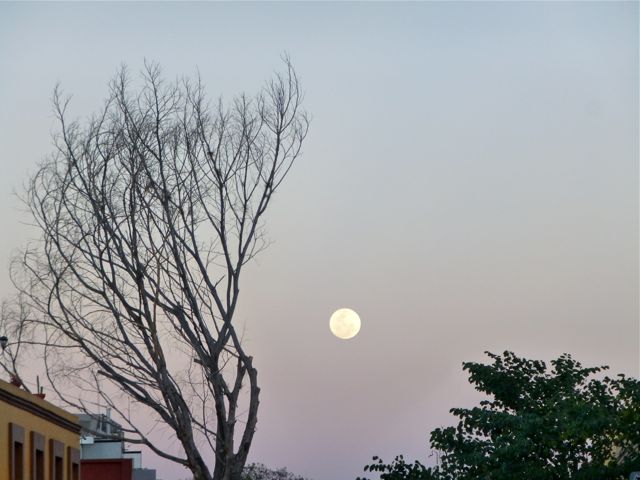
La Luna del Gusano rises above the city of Oaxaca.

P1060453

P1060454

P1060456

I’ve got to say, “La Luna del Gusano” sounds so much more poetic than, “Worm Moon.”  Ahhh, the romance of Spanish.

Read Full Post »

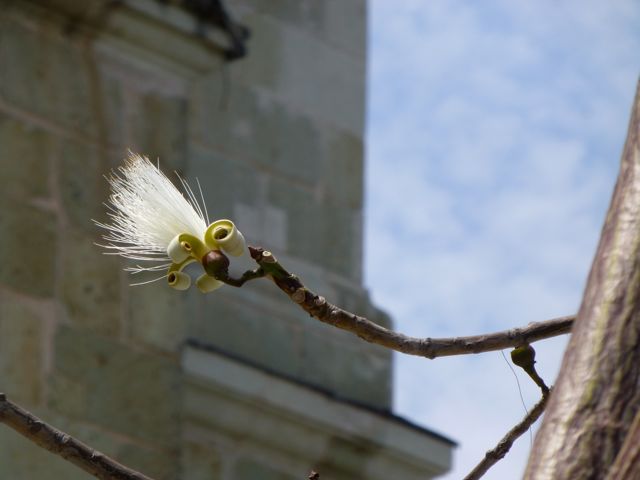
We are in the middle of the dry season; the mountains surrounding the valleys of Oaxaca are golden.  It’s still winter and my African tulip trees remain leafless against the sun and blue sky.  However, Mother Nature is hinting that Spring is coming; time for you guys to shave those winter beards.  And, this time of year, la madre naturaleza supplies the brushes — the Pseudobombax ellipticum.

P1050591

According to the Oaxaca Garden and Nature Club website, its common name in English is the Shaving Brush Tree.

P1050689

As you can see above, the flowers can be red or white.

P1050592

By the way, one of its common names en español is Cabellos de Ángel.

P1050687

Angel Hair or Shaving Brush?  You decide!

Read Full Post »

A mile or two from the city are fields of corn; a recurring reminder of where the masa used to make tortillas, tamales, and other mealtime staples, comes from.  Livestock roam the hills and are often seen being herded down the streets of local villages.

Goats being herded down dirt road

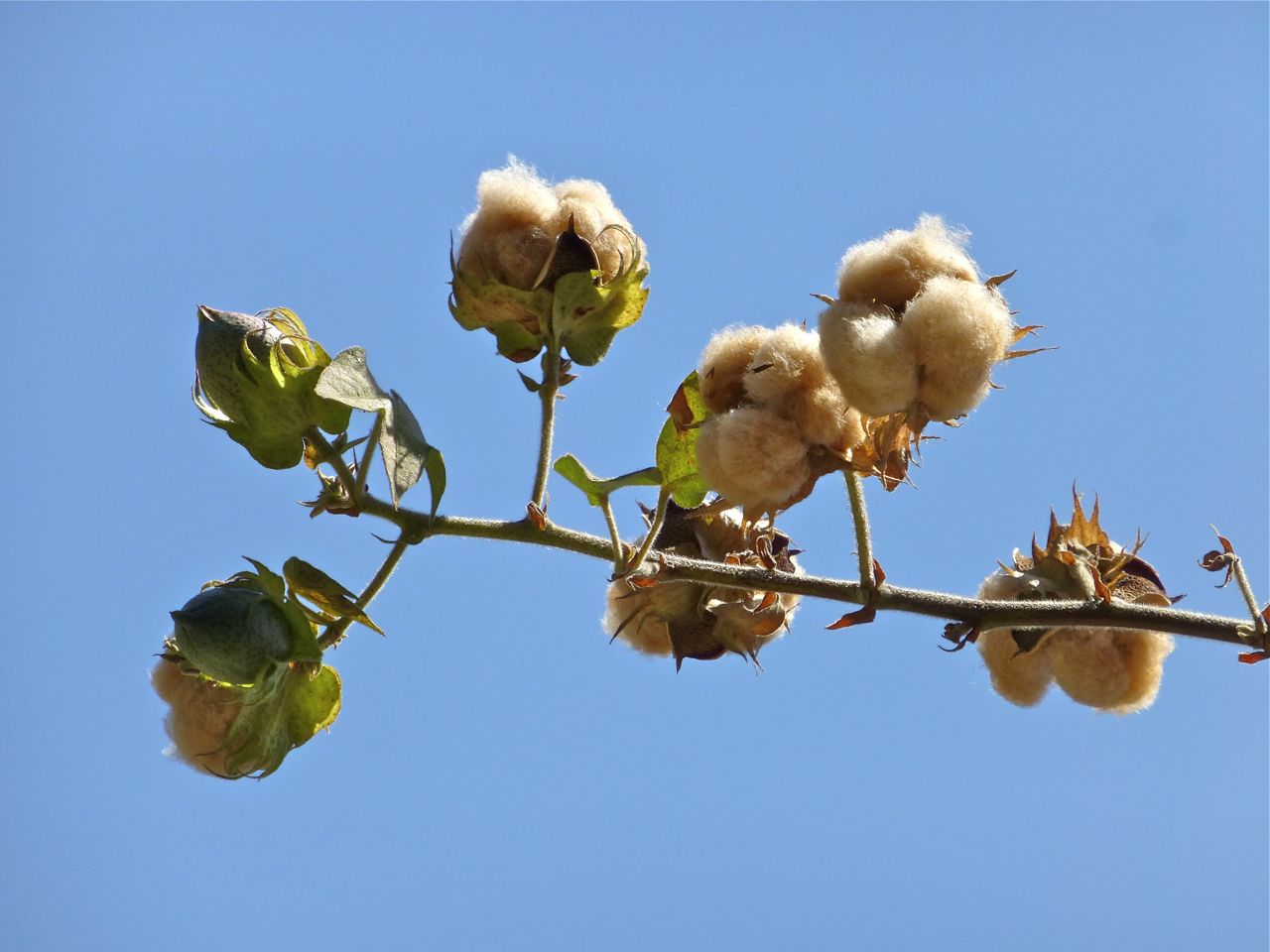
And, at the foot of the stairs of my new apartment is a coyuche bush — the brown cotton plant that has been cultivated in this part of the world for thousands of years.

P1050618

The ripe buds of the coyuche have been harvested, cleaned, spun, and woven into huipiles and cotones (men’s shirts) by countless generations.  However, like many textile traditions, industrialization has taken its toll.  The cultivation and use of coyuche is literally hanging by a thread, mostly confined to the Mixteca and Costa Chica regions of Oaxaca.  As a result, besides just liking the design and color, I have a profound appreciation for and treasure this old huipil that was given to me a couple of years ago.

Embroidery detail of huipil made of coyuche

It’s in desperate need of repair.  My friend and Mexican textile collector and chronicler, Sheri Brautigam, advised me to take it to Odilon Merino Morales, who is from San Juan Amuzgo and leads an effort to revive the use of coyuche.  I will ask him if he knows of someone who could give my huipil some tender loving mending.

Living close to the source — there is something wonderful about the coyuche plant’s daily reminder of the origin of one of my favorite huipiles.

Read Full Post »

It’s the dry season, no rain in a couple of months, and we are reminded how sacred and precious water is.

Wave and rain shower painted on wall

At the top of the wave:

“Fluye hermana agua de las nubes a la tierra y de la tierra a las nubes.”  (Sister water flowing from the clouds to earth and from the earth to the clouds.) 

A line from the poem, Oración al sagrado elemento agua.

Read Full Post »

No Danza de la Pluma, no convite, no patronal festival.  The Templo de la Preciosa Sangre de Cristo in Teotitlán del Valle on an ordinary day…

P1040237_crop

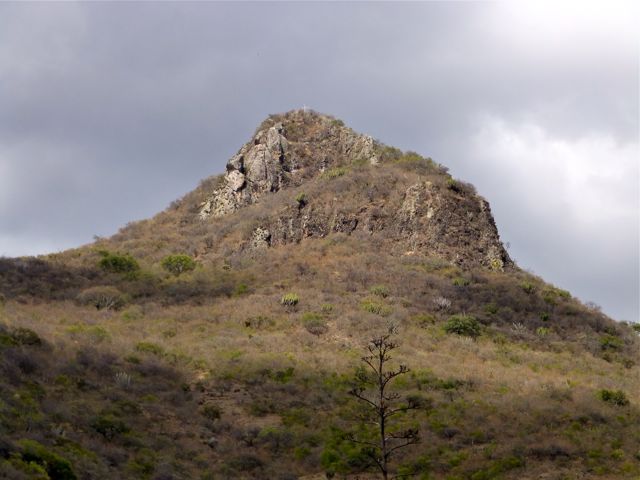
El Picacho up close and personal…

P1040240_enh

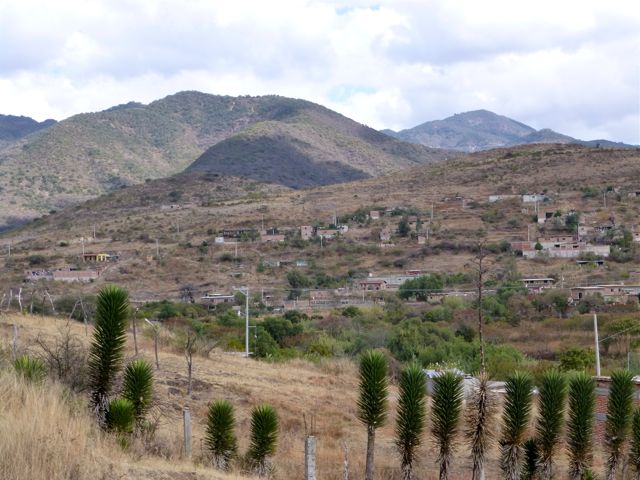
And, the hills where my young Zapotec friend, Sam,  “grew up… looking after [his] crazy goats!”  He is currently finishing a PhD in Sustainable Manufacturing at the University of Liverpool.  I see a connection.

P1040243_enh

Even unplugged, the hills were alive with the sound of music — a banda could be heard in the distance — a Teotitlán del Valle soundtrack.

Read Full Post »

They say, “politics makes strange bedfellow.”  Rivers do too, as US, Mexico reach pact on Colorado River water sale.  Hopefully, Mexico isn’t getting the short end of the stick, like Southern California’s Imperial Irrigation District is accusing its SoCal neighbor, the Metropolitan Water District, of handing it.

Having grown up and spending most of my life in Northern California and suffering through a couple of major droughts that included water rationing, while water flowed south to fill LA’s swimming pools and water its lawns, the only answer to stave off the upcoming worldwide “water wars,” is the recognition that water is a precious resource that must be conserved and not wasted.

Hmmm… I wonder how these neighbors on the 500 block of Avenida Morelos get along?

Front of Iglesia Evangelica Bautista

Outside of vegetariano Flor de Loto restaurant

Sign on building, Mezcalería In Situ Torrentera

The mezcalería is the newest addition to the ‘hood and for some reason it tickled me that the vegetarian restaurant is the only thing standing between it and the Baptist church.

Read Full Post »

Fifteen hundred years may have passed since Monte Albán was in full bloom as the center of Zapotec civilization.  However, the flowering continues…

This slideshow requires JavaScript.

Monte Albán on an early October morning.

Read Full Post »

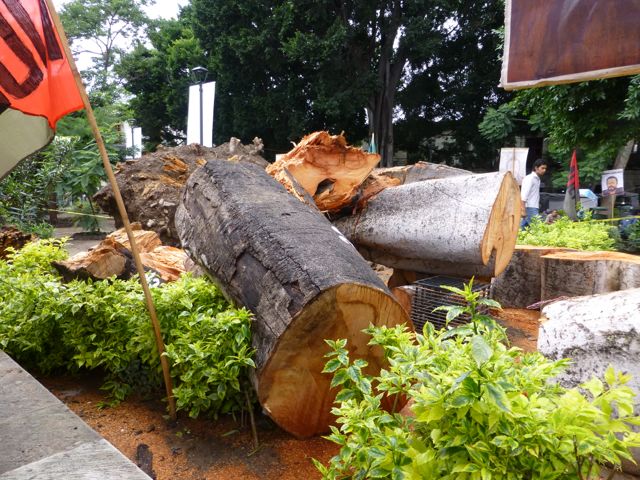
Instead of the coming of age novel, A Tree Grows in Brooklyn, we have the real life drama of a tree falls in Oaxaca.  Heading down to the mercado this morning, I was brought up short by this heartbreaking sight.

Large trunk of tree uprooted from ground.

According to reports, there were many present to hear and see one of the grand 130+ year old Indian laurels topple during a storm on Saturday night.  And, worst of all, ten people were injured, two seriously.  Trees in the city, including Indian laurels in the Zócalo, have been plagued by adversity.  A laurel in the Zócalo fell a few years ago, damaging a nearby building, and most recently in May 2011, I wrote about a laurel on the Alameda that toppled.  Resurrection was attempted and guy-wires remain to this day holding it upright.  I guess the experts decided this latest one was beyond rescue.

Large tree cut into pieces

Controversy reigns, as many assert that these trees should be able to withstand the rain and less-than gale force winds.  Thus speculation over the cause runs rampant.  Root rot appears to be the immediate culprit but the big question is, why?

Pile of massive wood logs

And, as Chris sadly noted a couple of months ago, regarding the diseased flamboyant trees in front of Santo Domingo de Guzmán, Any tree is hard to replace.

Read Full Post »
I grew up and lived most of my life twenty minutes from the Pacific Ocean.  I learned to drive on the road up over Mt. Tamalpais out to Stinson, Muir, and Bolinas beaches.  Needless to say, countless trips followed and continue!  So, yesterday I made my regular “Bay Area visit” pilgrimage to the beach.  Even on a foggy day, the sights, sounds, and smells of Stinson Beach are magical…

Alas, it’s 6 hours by car up and over the long and winding roads of the Sierra Madre del Sur to reach Puerto Escondido, Oaxaca’s closest Pacific Ocean beach.  The alternatives:  10+ hours by bus (by way of Salina Cruz) or a short but costly flight.  Still waiting for the long-promised highway that is supposed to cut auto travel time to two hours!!!

Read Full Post »

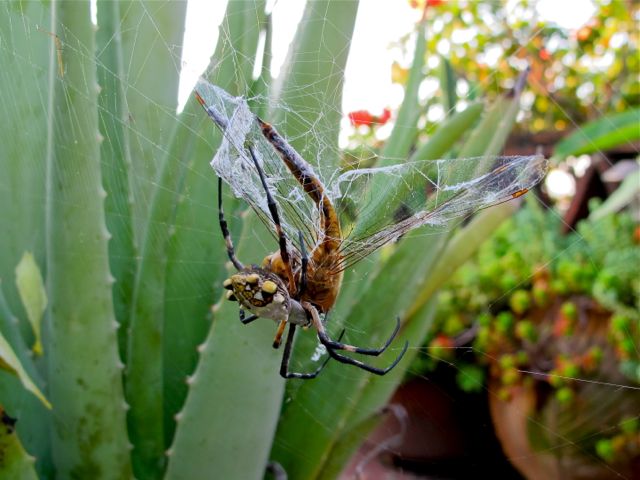
Monday morning, I went out onto the terrace to hang the wind chimes back up (too loud for sleeping), pick up spent African tulip tree blossoms (20 to 30), and say buenos días to Argiope (previously mentioned spider).

Hmmm… all was definitely not “as usual” in the spider’s web.  Argiope, what in the world is going on?

Argiope spider with dragonfly caught in her web.

Good grief, she had caught a dragonfly!  It must have been quite a battle, as her web was a mess and now she was trying to wrap it up.

Close-up of dragonfly caught in an Argiope orb weaver spider web.

This was serious business for her and she worked at it most of the day.  However I had to chuckle, as sayings from childhood rose up from the cobwebs in my brain  —  Your eyes bigger than your stomach.  Have you bitten off more than you can chew?  Pick on someone your own size!

Dragonfly hanging by a thread on the web as Argiope spider has moved away from her prey

Monday evening, she finally gave up and let it loose from her clutches.  When I retired for the night, the dragonfly was hanging by a thread.

Argiope spider sitting in middle of web with a wrapped up fly.

By the next morning, the remains of the dragonfly had fallen onto the patio and Argiope was sitting happily in her newly repaired web with a more appropriately sized breakfast.

Mother Nature is amazing!

Read Full Post »
« Newer Posts - Older Posts »