Feeds:
Posts
Comments

Archive for the ‘Science & Nature’ Category

Several mornings ago, after a day and night of rain, I went out on the terrace to check on the garden and found…

Pitaya flower with rain drops

Yikes, one of my Pitahaya (Hylocereus undatus – aka, Dragon fruit) had bloomed overnight!  Must be a relative of my other Night Blooming Cereus.

Two years ago, the original cuttings had been laying in the campo of a friend in San Martín Tilcajete.  When Chris (Oaxaca-The Year After) asked if we could have some, the answer was, “¡Por supuesto!”  Loving the wall of Pitahaya at Centro Académico y Cultural San Pablo, six months later, with the original five cuttings becoming fifteen, I could use them to begin to screen the chain link fence at the new Casita Colibrí.  I kept pruning and sticking them in the planter boxes.

Pitahaya climbing chain link fence

June 2, 2014, 8:40 AM

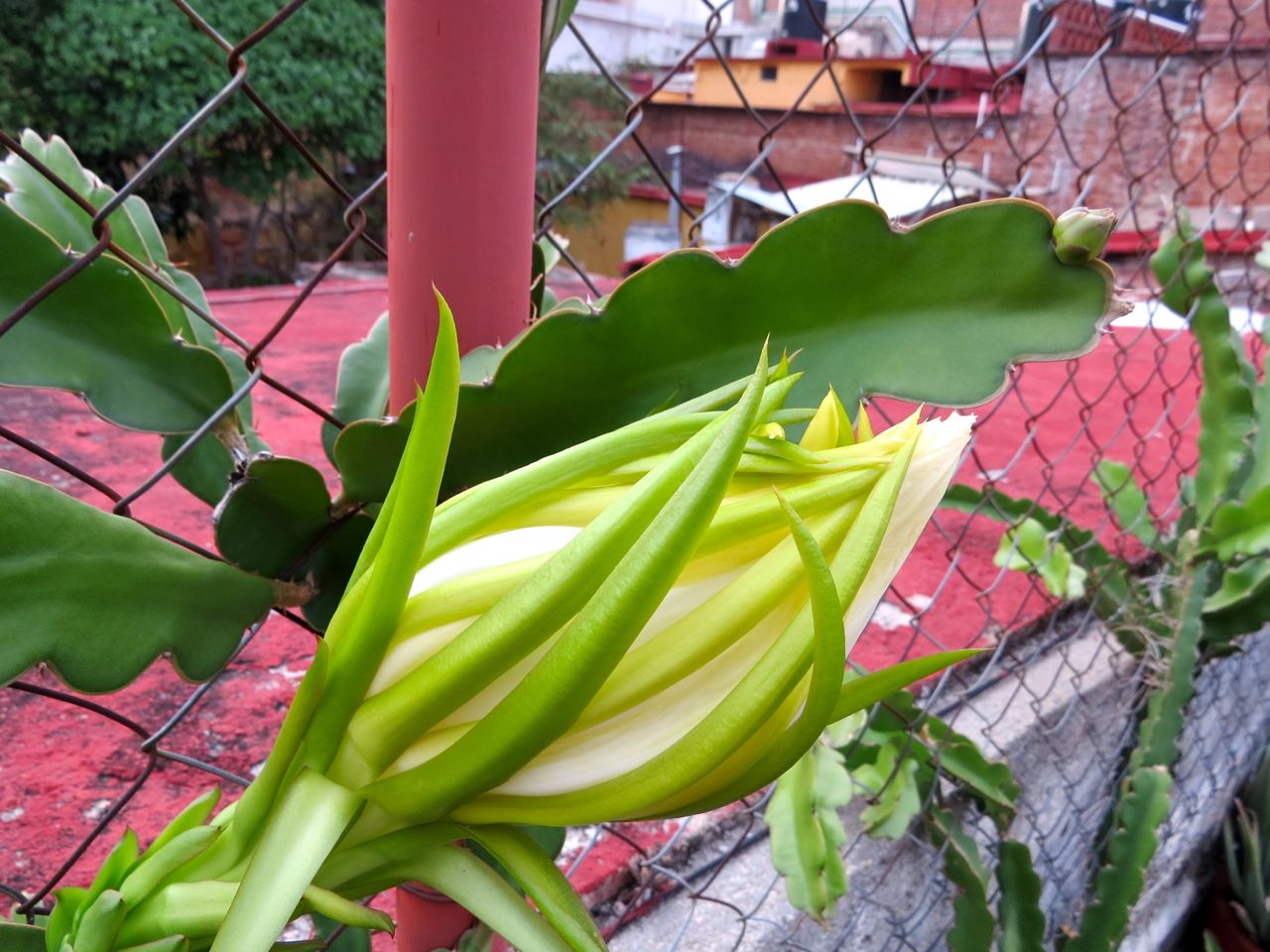
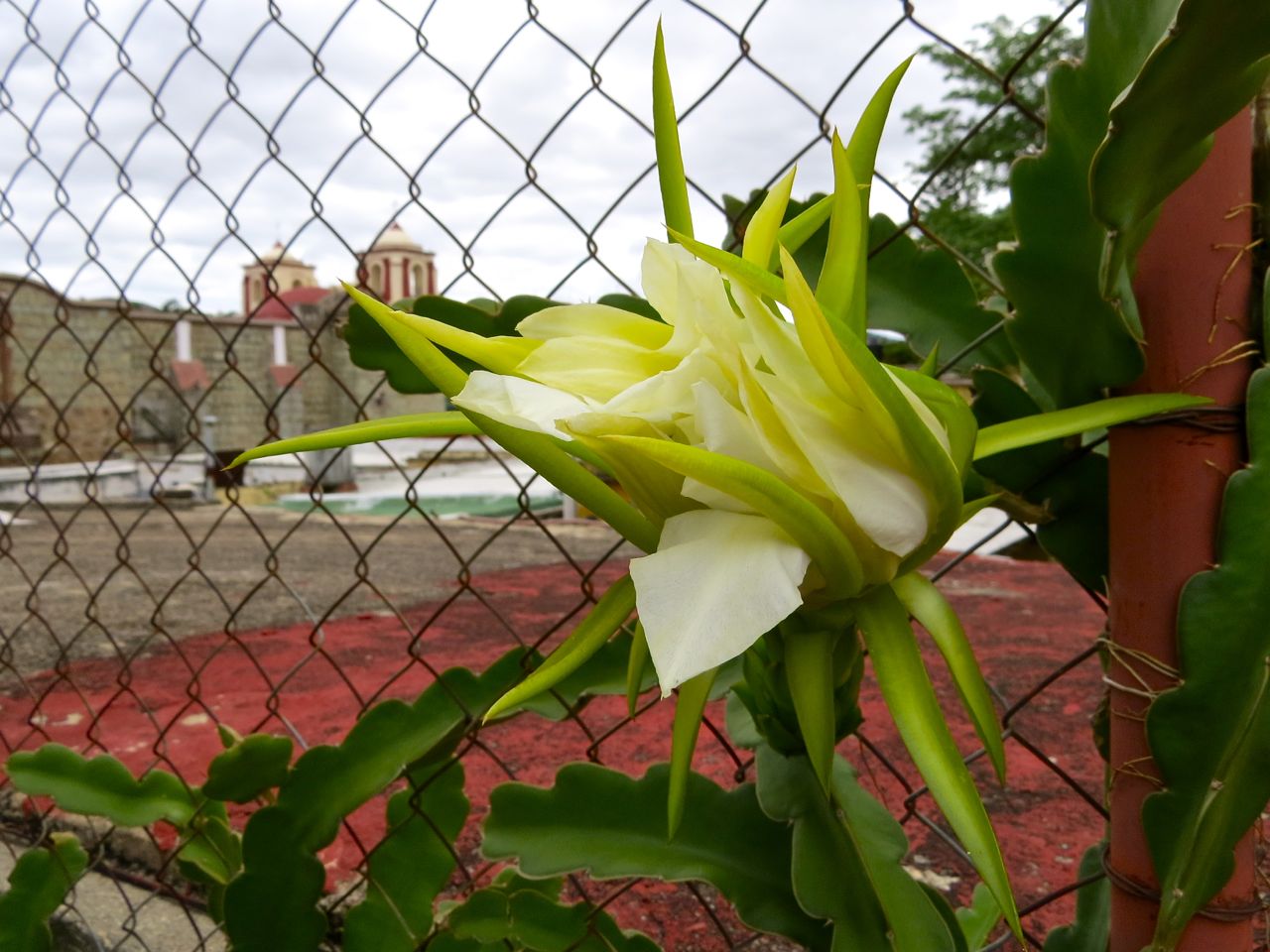
And now, they have begun blooming.  Having missed the “night-blooming” of my first flower, I was determined not to miss the unfolding of the second blossom, seen above near the top of the pole, providing the weather cooperated.  It did!

Pitahaya blossom

June 2, 2014, 7:20 PM

Pitahaya flower

June 2, 2014, 8:40 PM

Pitahaya flower, side view

June 2, 2014, 11:00 PM

By the next day, it had closed, never to reopen again.

Pitahaya flower closed

June 2, 2014, 2:54 PM

However, there will be fruit…

Read Full Post »

Yippee!!!  A new, and extremely colorful, species of grasshopper has been discovered in the pine-oak forest of the Sierra Madre del Sur Mountain Range in Oaxaca.  Liladownsia fraile has been named for Oaxaca’s favorite daughter and one of my favorite performers, Lila Downs, someone I’ve written about often.

(Photo Credit: UCF)

(Photo Credit: UCF)

From Science Codex,

A newly discovered grasshopper by University of Central Florida scientists now bears the name of Grammy-award winning singer and activist Ana Lila Downs Sanchez.

The scientists named the new species discovered on the side of a mountain road near Oaxaca, Mexico, after the Mexican-American singer as a nod to her efforts to preserve indigenous culture and penchant for wearing colorful, local costumes as part of her performances.

“It was primarily Paolo’s idea to name the grasshopper after the singer” said Derek Woller, one of the authors of the paper referring to colleague Paolo Fontana. “He’s a big fan of Lila Downs (her stage name). The grasshopper is so beautiful, so vibrant and colorful. When he told us all about her, her work, her colorful clothes, and that she was born in the region where we found the specimens, we thought, yeah, that’s great, let’s do it.”  Read full article HERE.

According to the Zootaxa article, Studies in Mexican Grasshoppers: Liladownsia fraile, a new genus and species of Dactylotini (Acrididae: Melanoplinae) and an updated molecular phylogeny of Melanoplinae (a mouthful, I know, but the photos are worth scrolling through the article), Liladownsia fraile had been sighted in San José del Pacifico, Suchixtepec, and Pochutla.

By the way, if you are in Oaxaca, Lila Downs is performing tonight at the Teatro Macedonio Alcalá — a benefit for Fondo Guadalupe Musalem, a nonprofit dedicated to improving the lives of the young indigenous women of Oaxaca through education.

poster for benefit

Read Full Post »

Yesterday, a new visitor arrived on the rooftop garden.  Naturally, I wanted to know the name of this tiny guest who seemed to love my sedum.  After searching page by page through my Smithsonian Handbooks:  Butterflies and Moths unsuccessfully, I spent hours this morning combing the web.  I think my new friend is from the family Lycaenidae (Gossamer-winged); subfamily Theclinae (Hairstreaks); tribe Eumaeini; and genus Electrostrymon.  However, for the life of me, I can’t figure out which species — while the markings match, the colors don’t.  Any lepidopterists out there who can help?

Pale green & orange butterfly

As for what he (I’m pretty certain it is male) was doing on the sedum — he was rubbing his wings together.  For this, I did find an answer.  According to the Learn About Butterflies website:

Hairstreaks usually have a pattern of lines or stripes on the underside wings. These, in combination with ocelli ( false eye markings ) and short tails ( false antennae ) act to divert attention away from the head, and towards the outer edge of the hindwings. By oscillating the wings, the tails are made to wiggle like antennae, further increasing the illusion that the butterfly is ‘back to front’. Attacking birds will always aim at the head of a butterfly, but are tricked into aiming at the tail. The butterfly is thus able to escape in the opposite direction unharmed. Another reason for wing-rubbing is that male Hairstreaks have patches of specialised wing scales – ‘androconia’, located on their upperside forewings. Sacs at the base of these scales contain pheromones. Rubbing the wings together helps to disseminate the pheromones, which attract females and induce them to mate.

Maybe there will be some springtime courting on the terrace….

Read Full Post »

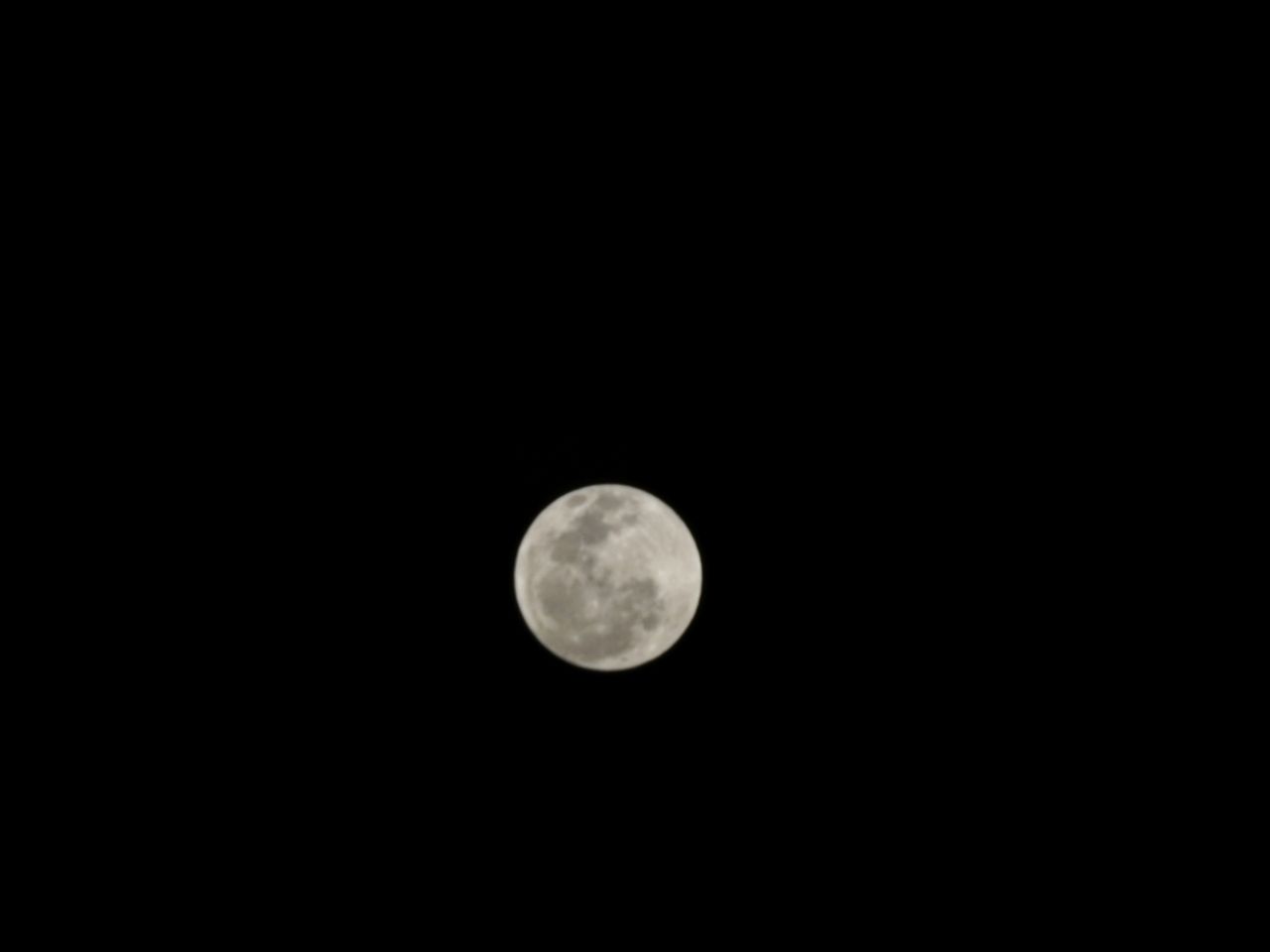
Early last night, needing a break from working on the Lord of the Little Burro blog post, I wandered out onto the terrace to check out the full moon rising over the city.  The night was clear, La Luna was brilliant, and she was going to be putting on quite a show in 6+ hours — a lunar eclipse.

Silvery full moon

April 14, 2014 – 7:21 PM (CDT)

There was no way I could stay up until then, though I did have fleeting thoughts of setting my alarm.  When bedtime came, I decided to leave it up to the fates or Semana Santa cohetes and church bells, though I did leave the Canon on her tripod, just in case.  The fates had it (probably because I didn’t eat dinner until 9:00 PM); I awoke around 2:00 AM, got up, took the camera out on the terrace, and looked up.  There was La Luna dressed as the Blood Red Queen.

Red colored eclipsed moon

April 15, 2014 – 2:20 AM (CDT)

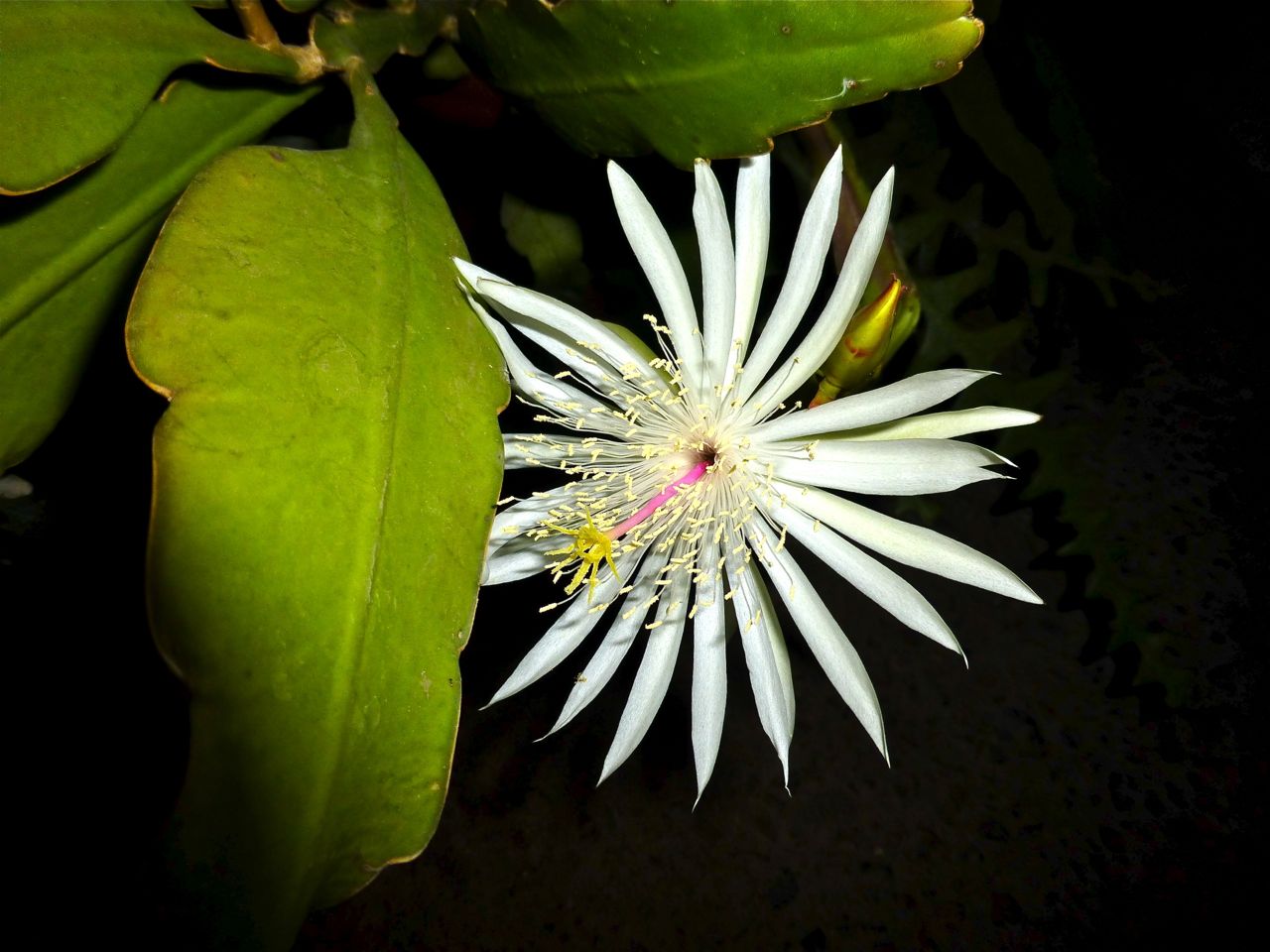
That little spec below and to the right of the moon is Spica, the brightest star in the Virgo constellation.  It’s extra visible because of the eclipse.  In addition, about 10 degrees west of the moon, an even tinier reddish spec could also be seen (though not in this photo) — Mars came to the party, too!  And, if this weren’t enough lunacy for one night, I happened to remember, earlier in the day it looked like one of the blossoms on my Night Blooming Cereus might be ready to bloom.  Sure enough…

Flower of Night Blooming Cereus

April 15, 2014 – 3:05 AM (CDT)

What a spectacular night!  Though, how I made it to my 9:00 AM breakfast appointment, I’ll never know.  Definitely, early to bed tonight.


Read Full Post »

You can cut all the flowers but you cannot keep spring from coming. –Pablo Neruda

Flor de mayo; May Flower

Spring has returned. The Earth is like a child that knows poems.  –Rainer Maria Rilke

P1020488

Every spring is the only spring, a perpetual astonishment. –Ellis Peters

Pseudobombax ellipticum, Shaving Brush Tree

Spring is nature’s way of saying, ‘Let’s party!‘  –Robin Williams

Read Full Post »

I’m still in recovery and catching-up mode and a nagging cold (caught in el norte) hasn’t helped.  While I’ve only ventured out of Casita Colibrí a few times, I’m loving being back in the land of color.

Colorful street art on wall

And, after my recent sojourn to points north, where Mother Nature is a drama queen when it comes to seasons, I’m savoring one of the subtle signs of spring in Oaxaca.

Lavender blossoms on jacaranda against blue sky

The jacarandas are beginning to bloom.

Lavender jacaranda blossoms against blue ski

Purple haze all in my eyes…

Street art:  lips painted on a wall

Excuse me while I kiss the sky!

Read Full Post »

Last week near Saratoga Springs, NY it was 15º F, doors and windows were sealed shut, and the furnace was blasting.

Snow02172014

Today, back in Oaxaca, it’s 90º F, doors and windows are wide open, and I’ve got the fan on.

IMG_2040

What a difference one week and 2000+ miles makes.  I’m definitely a warm weather person!

Read Full Post »

It may be the Winter Solstice, but here in Oaxaca my doors and windows are already open and I’m looking at a clear blue sky and an 85° F  temperature forecast.  Ahhh…

This is about as close as we get to Old Man Winter…

Winter mural

Mural on a wall along Niños Heroes, Oaxaca

Happy Winter Solstice to all in the northern latitudes and happy Summer Solstice to those south of the equator.

Read Full Post »

I went to Teotitlán del Valle yesterday for the annual Virgen de Guadalupe performance of the Danza de la Pluma.  As many of you know, I’ve seen it many times, BUT I’ve never stayed until the end, as the dance lasts for eight hours.  Yes, 8 hours!  It would mean returning to the city late at night — and driving at night is something most try to avoid.  Thus, I decided to spend the night at Las Granadas, one of the few B&Bs in town.  However, the thought of waking to the sounds of roosters crowing, burros braying, sheep bleating, AND going for a morning walk in the country sealed the deal.

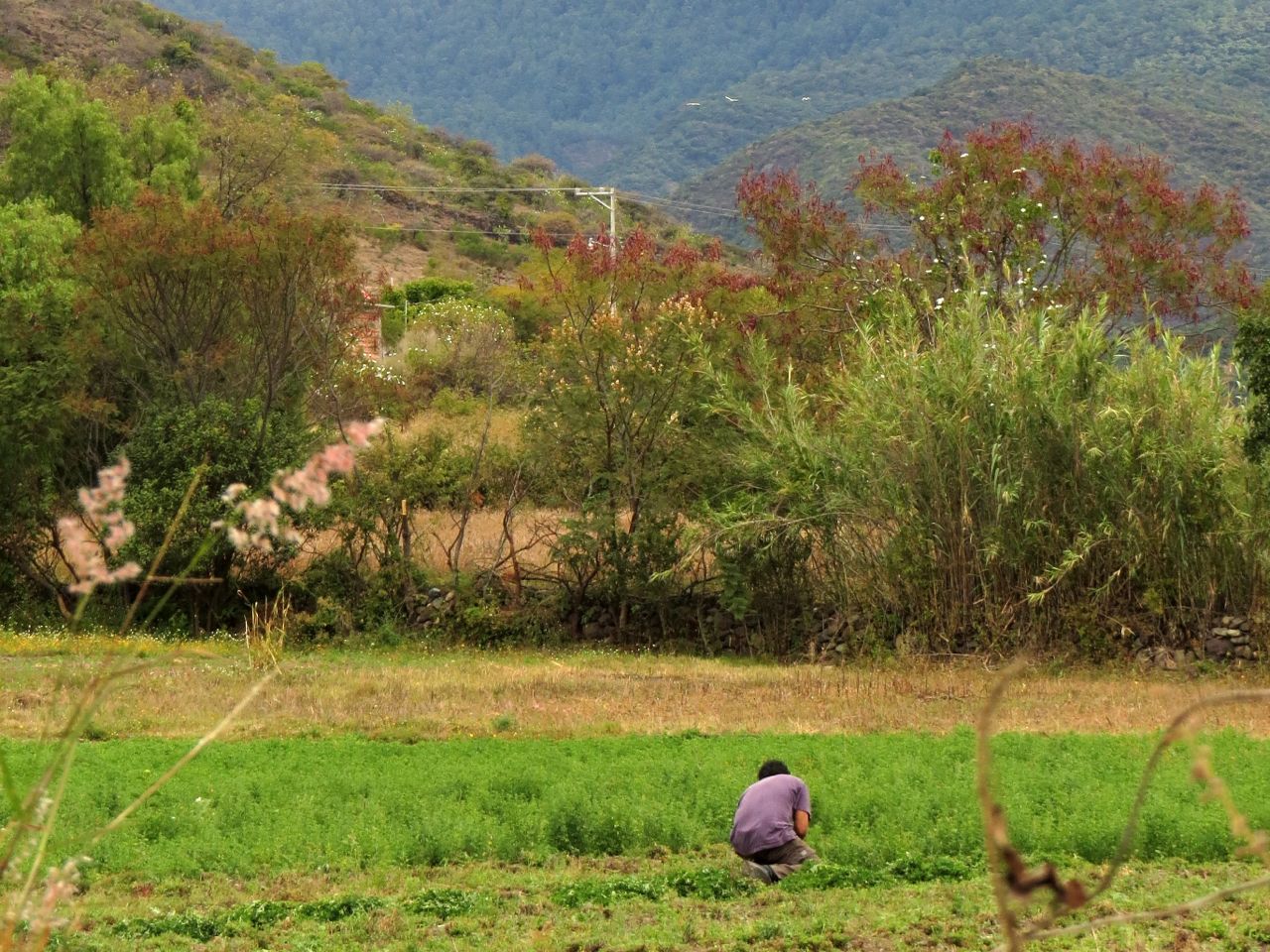
And so, a little before 9 AM today, I headed up (down?) Calle 2 de abril toward El Picacho.  The work day had long since begun…

IMG_0810

IMG_0806

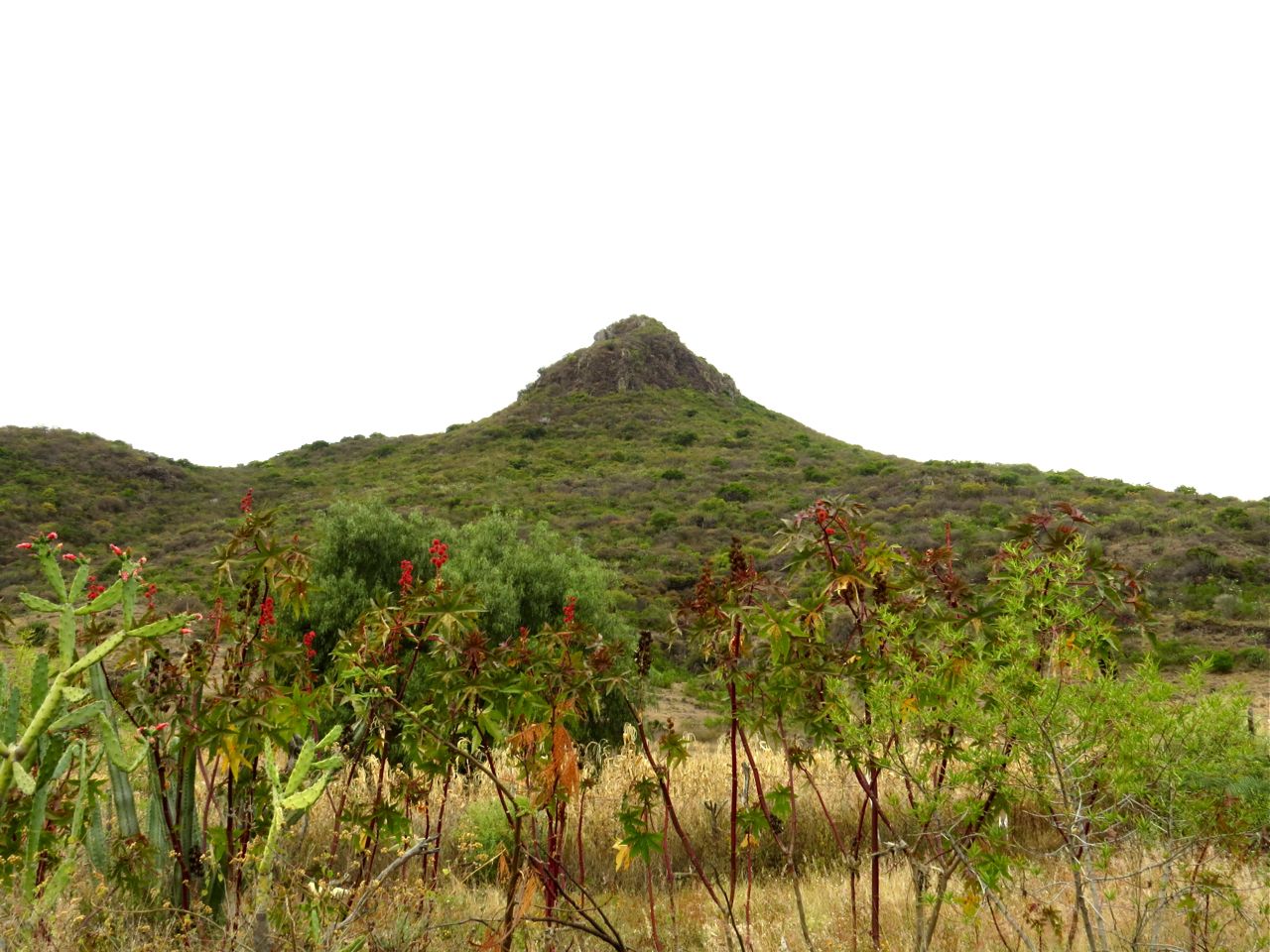
Crossing the Arroyo Grande, I turned right to begin the trek up Revolución.  El Picacho kept a watchful eye as I kept pausing to snap photos and just take in the sights and sounds of being out in the country.

El Picacho

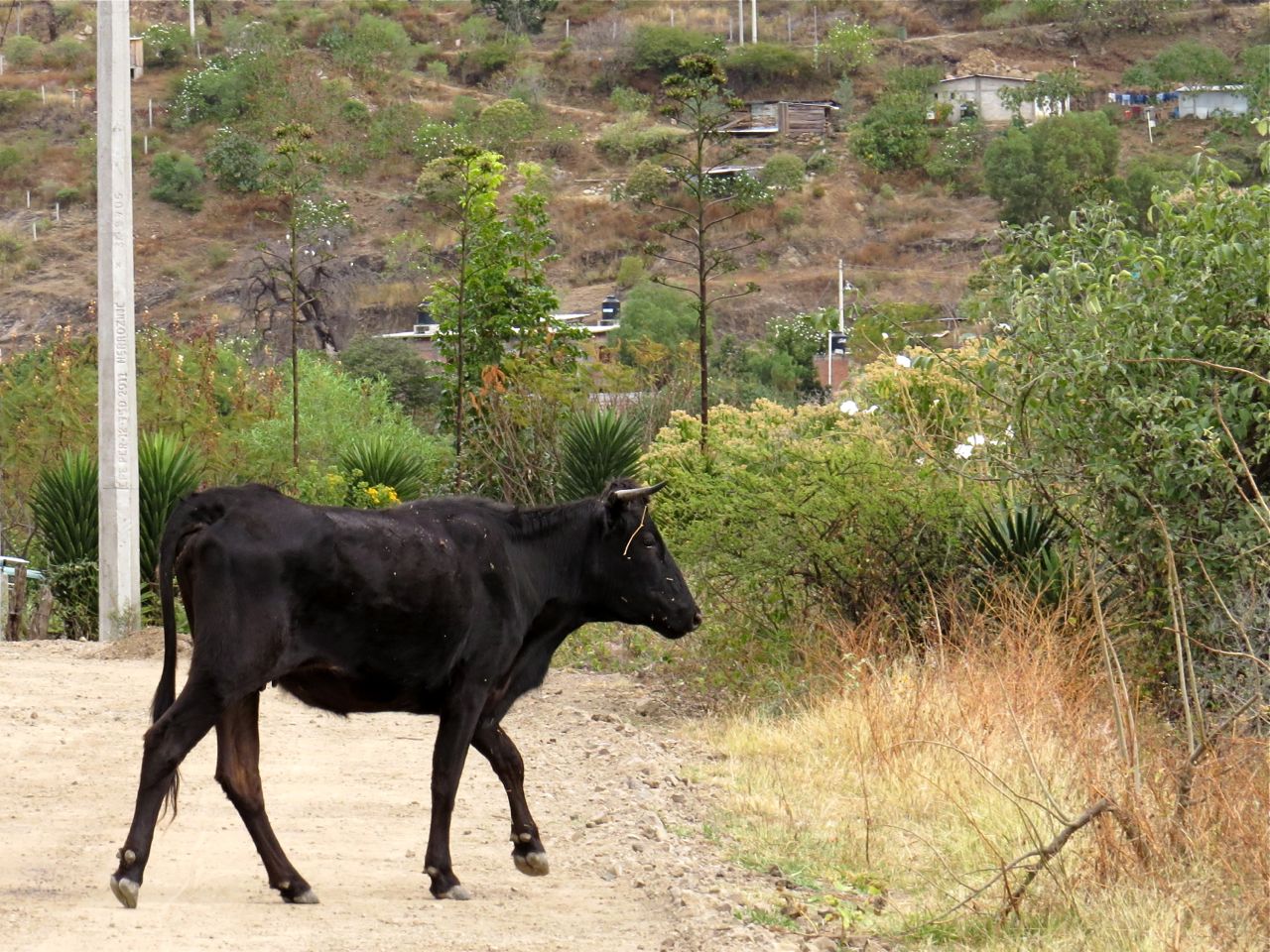
Black bull crossing dirt road

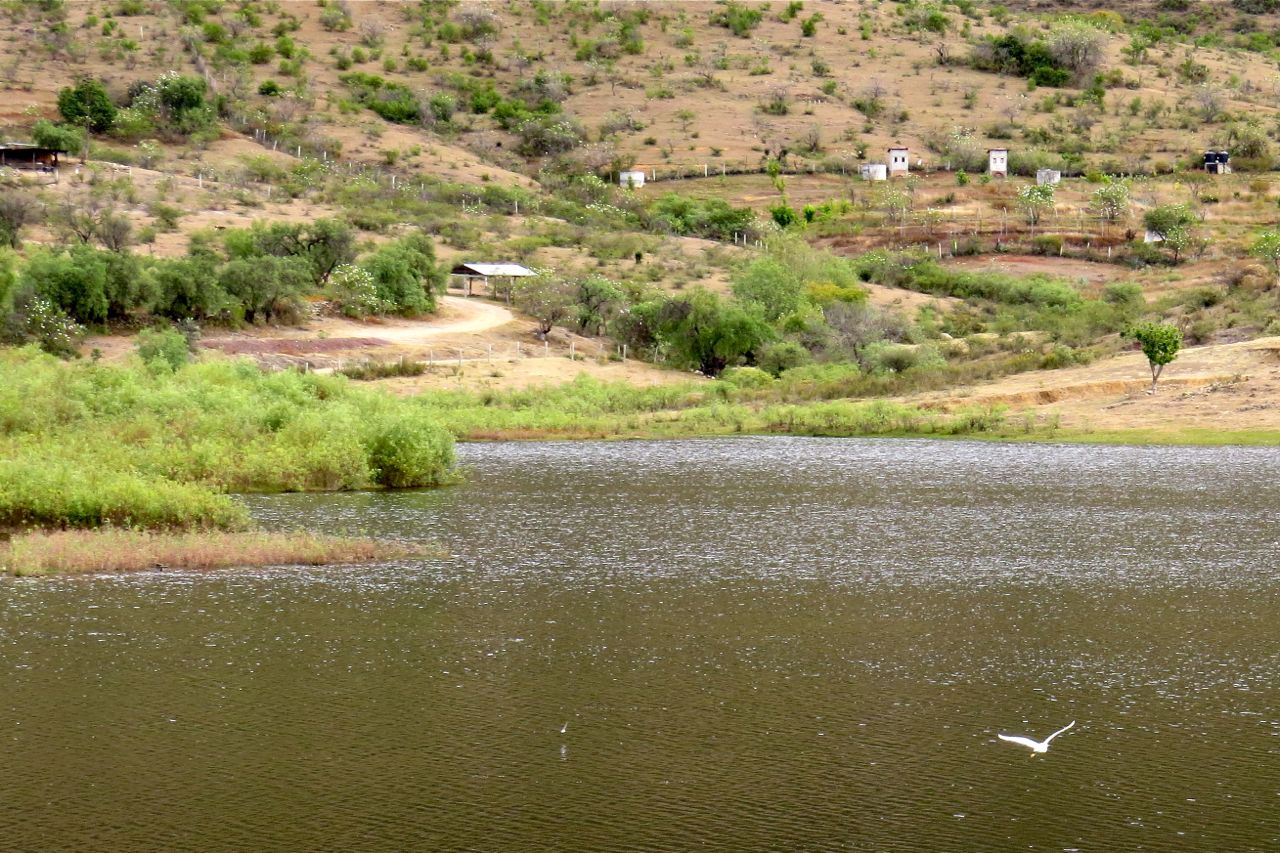
My destination was the presa (dam) and its precious reservoir.  Most of my life has been spent living five minutes from the San Francisco Bay and fifteen minutes from the Pacific Ocean — and now living in a landlocked city, I do miss bodies of water.

Dam, reservoir, and mountains

Reservoir

Crossing to the other side of the arroyo, I turned right on Avenida Benito Juárez for the return trip to the B&B.

Dirt crossroads

Houses on hillside

As I walked, the lyrics to Al Kooper’s, House in the Country kept playing in my mind.

No need to worry
Folks in a hurry
Leave them behind you
No one can find you
House in the country

All the relaxin`
Will soon fill the cracks in
Good for your head too
If you are led to
House in the country
Green surrounding
Love abounding
You won`t find a manhole there

A sublime morning in Teotitlán del Valle.  Ahhh…

Read Full Post »

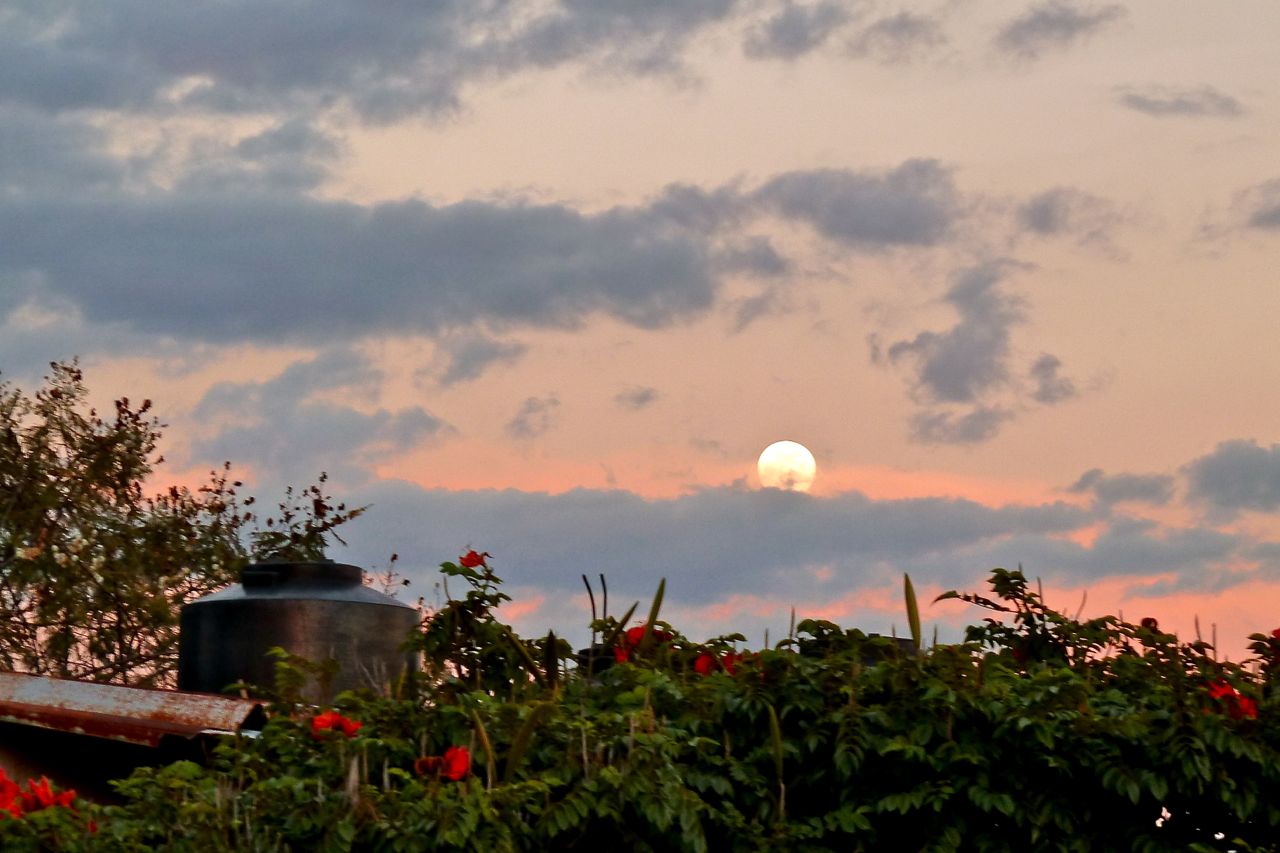
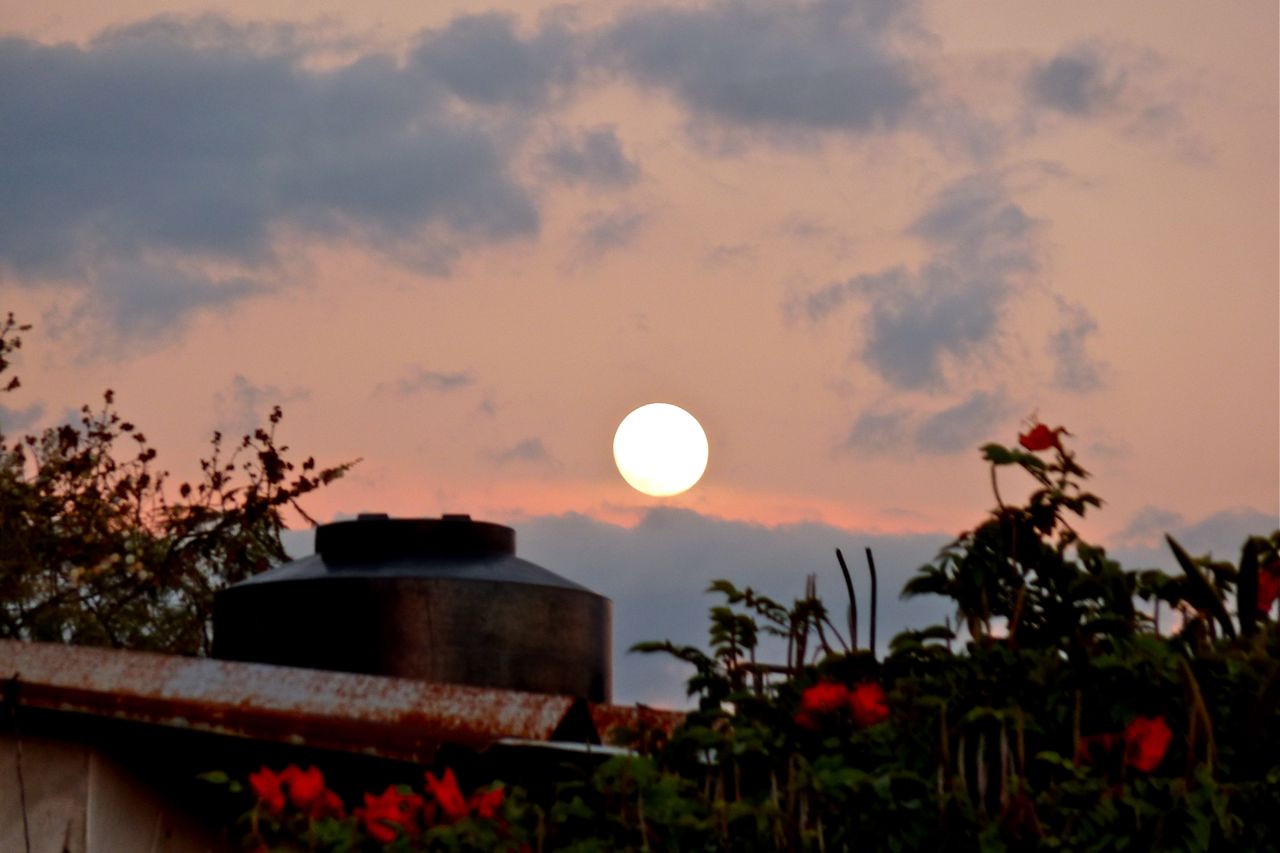
It may not be Moon Over Parador, but it was moon from my mirador….  The colors of last night’s sunset were spectacular, no matter which way one looked.  It made for a beautiful full moon rising over the African tulip tree and rooftop tinaco of my old apartment.

6:56 PM (CST)

6:56 PM (CST)

6:57 PM (CST)

6:57 PM (CST)

Actually, the moon wasn’t officially full until 9:15 (CST) this morning, but the above was full enough for me!

Read Full Post »

Much like the Mark Twain line, “The report of my death was an exaggeration,” unfortunately, so too the news announcing the death of GMO corn in Mexico.

P1080309_crop

According to the post by Think Mexican, The Fight Continues: GMO Corn Not Yet Banned in Mexico:

Contrary to reports, genetically modified (GMO) corn has not been banned in Mexico. On October 10, a Mexican judge from the Twelfth Federal District Court for Civil Matters in Mexico City issued an injunction suspending field trails of GMO corn, however, a complete ban was not ordered.

Federal Judge Jaime Eduardo Verdugo’s ruling does order the halting of “all activities involving the planting of transgenic corn in [Mexico] and ends the granting of permissions for experimental and pilot commercial plantings.” [Read full article, HERE]

From a large mural on the wall outside the Comisión Nacional para el Desarrollo de los Pueblos Indígenas, Delegación Oaxaca

La lucha continúa…

Read Full Post »

Sometime around 8,000 years ago, corn was first domesticated in the valley where I have the privilege of living.  Botanists have determined that the valley of Oaxaca was the “cradle” of maize evolution.  Maíz became the lifeblood of the Mesoamerican diet and culture and it continues today.

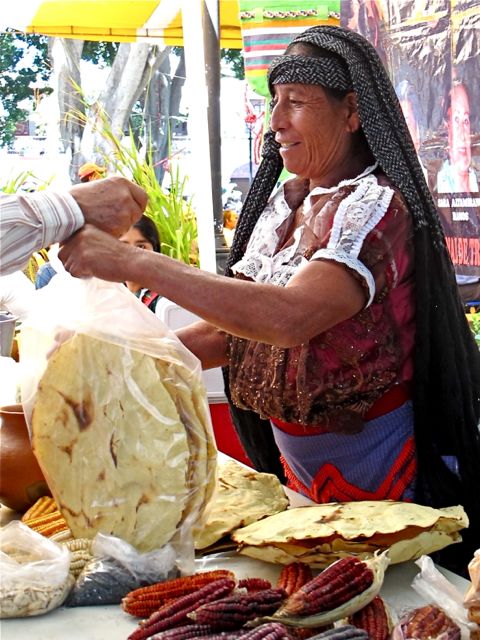
On September 29, Oaxaca celebrated el Día Nacional del Maíz Nativo (National Native Corn Day).  On the zócalo, across from the Government Palace, there were displays showcasing the multiple hues of native corn…

There were tlayudas for sale…

IMG_5627

However, there were also warnings about the dangers of genetically modified corn and the products containing them…

Genetically modified corn is a major issue in Oaxaca.  There is a concern that native plants could become infected with GMOs, which would then contaminate and compromise the genetic diversity of native varieties.  Speakers, at the event, discussed the importance of the community seed banks that have been established to safeguard native varieties and be used in the wake of economic and ecological crisis.  Two weeks after the aforementioned event, there was good news, a Mexico judge has placed an indefinite ban on genetically engineered corn.

And so to celebrate, I am re-posting the Lila Downs video of her song “Palomo del Comalito,” paying homage to maíz, and its “granitos de cristal” (grains of crystal).

And to bring this post full circle, the video was filmed in Teotitlán del Valle, located here in the valley where corn was first cultivated.

Read Full Post »

More from the Hecho en Oaxaca exhibit…

P1100004

The courtyard at the Museo de Arte Contemporáneo de Oaxaca (MACO)…

P1100060

Art is the tree of life.  — William Blake


Read Full Post »

“But one day we shall be rich, and the next poor. One day we shall dine in a palace and the next we’ll sit in a forest and toast mushrooms on a hatpin….” — Katherine Mansfield, The Aloe.

Last Sunday, via a narrow winding road, we drove up into the Sierra Norte for the 13th Regional Wild Mushroom Fair (Feria Regional de Hongos Silvestres) in San Antonio Cuajimoloyas.  The village is part of the Pueblos Mancomunados, a union of seven villages formed to protect the forest, preserve local traditions, and promote ecotourism, in order to provide employment. Thirty-seven miles northeast of Oaxaca city, 10,433 feet above sea level, and often in the clouds, Cuajimoloyas has an ethereal feel and seems a world apart from the valley below.

“I am… a mushroom on whom the dew of heaven drops now and then” — John Ford, The Broken Heart (1633).

Entering the plaza in front of the portales of the municipal building, we were surrounded by the 20 species of wild mushrooms endemic to the region.  There were mushrooms with shiny orange caps; mushrooms resembling coral, trumpets, a head of cauliflower, flower petals; baskets of freshly dug mushrooms, baggies of dried mushrooms, a bowl of spores; mushrooms sauteed, grilled on hot coals, stuffed in empanadas and tamales, and made into candy.

“Nature alone is antique, and the oldest art a mushroom.” — Thomas Carlyle, Sartor Resartus.

And there were the people of Cuajimoloyas…  I quickly found the enchanting abuela from last year, again selling Atole Rojo and it hit the spot!  Another abuela was selling fragrant fresh herbs, most I’d never heard of.  I forgot about a sprig she gave me and it was a pleasant surprise when I returned home and emptied my pockets.

I’m already looking forward to next year…

Read Full Post »

Colibríes?  I can’t resist!

Hummingbird from a wall in San Cristóbal de las Casas in Chiapas…
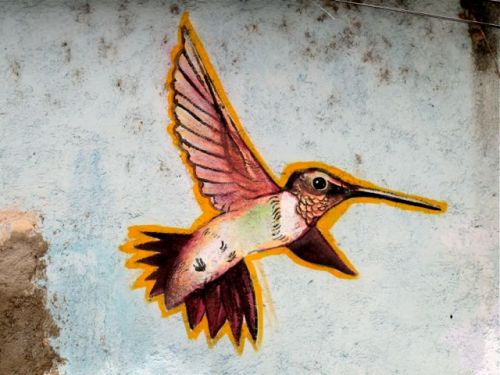
Hummingbird painted on wall

Hummingbird from a NASA’s Hubble Space Telescope photo…

Hubble image looks like the profile of a hummingbird

Separated at birth?  Cool article from Slate about this photo…

The Hummingbird Galaxy

I was pondering writing a longish post about the picture above, talking about what galaxies are, how they can physically collide, how their gravity can twist and distort their shapes into all sorts of weird things …

But seriously. That galaxy looks like a hummingbird.* What more do you need?

OK, you need a little more. For one, I’ve written quite a bit about how galaxy collisions happen, so you can read about how these work here and here. The two galaxies in this collision are called NGC 2936 (the blue birdie one) and NGC 2937 (the smaller cottonball one). Together they are known as Arp 142, named for an astronomer who observed weird, distorted galaxy pairs.They’re located about 300 million light-years from Earth.

Two things really stand out to me in this picture (besides a galaxy that looks like a flippin’ hummingbird). One is the long, delicate tendril of dark reddish dust exhumed from the previously spiral-shaped galaxy NGC 2936, flung into a long arc across tens of thousands of light-years of space. I wish we had more three-dimensional data here; I’d love to know what this structure really looks like from different angles. Since dust is very dark, it blocks light coming from behind it, so this tendril is in front of the hummingbird galaxy, or perhaps embedded in it.

The other thing is that the smaller galaxy seems to have survived this collision pretty well. The shape is only mildly distorted; you can see a bit of off-centered nature to the glow of stars around the core. I suspect its more compact nature has a lot to do with that; the stars are closer together, perhaps, and the overall gravity of all those stars helped it retain its shape.

And there is one other thing. These are two very different galaxies colliding! The ex-spiral galaxy is very blue, indicating lots of star formation happened recently. Young, massive stars are blue, and when galaxies collide, the gravitational interaction can cause huge clouds of gas to collapse and furiously form stars.

The other galaxy is yellower, indicating an older, more stable population—blue stars don’t live long, so a galaxy this color must not have formed stars in a long, long time. Billions of years, for sure. You can tell by looking that it doesn’t have much gas and dust in it, which fits; if it had, the collision would have stirred them up, and we’d see more blue stars there as well.

Note too that you can see a handful of far more distant galaxies in the picture. The ones to the lower right are red, which is most likely due to having their light absorbed and reddened by the dust in the hummingbird galaxy; that’s another thing interstellar dust does, much like dust and haze in the air can make a sunset look red.

All in all, there’s a lot going on in this image! The hummingbird shape makes me smile, and don’t get me wrong, it’s cool. But what you’re seeing here is far more than just a shape in the clouds; you are seeing a massive collision on a cosmic scale, the collective might of 100 billion suns, their gravity reaching out and twisting the shapes of these galaxies, stretching them like taffy, molding them like clay.

The Universe operates on the grandest of all scales, manipulating forces and energies far too large for us to grasp in our puny brains. Yet when it does so, it generates beauty and perhaps even amusement in those same brains. It helps us appreciate it and gives us another reason to want to. And, after a while, we really can begin to grasp what the Universe is telling us.

Maybe our brains aren’t so puny after all.

*Some folks say it looks like a penguin. I can see that, but it’s silly. I mean, c’mon, a galaxy shaped like a penguin? Ridiculous.

h/t Chris

Read Full Post »

« Newer Posts - Older Posts »