Sitting on a wall, high above Av. Independencia in Oaxaca city…
Tears welled up as I watched the march go by.
Posted in Creativity, Culture, Education, Politics, Protests, Tragedy, Violence, tagged Ayotzinapa, Caravana de Ayotzinapa, Democracy Now, demonstrations, graffiti, Guerrero, Iguala, Mexico, Mexico Burns as Outrage over Student Disappearances Sparks Protests Against State-Backed Violence, Normal Rural Ayotzinapa, Oaxaca, photographs, photos, protests, Santo Domingo de Guzmán, sidewalk memorial, signs, students, Teachers on November 16, 2014| 2 Comments »
The headline, Mexico Burns as Outrage over Student Disappearances Sparks Protests Against State-Backed Violence, from the Nov. 13 “Democracy Now” show, is not an overstatement. Yesterday, in front of Santo Domingo…
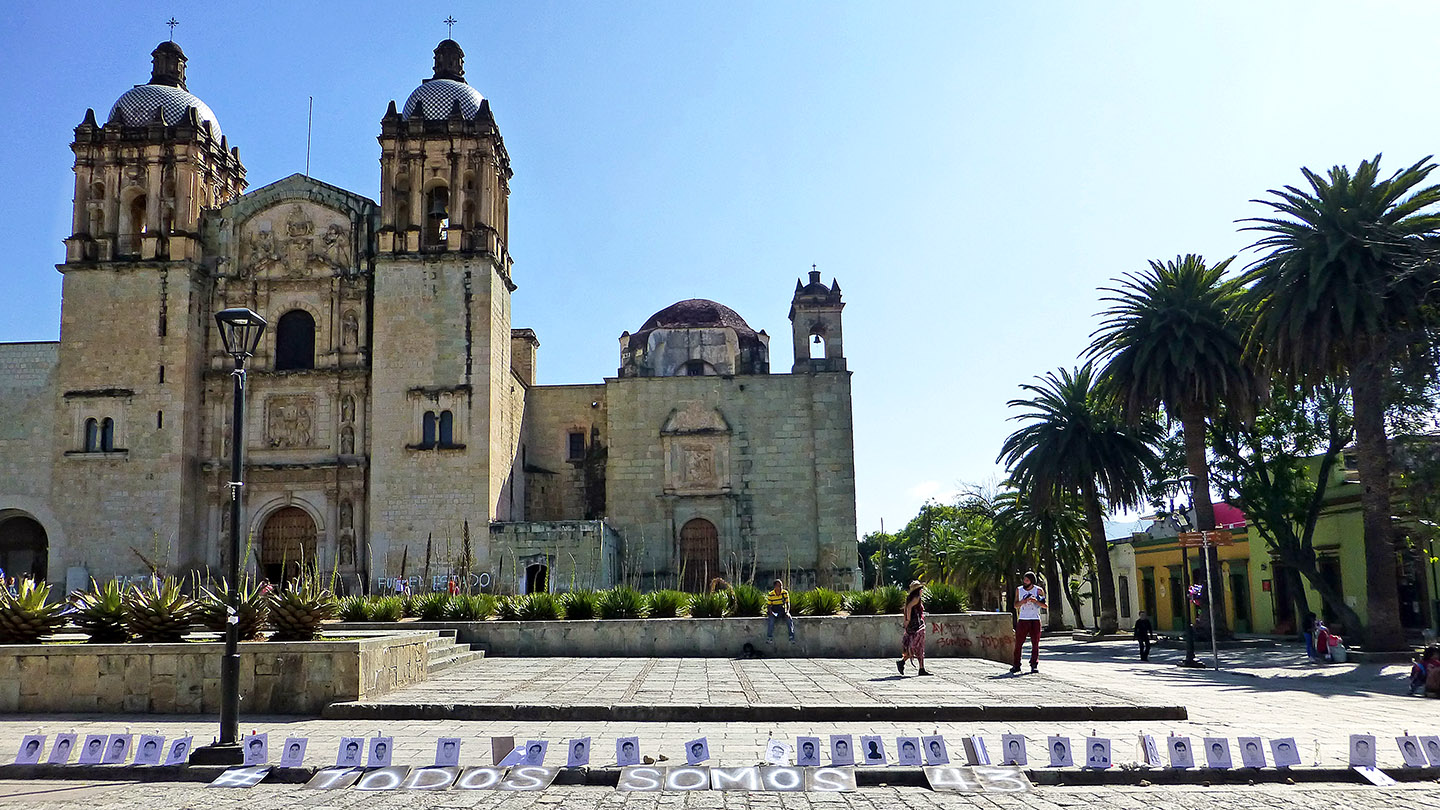
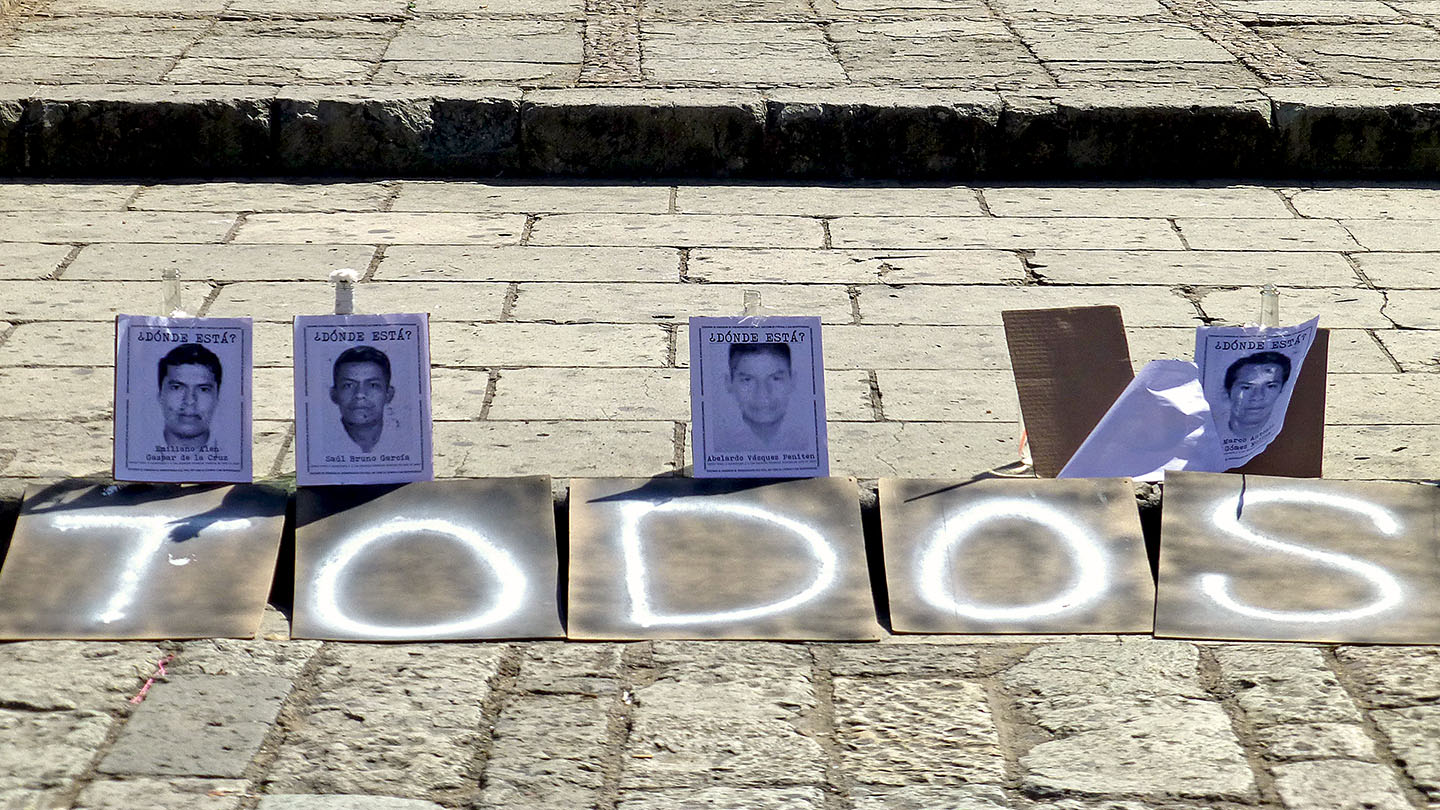
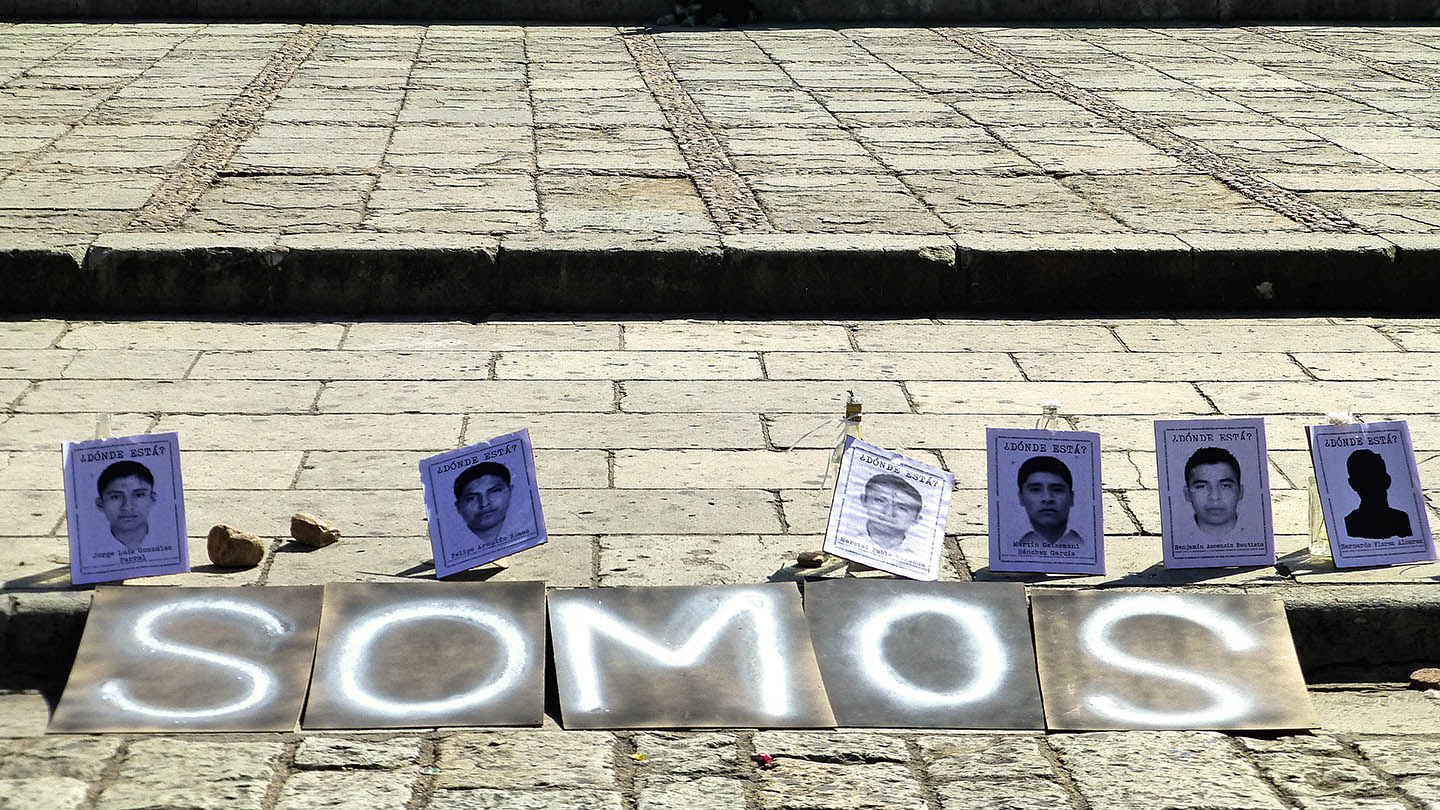
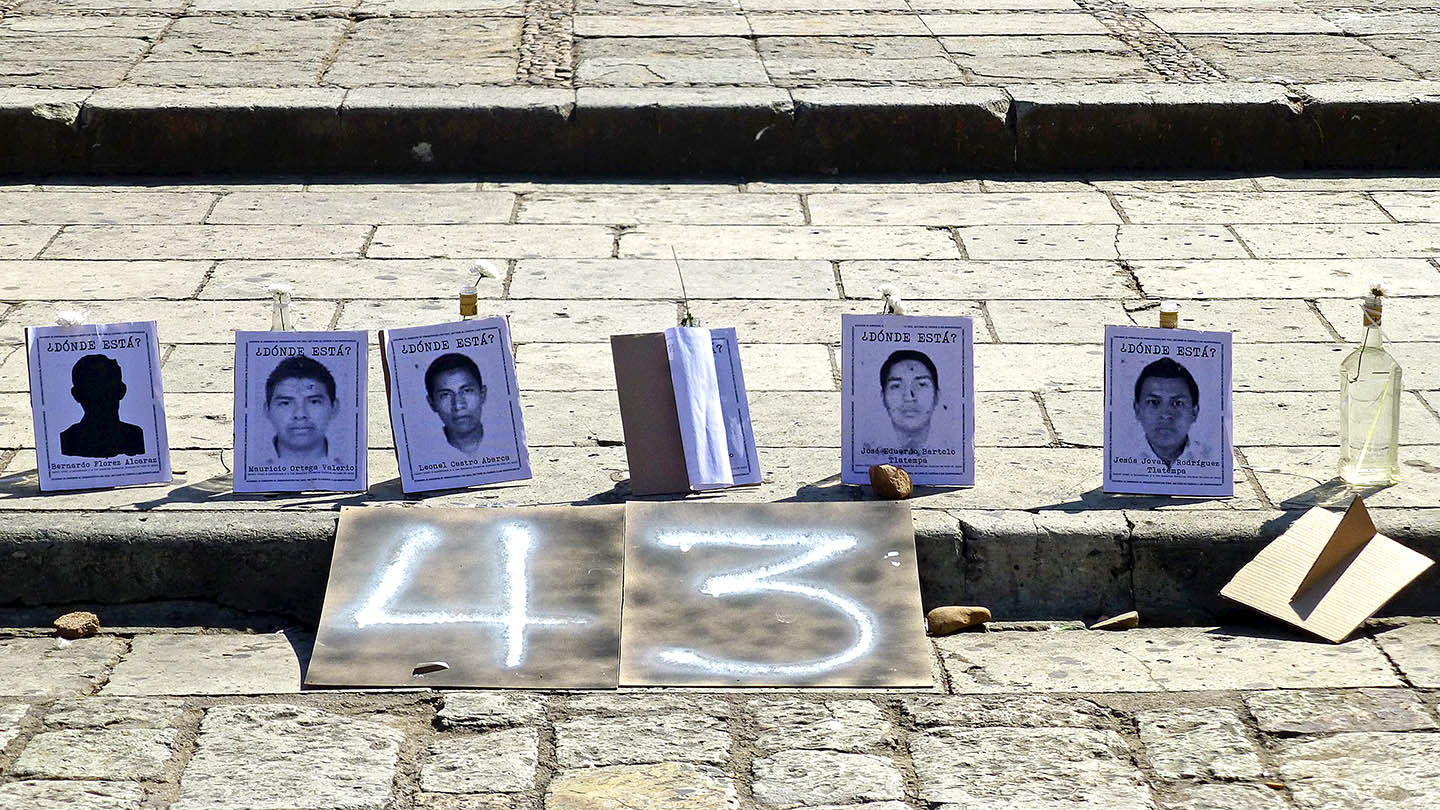
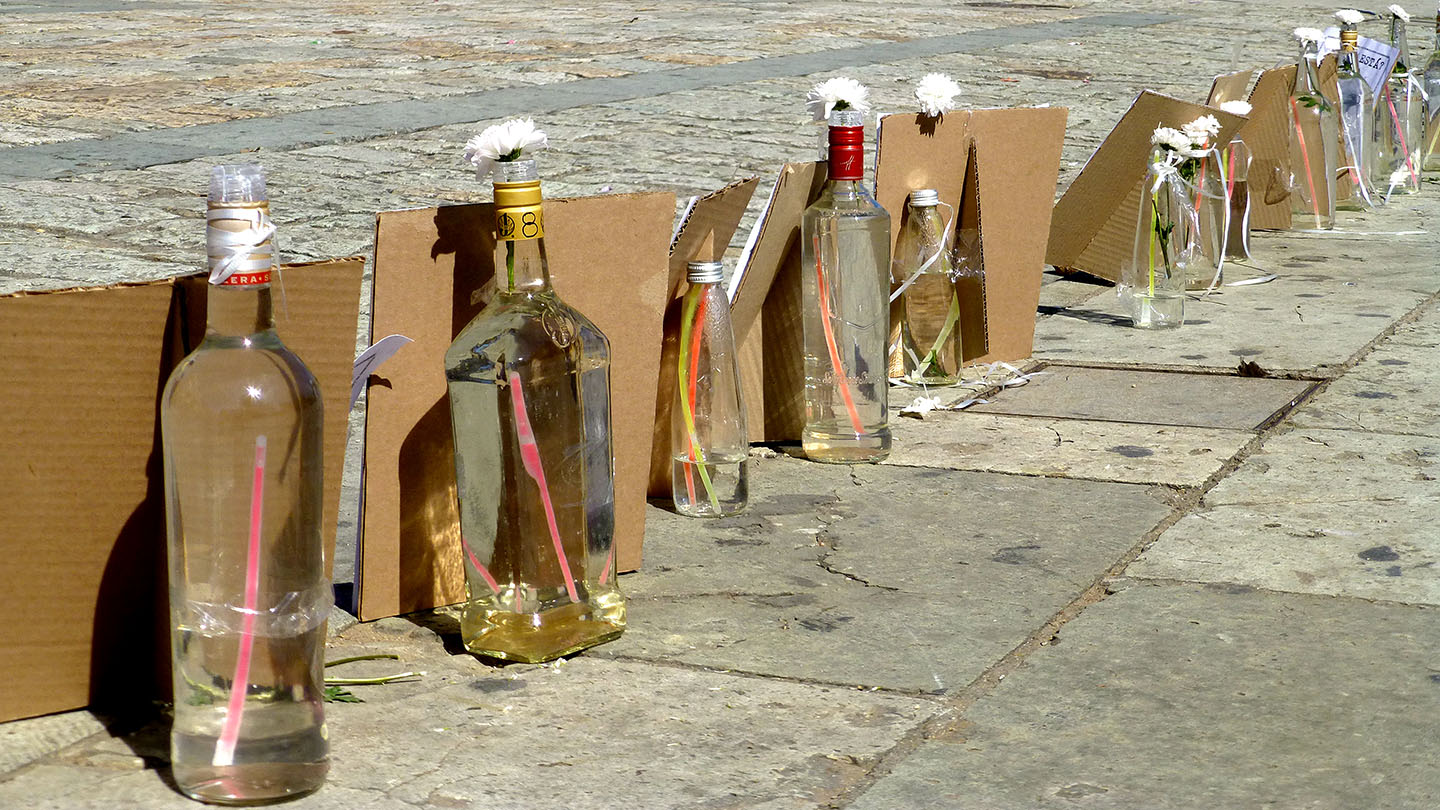
The Caravana de Ayotzinapa, one of three caravans by the parents and supporters of the missing 43 students from the Escuela Normal Rural Raúl Isidro Burgos teachers’ college in Ayotzinapa, Guerrero, is scheduled to arrive in Oaxaca tomorrow morning (Nov. 17). A procession from the crucero at Trinidad de Viguera to the zócalo in Oaxaca is scheduled to begin at 9 AM. Given the prohibition against foreigners participating in political activity, as much as I would like to be there, I’ll be sticking close to home.
However, for my friends in the USA, check out photographer and writer Tim Porter’s article, #43; there are demonstrations coming to a city near you. Tim is a frequent visitor to Oaxaca and, for my Marin peeps, his articles and photographs regularly appear in Marin Magazine.
Posted in Creativity, Culture, Education, Exhibitions, Music, People, Politics, Tragedy, Violence, tagged art, Arturo Leyva, Ayotzinapa, Donde está mi hermano?, Escuela Normal Rural, graphic arts, Guerrero, Iguala, illustrations, Mexico, Normal Rural Ayotzinapa, paintings, photo montage, photos, portraits, profiles, songs, students, teachers’ college, video on November 8, 2014| 9 Comments »
A beautiful photo montage and song by Arturo Leyva honoring the 43 students of the Escuela Normal Rural Raúl Isidro Burgos, teachers’ college in Ayotzinapa, Guerrero.
The video uses some of the #IlustradoresConAyotzinapa illustrations, paintings, and embroidery by Mexican designers, artists, and artisans of the faces of the 43 student teachers of Ayotzinapa.
In addition, journalist París Martínez has developed profiles of the 43 disappeared students by talking with their families and friends.
Posted in Creativity, Culture, Education, People, Politics, Protests, Tragedy, Violence, tagged Ayotzinapa, David Huerta, Emiliano Navarrete, exhibitions, graffiti, Guerrero, Iguala, Mexico, Museo de Arte Contemporáneo de Oaxaca, Normal Rural Ayotzinapa, Oaxaca, photographs, photos, signs, students on November 7, 2014| 10 Comments »
Tomorrow, it will be 43 days since the 43 students at the Escuela Normal Rural Raúl Isidro Burgos, teachers’ college in Ayotzinapa, Guerrero went missing. Images of the missing are being posted online and on walls.

Oaxaca, along with the rest of Mexico, is heartbroken and outraged that her sons have not been found. “We are not sheep to be killed whenever they feel like it” Emiliano Navarrete, father of one of the missing students, declared following a meeting with Mexico’s president, Enrique Peña Nieto.

As the brilliant Día de los Muertos colors of cempasúchil (marigolds), cresta de gallo (celosia or cockscomb), and roses began to fade, a massive march, led by the parents of the missing, filled the streets of Mexico City on November 5.
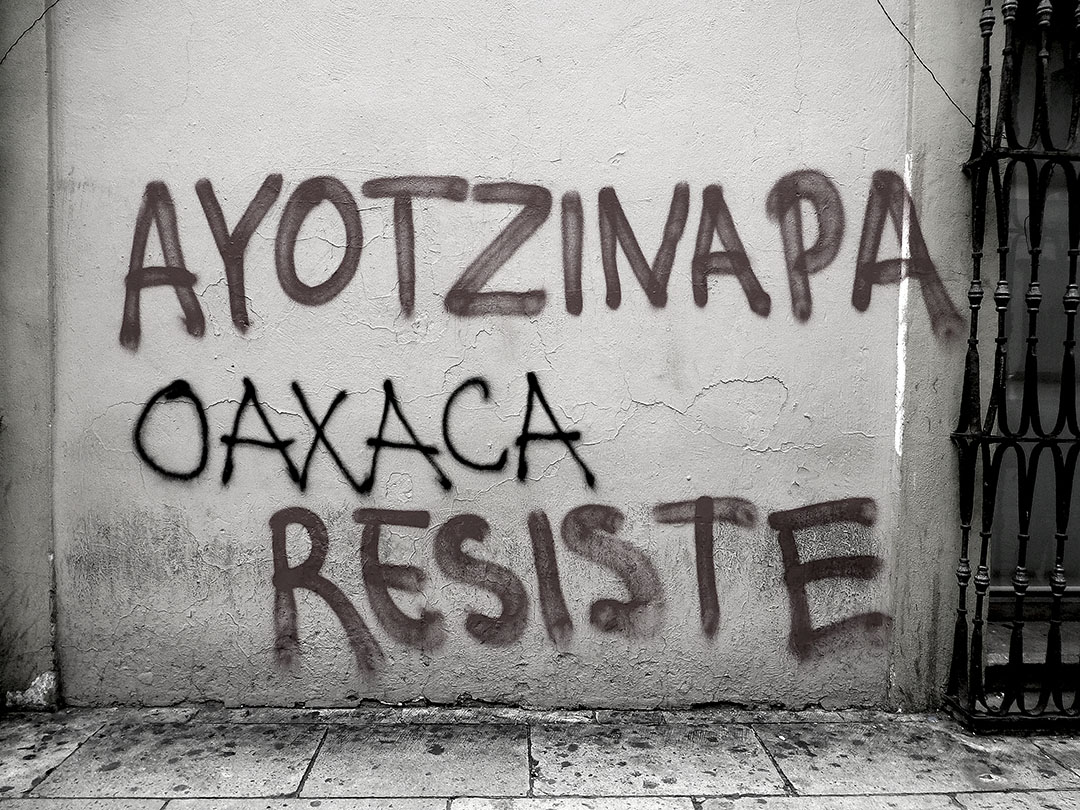
And, Oaxaca continues to add her voice on walls, in the streets, and at the Museo de Arte Contemporáneo de Oaxaca (MACO).
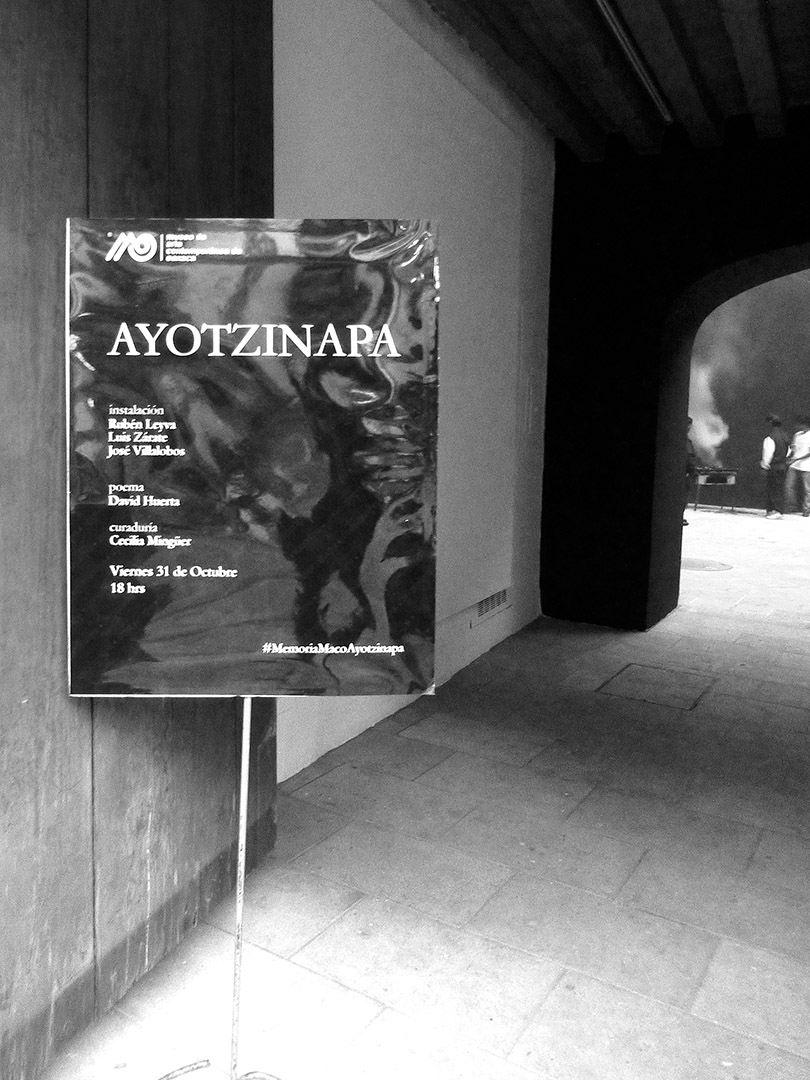
… where a beautiful poem, simply entitled “Ayotzinapa,” fills one of the walls of the courtyard.
Mordemos la sombra
Y en la sombra
Aparecen los muertos
Como luces y frutos
Como vasos de sangre
Como piedras de abismo
Como ramas y frondas
De dulces vísceras
Los muertos tienen manos
Empapadas de angustia
Y gestos inclinados
En el sudario del viento
Los muertos llevan consigo
Un dolor insaciable
Esto es el país de las fosas
Señoras y señores
Este es el país de los aullidos
Este es el país de los niños en llamas
Este es el país de las mujeres martirizadas
Este es el país que ayer apenas existía
Y ahora no se sabe dónde quedó
Estamos perdidos entre bocanadas
De azufre maldito
Y fogatas arrasadoras
Estamos con los ojos abiertos
Y los ojos los tenemos llenos
De cristales punzantes
Estamos tratando de dar
Nuestras manos de vivos
A los muertos y a los desaparecidos
Pero se alejan y nos abandonan
Con un gesto de infinita lejanía
El pan se quema
Los rostros se queman arrancados
De la vida y no hay manos
Ni hay rostros
Ni hay país
Solamente hay una vibración
Tupida de lágrimas
Un largo grito
Donde nos hemos confundido
Los vivos y los muertos
Quien esto lea debe saber
Que fue lanzado al mar de humo
De las ciudades
Como una señal del espíritu roto
Quien esto lea debe saber también
Que a pesar de todo
Los muertos no se han ido
Ni los han hecho desaparecer
Que la magia de los muertos
Está en el amanecer y en la cuchara
En el pie y en los maizales
En los dibujos y en el río
Demos a esta magia
La plata templada
De la brisa
Entreguemos a los muertos
A nuestros muertos jóvenes
El pan del cielo
La espiga de las aguas
El esplendor de toda tristeza
La blancura de nuestra condena
El olvido del mundo
Y la memoria quebrantada
De todos los vivos
Ahora mejor callarse
Hermanos
Y abrir las manos y la mente
Para poder recoger del suelo maldito
Los corazones despedazados
De todos los que son
Y de todos
Los que han sido
David Huerta
2 de noviembre de 2014. Oaxaca
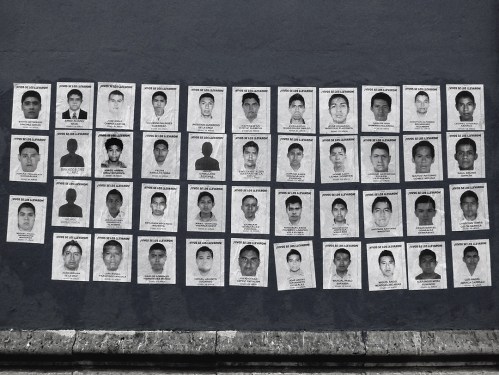
Update: Just hours after posting this, the worst has been announced. According to Mexico’s attorney general, “The 43 Mexican students who disappeared near Iguala, in southern Mexico in September, were kidnapped by police on order of the mayor, and turned over to a gang that killed them and burned their bodies before throwing the remains in a river….” — CNN
I can’t even begin to imagine the pain the parents must be feeling with the knowledge of the suffering and brutality their sons endured. I am so sad and tears are welling up. I think I will just let them fall…
Posted in Education, Parks & Plazas, Politics, Protests, Tragedy, Violence, tagged Ayotzinapa, Guerrero, Iguala, Normal Rural Ayotzinapa, Oaxaca, photographs, photos, signs, students, zócalo on October 24, 2014| 2 Comments »
As an extranjera (foreigner), I can do nothing more than observe…
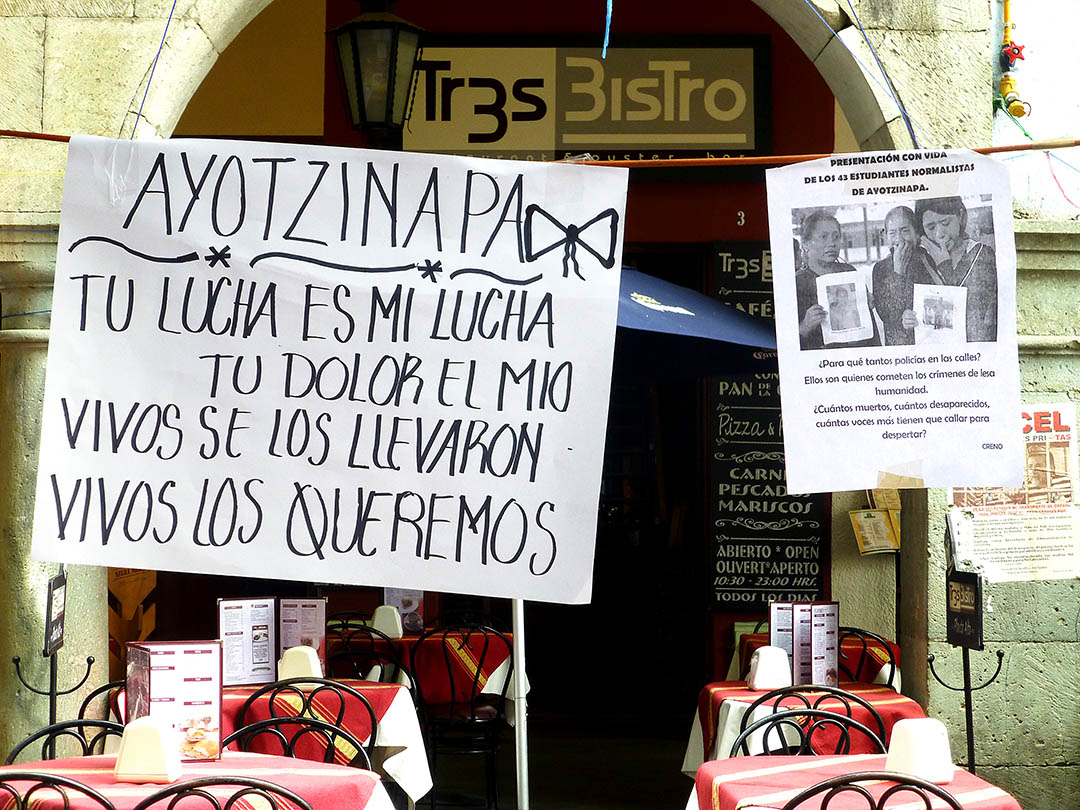

report…
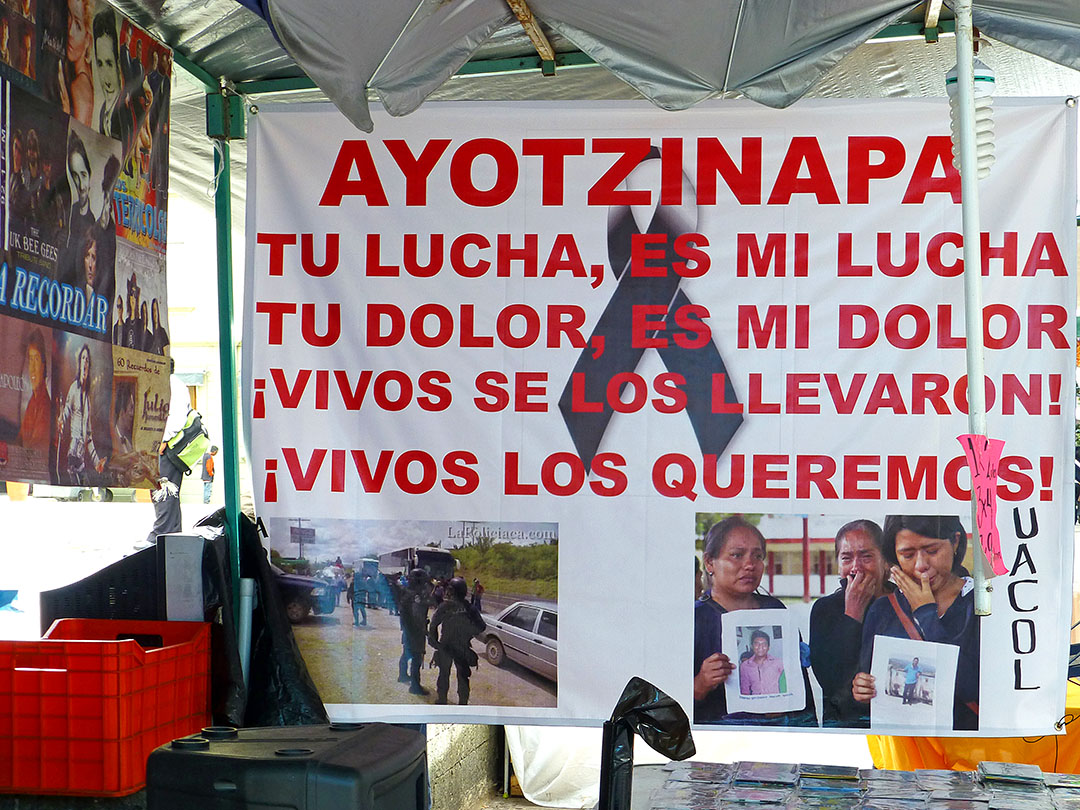

and feel.

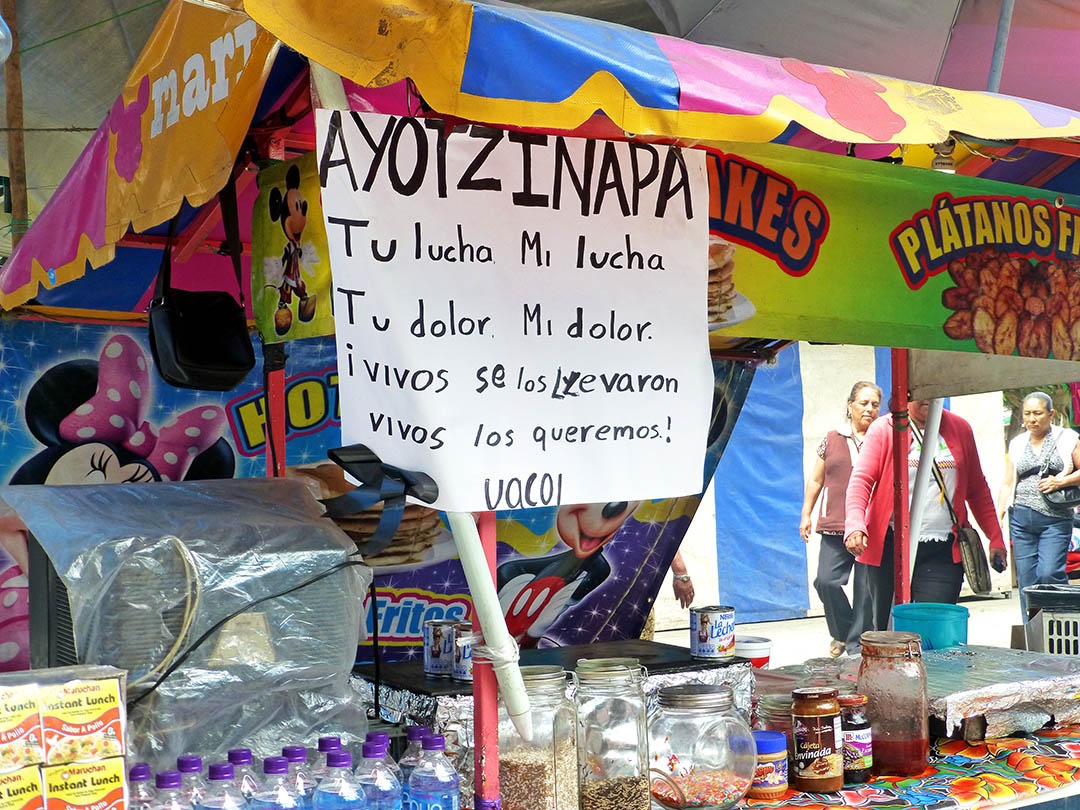
Signs on the Alameda and zócalo this week.
Posted in Economics, Education, Labor, Politics, Protests, Signs, tagged banners, Mexico, newsstands, Oaxaca, photographs, photos, posters, Seccion 22, signs, Teachers union, zócalo on August 15, 2014| 6 Comments »
I walked down to the zócalo today. Not exactly big news, I know, but the truth is, I’ve been avoiding it. However, I was out of dried cranberries and pecans and had to go to the Mercado Benito Juárez to restock the larder.
New posters have gone up on building walls, this one calling for justice for the victims of the previous governor (Ulises Ruiz Ortiz) and preparations for a general political strike against the structural reforms (education and the state-owned oil industry, of which I’ve previously written) recently passed by the federal government.

The zócalo and surrounding streets continue to be filled with teachers, tents, and al fresco kitchens. No surprise, this is causing a traffic nightmare and parking is at even more of a premium than usual. However, if you are in need of a pit stop for you or your car, this one is on Trujano at 20 de noviembre.

The restaurants under the portales on the zócalo have been especially impacted — some had patrons sipping their morning coffee and hot chocolate while looking out over the sea of tents, tarps, and banners and some were empty.

If you are tired of reading the newspaper accounts, D-II-218 of the Telesecundarias (rural distance education programs) from Miahuatlán has provided a poster so you can read up on the issues in dispute from the teachers’ point of view.

However, if you are tired of it all, you can always stop by the local newsstand to catch up on what’s really important — the opening of Home Depot (an OMG! OMG! OMG! event for some) or, if you are so inclined, graphic images of crime and violence. By the way, regarding the latter, I stumbled on a website that gives A Vague History of La Nota Roja.
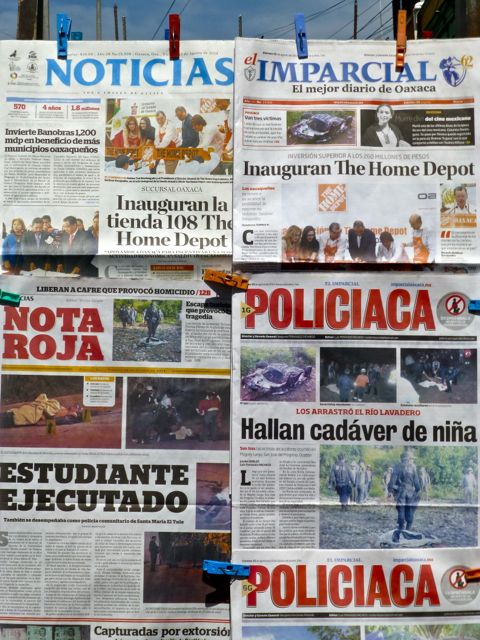
What can I say? Good news is in short supply, no matter where one looks. The handwriting seems to be on the wall here, there, and everywhere…
Posted in Culture, Economics, Education, Politics, Travel & Tourism, tagged discrimination, indigenous peoples, injustice, International Day of the World's Indigenous Peoples, map, Mexico, Oaxaca, photographs, photos, Pueblos indígenas, United Nations on August 9, 2014| 3 Comments »
August 9th is International Day of the World’s Indigenous Peoples; so designated twenty years ago by the United Nations General Assembly in an attempt to guarantee the human rights of over five thousand indigenous groups that exist in 90 countries.

Zapotec woman at Oaxaca’s Feria del Tejate y del Tamal – July 23, 2014
However, to cruise around the online versions of CNN International and the New York Times, one would never know of the day’s significance. At least Día Internacional de los Pueblos Indígenas isn’t being ignored by CNN Mexico. In an article published today (in Spanish) they cite seven challenges faced by the indigenous of Mexico:

Pueblos Indígenas en México (Indigenous peoples in Mexico) — Infographic from NoticiasMVS
And, regarding discrimination, yesterday ADNPolítico.com published an article, 5 ‘retratos’ de la discriminación hacia indígenas mexicanos (in Spanish). Despite the fact that the first article of the Mexican Constitution declares, any discrimination on grounds of ethnic origin is prohibited, the story highlights five recent cases that have made national headlines:
We, in Oaxaca, just experienced the spectacle of the Guelaguetza celebrating the indigenous cultures of Oaxaca. However, some say (in Spanish) it presents a static view of indigenous peoples, reinforces stereotypes, and sells exoticism — all to promote tourism.
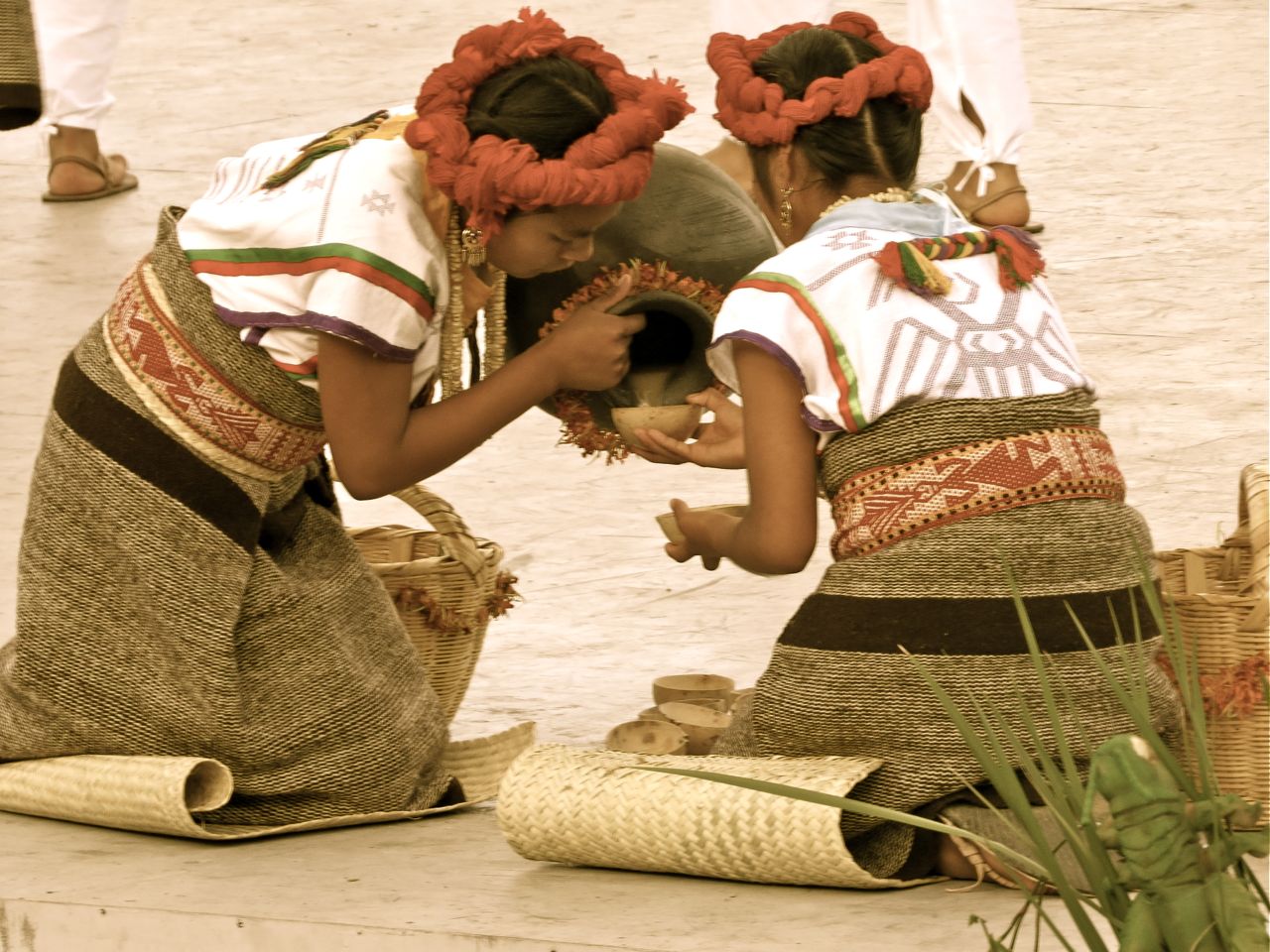
Mixtec dancers from San Antonio Huitepec at La Guelaguetza — July 21, 2014.
The focus of this year’s International Day is “Bridging the gap: implementing the rights of indigenous peoples.” Is it all talk, no action, and a lot of window dressing? I don’t know, but it sure seems like that to me… Sometimes, “poco a poco” isn’t good enough.
Posted in Celebrations, Creativity, Culture, Politics, tagged Árbol de la Diversidad, Bisexual, Gay, Gente Diferente, International Day Against Homophobia and Transphobia, Lesbian, LGBT, Mexico, Oaxaca, photographs, photos, public art, Transexual, Vinnii Gaxhee, Wangari Maathai quote on May 17, 2014| Leave a Comment »
“When we plant trees, we plant the seeds of peace and seeds of hope.” — Wangari Maathai, 2004 Nobel Peace Prize Laureate. From the poster for the inauguration of the Árbol de la Diversidad (Tree of Diversity) on Macedonio Alcalá celebrating May 17, International Day Against Homophobia and Transphobia.


The Ombudsman for Human Rights of the People of Oaxaca said the International Day Against Homophobia and Transphobia is an opportunity to become aware as a society of respect and acceptance that we owe to the other, a day that encourages us to live and work in building a more just, more humane, more egalitarian and fraternal society. (Noticias, 17 mayo 2014)
Posted in Celebrations, Economics, History, Holidays, Labor, People, Politics, tagged Día de los Trabajadores, Día del Trabajo, Día Internacional de los Trabajadores, holiday, International Workers' Day, labor, Lila Downs, Mary Harris Jones, May Day, Mexico, Mother Jones, Oaxaca, video, workers on May 1, 2014| Leave a Comment »
Even though the significance of May 1, as International Workers’ Day, had its origin in the USA, it is not celebrated there (for a variety of reasons I won’t go into here). However, like most countries in the world, Día del Trabajo is a national holiday in Mexico. To honor labor everywhere, here is Oaxaca’s favorite daughter singing her song, “Mother Jones.”
“Pray for the dead, but fight like Hell for the living.” — Mary Harris Jones (aka, Mother Jones, the miners’ angel)
Posted in Celebrations, Culture, Food, Parks & Plazas, Politics, Travel & Tourism, tagged Cocina Economica Isabel, Día de la Samaritana, huevos divorciados, Mexico, Oaxaca, photographs, photos, political rally, PRI, Tuna band, Viernes del Llano on March 28, 2014| 6 Comments »
Eight hours today in Oaxaca…

Tuna band in Llano Park

A queen and her consort at Viernes del Llano

Huevos Divorciados at Cocina Economica Isabel

Día de la Samaritana agua on the Alcalá

PRI march and rally at Plaza de la Danza
Posted in Creativity, Culture, Politics, Protests, Travel & Tourism, tagged dancers, Danza de la Pluma, danzantes, demonstrations, Mexico, Oaxaca, penachos, photographs, photos, protests, San Bartolo Coyotepec on March 24, 2014| 8 Comments »
Reason number 579 why I love Oaxaca…
Today was the first day of a way-too-short first time visit to Oaxaca by a couple of California gal pals — an orientation walk through El Centro was the order of the day. And what did we stumble upon in front of the Government Palace? Danzantes waiting to perform a couple of the dances from the Danza de la Pluma.
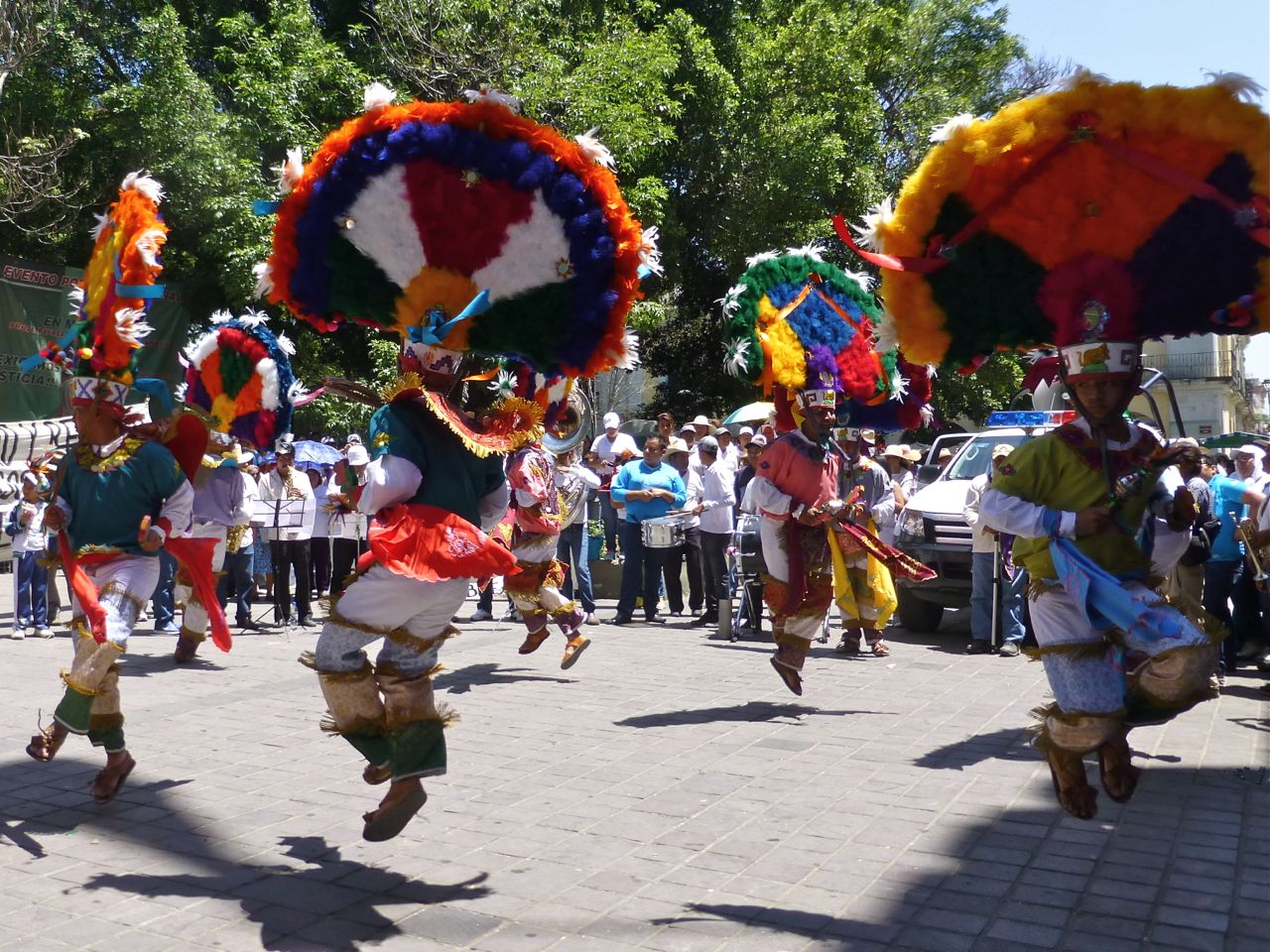
They began dancing and I flashed on Saturdays’ blog post, Danzantes in training. However, these guys definitely weren’t apprentices — they had the steps and jumps down WITH those heavy and seemingly unwieldy penachos on their heads — and the crowd cheered.
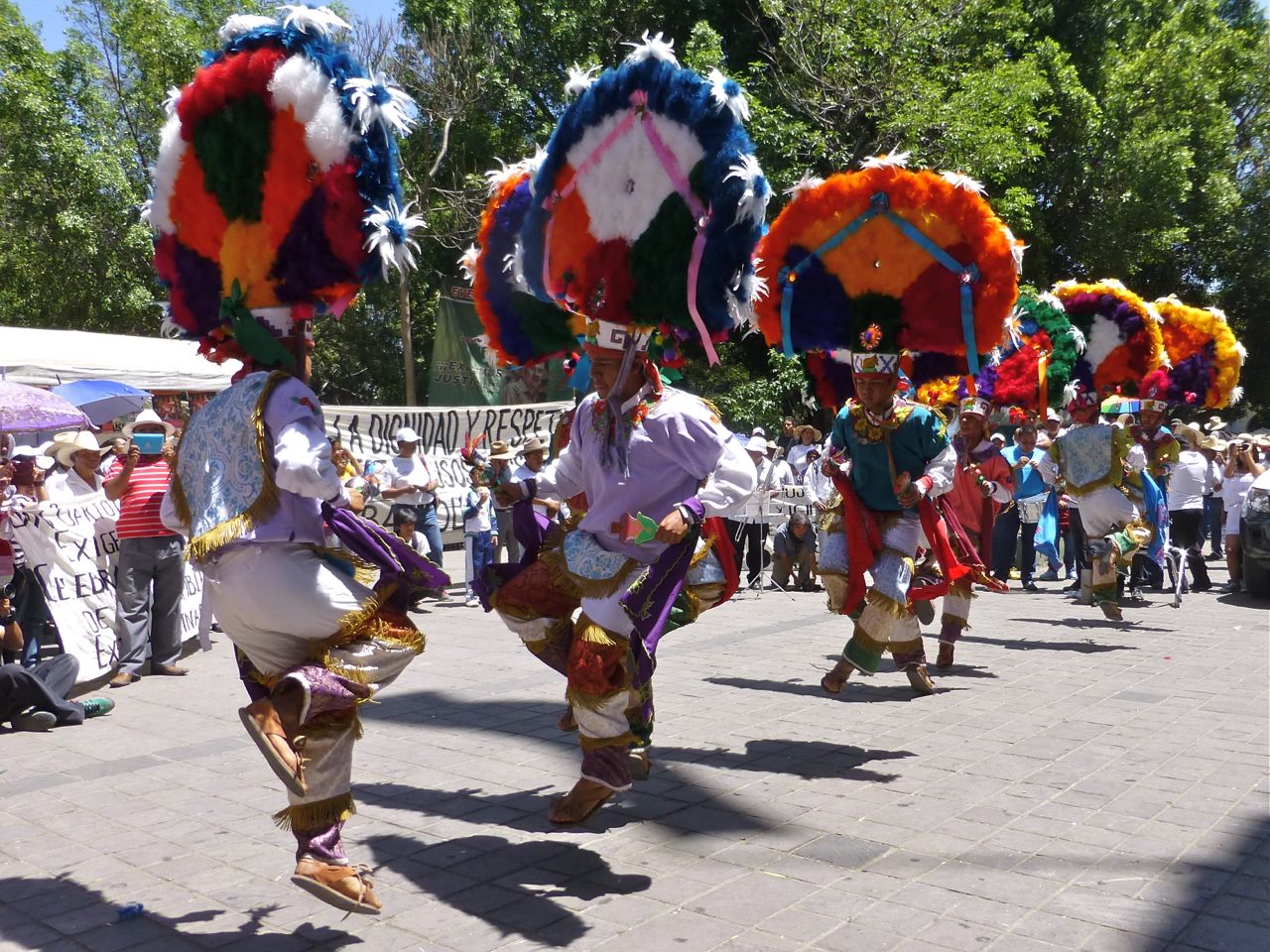
The danzantes and most of their gathered audience were from San Bartolo Coyotepec, about 15 km south of the city. It’s a village known for the artisans who make black pottery. However, along with the band and dancers, there were banners and protestors.
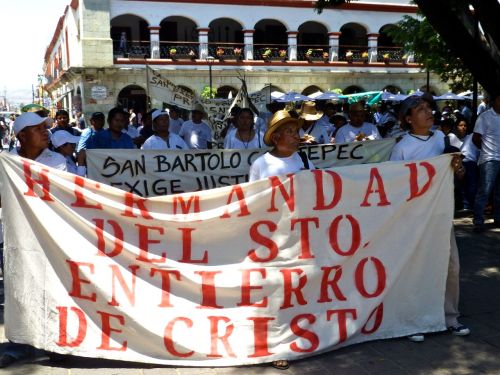
According to this article (in Spanish), “they arrived at the presidential palace in the main square of the city to demand the replacement of the elections because the process was considered seedy and does not represent the will of the community.”
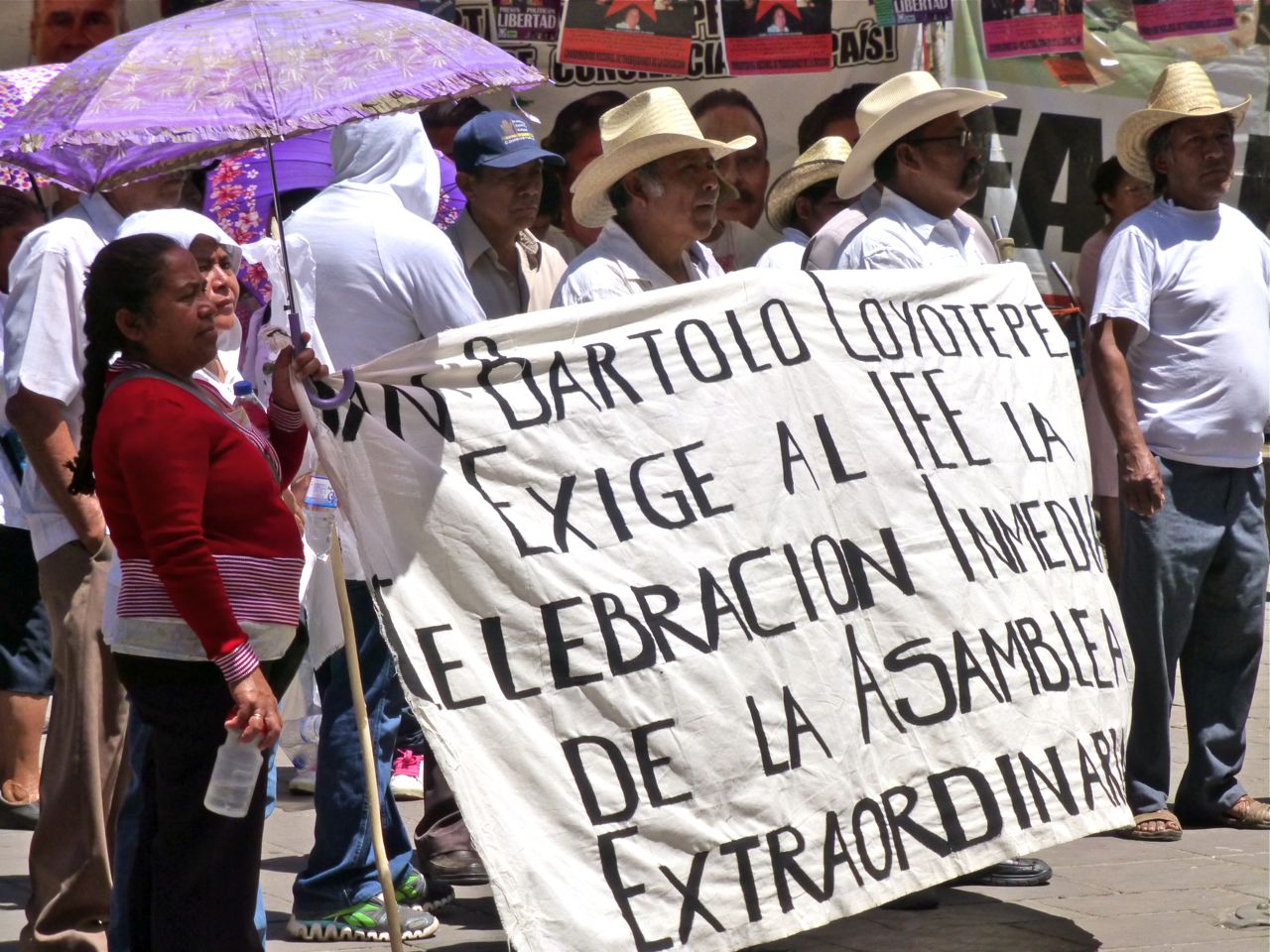
Culture and politics… I couldn’t have arranged a more quintessential Oaxaca experience, if I had tried. And my friends, what did they think? They loved it all!
Posted in Creativity, Economics, Politics, Protests, tagged Enrique Peña Nieto, graffiti, Mexico, Oaxaca, oil industry, PEMEX, petroleum industry, photographs, photos, protests, street art, urban art on February 20, 2014| 24 Comments »
Monday’s headline from the Huffington Post read, “Enrique Peña Nieto’s TIME Cover Sparks Outrage In Mexico.” The Time Magazine cover (to be published February 24, 2014) shows an imperious looking Peña Nieto, with the bold-face headline, “Saving Mexico.” Judging from personal conversations, numerous articles, and marches throughout the country, that is definitely not the way most Mexicans see their president.

Elected in 2012, Peña Nieto has proposed sweeping reforms, including a previously mentioned education package modeled after the disastrous US, “No Child Left Behind Act.” These unpopular reforms have citizens marching in the streets and calling for Peña Nieto’s head. One of the reforms that Mexicans find most egregious is the proposal to open Mexico’s state-run oil industry, PEMEX, to foreign investment. This is one that strikes at the heart of Mexican pride.
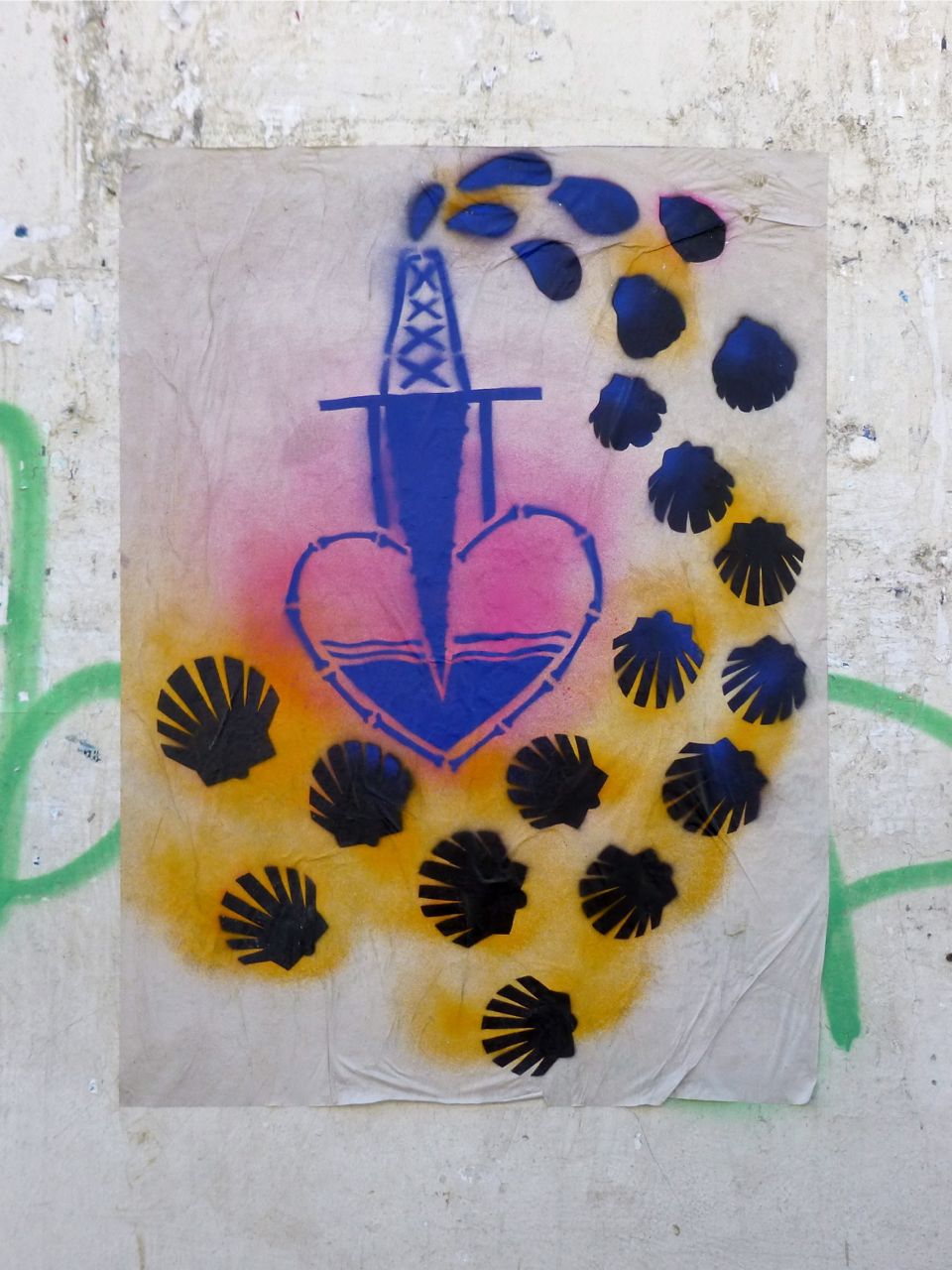
A little background: In 1938, in support of oil workers striking against foreign-owned oil companies, Mexico’s president, Lázaro Cárdenas, citing the 27th article of the 1917 constitution, expropriated the Mexican facilities of the United States and Anglo–Dutch oil companies, nationalized the oil reserves, and created the state-owned Petróleos Mexicanos (aka, PEMEX). Mexico now owned and controlled this valuable resource.
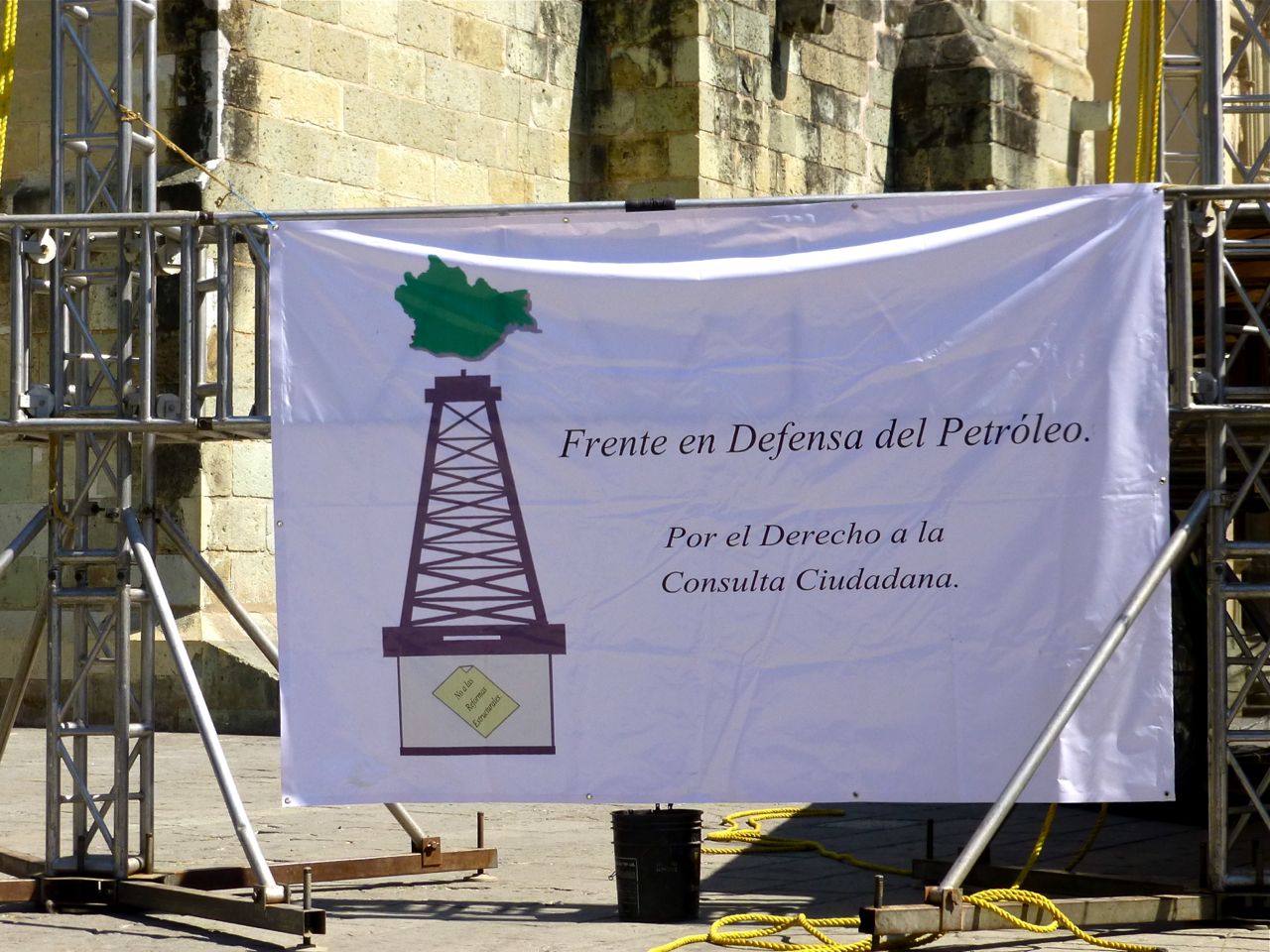
Back to the present: According to the Huffington Post article, “The energy bill, however, faced massive protests when it passed through Congress in December. Demonstrators shouted ‘The homeland is not for sale!‘ as officials voted to allow private companies to exploit oil and gas reserves in the country, according to the Associated Press.”
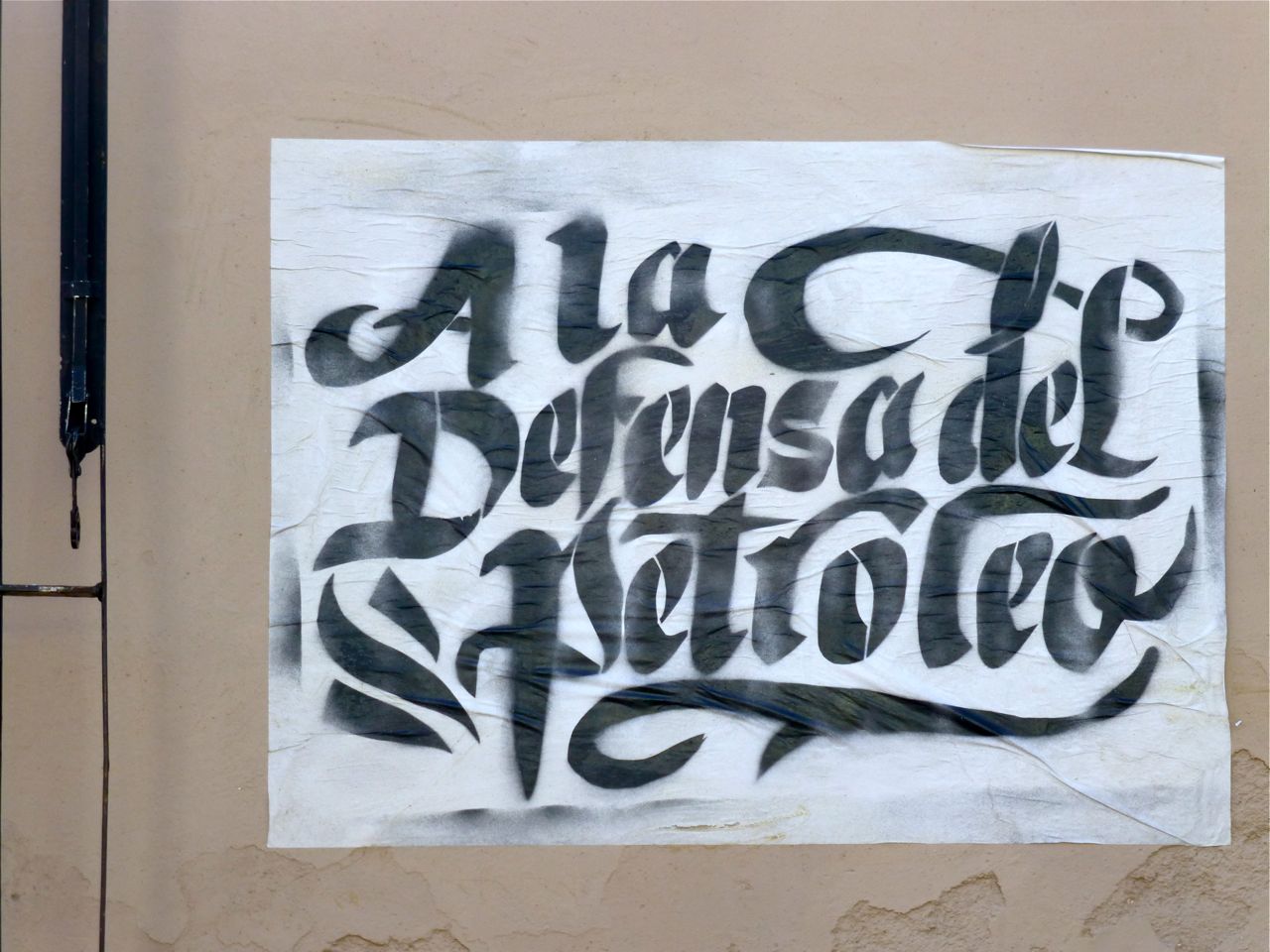
In true Oaxacan fashion, marches have been held and banners, posters, and murals have gone up throughout the city to express the outrage and indignation felt by a majority of Mexicans at what they see as an attempt by the Peña Nieto government to sell-off their patrimony.
Of course, as the Time Magazine article illustrates, the US is applauding Peña Nieto and the actions of his ruling party.
Posted in Celebrations, Parks & Plazas, Politics, tagged Javier Villacaña Jimenez, Mexico, Oaxaca, photographs, photos, Plaza de la Danza, politics on January 4, 2014| 2 Comments »
New year’s morning… 9:00 AM… music coming from the Plaza de la Danza. Sheesh, only a few hours after the booms, bangs, and hisses from fireworks that announced the arrival of 2014 had finally quieted. Thus, sleep deprived, I was moving slowly. However, speeches joined the music and I thought I heard mention of Mexico’s current president, Enrique Peña Nieto… AND there was cheering. Hmmm… I showered, dressed, and headed up Morelos.
Military…

Tubas…

Monos…
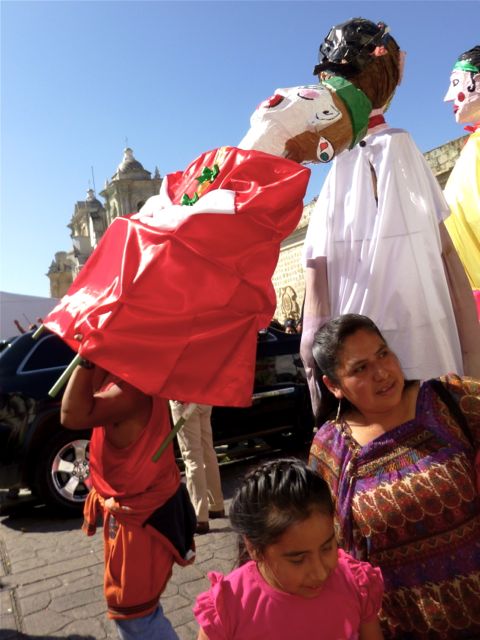
Marmotas…

Canastas…
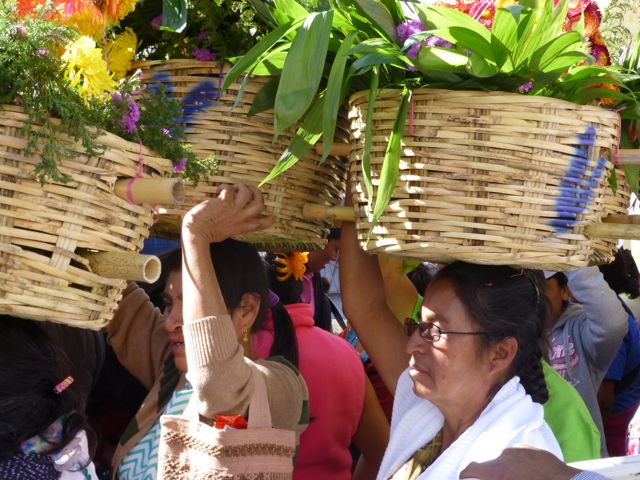
and crowds…
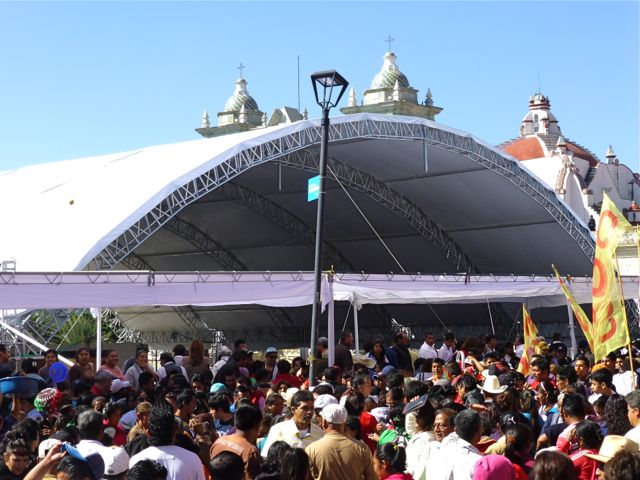
heralded the inauguration of Oaxaca city’s new mayor, Javier Villacaña Jimenez, a PRI-ista, political party of the state’s former (much-hated) governor and party of Mexico’s current president. Oaxaca’s current governor was elected July 4, 2010 by an alliance between the PAN, PRD, and a couple of other left-leaning parties, whose primary goal was ousting the PRI from its 80+ year reign in the state of Oaxaca.
This ought to be interesting…
Posted in Culture, Economics, Education, Politics, Protests, tagged education, educational reforms, graffiti, Mexico, Oaxaca, photographs, photos, political commentary, protests, street art, Teachers union, United States legislation, wall art on October 11, 2013| 13 Comments »
Expats and Mexicans alike, are watching in amazement at the nonsense (as in, making NO sense) taking place in the hallowed halls of Washington DC. And, since many of the expats are retired, we are holding our collective breath over the possibility social security checks will not be forthcoming in November and a tanking stock market that flushes our nest eggs away. Of course, Mexico is in the middle of its own mess, “educational reforms” and economic proposals that will hurt Mexico’s working class and rural populations the most.

Wall in Oaxaca city.
In a New York Times article two days ago, Carlos Puig explains the reality of the material conditions that have forced the teachers of Oaxaca to take the drastic action of abandoning their classrooms to lead massive and extremely disruptive protests in Mexico City against the “No Child Left Behind” style reforms that the Peña Nieto led government has proposed and passed. (Read a critique of the US education “reform” by Diane Ravitch, former “No Child Left Behind” proponent, here.)
Oaxaca is 500 kilometers from Mexico City, yet the real distance is much bigger. The state’s G.N.P. per capita is one-quarter the average for the country. Oaxaca ranks second-to-last among all states in infrastructure. More than half its population lives in towns of fewer than 2,500 people.
Being a teacher in Oaxaca means sometimes having to travel for an entire day to reach your school in a tiny community, teach for three days — to children of all grades — and travel back home for the weekend. It means having to deal with children who speak more than 20 different dialects.
Being a teacher in Oaxaca means operating in a different universe — and under different rules.

Banner hanging in front of a school in Oaxaca city
However, as in the USA, the incomprehensible words coming out of the mouths of the 1% and their elected representatives are mind-boggling in their obliviousness to the adverse consequences their behavior and policies cause. And, we scratch our heads in amazement… McClatchy journalist, Tim Johnson, has repeatedly blogged about the exceedingly “bad” behavior exhibited by Mexico City’s rich and powerful directed at those they consider “below” them — most recently, Las Ladies, episode 7. And, just last week in Oaxaca, most were aghast to read that an indigenous woman, in the advanced stage of labor, was turned away from a hospital and forced to give birth on the hospital lawn.
Daniel Goleman had a revealing piece in the New York Times a few days ago that helps explain where this lack of empathy the ruling elite exhibit, that results in callous social policy, comes from. He explains in Rich People Just Care Less that, by necessity, “the poor, compared with the wealthy, have keenly attuned interpersonal attention in all directions…” And that, “A growing body of recent research shows that people with the most social power pay scant attention to those with little such power” and, “In politics, readily dismissing inconvenient people can easily extend to dismissing inconvenient truths about them.”
Okay, now we know why the rich care less, so what are we going to do about it?

Part of a mural on Niños Heroes in Oaxaca city.


 Mexican Peso Converter
 View From Casita Colibrí
Heart and soul
Posted in Creativity, Culture, Economics, Politics, Protests, Sports & Recreation, tagged Copa Mundial 2014, El Tri, fútbol, Francisco Goldman, graffiti, Mexico, Oaxaca, photographs, photos, political commentary, soccer, street art, urban art, World Cup 2014 on June 23, 2014| 4 Comments »
What a game; three goals in 10 minutes in the second half!!! Another thrilling win by El Tri advances Mexico to the next stage in World Cup 2014. They struggled and needed a little help from their “friends” in el norte to even play in Brazil. However, against all odds, this team exhibits a gutsy and tenacious heart and soul that can’t help but have people rooting for them — much like the country of Mexico, itself.
Mural under fútbol stadium in Oaxaca – Dec. 2012
Francisco Goldman wrote an op-ed in yesterday’s New York Times. His article, “Fooling Mexican Fans,” relates the current politics of Mexico, the “bread and circuses” diversion of the World Cup, and the notion that El Tri might exemplify all that is inspiring and hopeful in the Mexican national character.
Goldman’s op-ed begins…
The day before the Mexican soccer team’s thrilling underdog tie with the World Cup favorite, Brazil, last week, the lead editorial of the news site SinEmbargo was titled, “Ready for your Clamato and Gatorade?” — common hangover remedies. “In about three weeks, when you wake from your World Cup dreams,” the editors wrote, “remember that when the soccer fest began, the country was on the verge of monumental decisions. If upon waking, you realize that the country’s energy reserves have been cheaply sold off or whatever else, don’t bother protesting because this is a chronicle foretold.”
To debate and pass laws that could open Pemex, the nationalized oil company, to foreign investment, the Mexican Congress scheduled legislative sessions from June 10 to 23, dates precisely coinciding with you know what. Final passage might be pushed back, but it originally looked like it was supposed to happen on Monday, when Mexico plays Croatia to decide which country advances to the elimination rounds.
As I wrote previously, Mexicans have been Expressing the outrage since last year, when Mexico’s newly elected president Enrique Peña Nieto (initials EPN), from the PRI party, first made the Pemex energy “reform” proposal.
Graffiti seen on a wall south of Oaxaca’s zócalo, May 23, 2014.
Goldman goes on to discuss this and other “reforms,” the role of the PRI, and the current overall political climate in Mexico. However, as dismal as it all sounds, he ends on a hopeful note…
There has been much talk lately about the way the style of soccer teams manifests national characters. I don’t know if that’s true. But when I look at the Mexican team which, after barely even qualifying for the World Cup, has been playing so well, I see a team without stars — a gritty, hard-working, pretty humble, resourceful, creative, disciplined, joyous, friendly-seeming group of players who seem to be learning to play the game as it is meant to be played.
These are values that we see enacted and re-enacted all over Mexico, and in Mexican communities elsewhere, every day. Someday Mexico will get another chance to vote the PRI away and to restart the long process of building the country from the ground up. It could do worse than take some inspiration from its national team.
Absolutely, those are the values I, too, see exhibited in Mexican communities both in Mexico and the US. There is hope for the future — and not just on the pitch! I encourage you to read Goldman’s op-ed in full. In the meantime, Mexico vs. Netherlands on Sunday at Estadio Castelao Forteleza. ¡¡¡ VAMOS EL TRI !!!
h/t K Hackbarth for the article
Share this:
Read Full Post »