Listening to the rhythm of the falling rain.

Ahhh… At long last, relief from weeks of energy sapping heat and a long very dry winter.
Posted in Casita Colibrí, Gardens, Weather, tagged Mexico, Oaxaca, photo, photographs, rain, weather on April 21, 2013| 2 Comments »
Listening to the rhythm of the falling rain.
Ahhh… At long last, relief from weeks of energy sapping heat and a long very dry winter.
Posted in Animals, Casita Colibrí, Gardens, Science & Nature, tagged birds, bougainvilla, bougainvillea, Casita Colibrí, daylight saving time, Mexico, Oaxaca, photographs, photos, sparrows, Tulsa Time song on April 7, 2013| 5 Comments »
Sparrow came by for a late breakfast on the bougainvilla this morning. Guess, like my neighbor, (s)he didn’t realize Mexico “sprung ahead” last night to Daylight Saving Time.
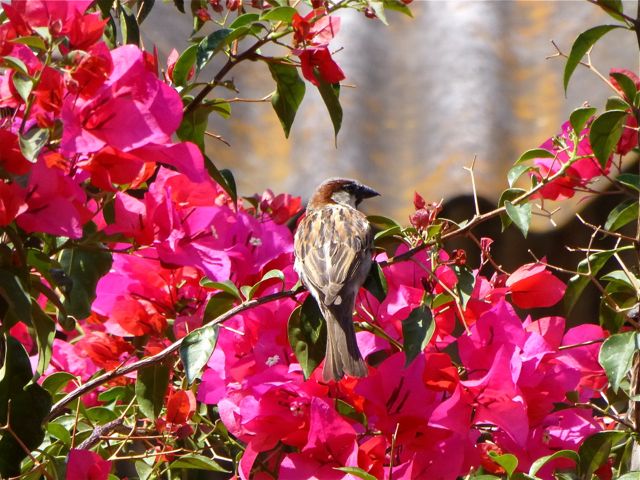
Or, should I say, most of Mexico. Teotitlán del Valle follows the sun and doesn’t set their clocks back. Let the confusion begin!

So, maybe Sparrow is…
Living on Teo Time.
Living on Teo Time.
Gonna set my watch back to it
‘Cause you know that I’ve been through it.
Living on Teo Time.
(With apologies to Daniel W. Flowers, songwriter of Tulsa Time.)
Posted in Buildings, Creativity, Culture, Exhibitions, Gardens, People, Travel & Tourism, tagged abandoned buildings, art, art installation, El Sueño de Elpis, exhibition, Matria Jardín Arterapéutico, Mauricio Cervantes, Mexico, Oaxaca, photographs, photos, Primavera, Seasons, Spring on March 22, 2013| 3 Comments »
Do you remember December’s abandoned building that artist Mauricio Cervantes transformed into Hope amidst decay with his El Sueño de Elpis? Bringing together artists, gardeners, and community members, he is again working his magic at Casa del SXIX. Honoring sustainability and reuse, Matria, Jardín Arterapéutico is a year-long multidisciplinary installation that will grow and change with the seasons.
Appropriately, on the first day of Spring — the season of rebirth, resurrection, and renewal — I was invited to wander through the site and watch as life was emerging from the decay.
Primavera, the beginning phase of Matria, Jardín Arterapéutico will be revealed to all on Saturday, March 23 at 2:00 PM. The building can be found at Murguía 103 (between Macedonio Alcalá and 5 de mayo).
Posted in Creativity, Culture, Gardens, People, Travel & Tourism, tagged ceramic pottery, de barro, Dolores Porras, Dolores Porras DVD, Mexico, Oaxaca, Oaxaca Lending Library, photographs, photos, popular travel destinations, potted plants, Santa María Atzompa on February 10, 2013| 2 Comments »
One of the biggest challenges of the recent move was carrying 150+ potted plants down two flights of stairs, across the driveway, and up a flight of stairs. They ranged in size from eight to eighteen inches across and ten to twenty-four inches tall. Needless to say, major respect was given to the cactus and their perilous spikes. However, I also gave special care to my two pots by the late potter, Dolores Porras.
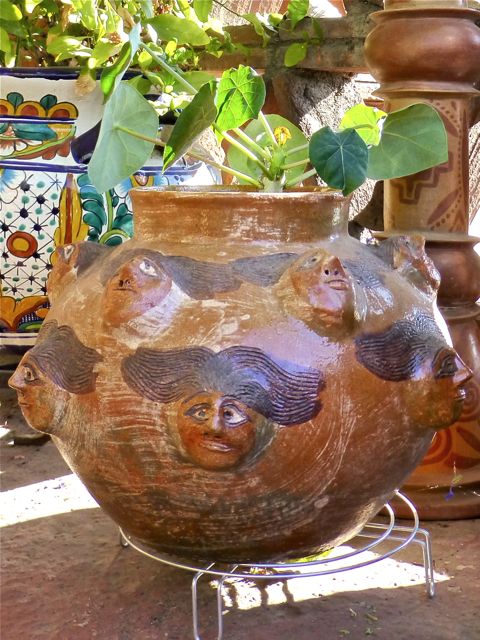
Growing up and spending her life in one of the villages of Oaxaca known for working in clay, Santa María Atzompa, her style was unique in the use of color and imagery — a touch of whimsy wherever her pots are found.

If you will be in Oaxaca tomorrow (Feb. 11, 2013), be sure to stop by the Oaxaca Lending Library to see Michael Peed discuss and show his documentary, Dolores Porras: Artista Artesana de Barro. And, if you’re not lucky enough to be there, check out the website for the film’s trailer.

Posted in Gardens, Holidays, Parks & Plazas, Travel & Tourism, tagged Christmas, flowers, garden, gardeners, holiday decorations, Mexico, Oaxaca, photographs, photos, plants, poinsettias, popular travel destinations, zócalo on November 27, 2012| 4 Comments »
Today, the truck arrived, the wheelbarrows were loaded, and the gardening crew began filling the flower beds of Oaxaca’s zócalo…
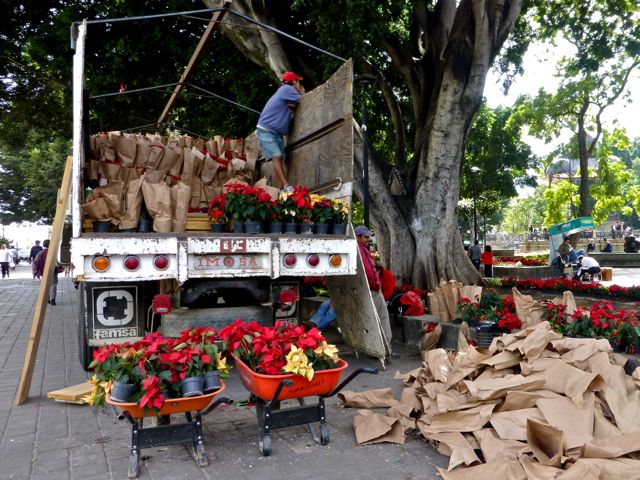
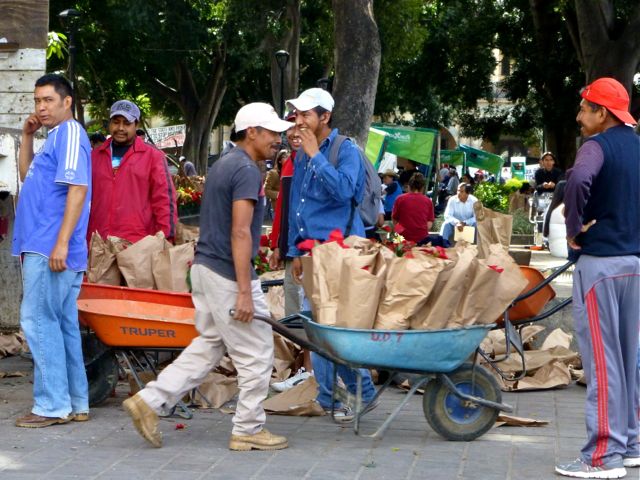
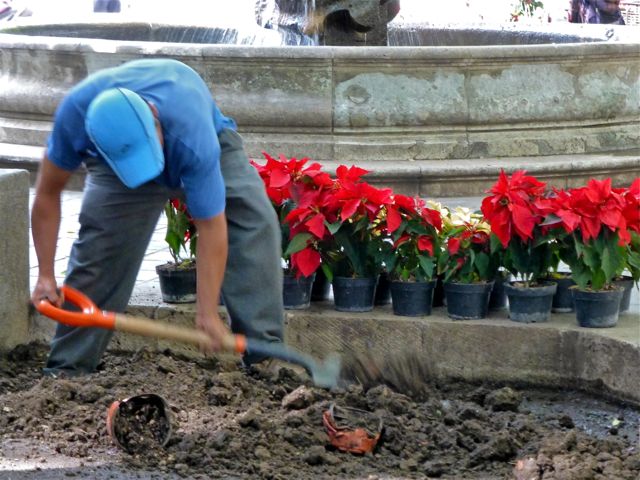
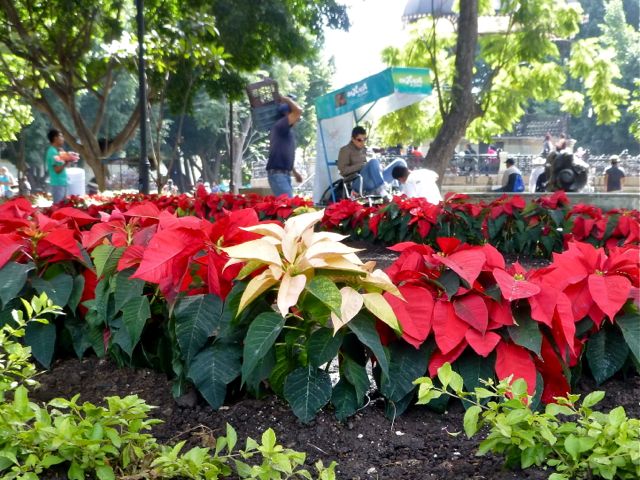
Navidad is coming to Oaxaca!
Posted in Churches, Gardens, Home, tagged African Tulip trees, Basilica de la Soledad, Casita Colibrí, Mexico, Oaxaca, photographs, photos, Templo de San José on November 15, 2012| 3 Comments »
Posted in Archaeology, Environment, Gardens, Parks & Plazas, Science & Nature, Travel & Tourism, tagged archaelogical site, archaeological zone, archaeology, flowers, Mexico, Monte Albán, nature, Oaxaca, photography, photos, plants, popular travel destinations, wildflowers on October 6, 2012| 2 Comments »
Fifteen hundred years may have passed since Monte Albán was in full bloom as the center of Zapotec civilization. However, the flowering continues…
Monte Albán on an early October morning.
Posted in Environment, Gardens, Parks & Plazas, Science & Nature, Weather, tagged Alameda, Indian Laurel tree, Mexico, Oaxaca, photographs, photos, trees, zócalo on October 2, 2012| Leave a Comment »
Instead of the coming of age novel, A Tree Grows in Brooklyn, we have the real life drama of a tree falls in Oaxaca. Heading down to the mercado this morning, I was brought up short by this heartbreaking sight.

According to reports, there were many present to hear and see one of the grand 130+ year old Indian laurels topple during a storm on Saturday night. And, worst of all, ten people were injured, two seriously. Trees in the city, including Indian laurels in the Zócalo, have been plagued by adversity. A laurel in the Zócalo fell a few years ago, damaging a nearby building, and most recently in May 2011, I wrote about a laurel on the Alameda that toppled. Resurrection was attempted and guy-wires remain to this day holding it upright. I guess the experts decided this latest one was beyond rescue.
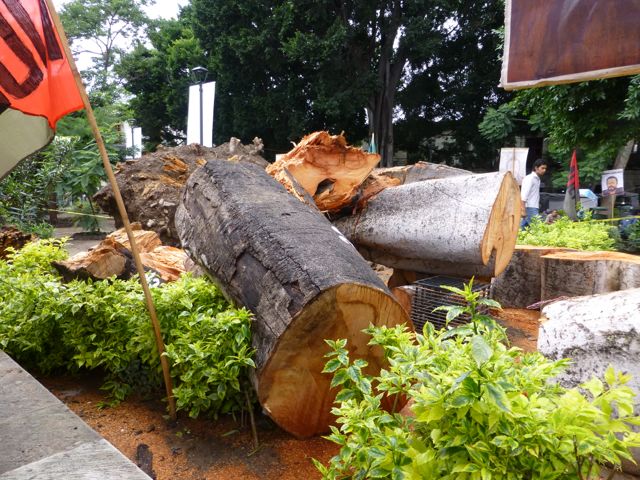
Controversy reigns, as many assert that these trees should be able to withstand the rain and less-than gale force winds. Thus speculation over the cause runs rampant. Root rot appears to be the immediate culprit but the big question is, why?

And, as Chris sadly noted a couple of months ago, regarding the diseased flamboyant trees in front of Santo Domingo de Guzmán, Any tree is hard to replace.
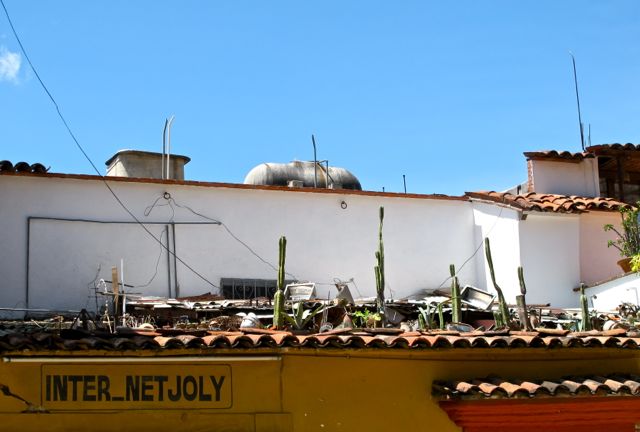
Posted in Buildings, Gardens, tagged buildings, cactus, Internet, Internet cafe, Inter_NetJoly, Mexico, Oaxaca, photography, photos on September 20, 2012| 2 Comments »
Posted in Animals, Gardens, Science & Nature, tagged Araneidae, Argiope, Casita Colibrí, dragonfly, garden, Mexico, nature, Oaxaca, orb weaver, orb weaver spiders, photographs, photos, spider on September 6, 2012| 5 Comments »
Monday morning, I went out onto the terrace to hang the wind chimes back up (too loud for sleeping), pick up spent African tulip tree blossoms (20 to 30), and say buenos días to Argiope (previously mentioned spider).
Hmmm… all was definitely not “as usual” in the spider’s web. Argiope, what in the world is going on?
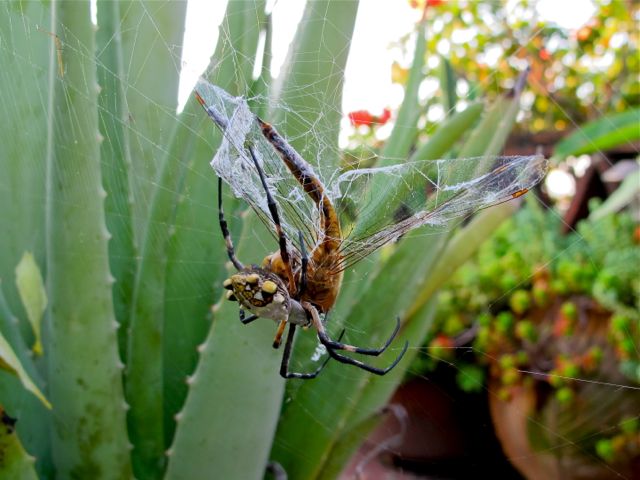
Good grief, she had caught a dragonfly! It must have been quite a battle, as her web was a mess and now she was trying to wrap it up.

This was serious business for her and she worked at it most of the day. However I had to chuckle, as sayings from childhood rose up from the cobwebs in my brain — Your eyes bigger than your stomach. Have you bitten off more than you can chew? Pick on someone your own size!

Monday evening, she finally gave up and let it loose from her clutches. When I retired for the night, the dragonfly was hanging by a thread.

By the next morning, the remains of the dragonfly had fallen onto the patio and Argiope was sitting happily in her newly repaired web with a more appropriately sized breakfast.
Mother Nature is amazing!
Posted in Animals, Gardens, Nature & Science, tagged Araneidae, Argiope, argiopes, Casita Colibrí, egg sack, garden, Mexico, nature, Oaxaca, orb weaver, orb weaver spiders, photographs, photos, spider on August 30, 2012| 5 Comments »
Warning: If you are an arachnophobe, read no further!
Remember Argiope, one of the orb weaver spiders who hung around Casita Colibrí’s garden from September of last year through January of this year? When last seen, she was laying eggs on my screen door. Alas (or perhaps, thank goodness), a workman who was coming in and out of my apartment must have brushed her and her eggs away, thus relieving me of answering the question, “Do I really want thousands of little spiders beginning to explore the world from my screen door?”
However, I suspect that wasn’t her first attempt at motherhood. One day this past June, I was surprised to find…

Argiope’s daughter? That is what I would like to think! And she is just as beautiful as her mother…

… both back (above) and front (below).

And, she is just as good as catching her lunch! I watched as she finished wrapping up the unfortunate fly above. I guess she needs all that nourishment…
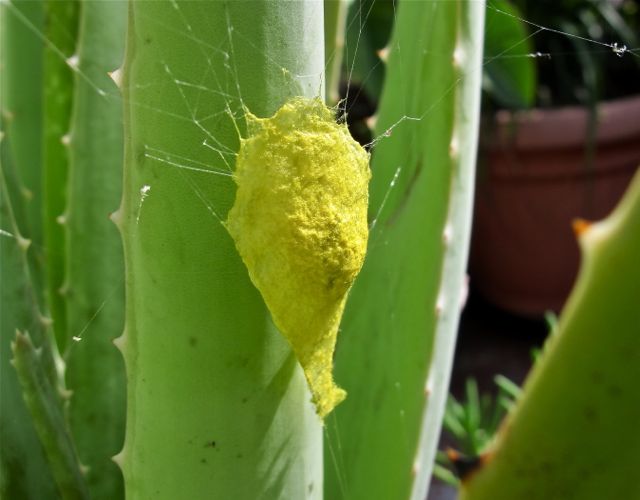
Another generation of Argiopes in waiting! And, as I write, the hunting continues…

More to come? La vida may be loca, but on it goes!
Posted in Buildings, Churches, Gardens, Weather, tagged African Tulip trees, Casita Colibrí, garden, Mexico, Oaxaca, photographs, photos, Templo de San José on July 4, 2012| 4 Comments »
Late yesterday afternoon; outdoor room (aka: my terrace) with a view. Ahhhhh….

And, despite the clouds above, this morning I can report, no rain for 36 hours!
Posted in Buildings, Food, Gardens, Parks & Plazas, Renovation, tagged frozen dessert, ice cream, Jardín Sócrates, Mexico, Nevería Malena, neveria, nieves, Oaxaca, photographs, photos, public spaces, renovation, Socrates Garden on June 2, 2012| 2 Comments »
On my first visit to Oaxaca, I was introduced to Jardín Sócrates, part of the Templo de la Soledad/Plaza de la Danza complex, between Independencia and Morelos. The original Jardín Sócrates was constructed as a public garden in 1881 and remodeled for its 100th birthday.
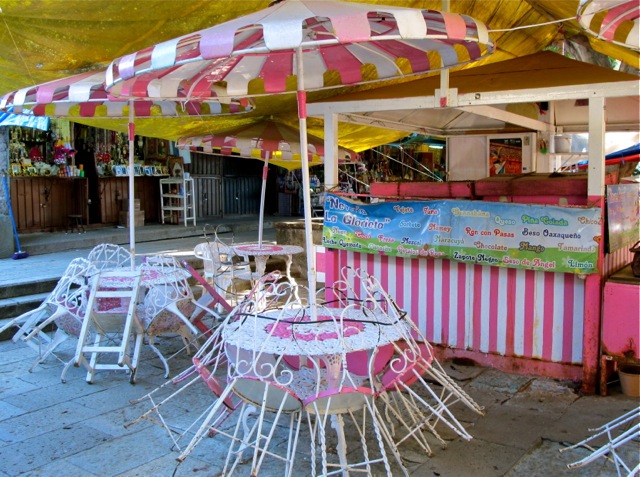
I have a weakness for ice cream, sherbet, and gelato and, thus, was completely “in heaven” being surrounded by stands selling the most amazing flavors of milk and water based frozen desserts.

Everyone has their favorite vendor, my friend G was partial to Nevería Malena, and so we sat down at one of their yellow and white iron tables.

It was SO hard to decide what to order; being tempted by too many choices and being mystified by what many of the flavors actually were.
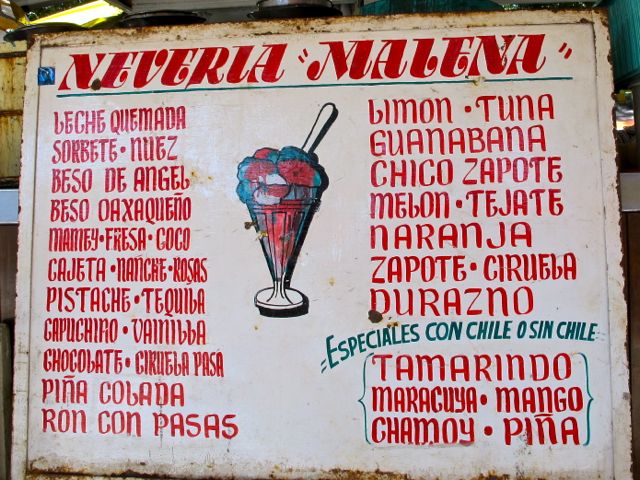
What in the world is Beso de Angel? I settled on a scoop of Leche Quemada (burnt milk) with a scoop of Tuna (fruit of the nopal cactus NOT the fish) on top. I was hooked!

As it worked out, two years later I moved into an apartment only a block away and I pass by Jardín Sócrates at least a couple of times a week. However, in mid October 2011, carpenters began constructing wooden puestos along Independencía below the Jardín. Ready for a feria? I wondered. Then they were painted! These took on a semi-permanent character. Hmmm…

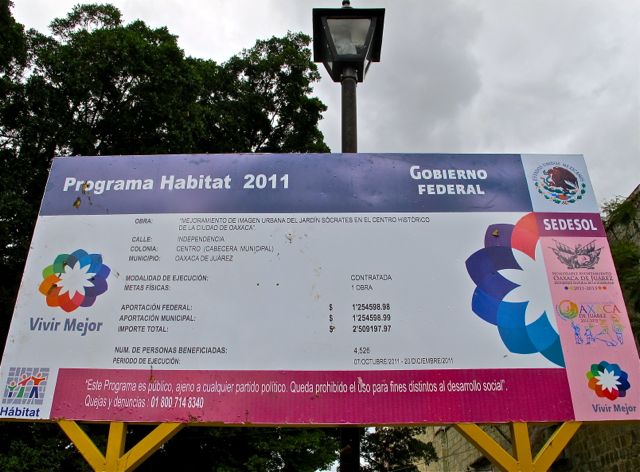
Soon, a sign went up explaining the Jardín Sócrates was undergoing an “image enhancement,” courtesy of the federal and municipal governments.
Demolition soon began, including the removal of the original green cantera (stone) pavement.

And, the neverías began moving down to the temporary puestos on Independencia. I found Nevería Malena, ordered my usual, and asked how long the relocation was going to last. “No sé.” (“Don’t know.”) was the answer.

Eight new stalls were constructed, the cantera was replaced with red terracotta tile, and new tables, chairs, and umbrellas materialized. After five months, the newly “enhanced” Jardín Sócrates opened on March 29, 2012.
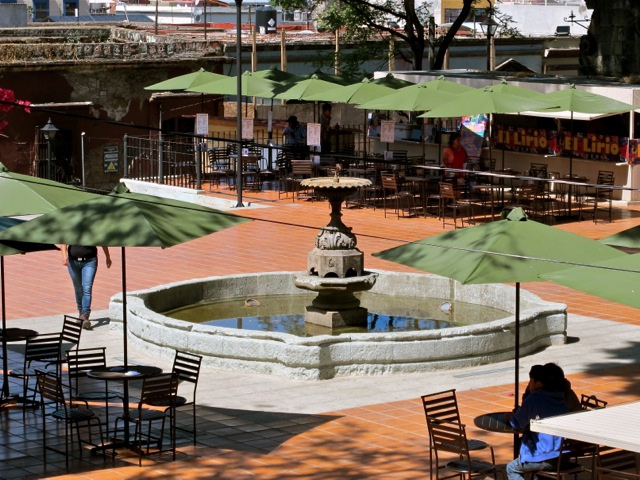
It does look lovely — orderly and coordinated — but I kind of miss the color and funkiness of the old.
Posted in Gardens, Nature & Science, tagged African tulip tree, Casita Colibrí, colibrí, Flame of the Forest, Flame Trees, hummingbird, Mexico, nature, Oaxaca, photo, photographs, photos, plants, Tulipan on May 15, 2012| Leave a Comment »
Just before this afternoon’s rains came, Casita Colibrí’s first African tulip tree blossom of the season.
And that means, colibríes (hummingbirds) won’t be far behind!
Posted in Buildings, Gardens, Museums, Nature & Science, People, Renovation, tagged Alejandro de Ávila B, Ethnobotanical, Francisco Toledo, garden, Jardín Etnobotánico de Oaxaca, jeff spurrier, Mexico, Oaxaca, Santo Domingo de Guzmán on February 12, 2012| Leave a Comment »
Be it looking down from the windows above, strolling through the gardens on a tour, or peeking through openings in the wall on Reforma or Berriozabal on the way to someplace else, Oaxaca’s Ethnobotanical Garden is always a soothing and uplifting sight.

Check out this informative and enlightening article by Jeff Spurrier discussing the origins and vision of Oaxaca’s Ethnobotanical Garden — from the Jan/Feb 2012 issue of Garden Design:
“I am not a gardener.” Francisco Toledo is sitting in the courtyard of the graphic art institute he founded in downtown Oaxaca City, Mexico, sipping on a glass of agua de jamaica. His fingers are paint-smudged, and he moves stiffly from a sore back. Toledo, 71, is one of Mexico’s best-known living artists; his paintings, sculptures, and textiles are in galleries and museums around the world. At home in Mexico, he is identified with a fierce and outspoken defense of the indigenous arts and culture of the southern state of Oaxaca. He also, as it turns out, helped to create one of the world’s most original public gardens.
“The professionals are the people who live in the country,” he says. “The campesinos and workers — I don’t have the patience.”
Nearly 20 years ago, the Mexican military moved out of a 16th-century Santo Domingo monastery complex it had used as a base for more than 120 years. Mexico’s president gave the exit order after being lobbied by Toledo and other leading artists and intellectuals belonging to Pro-Oax, an advocacy group urging the promotion and protection of art, culture, and the natural environment in Oaxaca. Soon, a great clamor began: The state government wanted the five-acre parcel in the heart of downtown Oaxaca City to create a hotel, convention center, and parking facility. A restoration team brought in by the National Institute of Anthropology and History wanted to establish a European garden in the 17th-century baroque style. Some of Toledo’s fellow artists wanted to use the grounds for workshops and exhibition space.
n 1993, when Toledo knew the army would be leaving, he asked Alejandro de Ávila B., who had family roots in Oaxaca and training in anthropology, biology, and linguistics, what he and other advocates would propose. De Ávila suggested making the space into a botanic garden — or, more precisely, an ethnobotanic garden, one that would “show the interaction of plants and people.”
I highly recommend reading the Full Article.
h/t Norma and Roberta



 Mexican Peso Converter
 View From Casita Colibrí