Feeds:
Posts
Comments

Archive for the ‘Exhibitions’ Category

One of the joys of life in Oaxaca is being surrounded by artists, meeting them, and watching their creations take shape. As 2023 was about to come to a close, friends and I spent the day visiting some of our favorite villages to the south of the city. First stop was breakfast in the Ocotlán de Morelos mercado at the stall of Beatriz Vázquez Gómez. Beatriz is famous not only for looking and dressing like Frida Kahlo, but also for serving delicious traditional Oaxacan food. Our next stop was San Antonino Castillo Velasco for their holiday food and artesanía feria where we strolled the aisles of embroidered blouses and dresses, artesanía, and (of course) mezcal. Working up an appetite (What, eating again?) we shared San Antonino’s famous and filling, empanadas de amarillo.

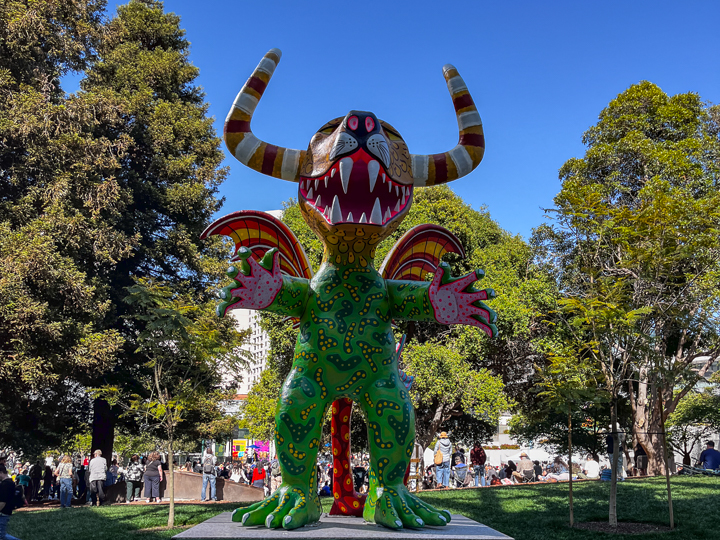
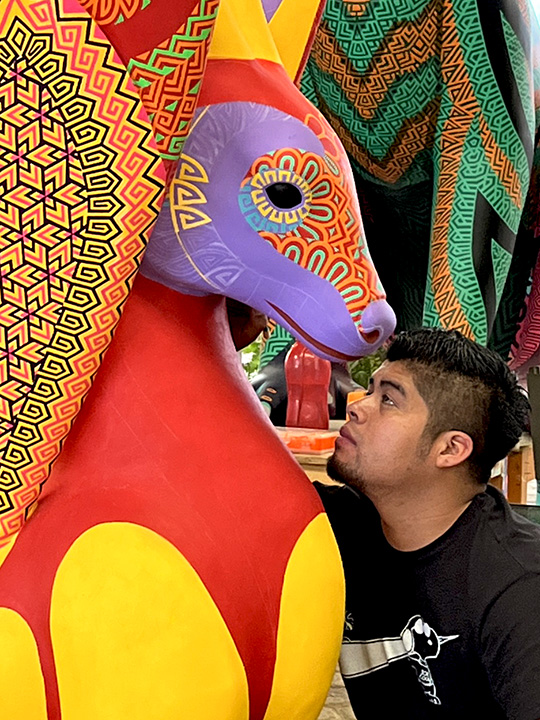
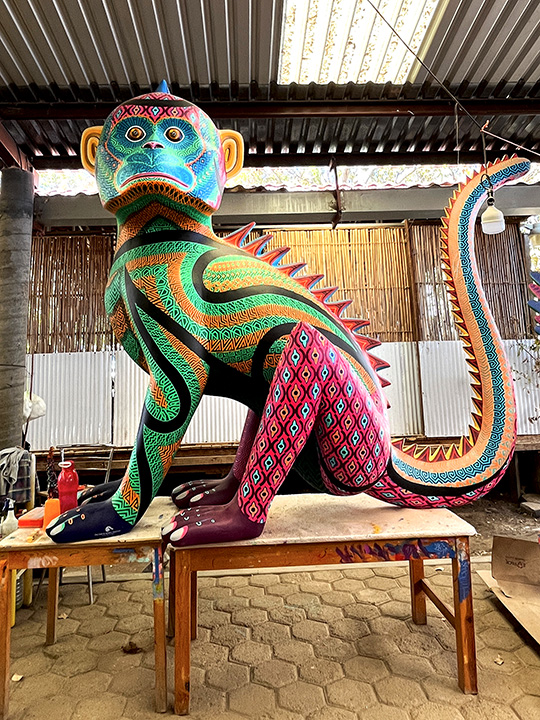
Our last stop of the day was in San Martín Tilcajete. It was at the workshop of Jacobo and María Ángeles where we stumbled on giant fantastical creatures that were being intricately painted in preparation for their journey to Denver, Colorado to be featured in an exhibition at the Denver Botanic Garden entitled, Spirit Guides: Fantastical Creatures.

In the words of Jacobo and María, “These monumental pieces are distinguished by a meticulous carving process and a painting technique that highlights a vibrant palette of colors. This technique not only stands out for its visual beauty, but is also linked to the research and preservation of Zapotec symbology, granting a profound meaning to this artistic and artisanal production.”

Spirit Guides is an unforgettable outdoor experience reminding us of the profound connections that bind us to the inhabitants of the natural (and cosmological) world.”

So, should you find yourself in the Denver area before the exhibition’s last day on September 8, 2024, let your spirit guide you to the Denver Botanic Gardens.

Read Full Post »

Jean-Baptiste Racine’s quote, “Life is a comedy to those who think, a tragedy to those who feel” comes to mind when I reflect on 2023. Looking at the state of the world, I think many of us have spent the year vacillating between laughing and crying. However, on this New Year’s Eve, I prefer to remember the celebrations and places I experienced with family and friends, old and new. These are the times that nourish my soul and empower me to welcome 2024.

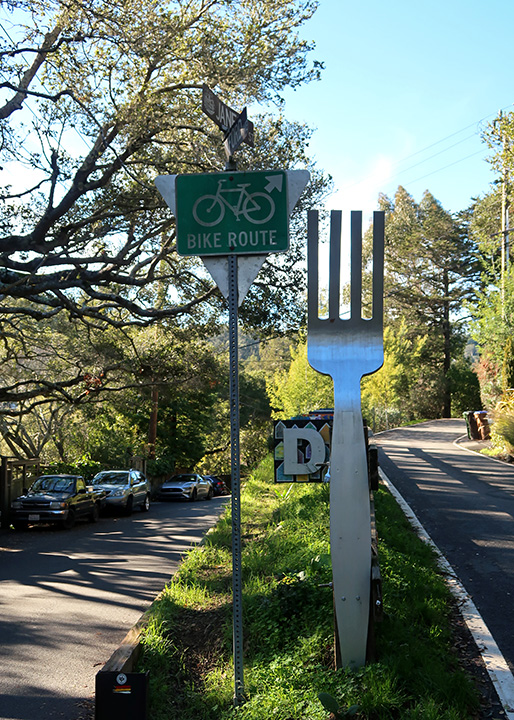
January 2023 – Mill Valley, CA. “Fork in the road.” I took the high road.
February 2023 – Oaxaca de Juárez. Archivo Histórico del Estado de Oaxaca.
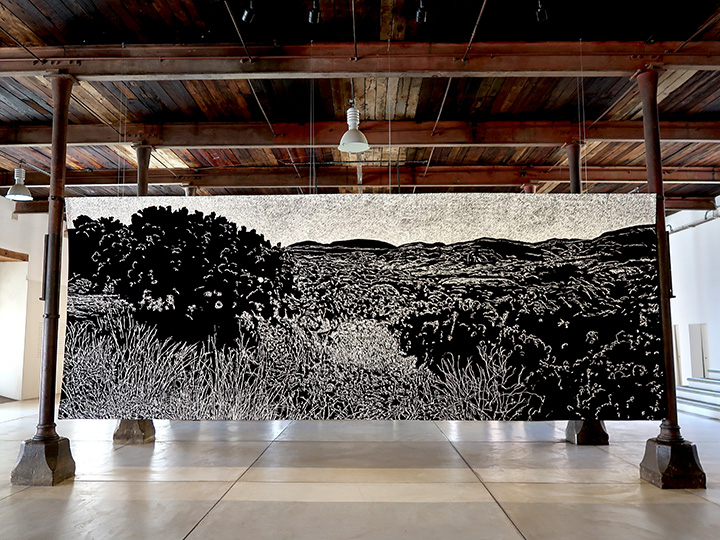
March 2023 – San Agustín Etla, Oaxaca. “Seamus Heaney & Jan Hendrix en Yagul” exhibition at Centro de las Artes de San Agustín (CASA).
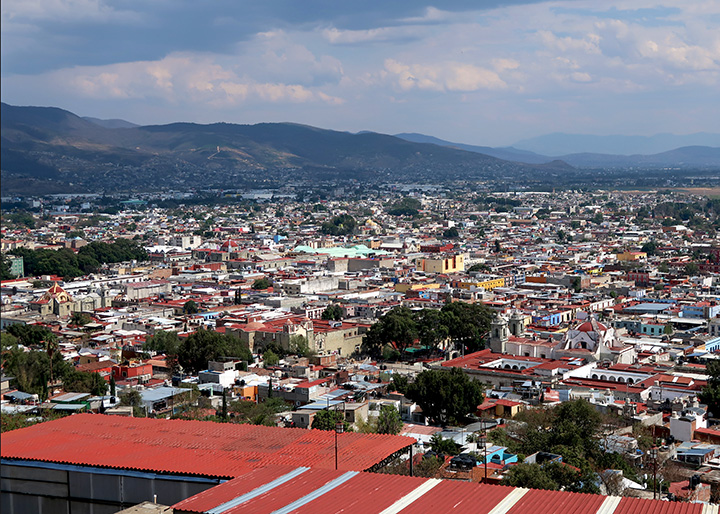
April 2023 – Oaxaca de Juárez. View from El Mirador Restaurante.
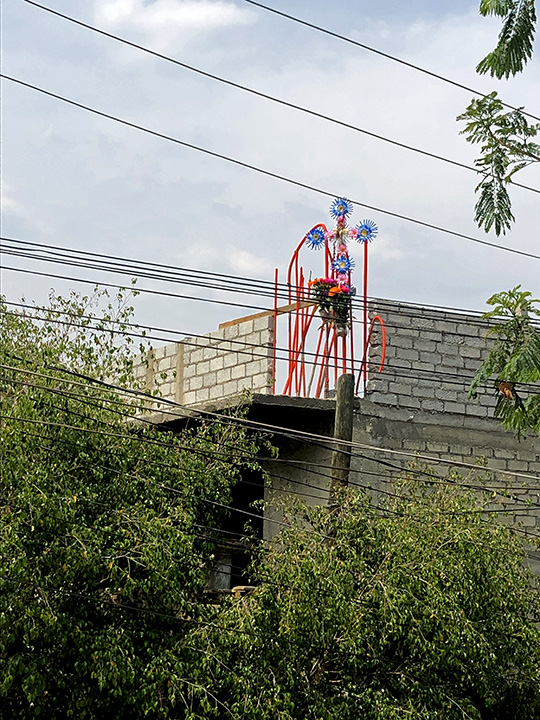
May 2023 – Oaxaca de Juárez. Cross on construction site in honor of Día de la Santa Cruz.
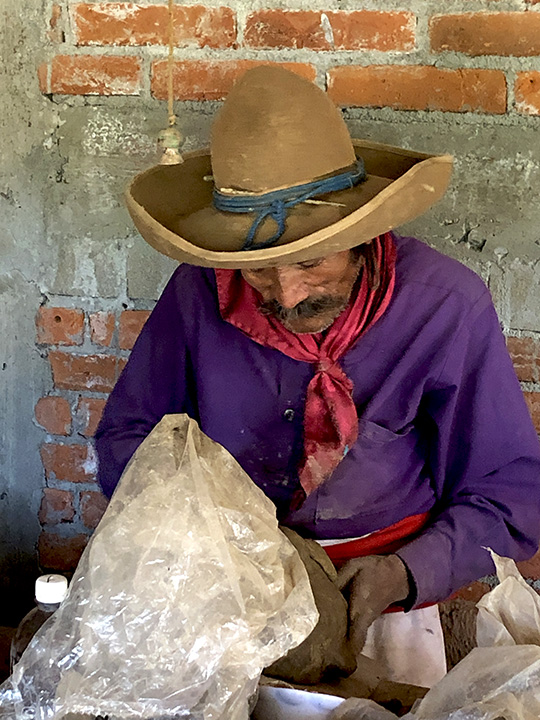
June 2023 – San Antonino Castillo Velasco, Oaxaca. Don José Garcia Antonío (aka, the blind potter).
July 2023 – Teotitlán del Valle, Oaxaca. Convite welcoming people to the festival honoring La Preciosa Sangre de Nuestro Señor Jesucristo.
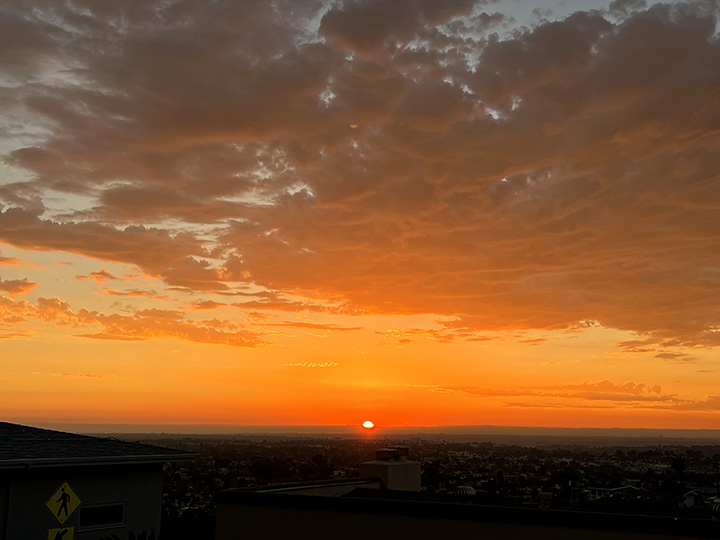
August 2023 – La Mesa, CA. Sunset over the Pacific Ocean.
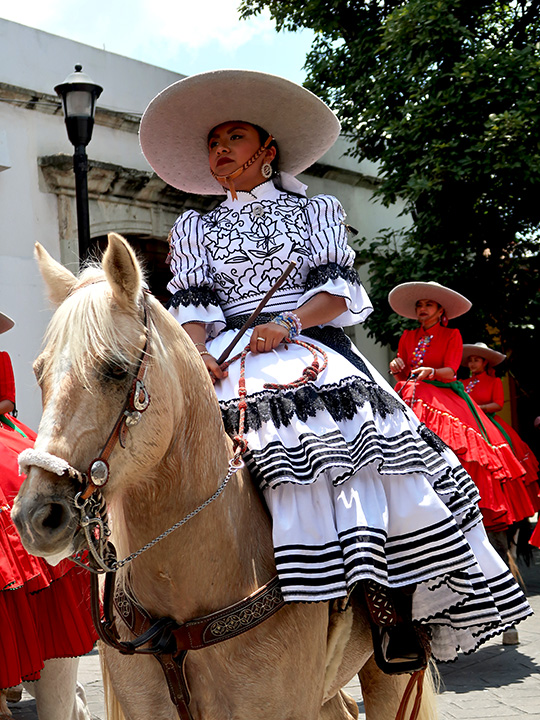
September 2023 – Oaxaca de Juárez. Escaramuzas riding in the Mexican Independence Day parade.
October 2023 – Oaxaca de Juárez. “Nelson” one of the Oaxaca Guerreros baseball team’s mascots.
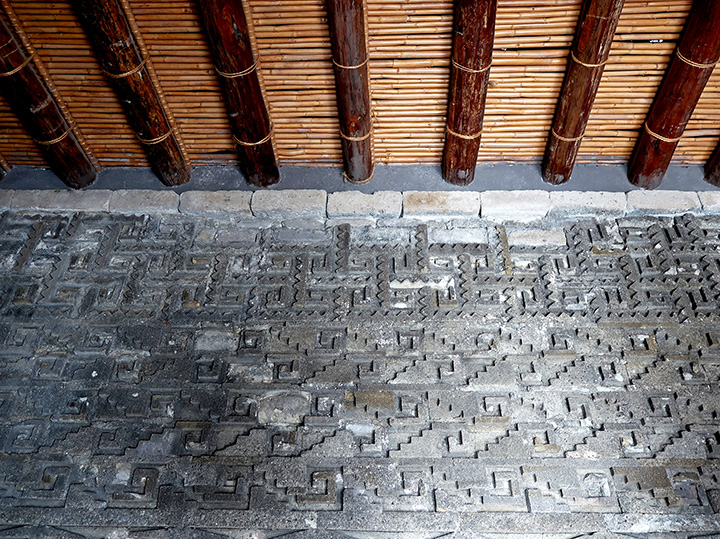
November 2023 – Villa de Mitla, Oaxaca. Interior wall and ceiling in the “Church Group” at the Mitla archeological site.
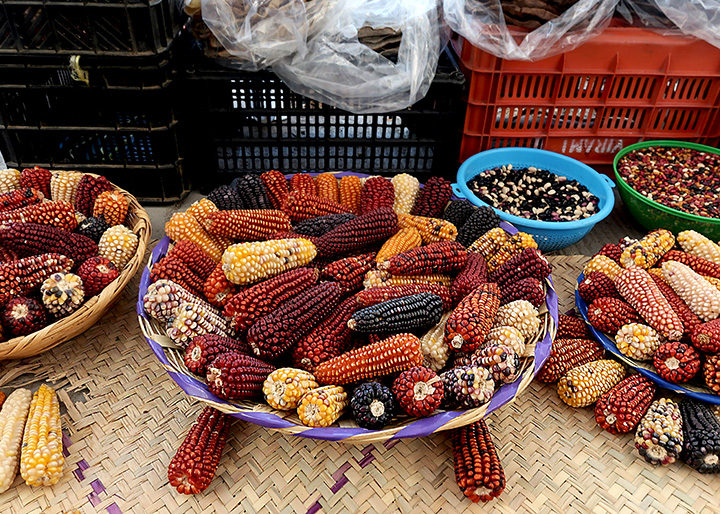
December 2023 – Unión Zapata, Oaxaca. Feria de la Agrobiodiversidad en Oaxaca.

Many thanks to all the wonderful readers of my blog; I am constantly amazed and gratified you choose to stop by. On this New Year’s Eve, with a renewed appreciation for the small things that bring joy and give life meaning, I wish you all, ¡Feliz Año Nuevo!

Read Full Post »

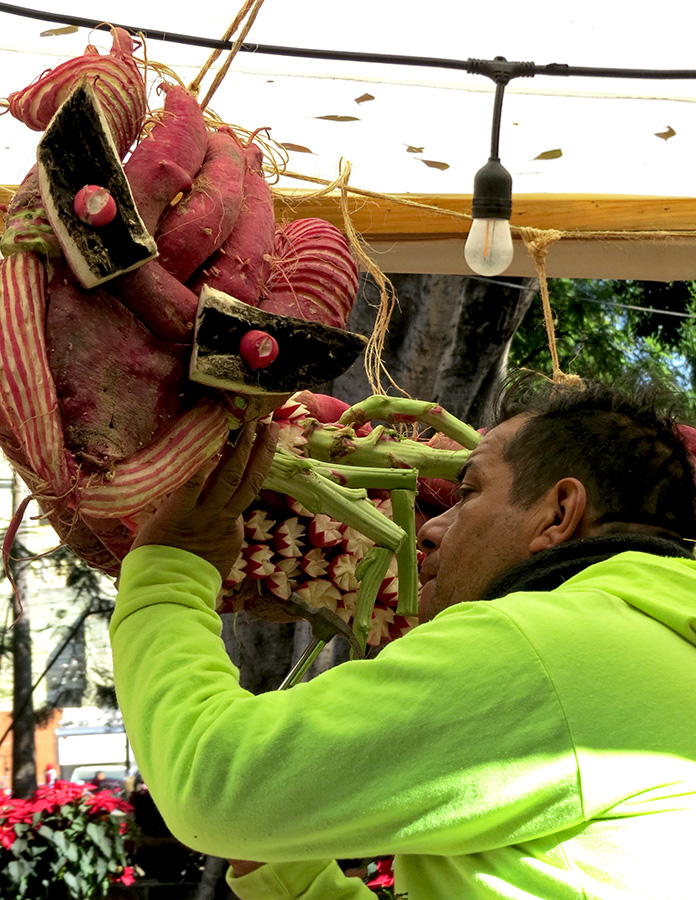
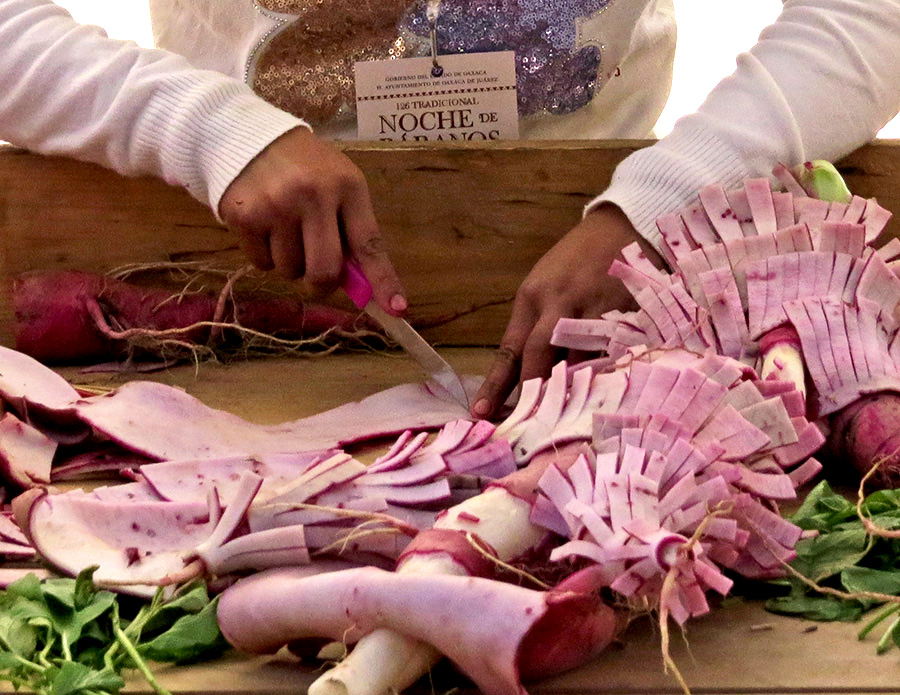
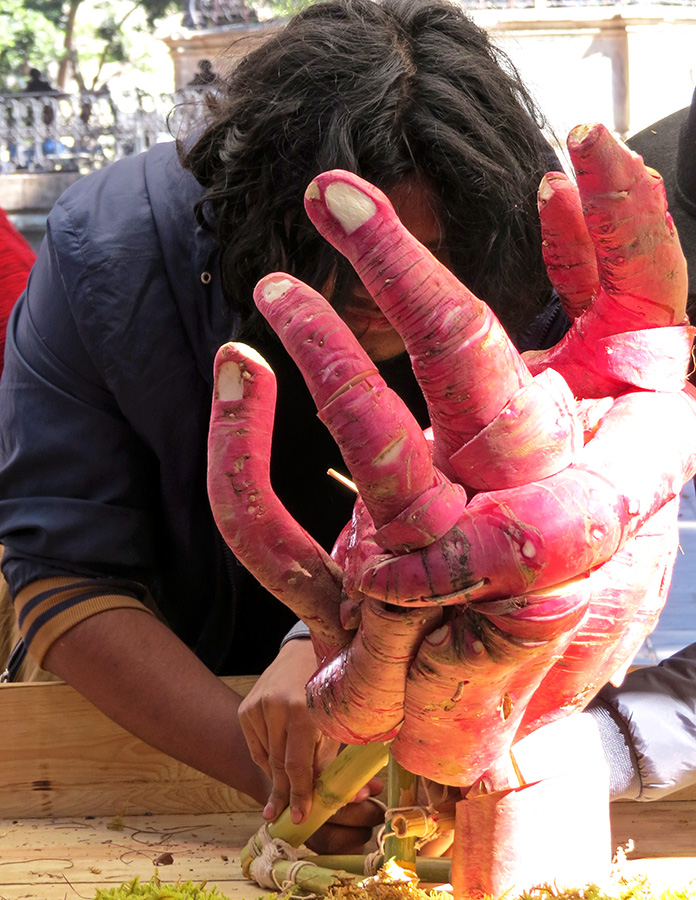
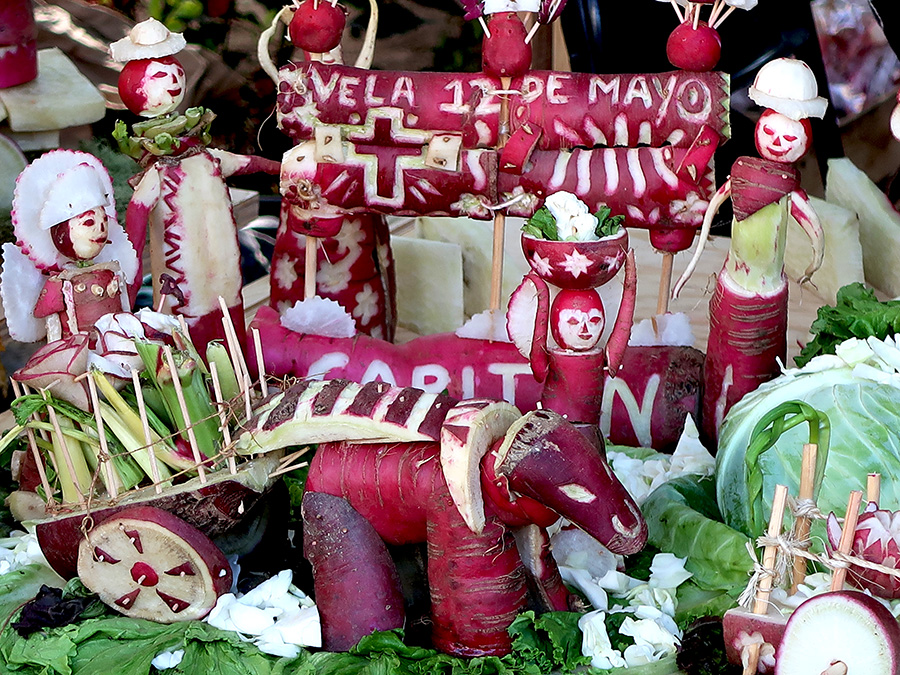
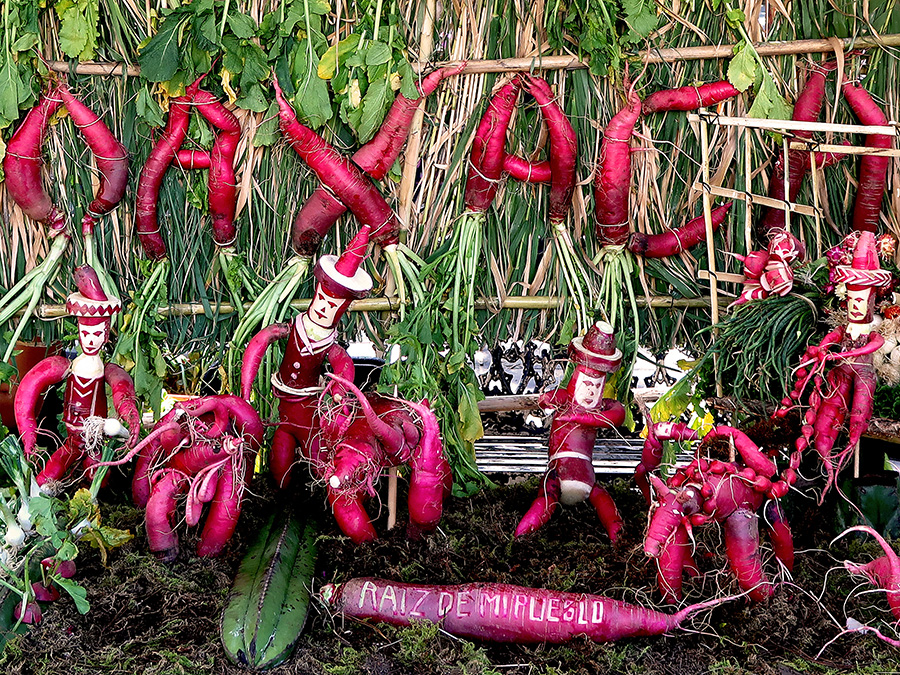
If it’s December 23, it must be the “only in Oaxaca” Noche de Rábanos. I love going in the morning to watch these skilled artists and their imaginations at work creating exquisite sculptures out of radishes — of all things!

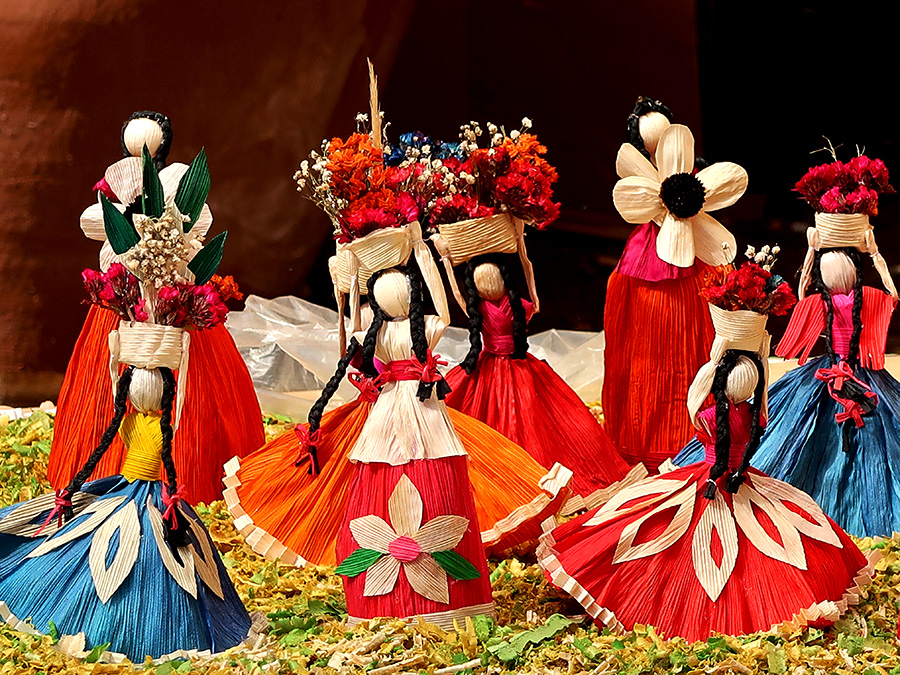
And, there weren’t just radishes. Creations of totomoxle (dried corn husks) and flor inmortal (dried flowers) were also on display. Stay tuned…

Read Full Post »

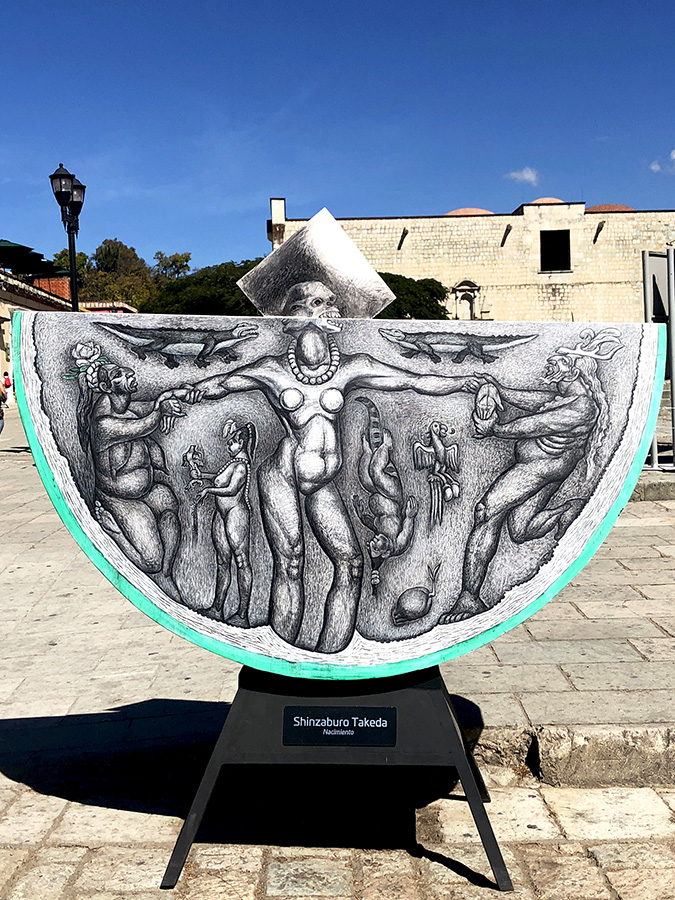
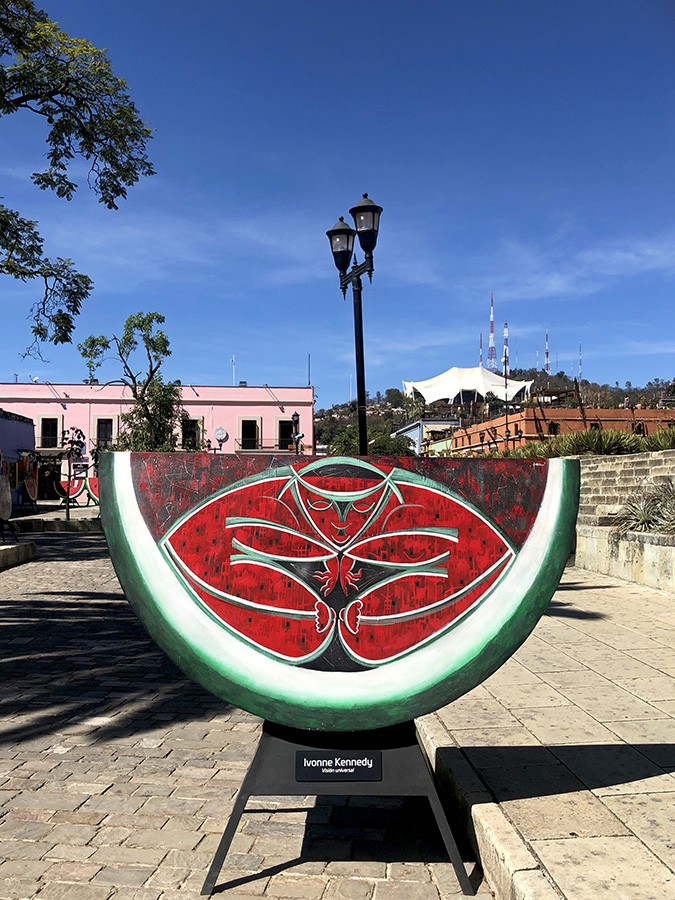
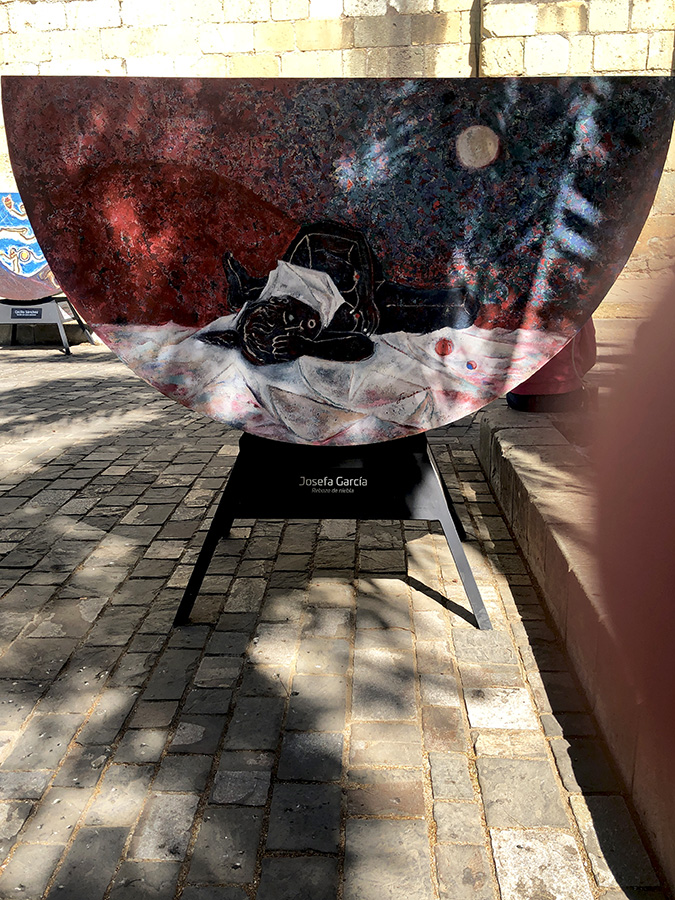
Rufino Tamayo’s iconic sandía paintings and the thirtieth anniversary of the Oaxaca painter’s death, provided the inspiration for a tribute to the artist commissioned by promoter and curator, Nancy Mayagoitia. In an homage, thirty artists, all with connections to Oaxaca, interpreted large sculptural watermelon slices. The free public exhibition opened at the end of October 2021 in the Plaza de la Danza and then moved outside Templo de Santo Domingo de Guzmán adjacent to Oaxaca’s walking street, Macedonio Alcalá — where, as of a few of days ago, it continues to reside.

“Nuevo amanecer y eclipse” by Felipe Morales
“Tamayo coleccionista” by Guillermo Olguín
“Reunión de cinco reinos” by Román Llaguno
“Tierra del sol” by Eddie Martínez
“Sonata para Tamayo” by Ixrael Montes
“Gallos y mujer sin mandolina” by Saúl Castro
“El rockanrolero y sus fans” by Hugo Vélez

After working on this blog post, I can’t get “Watermelon Man” by Mongo Santamaria out of my head. The link is from their performance at the 1969 Harlem Cultural Festival. If you want to watch something singularly special and significant, I highly recommend that you to check out Summer of Soul, a 2021 documentary that beautifully chronicles the festival.

Read Full Post »

Happy Mother’s Day to all the mothers and mother figures out there!

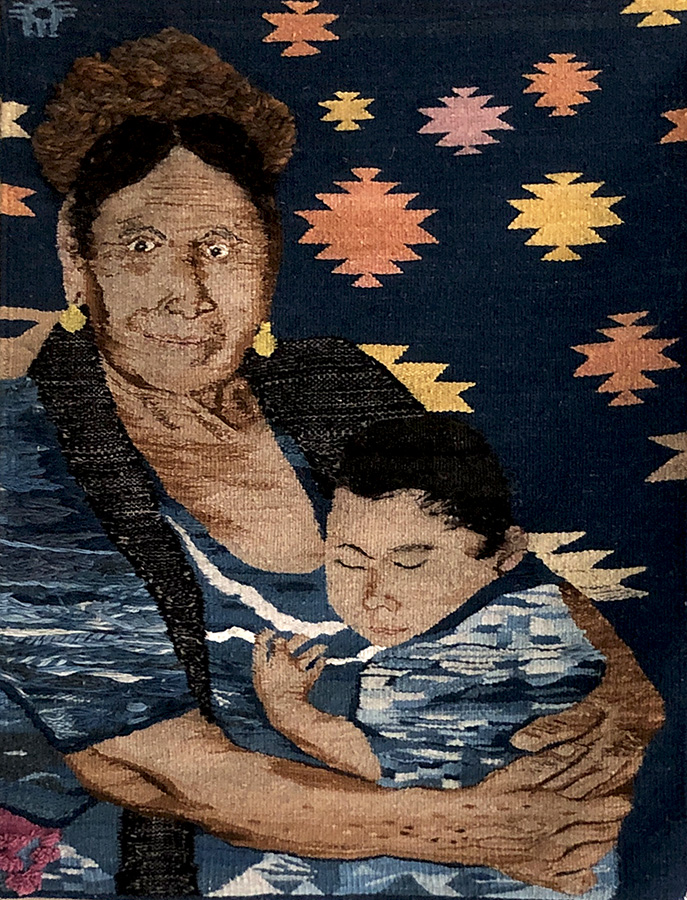
“Mi Segunda Madre” woven by Mario González Pérez using wool dyed with natural dyes.

The above wall hanging (photographed in February 2021) was part of the art exhibition, “Sangre y Herencia” (Blood and Heritage) at Hotel CasAntica. By the way, Día de las Madres is celebrated in Mexico on May 10.

Read Full Post »

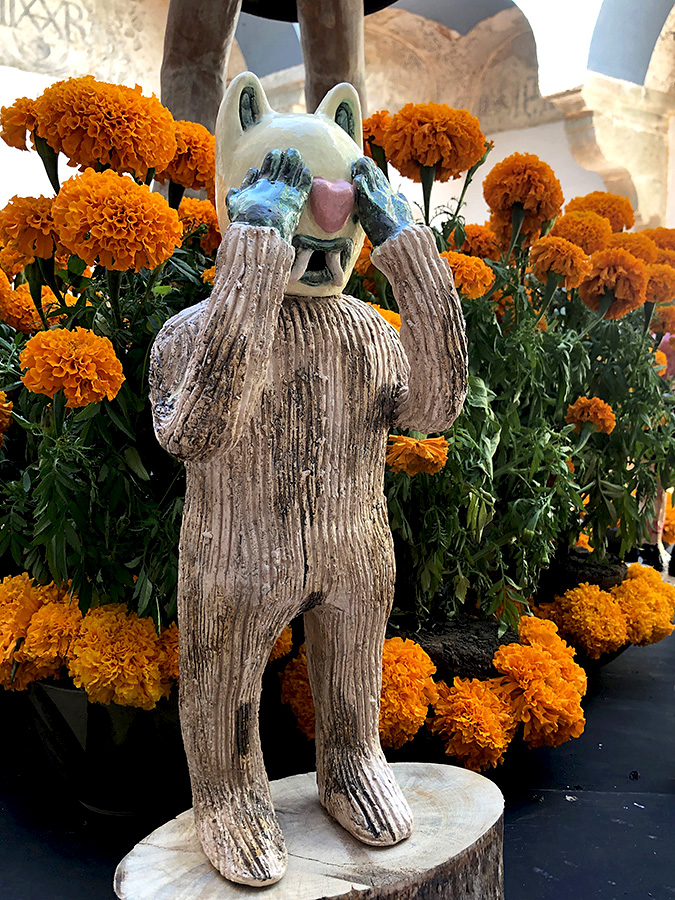
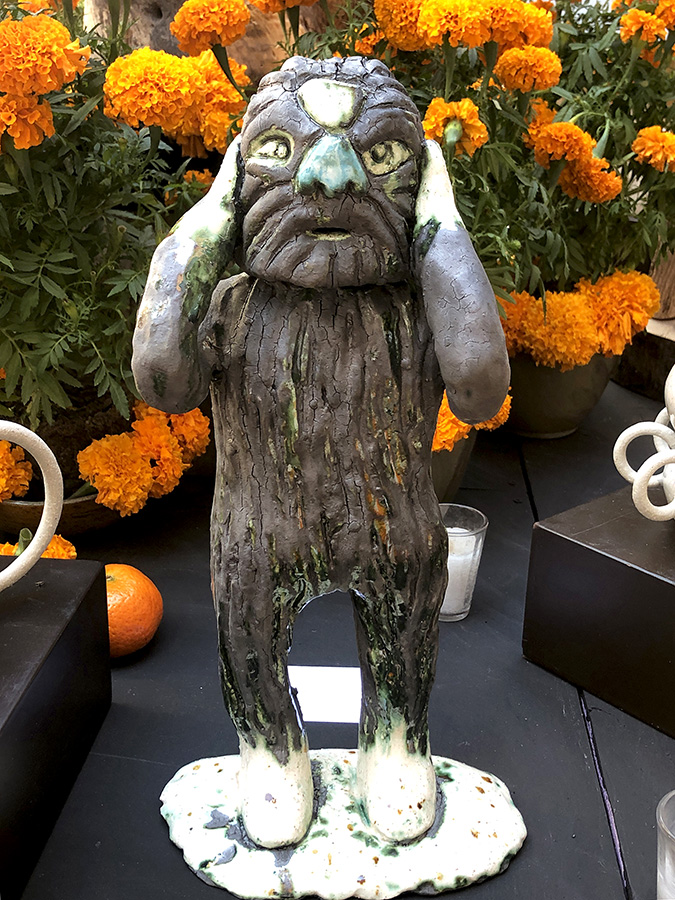
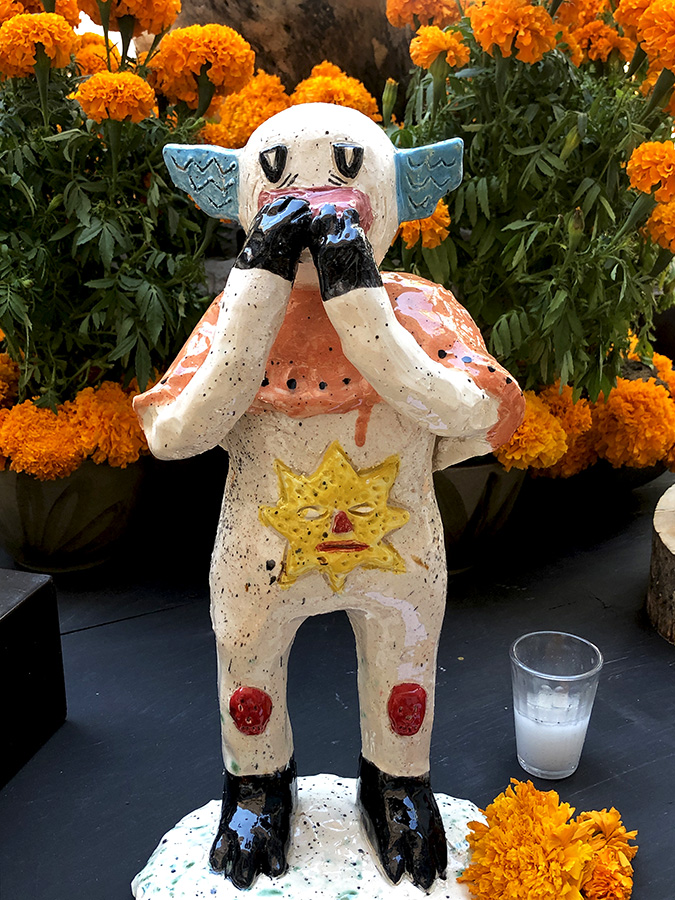
The Three Wise Monkeys

See no evil,
Hear no evil,
Speak no evil.

Well, maybe not monkeys! From the Día de Muertos altar “Transitions” by Estudio Dinamo at Voces de Copal Galeria.

Read Full Post »

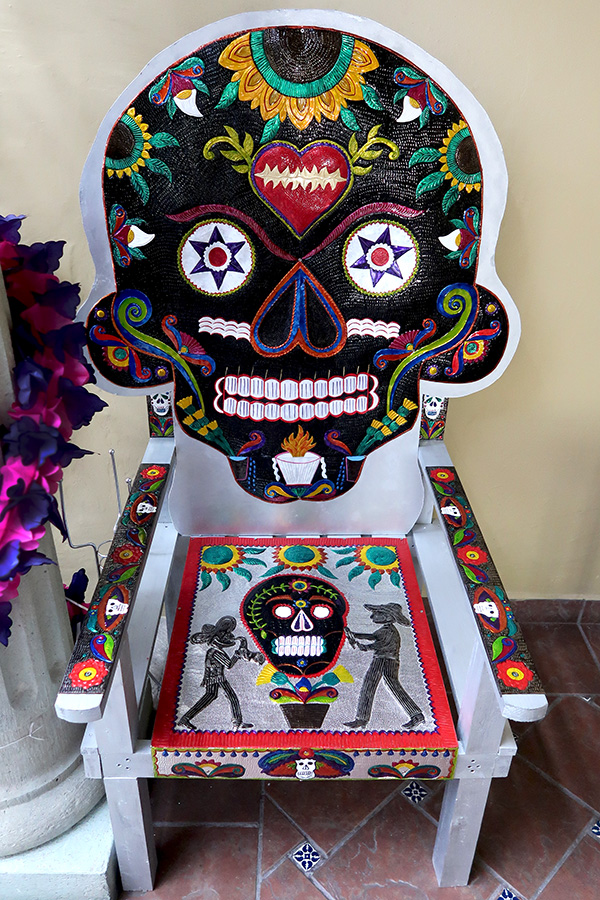
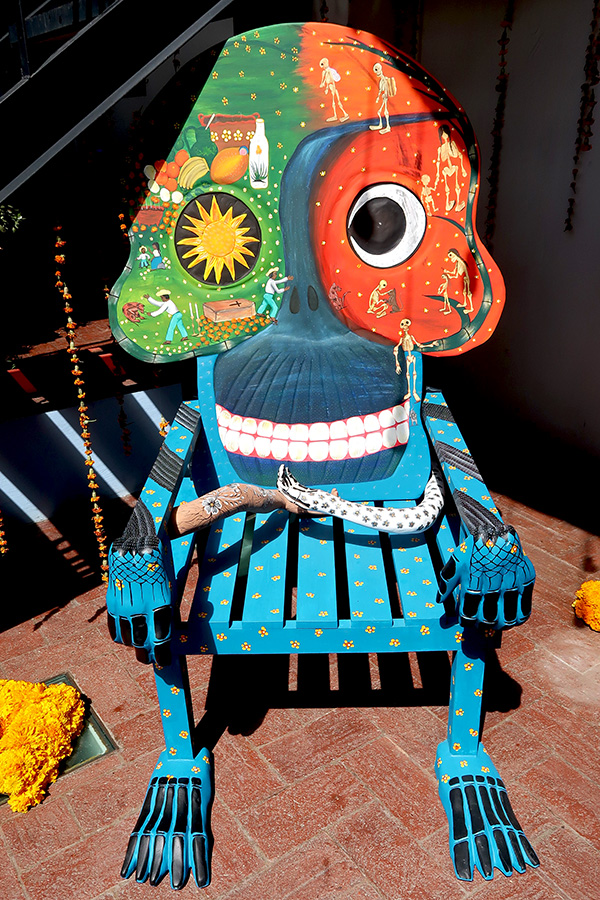
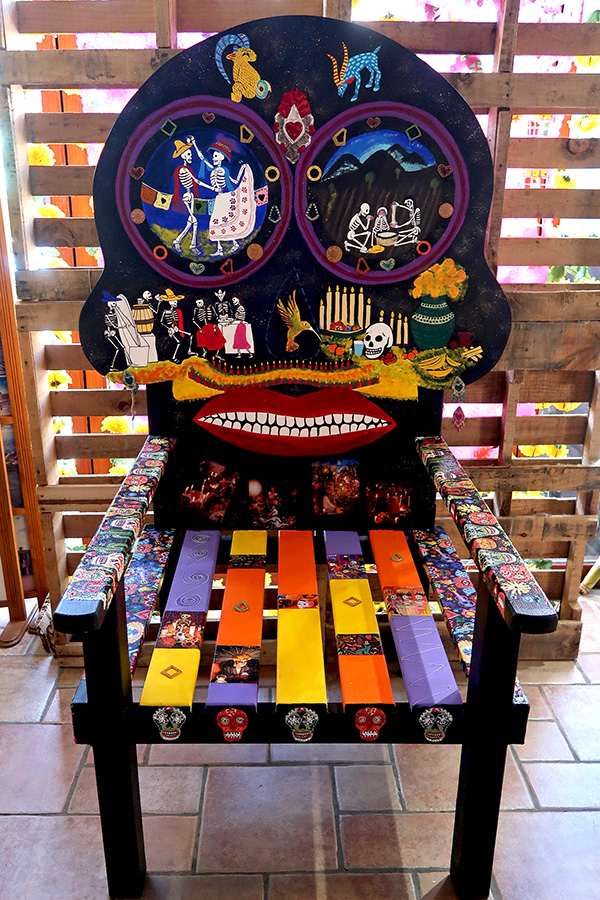
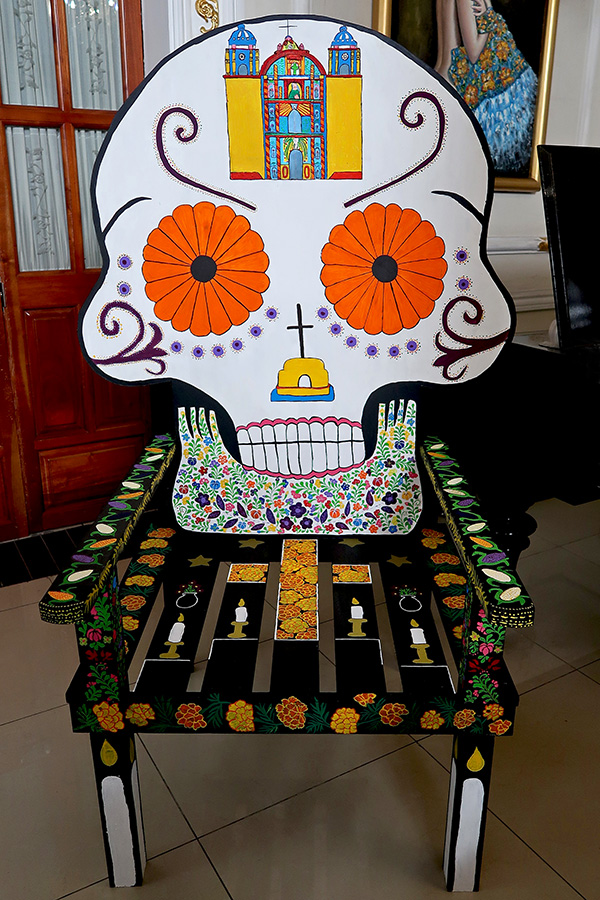
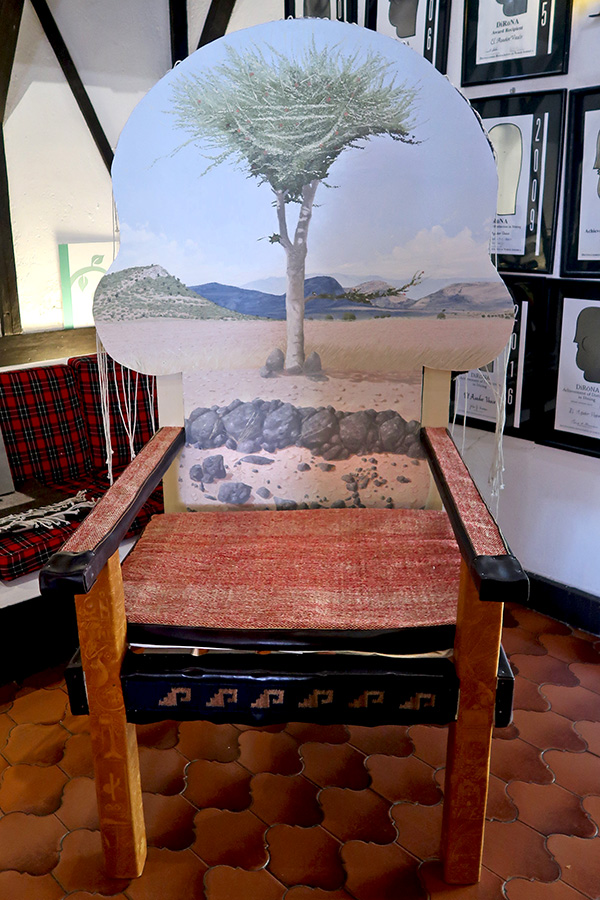
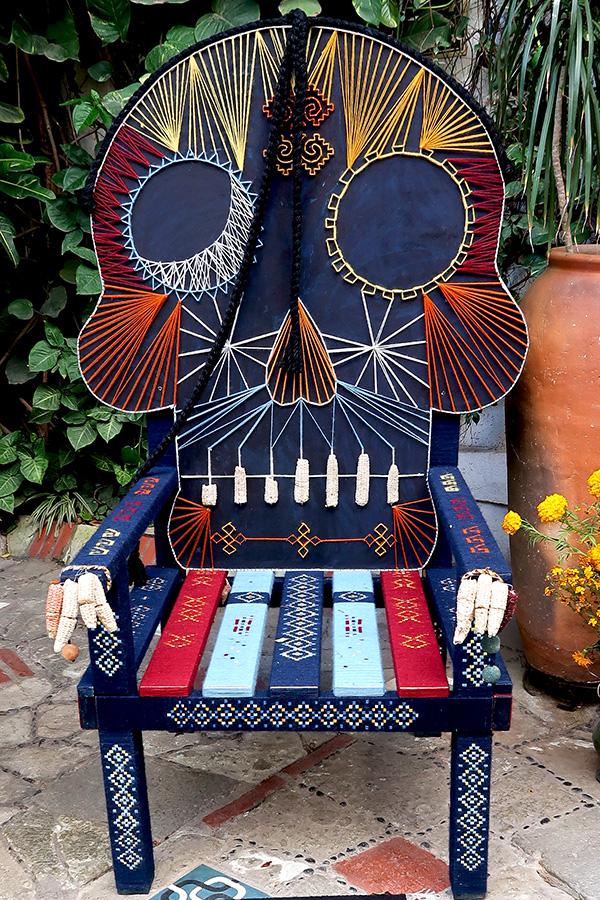
In my effort to “step away” from the US election news, I went in search of the fourteen chairs of the “Silla Calavera” project scattered throughout restaurants and hotels in the city — a creative and calorie-burning distraction!

Artist: Juana Vicente Ortega Fuentes, decorative painter; displayed at Pitiona restaurant. Title: Levantada de Cruz (Raised Cross).
Artist: Fabián Pacheco, metalwork artisan; displayed at Gozobi restaurant. Title: Tradición y costumbre (Tradition and practice).
Artist: Francisca Calvo, wooden alebrije artisan; displayed at Pitiona restaurant. Title: Platicando sobre las costumbres de mi pueblo (Talking about customs of my people).
Artist: Jesús Sosa Calvo, wooden alebrije artisan; displayed at Hotel Parador. Title: Como ves te ves (As you see you see).

The project arose as an idea to spread the traditions of Oaxaca through artistic creations using an object of daily life — a comforting and comfortable seat, where each artist, through their creativity and respect for the dead, exposes the face of a skull.

Artists: Taller de Barro Zamani, polychrome clay artisans; displayed at Terranova restaurant. Title: Muertos que viven (The dead who live).
Artists: Erika Nancy Carrillo Carreño, Montserrat Mandujano, Eliézer Vargas García, artesanas de la Costa oaxaqueña; displayed at Hotel Trébol. Title: Colores de vida y muerte (Colors of life and death).
Artist: Colectivo Zegache (Alejandro Mendoza, Eleuteria Pacheco Mendoza, Edith Santo Méndez, Nancy Martínez Gaspar); displayed at Hotel Casa Garay. Title: Dxi tu gúl (Zapotec, unable to translate).
Artist: Meletón Lazo, surrealist artist; displayed at Hotel Ferri. Title: Flor de piña (Pineapple flower dance).

Unfortunately, this next chair had been disassembled by the time I arrived, but here, in two parts, the back and the seat.

Artist: Gabriel Sosa, wooden alebrije artisan; seat back at Los Danzantes restaurant. Title: Fiesta de colores (Festival of colors).
Artist: Gabriel Sosa, wooden alebrije artisan; seat at Los Danzantes restaurant. Title: Fiesta de colores (Festival of colors).

The artisans, I think with great success, sought to capture and share their roots, customs, and traditions.

Artist: Marcos Lucero, painter; displayed at Hotel Santa Rosa. Title: Bii tugul/Viento de muertos (Wind of the dead).
Artist: Juan Lazo, landscape painter; displayed at El Asador Vasco restaurant. Title: La muerte es mas vida (Death is life).
Artists: Paulino Ramirez and Eduardo Ramirez, painting and wooden alebrijes; displayed at Restaurant Casa Palmeras. Title: La última luz (The last light).
Artist: Alfonso Canseco Peligro, graphic artist; displayed at La Mala restaurant. Title: Siéntate, vamos a tomar (Sit down and let’s drink).
Artists: Luis Lazo and family, textile artists; displayed at Hotel Casa Vertiz. Title: Ciclo de vida (Cycle of life).

Yesterday, the chairs were removed from the restaurants and hotels. Tonight, with an inaugural celebration, they went on display at ARIPO until November 15, 2020. For purchase after that date, contact Matlacihua Arte or individual artists.

Read Full Post »

Noche de Rábanos is coming and, while I’m shivering in California, I’m dreaming warm Rábanos, Totomoxtle, and Flor Inmortal dreams. This year promises to be bigger than ever — so big, the exhibition and competition have been extended to two days. December 22, 2019 will be reserved for Flor Inmortal, Totomoxtle, and, in the morning, the children’s category of rábanos.

Category: Flor Inmortal (Dried flowers)…

“Delegación de las Chinas Oaxaqueñas” by Juliana Galicia Péerez (2017)

Category: Totomoxtle Natural (Corn husks, natural color)..

“Esplendidas artesanías de Oaxaca” by Esmeralda Chavez Miguel (2017)

Category: Totomoxle Decorado (Corn husks, colored)…

“Chinas Oaxaqueñas de la Guelaguetza” by Pedro Leobardo Díaz Márquez (2017)

And, as is customary, the carved radish exhibition and competition will be held December 23. Get there in the morning to watch the artisans setting up and putting the final touches on their creations or in the late afternoon/evening to see the finished works and award winners.

Category: Rábano Libre (Radishes, non-traditional and contemporary themes)…

“Mirada de la noche” by Concepción del Carmen López Guzmán (2017)

Category: Rábano Tradicional (Radishes, Biblical and traditional Oaxaca themes)…

“Regada de la vela 12 de mayo” by Rosa del Alba Miguel Morales (2017)

Category: Rábano Tradicional…

“Raíz de mi pueblo” by Roberto Geovani Aguilar (2017)

To all in Oaxaca, enjoy this year’s, “Oaxaca, Land of Cultivated Dreams!”

Read Full Post »

I’m in el norte and it is all quiet on the norther front on this day honoring Our Lady of Guadalupe. In fact, the sound of silence was one of the things that struck me as the taxi drove me and my luggage through the streets of my little hometown at the base of Mount Tamalpais. The Oaxaca I left a few days ago, was a cacophony of rocket booms and bangs, church bells ringing, processions with enthusiastic bands, and barking dog. From my terrace, yesterday and today, I would have been treated to sound on steroids honoring Guadalupe. Funny what one gets used to…

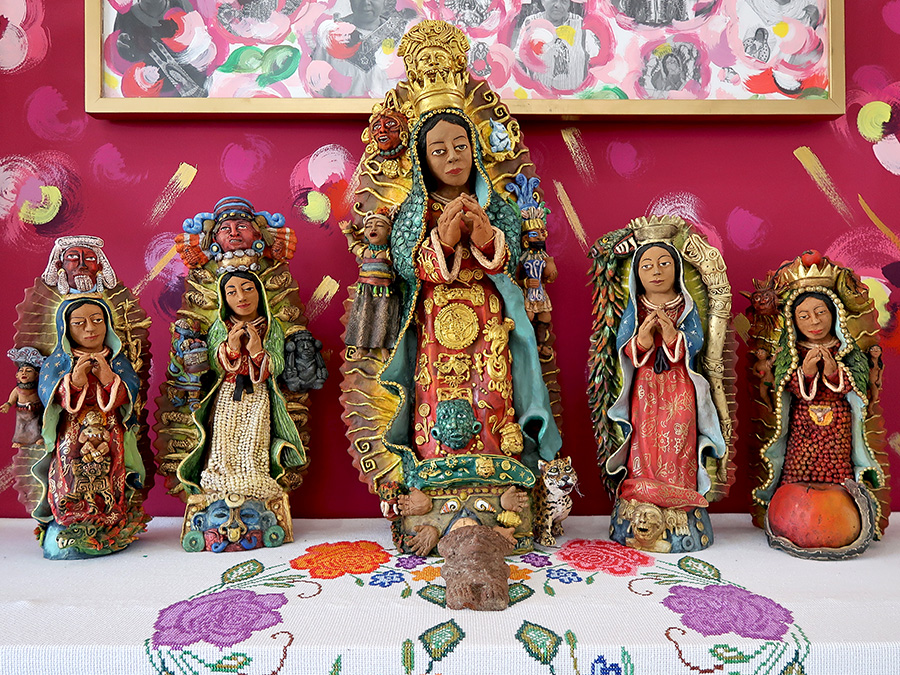
The above images of the Virgin of Guadalupe were created for an altar dedicated to Guadalupe at the Roses and Revelations textile exhibition and are by painter and sculptor, Demetrio Garcia Aguilar, a member of the talented Aguilar family of potters of Ocotlán de Morelos, Oaxaca. The indigenous symbols used pay homage to the pre-Hispanic fertility and earth goddess, Tonantzin (“Our Sacred Mother” in the Nahuatl language), whose temple at the top of Tepeyac Hill had been destroyed by the Spanish conquerors. Syncretically, this became the site where the apparition the Virgin Mary appeared to Juan Diego asking that a church be built on that site and thus the story of the Virgin of Guadalupe began — another step in the blending of the old and new religions and the original peoples and the Spanish newcomers.

By the way, the Roses and Revelations exhibition is on tour and is currently at the Museo Nacional de Culturas Popular in Coyoacán, in Mexico City. It will run to April 19, 2020.

Read Full Post »

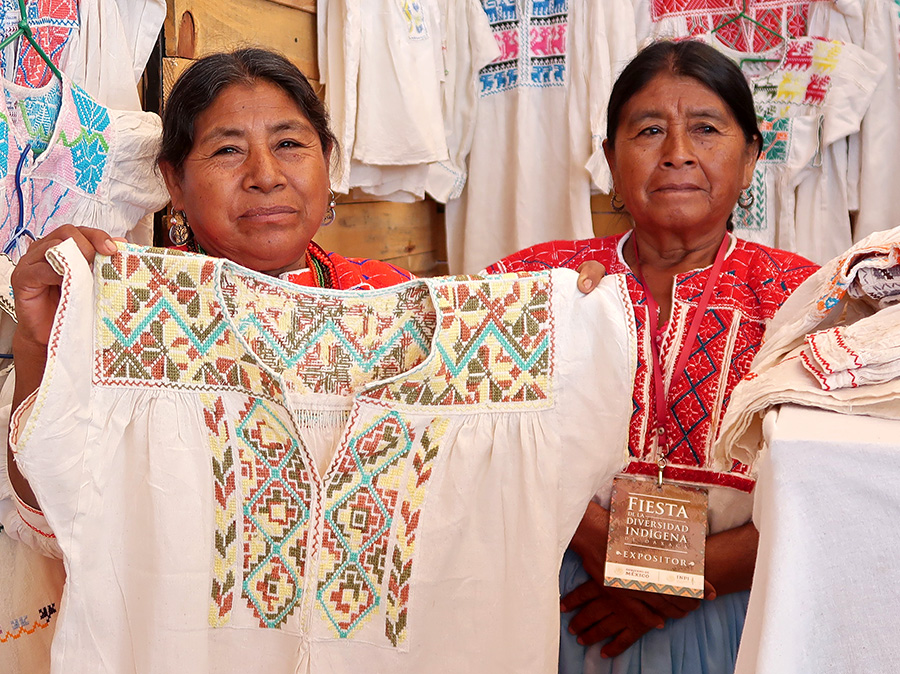
In commemoration of International Day of the World’s Indigenous Peoples, Mexico’s Instituto Nacional de los Pueblos Indígenas (INPI) is hosting a Fiesta de la Diversidad Indígena de Oaxaca.

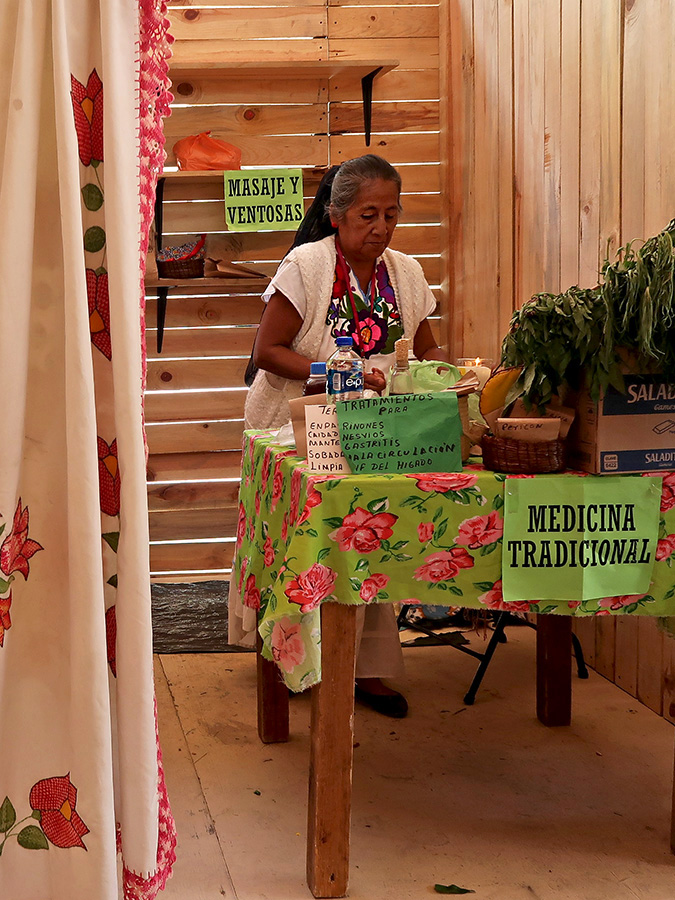
It is a four-day festival honoring and promoting the state of Oaxaca’s indigenous peoples and their communities with artesania, textiles and other products for sale, cultural performances and workshops, food booths, and even healing treatments — and it’s happening a block from Casita Colibrí in the Plaza de la Danza!

Yawi Naka – Triqui – La Laguna Guadalupe, Putla Villa de Guerrero

INPI has an excellent online atlas of the indigenous peoples of Mexico and it, along with the statistics I previously posted regarding poverty, discrimination, and the results thereof affecting Mexico’s indigenous and Afro-Mexican peoples are abysmal.

Na Jacinta Charis – Zapoteco – Juchitán de Zaragoza

According to this article (in Spanish), the charge of the INPI is to advocate for indigenous and Afro-Mexican rights and to recognize that in order for these peoples and their communities to survive, institutional efforts must be taken to guarantee their full exercise of social, political, cultural, and economic rights.

Productores de Maguey y Mezcal Lucas 2010 SPR de Ri – Zapoteco – San Isidro Guishe, San Luis Amatlán

The INPI is also attempting to advance an understanding that the family/community economy of these communities has a different production logic than the commercial market economy and that their economic model must be respected.

Organización de Medicos Indigenas Tradicionales de laCañada – Cuicateco – San Juan Bautista Cuicatlán

This festival provides a space to promote the various community projects and to showcase the artistic and cultural expressions in the city.

IMG_6911

Chenteñas Hazme Si Puedes – Zapoteco – San Vicente Coatlán

I’ve aready been twice to the event — talking with various vendors, buying the blouse above (along with cheese, sal de chicatanas, and olive oil with fresh organic herbs), and sitting at one of the long tables enjoying a tamal, empanada, and a jícara of tejate

The Fiesta de la Diversidad Indígena runs through late afternoon tomorrow (Sept. 1, 2019). If you are in Oaxaca city, be sure to check it out (schedule below).

Read Full Post »

For someone who grew up in California and now lives in Mexico, the new exhibition at the Museo de los Pintores Oaxaqueños (MUPO), “Construyendo Puentes en Épocas de Muros Arte chicano/mexicano de Los Ángeles a México” (Building Bridges in the Epoch of Walls Chicano/Mexican art from Los Angeles to Mexico), was a must see.

America is for Dreamers by Patrick Martínez

The 53 works, by a multigenerational group of twenty-nine artists of Mexican ancestry from Southern California, explore the themes, “Rebel Diamonds from the Sun,” “Imagining Paradise,” “Outsiders in their Own Home,” “Mapping Identity,” and “Cruising the Hyphenate.”

Cartonlandia by Ana Serrano

According to the introductory essay by the exhibition’s curator, Julian Bermudez, “In over 50 years of existence, the ever-evolving Chicano art has shaped itself into one of the main currents of the American creative canon.”

A Lunchtime Conversation by Ramiro Gómez

“Sitting among four cultures – the Pre-Columbian, the invasive Hispanic, Mexico itself, and the United States of America – Chicano art draws on all four and evolves out of both its roots and the decades of oppression its practitioners and their families have sustained.”

Paleta Cart by Gary Garay

“These artists have expanded their creative expression, demonstrating an agility to develop and refine their own mythologies, methodologies and philosophies. They have introduced a remarkable, original school of art into the history of art itself.”

The Closing of Whittier Boulevard by Frank Romero

If you are in Oaxaca, I highly recommend checking out, “Construyendo Puentes en Épocas de Muros.” The exhibition will run until November 10, after which it will travel to the Museo de las Artes de la Universidad de Guadalajara (Musa) and conclude its tour at the Centro Cultural Tijuana (CECUT).

Read Full Post »

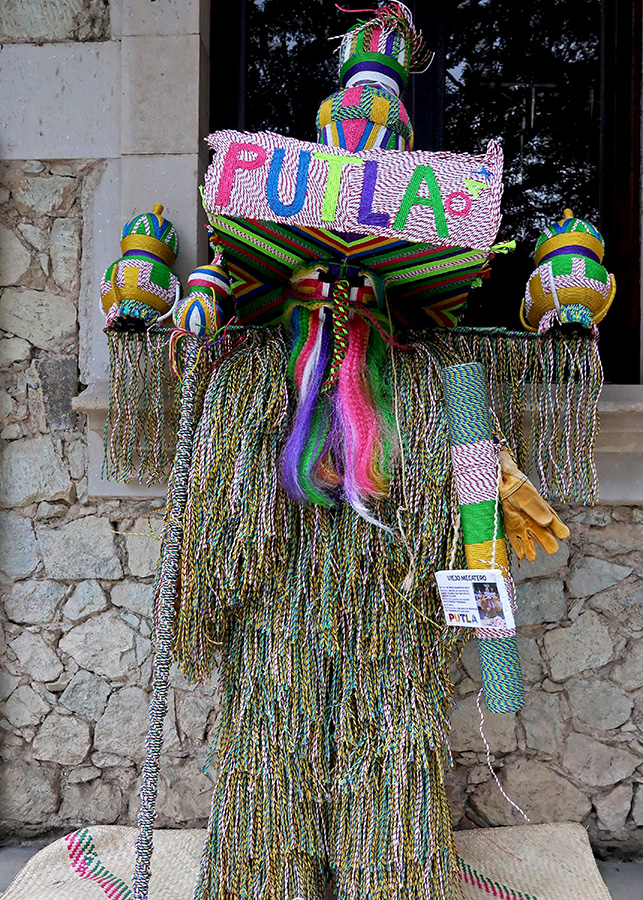
Remember these guys from my Everyone loves a parade post? They are known as Tiliches (aka, Los viejos, old ones) are a staple in the 3-day celebration of Carnaval in Putla de Guerrero, and a colorful part of the delegation from Putla during La Guelaguetza. Seeing them, it should come as no surprise that “tiliche” can be translated into English to mean junk, stuff, or rag.

Entering this year’s Festival de los Moles at the Jardín Etnobotánico de Oaxaca (Oaxaca Ethnobotanic Garden), guests were greeted by an exhibition of Tiliches — hosted by the newspaper archive, Hemoeroteca Néstor Sanchez.

Viejo de Tiliches – wearing the traditional costume of the Viejos/Tiliches during Carnaval in Putla.

Made of cloth, palm, and gourd with a mask of animal skin, suede gloves, and leather boots. It took one person a week to make.

Viejo Tapitas

Made from plastic water and soda bottle caps and hat of rafia. It took two people 45 days to make for a Carnaval 2018 costume contest in Putla and it weighs 30 kg. (66 lbs.)

Viejo Mecatero

Designed by Ángel Álvarez de Jesús and made from plastic rope, plastic thread, cardboard and silicone. It took seven people 45 days to make for the 2019 costume contest in Putla. It weighs 60 kg. (132 lbs.)

Viejo Azteca

Designed by Amando Herrera Villa and made of palm. It took him two months to make and weighs 15 kg. (33 lbs.)

The creativity here never ceases to amaze me. Unfortunately, the exhibition only ran from July 15 to 30, 2019. What fun it would be to go to Putla for their three day Carnaval celebration — where one can see hundreds of Tiliches dancing though the streets!

Read Full Post »

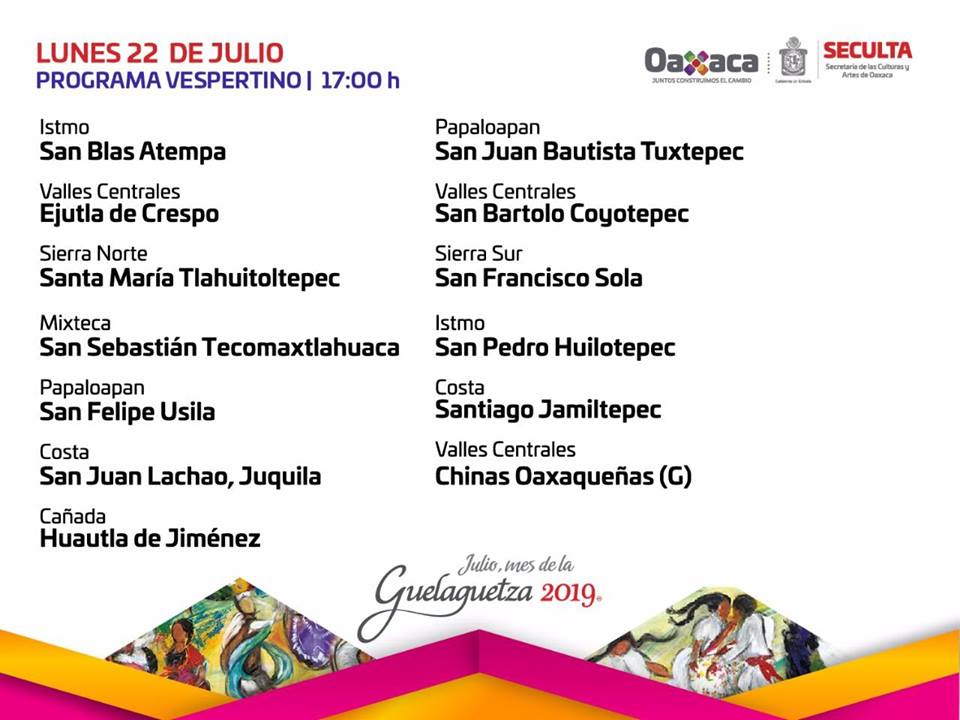
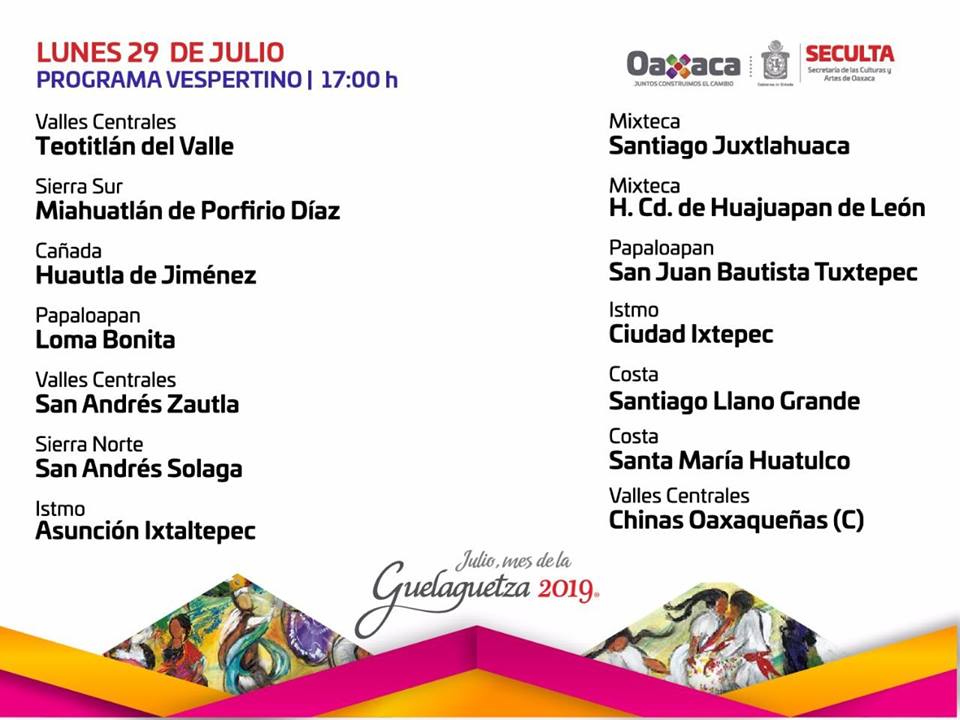
Oaxaca is filling with tourists as “Julio, Mes de la Guelaguetza” (July, month of the Guelaguetza) is upon us — a time when Oaxaca recognizes and celebrates the sixteen indigenous groups whose languages, traditions, and rich cultures long predate the arrival of the Spanish conquistadors (both military and religious) and permeate the character of the state.

San Francisco Sola delegation – Guelaguetza July 28, 2018 desfile

Every year more parades, food and artisan fairs, concerts, and regional Guelaguetzas are added.  Drawing both foreigners and nationals, it has become THE major tourist attraction for Oaxaca. [Click on images to enlarge]
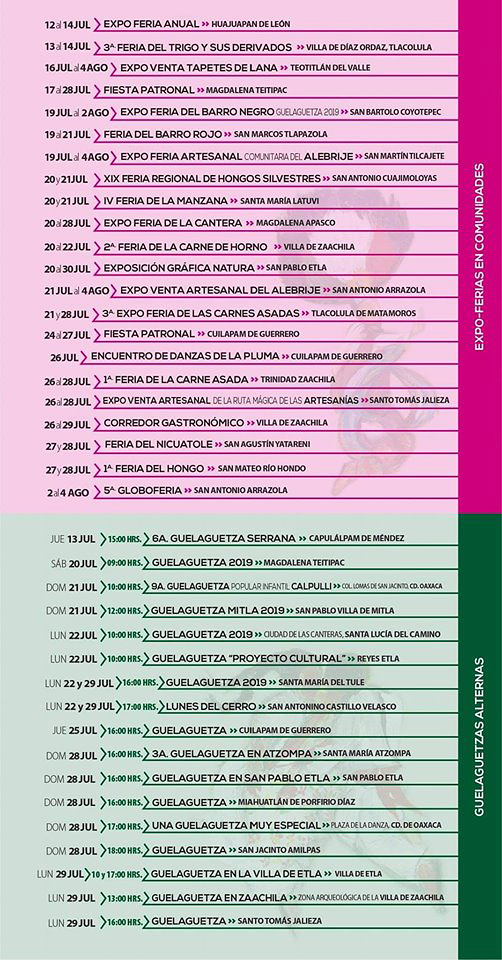
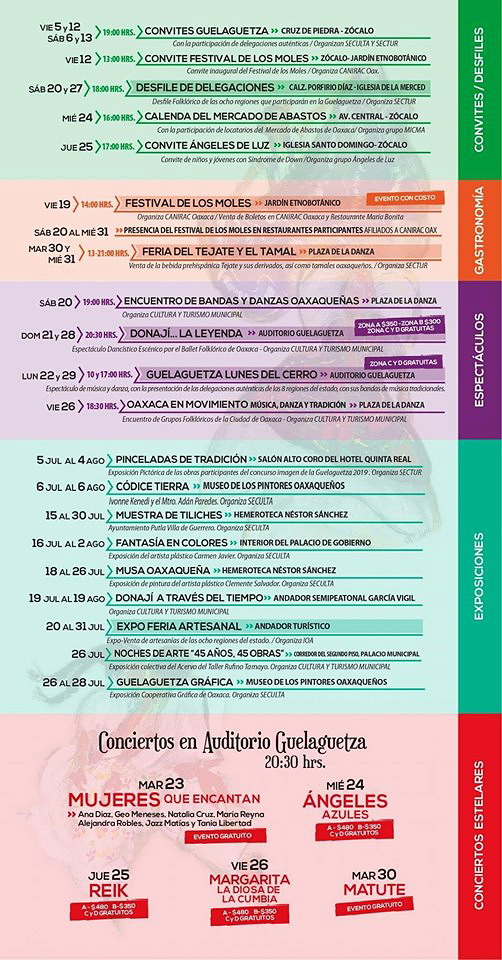
While the streets are filled with a party atmosphere and those who can afford the high-priced tickets are treated to a true spectacle — fabulous views, colorful costumes, music and dance — people question how the indigenous communities (over 50% of the state’s population and some of its poorest) actually benefit.
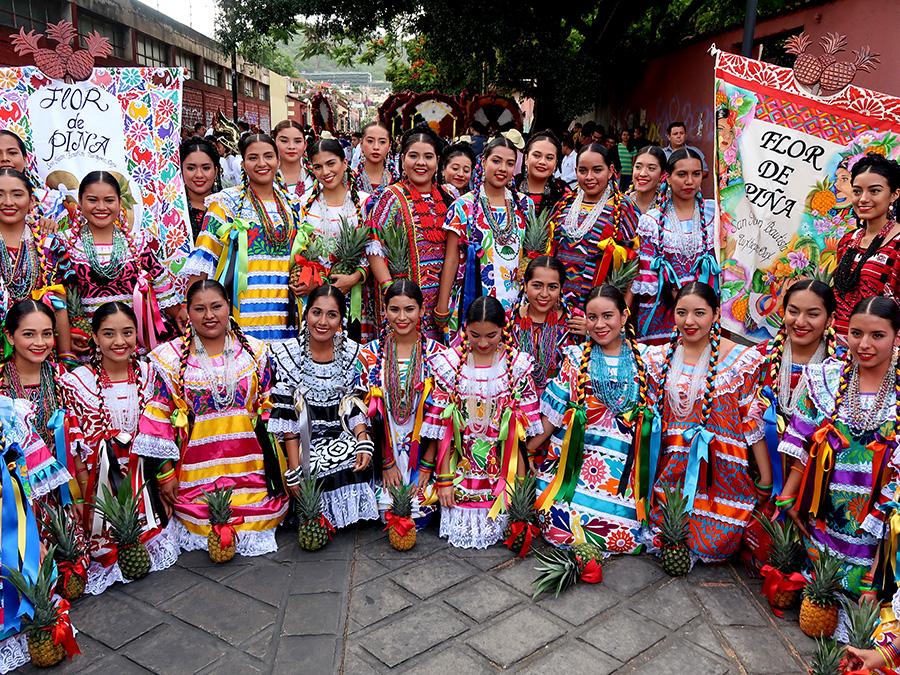
San Juan Bautista Tuxtepec delegation – Guelaguetza July 21, 2018 desfile

The dancers are not professional dancers, are not paid to perform, and most must travel from villages hours and hours away.
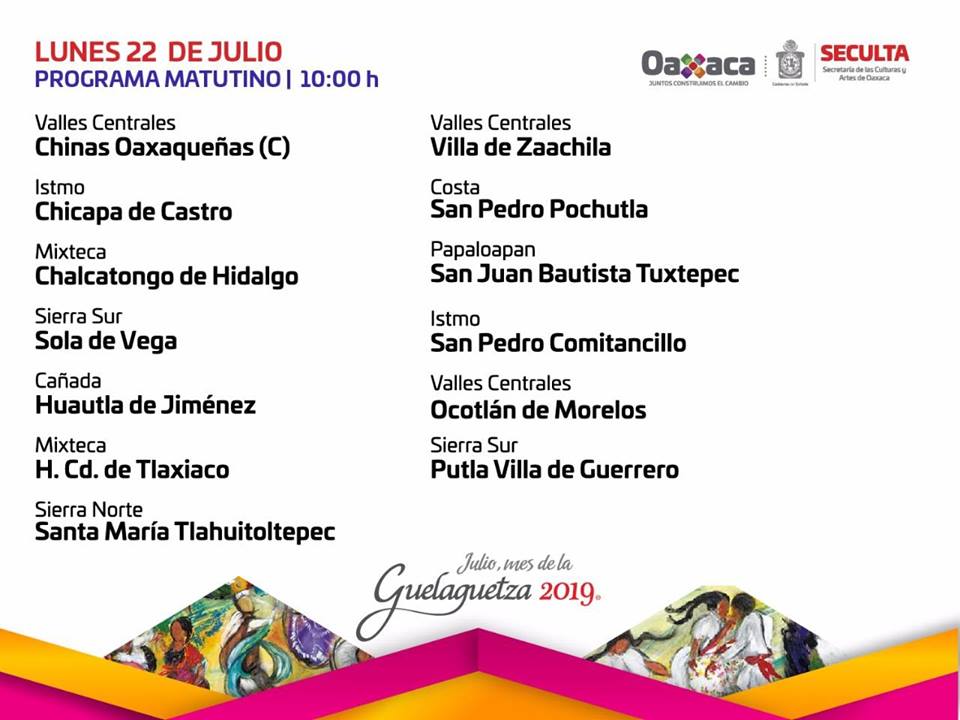
Guelaguetza1AM

July 22, 2018 morning

Guelaguetza1PM

July 22, 2018 evening

They do it for the love of their villages, pride in their heritage, and to share a little of their traditions with the world outside their communities — and I can’t help but be swept along in the joy and moved by their dedication.

Chinas Oaxaqueñas Genoveva Medina delegation – Guelaguetza July 28, 2018 desfile

To support their communities, I strongly recommend you do your shopping at the craft fairs in the city and visit the indigenous villages — buy directly from the artisans or shops that can show provenance.

Guelaguetza2AM

July 29, 2019 morning

Guelaguetza2PM

July 29, 2019 evening

The above four Guelaguetza performances, along with Donají, La Leyenda (tragic legend of the love between a Zapotec princess and a Mixtec prince — it doesn’t end well, but her face graces the official shield of the city of Oaxaca de Juárez) are usually shown live on CORTV — both on their television station and their YouTube channel.
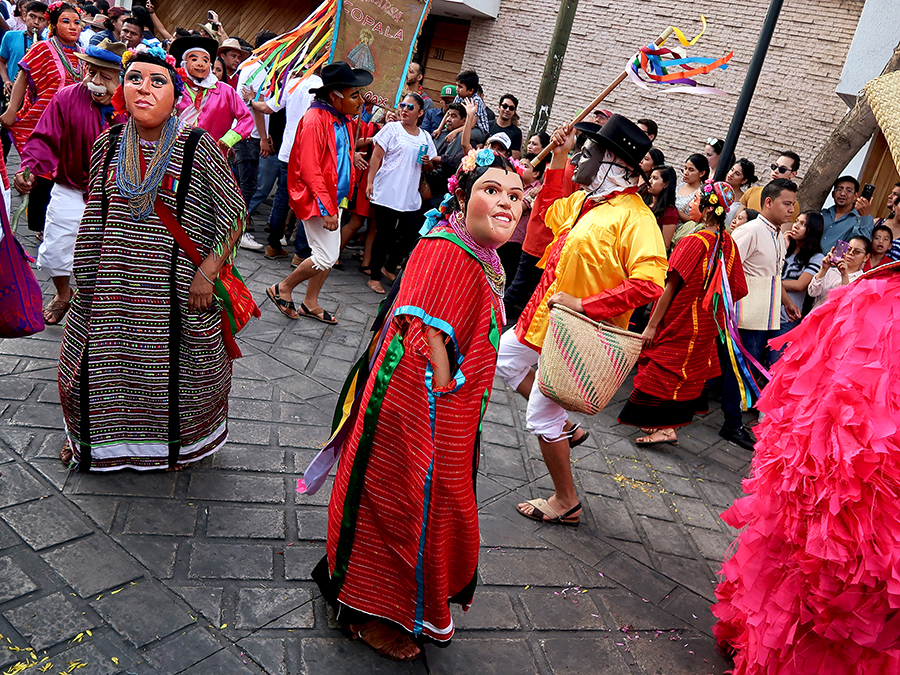
Putla Villa de Guerrero delegation – Guelaguetza July 28, 2018 desfile

Friends are arriving and my calendar is rapidly filling. Perhaps I’ll run into you at a regional Guelaguetza, at one of the desfiles in the city, the Festival de los Moles, the Feria de Hongos Silvestres in Cuajimoloyas, the Expo Feria Artesanal, the Feria del Tejate y Tamal, or at any one of the scores of other events happening here in July!

Read Full Post »

May 18 is Día Internacional de los Museos (International Museum Day).  Instituted in 1977 by the International Council of Museums (ICOM), the goal is to raise awareness of the role museums play in “cultural exchange, enrichment of cultures and development of mutual understanding, cooperation and peace among peoples.”  Traditionally, the primary mission of museums has been collecting, conservation, communication, research, and exhibition.  However, according to the ICOM:

Museums have transformed their practices to remain closer to the communities they serve. Today they look for innovative ways to tackle contemporary social issues and conflict. By acting locally, museums can also advocate and mitigate global problems, striving to meet the challenges of today’s society proactively. As institutions at the heart of society, museums have the power to establish dialogue between cultures, to build bridges for a peaceful world and to define a sustainable future.

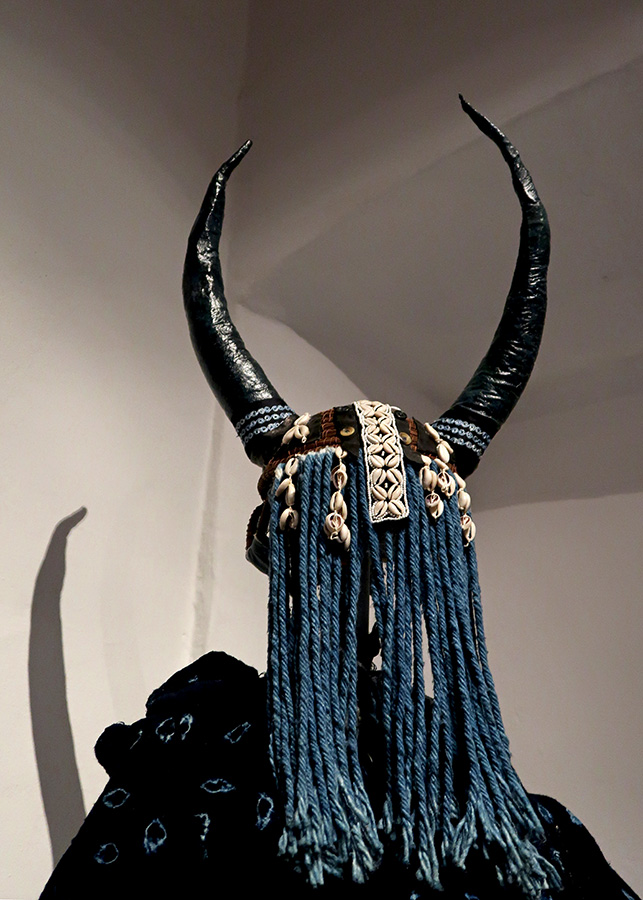
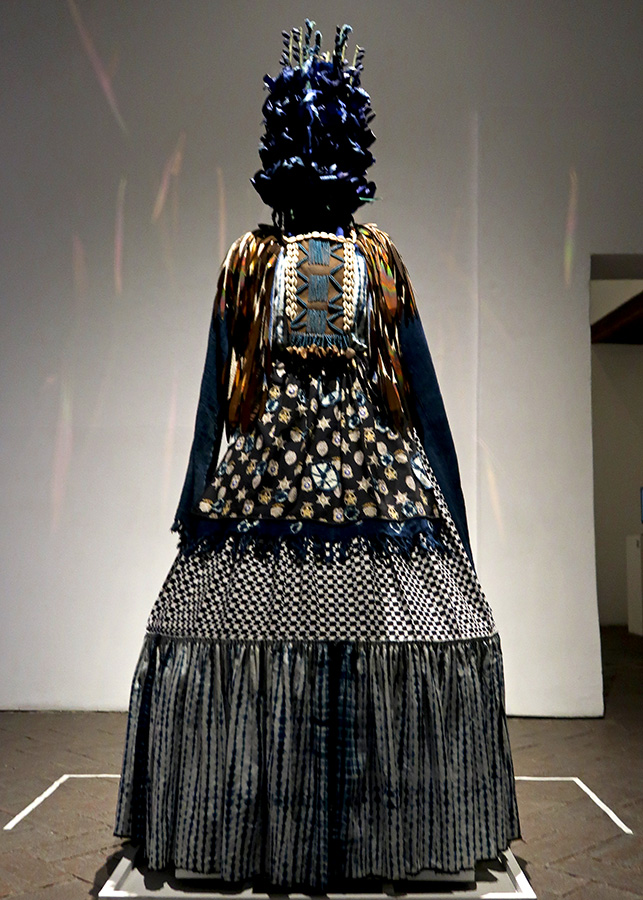
The museums of Oaxaca seem to have embraced this expanding and dynamic role — exemplified by this past winter’s exhibition at the Museo Textil de Oaxaca, Intervención Índigo, created by Laura Anderson Barbata, in collaboration with The Brooklyn Jumbies, Chris Walker, and Jarana Beat.

Performance and textiles meld the Zancudos (stilt walkers) of Zaachila, Oaxaca with the Afromexicano devil dance of Guerrero, the color indigo (a natural dye important to indigenous cultures in both Mexico and Africa), batik and beading techniques of Africa, with political commentary about the realpolitik of the African diaspora in North America.

Indigo is one of the oldest natural plant based dyes, used all over the world and ritually embedded with symbolism and spirituality; power and nobility…. Barbata employs textiles hand woven and dyed in Burkina Faso,Guatemala and the United States. The color historically represents absolute truth, wisdom, justice, and responsibility.

So, get thee to a museum near you — you will, no doubt, be enriched, enlightened, and maybe even empowered.


Read Full Post »
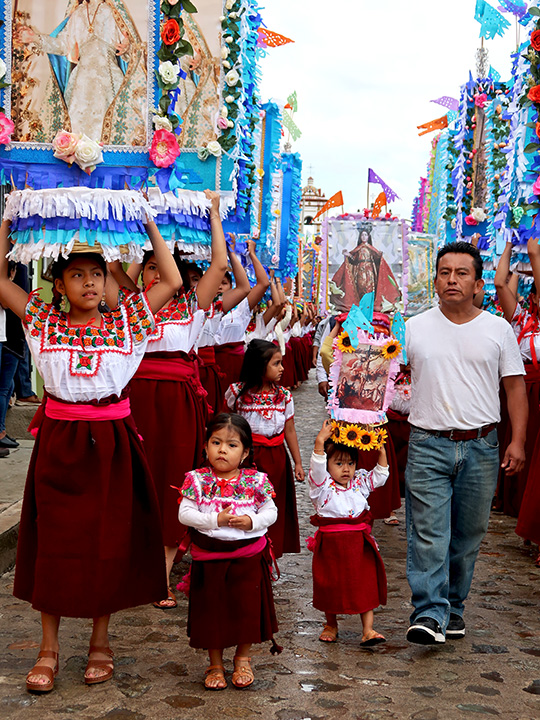
The devotion to the Virgin of Guadalupe captured the imagination of fiber artist Linda Hanna when, as an early teen, she visited Mexico with her family and saw believers crawling on their knees up to the Basilica of Our Lady of Guadalupe.

Blouse by Teresa Silvia Tzintzun, San Pedro Zipiajo, Michoacán (Purepecha).

Detail of blouse by Teresa Silvia Tzintzun, San Pedro Zipiajo, Michoacán (Purepecha).

The Virgin’s appeal continued to deepen when Linda moved to Oaxaca in 1997.  Thus the seeds/threads of the exhibition, “Rosas y Revelaciones: Homage to the Virgin of Guadalupe by Mexican Textile Artists” were sown/sewn.

Blouse by Marcolina Salvador Hidalgo, Chachahuantla, Puebla (Nahua).

Detail of blouse by Marcolina Salvador Hidalgo, Chachahuantla, Puebla (Nahua).

The legend of La Virgen de Guadalupe is known to every Mexican, every person of Mexican descent, and probably every foreigner who calls Mexico home.  The image of this dark-skinned Virgin who spoke Náhuatl is as imprinted on the national consciousness as she was on Juan Diego’s legendary tilma (cloak).

Dress by María Guadalupe Santiago Sánchez, San Antonino Castillo Velazco, Oaxaca (Zapoteco).

Detail of dress by María Guadalupe Santiago Sánchez, San Antonino Castillo Velazco, Oaxaca (Zapoteco).

Her image has continued to appear on cloth, albeit with human, not divine, intervention.  Both Father Miguel Hidalgo in the Mexican War of Independence and Emiliano Zapata, one hundred years later, during the Mexican Revolution, led their troops under the banner of Our Lady of Guadalupe.

Man’s tunic by Pascuala Vásquez Hernández, Zinacatán, Chiapas (Tzotzil, Maya).

Shawl by Adolfo García Díaz & Delvina Salinas Cruz, Tenancingo, Estado de México.

The Rosas y Revelaciones textile exhibition presents work from 52 communities in ten states in Mexico (Chiapas, Colima, Guerrero, Jalisco, Mexico, Michoacán, Oaxaca, Puebla, Tlaxacala, and Yucatán) — with the majority being from Oaxaca.

Apron by Valeria García Hernández, San Miguel del Valle, Oaxaca (Zapoteco).

Detail of apron by Valeria García Hernández, San Miguel del Valle, Oaxaca (Zapoteco).

Linda explained that she gave the artists free rein to let their imagination and expertise be their guide. I suspect these words by Guadalupe Ángela, from her poem, “Virgen de la Creación” (Madonna of Creation) composed for the exhibition, echo their prayers for inspiration and guidance:

Madonna of Creation
pull the image from me, the beauty.
Make it cedar, make it textile, make it
a landscape.  May the needle and thread be touched
by you.

Ruana by Erasto (Tito) Mendoza Ruiz, Teotitlán del Valle, Oaxaca (Zapoteco).

When you go, be sure to take the time to watch the video interviews with some of the artisans — the seriousness, devotion, and honor they felt at being selected to participate in this incredibly special project is extremely moving.  The show is currently at the Museo Estatal de Arte Popular Oaxaca (MEAPO) (closed on Mondays) in San Bartolo Coyotepec, Oaxaca and runs through March 17, 2019 (extended until April 28, 2019) — after which it will be prepared to tour.  Its first stop will be at the Museo Nacional de Culturas Populares in Coyoacán, Mexico City — in time for Día de la Virgen de Guadalupe on December 12, 2019.

(ps)  Linda is hoping the exhibition will develop wings and fly throughout Mexico and eventually to the USA.  If you have contacts in the museum world who might be interested in hosting this exhibition, please be sure to contact Linda Hanna at Casa Linda.

Read Full Post »
Older Posts »