Feeds:
Posts
Comments

Archive for the ‘Culture’ Category

… to the fabulously fabulous and ridiculous; a traditional comparsa on the morning of November 2, 2011.  After hiking up to the top of the hill in Vista Hermosa (beautiful view), Etla, following the sound of music, a surreal sight unfolded…

This slideshow requires JavaScript.

We tagged along with the band, dancers, and their friends and neighbors, up and down the hills, navigating steep dirt paths, as they played, danced, drank mezcal, and stopped in front yards for much-needed rest and refreshments of caldo de pollo (chicken soup), pan de muerto (Days of the Dead bread), and mezcal… of course!

By the way, did I mention, these guys and (one) gal, had been playing and dancing all night long?!!

Read Full Post »

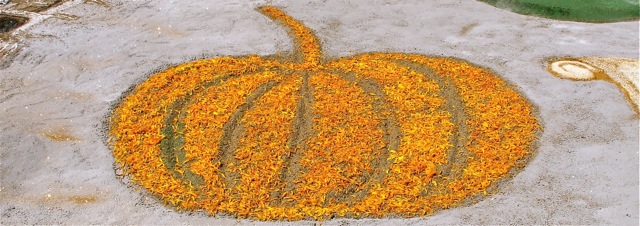
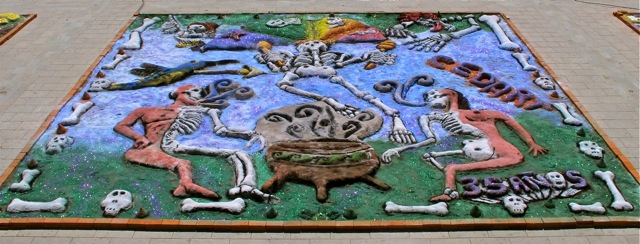
The tapetes de arena are finished and cover the stone flooring of the Plaza de la Danza.  Always difficult to photograph, the following are an experiment in cropping.

Centro de Educación Artística Miguel Cabrera

Casa de Cultura de Tlacolula de Matamoros

Escuela de Bellas Artes de la Universidad Autónoma Benito Juárez de Oaxaca

Several other organizations participated and among the unsigned are tapetes de arena from Casa de las Artesanías de Oaxaca, Sociedad Civil de Maestros Oaxaqueños del Arte Popular, and Grupo Colectivo Camaleón.

Walk with us…

And for those in el norte…

A happy and safe Halloween!


Read Full Post »

Tourists are arriving by planes, buses, and automobiles.

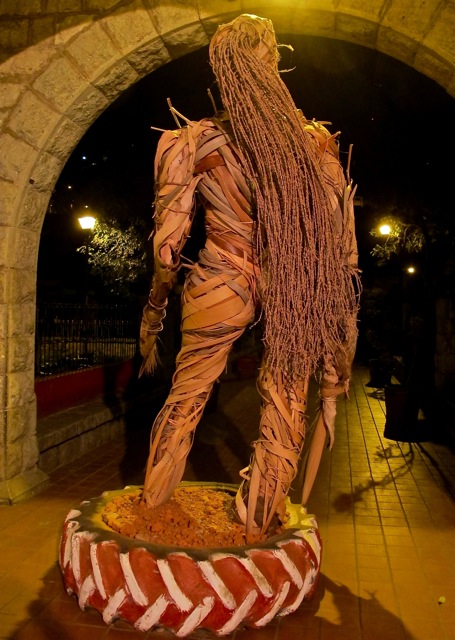
Human scupture of palm

The streets, hotels, restaurants, and shops of Oaxaca are filling for los Días de Muertos.   Hopefully, before they depart…

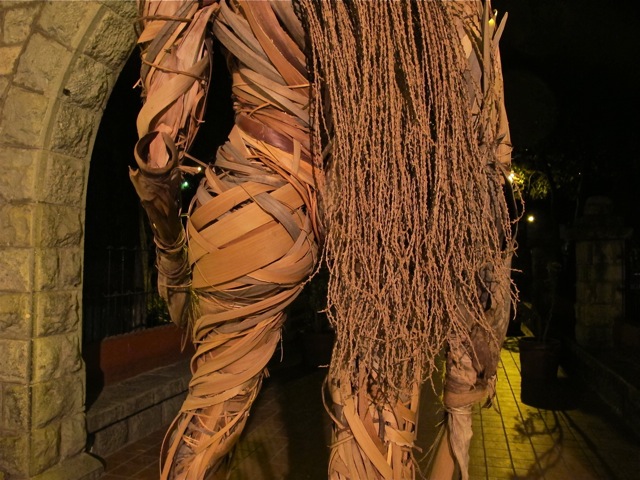
Back view of palm leaf female sculpture

…they will spread a little wealth; and, when they return to their homes, they will sing Oaxaca’s praises.  Alas, their comings and goings won’t be by train.  Passenger train service is no more and the old railroad station opened as the Museo del Ferrocarril Mexicano del Sur in 2003.

And that is where you will find this shapely resident, as you come and go.


Read Full Post »

Strolling up Macedonio Alcalá on Sunday, I stumbled on an exhibit and workshop being set up in the middle of this walking street, courtesy of Puntos de Encuentro, Primer Festival de Artes Visuales Oaxaca 2011 (Meeting Points, the First Visual Arts Festival, Oaxaca 2011).

This slideshow requires JavaScript.

Reason number ??? (I’ve lost count) why I love Oaxaca!!!

Read Full Post »

Yesterday, a couple of gal pals and I headed south of the city to San Martín Tilcajete.

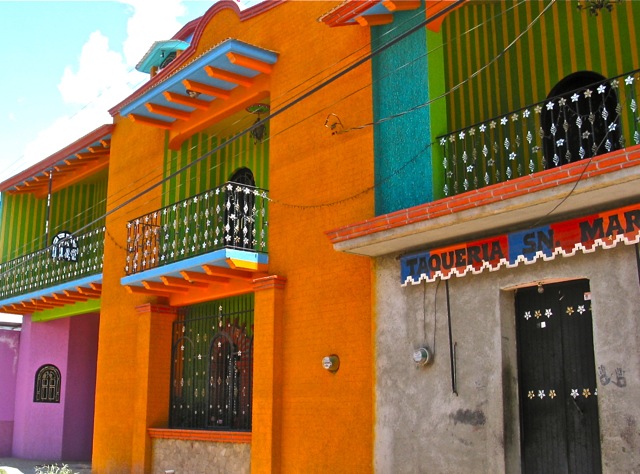
Colorfully painted buildings
They were in search of alebrijes (hand-carved and intricately painted wooden creatures).  We shared the roads…

Herd of goats and goat herders on a dirt road

and the sidewalks with local inhabitants.

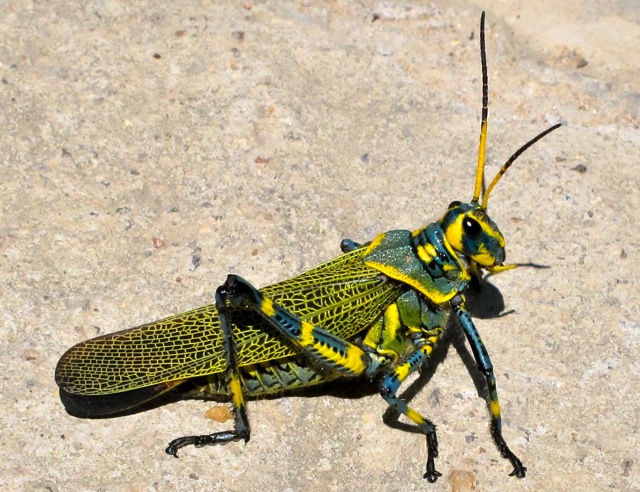
Green grasshopper with yellow and black markings on sidewalk.

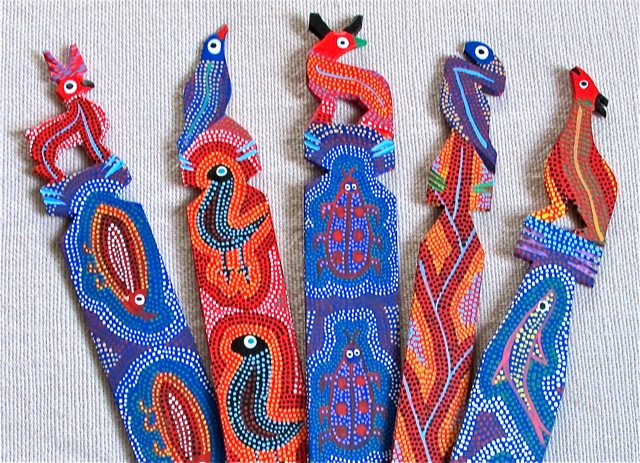
With real critters like this, it’s no wonder the carvers and painters of San Martín Tilcajete are inspired to imagine and create the beautiful and fanciful.

Intricately painted wooden bookmarks topped with colorful creatures.

I hadn’t planned to buy anything, but couldn’t resist a colibrí refrigerator magnet, to add to my growing collection of hummingbirds… both real and imagined!

Brightly painted wooden refrigerator magnet

While there, we discovered San Martín Tilcajete will be holding an exposition at the end of the month to showcase, promote, and (hopefully) sell Oaxacan folk art.

Poster for the exposition of Oaxacan folk art on Oc. 28 - Nov. 3

In addition, the Oaxaca Lending Library will be presenting a slide show on Oaxacan Folk Art on October 26.

Read Full Post »

Octavio Paz, writing about the Mexican independence movement in The Labyrinth of Solitude:

The eighteenth century prepared the way for the Independence movement.  In fact, the science and philosophy of the epoch… were necessary intellectual antecedents of the Grito de Dolores.  [p. 118]

…the insurgents vacillated between Independence (Morelos) and modern forms of autonomy (Hidalgo).  The war began as a protest against the abuses of the metropolis and the Spanish bureaucracy, but it was also, and primarily, a protest against the great native landholders.  It was not a rebellion of the local aristocracy against the metropolis but of the people against the former.  Therefore the revolutionaries gave greater importance to certain social reforms than to Independence itself:  Hidalgo proclaimed the abolition of slavery and Morelos broke up the great estates. 

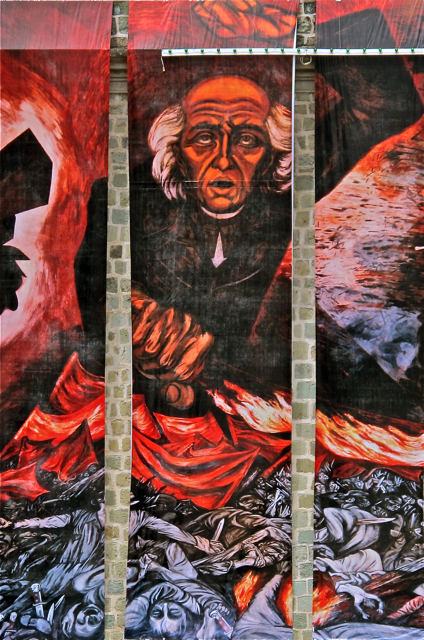
Banner on Oaxaca's Municipal Building; reproduction of mural by José Clemente Orozco of Miguel Hidalgo y Costilla.

The Revolution of Independence was a class war, and its nature cannot be understood correctly unless we recognize the fact that unlike what happened in South America, it was an agrarian revolt in gestation.  This is why the army (with its criollos like Iturbide), the Church and the great landowners supported the Spanish crown… [p. 123]

Paz, Octavio.  The labyrinth of solitude, the other Mexico; Return of the labyrinth of solitude; Mexico and the United States; The philanthropic ogre.  New York:  Grove Press, 1985

Read Full Post »

Seen at the Biblioteca Pública Central Margarita Maza de Juárez on Friday…

Heart on the right?  Don’t mess with this librarian!

Shhhh…

Whew!  just part of an eye-catching exhibition at the library.

Read Full Post »

My Spanish language abilities are progressing little by little (poco a poco).  However, one thing my wonderful and extremely patient Spanish teacher, Laura Olachea, has neglected to cover is Madre-isms; those too numerous to count and unique to Mexican Spanish, expressions that the mamas, hijas, and hermanas for the most part never use, at least not in mixed or polite company.

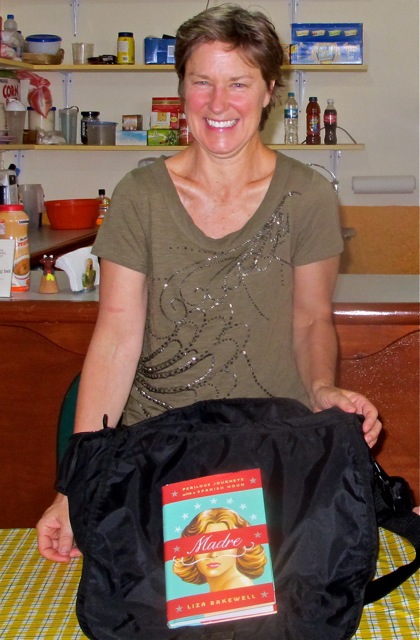
Of course, being that one doesn’t know what one doesn’t know, I was oblivious!  Oblivious, that is, until I read Norma Hawthorne’s review of the new book, Madre: Perilous Journeys With a Spanish Noun, by Liza Bakewell.  Intrigued, I purchased the book when I was in el norte in June and immediately plunged in.
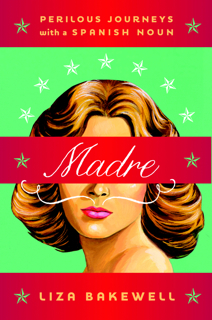
Cover of book, Madre: Perilous Journeys With a Spanish Noun, by Liza Bakewell

In July, while I was immersed in the “madre” minefield, Liza arrived in Oaxaca for some much-needed R & R, to write an article or two, and to promote her book.  I had the pleasure of getting to know her (she’s warm, smart, and funny), eat one of Aurora’s (you will meet her in the book) empanadas, and assist with setting up a couple of speaking engagements.  The first, in English, was at the Oaxaca Lending Library, where the audience was overwhelmingly women and, as expected, mostly gringas.  There was much surprise and laughter as Liza read excerpts from the book, expanded on points, and answered numerous questions.

Liza Bakewell at the Oaxaca Lending Library showing her book, Madre...

The second speaking engagement, the following evening, was at the Instituto de Artes Gráficas de Oaxaca (IAGO) and was conducted all in Spanish.  And here, surrounded by the Rini Templeton exhibit, I looked around and noticed the majority of people attending were Mexican men.  However, like Guillermo Fricke, Director of IAGO, people listened closely, occasionally chuckled knowingly, and stayed to ask questions and make respectful and thoughtful comments.
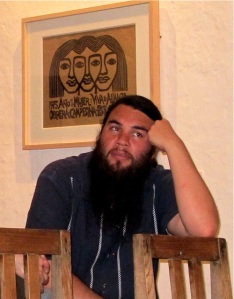
Guillermo Fricke listening to the talk by Liza Bakewell at IAGO

It was a much more reserved gathering than the day before, but no less attentive and appreciative.  And, reflecting on previous events and observations and now reading Labyrinth of Solitude, by Octavio Paz, I’m coming to understand, except for fiestas, that is the Mexican way.  Though, I wonder, if it had been all Mexican women in attendance, would it have been different?  I think so.  There is something about the bond women share that crosses boundaries and cultures….

However, thanks to Liza, at least while in Mexico, I may never utter the word, madre, again!

(ps)  If your local library doesn’t have Madre: Perilous Journeys With a Spanish Noun, ask them to order it!

(pps)  Another insightful review of Madre has just appeared on GlobetrotterGirls.com

Read Full Post »
Tomorrow marks the 100th anniversary of the birth of comedian, actor, writer, and producer, Cantinflas.

Cantinflas head shot with hat on

Fortino Mario Alfonso Moreno Reyes was born in the Santa María la Redonda neighbourhood of Mexico City, and grew up in the tough neighborhood of Tepito. [4] He made it through difficult situations with the quick wit and street smarts that he would later apply in his films. After an unsuccessful attempt to enter the United States through California, he became a prizefighter in his teens as a source of income.[5] His comic personality led him to a circus tent show, and from there to legitimate theatre and film.  [Read full Wikipedia entry]

Reading the following article recalled fond memories of watching Cantinflas on the big screen in the films, Pepe and Around the World in Eighty Days and, on our black and white TV, in old Mexican-made movies.  Like Charlie Chaplin’s little tramp character, even as a child, I “got” and identified with the everyman characters Cantinflas portrayed and understood he was often the smartest character in the story.

Mexico Marks Century Of Comic Cantinflas’ Birth

MEXICO CITY August 11, 2011, 05:23 am ET
It is hard to think of a Mexican Everyman without turning to Cantinflas, the tattered, droopy-pants character created by comic Mario Moreno in the “tent theaters” of Mexico’s slums in the 1930s.

With the approach of Friday’s centenary of his birth, he has been celebrated as a touchstone of Mexican national identity, fondly remembered for his convoluted doublespeak and clever underdog persona he portrayed for nearly six decades until his death in 1993.

He is best known in the rest of the world for his turn as David Niven’s resourceful valet in “Around the World in Eighty Days,” but the pencil-mustached Cantinflas contributed something much deeper in Mexico… Cantinflas reflected the poorer side of Mexico that gets by on its wits… Wise behind his seeming illiteracy, able to snowball the pompous with a stream of clever but meaningless verbiage, Cantinflas was able to make the transition to movies, where he can still be seen winning out over snobs, bureaucrats and corrupt politicos….  [Read full article]

(ps)  Update:  from the NPR program, All Things ConsideredThe Chaos And Comedy Of Mexico’s Cantinflas.   h/t  gg

Read Full Post »
Currently, the Instituto de Artes Gráficas de Oaxaca is exhibiting the work of Rini Templeton; three rooms of her iconic work.  For those who may not be familiar with the name, there is a good reason…

For 20 years an extraordinary artist-activist named Rini Templeton drew struggles of grassroots people in the United States, Mexico and Central America. She made thousands of drawings, didn’t sign them and gave them away freely, so her name remains unknown while her work is widely known, used and loved.  [Read full biography at RiniArt.org]

As the former director of a labor library and archive, the exhibition kindled so many wonderful memories of this talented, committed, and inspiring woman’s work.

Read Full Post »
Yesterday, I opted for the smaller and more intimate Guelaguetza in the Villa de Etla, about 12 miles northwest of Oaxaca city.  As far as I could tell, seven of the eight regions of the state of Oaxaca were present; only the Sierra Sur was missing.  FYI:  In the photos below, I purposefully left out the Plume dancers, who represented the Valles Centrales, as you will find plenty of photos of the Danza de la Pluma in my postings from the Fiesta de Preciosa Sangre de Cristo in Teotitlán del Valle.  By the way, Chris at Oaxaca-The Year After posted a terrific Guelaguetza Guide to assist in identifying the regions of Oaxaca.  It’s in Spanish, but even a non-Spanish speaker can learn quite a bit.

On a more serious note… I was reminded today by a Oaxaqueña friend, Guelaguetza in the city of Oaxaca is controversial.  Tickets (available through TicketMaster, I might add) for reserved seating to the official performances on Cerro Fortín at the (newly renovated and hotly disputed) Guelaguetza Auditorium are beyond the reach of most Oaxaqueños, some events are sponsored by Coca Cola, hundreds of thousands of pesos of tax payer monies have been spent on the sound and light show (spectacular, as it is), nightly fireworks, bringing in celebrities, and slick, though often inaccurate, publicity.  All is geared (well, not the inaccuracies) toward tourists; a boon to the restaurants and hotels around the zócalo.  But…

Unfortunately, what is lost is that the Guelaguetza is supposed to be a celebration that brings together the extremely diverse indigenous communities, from the various regions of the state to share their crafts, food, dance.  It wasn’t supposed to be crass commercialism that caters to tourists and well-heeled locals, at the expense of peoples who originated the tradition.  And, my friend asked, along with admiring their costumes and colorful dances, wouldn’t a portion of the pesos be better spent attending to the real and extremely pressing needs of the poverty stricken indigenous communities, especially with regard to infrastructure and education?

However, yesterday in Etla, I caught, perhaps, a glimpse of the original meaning of Guelaguetza.  Admission was free and open to one and all.  Free tamales and beverages (alcoholic and non) were offered to the standing-room only crowd, along with the sombreros, baskets, fans, whisk brooms, tlayudas, and fruit that each of the delegations of dancers tossed to the audience at the end of their performances.  After it was over, fellow blogger Chris and I looked around and realized, we were probably the only gringo and gringa in attendance.  What an honor and privilege!

Read Full Post »

The rain held off long enough today for the conclusion of  Oaxaca’s Sexto (6th) Festival Nacional de Danzón.  Like last year, I was captivated by young and old, feet and faces, formality and style, intensity and joy; and everything in between coming together under the laurels of the Zócalo.

This slideshow requires JavaScript.

Hmmm…  I wonder if I can work up the nerve to inquire about dance lessons at the studio around the corner???

Read Full Post »

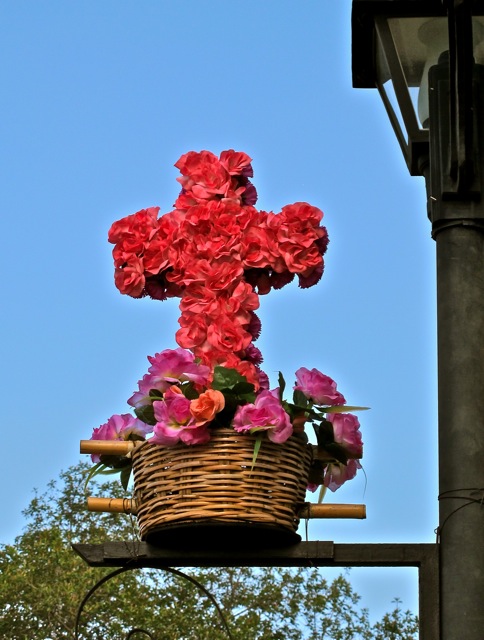
Just strolling along Constitución en route to and from the Oaxaca Lending Library.  First en la mañana…

Cross of flowers extending from a lamp post

and across Reforma, pasted on one of the previously mentioned Old and dangerous buildings.

Poster pasted on side of building advertising "Tianguis Cultural; Libertad y Resistencia; Plazuela del Carmen Alto; 25 Julio - 01 Agosto"

And then, en la tarde… father, son, and daughter waiting to perform on a stage set up at the Jardin El Pañuelito.

Father, daughter, and son dancers sitting on sidewalk waiting to perform

Going from here to there is never just going from here to there!

Read Full Post »

Last night I, along with thousands of others, gathered on the Alameda, with eyes gazing upwards at the “espectáculo” being projected on the facade of the Cathedral.

Three projectors allowed alebrijes to march across the front of the Cathedral, tapetes to hang from the rooftop, and tin ornaments to be displayed, as if they were on a wall in a mercado waiting to be purchased.  Buildings collapsed and were rebuilt, vines reclaimed a pyramid, and so much more.  It was accompanied by music familiar to anyone who has spent more than a day in Oaxaca.  And, at the end, Flor de Piña was heard as fireworks erupted over the Cathedral.

This slideshow requires JavaScript.

And so, for whatever role they may have played, my hat is off to the two guys hanging around in their hammocks, mentioned in my July 20 and July 24 posts.  The Sinfonía de Luz y Sonido was, indeed spectacular!

Rumor has it that it is being streamed, though I haven’t discovered the link as yet.  If I find it, I promise to add it to this post.

Read Full Post »

For the first time, live internet streaming of today and tonight’s (and presumably next Monday’s) Guelaguetza performances  at:  http://www.telmex.com/guelaguetza

Guelaguetza Auditorium

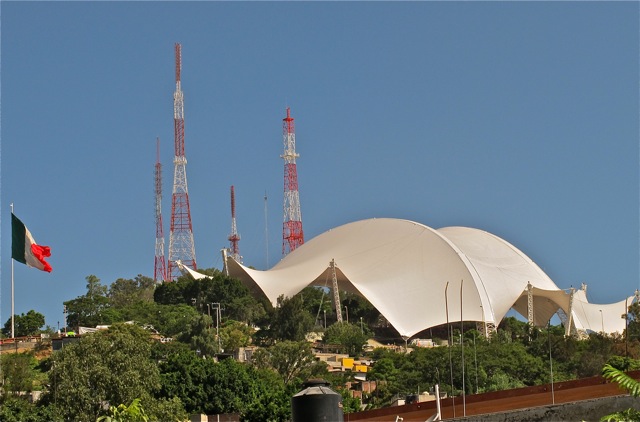
As you can see from the photo I just took of the Guelaguetza Auditorium, it is a stunning blue-sky Oaxaca day.

Read Full Post »

« Newer Posts - Older Posts »