Feeds:
Posts
Comments

Archive for the ‘Creativity’ Category

Today the Oaxaca Lending Library played host to Oaxaca FilmFest4 founder and artistic director, Ramiz Adeeb Azar.  He and 4 members of the festival staff came to the library to “pitch” the festival, which opens September 21 and runs through the 28th.  (Note:  it has moved from November to September).  It wasn’t a hard sell, as many of us have been following it since it began in 2010.  And, I’ve got to say, it’s come a long way in a short amount of time.  According to Ramiz, it has…

  • Grown to be one of the Largest International Film Festivals in Latin America
  • Discovered over a dozen films that have gone onto commercial success
  • Created a highly competitive Script Writing Competition.
  • Created “Pitch It”; a unique platform that allows screenwriters to sell their scripts to industry executives around the globe
  • Conducted the longest University Rally ever (10 days throughout the entire state!)
  • Rolled out Academia; a five-day training program designed to enhance Festival Attendees’ self-distribution skills
  •  Developed Academia Exchange; a unique exchange between filmmakers and students

  • Gained membership of the Mexican Film Festival Association (La Red Mexicana de Festivales Cinematográficos) and in 2013 was the host of their national conference
  • Gained recognition as an official IMDB Film Festival

The festival has already set up shop in Plaza San Jerónimo (on Macedonio Alcalá) where staff and volunteers are hard at work and, like last year, the site will serve as the festival’s Hospitality and Information Center.

If you love film, but have never been to a film festival, I highly encourage you to give it a try.  Prior to relocating to Oaxaca, for 7 years, one of the highlights of my calendar year was volunteering at the Mill Valley Film Festival.  Besides being a lot of fun (never forget, on my hands and knees mopping up spilled red wine at the feet of Katherine Ross and Sam Elliot), I had the opportunity to see some truly wonderful films — especially shorts and documentaries that are rarely shown in the big chain multiplexes.  The MVFF was one of the things I missed most (along with crusty sourdough bread and being able to flush toilet paper down the toilet) when I moved down here.

However, along came the Oaxaca FilmFest and, though it didn’t satisfy my craving for sourdough bread or cause new plumbing to be installed in Oaxaca, it does come with a well-considered, eclectic, and always creative selection of films (feature-length and shorts) from all over the world.

Last year, El último hielero (The Last Ice Merchant) a touching documentary from Equador was a favorite of mine, as was The Cart, a humorous short from Russia.  And, if the two short films Ramiz showed today —  the animated, Sleight of Hand and the very moving, Part of the Change — were any indication, the selectors did a terrific job again this year.  So, if you are in Oaxaca, get thee to the Oaxaca FilmFest4 information center at Plaza San Jerónimo and pick up your festival schedule or download it from the festival website.

FYI:  All screenings are public and free (except Cinemex and Foundation Nights) and every film is projected in its original language, with Spanish, English, or dual subtitles.

Read Full Post »

The Danza de la Pluma penachos (headdresses), capes, and leggings are spectacular and unique to Teotitlán del Valle.  The feathered designs on the penachos are more intricate and varied than in other pueblos; and the capes and leggings are hand-woven in this village that is internationally known for its weaving.  However, while the Danza de la Pluma is a crowd-pleaser during the annual July Guelaguetza on Cerro del Fortín in Oaxaca, folkloric groups from other villages are usually chosen to perform it, as Teotitlán’s costumes are not considered “authentic.”

IMG_4828

However, performing for tourists is not why Teotitlán del Valle tells this story through music and dance several times a year.  It is performed on the church plaza, not the municipal plaza, because it is an integral part of the annual major religious celebrations of the village:  Fiesta titular a la Preciosa Sangre de Nuestro Señor Jesucristo in July, Fiesta a la Natividad de la Virgen María in September, Fiesta a el Rosario de la Virgen María in October, and Fiesta a la Virgen de Guadalupe in December.

Penachos from the Fiesta a la Natividad de la Virgen María on Sunday…

Capes from Sunday’s Fiesta a la Natividad de la Virgen María and July’s Preciosa Sangre de Nuestro Señor Jesucristo festival.

Leggings from both festivals…

The various elements of the costumes do not come cheap and dancers must appeal to their extended families to assist in commissioning each of the pieces.  Thus, as annual festivals come and go during a dancer’s 3-year commitment, the costumes may evolve.

With their performances, the dancers honor the rituals of their church and community.  And, with their magnificent costumes, they pay homage to the creativity, talent, and tradition of Teotitlán del Valle’s weavers and feather artists.

Read Full Post »

More from the Hecho en Oaxaca exhibit…

P1100004

The courtyard at the Museo de Arte Contemporáneo de Oaxaca (MACO)…

P1100060

Art is the tree of life.  — William Blake


Read Full Post »

Work in progress on Tinoco y Palacios by Jorel and the Rhu Crew…

P1080919

Up close and personal…

All finished!

P1100148

Read Full Post »

Another wall, courtesy of the Hecho en Oaxaca urban art project of the Museo de Arte Contemporáneo de Oaxaca (MACO).  It reminds me of the John Mayer song,

Waiting on the World To Change

Me and all my friends
We’re all misunderstood
They say we stand for nothing and
There’s no way we ever could

Now we see everything that’s going wrong
With the world and those who lead it
We just feel like we don’t have the means
To rise above and beat it

Wall art of boy sitting

So we keep waiting
Waiting on the world to change
We keep on waiting
Waiting on the world to change

It’s hard to beat the system
When we’re standing at a distance
So we keep waiting
Waiting on the world to change

Now if we had the power
To bring our neighbors home from war
They would have never missed a Christmas
No more ribbons on their door
And when you trust your television
What you get is what you got
Cause when they own the information, oh
They can bend it all they want

That’s why we’re waiting
Waiting on the world to change
We keep on waiting
Waiting on the world to change

It’s not that we don’t care,
We just know that the fight ain’t fair
So we keep on waiting
Waiting on the world to change

And we’re still waiting
Waiting on the world to change
We keep on waiting waiting on the world to change
One day our generation
Is gonna rule the population
So we keep on waiting
Waiting on the world to change

We keep on waiting
Waiting on the world to change

~~~

But, then again, maybe he’s waiting to join the struggle to make the change…

Read Full Post »

I think I’ve mentioned several times before, Oaxaca is filled with art — in the streets, museums, and galleries.  New venues crop up regularly and exhibit openings, replete with mezcal, cervesa, and botanas, seem to occur a couple of times a week.  I can’t keep track!

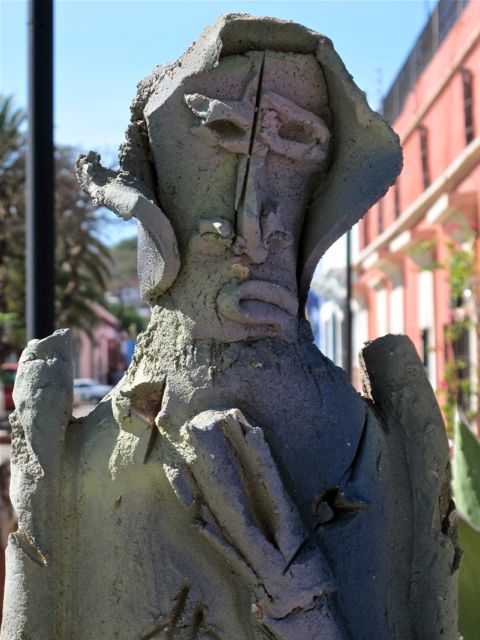
A few days ago, on our way to La Popular for tortas, my friend (and artist) Laurie Fisher and I stopped by the Galería Noel Cayetano Arte Contemporaneo to see the current exhibit, Los Apóstoles (The Apostles).  Male and female, they are all self portraits by Nayarit born sculpture and painter, Vladimir Cora.

Cora dedicated the exhibition to all all those who do their job well have not been corrupted.  “Todos tenemos un apostolado y si lo haces honestamente, esta exposición es para ti.” — Vladimir Cora (Noticias, 10 agosto 2013)

The Cayetano gallery is upstairs at the Plaza Santo Domingo, M. Alcalá 405-30 in Oaxaca city.

Read Full Post »

Congratulations to one of my favorite weavers, Amalia Martínez Casas from the mountain village of Tamazulápam del Espíritu Santo, winner of the 13th Popular State Art Prize “Benito Juarez” 2013.  The award, presented several days ago by Oaxaca governor Gabino Cue, recognized and honored her work using the backstrap loom, using cotton thread and wool dyed with indigo and banana peel, to weave the traditional costume of Tamazulápam in the Mixe.

Three or four times a year, an artisan fair is held in Llano Park.  Puestos upon puestos of pottery, wood carved alebrije, jewelry, and textiles are on display.  It was here, two years ago, where I first discovered the exquisite work of the tiny and talented weaver, Amalia Martínez Casas.

IMG_4175

I couldn’t resist buying this huipil; a subtle black on charcoal grey that looks both traditional here in Oaxaca and very hip with black leggings and boots in el norte.

And, then the next time, even though the dye was a little uneven, I couldn’t resist buying this short huipil — the color had me at, hola!

Her well-crafted technique and finely drawn designs are sophisticated, be they executed in subdued huipiles or brilliant red serapes.

Every time I wear one of her works of art, people ask, “Where is it from?”  “Who made it?”  “Where can I get one?”  I’ve pointed several friends to her stall in Llano Park during artisan fairs and last week, at the request from a friend in California, I bought this one.  The slight green tint will be perfect with her red hair.  (Yes, this one’s for you, Louise!)

Photos of the award ceremony can be found HERE and video is available HERE.  (Amalia Martínez Casas can be seen beginning at 6:00 minutes.)  And, for more of her creations, check out a blog post Chris did last January.

Read Full Post »

Some of my closest friends have been (and continue to be) musicians.  And, one of the things I find so appealing about Oaxaca is that music is everywhere and all the time.  Marimbas are set up on sidewalks, accordions are almost ubiquitous, and free concerts occur weekly in the zócalo.  Music is honored and valued as an integral part of the culture — a birthright.

Each of the 8 regions of the state has its own distinctive “sones” and “jarabes” and they are tremendous source of pride.  Within a bar or two of Pinotepa,  Canción Mixteca, or any one of Oaxaca’s regional anthems, the clapping begins, tears may well up, and audiences of all ages begin singing the lyrics.  Thus, a major feature of the modern “Mondays on the Hill” that is Guelaguetza, is the performance of the music and dance of each of the regions.

And, so I give you, some of the musicians who played almost non-stop for 3 hours, while their delegations danced their way through the streets of Oaxaca city during the last two Saturday evening Guelaguetza desfiles (parades).

This slideshow requires JavaScript.

Here’s to the musicians, long may they play!


Read Full Post »

Yesterday, in the midst of Guelaguetza festivities, Oaxaca learned of the death of one of her beloved artists.   A sculpture and painter, Alejandro Santiago was only 49 years old when he succumbed to a massive heart attack.

Image of Alejandro Santiago projected on screen at Homage

Image of Alejandro Santiago projected on the screen at today’s Homage

Perhaps his most important work resulted from a return to the Zapotec village of his birth, San Pedro Teococuilco, after many years away.  He was moved by the large numbers of men and women who had left, leaving it almost deserted.  Inspired and feeling the need to make a statement about what had happened to his pueblo, and countless others in Mexico, he created a massive exhibition of 2501 sculptures, an homage to those who had left, plus one — those who are yet to make the journey northward.

One of his 2501 Migrants from a 2012 exhibit along Macedonio Alcalá,

One of his 2501 Migrants from a 2012 exhibit along Macedonio Alcalá,

There was an Homage to Maestro Alejandro Santiago this morning at the Teatro Macedonio Alcalá.

Casket of Alejandro Santiago on the stage of Teatro Macedonio Alcalá

Casket of Alejandro Santiago on the stage of Teatro Macedonio Alcalá

And, according to Think Mexican, there will be a memorial “in the coming days at La Calera.”

For more photos from the 2501 Migrants exhibit, see my blog post The path of the migrant.

Update:  Valerie J. Nelson has written a lengthy tribute to Alejandro Santiago for the Los Angeles Times.

RIP, Maestro.


Read Full Post »

Oaxaca is alive with street art these days — even more than usual and that’s saying a lot!  As part of their Hecho en Oaxaca (Made in Oaxaca) exhibition, the Museo de Arte Contemporáneo de Oaxaca (Museum of Contemporary Art of Oaxaca) invited a dozen well-known and accomplished urban artists to transform the walls of the museum and the Historic District of the city.

A lifetime ago, prior to becoming a librarian, I was a registered nurse, first working in a hospital and then as a visiting nurse.  The current MACO exhibit reminded me of one of the primary reasons why I much preferred the latter — it was the creativity needed in creating treatment plans to provide care in a patient’s often-times challenging home environment.

The imagination and inventiveness required to create art on crumbling walls with windows, doors, meters, and electrical boxes, never ceases to amaze me.  As you can see below, even in MACO, that same vision is evident in the use of the museum’s many rooms and courtyards — including incorporating doorways, window sills, and colonial era frescos.

 Yescka

Retna

Dr Lakra

Swoon

Saner

If you love Oaxaca’s street art, get yourself to MACO.  The exhibition runs through the first week of October 2013.

Read Full Post »

Colibríes?  I can’t resist!

Hummingbird from a wall in San Cristóbal de las Casas in Chiapas…

Hummingbird painted on wall

Hummingbird from a NASA’s Hubble Space Telescope photo…

Hubble image looks like the profile of a hummingbird

Separated at birth?  Cool article from Slate about this photo…

The Hummingbird Galaxy

I was pondering writing a longish post about the picture above, talking about what galaxies are, how they can physically collide, how their gravity can twist and distort their shapes into all sorts of weird things …

But seriously. That galaxy looks like a hummingbird.* What more do you need?

OK, you need a little more. For one, I’ve written quite a bit about how galaxy collisions happen, so you can read about how these work here and here. The two galaxies in this collision are called NGC 2936 (the blue birdie one) and NGC 2937 (the smaller cottonball one). Together they are known as Arp 142, named for an astronomer who observed weird, distorted galaxy pairs.They’re located about 300 million light-years from Earth.

Two things really stand out to me in this picture (besides a galaxy that looks like a flippin’ hummingbird). One is the long, delicate tendril of dark reddish dust exhumed from the previously spiral-shaped galaxy NGC 2936, flung into a long arc across tens of thousands of light-years of space. I wish we had more three-dimensional data here; I’d love to know what this structure really looks like from different angles. Since dust is very dark, it blocks light coming from behind it, so this tendril is in front of the hummingbird galaxy, or perhaps embedded in it.

The other thing is that the smaller galaxy seems to have survived this collision pretty well. The shape is only mildly distorted; you can see a bit of off-centered nature to the glow of stars around the core. I suspect its more compact nature has a lot to do with that; the stars are closer together, perhaps, and the overall gravity of all those stars helped it retain its shape.

And there is one other thing. These are two very different galaxies colliding! The ex-spiral galaxy is very blue, indicating lots of star formation happened recently. Young, massive stars are blue, and when galaxies collide, the gravitational interaction can cause huge clouds of gas to collapse and furiously form stars.

The other galaxy is yellower, indicating an older, more stable population—blue stars don’t live long, so a galaxy this color must not have formed stars in a long, long time. Billions of years, for sure. You can tell by looking that it doesn’t have much gas and dust in it, which fits; if it had, the collision would have stirred them up, and we’d see more blue stars there as well.

Note too that you can see a handful of far more distant galaxies in the picture. The ones to the lower right are red, which is most likely due to having their light absorbed and reddened by the dust in the hummingbird galaxy; that’s another thing interstellar dust does, much like dust and haze in the air can make a sunset look red.

All in all, there’s a lot going on in this image! The hummingbird shape makes me smile, and don’t get me wrong, it’s cool. But what you’re seeing here is far more than just a shape in the clouds; you are seeing a massive collision on a cosmic scale, the collective might of 100 billion suns, their gravity reaching out and twisting the shapes of these galaxies, stretching them like taffy, molding them like clay.

The Universe operates on the grandest of all scales, manipulating forces and energies far too large for us to grasp in our puny brains. Yet when it does so, it generates beauty and perhaps even amusement in those same brains. It helps us appreciate it and gives us another reason to want to. And, after a while, we really can begin to grasp what the Universe is telling us.

Maybe our brains aren’t so puny after all.

*Some folks say it looks like a penguin. I can see that, but it’s silly. I mean, c’mon, a galaxy shaped like a penguin? Ridiculous.

h/t Chris

Read Full Post »

Monday, we returned to Teotitlán del Valle for the Fiesta titular a la Preciosa Sangre de Nuestro Señor Jesucristo — the pueblo’s most important festival of the year.  While special masses have been celebrated at the Templo de la Preciosa Sangre de Cristo (the village church) since June 30, Monday’s convite (procession) by the unmarried women in the village, kicked off the more public events.

Lovingly decorated canastas (baskets) waited in the church to be reclaimed by their owners, placed on their heads, and carried through the streets.

Crowds gathered in the plaza in front of the church and sidewalks and streets along the route.

And then it began — with solemn drum beats, fireworks, church bells, marmotas (cloth balloons on a pole), and a band.

Little boys (and a few girls) carrying model airplanes (don’t ask me why), paper mache lambs, and turkeys followed.

And then came the neatly organized rows of girls and young women.

For over an hour they wound their way up and down and around the streets of Teotitlán del Valle.  The weather was perfect, no late afternoon thunder showers this year, and it was glorious.

Stay tuned, the festivities continue all week.  And, check out Oaxaca-The Year After this week for blogger buddy Chris’s photos and commentary.

Read Full Post »

Ahhh…  I’m back in my new and improved Casita Colibrí.  Friday night, with lightning flashing all around the Embraer, my fellow passengers and I bounced our way across Mexico and back to Oaxaca.  Gracias, Hurricane Erick for Mr. Toad’s Wild Ride!  With appreciation and relief, spontaneous applause erupted when the little plane landed.

There have been many changes in the 7 weeks I’d been gone…  Juan finished the screens on my doors and windows; they are beautifully made and not a single mosquito has been seen or heard!  I left at the end of the dry season; golden-brown hills and fields and a constant coating of dust dulled nature’s and human-applied colors.  I returned to the lush green hills and fields of the rainy season and the lustrous green leaves and red-orange blossoms of my African tulip trees.
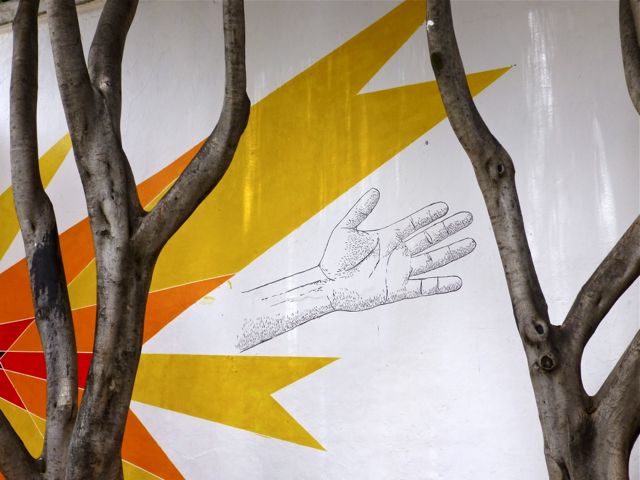
And, new street art gleamed…

Oaxaca in technicolor!

Read Full Post »

Winging my way south!

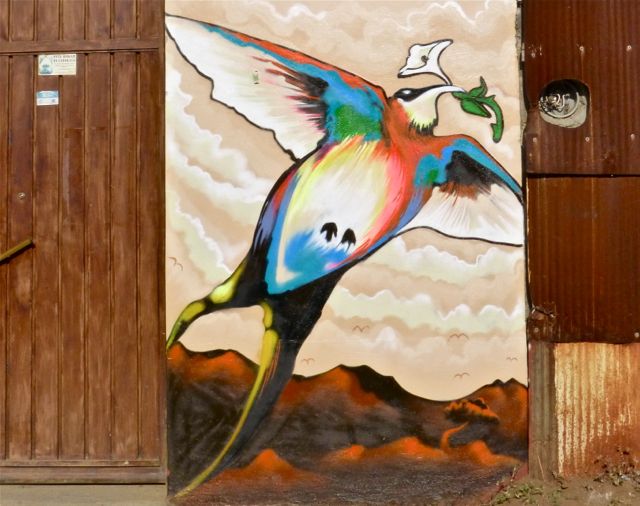
bird painted on wall of building

A wall on Antonio de León in Xoxocotlán, Oaxaca.  Ahhh…

Read Full Post »

Oaxaca’s annual Guelaguetza festival honoring the traditions of costume, dance, and sharing of the eight regions of the state of Oaxaca is less than a month away.  There will be competitions leading up to the choosing of Goddess Centeotl to preside over the festival and parades by the delegations through the city on the two Saturdays that precede the July 22 and 29 programs at the Guelaguetza Auditorium on Cerro Fortín.

There will official and alternative celebrations in the city and surrounding villages.  According to yesterday’s press conference, more than 70 events are scheduled and Lila Downs will be the official Guelaguetza 2013 ambassador.  Hmmm… I wonder what that means?  Surprise Lila Downs performances?  It’s Oaxaca, so you just never know!
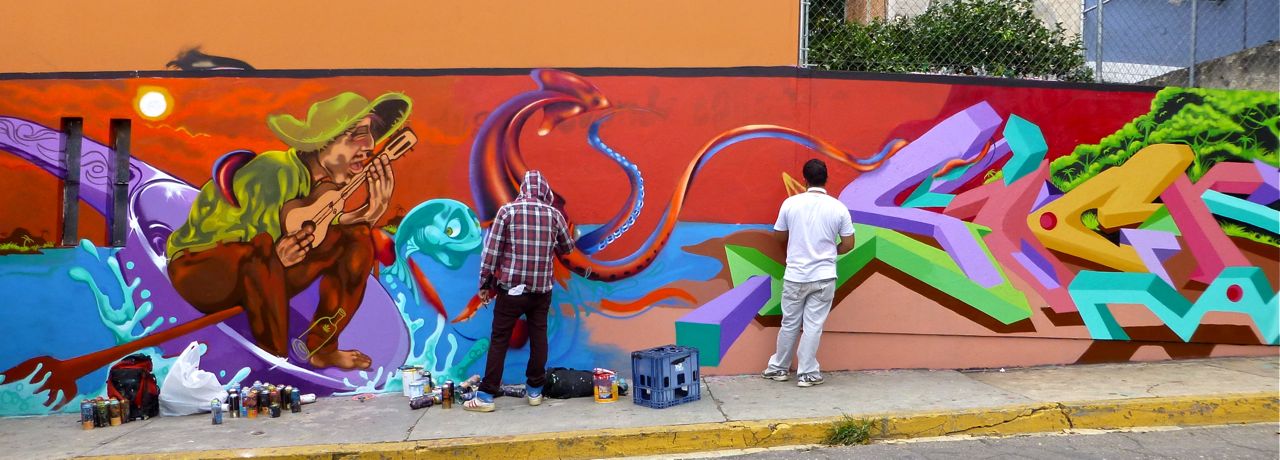
To get everyone in the spirit, here’s a few photos from another of Oaxaca’s wonderful urban art covered walls.  It celebrates the heritage of Oaxaca and can be found at José López Alavez 1406, in the Xochimilco neighborhood of the city.

By the way, this past Sunday, San Francisco’s North Bay residents got an early and small flavor of Guelaguetza.  Oaxacan dances, dishes and costumes in Santa Rosa entertained over 1,000 spectators and, no doubt, the hearts of the Oaxaqueños participating and in the audience swelled with pride.  If I’d only known about it in advance, I would have gladly extricated myself from the complexities and minutiae of getting my grandparents’ house ready to sell and driven up there for a taste of Oaxaca.  They were even serving tlayudas!

Oh well, this time next month I will be happily back in Oaxaca and, no doubt, be exhausted, exhilarated, and pouring through hundreds of photos from the first week of Guelaguetza activities.

Read Full Post »

« Newer Posts - Older Posts »