Feeds:
Posts
Comments

Posts Tagged ‘textiles’

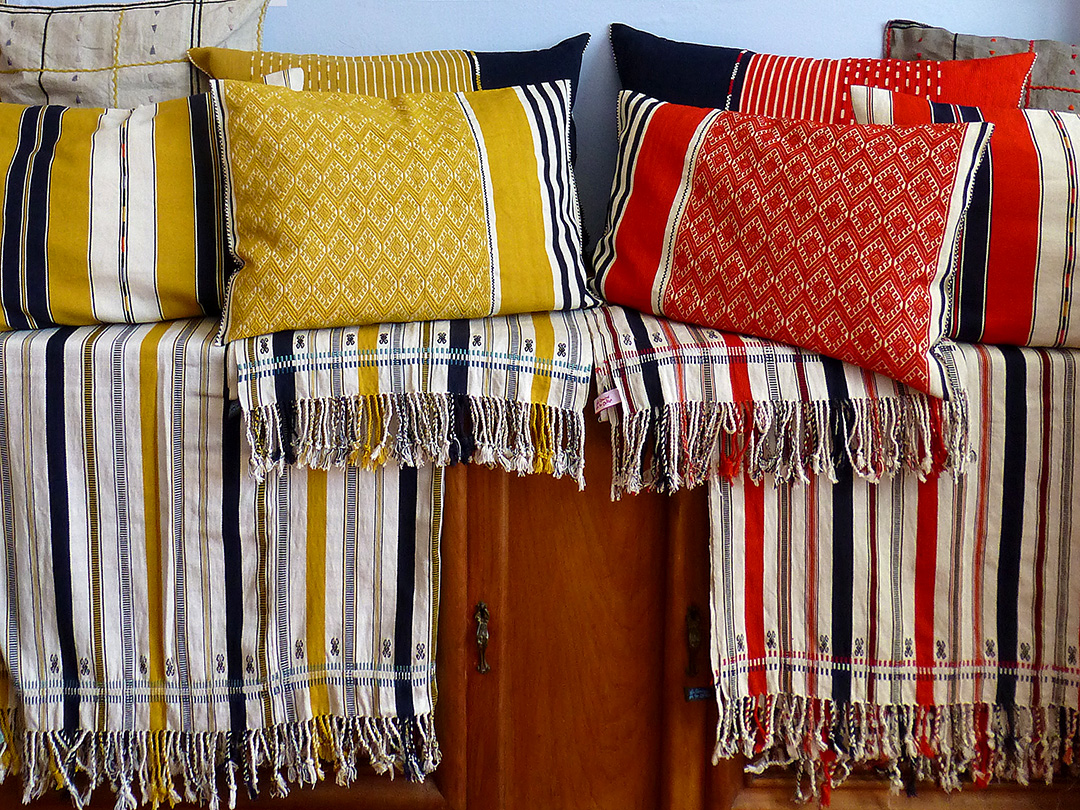
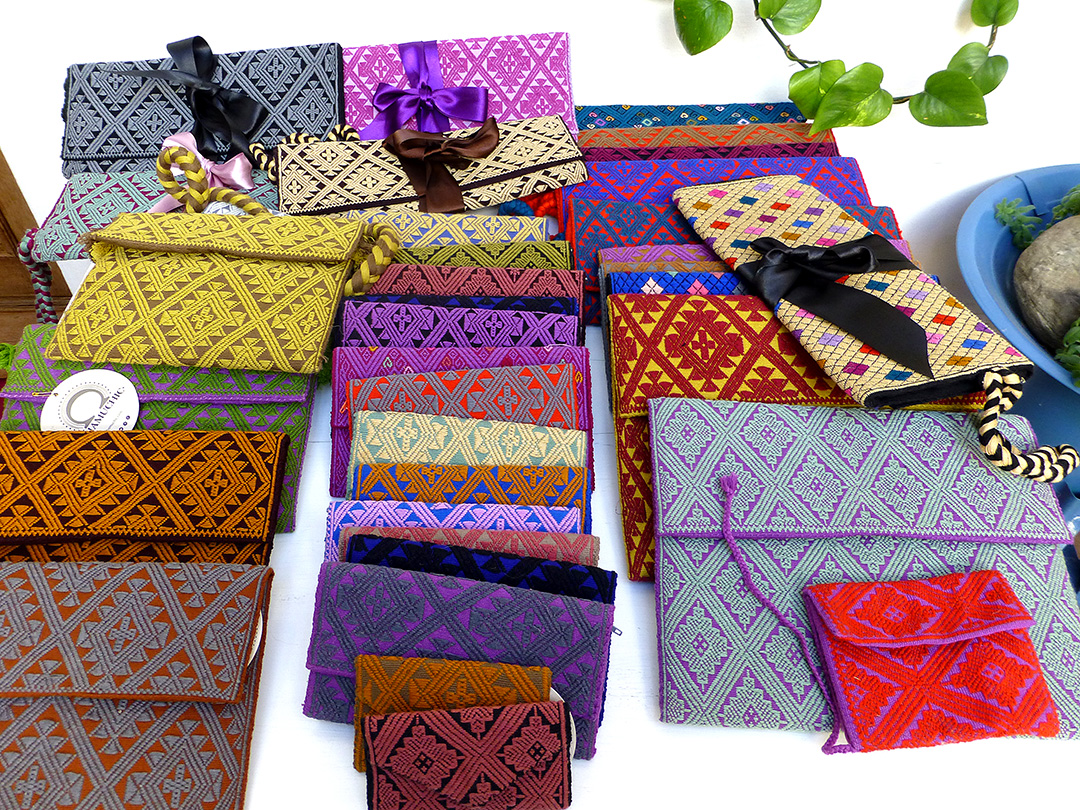
Last Friday, I walked over to the B&B, El Diablo y la Sandía and walked into the highlands of Chiapas.

P1050822

It was the first of a 3-day expoventa of textiles by El Camino de los Altos

P1050819

and Chamuchic, two weaving collectives from Chiapas.  Their colors and designs are sophisticated and I wanted them all!

P1050823

Alas, the budget limited me to two pillow covers that have joined two solid colored brocaded covers that I bought at a similar expoventa a year and a half ago.

P1050934

I think they look great under my beautiful poncho woven by Amalia Martínez Casas.

Read Full Post »

Congratulations to one of my favorite weavers, Amalia Martínez Casas from the mountain village of Tamazulápam del Espíritu Santo, winner of the 13th Popular State Art Prize “Benito Juarez” 2013.  The award, presented several days ago by Oaxaca governor Gabino Cue, recognized and honored her work using the backstrap loom, using cotton thread and wool dyed with indigo and banana peel, to weave the traditional costume of Tamazulápam in the Mixe.

Three or four times a year, an artisan fair is held in Llano Park.  Puestos upon puestos of pottery, wood carved alebrije, jewelry, and textiles are on display.  It was here, two years ago, where I first discovered the exquisite work of the tiny and talented weaver, Amalia Martínez Casas.

IMG_4175

I couldn’t resist buying this huipil; a subtle black on charcoal grey that looks both traditional here in Oaxaca and very hip with black leggings and boots in el norte.

And, then the next time, even though the dye was a little uneven, I couldn’t resist buying this short huipil — the color had me at, hola!

Her well-crafted technique and finely drawn designs are sophisticated, be they executed in subdued huipiles or brilliant red serapes.

Every time I wear one of her works of art, people ask, “Where is it from?”  “Who made it?”  “Where can I get one?”  I’ve pointed several friends to her stall in Llano Park during artisan fairs and last week, at the request from a friend in California, I bought this one.  The slight green tint will be perfect with her red hair.  (Yes, this one’s for you, Louise!)

Photos of the award ceremony can be found HERE and video is available HERE.  (Amalia Martínez Casas can be seen beginning at 6:00 minutes.)  And, for more of her creations, check out a blog post Chris did last January.

Read Full Post »

For lovers of textiles and Mexico, the latest online issue of the magazine, HAND/EYE (love the title!), has a terrific interview with friend and textile designer/collector/researcher, Sheri Brautigam.  The article, Documenting the Lives of Textiles, covers a wide range of topics, including preservation and revival of traditions and concerns re traditional versus modern designs.  As would be expected, given the subject matter, it includes lots of photos!


Documenting the Lives of Textiles

BY Annie Waterman | October 10, 2012

Close-up of traditional shawl

Courtesy of Sheri Brautigam

An Interview with Sheri Brautigam

Textile expert, Sheri Brautigam, shares with HAND/EYE Online, her experience as a documenter of “living” indigenous textiles. 

HAND/EYE: How did you first find yourself in Mexico and documenting “living” indigenous textiles?

Sheri Brautigam: I went to the university in Mexico City in the 60’s and that was the beginning of my lifelong relationship and many in-depth experiences with Mexico. This time, I was training Mexican English teachers through the English Language fellowship with the U.S. State Department—sort of like the English Teachers’ Peace Corps. My location was in a small town in the State of Mexico—Atlacomulco, surrounded by many different indigenous villages. When I went to a nearby village Mazahua ‘Saints Day’ festival and saw the amazing garments the ladies were wearing, I started my documentation.

H/E: How did you first get into becoming a researcher/ textile collector?

SB: I had a textiles design studio (surface design textiles) in San Francisco for about 18 years, so I had been collecting world textiles since the 1960s. That was when they were readily available from world travelers. I have loved and been involved with textiles most of my life and always want to know how these beautiful things are made … and now in Mexico, it’s even more exciting to see them in context. 

H/E: What sort of future do you predict for the world of traditional textiles? What changes have you noticed over the years? 

SB: I’m very hopeful that many traditional Mexican textiles will survive and become even finer. This I have seen in Oaxaca and Chiapas. When appreciation comes from the outside world and the artisans can earn money, they have an incentive to keep producing. The more money they can earn from superior work also encourages some artisans with higher skills to train their children. The more affluent indigenous people become, the more pride they have in their own culture and the continuation of their textile traditions.

Certainly some of the indigenous will leave their village and go to the towns and cities to work and wear jeans and t-shirts—but when they come home they will wear a huipil for the feast day. It’s their cultural identity.

Click HERE to read full article.

Read Full Post »

Even though the Guelaguetza is over, textiles continue to be on my mind — actually I can never get enough of them!  So, a few days ago I walked down to the Museo Textil de Oaxaca to see the current exhibition, “Tormentos y Sueños” by Carolyn Kallenborn.  While not a Oaxaqueña, the respect she has for and inspiration she draws from the weavers and textile traditions of Oaxaca are obvious.

Kallenborn explains, “The pieces in this exhibit speak to the beauty and interaction between opposites.” (my translation)  The works are at once, complex and simple, using detail and negative space — much like storms and dreams.  Photographing a whole piece proved too much for my novice skills, thus I hope close-ups of these four pieces will whet your appetite.

If you are, or will be, in Oaxaca, I encourage you to see the whole!  The exhibit runs through November 9, 2012.

Read Full Post »

The textiles of Oaxaca are currently on center stage, both literally and figuratively, during these 10 days of Guelaguetza festivities.  And perhaps, besides drawing in much-needed tourist pesos, the Guelaguetza plays an important role in the appreciation and preservation of Oaxaca’s textile traditions.

Delegation from San Andrés Huaxpaltepec, District of Jamiltepec, in the Costa region of the state of Oaxaca.

However, the textile traditions of Lebanon have not fared so well.  According to the article, The End of the silk road, by Ana Marie Lucas and posted to Now Lebanon, silk production, which dates back to the Middle Ages, is on death’s doorstep.  Only two artisanal workshops remaining today.  However, along with the Italian Embassy, the Mexican Embassy, Alfredo Harp Helú Foundation, and Textile Museum of Oaxaca are coming to the rescue.

“We wanted to share our experience with the Lebanese,” Mexican Ambassador Jorge Alvarez Fuentes told NOW Extra. “When I saw the House of the Artisan closed and in need of more attention I thought this was the perfect place to exhibit both Mexican and Lebanese items,” he explained.

“Aside from the exhibition, we wanted to organize two conferences and a workshop of how to dye the silk with natural pigments. This way many people will be able to see how the Phoenicians could extract the purple dye from the Murex shell,” he added.

According to Héctor Meneses, head of the Textiles Museum in Oaxaca, there are surprising similarities between the Lebanese and Mexican traditions in terms of pigment extraction. Mexicans extracted the red dye from a species of snail, very similar to the purple dye extracted by the Phoenicians from the Murex shell. “The difference is that in Mexico, this process is still alive and it’s being used,” he said during a conference.  [Read full article HERE]

FYI:   Alfredo Harp Helú is a Mexican businessman who, like his cousin Carlos Slim Helú (world’s richest man), is of Lebanese extraction.  Harp Helú maintains a residence in Oaxaca and, besides his foundation funding the Textile Museum, he and his foundation are involved in several other philanthropic projects in the state of Oaxaca.

h/t to Margie Barclay for the article.

Read Full Post »

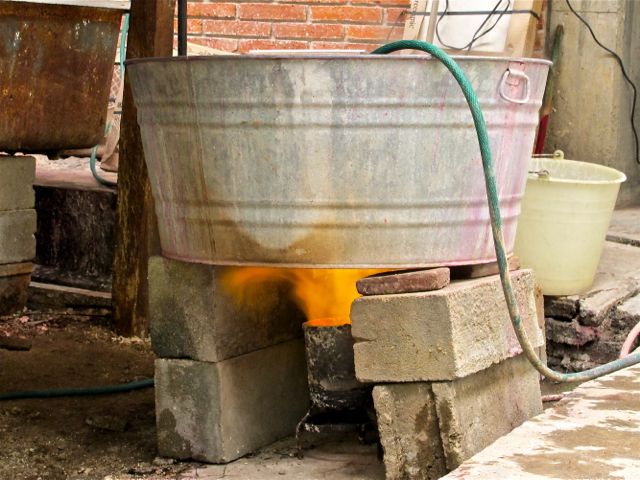
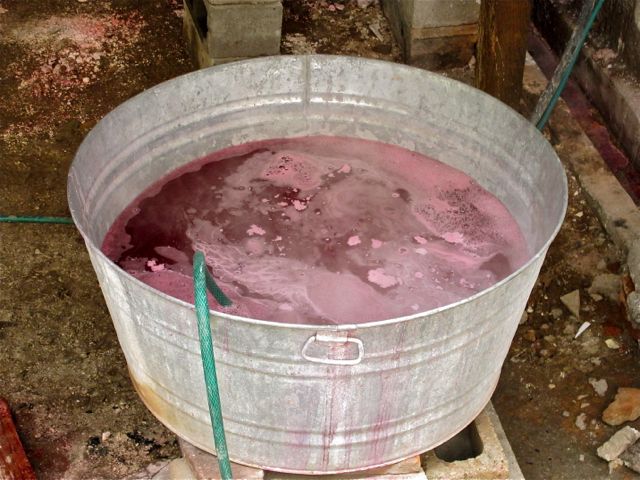
Have I mentioned there is a weaving business that operates out of the apartment complex where I live?   Most of the operations have recently moved offsite — apparently, not so the dying.

I returned home on Tuesday to find a fire roaring…

Large metal pot propped up concrete blocks over a fire

A dye bath roiling…

Galvanized metal bucket filled with roiling red dye bath

Luci and Luís rinsing and removing excess water from newly dyed cotton yarn…

A man and woman wearing rubber boots walking on wet yard

And, a new view from Casita Colibrí…

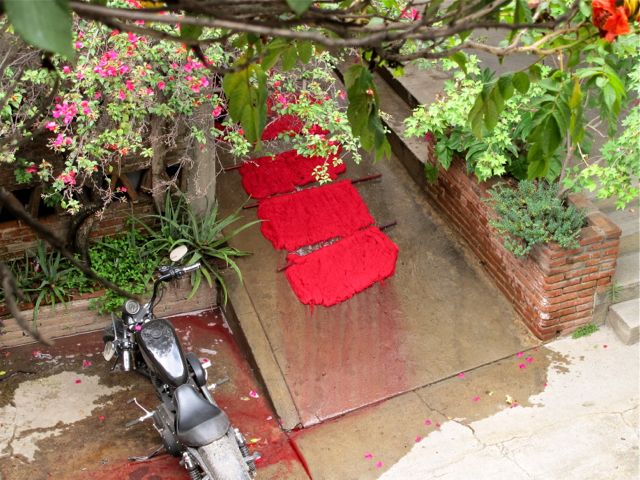
Red newly dyed yarn laid out on cement sloped slab; tree leaves in foreground

Hanks now just “hanging out” above the looms…

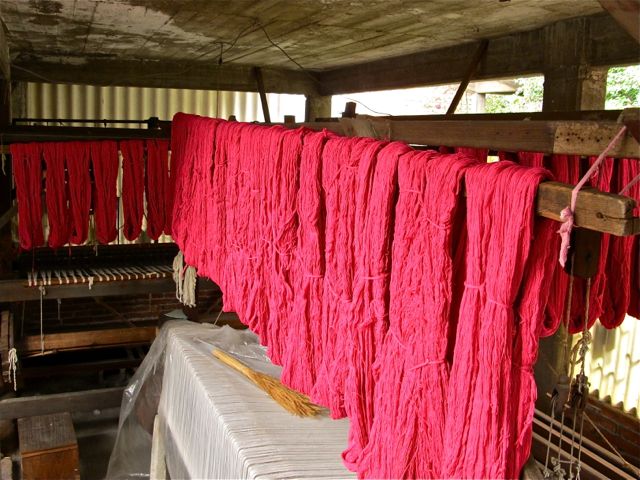
Hanks of pinkish/red yarn hanging above looms

Read Full Post »

December seems to be quite a month for the Virgins of Oaxaca.

December 8, I was awakened by cohetes (rockets… all bang, no bling) at 4:45 AM.  They continued sporadically until about an hour later, when wildly clanging church bells heralded a non-stop barrage of more cohetes for several minutes… they eventually faded away, but a banda was heard in the distance.

It was the feast day of the Virgin of Juquila (La Virgen de Juquila), one of Oaxaca’s own.  According to legend, in 1633, when a fire burned the small Chatino village of Amialtepec to the ground, a small statue of the Virgin Mary was rescued amidst the ashes. It was a miracle; she was undamaged, save for her light skin color, which was permanently darkened by the smoke… causing her to look more like the Chatino people, who revered her.

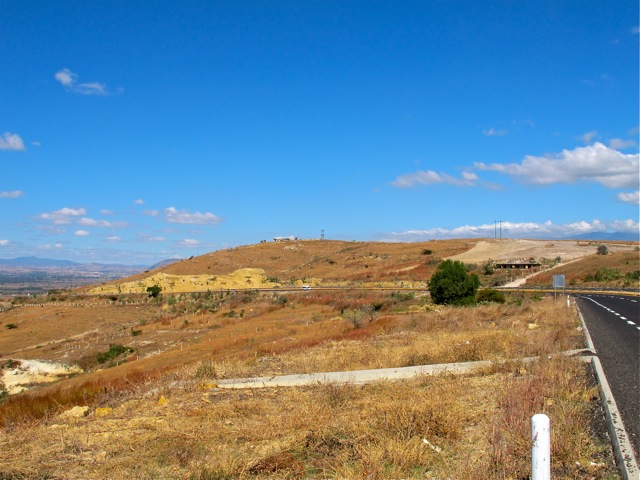
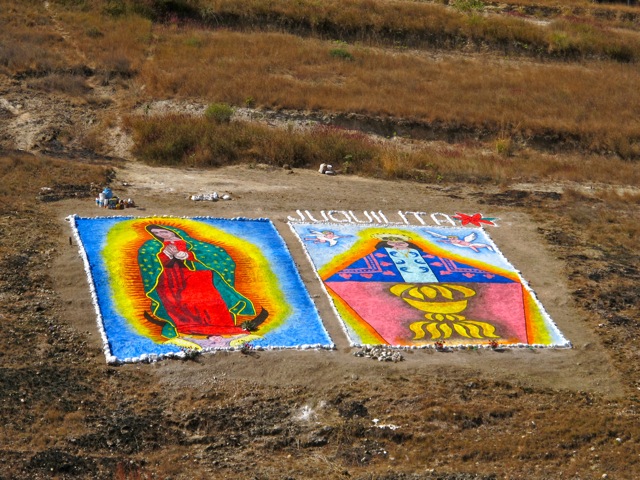
Here she is, in a field alongside La Virgen de Guadalupe, almost at the crest of the new carretera between Oaxaca and San Martín Tilcajete.

Brown fields next to highway at crest of hill

La Virgen de Guadalupe on the left and La Virgen de Juquila on the right.

Sand paintings of the Virgin of Guadalupe and the Virgin of Juquila on a mountainside.

The Virgin of Guadalupe had her day only four days later, on December 12.  La Virgen de Guadalupe is known as the Queen of Mexico and Empress of America, and is the patron saint of México.  Reports estimate that 5.8 million of the faithful made the pilgrimage this year to Basilica of Our Lady of Guadalupe in Mexico City to honor the dark-skinned virgin who appeared to Indian peasant Juan Diego on Dec. 12, 1531 near what is now Mexico City.

In Oaxaca, worshipers flocked to the Chapel of Guadalupe at the north end of Llano Park and a carnival filled the park for all the little Juan Diegos and girls in period costume to be entertained.  However, I headed out to Teotitlán del Valle to see this Zapotec village honor La Virgen de Guadalupe with their traditional Danza de la Pluma.  Several of the Danzantes (dancers) were wearing capes woven and embroidered especially for this day…
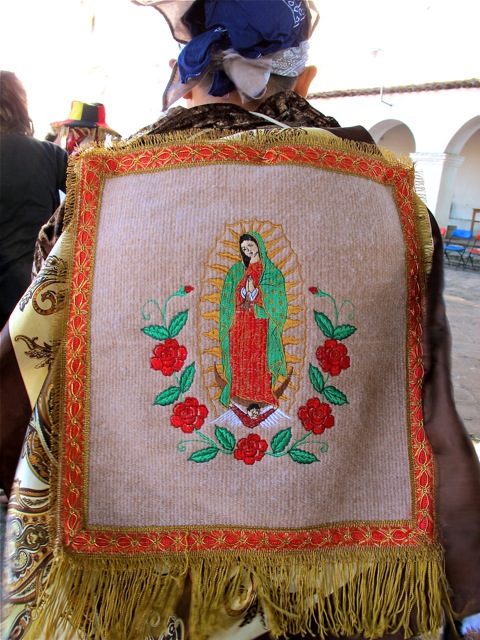
Virgin of Guadalupe embroidered on the back of the cape of a Danzante.

The weaving and embroidery were spectacular!
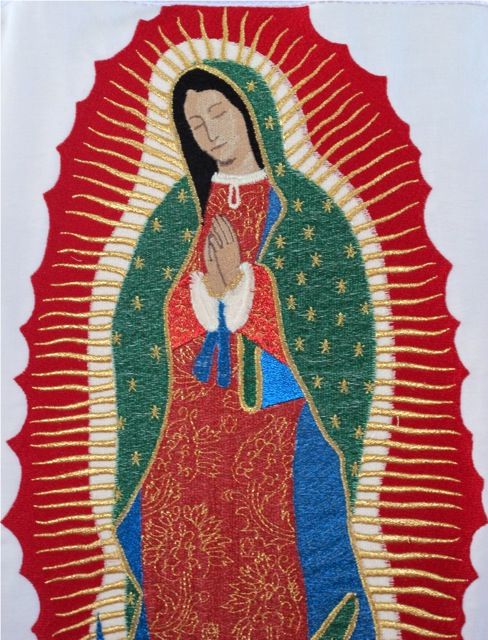
Closeup of the Virgin of Guadalupe on the back of Moctezuma's cape.

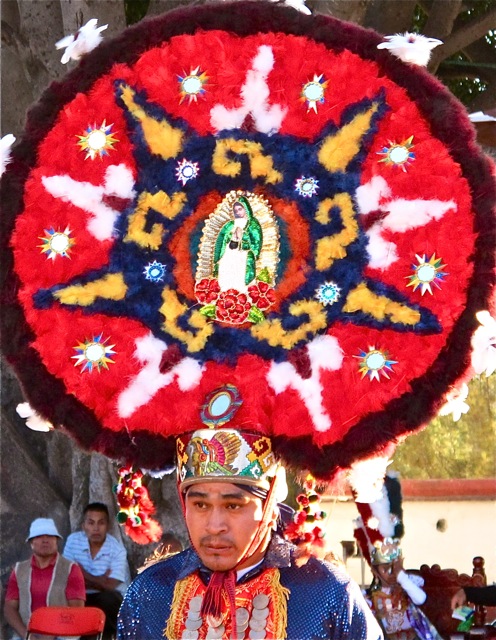
And, at least one of the Danzantes had an image of the Virgin of Guadalupe in the middle of his corona (feathered headdress).

Feathered headdress with image of the Virgin of Guadalupe  in the center.

Malinche and Doña Marina also had similar images on the skirts of their dresses.  To see those and several other photos of the dancers, you should take a look at what Chris has posted at, Oaxaca-The Year After.

Next on the “Virgin” calendar is December 18, the feast day of La Virgen de la Soledad (the Virgin of Solitude), Oaxaca’s patron saint.  Stay tuned…

Read Full Post »
« Newer Posts