Feeds:
Posts
Comments

Posts Tagged ‘street art’

Back to Havana… and the colorful and captivating Callejón de Hamel, in Barrio Cayo Hueso.  (For a more in depth and fascinating history of this neighborhood, see Neighborhood as Refuge: Community Reconstruction, Place Remaking, and Environmental Justice in the City  by Isabelle Anguelovski.)

It was our first full day and serendipity and synchronicity brought us Dayan, an enthusiastic guide with boundless energy and pride.

Without hesitation, Dayan immediately made a beeline to this alley  — the creation of self-taught artist, Salvador González Escalona.  It is a living, breathing gallery and studio, where artists were welding and painting as we stopped to watch and wonder at their creations.

The cultural character of this community cannot be separated from its religious traditions and practices — a syncretism of African religions brought by slaves and Catholicism brought by the Spanish conquerors.  Salvador Gonzáles Escalona explains, “I am talking about the religion known as Santería, which comes from the Yorubas; Palo Monte, which comes from the Congo; Abakuá, which has to do with Calabar [the Cross River Delta in Nigeria]; and maybe some manifestations of spiritism, a cultural expression of working class people, the ordinary folks in our country.”

Callejón de Hamel is also home to a vibrant musical scene.  “In this alley many years ago, in the 40’s, a cuban musical movement was born, known as ‘filin,’ songs of feeling, with our friend Angelito Díaz and his now deceased father, Tirso Díaz. There were figures such as Elena Burque, the late Moraima Secada, aunt of Jon Secada, Omara Portuondo [featured in Buena Vista Social Club], César Portillo de la Luz, and many others.” — Salvador Gonzáles

On Sundays, around noon, the street comes alive with musicians, dancers, and the sights and sounds of Cuban rumba.  Alas, around that time, we were in the midst of changing hotels.  Next time, for sure!

Read Full Post »

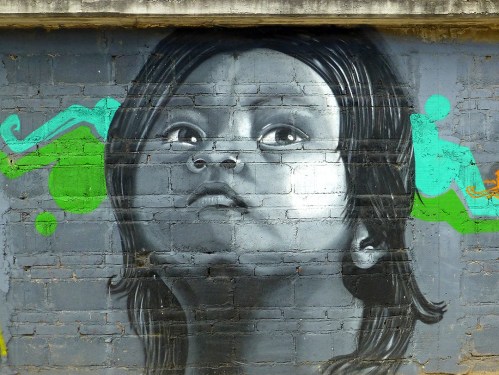
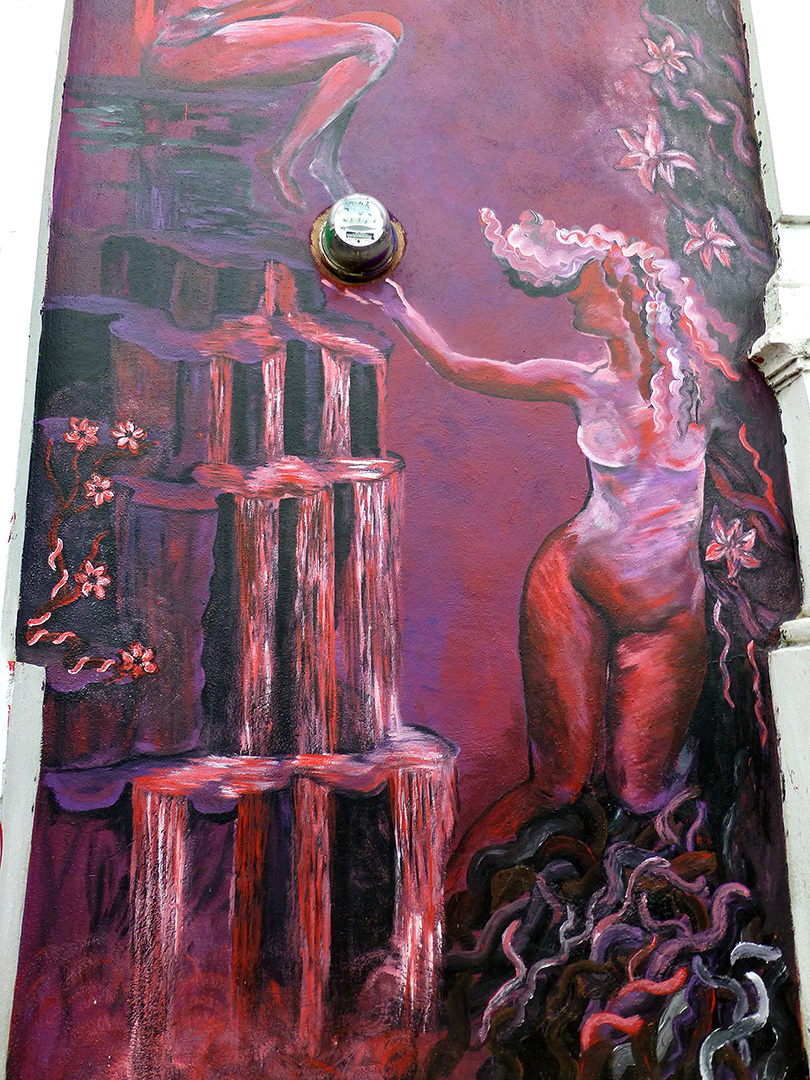
Back in Oaxaca… I don’t know the story of this mural that recently appeared at the corner of Allende and Tinoco y Palacios.  However, on this Mother’s Day (in the US), it seems appropriate.

A mother’s eye is always watching…

Read Full Post »

A pause in the Cuba coverage to echo Dorothy, “There’s no place like home” — especially if that home is Oaxaca.  I needed (yes, needed!) chocolate and coffee and, thus, headed toward the Benito Juárez and 20 de noviembre mercados.  As always, even just a grocery shopping trip is a feast for the senses.

P1190316

First, a calenda on Calle Independencia of students, academics, and workers to launch the registration of candidates for rector of Universidad Autónoma Benito Juárez de Oaxaca (UAJBO).

P1190325

A peek into el pasillo de las carnes asadas (ahhh, the smells) in 20 de noviembre mercado, while waiting for my chocolate guy to finish with other customers.

P1190329

A look at the finished murals (and merchandise) in a newly opened shop at Calle Macedonia Alcalá 100.

P1190332

Stopping to gaze up at the “Aves Sin Paraíso” exhibition above the Alcalá.

P1190340

Almost back to Casita Colibrí, a new stencil at the corner of Morelos and Tinoco y Palacios.

By the way, I got the chocolate, but couldn’t find my coffee guy in the maze of temporary stalls set up on the streets surrounding the Benito Juárez mercado (it’s undergoing a much-needed renovation).  There’s always mañana — I’m not completely out, yet.

Save

Read Full Post »

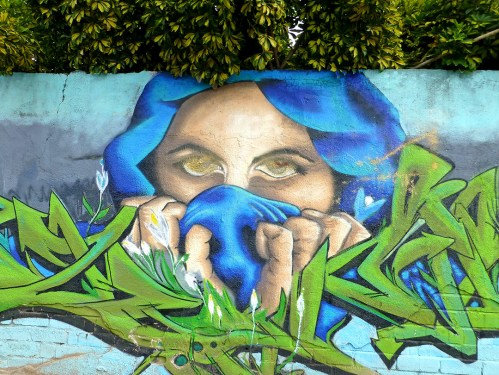
The murals may be disappearing, but the walls of Oaxaca continue to radiate with messages.

P1180042

P1170440

P1160805

2016_04_26 Blog Walls of Oaxaca

P1170834

Oaxaca, never a dull moment and never a dull wall.


Read Full Post »

Because today is Valentine’s Day and International Mother Language Day is coming up on February 21, learn to say “I love you” in 7 of the 69 indigenous languages spoken in Mexico — including Zapoteco, Mixteco, and a couple of other languages of Oaxaca.

P1150347

¡Feliz Día del Amor y Amistad!  Happy Day of Love and Friendship!

Read Full Post »

P1160526

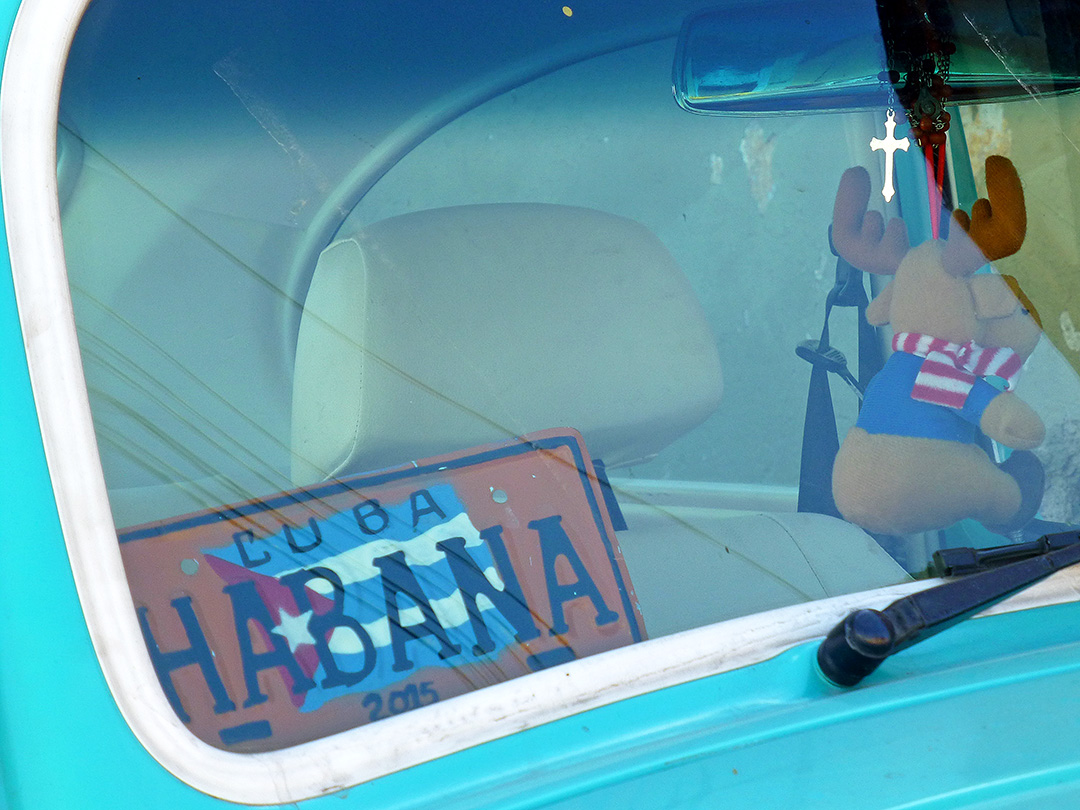
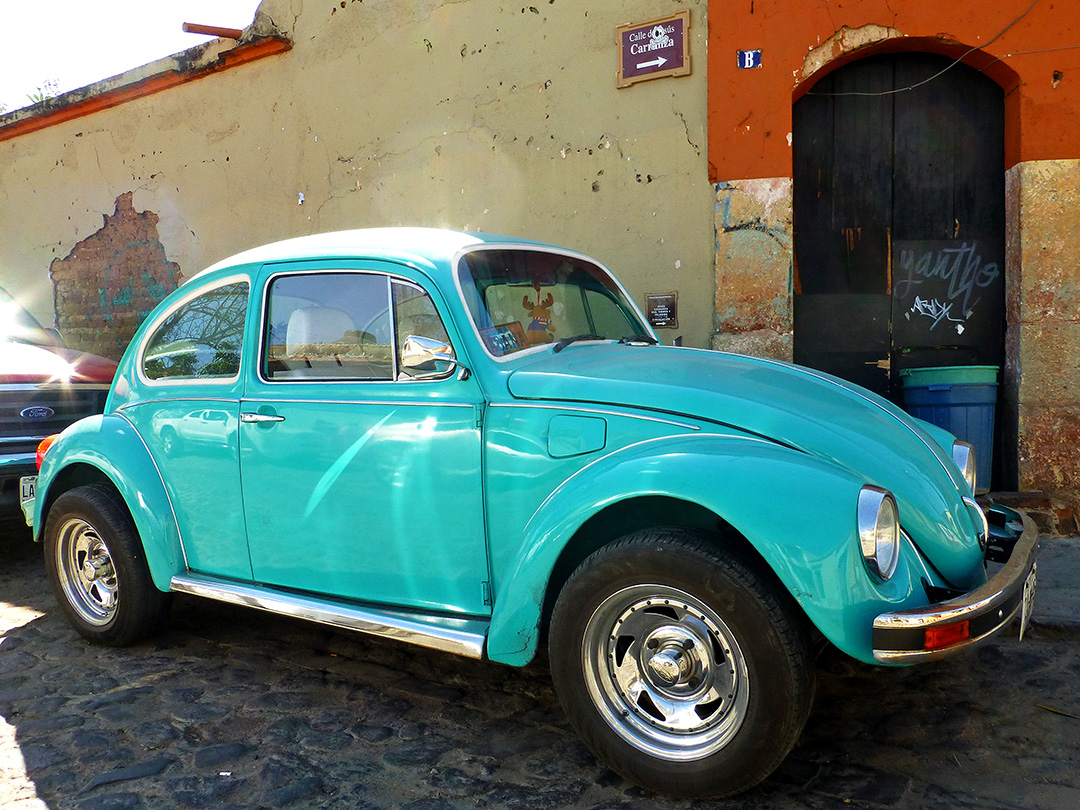
Unfortunately, not Cuba.  (One of these days…)

P1160525

Saw it yesterday walking down Tinoco y Palacios, on my way home from Mercado Sanchez Pascuas.

P1160530_crop

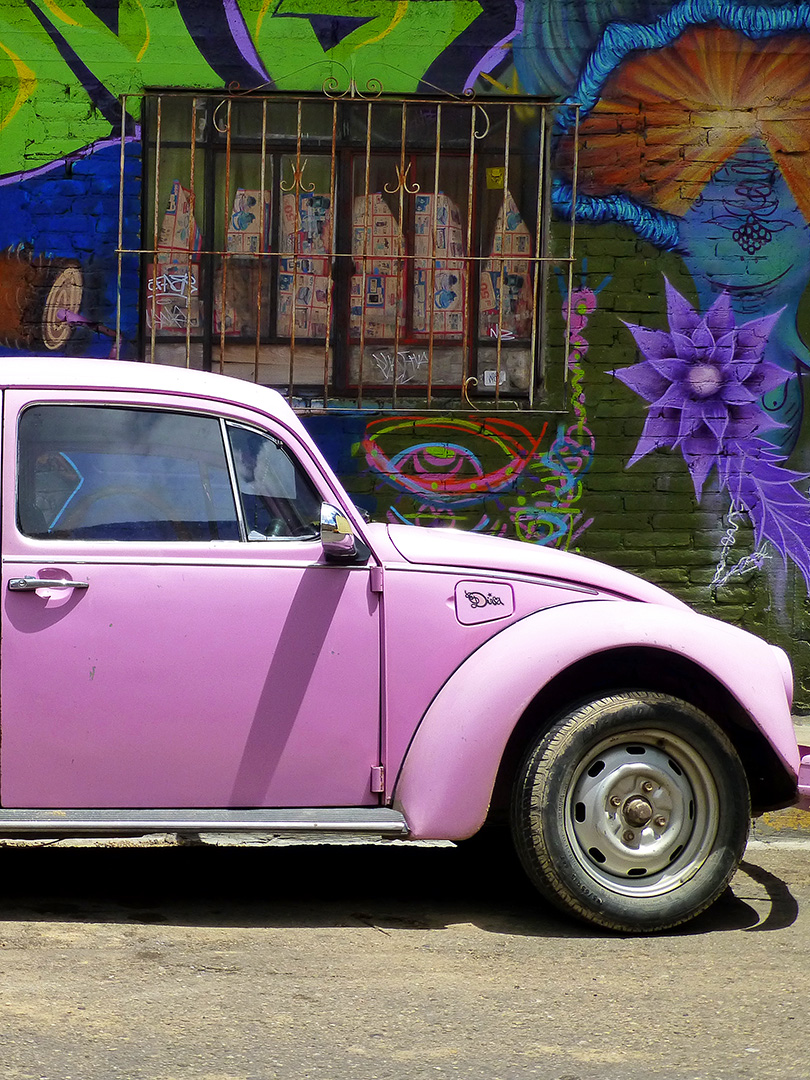
Leather upholstery, wood steering wheel, and paneled dashboard — it’s one very cool vocho.

P1160532

However, when it comes to telling a color story, wish it had been parked a couple of blocks down the hill, in front of this wall. 😉

Read Full Post »

In Oaxaca city…

P1140033

P1150610

P1160356_copy

In Tlacolula de Matamoros…

P1140990

P1100121

P1100113

They are seen and they are watching.

Read Full Post »

In the category of “your just never know,” the two-block long Callejón Hidalgo is a treasure-trove of murals.

P1150617P1130455

P1130457

P1130459

P1150618

And, there are more!  Located between Tinoco y Palacios and Porfirio Diaz above Calle Jesus Carranza, it’s well worth the trek up the hill.

Read Full Post »

P1150416

“Telephones” on the street in Oaxaca.  Call me, maybe.   😉

Read Full Post »

Pretty in pink on the streets of Oaxaca…P1140835

P1140380

P1140833

P1140814

P1130556

And, this doesn’t even include the pink and lime green of Correos de México (Mexican post office).

Read Full Post »

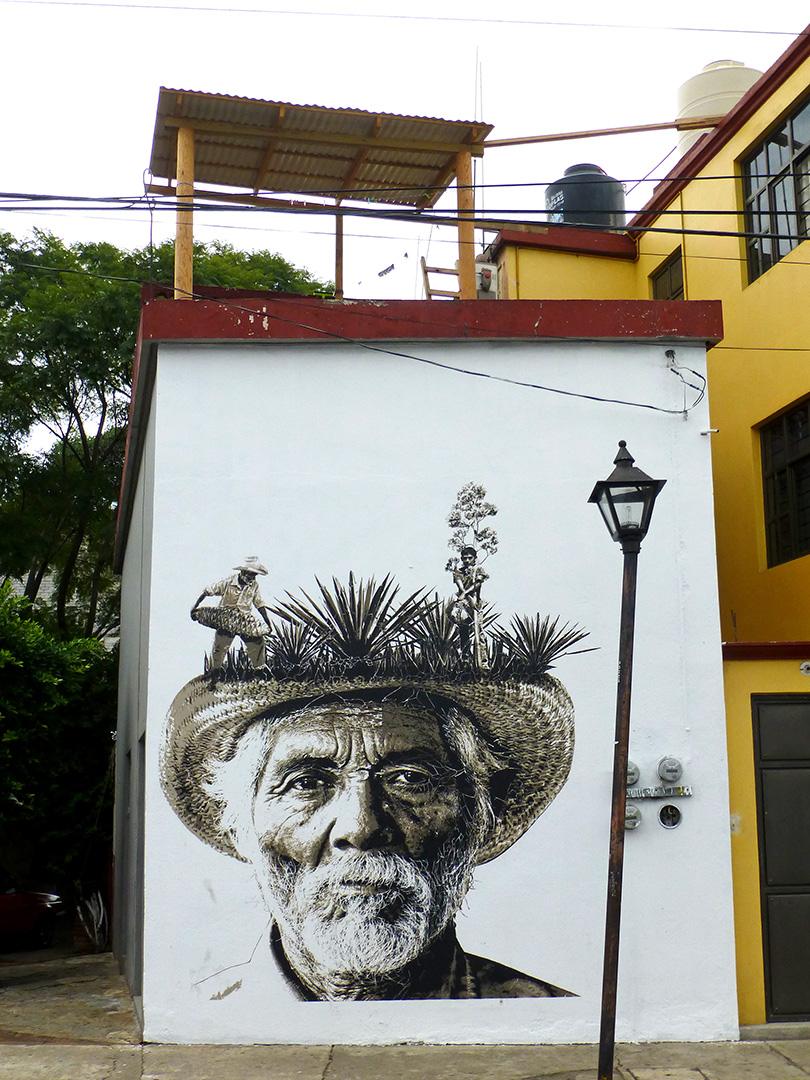
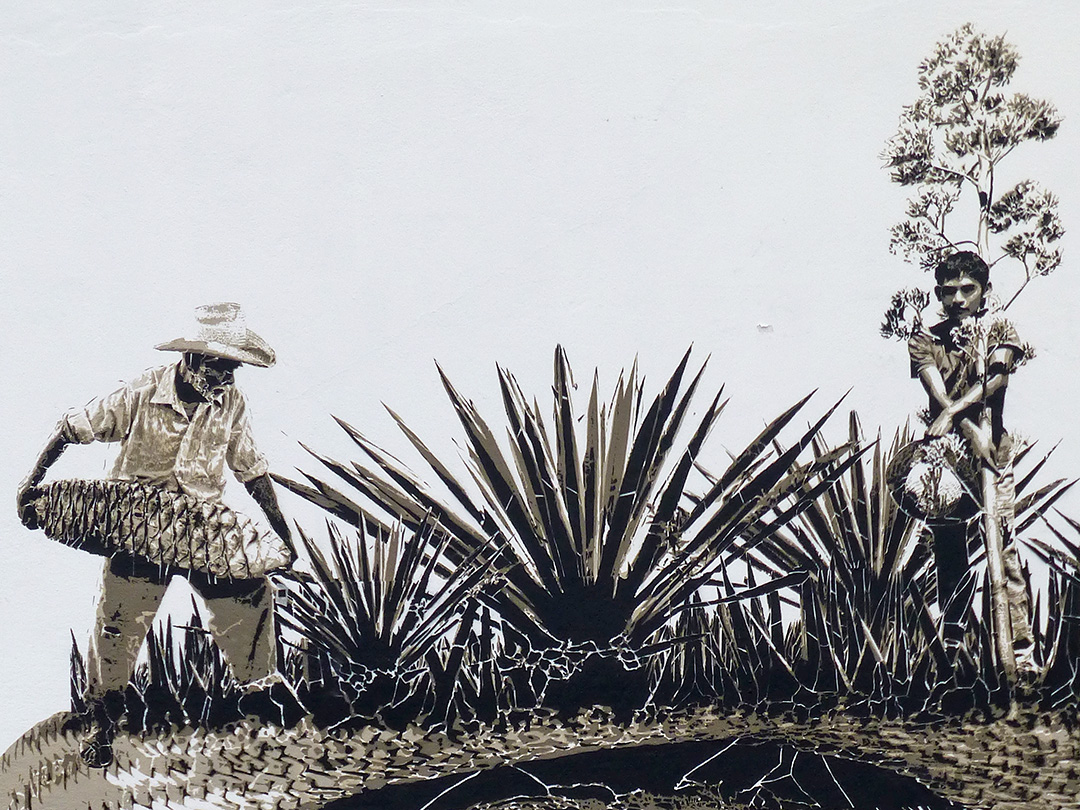
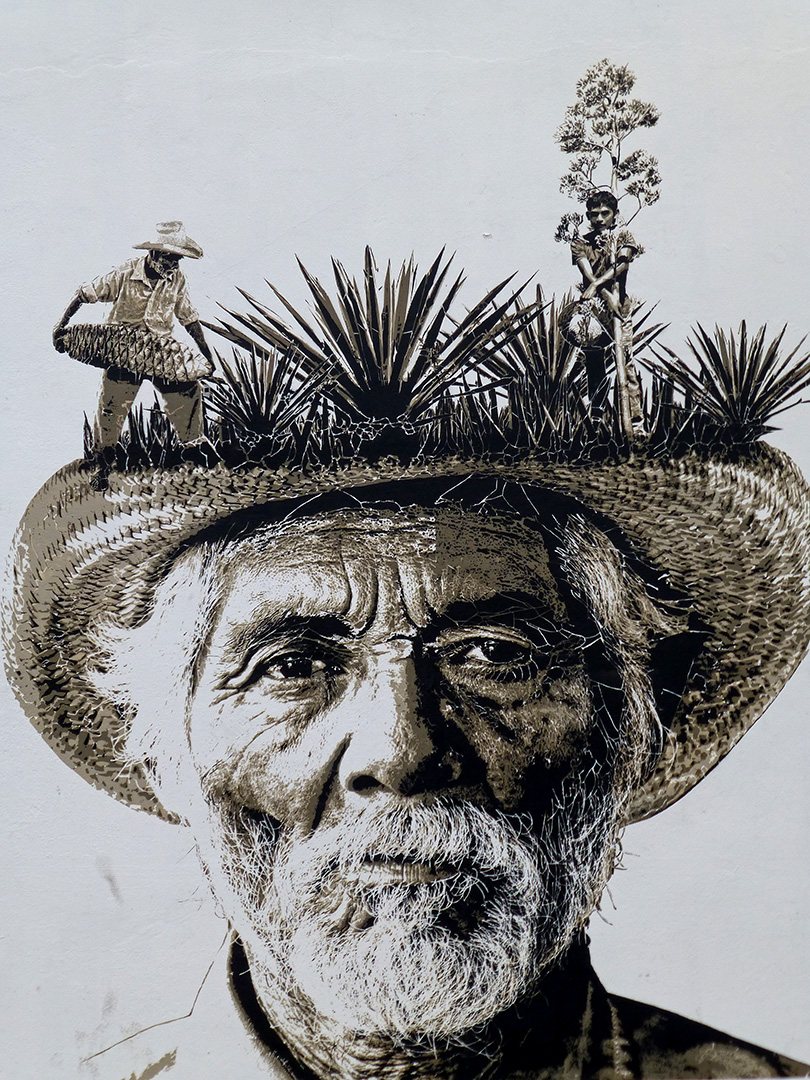
Before a “suspendida” order is slapped on this stunning piece by the Lapiztola collective celebrating the human face of agave cultivation, here is another moving work of art for the people, seen on Tinoco y Palacio on the wall of Piedra Lumbre, near the Sanchez Pascuas mercado.  It tells a story…

P1140381The wisdom of cultivation handed down from generation to generation.

P1140382From the agave comes mezcal.

P1140382lgThere are 199 “recognized” species of agave.  How many can be used to make mezcal?  The Mezcal PhD explores the answer.  And, for an illustrated guide to many of the more popular varietals, click The Many Varieties of Mezcal.

Read Full Post »

As many of you already know, one of my favorite things about living and being in Oaxaca is, you just never know what you will stumble across.  Rounding a corner, one might come upon a calenda (parade) with band, marmotas, monos, and dancers; a street artist or payaso (clown) entertaining a gathering of nin@s to abuel@s; street art; or a newly opened store.

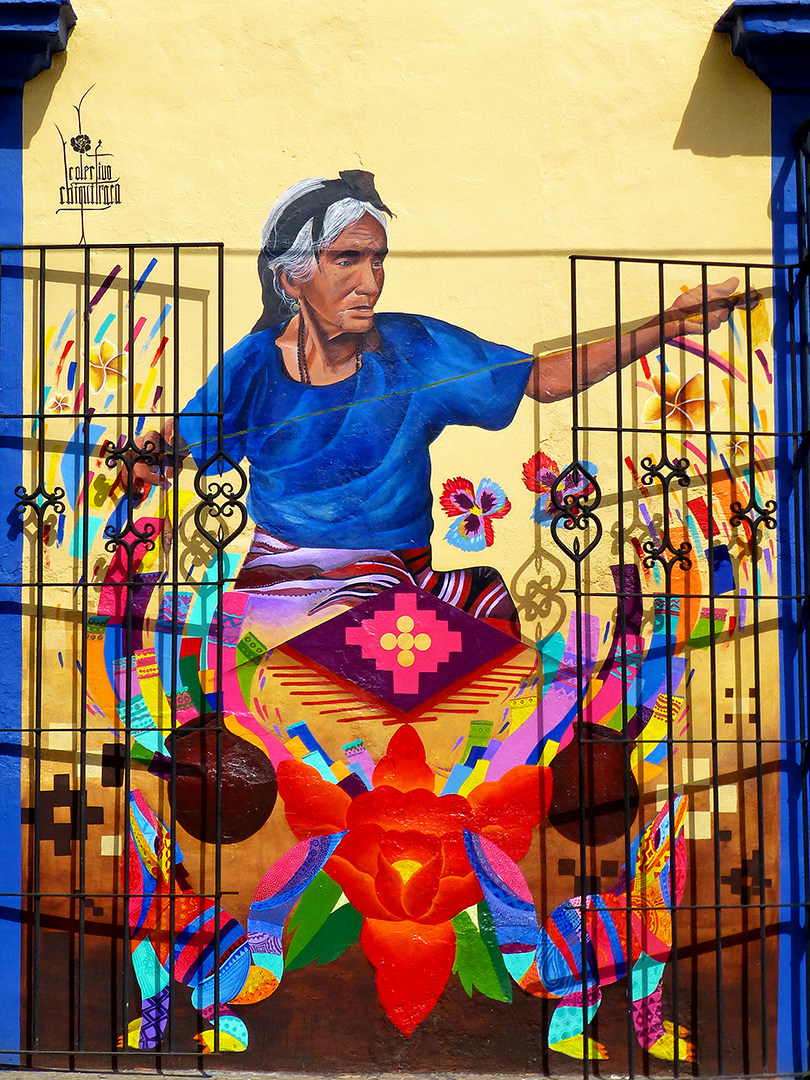
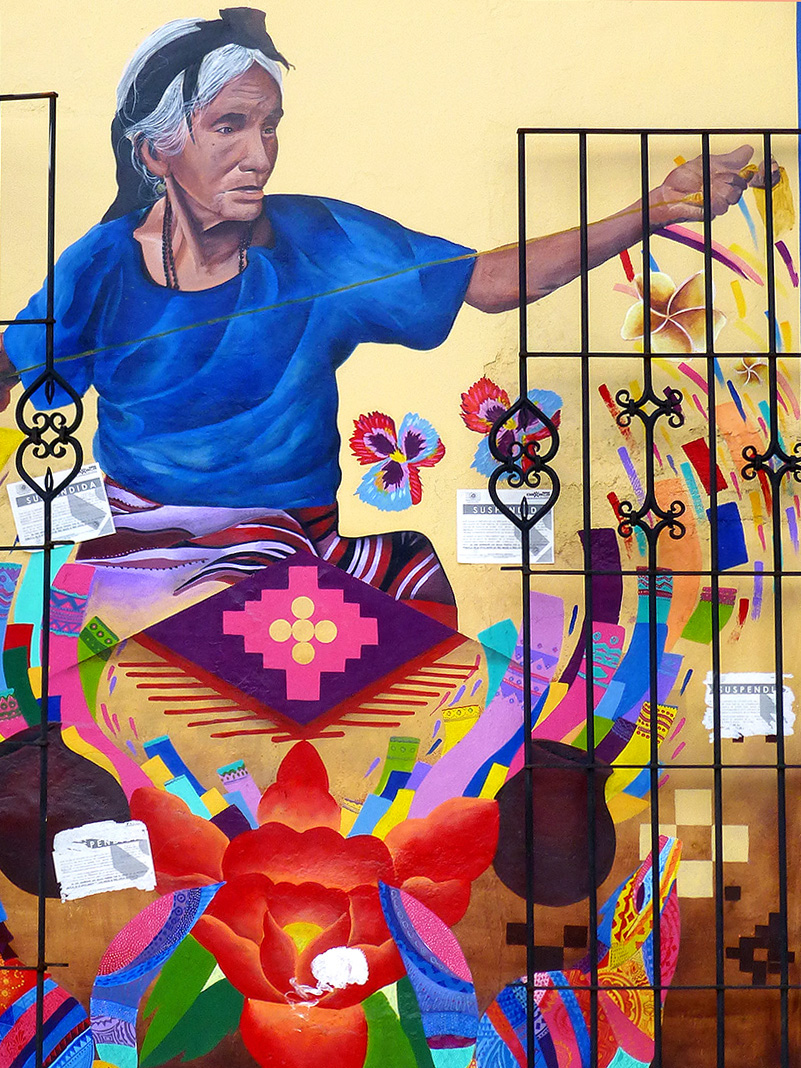
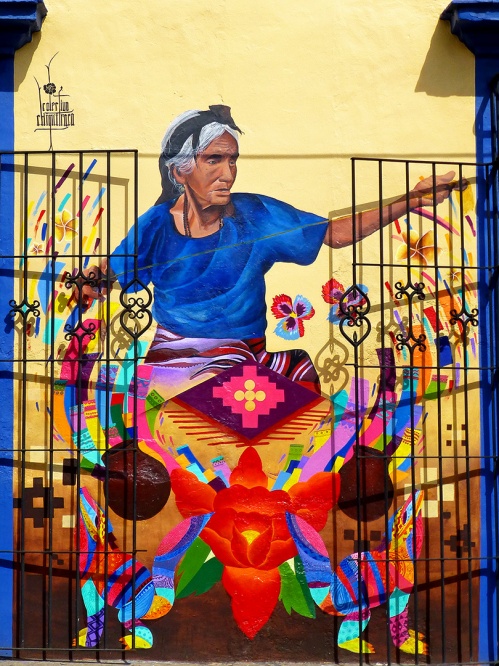
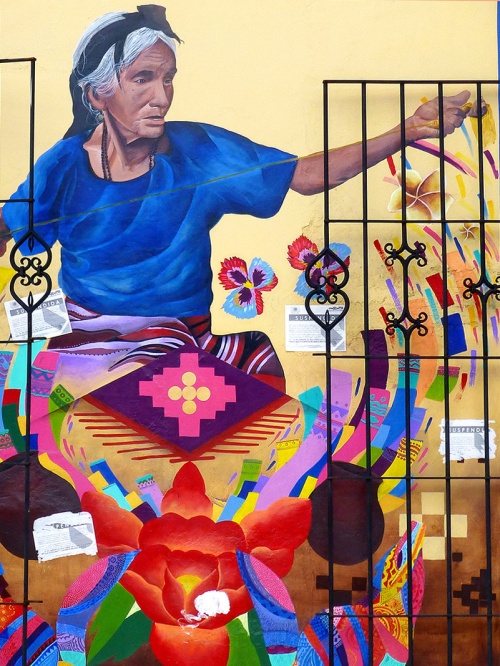
So (no surprise), a few months ago, walking up Tinoco y Palacios enroute to the Sanchez Pascuas mercado (in need of a few staples like quesillo, aguacates, and tamales), a stunning new mural caught my eye.P1120515Positioned to entice potential customers into Color y Cultura, a newly opened artisan community shop, the mural is the work of Chiquitraca Colectivo from Juchitán.  It worked, I was hooked, and later returned to browse and eventually buy a pair of earrings carved from a gourd.  However, during a return trip to the mercado, I was rather shocked to see unsightly papers defacing the mural.
P1140828

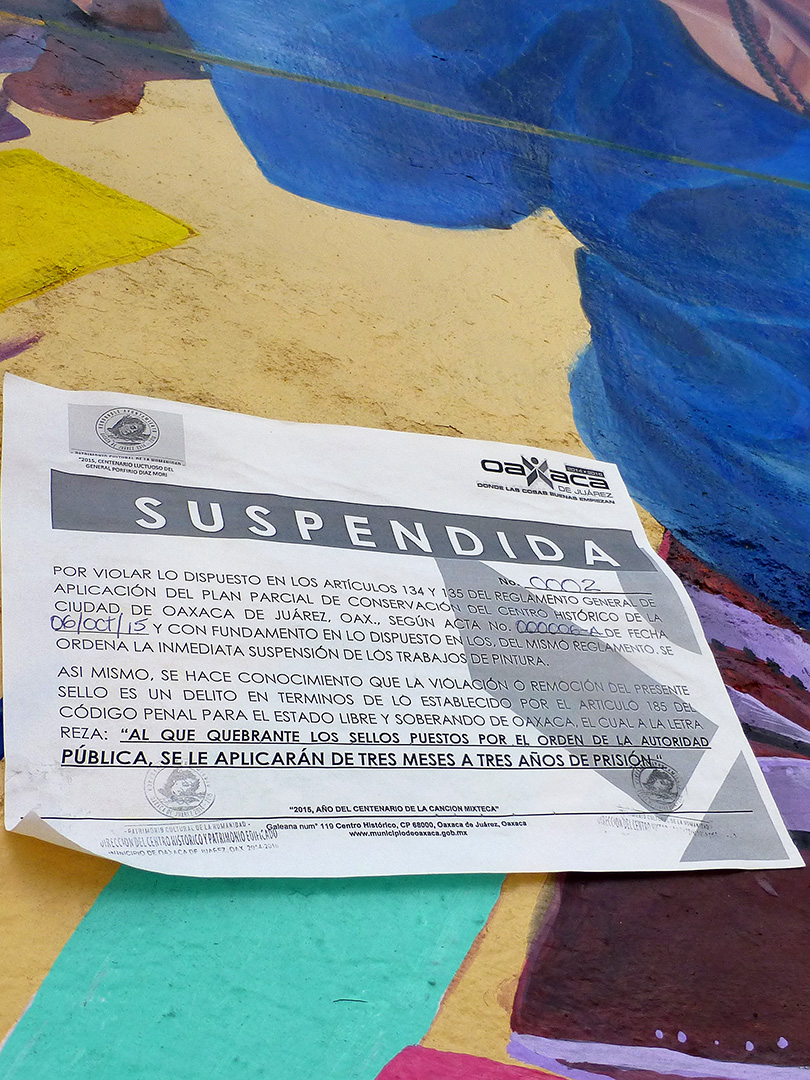
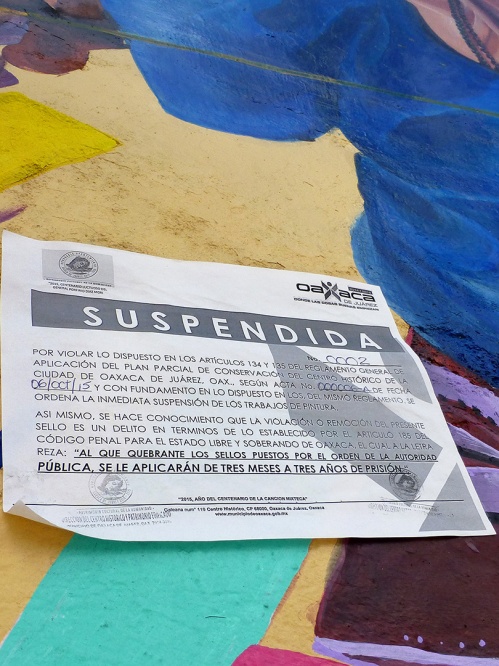
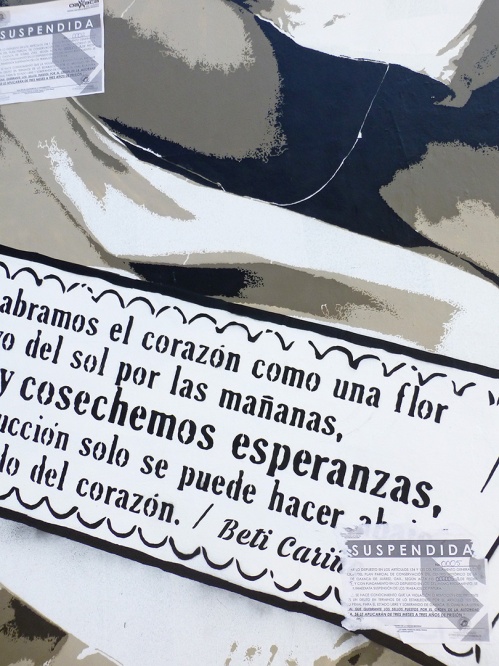
Usually, street murals are “hands off” zones for vandalism.  However, closer inspection revealed official notices declaring, “Suspendida” (suspended) and going on to say that the mural violates regulations on the conservation of the historic district.
P1140829

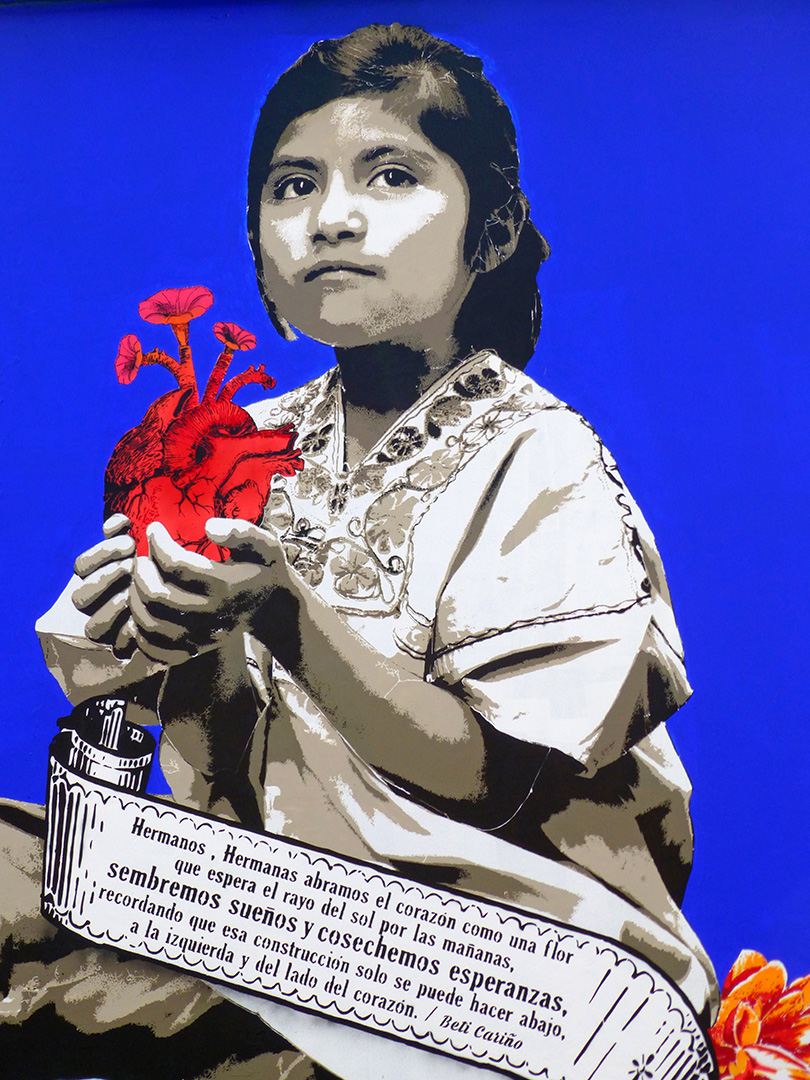
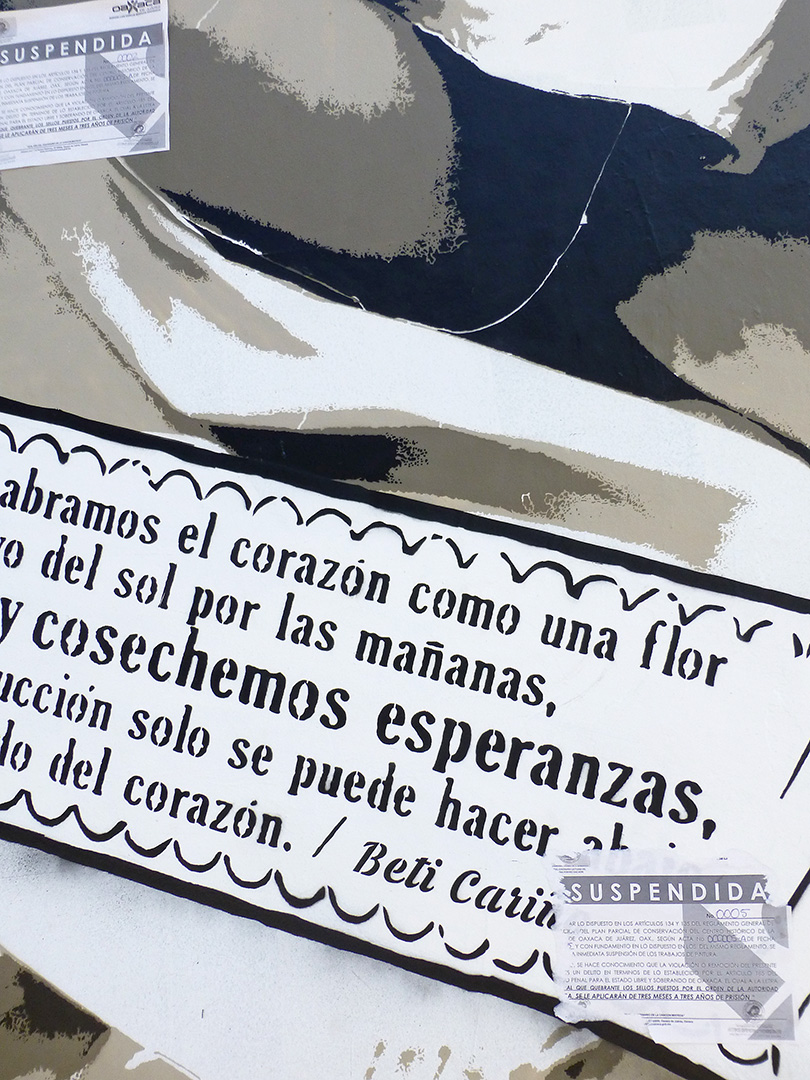
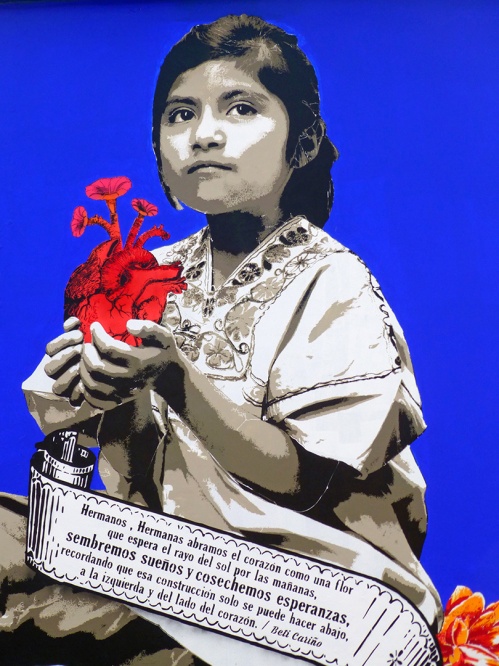
And, if this weren’t egregious enough, remember the stunning We sow dreams and harvest hope mural on the side of Museo Belber Jimenez?
P1090820copy

It too now has appalling “Suspendida” notices plastered on it.  WTF is going on???  A little research revealed that a law was recently passed to “criminalize” wall art.  Yes, yes, yes… I understand that the “powers that be” and even ordinary residents are sick of graffiti on historic buildings.  BUT to lump the anarchist “A” spray-painted on the side of the Cathedral with magnificent murals painted on ugly decaying walls and beautiful works of art privately commissioned by businesses and museums to decorate their buildings, is the height of absurdity, never mind assigning a “criminal” aspect to it.  Believe me, Oaxaca has a laundry list of more important issues that it needs to address.
P1140752

If in their “infinite wisdom” they are attempting to “clean up” the city to better appeal to tourist dollars, euros, yen, etc., then I think they are barking up the wrong tree — we extranjeros (foreigners) love the street art!  To that end, below is a copy of a letter I sent to the president of Central Connecticut State University (CCSU) last year, when officially authorized murals painted by art students as part of their course work were ordered removed by the university administration.

Dear President Miller:

I am writing to you from the city of Oaxaca de Juárez in southern Mexico, nestled in the valley where corn was first cultivated.  I have the privilege of living in culture that has a deep respect for, and appreciation of, communication through all forms of art.

Oaxaca is filled with museums and public art.  In addition, her walls are covered with murals, both officially sanctioned and unauthorized.  An example of the latter:  My current neighbor, previously lived next to a concrete bench built into a wall along her street.  It’s primary function seemed to serve as a gathering place for garbage and graffiti.  Being an artist, she painted a living room scene around the bench, replete with, a lamp, bouquets of flowers, pillows on the sofa/bench, and a framed painting with the image of a smiling creature holding a sign that quotes Oaxaca’s favorite son and former Mexican president, Benito Juárez:  “El respecto al derecho ajeno es la paz.”  (Respect for the rights of others is peace.)  It is a quote that every Mexican school child learns and in the eighteen years since the bench and mural were first painted, it has become a beloved icon of the street and very little graffiti and garbage have reappeared.

Oaxaca would lose much of her character and lessons would be lost, if we were to wake one morning and find all her murals disappeared.  The story is the same at CCSU and it would be shameful if the beautiful and thought-provoking student murals at CCSU were to be needlessly destroyed.

Read Full Post »

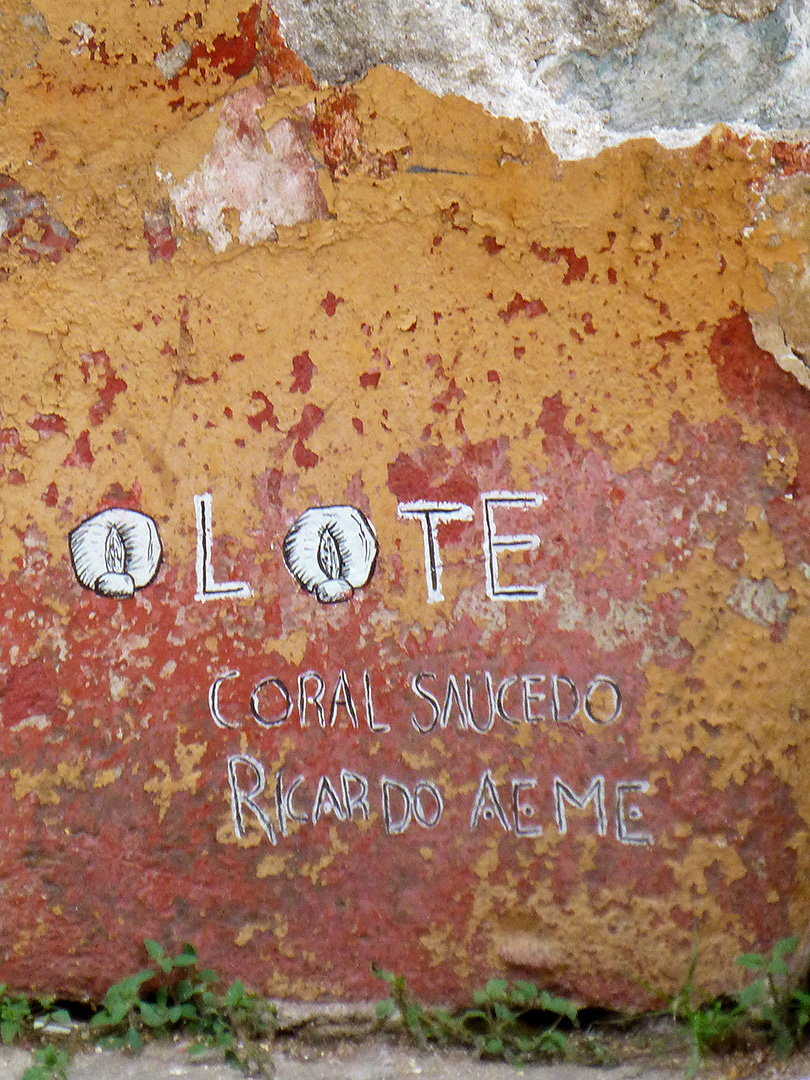
September 29 was Día Nacional del Maíz (National Day of Corn) in Mexico.  Corn was first cultivated approximately 8,000 years ago in the valley of Oaxaca and native varieties are still grown by the descendants of those original farmers.  This was a day to, not only pay homage to Mother Corn but, as Mexican painter Francisco Toledo reminded those along Oaxaca’s Alcalá, to continue the struggle to defend native corn against impending invasion by Monsanto and its genetically modified seeds.P1130669 The year revolves around the cycle of corn, which is planted in the same fields as beans and squash to make a perfect growing environment.P1130658The cornstalk grows, the bean plant crawls up the corn, and the squash vine sprawls out and shades the ground to keep it moist… Some of the corn is harvested in August and eaten fresh, while the rest is left on the stalks to dry.P1130662All parts of the corn plant are used — kernels, husks (for tamales), cobs (pig feed), and stalks (cow feed).  The dried corn is stored and used in many ways throughout the year.P1130675Text in italics is from the Seasons of My Heart cookbook by Susana Trilling.

The artists of the above, used the signature “olote” which is derived from Nahuatl word, olotl.  In English, it translates to “corncob” and “a nobody.”  Thank you to a couple of “nobodies,” Coral Saucedo and Ricardo Aeme, for such an expressive and beautiful piece of art honoring the sacred corn.

Read Full Post »

P1130507

P1130749

P1130557

P1140032

P1130719

P1140093crop

Never silent and never dull.

Read Full Post »

Last week, walking down Crespo, I spotted a mural at the turnoff to Calle Panorámicas del Fortín and discovered it was the work of Jesus Kobe.

Hmmm… Recently, I’d seen another of his works on Allende near Crespo.

I was familiar with the artist because last year, friends and I were walking along Panorámicas and stopped at this mural.

We walked further along to find another mural, but without a signature.  It turned out the artist was walking by and when he saw us admiring the work, he graciously stopped to chat.  It was Kobe and he explained that he only signs his work once it is completed.

Serendipity, why this place never ceases to surprise and delight!

And, watch and hear Kobe explain the inspiration that underlies the mural he created for Santa Fe Taqueria in Portland, Oregon:

Read Full Post »
« Newer Posts - Older Posts »