Sunday is market day in Tlacolula. The sounds and sights…

The smells and tastes…

And, most of all, the people…

Much needed chicken soup for my soul.
Posted in Culture, Food, Markets, Travel & Tourism, tagged market day, markets, mercados, Mexico, Oaxaca, photographs, photos, popular travel destinations, Tlacolula de Matamoros on July 9, 2013| 13 Comments »
Sunday is market day in Tlacolula. The sounds and sights…
The smells and tastes…
And, most of all, the people…
Much needed chicken soup for my soul.
Posted in Buildings, Creativity, Culture, Transportation, Travel & Tourism, Weather, tagged graffiti, Mexico, murals, Oaxaca, photographs, photos, popular travel destinations, rainy season, street art, urban art on July 7, 2013| 3 Comments »
Ahhh… I’m back in my new and improved Casita Colibrí. Friday night, with lightning flashing all around the Embraer, my fellow passengers and I bounced our way across Mexico and back to Oaxaca. Gracias, Hurricane Erick for Mr. Toad’s Wild Ride! With appreciation and relief, spontaneous applause erupted when the little plane landed.
There have been many changes in the 7 weeks I’d been gone… Juan finished the screens on my doors and windows; they are beautifully made and not a single mosquito has been seen or heard! I left at the end of the dry season; golden-brown hills and fields and a constant coating of dust dulled nature’s and human-applied colors. I returned to the lush green hills and fields of the rainy season and the lustrous green leaves and red-orange blossoms of my African tulip trees.
And, new street art gleamed…


Oaxaca in technicolor!
Posted in Education, People, Travel & Tourism, tagged abuelas, education, grandmothers, Manuela Hernandez, Mexico, Oaxaca, photographs, photos, popular travel destinations on June 27, 2013| Leave a Comment »
I adored my maternal grandmother. She was short and plump with a crown of white hair framing a broad round face. Her life wasn’t easy and years of hard work lined her face, but it was a face dominated by wise and remarkably kind eyes. I see the same strength and wisdom and loving presence in the abuelas of Oaxaca. Across years and miles, they bring a little of my grandma back and it makes me smile.
And, speaking of Oaxaca’s awesome abuelas…
Mexican grandmother graduates from primary school at age 100
By Luc Cohen
MEXICO CITY | Wed Jun 26, 2013 11:30pm IST
(Reuters) – You’re never too old to learn: Mexican grandmother Manuela Hernandez has finally graduated from primary school – at the age of 100.
Born in the southern Mexican state of Oaxaca in June 1913, the year before World War One began, she left primary school after just a year to help her poor family with household chores.
Hernandez only resumed her studies in October at age 99 at the recommendation of a grandchild, and she was handed her diploma at a celebration on Saturday.
“I liked school very much, but I could not continue studying,” she told Uno TV. “By the next year I could already wash and iron.”
Hernandez will continue her studies in secondary school.
More than half of Oaxaca state residents older than 15 have not completed primary education, the second-highest rate in the country behind neighboring Chiapas, a state education official said. (Reporting by Luc Cohen; Editing by Simon Gardner and Cynthia Osterman)
You might want to also take a look at this brief video of Manuela Hernandez explaining why she had to leave school as a child.
Posted in Education, Parks & Plazas, Signs, Travel & Tourism, tagged accessibility, accessible tourism, blind, Braille, Dirección de Turismo Municipal, Mexico, Oaxaca, photographs, photos, police, popular travel destinations, street names, street signs, tourism, training, Turismo Accesible 2013, visually impaired on May 24, 2013| 1 Comment »
… in their shoes. A couple of weeks ago, as I crossed the Alameda, I came across the following scene.
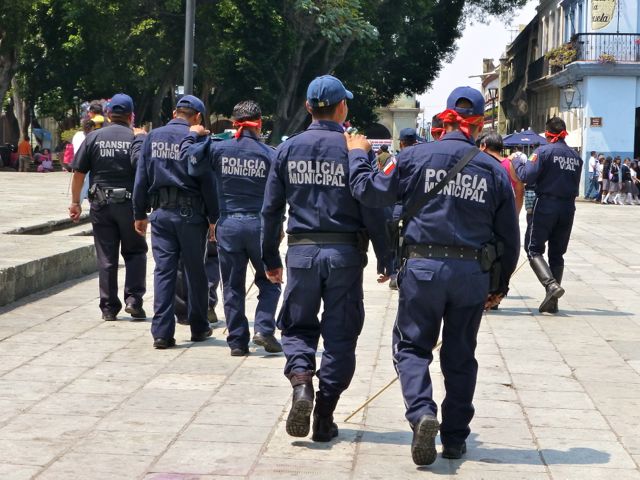
According to this article in Noticias, this is part of the Blind Accessible Tourism 2013 project of the Municipal Tourism Office. “During the tour, the participants experience the uncertainty that visually impaired people feel when walk the streets, and reflect on the importance of signs with street names written in Braille and audio traffic lights,” said Vladimir Martinez Lopez, who has been blind since age 11 and is the instructor for the course.
I blogged about the Braille street signs and the library for the blind and visually impaired soon after the signs began appearing at the beginning of 2012. Since then, I’ve seen them used by the sightless and intrigue and stimulate conversation among the sighted.
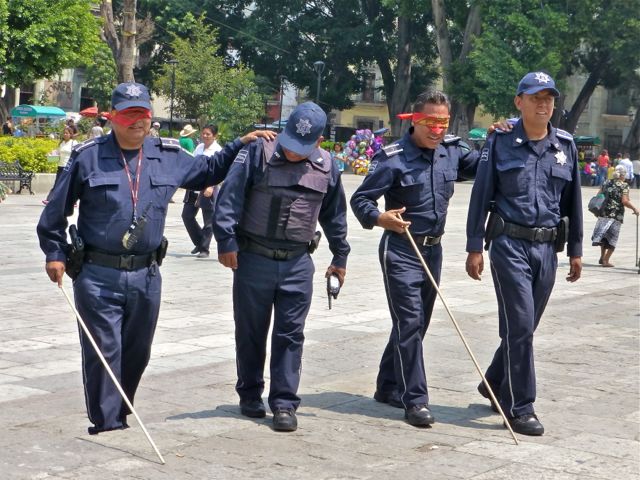
Now if they could just do something about the hazards of crossing the street at the intersections. Be they cars, buses, trucks, or motorcycles, they do not stop before turning a corner. Visually impaired or sighted, it’s like playing Russian Roulette!
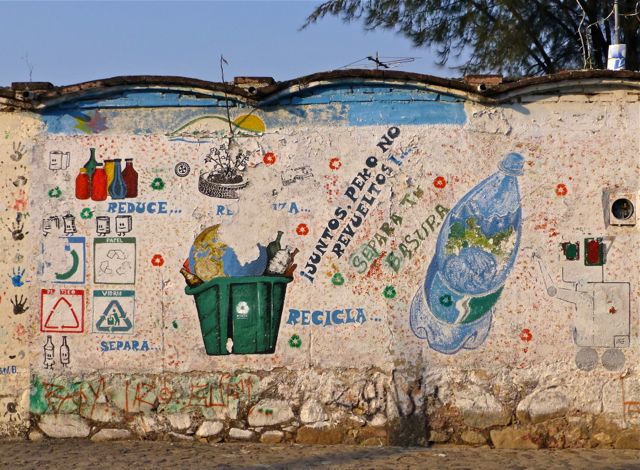
Posted in Education, Environment, Signs, tagged environmentalism, Mexico, Oaxaca, photographs, photos, popular travel destinations, recycling, street art, Teotitlán del Valle, wall art on May 18, 2013| 1 Comment »
Posted in History, Travel & Tourism, tagged A Wicked War: Polk, Amy S. Greenberg, Clay, history, Invasion of Mexico, Lincoln and the 1846 U.S. Invasion of Mexico, Mexican American War, Mexico, Niños Héroes de Chapultepec, Oaxaca, Pan-American Highway, politics, popular travel destinations on May 11, 2013| 16 Comments »
One of the main roads into and out of Oaxaca is Federal Highway 190. It is a section of the Pan American Highway (which runs from Prudhoe Bay, Alaska to Ushuaia, at the southernmost tip of Argentina). I cross the highway several times a month on my way to the Organic Market in Xochimilco or to a restaurant in Colonia Reforma — and the same thought always crosses my mind, “I can’t believe I’m walking across the Pan American Highway!”
However, the highway has another name, as runs through the city — Calzada Niños Héroes de Chapultepec. Child heroes of Chapultepec? Who were they? If you visit Mexico City, your guidebook or tour guide might direct you to Chapultepec Castle (Castillo de Chapultepec) set high on a hill in the middle of the beautiful 1694 acre Bosque de Chapultepec (Chapultepec Park). There you will discover that they were young martyrs from what is called the Mexican-American War in the USA and is known here as the Invasion of Mexico.
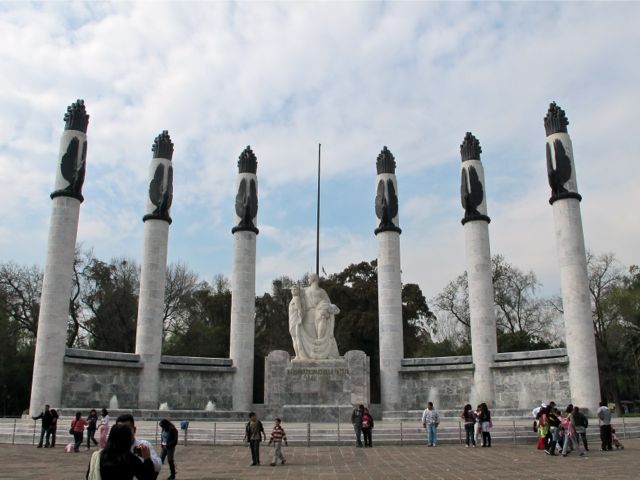
Monument to the Child Heroes in Chapultepec Park
Penn State historian Amy S. Greenberg calls it, A Wicked War, and her book, by the same name, chronicles a war waged on the basis of a Presidential lie, against a guiltless neighbor, for the express purpose of annexing half its territory. (Hola, Texas, New Mexico, Colorado, Arizona, Utah, Nevada, and California.) Then Illinois congressman Abraham Lincoln opposed the war and it spawned the first U.S. anti-war movement.
To discover what your teachers may not have told you about the Invasion of Mexico and its Niños Heroes, take a look at last week’s CBS Sunday Morning segment by Mo Rocca and with Amy Greenberg.
h/t Tim Johnson
Posted in Celebrations, Churches, Culture, Holidays, Religion, Travel & Tourism, tagged Día de la Santa Cruz, El Picacho, Mexico, Oaxaca, popular travel destinations, Templo de la Preciosa Sangre de Cristo, Teotitlán del Valle on May 4, 2013| 7 Comments »
Yesterday (May 3) was Día de la Santa Cruz and in Mexico it is the feast day of construction workers. Crosses are erected on building sites and decorated. The tradition has its origins with the guilds during the colonial era.
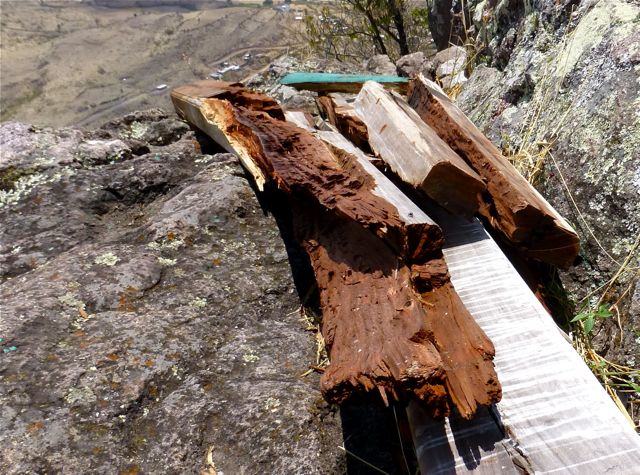
However, in Teotitlán del Valle, tradition calls for hiking up to the top of El Picacho. A tall aqua colored wooden cross stands at the top of the peak.

There were two crosses, but apparently one was hit by lightning a week or two ago. It lies in splintered pieces below where it stood.
Mountain and custom beckoned, and so we headed out to Teotitlán yesterday morning to climb the mountain. The trek began and our eyes were on the prize as we passed by irrigated fields…

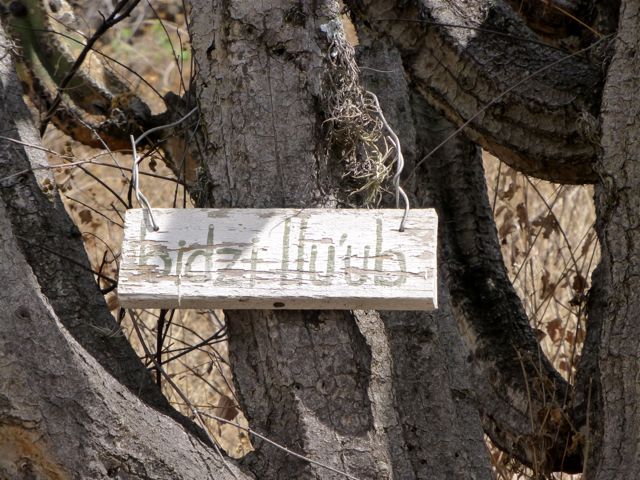
Along the steep and winding trail, there were signs…

in Zapoteco.
Bromeliads and other epiphytes clung to branches.
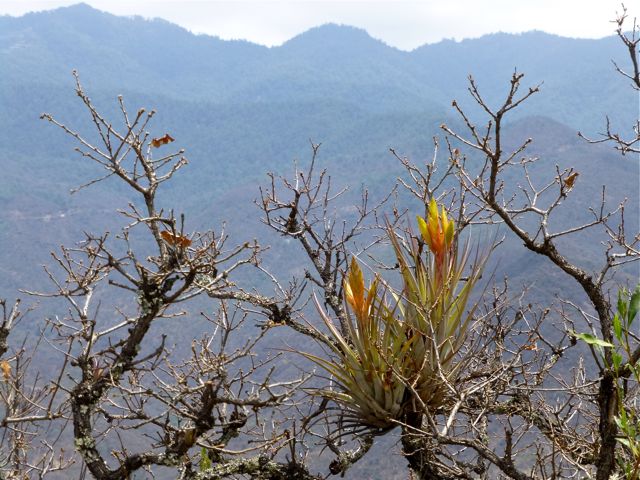
All along the way, the views were spectacular.

As we climbed, Templo de la Preciosa Sangre de Cristo grew smaller and smaller.

And, our destination grew closer and closer.

Almost two hours later (we stopped a lot!), we encountered the tethered burros that brought the tamales, aguas, and cervesas that awaited us at the top.
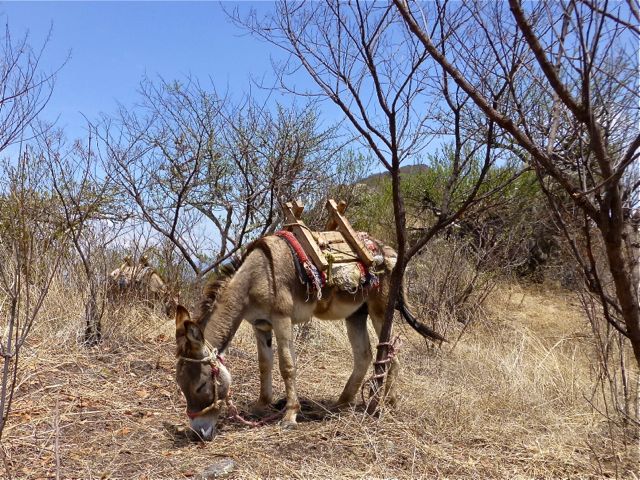
Besides sustenance, there were fireworks…
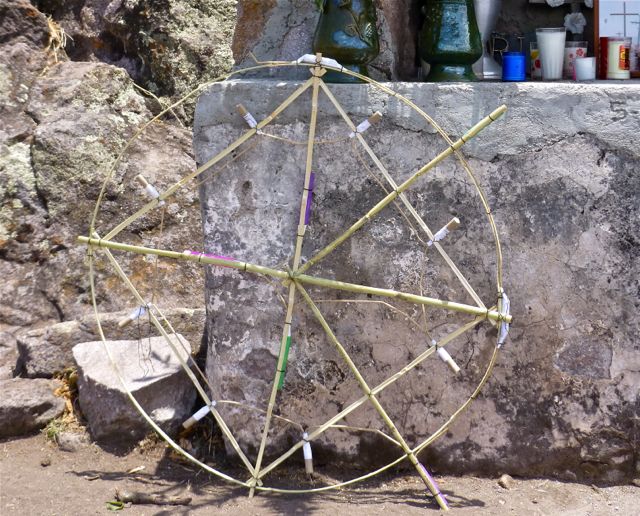
and expansive and even more spectacular views.

There were parents, teens, toddlers, abuelos…

and abuelas.

Muchisimas gracias to the people of Teotitlán del Valle, who never fail to warmly welcome us and, again, generously offered us food and drink.
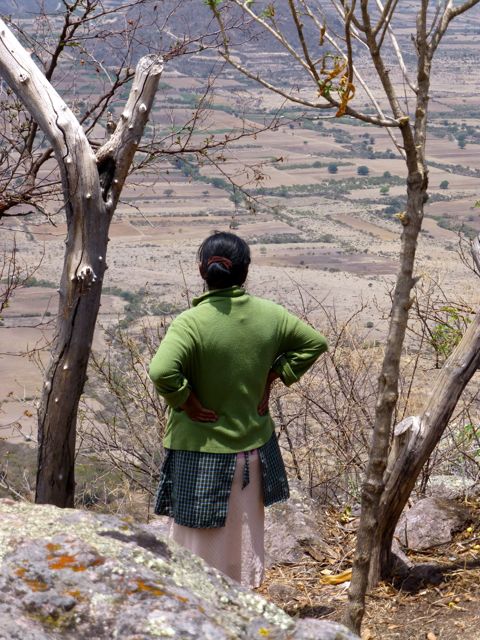
They are very special people who live in a very special place.
FYI: The trip down took less than an hour, I returned home exhausted, sore, sunburned (even though I’d slathered on sunscreen), and thoroughly exhilarated.
Posted in Creativity, Culture, Language, Music, Travel & Tourism, tagged Chikirriyó'i, colibrí, hummingbird, marble mason, Mexico, Mixteca, music, Oaxaca, photographs, photos, popular travel destinations on April 26, 2013| 5 Comments »
Wednesday in the Mixteca…

How could I resist? Photo, yes. Dining, no. We had already eaten and so were not tempted to try Restaurant El Colibrí, across the street. However, still scratching my head about the relationship between marble (marmol) and hummingbird (colibrí).
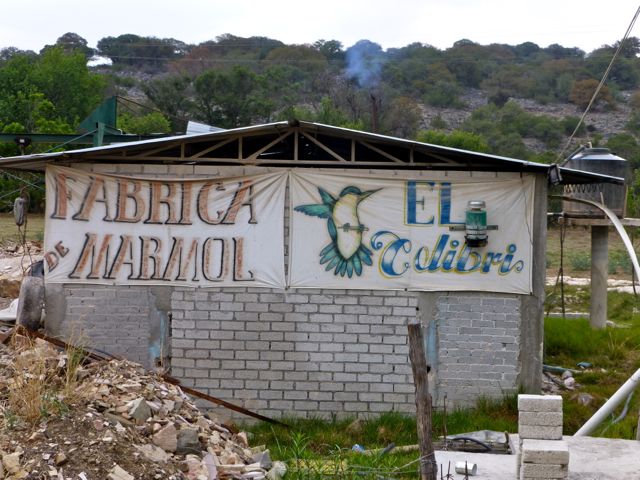
This librarian couldn’t resist doing a little research. According to Wikipedia, the hummingbird in Aztec culture was, “emblematic for their vigor, energy, and propensity to do work along with their sharp beaks that mimic instruments of weaponry, bloodletting, penetration, and intimacy.” Hmmm… the tools and strength needed by a marble mason. Now, it’s beginning to make sense.
(Thanks Chris for stopping so I could take the above photos.)
And now a song from the Mixteca, “Chikirriyó’i” (“El Colibrí”) (The Hummingbird):
Posted in Food, Restaurants, Travel & Tourism, tagged Comida Corrida, Dondé está el Chef?, food, Gío, Jean Michel Thomas, lunch, Mexico, Oaxaca, photographs, photos, popular travel destinations, restaurants on April 24, 2013| 8 Comments »
A meal named for the 3 parts of a bullfight? Yes, the origin of the name of Mexico’s ubiquitous 3-course, fixed price, midday meal, Comida Corrida, is derived from the “Tres tiempos” of a “Corrida de toros.”
Ordinarily, simple and substantial, chef Jean Michel Thomas of Gío (aka, Dondé está el Chef?) has taken it to a French infused gourmet level — all for only 80 pesos. My lunch on Monday…

Crema de Flor de Calabaza al Aji Panca accompanied by Agua de Jamaica

Tartare de Atún Fresco con Tomate y Arroz a la Mostaza de Dijon

Pastel de Chocolate Oaxaca con Coulis de Mango
Gío currently can be found at Eucaliptos 407A, Colonia Reforma, in the city of Oaxaca. It is open Monday through Friday, from 2:00 – 5:00 PM.
¡Buen provecho!
Posted in Churches, Travel & Tourism, Weather, tagged Basilica de la Soledad, Mexico, Oaxaca, photographs, photos, popular travel destinations, sidewalks, weather on April 17, 2013| 10 Comments »
… go out in the midday sun!
For more than a week, most afternoons have found me holed up inside my apartment with curtains drawn against an unrelenting sun — a semi-successful attempt to retain the cool air I’d ushered in when doors and windows were thrown open first thing in the morning.

These May-like temperatures, in the mid to high 90s F during the day, have been THE major topic of conversation amongst Oaxaqueños, ex-pats, and visitors, alike. If you must venture out, as I did yesterday, you hug that sliver of shadow. Umbrellas come in handy too!

The multiplex theaters on the outskirts of the city are some of the very few buildings with air-conditioning. However, to get there, one must take a sweltering bus or taxi ride through traffic clogged streets, never knowing when a bloqueo or road construction will bring your retreat to a scorching halt. A better alternative is to follow the lead of these priests processing into the Basilica and head to the nearest church. Mil gracias to the architectural gods for their thick stone walls and soaring ceilings!

¡Hace mucho calor! Time for a siesta…
Posted in Creativity, Culture, Music, Travel & Tourism, tagged Bird On a Wire, graffiti, Leonard Cohen, Mexico, Oaxaca, photographs, photos, popular travel destinations, street art, urban art, wall art on April 15, 2013| 4 Comments »
More from the wall art at Calle Melchor Ocampo and La Noria. I can’t help thinking of Leonard Cohen’s, Bird on a Wire.

Like a bird on a wire,
Like a drunk in a midnight choir
I have tried in my way to be free.
Posted in Celebrations, Culture, Holidays, Religion, Travel & Tourism, tagged Christianity, Good Friday, Holy Week. Semana Santa, Mexico, Oaxaca, photo, photographs, photos, popular travel destinations, Procesión del Silencio, Procession of Silence, religion, ritual procession, Viernes Santo on April 3, 2013| 8 Comments »
The Semana Santa poster said the Viernes Santo (Good Friday) Procesión del Silencio was to begin at 6 PM in front of Preciosa Sangre de Cristo. Knowing the drill, I arrived at 4:45 to take photos as contingents and participants arrived — but nobody was there. The old antiwar slogan, “What If They Gave a War and Nobody Came” came to mind.
Of course it was going to happen, it’s just that time isn’t what it seems here. Word on the scene had it that, despite the poster info, it wasn’t to begin until 6:30 PM. No worries! Well, except that Mexico doesn’t begin Daylight Saving Time until next weekend, the light began rapidly fading, and 6:30 PM became 7 PM. Por favor, let Oaxaca’s 27th annual Parade of Silence begin!


And it eventually did — up Macedonio Alcalá, left at the Cruz de Piedra, left again on García Vigil to Independencia, another left, and back up the Alcalá. And so, in darkness and silence the procession returned to the church where it all began. Contingents could be heard late into the night parading through the streets of the city, as they returned the Jesuses and Marías to their respective home churches.
Lots more photos can be seen over at Oaxaca-The Year After.
Posted in Celebrations, Culture, Holidays, Religion, Travel & Tourism, tagged Cofradía, Confraternity, Mexico, Oaxaca, penitents, photographs, photos, popular travel destinations, Procesión del Silencio, Procession of Silence, religion, Semana Santa, Viernes Santo on March 31, 2013| Leave a Comment »
In Oaxaca the penitents gathered…

in front of Preciosa Sangre de Cristo on Good Friday…
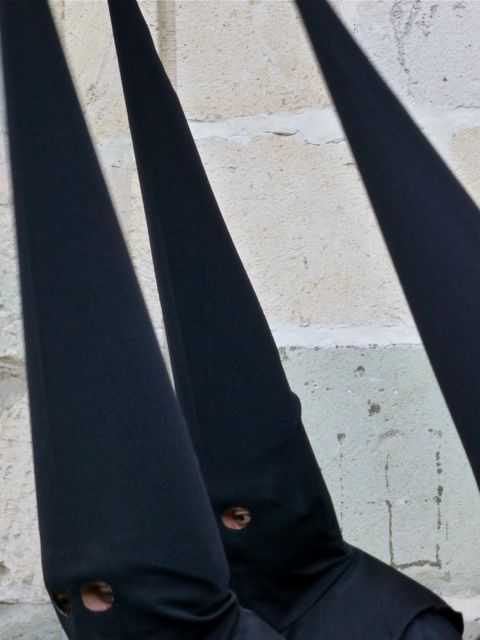
preparing for the Procession of Silence.

For those who are wondering, “What’s with the hoods (capirotes)?” The answer can be traced back to the Middle Ages. Members of lay religious charitable organizations (cofradías) would don the masks and hoods to guarantee anonymity and promote humility in their service.
From the Holy Week in Seville, Wikipedia page:
At the heart of Semana Santa are the brotherhoods (Hermandades y Cofradías de Penitencia),[1] associations of Catholic laypersons organized for the purpose of performing public acts of religious observance; in this case, related to the Passion and death of Jesus Christ and to perform public penance.
The brotherhoods, besides the day-to-day work in preparation for the processions, also undertake many other self-regulated religious activities, and charitable and community work. Many brotherhoods maintain their own chapel, while others are attached to a regular parish.
The Spanish brought the tradition to Mexico and penitents continue to play a major role in the Viernes Santo, Procesión del Silencio in Oaxaca.
Posted in Celebrations, Culture, Holidays, Religion, Travel & Tourism, tagged Easter, Estaciones de la Cruz, Good Friday, Holy Week, Mexico, Oaxaca, photographs, photos, popular travel destinations, ritual procession, Semana Santa, Stations of the Cross, Via Crucis, Viernes Santo on March 30, 2013| 2 Comments »
And so Viernes Santo (Good Friday) began…


Mass said, a Vía Crucis (Stations of the Cross) procession through the streets of my neighborhood.
Posted in Science & Nature, Travel & Tourism, tagged full moon, La luna del gusano, Mexico, Moon, Oaxaca, photographs, photos, popular travel destinations, Worm Moon on March 28, 2013| 2 Comments »
La Luna del Gusano rises above the city of Oaxaca.
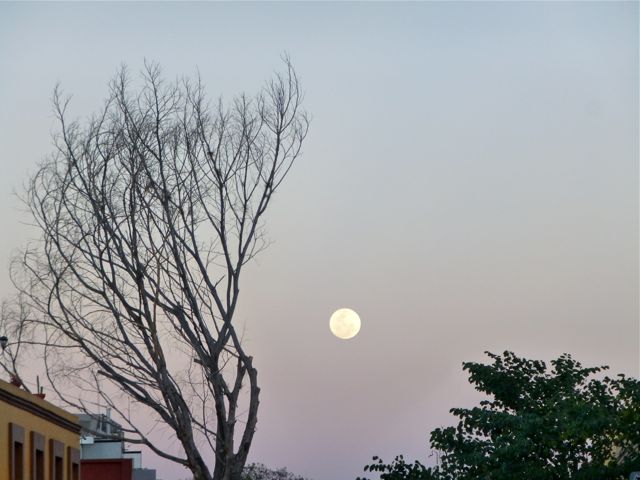


I’ve got to say, “La Luna del Gusano” sounds so much more poetic than, “Worm Moon.” Ahhh, the romance of Spanish.




 Mexican Peso Converter
 View From Casita Colibrí