Meet the new gals in town…

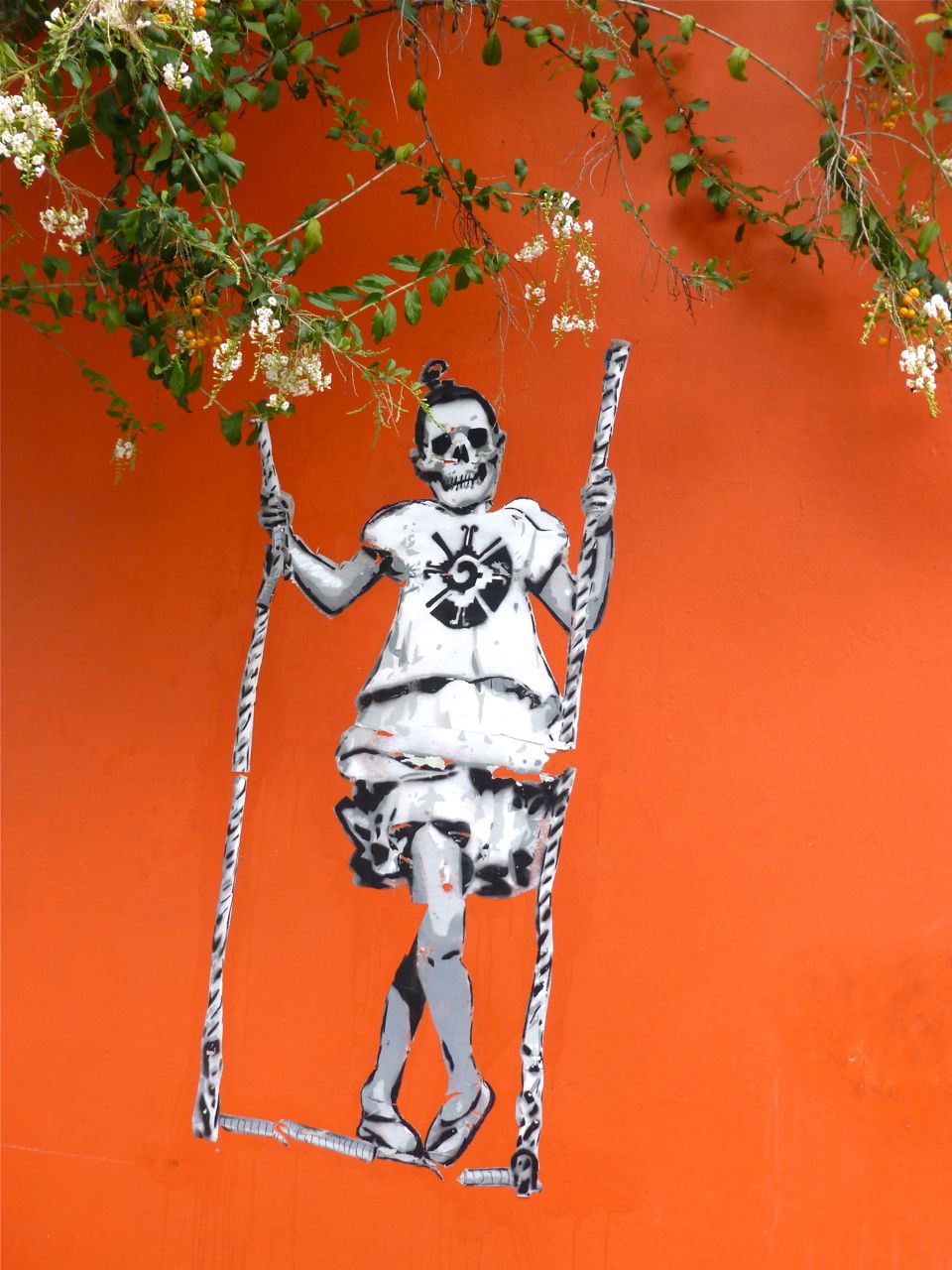
Life and death in Oaxaca.
Posted in Creativity, Culture, Religion, Travel & Tourism, tagged calacas, graffiti, Mexico, Oaxaca, photographs, photos, popular travel destinations, skeletons, street art, urban art, Virgin of Guadalupe, wall art on March 14, 2014| 2 Comments »
Posted in Buildings, Churches, Creativity, Culture, Religion, Travel & Tourism, tagged Cathedral of Oaxaca, La catedral de Nuestra Señora de la Asunción, Mexico, Oaxaca, photographs, photos, popular travel destinations, religious statuary, statues on February 5, 2014| 5 Comments »
It’s amazing how sometimes light, shade, and a pristine backdrop can come together to highlight something you have looked at hundreds of times, but have never really seen.
Early last week, on a stunningly clear blue sky day, I passed the La Catedral de Nuestra Señora de la Asunción (the Cathedral of Our Lady of the Assumption) and stopped dead in my tracks.
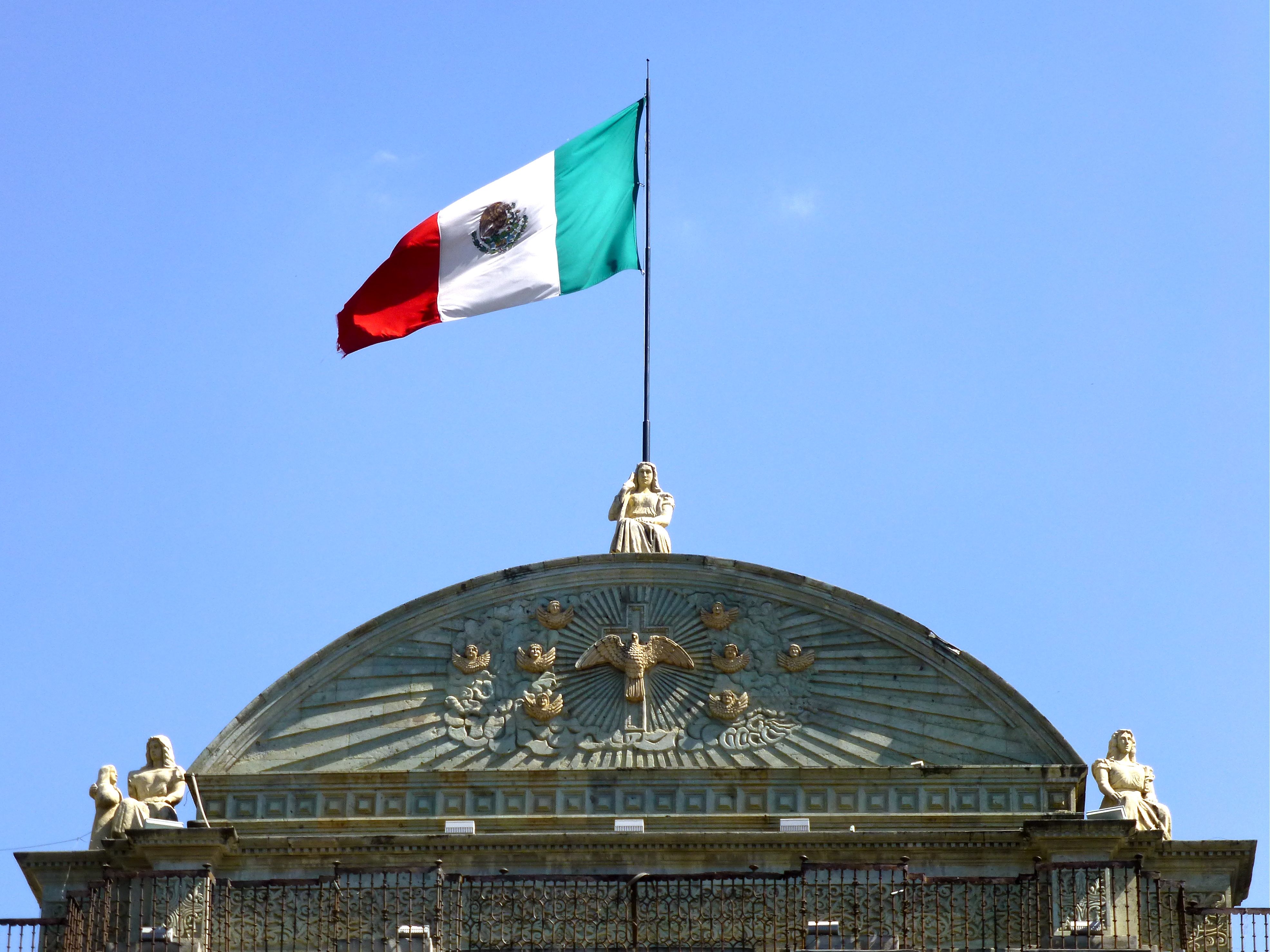
The flag must have been what initially caught my attention — it’s not an everyday occurrence — but what held my gaze were the three gals atop the Cathedral.

I wondered, are they new?
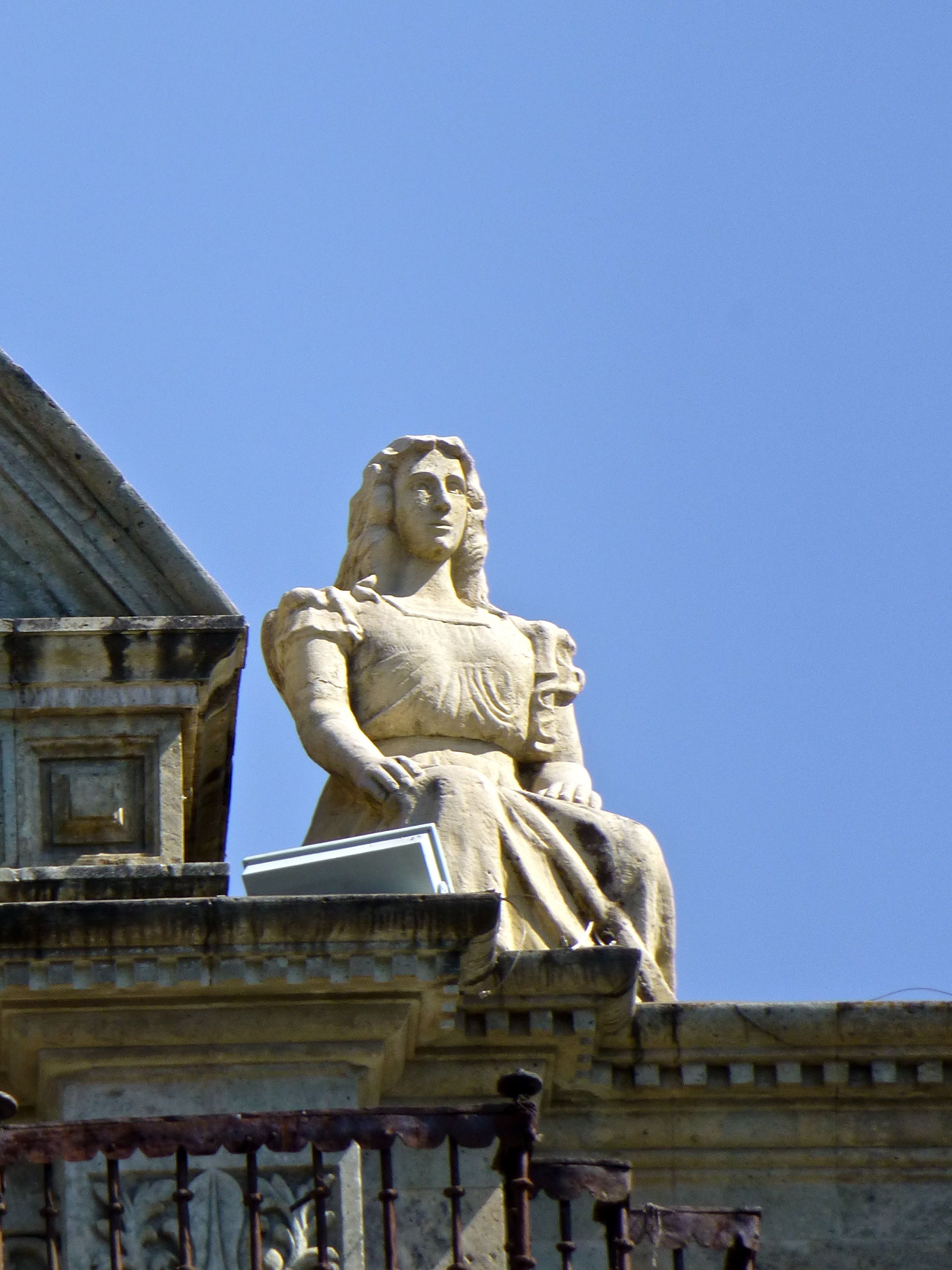
Once home, I scrolled through old photos I’d taken and sure enough there they were in every photo of the Cathedral’s facade.

Hmmm… How could I have missed their imposing presence?
Now to find out who they represent. (You can take the librarian away from the reference desk, but you can’t take the reference questions away from the librarian!) Anybody out there have any answers???
Posted in Food, Parks & Plazas, People, Travel & Tourism, tagged frozen dessert, ice cream, Jardín Sócrates, Mexico, Nevería Malena, neveria, nieves, Oaxaca, photographs, photos, popular travel destinations, Socrates Garden on January 28, 2014| 6 Comments »
After more than two weeks of frente fríos (cold fronts) sweeping down from el norte, the weather has turned downright hot, with temperatures in the mid 80s (F). What’s a person to do? Today, this person headed to her favorite ice cream parlor, Nevería Malena at Jardín Socrates.
I previously mentioned this nevería when the Jardín underwent an image enhancement a year and a half ago. And, as before I ordered leche quemada (burnt milk) and tuna (nopal cactus fruit). It may not have been the most nutritious lunch, but it hit the spot!

As you can see from the photo, Nevería Malena now sports spiffy new seat covers for the backs of their wrought iron chairs. And, on the back of the laminated menu of flavors, the story of Malena and the “tradition that flatters your palate” is told. (My translation follows.)

Señora Malena is the 5th child of Ángel Armengol and Anacieta Hernández. They taught her the craft and soon she became one of the most prestigious and famous for the seasoning and flavors of her frozen dessert.
Initially, Malena walked around the Zócalo, offering her frozen dessert in glasses. Later she relocated next to the Cathedral where she continued to offer her delicious frozen dessert. (Note: At that time natural ice was brought from the community of “La Nevería” in the Sierra Juárez.) She then moved to the Alameda de León to a space which already had a laminated roof. It was here she affectionately began to be called, “Malenita” and the stall was named Malena.
Malena became famous for traditional flavors like burnt milk, sorbet, walnut, pear, and lemon. Fame grew with an invitation by the Secretariat of Tourism to participate in the “Week of Oaxaca in Mexico,” at which Malena participated for 15 years. The stall subsequently was transferred to “Socrates Garden” where it is currently run by her children and grandchildren, with love and affection — to continue the tradition and increase the variety of flavors.

And, increase the flavors they have! So many to choose from. Hmmm… next time, Beso de Ángel or Diablo???
Posted in Culture, Food, People, Travel & Tourism, tagged Dolores Porras DVD, food, Hotel las Golondrinas, huevos divorciados, Mexico, Michael Peed, Oaxaca, photographs, photos, popular travel destinations on January 23, 2014| 8 Comments »
Sí, huevos divorciados! A little food porn to begin the day…
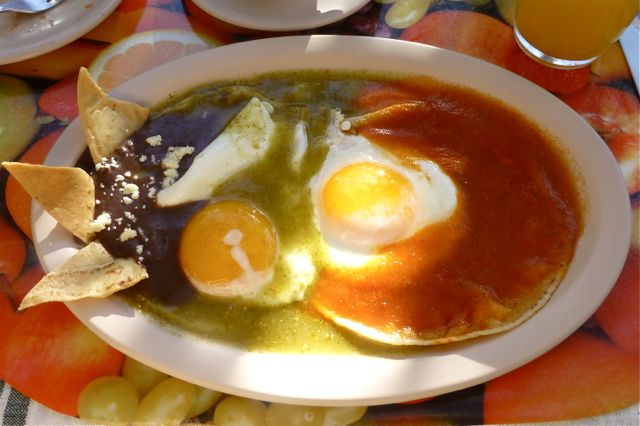
Early morning walk up to Hotel las Golondrinas yesterday morning for breakfast. Surrounded by the distinctive pottery of Dolores Porras, it was the perfect setting to meet Michael Peed, filmmaker of the documentary, Dolores Porras: Artista Artesana de Barro.
Posted in Creativity, Culture, Restaurants, Travel & Tourism, tagged bar stools, Eartha Kitt quote, Fred Astaire video, La Condesa Oaxaca, Mexico, Oaxaca, photographs, photos, popular travel destinations, restaurant on January 17, 2014| 2 Comments »
And now for a little levity…
Seen through the window of La Condesa restaurant and bar in Oaxaca.

I love to tease men with my legs. — Eartha Kitt
I keep waiting for the bar stools to break out into a tap dance routine. A friend posted this video on Facebook yesterday of Fred Astaire tapping and drumming — at the same time! I wonder what he would have done with these stools?
Posted in Creativity, Culture, Exhibitions, Travel & Tourism, tagged art, Gorilla Gallery, Mexico, Oaxaca, photographs, photos, popular travel destinations, urban art, Yescka on January 13, 2014| Leave a Comment »
Urban artist, Yescka, at work on December 20, 2013 at Gorilla Gallery in Oaxaca…


Live action painting from the back of the glass, a devilish Virgen de Guadalupe emerges…


From the back and from the front, La Virgen is finished.


Yescka then turned to one of the gallery’s windows; outside looking in and inside looking out.


Like street art, these works are not forever. In a month (or so), the virgin will be disappeared and another artist will come to Gorilla Gallery to create another ephemeral masterpiece.
Gorilla Gallery is at Crespo 213 and is open on Thursdays, from 2:00 – 8:0 PM.
Posted in Celebrations, Culture, Travel & Tourism, tagged Año Nuevo, I Hope You Dance lyrics, Mexico, New Year's Eve, Oaxaca, photographs, photos, popular travel destinations on December 31, 2013| 16 Comments »
Feliz año nuevo y muchisimas gracias to all my wonderful blog readers — for reading, for commenting, for sharing, for the opportunity to meet some of you, and for inspiring me to continue.
Tonight, don’t forget to eat 12 grapes at midnight, making a wish for the new year as you eat each one. And, if one of your wishes is to travel, take your suitcase out for a walk after you finish your grapes.
My wish for you in 2014…
I Hope You Dance
Written by Mark D. Sanders and Tia Sillers and
recorded by Lee Ann Womack
I hope you never lose your sense of wonder
You get your fill to eat
But always keep that hunger
May you never take one single breath for granted
God forbid love ever leave you empty handed
I hope you still feel small
When you stand by the ocean
Whenever one door closes, I hope one more opens
Promise me that you’ll give faith a fighting chance
And when you get the choice to sit it out or dance
I hope you dance
I hope you dance
I hope you never fear those mountains in the distance
Never settle for the path of least resistance
Living might mean taking chances
But they’re worth taking
Lovin’ might be a mistake
But it’s worth making
Don’t let some hell bent heart
Leave you bitter
When you come close to selling out
Reconsider
Give the heavens above
More than just a passing glance
And when you get the choice to sit it out or dance
I hope you dance
(Time is a wheel in constant motion always)
I hope you dance
(Rolling us along)
I hope you dance
(Tell me who)
I hope you dance
(Wants to look back on their youth and wonder)
(Where those years have gone)
I hope you still feel small
When you stand by the ocean
Whenever one door closes, I hope one more opens
Promise me that you’ll give faith a fighting chance
And when you get the choice to sit it out or dance
Dance
I hope you dance
I hope you dance
(Time is a wheel in constant motion, always)
I hope you dance
(Rolling us along)
I hope you dance
(Tell me who)
(Wants to look back on their youth and wonder)
I hope you dance
(Where those years have gone)
(Tell me who)
I hope you dance
(Wants to look back on their youth and wonder)
(Where those years have gone)
Posted in Celebrations, Creativity, Culture, Exhibitions, Holidays, Parks & Plazas, People, Restaurants, Travel & Tourism, tagged artisans, Café Café, Christmas, dried corn husks, Elpidio Adrián González López, Mercado Antiguo en la Plaza de las Armas 1885, Mexico, Night of the Radishes, Noche de Rabanos, Oaxaca, photographs, photos, popular travel destinations, Totomoxtle on December 27, 2013| Leave a Comment »
Despite of the name, Noche de Rábanos isn’t just about carving radishes. The creativity and ingenuity of the gardeners and artisans of Oaxaca in several other categories are also on display — Flor Inmortal (dried flowers), Totomoxtle (dried corn husks) Natural, and Totomoxtle Decorated, as well as two Children’s categories.
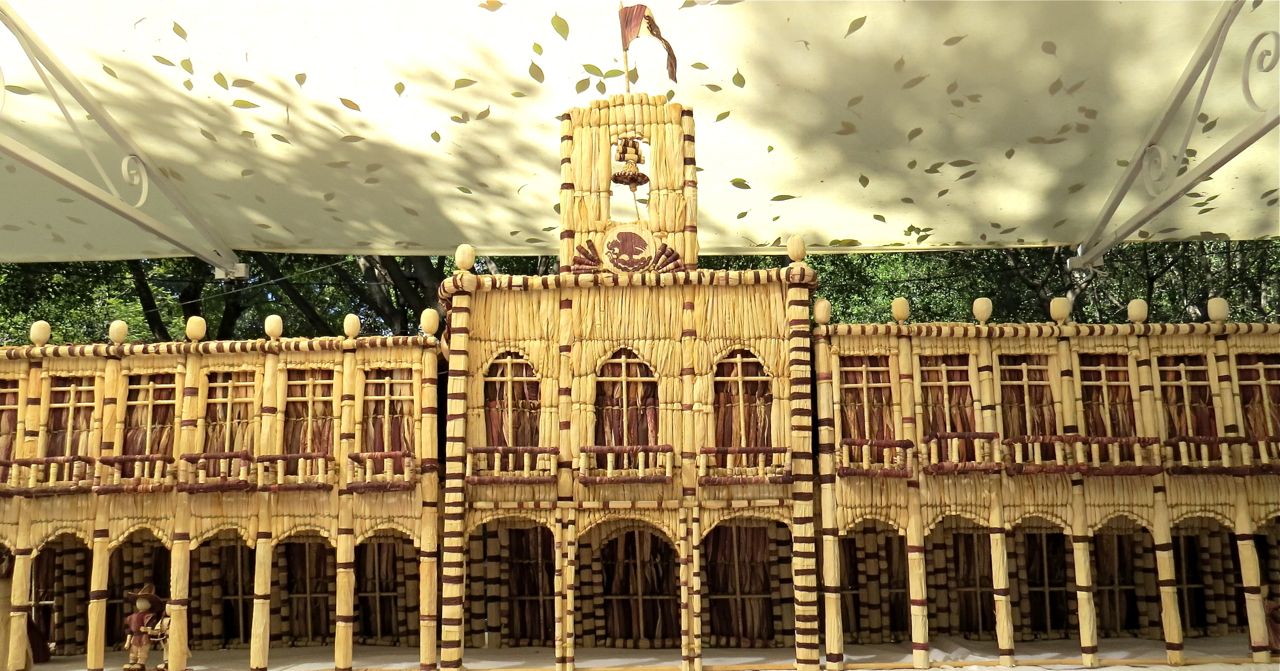
First place in the Totomoxtle Natural category went to Elpidio Adrián González López and his amazing creation, Mercado Antiguo en la Plaza de las Armas 1885.


If you missed it December 23 on the zócalo, or want to see it up close and personal, head over to CaféCafé, on the corner of Porfirio Díaz and M. Bravo.


It will be on display until January 6, 2014.
h/t Jane & Ken
Posted in Celebrations, Churches, Culture, Holidays, Parks & Plazas, People, Religion, Travel & Tourism, tagged 'Twas the Night Before Christmas, “Lalo” Guerrero, Christmas, Christmas Eve, Eduardo Guerrero, Mexico, Navidad, Noche Buena, Oaxaca, Pancho Claus, photographs, photos, poem, popular travel destinations, ritual procession on December 25, 2013| 8 Comments »
Noche Buena (Christmas Eve) in Oaxaca means posadas from churches around the city converge on the zócalo. Flatbed trucks carrying Jesus, Mary, and Josephs; fireworks, pinwheels, and sparklers; brass bands; China Oaxaqueña folkloric dancers; and the faithful carrying candles arrive to circle the zócalo again and again and again. Spectators, young and old wave sparklers, take photos, and crack powder or confetti filled eggs on each others heads — and it’s quite a scene!
And, in what has become a Christmas Eve tradition (it was still Christmas Eve when I began this post) on my blog, Ernie Villarreal’s version of the song, Pancho Claus, by Chicano music legend, Eduardo “Lalo” Guerrero.
Pancho Claus
‘Twas the night before Christmas and all through la casa
Not a creature was stirring, Caramba! ¿Que pasa?
Los ninos were all tucked away in their camas,
Some in vestidos and some in pajamas.
While Mama worked late in her little cocina,
El viejo was down at the corner cantina.
The stockings were hanging con mucho cuidado,
In hopes that St. Nicholas would feel obligado
To bring all the children, both buenos y malos,
A Nice batch of dulces and other regalos.
Outside in the yard, there arouse such a grito,
That I jumped to my feet, like a frightened cabrito.
I went to the window and looked out afuera,
And who in the world, do you think que era?
Saint Nick in a sleigh and a big red sombrero
Came dashing along like a crazy bombero!
And pulling his sleigh instead of venados,
Were eight little burros approaching volados.
I watched as they came, and this little hombre
Was shouting and whistling and calling by nombre.
¡Ay, Pancho! ¡Ay, Pepe! ¡Ay, Cuca! ¡Ay, Beto!
¡Ay, Chato! ¡¡Ay, Chopo! ¡Maruca and ¡Nieto!
Then standing erect with his hand on his pecho
He flew to the top of our very own techo.
With his round little belly like a bowl of jalea,
He struggled to squeeze down our old chimenea.
Then huffing and puffing, at last in our sala,
With soot smeared all over his red suit de gala.
He filled the stockings with lovely regalos,
For none of the children had been very malos.
Then chuckling aloud and seeming contento,
He turned like a flash and was gone like the viento.
And I heard him exclaim and this is VERDAD,
Merry Christmas to all, And to All ¡Feliz Navidad!
Posted in Creativity, Culture, Science & Nature, Travel & Tourism, tagged graffiti, Mexico, murals, Oaxaca, photographs, photos, popular travel destinations, street art, urban art, Winter Solstice on December 21, 2013| 2 Comments »
It may be the Winter Solstice, but here in Oaxaca my doors and windows are already open and I’m looking at a clear blue sky and an 85° F temperature forecast. Ahhh…
This is about as close as we get to Old Man Winter…

Mural on a wall along Niños Heroes, Oaxaca
Happy Winter Solstice to all in the northern latitudes and happy Summer Solstice to those south of the equator.
Posted in Celebrations, Churches, Culture, Holidays, Parks & Plazas, Religion, Travel & Tourism, tagged Basilica de la Soledad, food, Mexico, Nuestra Señora de la Soledad, Oaxaca, Patrona de los Oaxaqueños, photographs, photos, Plaza de la Danza, popular travel destinations, Queen of Oaxaca, Virgen de La Soledad, Virgin of Solitude on December 18, 2013| 6 Comments »
Today is the feast day of Nuestra Señora de la Soledad, the mother, queen, and patron saint of Oaxaqueños.

If you enter the word “soledad” into a Spanish to English translation program, “solitude” and “loneliness” result. However, for the past ten days, Our Lady of Solitude hasn’t had much of an opportunity to be lonely. On December 15, she was taken down from her glass encased niche in the Basílica, that bears her name, and carried out into the fresh air of the church plaza. On the 16th, she took a road trip through the streets of Oaxaca, stopping to visit several other churches along the route.
The faithful have been coming to honor her.


And, over the past 24 hours, she has been entertained by fireworks, bands, and the ringing of bells.


Food stalls surround her from Morelos to Independencia…


along with vendors of the sacred…


and the profane.


There is even a carnival for the kids.


With crowds, like these…


Nuestra Señora de la Soledad might just be looking forward to returning to the solitude of her glass enclosed niche. I know I’m looking forward to a quiet night’s sleep!
Posted in Celebrations, Creativity, Culture, Holidays, Religion, Travel & Tourism, tagged Mexico, Oaxaca, photographs, photos, popular travel destinations, religious pilgrimages, Virgen de Juquila, Virgin of Juquila on December 7, 2013| 7 Comments »
No doubt, tomorrow I will be awakened, long before the crack of dawn, by the cracks and pops of cohetes (rockets — all bang no bling) and the seemingly non-stop clangs and bongs emanating from the bell towers of the countless churches that surround me in Oaxaca city’s historic district. And, I’m sure, I will hear the sounds of a procession — December 8 is the feast day of the Virgin of Juquila (La Virgen de Juquila).
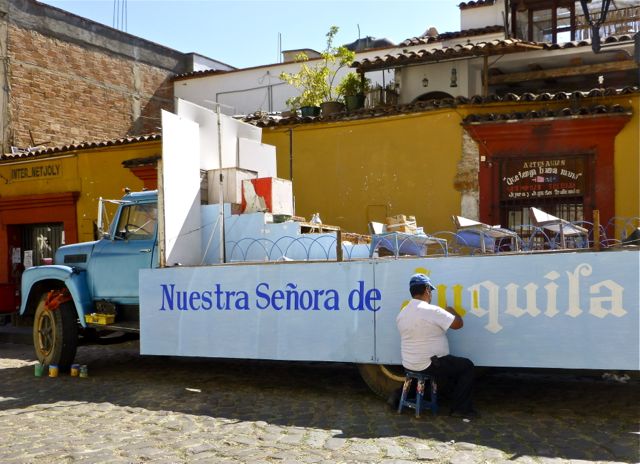
Flatbed truck on Constitución in Oaxaca city, Dec. 6, 2012.
According to legend, in 1633, when a fire burned the small Chatino village of Amialtepec to the ground, a small wooden statue of the Virgin Mary was rescued amidst the ashes. She was undamaged, save for her light skin color, which was permanently darkened by the smoke, causing her to more closely resemble the Chatino people, who live in this remote mountainous region. Local priests declared her survival a miracle and she has been venerated ever since and her image appears throughout Oaxaca.
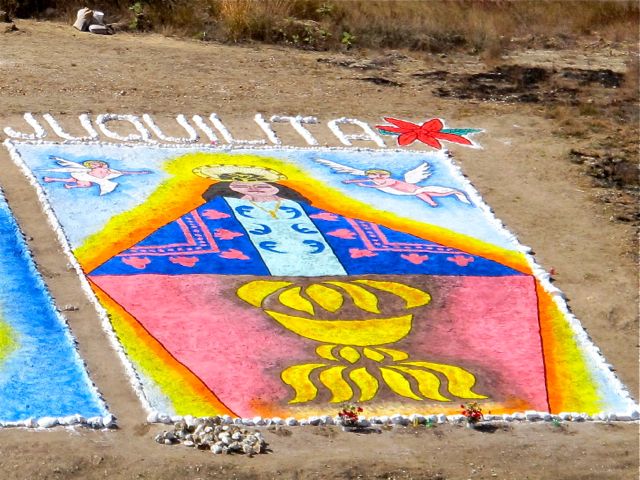
Image of La Virgen de Juquila along highway 175.
In 1776, the Bishop had a new temple built for La Virgen de Juquila in the nearby, but larger, village of Santa Catarina Juquila. Today, pilgrims continue to come, not just on her feast day, often making the arduous journey up into the mountains by bicycle or even on foot. They go to La Capilla del Pedimento in Amialtepec to fashion images from its clay soil — replicas of wished for items (cars, houses, healed body parts, etc.) to lay at her feet.

Side of a building in residential neighborhood of Santa Cruz Xoxocotlán, Oaxaca
According to this morning’s Noticias, the Archbishop of Antequera Oaxaca has called upon Catholics, as part of tomorrow’s feast day, to pray for reconciliation and peace in Oaxaca. That’s a tall order. The miracle of her survival has given La Virgen de Juquila the power to bestow miracles — such is the faith of her believers. We shall see…
Posted in Celebrations, Culture, Religion, Travel & Tourism, tagged Barrio de Jalatlaco, comparsa, Day of the Dead, Día de los Muertos, Mexico, muerteada, Oaxaca, photographs, photos, popular travel destinations on October 28, 2013| 2 Comments »
Cempasuchitl, catrinas, and comparsas. El día de los muertos is coming…


Mural at the corner of Aldama and Hidalgo in Barrio de Jalatlaco.
Posted in Creativity, Culture, Travel & Tourism, tagged face painting, Mexico, Oaxaca, photo, photographs, popular travel destinations on October 24, 2013| 6 Comments »

How now, spirit! whither wander you? — Puck, Midsummer Night’s Dream.
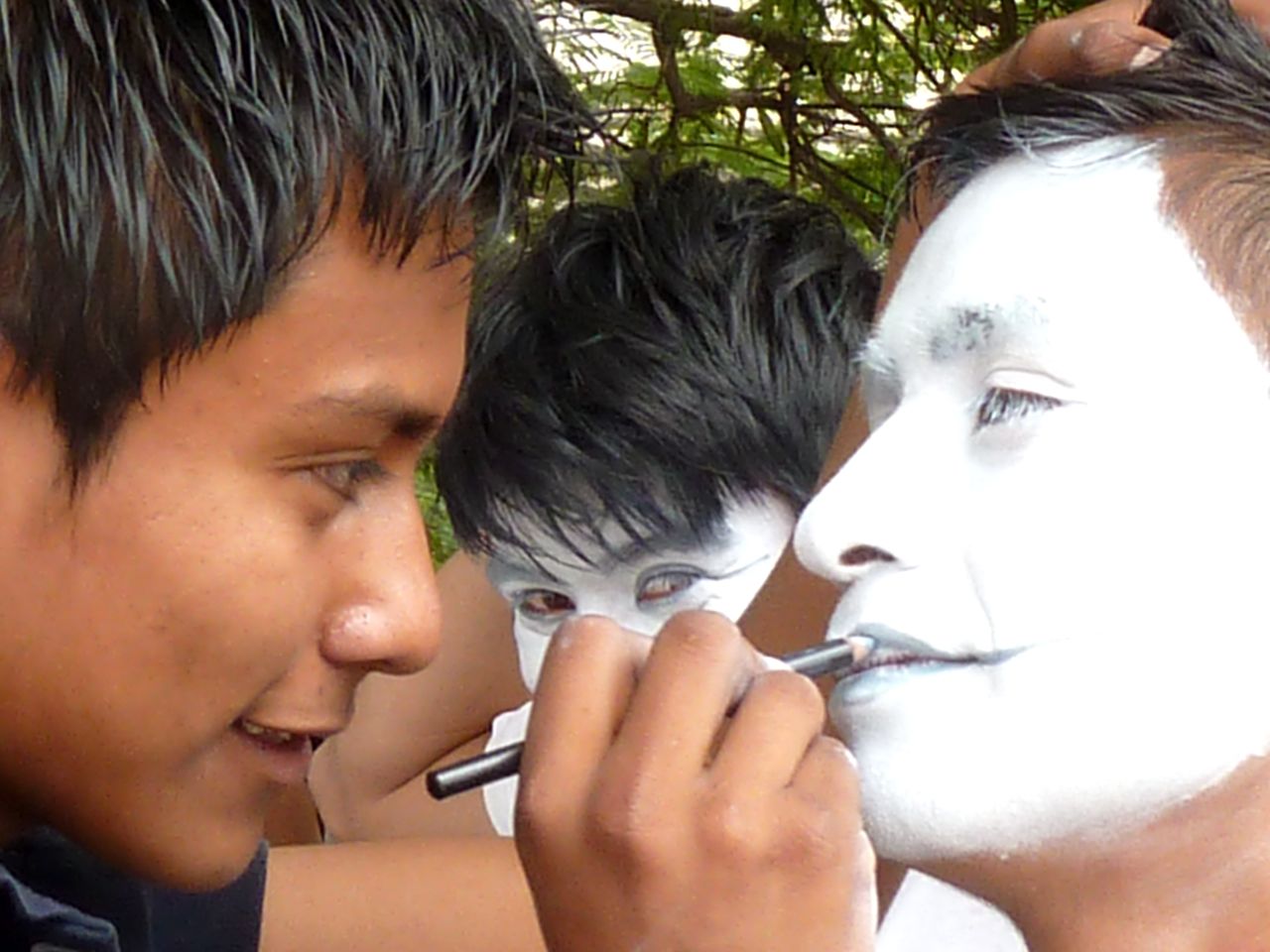
Just another Wednesday walk in Oaxaca.
Posted in Celebrations, Creativity, Culture, Travel & Tourism, tagged calendas, cell phones, DPchallenge, marmotas, Mexico, Oaxaca, parades, photographs, photos, popular travel destinations, Señor de Tlacolula, Tlacolula de Matamoros on October 14, 2013| 6 Comments »
There is a lot of work that goes into getting a marmota ready to go to the dance. Getting dressed takes a quite a crew and there is a lot of up close and personal last-minute cinching that must be done. Then there is squeezing (she does weigh over 70 kilos) through the church plaza portal, to make her grand entrance onto the street. However, once she emerges, she joins with her friends to dance through the streets of Tlacolula de Matamoros late into the night!
Calenda in honor of el Señor de Tlacolula, October 11, 2013. Living history from the valley where corn was first cultivated.


 Mexican Peso Converter
 View From Casita Colibrí