Feeds:
Posts
Comments

Posts Tagged ‘photographs’

Congratulations to one of my favorite weavers, Amalia Martínez Casas from the mountain village of Tamazulápam del Espíritu Santo, winner of the 13th Popular State Art Prize “Benito Juarez” 2013.  The award, presented several days ago by Oaxaca governor Gabino Cue, recognized and honored her work using the backstrap loom, using cotton thread and wool dyed with indigo and banana peel, to weave the traditional costume of Tamazulápam in the Mixe.

Three or four times a year, an artisan fair is held in Llano Park.  Puestos upon puestos of pottery, wood carved alebrije, jewelry, and textiles are on display.  It was here, two years ago, where I first discovered the exquisite work of the tiny and talented weaver, Amalia Martínez Casas.

IMG_4175

I couldn’t resist buying this huipil; a subtle black on charcoal grey that looks both traditional here in Oaxaca and very hip with black leggings and boots in el norte.

And, then the next time, even though the dye was a little uneven, I couldn’t resist buying this short huipil — the color had me at, hola!

Her well-crafted technique and finely drawn designs are sophisticated, be they executed in subdued huipiles or brilliant red serapes.

Every time I wear one of her works of art, people ask, “Where is it from?”  “Who made it?”  “Where can I get one?”  I’ve pointed several friends to her stall in Llano Park during artisan fairs and last week, at the request from a friend in California, I bought this one.  The slight green tint will be perfect with her red hair.  (Yes, this one’s for you, Louise!)

Photos of the award ceremony can be found HERE and video is available HERE.  (Amalia Martínez Casas can be seen beginning at 6:00 minutes.)  And, for more of her creations, check out a blog post Chris did last January.

Read Full Post »

Wading through the 900+ Guelaguetza photos and wondering…  Where do I start?  Where do I stop?  Today, it will be with two delegations from the Jamiltepec District in the Costa Region of the state of Oaxaca.

I begin with photos from last Saturday’s desfile of these fierce (and one not-so-fierce) looking guys from San Juan Colorado.

And, I will end this post with San Andrés Huaxpaltepec delegation.

With the crowds that line the parade route and the contingent of family, friends, and aides (providing props and costume repair, along with much-needed water) that accompany each delegation, it was hard to photograph, let alone video, the dancing along the way.  However, click HERE to watch a video of the La Mayordomía de San Andrés Huaxpaltepec from last Monday’s performance at the Guelaguetza Auditorium.  And, you can click HERE for a video I found of the Danza los Chareos of San Juan Colorado.


Read Full Post »

I love arriving early at the assembly site for the Guelaguetza desfile.  There is time to mingle with the delegations as parade participants gather.  Tourists, bloggers, and professionals aren’t the only ones taking photos…

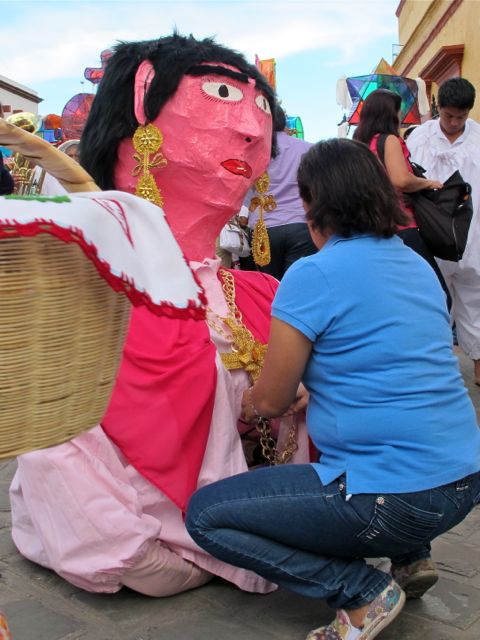
Finishing touches are put on costumes and canastas.

Adjustments are made to sandals and feet are rested before beginning the 3 hour procession through the streets of the city.

We won’t ask what alteration she is making!

IMG_2213

More parade photos to come…


Read Full Post »

And so, Guelaguetza 2013 ended last night in an explosion of fireworks from Cerro del Fortín…

Not a bad view from Casita Colibrí!

Read Full Post »

Some of my closest friends have been (and continue to be) musicians.  And, one of the things I find so appealing about Oaxaca is that music is everywhere and all the time.  Marimbas are set up on sidewalks, accordions are almost ubiquitous, and free concerts occur weekly in the zócalo.  Music is honored and valued as an integral part of the culture — a birthright.

Each of the 8 regions of the state has its own distinctive “sones” and “jarabes” and they are tremendous source of pride.  Within a bar or two of Pinotepa,  Canción Mixteca, or any one of Oaxaca’s regional anthems, the clapping begins, tears may well up, and audiences of all ages begin singing the lyrics.  Thus, a major feature of the modern “Mondays on the Hill” that is Guelaguetza, is the performance of the music and dance of each of the regions.

And, so I give you, some of the musicians who played almost non-stop for 3 hours, while their delegations danced their way through the streets of Oaxaca city during the last two Saturday evening Guelaguetza desfiles (parades).

This slideshow requires JavaScript.

Here’s to the musicians, long may they play!


Read Full Post »

“But one day we shall be rich, and the next poor. One day we shall dine in a palace and the next we’ll sit in a forest and toast mushrooms on a hatpin….” — Katherine Mansfield, The Aloe.

Last Sunday, via a narrow winding road, we drove up into the Sierra Norte for the 13th Regional Wild Mushroom Fair (Feria Regional de Hongos Silvestres) in San Antonio Cuajimoloyas.  The village is part of the Pueblos Mancomunados, a union of seven villages formed to protect the forest, preserve local traditions, and promote ecotourism, in order to provide employment. Thirty-seven miles northeast of Oaxaca city, 10,433 feet above sea level, and often in the clouds, Cuajimoloyas has an ethereal feel and seems a world apart from the valley below.

“I am… a mushroom on whom the dew of heaven drops now and then” — John Ford, The Broken Heart (1633).

Entering the plaza in front of the portales of the municipal building, we were surrounded by the 20 species of wild mushrooms endemic to the region.  There were mushrooms with shiny orange caps; mushrooms resembling coral, trumpets, a head of cauliflower, flower petals; baskets of freshly dug mushrooms, baggies of dried mushrooms, a bowl of spores; mushrooms sauteed, grilled on hot coals, stuffed in empanadas and tamales, and made into candy.

“Nature alone is antique, and the oldest art a mushroom.” — Thomas Carlyle, Sartor Resartus.

And there were the people of Cuajimoloyas…  I quickly found the enchanting abuela from last year, again selling Atole Rojo and it hit the spot!  Another abuela was selling fragrant fresh herbs, most I’d never heard of.  I forgot about a sprig she gave me and it was a pleasant surprise when I returned home and emptied my pockets.

I’m already looking forward to next year…

Read Full Post »

There is SO much going on in Oaxaca right now that the doing isn’t leaving much time for the writing!

However, I’ll give it a try with today’s Feria del Tejate y el Tamal.  The festival is part of an effort to preserve the food culture of the Zapotec.

IMG_3345

What, you may ask, is tejate?  It’s a frothy, refreshing, and nutritious non-alcoholic pre-Columbian beverage made from Nixtamal corn mixed with tree ash, toasted cacao beans, mamey seeds, and Rosita de Cacao flowers.  The sale of tejate is the main economic activitity in San Andrés Huayapam, located about 7 miles north of the city, and it is prepared and served by the tejateras of the Unión de Mujeres Productoras del Tejate.

Then, of course, there were the tamales — in tin buckets and giant pots covered in layers of tea towels, many colorfully embroidered.  So many vendors anxious to reach into the steaming buckets and so many varieties to choose from.  Where does one start?

Blogger buddy Chris recommended the Rajas and Verde from the gal “down at that end,” a taste of a friend’s Flor de Calabaza added that to the list, Mole is a given, and I had to find Chichilo.  The latter is one of the seven moles of Oaxaca, it is only served on special occasions, such as weddings and christenings, or when the crops have been harvested.  Chilhuacle negro, mulatto, and pasilla chiles; blackened tortillas and seeds of the chiles; and avocado leaves (the latter imparting a subtle anise flavor) give it its distinctive flavor.  After three unsuccessful attempts, eureka, I found it!  And so I returned home with five mouth-watering tamales.

Platter with 5 tamales

Speaking of ingredients like corn, cacao, chiles, and calabaza, for a graphic of foods Mexico gave to the world, click HERE.

¡Buen provecho!

Read Full Post »

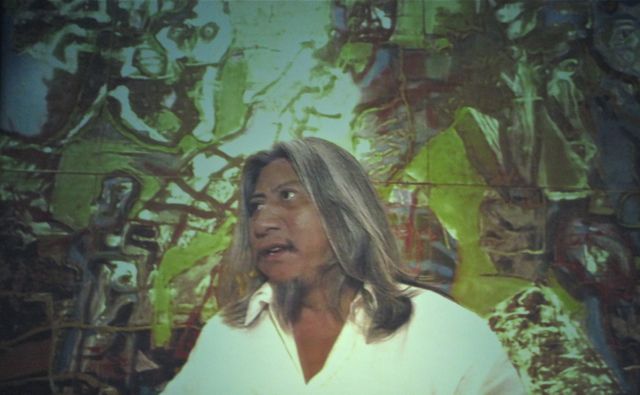
Yesterday, in the midst of Guelaguetza festivities, Oaxaca learned of the death of one of her beloved artists.   A sculpture and painter, Alejandro Santiago was only 49 years old when he succumbed to a massive hear attack.

Image of Alejandro Santiago projected on screen at Homage

Image of Alejandro Santiago projected on the screen at today’s Homage

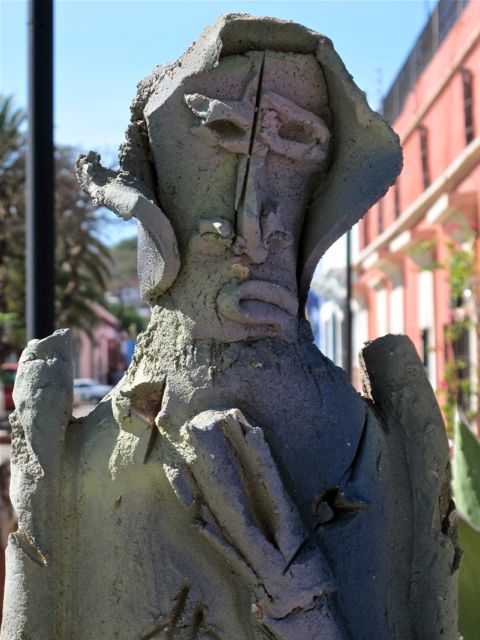
Perhaps his most important work resulted from a return to the Zapotec village of his birth, San Pedro Teococuilco, after many years away.  He was moved by the large numbers of men and women who had left, leaving it almost deserted.  Inspired and feeling the need to make a statement about what had happened to his pueblo, and countless others in Mexico, he created a massive exhibition of 2501 sculptures, an homage to those who had left, plus one — those who are yet to make the journey northward.

One of his 2501 Migrants from a 2012 exhibit along Macedonio Alcalá,

One of his 2501 Migrants from a 2012 exhibit along Macedonio Alcalá,

There was an Homage to Maestro Alejandro Santiago this morning at the Teatro Macedonio Alcalá.

Casket of Alejandro Santiago on the stage of Teatro Macedonio Alcalá

Casket of Alejandro Santiago on the stage of Teatro Macedonio Alcalá

And, according to Think Mexican, there will be a memorial “in the coming days at La Calera.”

For more photos from the 2501 Migrants exhibit, see my blog post The path of the migrant.

Update:  Valerie J. Nelson has written a lengthy tribute to Alejandro Santiago for the Los Angeles Times.

RIP, Maestro.


Read Full Post »

Remember my recent posts from Santa María Tlahuitoltepec up in the mountains of the Mixe?  They are one of the 13 delegations who will be dancing at this morning’s Guelaguetza performance on Cerro Fortín.

Dancers in action from Santa María Tlahuitoltepec

To watch today’s and next Monday’s 10 AM and 5PM performances, click HERE or HERE.   Enjoy!

Read Full Post »

Yesterday, we began the marathon than is Guelaguetza in Oaxaca.  First on the day’s agenda was a morning trip to Reyes Etla.

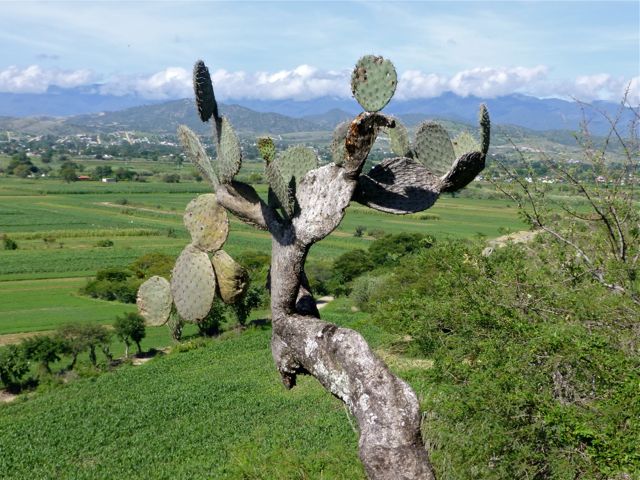
The Señor de las Peñas church sits atop at hill and views of the lush green fields (gracias, rainy season) and the mountains were breathtaking.

Cactus, farmland, mountains

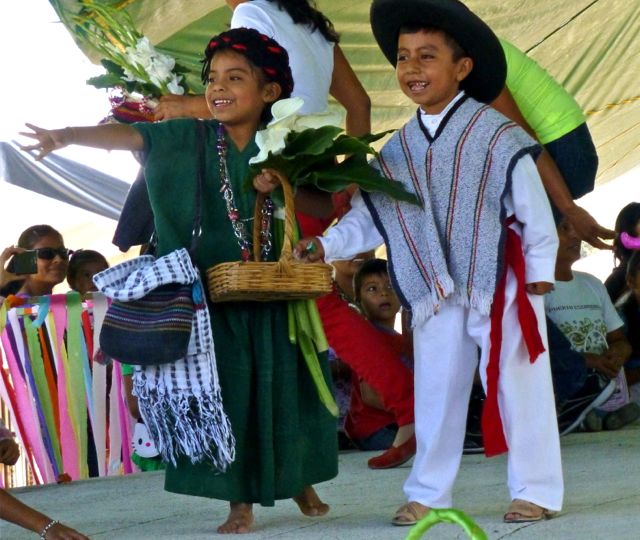
Impossibly adorable children danced and shared, in the spirit of Guelaguetza.

Boy and girl in traje throwing candy to audience

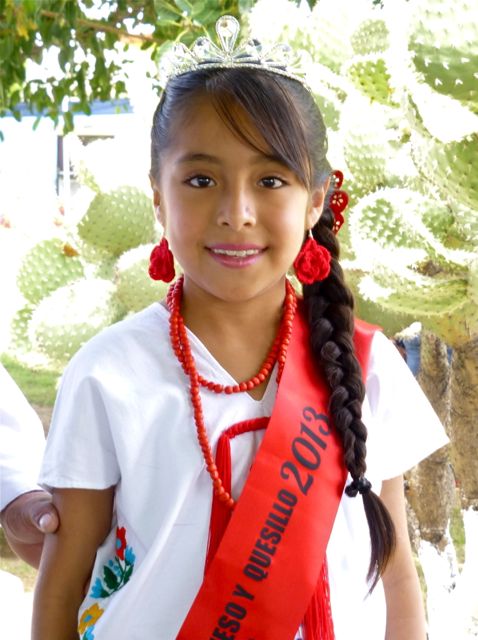
We were in the heartland of Oaxaca cheese country for the crowning of  Jimena Santiago Vasquez, as queen of the third Expo Feria de Queso y Quesillo.

Girl with crown and red sash

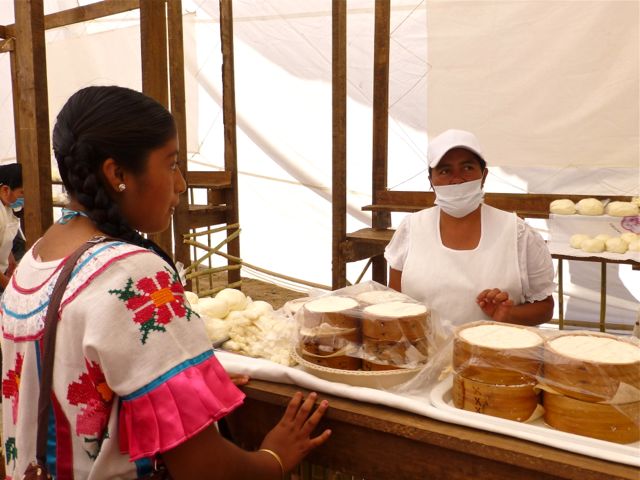
Did I say cheese?  Oh, yes — stalls and stalls of yummy cheese.  The fair runs through Monday and we will be back!

Woman selling cheese

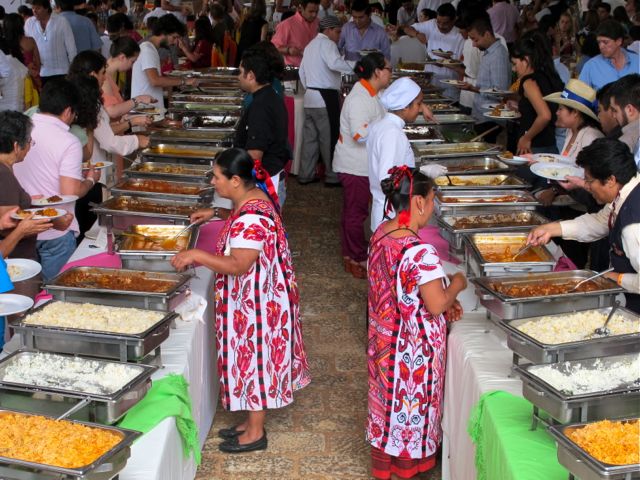
Next on our itinerary was a return to the city for a little (?) gluttony — the Festival de los 7 Moles opening banquet on the grounds of the Jardín Etnobotánico de Oaxaca.  Botanas Oaxaqueña (cheese, chicharrón, chiles rellenos), followed by Sopa de Fandango, 15 (not 7) Moles, 4 Tipos de Arroz, followed by a platter of pastries and scoops of Leche Quemada and Tuna nieves (sorbets).  Oh, and did I mention, cervesas and mezcal?

Lines of serving platters and people

We even got a little culture, as author, Laura Esquivel (Like Water for Chocolate) spoke, though it was a little hard to hear her, with all the eating, drinking, and related conversations!

Profile of Laura Esquivel

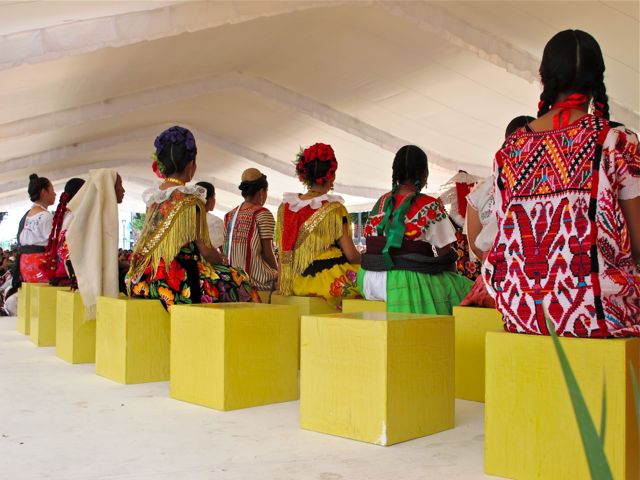
Moving rather slowly, we pushed back from the table and headed down to the Alameda (oh, it felt good to walk!) to take in the last stage of the Diosa Centéotl competition — the chosen “Goddess” presides over Guelaguetza.  However, the area surrounding the tented stage was a mass of people by the time we arrived and the best I could do was see the backs of the magnificent traje.  (See Chris’s blog for close-ups from the stage one competition.)  And, the winner is…  Dulce Yanet Grijalba Martínez, from the Zapotec community of San Pablo Villa de Mitla.

Backs of women sitting in traditional dress

After a brief siesta, I rendezvoused with some young friends and we walked over to the Plaza de la Danza for a free performance by Alejandra Robles, one of my favorite Oaxaqueña singers.  (For video from the last time I saw her, click HERE.)

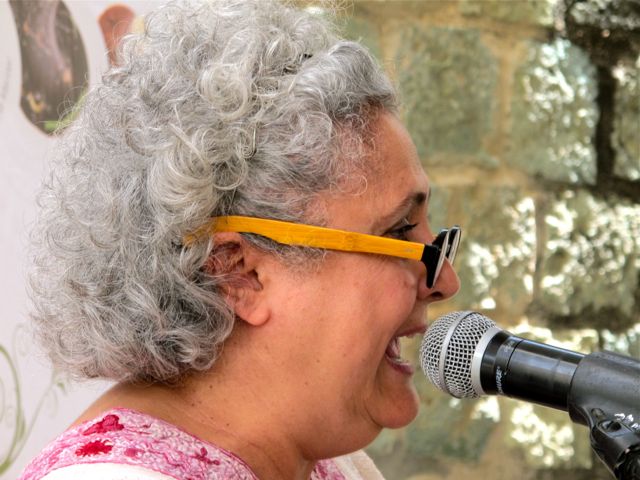
Alejandra Robles

The night was still young for my young friends and they were off to get a nieve at Jardín Socrates.  I was off to bed, because I’d already had my day’s allowance of nieve AND we’ve only just begun!

Read Full Post »

Colibríes?  I can’t resist!

Hummingbird from a wall in San Cristóbal de las Casas in Chiapas…
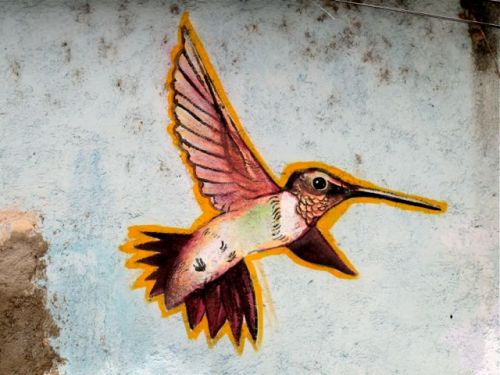
Hummingbird painted on wall

Hummingbird from a NASA’s Hubble Space Telescope photo…

Hubble image looks like the profile of a hummingbird

Separated at birth?  Cool article from Slate about this photo…

The Hummingbird Galaxy

I was pondering writing a longish post about the picture above, talking about what galaxies are, how they can physically collide, how their gravity can twist and distort their shapes into all sorts of weird things …

But seriously. That galaxy looks like a hummingbird.* What more do you need?

OK, you need a little more. For one, I’ve written quite a bit about how galaxy collisions happen, so you can read about how these work here and here. The two galaxies in this collision are called NGC 2936 (the blue birdie one) and NGC 2937 (the smaller cottonball one). Together they are known as Arp 142, named for an astronomer who observed weird, distorted galaxy pairs.They’re located about 300 million light-years from Earth.

Two things really stand out to me in this picture (besides a galaxy that looks like a flippin’ hummingbird). One is the long, delicate tendril of dark reddish dust exhumed from the previously spiral-shaped galaxy NGC 2936, flung into a long arc across tens of thousands of light-years of space. I wish we had more three-dimensional data here; I’d love to know what this structure really looks like from different angles. Since dust is very dark, it blocks light coming from behind it, so this tendril is in front of the hummingbird galaxy, or perhaps embedded in it.

The other thing is that the smaller galaxy seems to have survived this collision pretty well. The shape is only mildly distorted; you can see a bit of off-centered nature to the glow of stars around the core. I suspect its more compact nature has a lot to do with that; the stars are closer together, perhaps, and the overall gravity of all those stars helped it retain its shape.

And there is one other thing. These are two very different galaxies colliding! The ex-spiral galaxy is very blue, indicating lots of star formation happened recently. Young, massive stars are blue, and when galaxies collide, the gravitational interaction can cause huge clouds of gas to collapse and furiously form stars.

The other galaxy is yellower, indicating an older, more stable population—blue stars don’t live long, so a galaxy this color must not have formed stars in a long, long time. Billions of years, for sure. You can tell by looking that it doesn’t have much gas and dust in it, which fits; if it had, the collision would have stirred them up, and we’d see more blue stars there as well.

Note too that you can see a handful of far more distant galaxies in the picture. The ones to the lower right are red, which is most likely due to having their light absorbed and reddened by the dust in the hummingbird galaxy; that’s another thing interstellar dust does, much like dust and haze in the air can make a sunset look red.

All in all, there’s a lot going on in this image! The hummingbird shape makes me smile, and don’t get me wrong, it’s cool. But what you’re seeing here is far more than just a shape in the clouds; you are seeing a massive collision on a cosmic scale, the collective might of 100 billion suns, their gravity reaching out and twisting the shapes of these galaxies, stretching them like taffy, molding them like clay.

The Universe operates on the grandest of all scales, manipulating forces and energies far too large for us to grasp in our puny brains. Yet when it does so, it generates beauty and perhaps even amusement in those same brains. It helps us appreciate it and gives us another reason to want to. And, after a while, we really can begin to grasp what the Universe is telling us.

Maybe our brains aren’t so puny after all.

*Some folks say it looks like a penguin. I can see that, but it’s silly. I mean, c’mon, a galaxy shaped like a penguin? Ridiculous.

h/t Chris

Read Full Post »

We returned to Teotitlán del Valle on Tuesday and Wednesday for performances of the Danza de la Pluma, a ritual re-enactment of the battles between the Aztec and Spanish.  According to OaxacaWiki:

The origin of this dance goes back to the spiritual and physical conquest of Mexico by the Spanish – La Guerra de Conquista. The dance originated in the town of Cuilpam de Guerrero where Martin Cortes (son of Cortes) celebrated the first baptism of his child. Martin played the role of his father and the locals played the roles of the conquered indigenous peoples.

The story is told in 41 bailes (dances) and lasts from early afternoon into the night.  Selected years in advance, it is an honor to be a dancer and they perform their roles for 3 years.  This week, during the multi-day fiesta honoring Preciosa Sangre de Nuestro Señor Jesucristo, we saw the first performances by the new cast and they looked great!

Presenting the Cast of Characters

Montezuma

Doña Marina (hat) and Malinche (headdress)

2 Subalternos

16 Danzantes:  Teotiles (2), Capitánes (2), Reyes (4), and Vasallos (8)

They are going to be fun to watch during the next 3 years.   (By the way, the costumes may change from day-to-day, but the cast remains the same.)

Read Full Post »

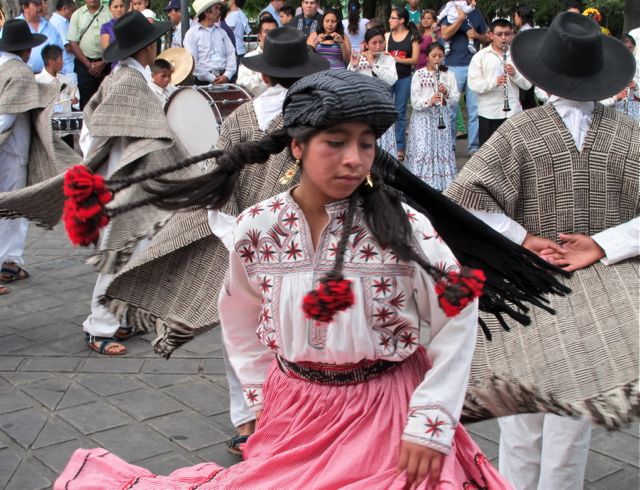
Monday, we returned to Teotitlán del Valle for the Fiesta titular a la Preciosa Sangre de Nuestro Señor Jesucristo — the pueblo’s most important festival of the year.  While special masses have been celebrated at the Templo de la Preciosa Sangre de Cristo (the village church) since June 30, Monday’s convite (procession) by the unmarried women in the village, kicked off the more public events.

Lovingly decorated canastas (baskets) waited in the church to be reclaimed by their owners, placed on their heads, and carried through the streets.

Crowds gathered in the plaza in front of the church and sidewalks and streets along the route.

And then it began — with solemn drum beats, fireworks, church bells, marmotas (cloth balloons on a pole), and a band.

Little boys (and a few girls) carrying model airplanes (don’t ask me why), paper mache lambs, and turkeys followed.

And then came the neatly organized rows of girls and young women.

For over an hour they wound their way up and down and around the streets of Teotitlán del Valle.  The weather was perfect, no late afternoon thunder showers this year, and it was glorious.

Stay tuned, the festivities continue all week.  And, check out Oaxaca-The Year After this week for blogger buddy Chris’s photos and commentary.

Read Full Post »
Sunday is market day in Tlacolula.  The sounds and sights…

piles of gourds

The smells and tastes…

Chicken on a grill

And, most of all, the people…

Woman carrying tlayudas on head

Much needed chicken soup for my soul.

Read Full Post »

Ahhh…  I’m back in my new and improved Casita Colibrí.  Friday night, with lightning flashing all around the Embraer, my fellow passengers and I bounced our way across Mexico and back to Oaxaca.  Gracias, Hurricane Erick for Mr. Toad’s Wild Ride!  With appreciation and relief, spontaneous applause erupted when the little plane landed.

There have been many changes in the 7 weeks I’d been gone…  Juan finished the screens on my doors and windows; they are beautifully made and not a single mosquito has been seen or heard!  I left at the end of the dry season; golden-brown hills and fields and a constant coating of dust dulled nature’s and human-applied colors.  I returned to the lush green hills and fields of the rainy season and the lustrous green leaves and red-orange blossoms of my African tulip trees.

And, new street art gleamed…

Oaxaca in technicolor!

Read Full Post »

« Newer Posts - Older Posts »