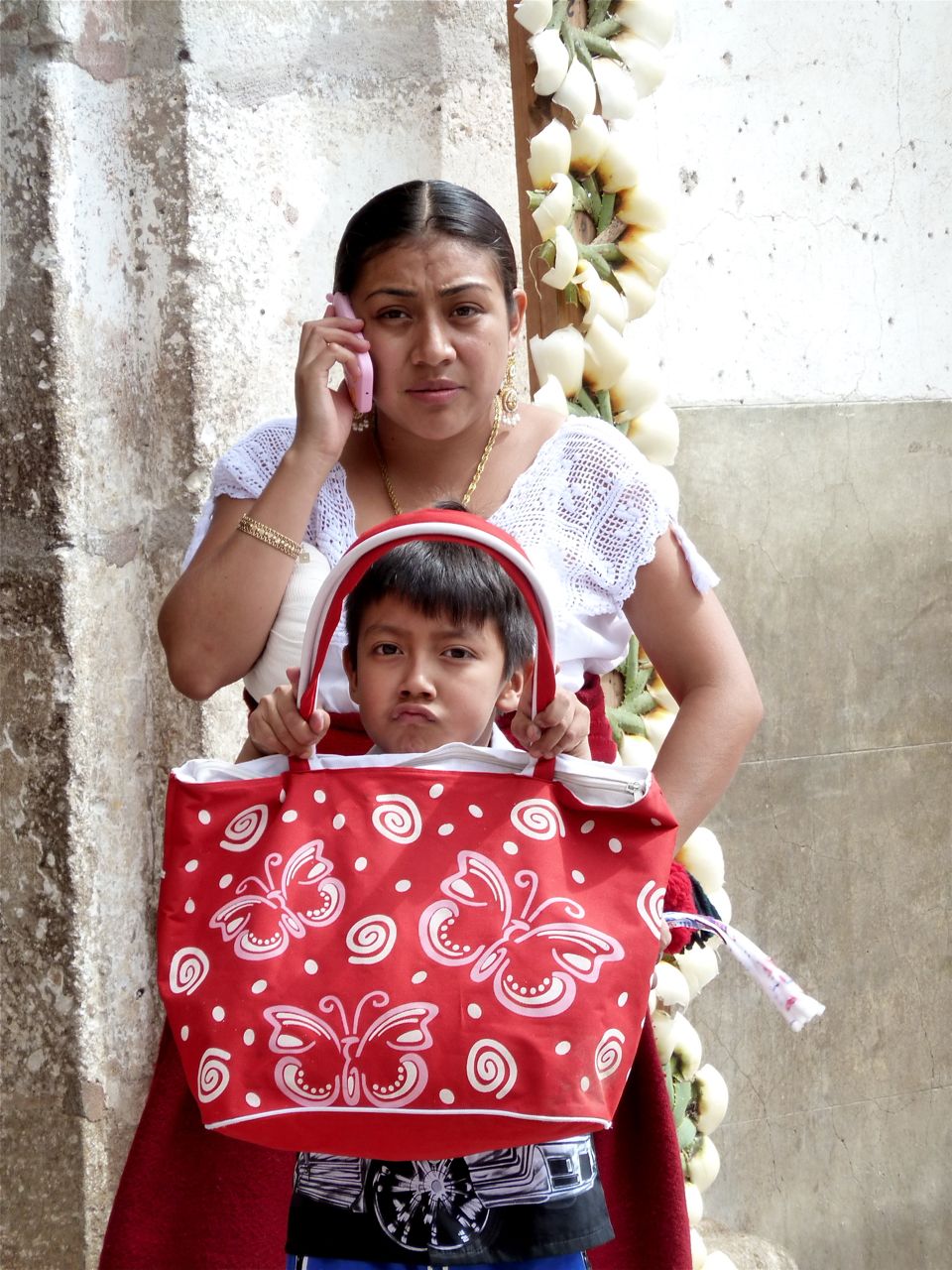
Outside Templo de Santa María de la Asunción, Tlacolula de Matamoros, on Friday, waiting for the calenda to begin.
Posted in Celebrations, Culture, Travel & Tourism, tagged calendas, cell phones, Mexico, Oaxaca, parades, photographs, photos, popular travel destinations, Señor de Tlacolula, Tlacolula de Matamoros on October 13, 2013| Leave a Comment »
Outside Templo de Santa María de la Asunción, Tlacolula de Matamoros, on Friday, waiting for the calenda to begin.
Posted in Celebrations, Culture, Religion, Travel & Tourism, tagged baskets, calendas, canastas, Fiesta de la Virgen del Rosario, Mexico, Oaxaca, parades, popular travel destinations, Tlacolula de Matamoros, Virgin of the Rosary on October 8, 2013| 2 Comments »
Before returning to honor al Señor de Tlacolula this Friday, I figured I’d better finish posting pics from last Friday’s la Virgen del Rosario calenda.


This annual procession slowly winds its way through the streets of Tlacolula de Matamoros. Participants stop at “stations” throughout the village, where religious ritual is performed, rest breaks are taken, and tamales, sweets, and beverages (yes, including mezcal) await. This goes on until after midnight. I don’t know how they do it!
Posted in Celebrations, Culture, Religion, Travel & Tourism, tagged calendas, Fiesta de la Virgen del Rosario, marmotas, Mexico, Oaxaca, parades, popular travel destinations, Tlacolula de Matamoros, Virgin of the Rosary on October 5, 2013| Leave a Comment »
Yesterday, we headed about 20 miles southeast of the city to Tlacolula de Matamoros for their calenda (parade) in honor of la Virgen del Rosario (the Virgin of the Rosary). While we go to Tlacolula often, especially for their Sunday market, and while we’ve been to countless calendas, this particular one was a first — and what fun it was!
I’m always amazed at the variations from one village to another — even those only a few miles apart. I have to say, one of the most striking features of Tlacolula’s calenda was the masses of marmotas. No, I’m not talking the groundhog/woodchuck variety. These, at their most awesome, are ginormous cloth globes on a pole that are carried in every calenda I’ve ever seen down here.

Little boys start out with little marmotas — learning how to position it in the holster and becoming comfortable carrying it for several blocks.


The pre-teens graduate to bigger and heavier marmotas and the lesson here is one of balance — learning to find one’s center — and that you get by with a little help from your friends.


Teens refine their moves and their “look.” Look ma, no hands! After all, a central part of the calenda is a procession of the unmarried girls and young women of the village!
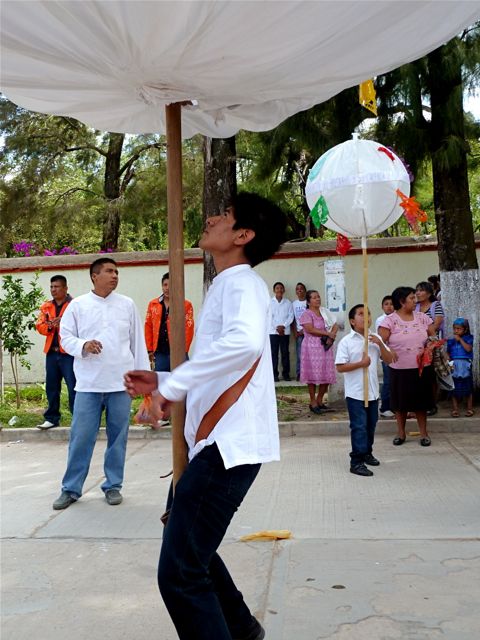
Young men eventually become good-natured and married journeymen…
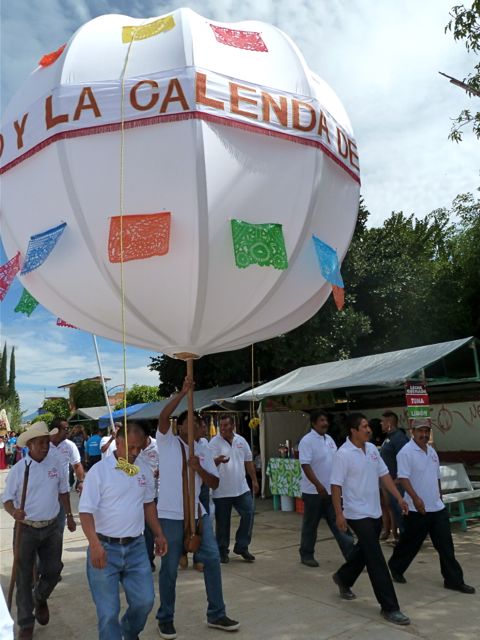
I’m guessing it never ceases being a source of macho pride — enough to tempt one of Tlacolula’s senior citizens into showing, he’s still got it!

And then there was the gringo…

Check out Oaxaca–The Year After for this hilarious tale in his own words. (I’m still laughing!)

Marmotas on parade — it was a spectacular sight!
Posted in Creativity, Culture, Politics, Protests, Travel & Tourism, tagged graffiti, Mexico, Oaxaca, photographs, photos, political commentary, popular culture, popular travel destinations, posters, street art, wall art on October 3, 2013| Leave a Comment »
Remember the childhood riddle, “What’s black and white and red all over?”


Old answer: A newspaper. New answer: The walls of Oaxaca.
Posted in Food, Restaurants, Travel & Tourism, tagged food, McCarthy's Irish Pub, Mexico, Oaxaca, photographs, photos, restaurants on October 1, 2013| 2 Comments »
When you are caught in stop and go (mostly stopped) traffic and getting hungrier by the minute, the only thing to do is turn off onto a side street and find an Irish pub.


Hamburger and French fries = comfort food to soothe the traffic-challenged soul. But, in Oaxaca??? Yes, McCarthy’s Irish Pub in Reforma! Probably wasn’t the best dining decision we have ever made. French fries were pretty good, but hamburgers left a lot to be desired. However, by the time we left, the traffic had thinned and it was smooth sailing home!
Posted in Culture, Transportation, Travel & Tourism, tagged boys, keyboard, Mexico, musical instruments, Oaxaca, photographs, photos, traffic, transportation on September 28, 2013| Leave a Comment »
Navigating through traffic in Oaxaca, you just never know what you will see…

¡¡¡Cuidado!!!
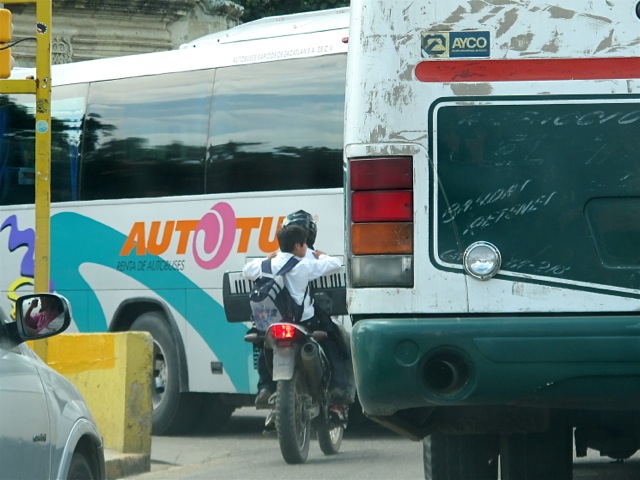
Por favor, never come between a boy and his keyboard.
Posted in Buildings, Celebrations, Culture, Travel & Tourism, tagged decorative lighting, Dreamer, El Mes de la Patria, Government Palace, José María Morelos y Pavón, Mexican Independence, Mexico, Miguel Hidalgo y Costilla, Oaxaca, Oaxaca Film Festival, Oaxaca FilmFest4, Palacio de Gobierno, photo, photographs, Twenty Million People on September 26, 2013| 3 Comments »
Early Wednesday evening, I walked down to the Palacio de Gobierno to see Dreamer, one of the Oaxaca FilmFest4 offerings. It had been raining on and off all day and so, to lighten my load and make room for my umbrella, I left my camera at home. Why would I need it? I was just going to be sitting in a small dark theater. Sheesh, was I mistaken! It was twilight when I entered the Palace via the side door on Flores Magón, but we were directed to exit through the main front entrance — and I was blown away by the scene before me. The rain-soaked zócalo glistened and glittered, awash with El Mes de la Patria green, white, and red lights.
Needless to say, last night when I returned to watch, Twenty Million People, I took my camera!

Heroes of the independence movement, Hidalgo and Morelos in the spotlight as they gaze down from the Government Palace. I always forget how beautiful the zócalo is at night!
Posted in Archaeology, Culture, History, Travel & Tourism, tagged archaelogical site, archaeological zone, archaeology, Mexico, Oaxaca, photography, photos, popular travel destinations, Santa María Atzompa, Zona Arqueologica de Atzompa on September 24, 2013| 4 Comments »
Almost a year after our first visit to the newly opened Atzompa archaeological site, yesterday, we returned. The beautiful paved road up from Santa María Atzompa (elevation 1,580 meters) now brings one to a parking lot right across from the entrance, making for less of a haul up the hill for those less mobile or challenged by the altitude — at the top it is almost 300 meters above the village below — even we were huffing and puffing.

Atzompa was part of Monte Alban and one of its largest settlements. At the top of the stairs (above), is the largest (45 meters by 22 meters) of the 6 ball courts found among the Monte Alban communities.

Investigations of the Atzompa site first began in 1940 by Jorge R. Acosta, who was part of the Monte Alban Project. However, in 2007 the National Institute of Anthropology and History began formal explorations using a team of architects, archeologists, topographers, and restorers.

Though the path is currently difficult to see, make sure to go around to the left of the building above to see the north quadrant. Informational placards in Spanish and English are now in place throughout the site and most of the facts in this post are taken from them, but, of course, I neglected to take a photo of the placard for the building below!

Residents from the land cooperatives in the surrounding communities have been hired to do much of the field and lab work. Not a bad setting to work…

One can, in the words of The Who, “see for miles and miles and miles and miles and miles…”
 Except for the birds, insects, lizards, and workers, we had this spectacular setting to ourselves — I think we only saw 3 other visitors the entire time we were there. Perhaps when the second entrance on the Monte Alban side opens, it will attract more attention. In the meantime, the peace and tranquility are a gift in these chaotic times.
Oaxaca–The Year After has more from yesterday’s visit.
Posted in Creativity, Culture, Travel & Tourism, tagged graffiti, In the Shape of a Heart, Jackson Browne lyrics, love, Mexico, Oaxaca, photo, photography, street art, urban art, wall art on September 22, 2013| 2 Comments »
Ahh, young love… On the walls of Oaxaca, among the extraordinary art and pithy political statements, there are declarations of love.

People speak of love don’t know what they’re thinking of
Wait around for the one who fits just like a glove
Speak in terms of belief and belonging
Try to fit some name to their longing
People speak of love
— In the Shape of a Heart by Jackson Browne
Posted in Celebrations, Culture, Travel & Tourism, tagged Congreso Nacional de Danzón, dance, Danzón, festivals, Mexico, music, Oaxaca, photographs, photos on September 20, 2013| 2 Comments »
Not only is the previously mentioned Oaxaca FilmFest4 opening tomorrow night, but last night a calenda up Morelos heralded the arrival of the 8th Congreso Nacional de Danzón. Alas, it was raining, I’m a wimp, and so stayed home. However, the music coming from the Plaza de la Danza sounded wonderful. Sigh….
If you are walking around Oaxaca during the next few days, be on the lookout for the guapas y guapos (the guys are all duded up, too) of Danzón. They are adding a lot of glitz and glamour to the streets of the city.

For the uninitiated, Danzón is a very stately dance that originated in Cuba. However, it seems to be most beloved in Puerto Rico and Mexico. It has especially flourished in Oaxaca, where one can find dancers young and old dancing under the laurel trees in the Zócalo every Wednesday evening at 6:30. And, no wonder it has retained its popularity here, according to Wikipedia, “many famous danzones were composed by Oaxacan musicians such as the famous Nereidas and Teléfono de larga distancia, both works of Amador Pérez Dimas, from the town of Zaachila, near Oaxaca city.”
If you aren’t anywhere where Danzón is performed, you can check out the 1991 movie, Danzón:
Julia (Rojo) is a phone operator in Mexico City who divides her time between her job, her daughter and the danzon: a cuban dance very popular in Mexico and Central America. Every wednesday Julia does the danzon with Carmelo (Rergis) in the old “Salon Colonia”. They’ve danced for years but barely know each other. One night Carmelo disappears without a trace. Feeling lonely and sad, Julia takes a train to Veracruz, where she knows Carmelo has a brother. That sudden trip will change Julia’s life forever. — IMDB
I haven’t seen the movie, but according to one reviewer, the soundtrack is worth the rental price. I’m going to try to find it!
Posted in Creativity, Culture, People, Travel & Tourism, tagged entertainment, film, film festivals, international film festivals, Mexico, movies, Oaxaca, Oaxaca Film Festival, Oaxaca FilmFest4, photographs, photos, popular travel destinations, Ramiz Adeeb Azar on September 18, 2013| 1 Comment »
Today the Oaxaca Lending Library played host to Oaxaca FilmFest4 founder and artistic director, Ramiz Adeeb Azar. He and 4 members of the festival staff came to the library to “pitch” the festival, which opens September 21 and runs through the 28th. (Note: it has moved from November to September). It wasn’t a hard sell, as many of us have been following it since it began in 2010. And, I’ve got to say, it’s come a long way in a short amount of time. According to Ramiz, it has…
The festival has already set up shop in Plaza San Jerónimo (on Macedonio Alcalá) where staff and volunteers are hard at work and, like last year, the site will serve as the festival’s Hospitality and Information Center.


If you love film, but have never been to a film festival, I highly encourage you to give it a try. Prior to relocating to Oaxaca, for 7 years, one of the highlights of my calendar year was volunteering at the Mill Valley Film Festival. Besides being a lot of fun (never forget, on my hands and knees mopping up spilled red wine at the feet of Katherine Ross and Sam Elliot), I had the opportunity to see some truly wonderful films — especially shorts and documentaries that are rarely shown in the big chain multiplexes. The MVFF was one of the things I missed most (along with crusty sourdough bread and being able to flush toilet paper down the toilet) when I moved down here.
However, along came the Oaxaca FilmFest and, though it didn’t satisfy my craving for sourdough bread or cause new plumbing to be installed in Oaxaca, it does come with a well-considered, eclectic, and always creative selection of films (feature-length and shorts) from all over the world.


Last year, El último hielero (The Last Ice Merchant) a touching documentary from Equador was a favorite of mine, as was The Cart, a humorous short from Russia. And, if the two short films Ramiz showed today — the animated, Sleight of Hand and the very moving, Part of the Change — were any indication, the selectors did a terrific job again this year. So, if you are in Oaxaca, get thee to the Oaxaca FilmFest4 information center at Plaza San Jerónimo and pick up your festival schedule or download it from the festival website.
FYI: All screenings are public and free (except Cinemex and Foundation Nights) and every film is projected in its original language, with Spanish, English, or dual subtitles.
Posted in Celebrations, Culture, History, Holidays, Travel & Tourism, tagged desfile, holidays, Mexican Independence Day, Mexico, military, Oaxaca, parade, photographs, photos, popular travel destinations, women military on September 16, 2013| 6 Comments »
What do the guys do while waiting for an Independence Day parade to begin?
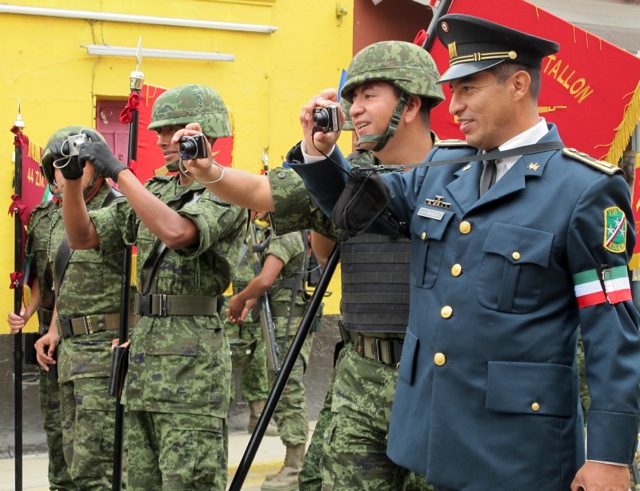
And, what do gals do? Pose for them!
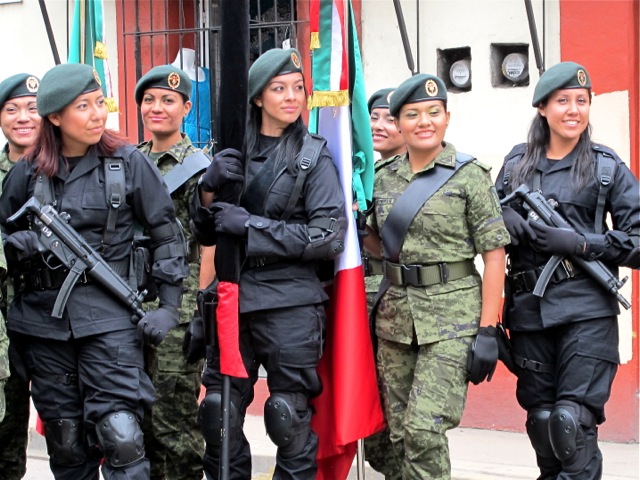
A mother takes twenty years to make a man of her boy, and another woman makes a fool of him in twenty minutes. — Robert Frost
Posted in Celebrations, History, Holidays, Travel & Tourism, tagged El Grito, el grito de dolores, Grito de Dolores, Mexican flag, Mexican Independence Day, Mexico, Oaxaca, photographs, photos on September 15, 2013| 2 Comments »
At 11 PM tonight, with El Grito de Dolores, also known as El Grito de la Independencia (the Shout of Independence), echoing from government buildings throughout the country, Mexico begins celebrating her long and hard-fought independence from Spain. Despite the gathering of meteorological and political storm clouds, Oaxaca has gotten her green, white, and red on.
Doors are decorated, bunting is hung, and Mexico’s tricolor appears…


This proud yet faded flag with frayed edges seems a fitting symbol this year.

In the words of Che Guevara, “La lucha continua.”
Posted in Holidays, Labor, Politics, Protests, Weather, tagged current-events, demonstrations, El Grito, Frente Único de Lucha, Mexico, Oaxaca, photographs, photos, politics, protests, San Juan Copala, Triqui on September 14, 2013| 2 Comments »
Yesterday, as today’s article in Noticias states, “with great dignity and head held high” the Triqui families from San Juan Copala pulled up stakes and moved to temporary housing in Colonia Reforma. The 105 displaced families had been occupying the front of the Government Palace for several years, but reached an agreement with the state government to relocate.


Meanwhile, on the east side of the Government Palace, the band played on… September is “La mes de la patria” (the month of the motherland). Tomorrow night, governor Gabino Cue will repeat El Grito de Independencia (the Cry of Independence) from the balcony of the Government Palace and Monday, an hours-long patriotic parade will pass in front of the Palace.


Today, the scene has changed. Members of the Frente Único de Lucha (FUL), the new incarnation of APPO, have taken up positions in front of the Government Palace and vowed to remain until those arrested in clashes with the federal police, on December 1 and yesterday in Mexico City, are released. Hmmm… I wonder what will happen tomorrow and/or Monday.


Just remember, when you read, hear, or watch the news… Chiapas, Guerrero, and Oaxaca are the most indigenous and poorest states in Mexico. And now, the tears of Mother Nature are raining down on Oaxaca.


 Mexican Peso Converter
 View From Casita Colibrí
They ARE different
Posted in Culture, Economics, Education, Politics, Protests, tagged education, educational reforms, graffiti, Mexico, Oaxaca, photographs, photos, political commentary, protests, street art, Teachers union, United States legislation, wall art on October 11, 2013| 13 Comments »
Expats and Mexicans alike, are watching in amazement at the nonsense (as in, making NO sense) taking place in the hallowed halls of Washington DC. And, since many of the expats are retired, we are holding our collective breath over the possibility social security checks will not be forthcoming in November and a tanking stock market that flushes our nest eggs away. Of course, Mexico is in the middle of its own mess, “educational reforms” and economic proposals that will hurt Mexico’s working class and rural populations the most.
Wall in Oaxaca city.
In a New York Times article two days ago, Carlos Puig explains the reality of the material conditions that have forced the teachers of Oaxaca to take the drastic action of abandoning their classrooms to lead massive and extremely disruptive protests in Mexico City against the “No Child Left Behind” style reforms that the Peña Nieto led government has proposed and passed. (Read a critique of the US education “reform” by Diane Ravitch, former “No Child Left Behind” proponent, here.)
Oaxaca is 500 kilometers from Mexico City, yet the real distance is much bigger. The state’s G.N.P. per capita is one-quarter the average for the country. Oaxaca ranks second-to-last among all states in infrastructure. More than half its population lives in towns of fewer than 2,500 people.
Being a teacher in Oaxaca means sometimes having to travel for an entire day to reach your school in a tiny community, teach for three days — to children of all grades — and travel back home for the weekend. It means having to deal with children who speak more than 20 different dialects.
Being a teacher in Oaxaca means operating in a different universe — and under different rules.
Banner hanging in front of a school in Oaxaca city
However, as in the USA, the incomprehensible words coming out of the mouths of the 1% and their elected representatives are mind-boggling in their obliviousness to the adverse consequences their behavior and policies cause. And, we scratch our heads in amazement… McClatchy journalist, Tim Johnson, has repeatedly blogged about the exceedingly “bad” behavior exhibited by Mexico City’s rich and powerful directed at those they consider “below” them — most recently, Las Ladies, episode 7. And, just last week in Oaxaca, most were aghast to read that an indigenous woman, in the advanced stage of labor, was turned away from a hospital and forced to give birth on the hospital lawn.
Daniel Goleman had a revealing piece in the New York Times a few days ago that helps explain where this lack of empathy the ruling elite exhibit, that results in callous social policy, comes from. He explains in Rich People Just Care Less that, by necessity, “the poor, compared with the wealthy, have keenly attuned interpersonal attention in all directions…” And that, “A growing body of recent research shows that people with the most social power pay scant attention to those with little such power” and, “In politics, readily dismissing inconvenient people can easily extend to dismissing inconvenient truths about them.”
Okay, now we know why the rich care less, so what are we going to do about it?
Part of a mural on Niños Heroes in Oaxaca city.
Share this:
Read Full Post »