Feeds:
Posts
Comments

Posts Tagged ‘Oaxaca’

According to the Indigenous Farmworker Study (IFS), there are approximately 165,000 indigenous Mexican farmworkers and their children living  in California — with a significant percentage coming from the state of Oaxaca.  Writer and photographer David Bacon has been photographing and interviewing indigenous Mexican migrants working in California’s agricultural fields for many years.  The following Truthout article is from his photo-documentary project, Living Under the Trees, sponsored by the California Council for the Humanities and California Rural Legal Assistance.

Young, at Work in the Fields

by David Bacon

(Photo: Bacon/After Image)

(Photo: Bacon/After Image)

Most young farm-workers in California are migrants from Mexico, especially the south of the country, where many people share an indigenous culture and language. Ricardo Lopez, living in a van with his grandfather in a store parking lot in Mecca, a tiny farmworker town in the Coachella Valley, says working as a migrant without a formal home was no surprise:

This is how I envisioned it would be working here with my grandpa and sleeping in the van. It’s hot at night, and hard to sleep well. There are a lot of mosquitoes, very few services, and the bathrooms are very dirty. At night there are a lot of people here coming and going. You never know what can happen; it’s a bit dangerous. But my grandfather has a lot of experience and knows how to handle himself. With the money I earn I’m going to help my mother and save the rest. I’ll be attending college in the fall at Arizona Western College—my first year. I want to have a good job, a career. I’m not thinking of working in the fields. Not at all. I look at how hard my grandfather has worked. I don’t want to do field work for the rest of my life because it’s so hard and the pay is so low.

Lopez describes the reality for farmworkers in California in a way that gives tangible meaning to the facts and numbers describing farmworker life. There are about 120,000 indigenous Mexican farmworkers in California. Counting the 45,000 children living with them, that is a total of 165,000 people. They are the most recent migrants from Mexico. They speak twenty-three languages, come from thirteen different Mexican states, and have rich cultures of language, music, dance, and food that bind their communities together.

<snip>  Click HERE to read full article.

This project is therefore a reality check. The idea is to give indigenous migrant communities a vehicle they can use to find support for dealing with the social problems they face, such as housing, low wages, and discrimination. This documentary work is not neutral. Its purpose is to help provide a means for people to organize and win support in a world that, at best, treats them as invisible, and at worst demonizes them. I used to be a union organizer, and this work is very similar. Social documentation not only has to have an engagement with reality, but should try to change it.

Click HERE to read full article.
Read Full Post »

Braving 90+º F temperatures this afternoon, I headed down to the, you-can-buy-anything-you-want, Mercado Benito Juárez.  This is my “go to” market for nueces (pecans), arándanos (dried cranberries), coffee beans, chapulines (grasshoppers), fruits, and vegetables.  There is also mole, meats, fish, textiles, flowers, souvenirs, piñatas, costumes, lucha libre masks, baskets, leather goods, hats, hair-care products, jewelry, and much more — the original “mall.”

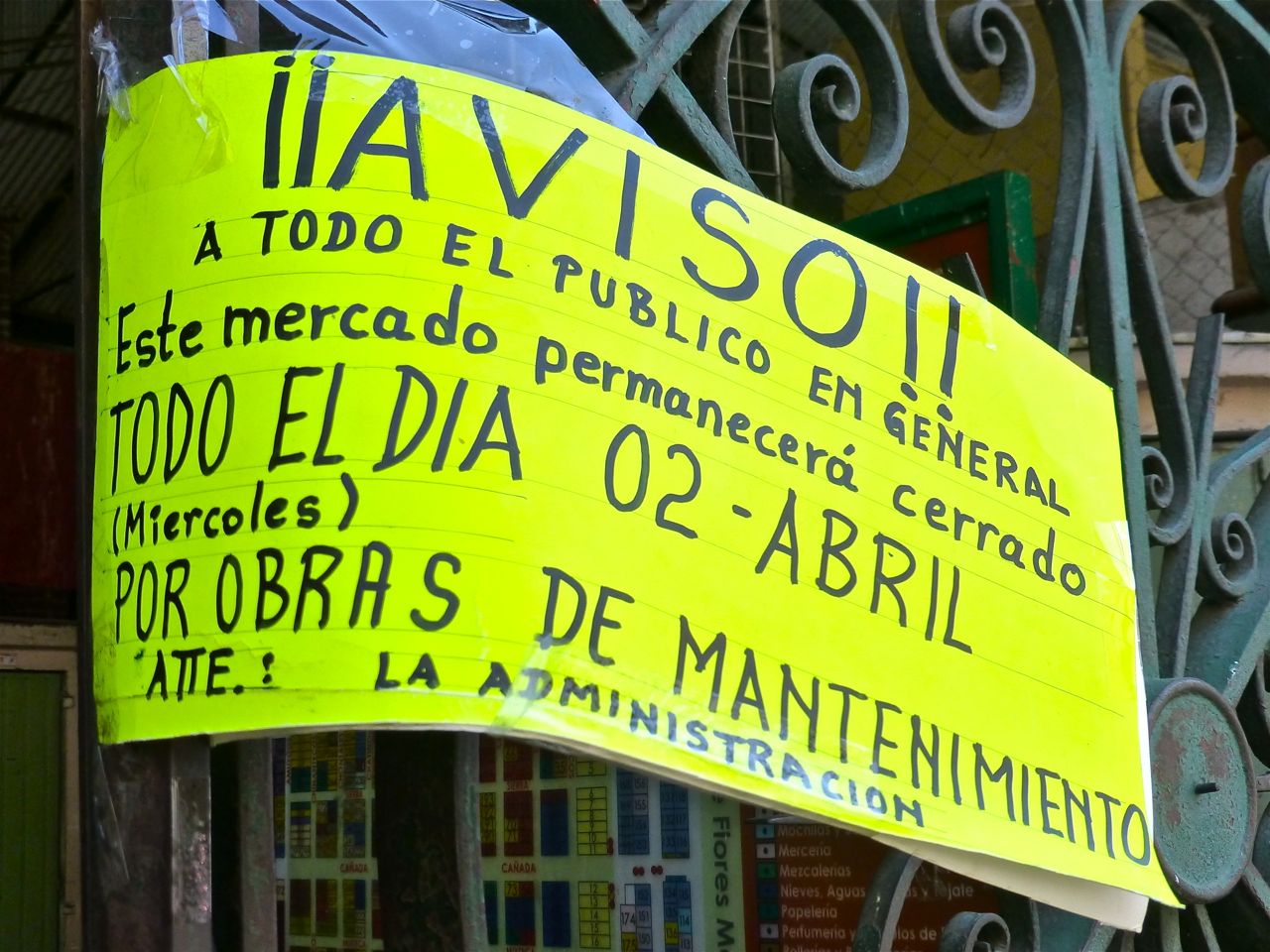
Today, all I needed was my favorite tiny Dominico bananas and a couple of avocados.  However, suspicion set in when I noticed NO double-parked vehicles or even much traffic on Las Casas.  A bloqueo (blockade)?  No.  Muy extraño (very strange).  I crossed the street and walked down to my regular entrance into the market and noticed the corrugated metal doors of the vendor stalls along the street were tightly shut and then saw a sign at the gate to the market that read…

P1030014

Closed for maintenance work!!!  No reason why, no re-opening date, and no relocation site for the vendors was given.  I flashed on visions of the six-month renovation of my neighborhood, Mercado IV Centenario.  Hmmm… does it have something to do with the aguas negras (sewage), due to a short-circuit underground that was reported last week?  I’m guessing, yes.  According to today’s report in NSS Oaxaca, there is dredging going on (Oaxaca’s version of Roto Rooter?), vendors will then clean up (disinfect?) their stalls, and the mercado will reopen tomorrow.  Por favor, keep your fingers crossed.

Update:  Mercado Benito Juárez re-opened yesterday, as promised.  According to my favorite fruit and vegetable vendor, it was closed on Wednesday due to the aguas negras problem.

Read Full Post »

The walls of Oaxaca continue to talk.

Read Full Post »

If you are in Oaxaca and it’s the fourth Friday of Lent, it must be Día de la Samaritana (AKA, el Día de las Aguas) — a uniquely Oaxacan celebration.  It is inspired by the Gospel of John story in the New Testament:  At noon, a tired and, apparently, thirsty Jesus, on his way to Galilee, asks a Samaritan woman at Jacob’s Well in Sychar for some water.  His request was highly unusual because, according to the Old Testament, “Jews regarded the Samaritans as foreigners and their attitude was often hostile.”  The woman complied with his request and the rest is history.

By noon, this past Friday in Oaxaca, the thermometer had already reached 90º F in El Centro Histórico and people of all ages, from small children to abuelos, were already lined up at bougainvilla and palm decorated booths in front of churches, schools, and businesses for the traditional Día de la Samaritana free aguas.  It wasn’t just plain water they were waiting on, it was for divinely flavored aguas frescas made with fresh fruits and flowers — jamaica, horchata, chilacayota, tamarindo, sandia, and others.  However in front of the churches, prior to the offering of aguas, there was a reenactment of Jesus and the Samaritana, as well as a priestly blessing — and an article in Noticias reported that, given the blazing hot sun, some in the crowd became a little impatient.

This slideshow requires JavaScript.

All were eventually served and the streets were filled with smiling people drinking a rainbow of aguas.  Within an hour the serving pots, pitchers, bowls, and buckets were empty and all that remained were garbage containers filled to overflowing with plastic cups.

By the way, talking to my friend Sam, who teaches at Universidad José Vasconcelos de Oaxaca, they had an aguas frescas contest — memorable combinations of watermelon with strawberries and lime; atole with tuna nieve; and coconut with strawberries.  However, I was informed the day’s winner was the piña colada — alas, minus the rum, I’m thinking.

Read Full Post »

Eight hours today in Oaxaca…

Tuna band in Llano Park

Tuna band in Llano Park

A queen and her consort at Viernes in Llano.

A queen and her consort at Viernes del Llano

Huevos Divorciados at Cocina Economica Isabel

Huevos Divorciados at Cocina Economica Isabel

Día de la Samaritana agua on the Alcalá

Día de la Samaritana agua on the Alcalá

PRI march and rally at Plaza de la Danza

PRI march and rally at Plaza de la Danza

Read Full Post »

As I’ve mentioned before, Oaxaca is one of the most indigenous and (no surprise) one of the poorest states in Mexico.  And, the Triqui of the Mixteca region of Oaxaca are some of the state’s poorest residents.  They have recently come to the attention of sports lovers, as a result of the heartwarming story of their youth basketball team, dubbed the Barefoot champions of the mountains.

However, while their success story makes us feel good, it is rare.  Political violence and poverty continue to chase the Triqui out of their beautiful and ancient mountain communities in search of a better future for their families.   And, discrimination continues to follow them into el norte.  To add to the strikes against them wherever they go, Spanish is not their native language — the state of Oaxaca is home to 16 distinct ethnolinguistic groups, with Triqui being one.  And so, the story of Bernadina Hernandez and her grassroots efforts in Hollister, California should be known, appreciated, and celebrated.

A little background information…

Muchisimas gracias a Jody for turning me on to Bernadina’s story.

Read Full Post »

Reason number 579 why I love Oaxaca…

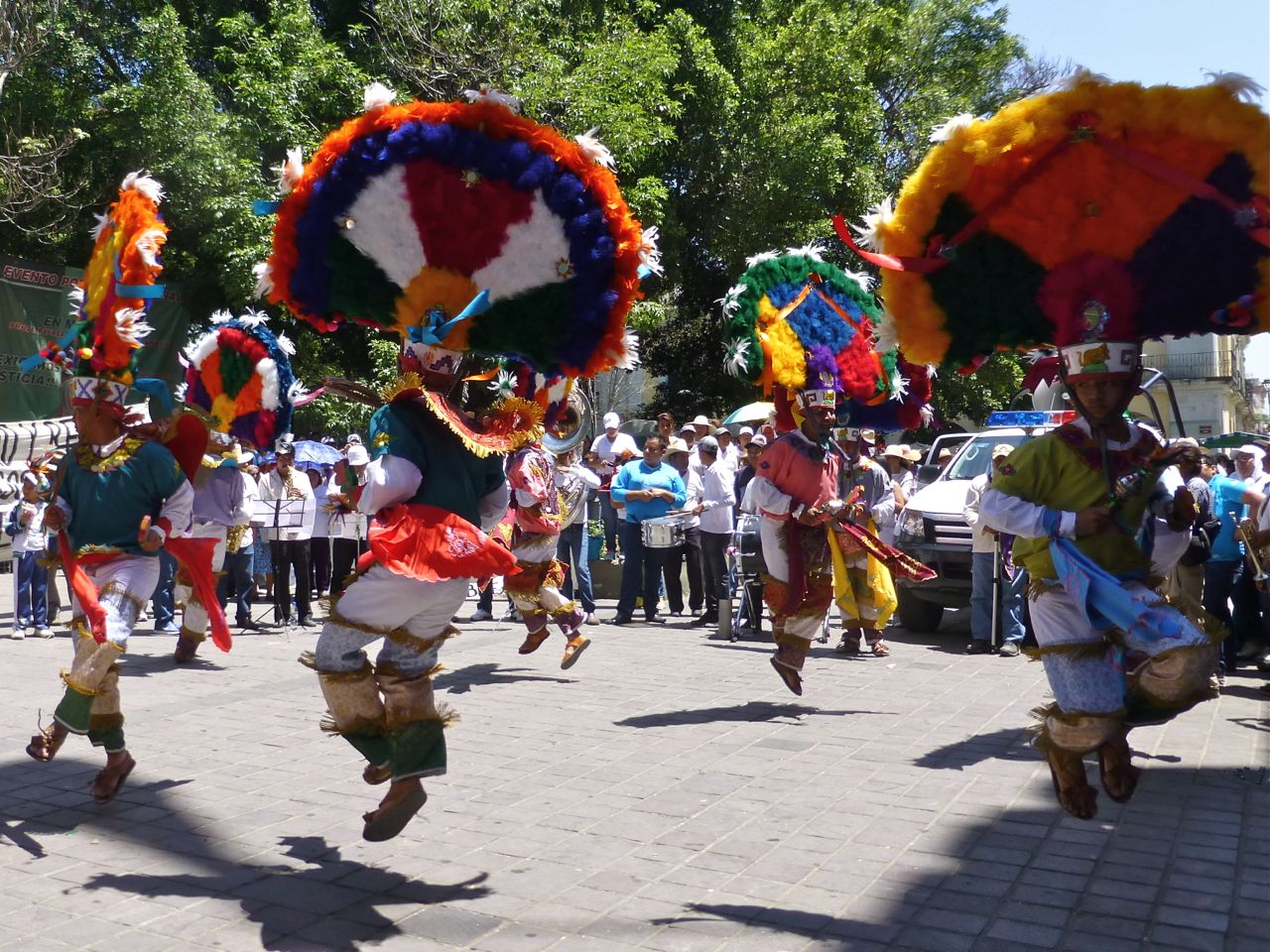
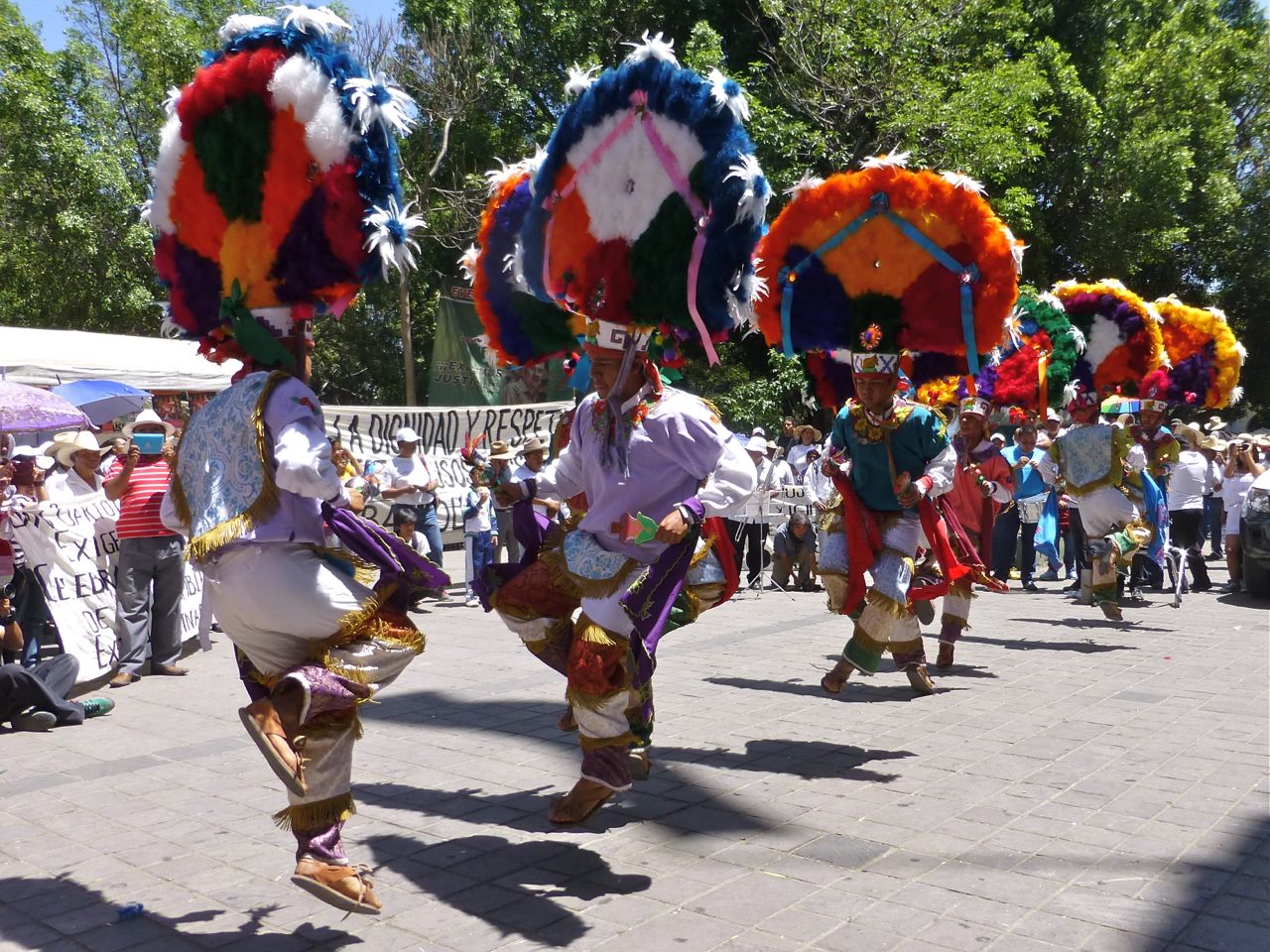
Today was the first day of a way-too-short first time visit to Oaxaca by a couple of California gal pals — an orientation walk through El Centro was the order of the day.  And what did we stumble upon in front of the Government Palace?  Danzantes waiting to perform a couple of the dances from the Danza de la Pluma.

P1020718

They began dancing and I flashed on Saturdays’ blog post, Danzantes in training.  However, these guys definitely weren’t apprentices — they had the steps and jumps down WITH those heavy and seemingly unwieldy penachos on their heads — and the crowd cheered.

P1020715

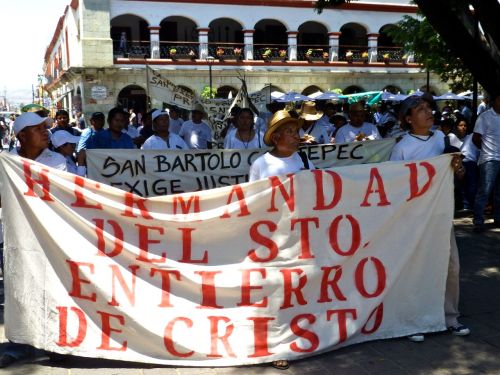
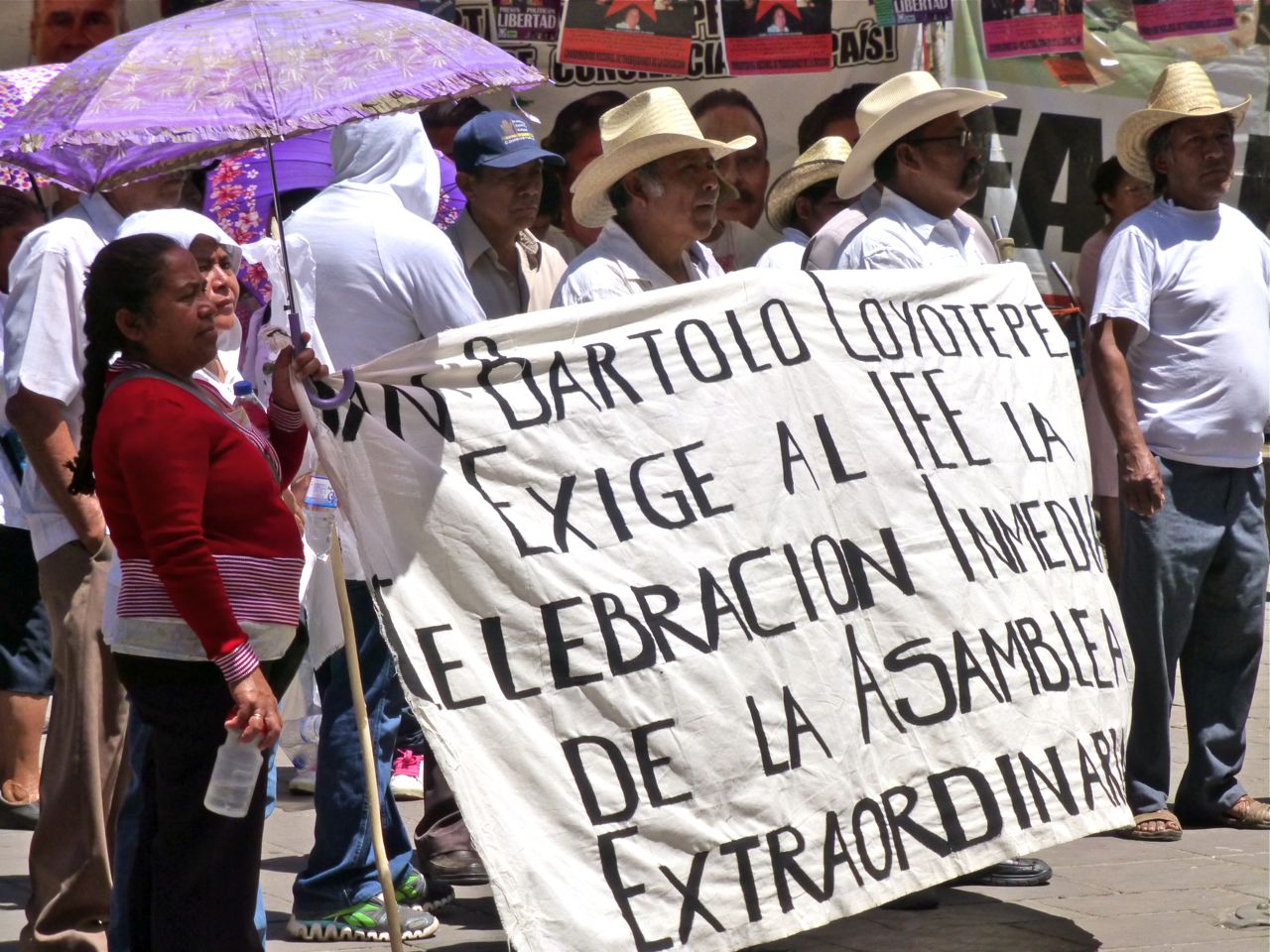
The danzantes and most of their gathered audience were from San Bartolo Coyotepec, about 15 km south of the city.  It’s a village known for the artisans who make black pottery.  However, along with the band and dancers, there were banners and protestors.

P1020723

According to this article (in Spanish), “they arrived at the presidential palace in the main square of the city to demand the replacement of the elections because the process was considered seedy and does not represent the will of the community.”

P1020702

Culture and politics… I couldn’t have arranged a more quintessential Oaxaca experience, if I had tried.  And my friends, what did they think?   They loved it all!

Read Full Post »

This morning, as I was getting ready to go to my local mercado, I heard the unmistakable sounds of the Danza de la Pluma (feather dance).  I’ve seen it often enough in Teotitlán del Valle to know the music.  While it is performed throughout the valley and is always one of the big hits during July’s Guelaguetza, Teotitlán del Valle is one of only two villages where it is performed as a religious ritual during their three major yearly festivals.

As I approached the Plaza de la Danza, the music got louder and louder.  Once there, I looked down to see 75 – 100 dancers in jeans and t-shirts practicing one of the (forty-one) dances of the Danza de la Pluma.  They were danzantes in training from various folkloric groups in the valley of Oaxaca.

As you can see from the video, the footwork is complex and the steps require a lot of stamina.  And, just wait until they put on the penachos (headdresses)!

I often wonder and worry that the traditional dances will eventually be lost.  Today’s encounter with these young dancers gave me hope.

Read Full Post »

You can cut all the flowers but you cannot keep spring from coming. –Pablo Neruda

Flor de mayo; May Flower

Spring has returned. The Earth is like a child that knows poems.  –Rainer Maria Rilke

P1020488

Every spring is the only spring, a perpetual astonishment. –Ellis Peters

Pseudobombax ellipticum, Shaving Brush Tree

Spring is nature’s way of saying, ‘Let’s party!‘  –Robin Williams

Read Full Post »

Domingo’s escape from the city out into the countryside of Oaxaca brought back one of my fondest childhood memories:  Sunday drives with my grandparents into the golden hills of northern California.  Two-lane winding roads with only the occasional car or pickup truck; farms, fields, and roadside stands outside my rolled down window always brought a sense of adventure mixed with freedom and serenity.  And, it still does…

Oaxaca city to Teotitlán del Valle, where we yielded to a herd of cattle.

Close-up white bull

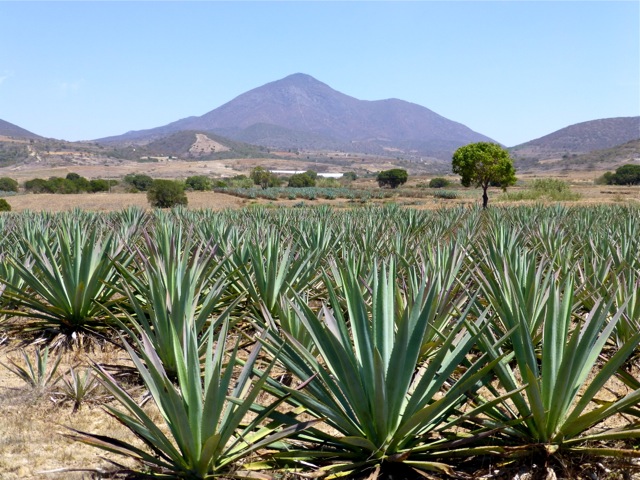
Santiago Matalán past fields of agave to San Baltazar Chichicapam.

Agave fields with mountain in distance

We continued on the mostly deserted road  towards Octotlán de Morelos.

Tile roof lean-to on rocky outcrop

Onto Hwy. 175 and a lunch stop at the roadside restaurant, between Santo Tomás Jalieza and San Martín Tilcajete, from almost two weeks earlier.

Sign for Los Huamuches with tables in background

And this time we noted the name:  Los Huamuches.  Another delicious comida… a perfect way to end our meandering and head for home.

Read Full Post »

Meet the new gals in town…

Virgin of Guadalupe painted on yellow wall

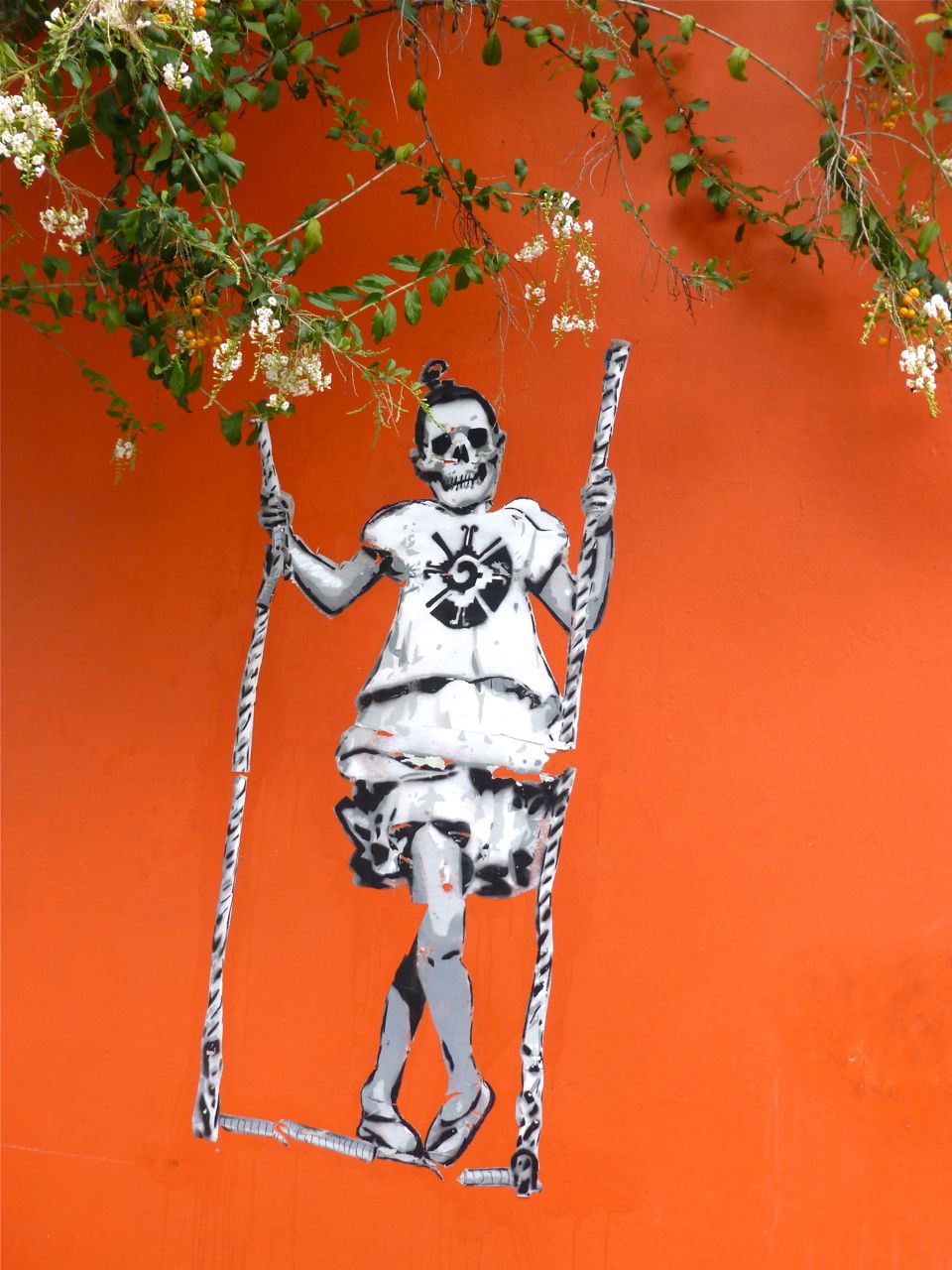
Skeleton on swing painted on orange wall

Life and death in Oaxaca.

Read Full Post »

Blog post as catharsis…

Saturday was a sad day in Oaxaca.  It brought the completely unexpected death of one of Oaxaca’s most talented artists, Arnulfo Mendoza Ruiz.  He was only 59.  I knew him a little, peripherally through my blogger buddy, Chris, who has known him and his large Zapotec family in Teotitlán del Valle (his sisters are well-known chefs) for many years and with whom he had been collaborating on a project.  Arnulfo had a well-known store and workshop called La Mano Mágica on the walking street here in Oaxaca, which showcased, not only his artistry (paintings, exquisite weavings, metal work, and more), but also the cream of Oaxaca’s artesanía and artist community.  We would occasionally stop by or he would hail us from the doorway — always with twinkling eyes, mischievous smile, and well-worn fedora atop his head.

Black bow above closed doors of La Mano Mágica

Today, the doors are closed.

As I’ve mentioned several times before, ritual and tradition play central roles in all aspects of Zapotec culture and it was amazing to watch it being expressed on Saturday.  Arnulfo died in the morning and by the early afternoon, friends, family, and many of the major artists in Oaxaca, were gathered in La Mano Mágica.  At one point, there was mournful chanting by several men in the gallery where his casket lay, later a band played, people came and went in the main workshop room, and in the room behind, his sisters prepared and served chicken covered in black mole, rice, tortillas, and atole.  The women busied themselves with the ritual of preparing and offering food, but allowed the tears to well up when condolences were given.  However, the men in the family sat or stood in clusters in the other two rooms, and remained stoic.

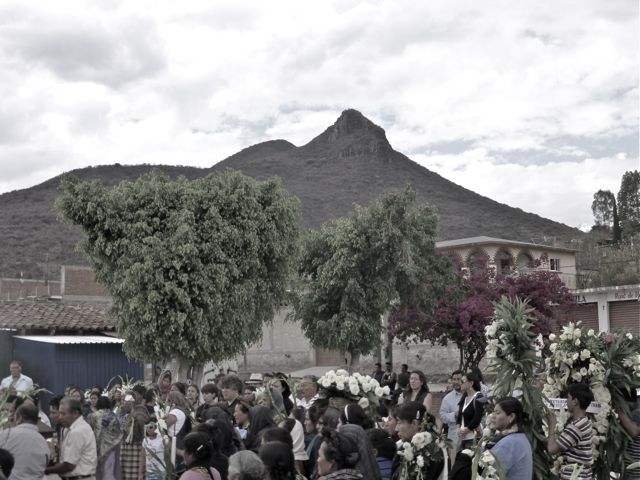
Mourners in church plaza, El Picacho in background

Under the embrace of El Picacho

According to belief, the funeral was held the next day.  As we drove out to Teotitlán del Valle on Sunday, the winter sky’s usual puffy white clouds had turned dark and gray and a few tear drops fell from the heavens.  There is a tradition of dimming the lights on Broadway to honor the death of a prominent member of the theatrical community.  And, yesterday, it felt like Mother Nature desaturated the color of Oaxaca a little in honor of Arnulfo Mendoza Ruiz.

Casket being carried into church

Led by the solemn sounds of a band, pallbearers carried the casket from his home high atop a hill in Teotitlán del Valle, down the steep and winding cobblestone streets, to Templo de la Preciosa Sangre de Cristo where a mass was celebrated.  And then, all processed to the cemetery.  The anguished sobs, as his body was lowered into the earth, were heart-wrenching.  Like laughter, I think grief is contagious, as it reaches into our heart, takes hold, and shakes the continuum of feeling in each of us.  And so, tears welled-up in my eyes.

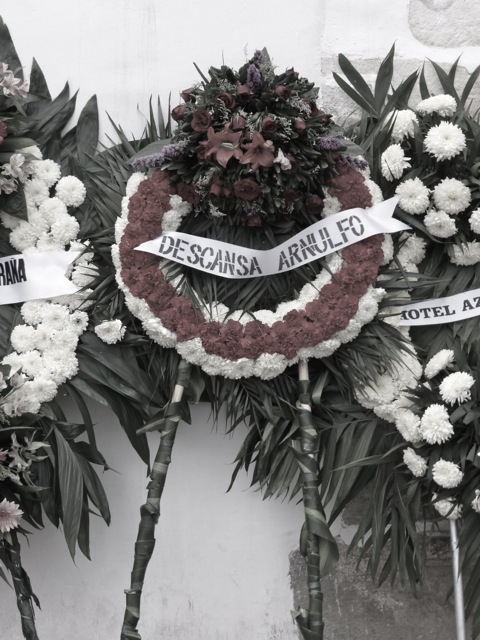
Floral wreath with ribbon reading, "Descansa Arnulfo"

Rest in peace, Arnulfo

Today, I continue to feel drained and very sad.  I didn’t know Arnulfo well, but feel humbled by the fragility of physical life.  I keep reflecting on how each of us tries to bring meaning to this temporal physical existence.  Arnulfo was a flawed man and was chased by demons, but in his creativity and nurturing of the arts, he left the world a little better than he found it.

Chris’s farewell blog posts to his friend are especially touching:   A sad day – Arnulfo Mendoza (1954-2014) and Another sad day – Arnulfo Mendoza (1954-2014).

And, here are two online obituaries (in Spanish):  Adiós a Arnulfo Mendoza and Oaxaca de luto por la muerte de Arnulfo Mendoza.

Read Full Post »

Tuesday, not only brought the previously mentioned Carnaval, San Martín Tilcajete style, it also provided comida, muy sabrosa.  No, not one of the 4 restaurants in Oaxaca recently listed in the 101 Best Restaurants in Latin America and the Caribbean.  I’m talking about al fresco dining in a roadside restaurant.  Sitting under the branches of a large shade tree on plastic chairs, around a plastic table, with cars and trucks speeding by, it was surprisingly tranquil.

Woman cooking on comal

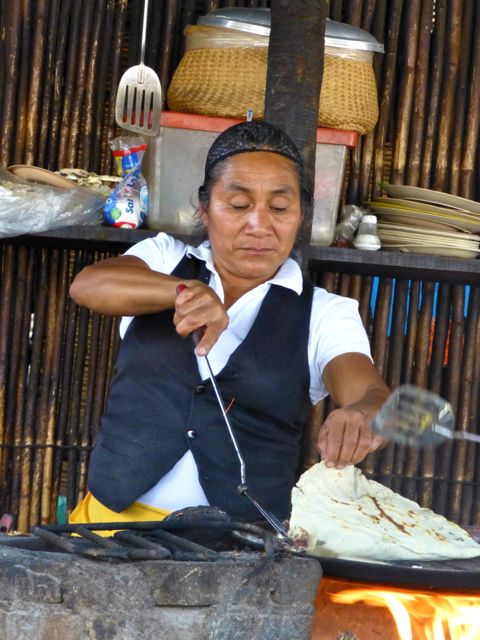
We had ringside seats as our lunch was prepared on a well seasoned comal.  I couldn’t help thinking as we sat at this unpretentious restaurant, in the middle of the fields that yielded the ingredients for our lunch, prepared according to culinary traditions passed down through generations of Zapotecos, this is quintessential “slow food.”

Woman lifting tlayuda off comal

That’s my tlayuda (sometimes spelled, clayuda) being lifted off the comal — and it was one of the best I’ve eaten!  Fyi, tlayudas are one of the 10 Essential Things To Eat And Drink In Oaxaca.

P1020181

For more on our yummy lunch, see Chris’s blog post, Fat Tuesday done right.  Alas, neither one of us took note of the name of the restaurant — all I know is it’s on the east side of Hwy 175, between San Martín Tilcajete and San Tomás Jalieza.

Read Full Post »

Another day… another celebration… another adventure!  Yesterday was Día de Carnaval (aka, Fat Tuesday, Mardi Gras, Carnival), a day to let the good times roll before the sacrifices of the Lenten season.

As you have probably surmised, the Spanish brought the tradition to Mexico.  Like many other seasonal celebrations, it conveniently coincided with indigenous festivals celebrating the “lost days” of the Mesoamerican calendar, “when faces were covered to repel or confuse evil.”  Apparently, it caught on “because it was one time when normal rules could be broken especially with the use of masks to hide identities from the authorities.”

And so, off we went for Día de Carnaval in San Martín Tilcajete (28 km south of the city), a village known for its fancifully painted wood-carved alebrije and masks.  We are still doing May weather in March and, thus, it was hot and shade was in short supply.

In the morning, a bride and groom were chosen, villagers gathered for a boisterous and hilarious ceremony in the courtyard, they danced, and then all processed through the streets of San Martín Tilcajete to a designated location where the happy “couple” knelt before a jolly looking “priest.”  By the way, those beautiful “women” in gorgeous gowns aren’t what they seem!

Young and old, the “guests” were a colorful crowd.  Many of the diablos and diablillos covered their faces with colored pigments and their bodies with red or black oil — rumor has it, motor oil is sometimes used.  Yuck!

I’d been to San Martín Tilcajete many times — to go from one workshop to another in search of the perfect alebrije for a gift or to add to my collection — but never before for Carnaval.  It was great fun and the photo ops were endless.

As they say in New Orleans, “Laissez les bons temps rouler!”

Read Full Post »

Maybe it’s the recent trip to the US — staying in my childhood home, rearranging boxes of old LPs in the garage, looking at framed Fillmore and Winterland concert tickets from shows I attended “back in the day.”  Another sixties-era song came to mind when I ran across this photo I’d taken in January of some street art on Rio Papaloapam in Santa Rosa, Oaxaca (not California).  Ahhh…  the beautiful harmonies of Buffalo Springfield singing Bluebird by Stephen Stills.

On top of an meter box, a painted bluebird

Listen to my bluebird laugh
She can’t tell you why
Deep within her heart, you see
She knows only crying, just crying

There she sits, aloft a perch
Strangest color blue
Flying is forgotten now
Thinks only of you, just you, oh yeah

So get all those blues
Must be a thousand hues
And be just differently used
You just know

You sit there mesmerized
By the depth of her eyes
That you can’t categorize
She got soul, she got soul

Do you think she loves you?
Do you think at all?

Soon she’s going to fly away
Sadness is her own
Give herself a bath of tears
And go home and go home

Read Full Post »

« Newer Posts - Older Posts »