Feeds:
Posts
Comments

Posts Tagged ‘Guelaguetza’

It didn’t start that way; I awoke to horrifying news from Colorado.  Thank goodness blogger buddy Chris called and the heart that beats in Oaxaca beckoned.

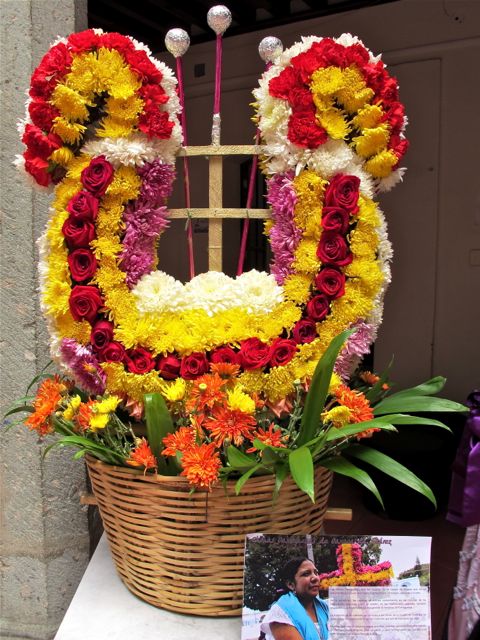
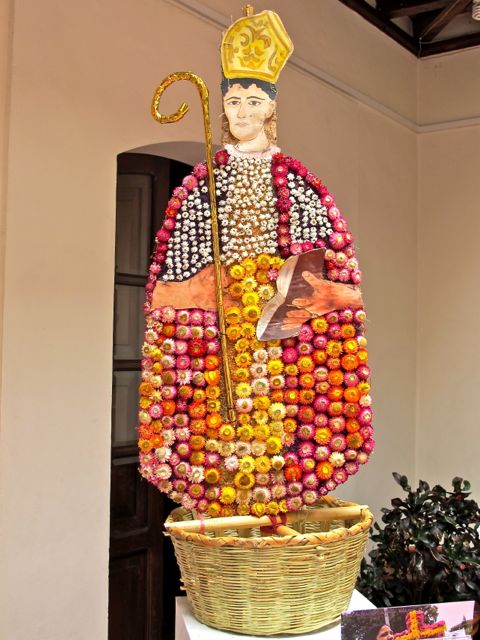
First stop was the “Al Son del Valle,” an exhibition of canastas from 17  villages in the central valleys of Oaxaca.  These are baskets that are carried on the heads of women during calendas (parades); you may remember them from previous posts on the convites in Teotitlán del Valle.  The art of crafting canastas and the traditions and culture they represent have been proudly and lovingly passed down through the generations.

San Antonino Castillo Velasco canasta decorated with Flor Inmortal, the flower that never dies.

Canasta from San Mateo Macuilxóchitl

From San Jerónimo Tlacochahuaya, these canastas are lit and become pinwheels of fireworks at the end of a calenda.

Canasta of Las Chinas Oaxaqueñas of the city of Oaxaca

Canasta from Tlacolula de Matamoros.

Canasta from Zimatlán de Álvarez made of crepe paper.

Muchas gracias, Oaxaca, I needed that!

Read Full Post »

This year marks the 80th anniversary of the modern Guelaguetza festival in Oaxaca.  The calendar is filled with official Guelaguetza activities and other events that take advantage of the massive annual influx of tourists (especially from other parts of Mexico).  The colorful and distinctive costumes worn by the Guelaguetza delegations from each of the 8 regions of the state of Oaxaca play a major role in wowing visitors and residents — including, me!
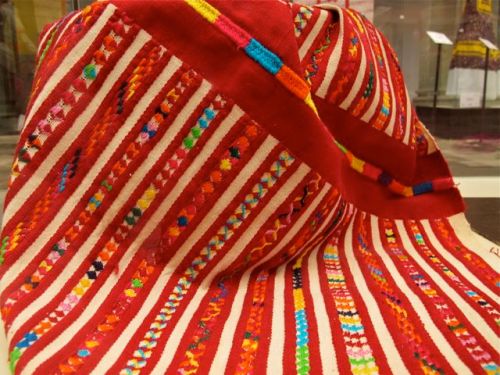
Huipil de San Andrés Chicahuaxtla, Putla Villa de Guerrero, Oax.

As a result, the “Oaxaca Xaba Lulá” exhibition has been mounted in the Government Palace.

Traje de la Villa Sola de Vega, Oax.

These are only a fraction of the items on exhibit and the photos were chosen primarily because they showed the least amount of reflection on the plexiglass display cases.  It is a beautiful, but challenging to photograph, setting!

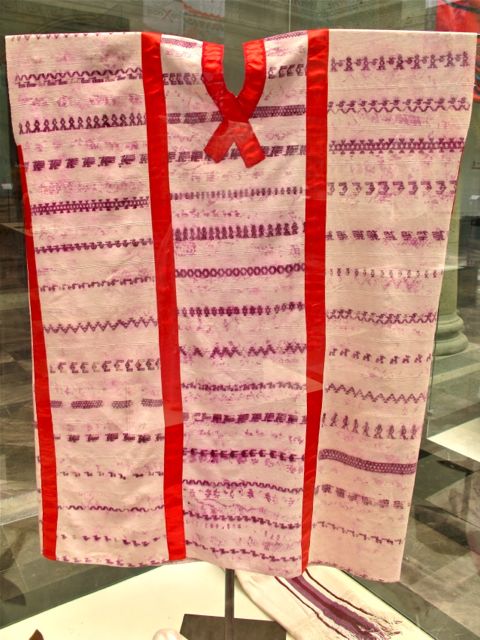
Huipil de San Bartolomé, Ayautla, Teotitlán, Oax.

The collection of trajes típicos (typical costumes) representing the 8 regions of Oaxaca runs through the end of the month.

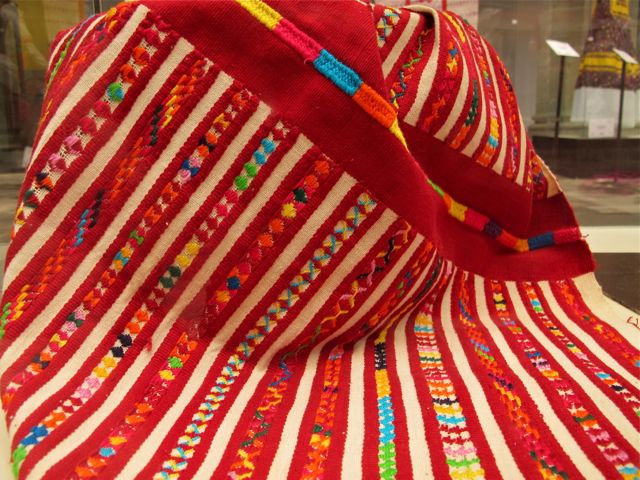
Rebozo de San Juan Colorado, Jamiltepec, Oax.

The dresses, hats and accessories were donated by Oaxacan citizens from different regions of the state and were made in the traditional way, with many using natural dyes.
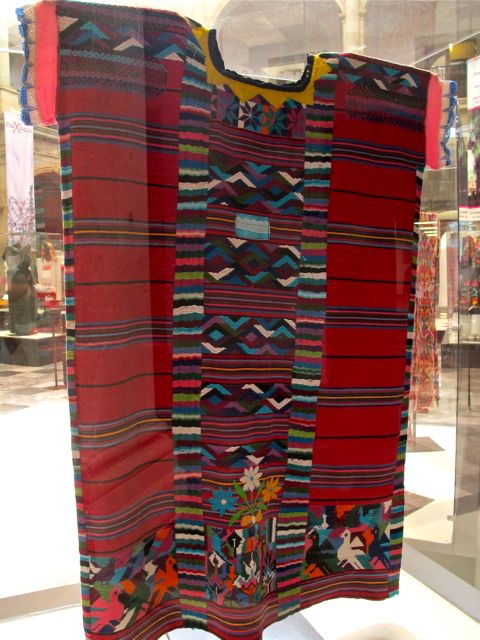
Huipil de Gala de San Lucas Ojitlán, Tuxtepec, Oax.

At the July 6 opening, José Zorrilla de San Martin Diego (Minister of Tourism and Economic Development), explained that they reflect a cultural essence that has prevailed for centuries in customs and traditions of the people of Oaxaca.

Funda de San Jerónimo Tecoátl, Teotitlán. Oax.

He observed that the Oaxacan costumes are a reflection of the depth of the culture, traditions, and ancestral weaving techniques that have been passed from generation to generation of Oaxacan hands.

Traje de Santa María Tlahuitoltepec, Mixe, Oax.

“The huipiles display in all their splendor the details that form a labyrinth of colors, a tiny universe that reflects the vastness of fertile nature and the symbolism that characterizes our native land and which graces the greatest festival of Oaxacaños,” Zorrilla de San Martin Diego very poetically suggested.
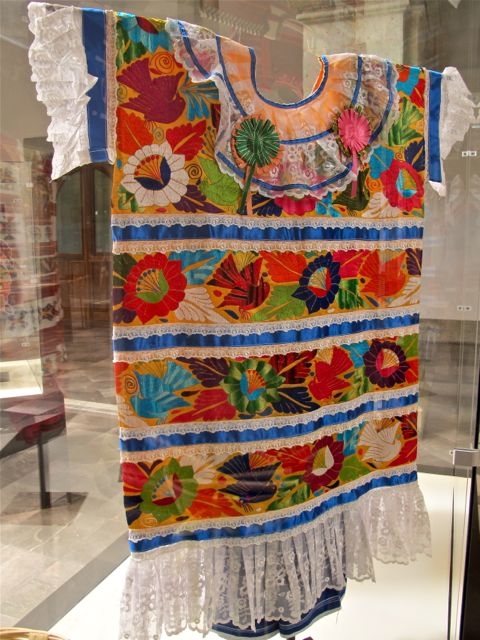
Huipil de Jalapa de Díaz, Tuxtepec, Oax.

Needless to say, during the next two weeks, I’m going to try to hit as many of the fairs, parades, dances, and exhibitions as possible.  Stay tuned…

Save

Read Full Post »
Early Saturday morning I was on my way to the doctor’s office, thus walking with purpose.  However, turning onto Constitución, along the south side of Santo Domingo, I had to pause…

Man and woman in stylized Aztec costume in jewel tones.

A photo shoot in progress?  I didn’t actually have a doctor’s appointment, just dropping by for a consultation (common here), so I lingered.

HE was obviously modeling “glamed-up” Aztec.  But SHE…

Woman in stylized Aztec costume in jewel tones.

Hmmm… Japanese???  Of course not!  Comparing it to images found in the codices, it, too, is an extremely stylized expression of  the fashion and hair of some classes of Aztec women.

Close-up of woman wearing purple silk huipil and stylized Aztec hairdo.

¡Muy hermosa!

Update:  I think Sheri is probably correct.  This may be a promotion for, or at least evoke, the annual reenactment of the Donají la leyenda, during Guelaguetza.  It is the legend of Princess Donají, a Zapotec princess who was kidnapped and decapitated by rival Mixtecos.  Her beautiful head was later found intact by a shepherd under a lily.  The body and head were reunited and buried together near, what is now, the city of Oaxaca’s airport.   The face of Donají appears on the official shield of the city of Oaxaca de Juárez.

Official shield of Oaxaca de Juárez.

The elevation and celebration of this story makes me wonder how today’s Mixtecos feel about it…

Read Full Post »

Friday was a delightful day… a late morning and early afternoon spent in leisurely conversation with one of my closest friends over desayuno at Cocina Economica Isabel, a stop at the Merced mercado to pick up some pan dulce, and a stroll through the Zócalo, before returning home.  I envisioned a late afternoon and evening of visiting with my neighbor before she is heads north for a USA visit, catching up on email, and watching a movie.  Perfection, I thought!  Who could ask for more?

“More” came via my email inbox; notice of the 10th Guelaguetza Infantil, with a calenda (parade) from Santo Domingo de Guzmán to the Zócalo beginning at 6 PM.  This definitely called for a change of plans!  And, sure enough, as I got closer to Santo Domingo, there they were; delegations of children representing the regions of Oaxaca.

Girl and boy in costume of the Istmo.

Istmo de Tehuantepec couple (a young Frida Kahlo, perhaps?) posing for photos.

Girl in Istmo costume covering her ears

There were several bands playing and it got a little too loud for this girl from the Istmo.

Girl in Tuxtepec costume holding basket of candy.

However this girl, representing the Papaloapan, didn’t seem to mind and was ready to toss candy to the crowd. She wasn’t alone — once the calenda started, candy began flying fast and furious and the pockets of the kids watching on the sidelines began bulging!

Girl wearing a costume from the Costa regionGirls from the Costa region received last-minute instructions.

Boys in white shirts and straw cowboy hats holding school banner reading "Cervantes"

Costa boys were charged with holding up their school banner.

Close up of girls in the costumes from Tuxtepec

The girls representing the Papaloapan clutched plastic pineapples, ready for the always popular Flor de Piña dance from Tuxtepec.

2 girls standing together; one in Istmo costume and one in Tuxtepec costume

A little cross cultural comparing of notes (actually, cell phone games) was happening between the Istmo and Papaloapan.

Girl in Mixteca costume dancing.

All the while, the dancers from the Mixteca danced their way down the Álcala.

Closeup of boy with Danza de la Pluma head dress.

And, the young Danza de la Pluma danzantes, representing the Valles Centrales, carefully balanced their penachos (headdresses).

Tonight at 5 pm, these 300 kids from 52 preschools, will perform traditional regional dances in the auditorium of the Universidad Regional del Sureste, Rosario campus in San Sebastián Tutla.

Read Full Post »

This morning, I was awakened from a sound sleep by the insistent siren and recorded voice alerting the neighborhood of an impending earthquake.  I bolted upright, moved to the side of the bed and slipped on my flip-flops — ready to head out the door if shaking commenced.  As I’ve mentioned before, I think Mexico’s Earthquake Warning System is terrific and something the US should emulate.

However, this time, no rocking and rolling occurred, but I was left wide awake and wondering if and where an earthquake had occurred.  So I pulled out my iPod Touch and opened my iEarthquake app and found that at 5:10 this morning, there was a magnitude 5.7 earthquake about 105 miles WSW from the city of Oaxaca in the mountains near the coast.  The epicenter was 6.2 miles northwest of Pinotepa Nacional, in the Costa region of the state of Oaxaca.

So, I decided to use this event for a geography lesson.  The state of Oaxaca has 8 regions (it used to be 7, but not too long ago the Sierra Region was split into two):

These regions are home to 14 distinct ethno linguistic groups and the regions vary dramatically in topography, vegetation, and climate.  One can catch a glimpse of the unique costumes, dances, and dancers of each region during the Guelaguetza celebration in Oaxaca in July.   The city of Oaxaca is located in the Valles Centrales (“Centro” on the map below).

Color coded map of the regions and districts of Oaxaca

Map from Wikipedia

For a painless way to learn more about the geography of Mexico, you might want to take a look at the Mexican States games.

Read Full Post »

Fascinating and revealing… from Upside Down World.  I encourage you to read the full article.

Defying the Myth of Native Desolation: Cultural Continuity in Oaxaca
Written by Kathleen Melville
Friday, 09 December 2011 15:56

Woman grinding masa on stone matate

“There is no remedy, and the Indians are coming to an end.” – Don Felipe Huamán Poma de Ayala, 1615 (quoted in Restall, 100)

Despite the passage of nearly four hundred years, Huamán Poma’s dismal pronouncement remains the sad ending to many popular narratives of the conquest. In classrooms throughout the United States, students learn that the arrival of Columbus spelled the end of Native American civilization and that the Spanish conquest obliterated indigenous culture and society in the Americas. As Matthew Restall notes in “The Seven Myths of the Conquest”, this pervasive “myth of native desolation” (102) obscures the strength and vitality of indigenous people throughout history and into the present.

In Oaxaca, Mexico, the lives and work of indigenous people belie the myth of native desolation and attest to thousands of years of continuous, evolving culture. In July, over 30 educators from the United States convened in Oaxaca for a summer institute funded by the National Endowment of the Humanities. Our goal was to better understand the histories and cultures of indigenous people in the region so that we might help illuminate and preserve them through our teaching. With unit plans that we designed and shared, we hope to disturb and diminish the myth of native desolation and to enrich our students’ perspectives on native culture.

<snip>

Globalization and transnational corporations also pose a significant threat to indigenous cultural continuity. Artisans in Oaxaca complained that Asian companies have been mass-producing textiles and wood carvings abroad and then undercutting the tourist market locally. As documented in several articles on this site, the agricultural corporation Monsanto aims to expand its reign into Oaxaca and eliminate small maize farms like the Vicente family’s. Drug cartels, their own breed of transnational organization, also jeopardize indigenous culture by increasingly luring young people into lives of violence far from home. These giants make for formidable foes in the fight for cultural survival, but the indigenous communities of Oaxaca have faced formidable foes in the past. From the Aztec conquest to the Spanish conquest to the present day, indigenous communities in Oaxaca have endured and evolved, defying the myth of native desolation and defining a culturally sustainable future for themselves.  [Full article]

(FYI:  I just had first-hand experience with the threat cheap imports pose to the livelihoods of Oaxaca’s artisans.  I do all my Christmas shopping in Oaxaca (so much more enjoyable than hitting the malls in the USA) and purchased backscratchers for stocking-stuffers that “looked” like they were made from the ubiquitous carrizo found anywhere a trickle of water is found in Oaxaca.  However, there they were in a bin at one of the chain drug stores here in el norte!  I’m thinking they were made in China.  Wood carvers, potters, and weavers, the conversation is the same; business is down and these creative and talented folks are being forced to return to work in the fields.)  — casitacolibrí

Read Full Post »

In August 2011, Vive Oaxaca launched a campaign to showcase the best of the state through a series of video shorts.  Two have already been released online:

Esto es Zaachila

http://www.youtube.com/watch?v=cGss60-HeNk&feature=youtu.be

and, Esto es Guelaguetza

I’m looking forward to Monday night’s online release of, Esto es Oaxaca de Juárez.  I guess you know what my Tuesday morning blog post will be!

Read Full Post »

As I mentioned a few days ago, El Grito and Mexican Independence Day are coming and, besides flags and green, white and red decorations, it also means parades and fuegos artificiales (fireworks).   The latter will, no doubt be grand and, if last year is any indication, the rooftop with have a ringside view.

In anticipation, I thought I’d share a video from the rooftop of the nightly fireworks during July’s Sinfonía de Luz y Sonido throughout this year’s Guelaguetza.

Read Full Post »

Yesterday, I opted for the smaller and more intimate Guelaguetza in the Villa de Etla, about 12 miles northwest of Oaxaca city.  As far as I could tell, seven of the eight regions of the state of Oaxaca were present; only the Sierra Sur was missing.  FYI:  In the photos below, I purposefully left out the Plume dancers, who represented the Valles Centrales, as you will find plenty of photos of the Danza de la Pluma in my postings from the Fiesta de Preciosa Sangre de Cristo in Teotitlán del Valle.  By the way, Chris at Oaxaca-The Year After posted a terrific Guelaguetza Guide to assist in identifying the regions of Oaxaca.  It’s in Spanish, but even a non-Spanish speaker can learn quite a bit.

On a more serious note… I was reminded today by a Oaxaqueña friend, Guelaguetza in the city of Oaxaca is controversial.  Tickets (available through TicketMaster, I might add) for reserved seating to the official performances on Cerro Fortín at the (newly renovated and hotly disputed) Guelaguetza Auditorium are beyond the reach of most Oaxaqueños, some events are sponsored by Coca Cola, hundreds of thousands of pesos of tax payer monies have been spent on the sound and light show (spectacular, as it is), nightly fireworks, bringing in celebrities, and slick, though often inaccurate, publicity.  All is geared (well, not the inaccuracies) toward tourists; a boon to the restaurants and hotels around the zócalo.  But…

Unfortunately, what is lost is that the Guelaguetza is supposed to be a celebration that brings together the extremely diverse indigenous communities, from the various regions of the state to share their crafts, food, dance.  It wasn’t supposed to be crass commercialism that caters to tourists and well-heeled locals, at the expense of peoples who originated the tradition.  And, my friend asked, along with admiring their costumes and colorful dances, wouldn’t a portion of the pesos be better spent attending to the real and extremely pressing needs of the poverty stricken indigenous communities, especially with regard to infrastructure and education?

However, yesterday in Etla, I caught, perhaps, a glimpse of the original meaning of Guelaguetza.  Admission was free and open to one and all.  Free tamales and beverages (alcoholic and non) were offered to the standing-room only crowd, along with the sombreros, baskets, fans, whisk brooms, tlayudas, and fruit that each of the delegations of dancers tossed to the audience at the end of their performances.  After it was over, fellow blogger Chris and I looked around and realized, we were probably the only gringo and gringa in attendance.  What an honor and privilege!

Read Full Post »

Last night I, along with thousands of others, gathered on the Alameda, with eyes gazing upwards at the “espectáculo” being projected on the facade of the Cathedral.

Three projectors allowed alebrijes to march across the front of the Cathedral, tapetes to hang from the rooftop, and tin ornaments to be displayed, as if they were on a wall in a mercado waiting to be purchased.  Buildings collapsed and were rebuilt, vines reclaimed a pyramid, and so much more.  It was accompanied by music familiar to anyone who has spent more than a day in Oaxaca.  And, at the end, Flor de Piña was heard as fireworks erupted over the Cathedral.

This slideshow requires JavaScript.

And so, for whatever role they may have played, my hat is off to the two guys hanging around in their hammocks, mentioned in my July 20 and July 24 posts.  The Sinfonía de Luz y Sonido was, indeed spectacular!

Rumor has it that it is being streamed, though I haven’t discovered the link as yet.  If I find it, I promise to add it to this post.

Read Full Post »

For the first time, live internet streaming of today and tonight’s (and presumably next Monday’s) Guelaguetza performances  at:  http://www.telmex.com/guelaguetza

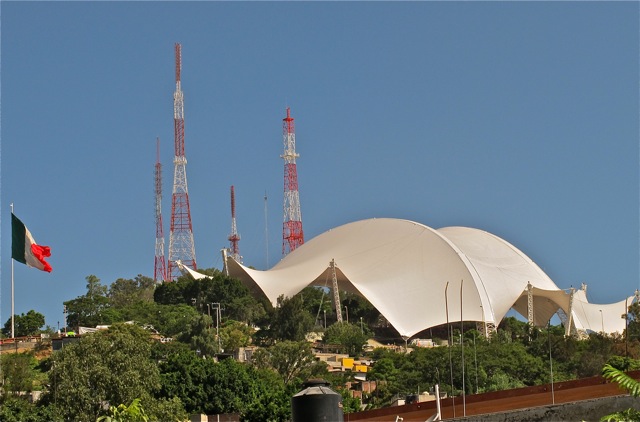
Guelaguetza Auditorium

As you can see from the photo I just took of the Guelaguetza Auditorium, it is a stunning blue-sky Oaxaca day.

Read Full Post »

Aha!  So this is what the guys in the hammocks mentioned a few days ago are guarding:  It’s the gear for a sound and light show being projected on the Cathedral.  Noticias has cleared up the mystery and posted a video snippet to lure readers:

Sinfonia de luz en la Catedral oaxaqueña

It worked… I’m going!!!

Read Full Post »

Guelaguetza… the offering and sharing has begun!  Under cloudy skies, with the occasional torrential downpour, buses bringing dancers and bands began arriving for the Desfile de Delegaciones Regionales, tonight’s hour-long parade down the Alcalá to the zócalo.

This slideshow requires JavaScript.

Parade has ended, I’m back at Casita Colibrí, the sky has cleared, a 200-piece youth orchestra from the central valleys of Oaxaca has finished playing traditional Oaxacan music in the Plaza de la Danza, and the third round of fireworks has just erupted from the zócalo.  Ahhhh… this place is amazing!!!

For more information on Guelaguetza:

Read Full Post »

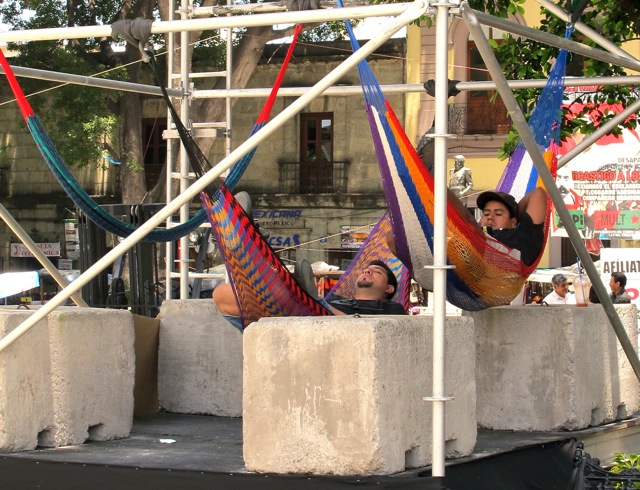
Hammock time

Guelaguetza is almost here, the Zócalo is teeming with tourists, and a massive stage is being set up opposite the cathedral.  I think these guys are guarding it.  I want their job!


Two guys in hammocks hanging from stage scaffolding

Hmmm… there’s an empty hammock.  Maybe I should apply!

Read Full Post »

« Newer Posts