Feeds:
Posts
Comments

Posts Tagged ‘garden’

Remember the night my Pitahaya (aka, Dragon fruit) blossom was ready for her close-up?  Three months later, here she is…

Pitahaya fruit

Though there is fruit, flowers continue to put on their bloomin’ after-dark show.

Pitahaya flower and fruit

Their beauty never ceases to enchant.

Pitahaya flower

From terrace to table…

2 halves of Pitahaya fruit

My version of “farm fresh.”

Read Full Post »

This has been a good year for my stinky Stapelia gigantea.

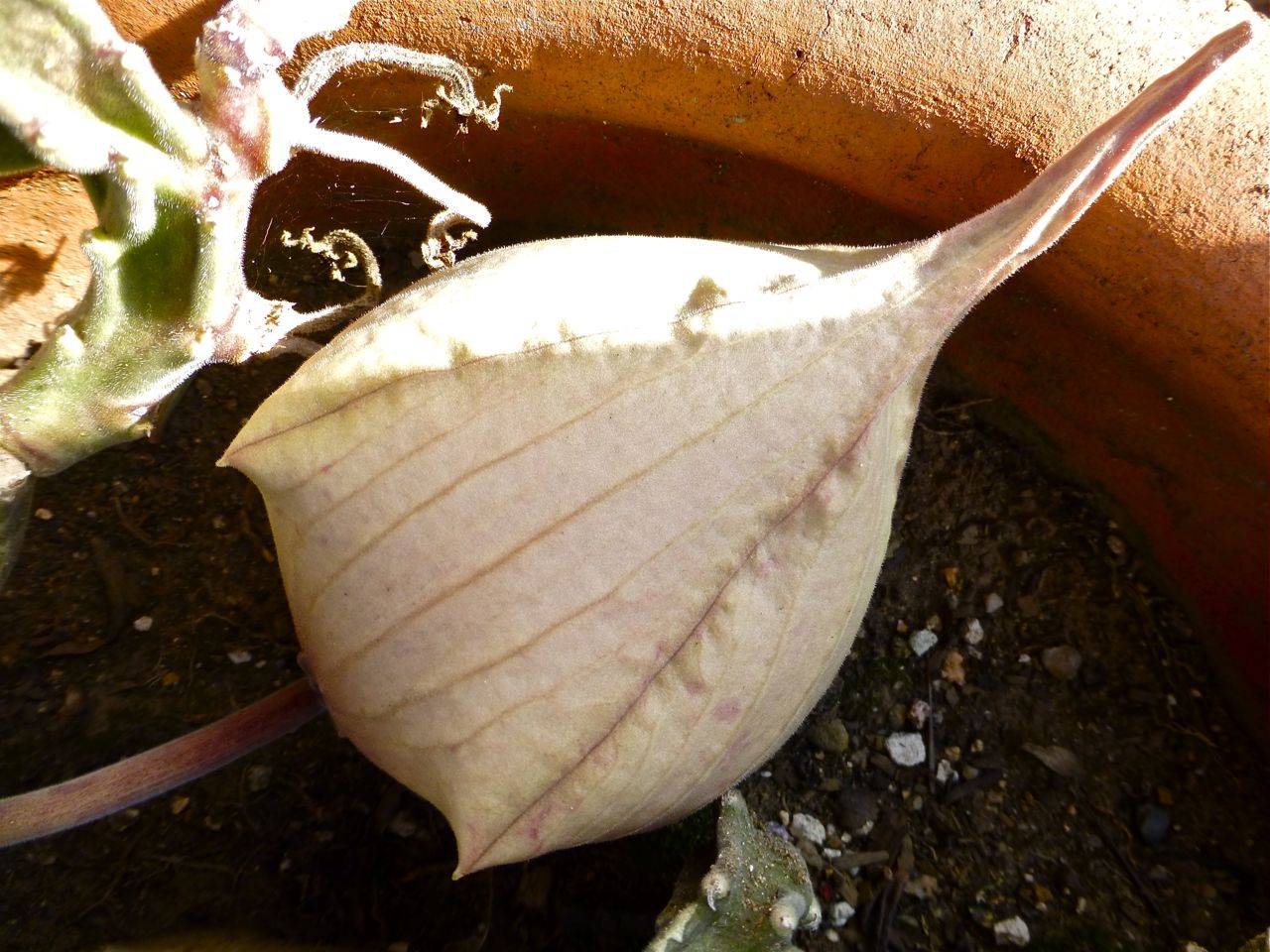
Stapelia gigantea unopened blossom

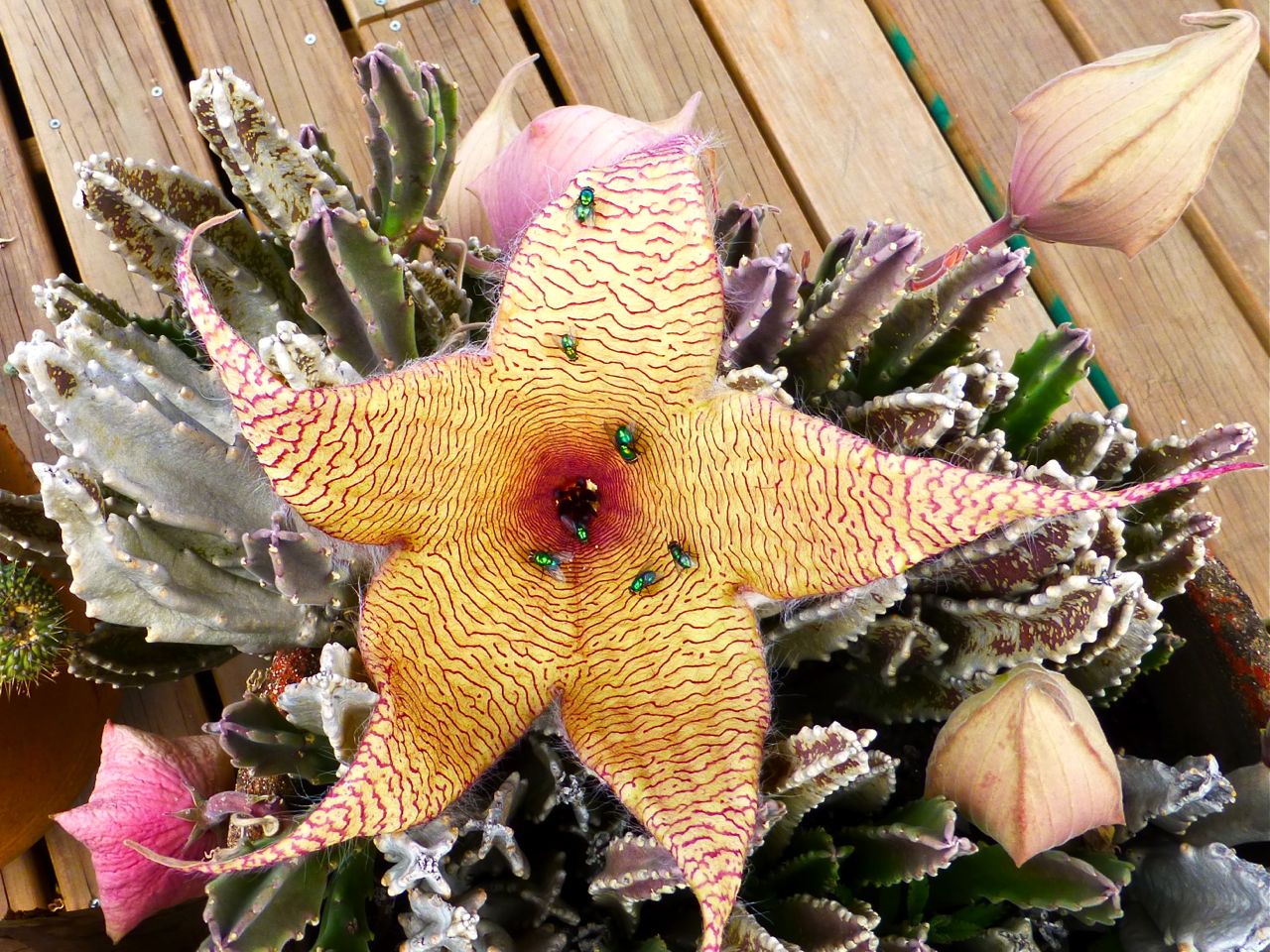
Feather-light blossoms open to reveal zebra-striped, hairy flowers.  Apparently, to carrion eating insects, these tiny soft white hairs resemble mold growing on rotting meat — a disgusting thought!

Part of Stapelia gigantea hairy petal

And, to complete the putrid package, the flowers smell like rotten meat.

Stapelia gigantea open flower with 7 green bottle flies

An odious odor only a green bottle fly could love.

Save

Save

Read Full Post »

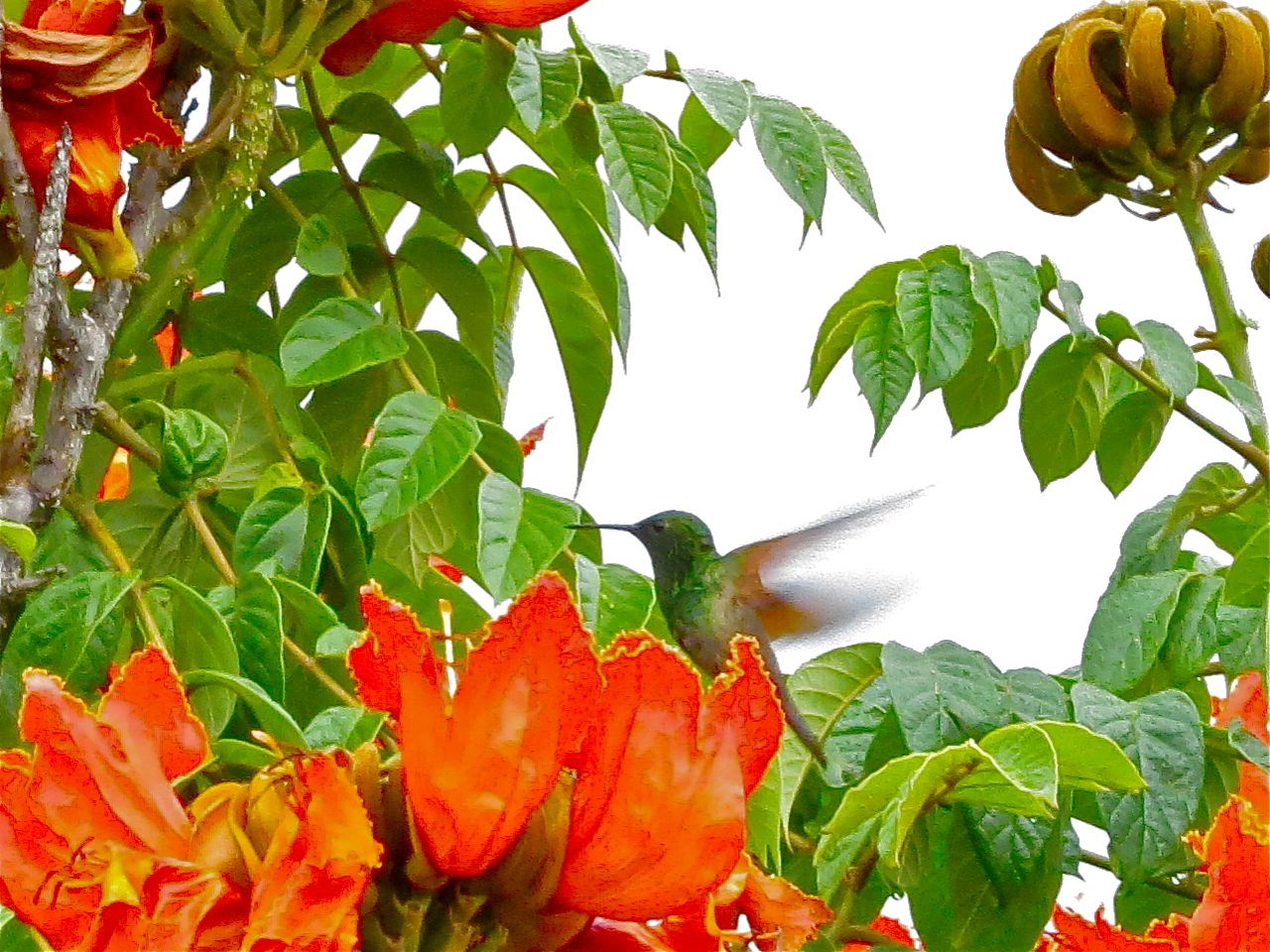
The African Tulip Trees (Árbol del tulipán) are in full leaf and bloom, adding an explosion of greens and red-orange to the view from Casita Colibrí…

IMG_5752

… and providing the colibríes (hummingbirds), who give my apartment its name, a home, playground, and 4-star restaurant.

Read Full Post »

The azucena is a variety of tuberose and its name is familiar in Oaxaca.  A popular boutique hotel near Casita Colibrí and  a well-known restaurant at the entrance to San Martín Tilcajete are both namesakes. This must be a special flower.  It is!  A few evenings ago, I went out onto the terrace to soak in the view, as lights came on in the city, and discovered azucenas blooming in an old planter box on the terrace wall.  Another night bloomer joins my pitahaya and night-blooming cereus.

Stalks of flowering azucenas

As Judy Sedbrook at Colorado State University, Cooperative Extension, explains, flowering plants on The Night Shift take over as the sun sets.  They are often white or light-colored, to better reflect the moonlight, and exhibit a heady scent, both in an effort to attract their night flying moth and bat pollinators.

2 azucenas flowers against dark sky

I love these sweet-smelling nighttime surprises!

Read Full Post »

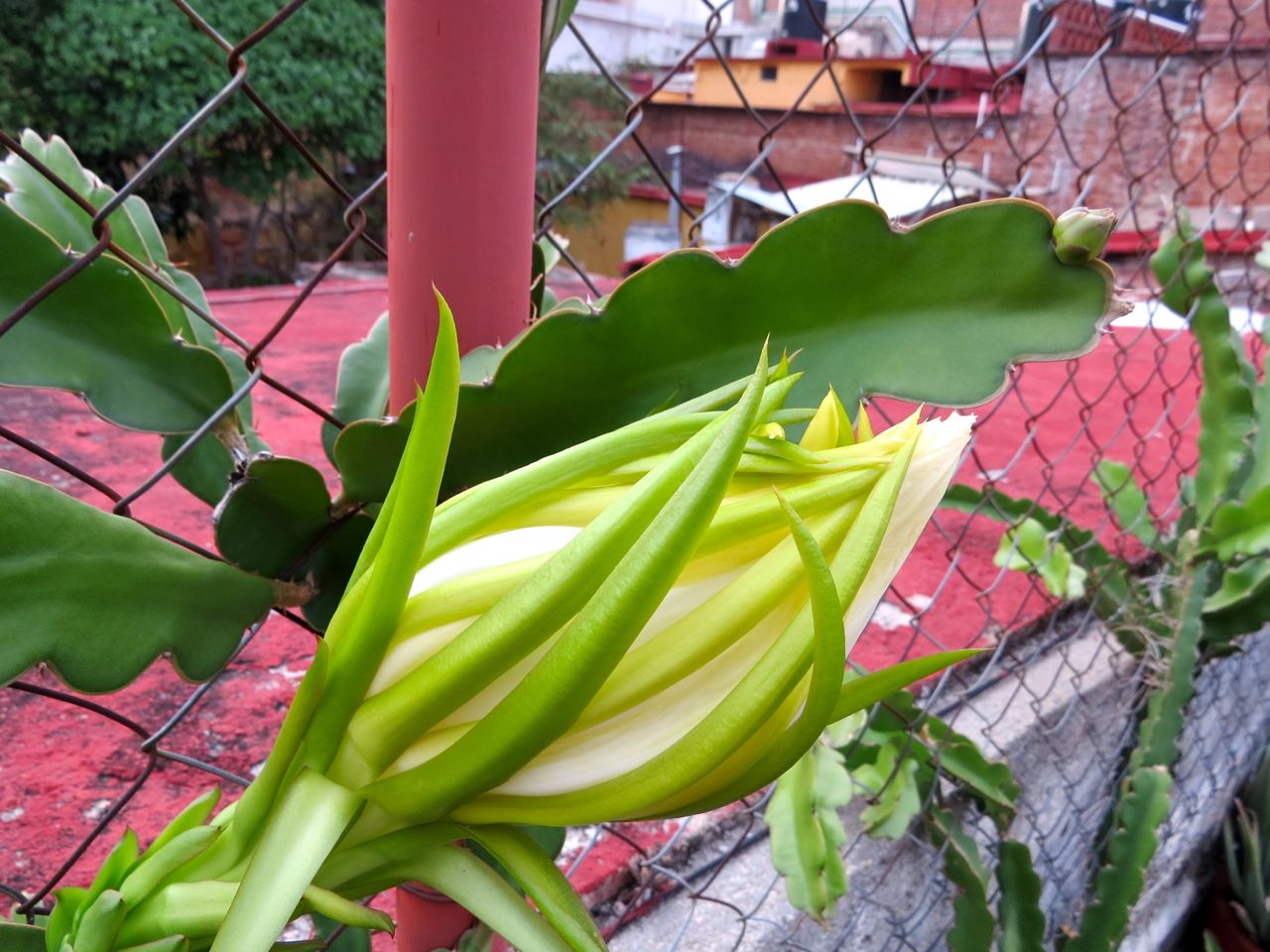
Several mornings ago, after a day and night of rain, I went out on the terrace to check on the garden and found…

Pitaya flower with rain drops

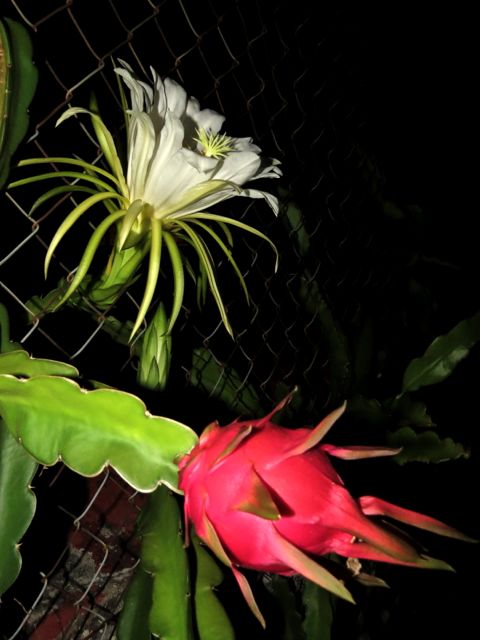
Yikes, one of my Pitahaya (Hylocereus undatus – aka, Dragon fruit) had bloomed overnight!  Must be a relative of my other Night Blooming Cereus.

Two years ago, the original cuttings had been laying in the campo of a friend in San Martín Tilcajete.  When Chris (Oaxaca-The Year After) asked if we could have some, the answer was, “¡Por supuesto!”  Loving the wall of Pitahaya at Centro Académico y Cultural San Pablo, six months later, with the original five cuttings becoming fifteen, I could use them to begin to screen the chain link fence at the new Casita Colibrí.  I kept pruning and sticking them in the planter boxes.

Pitahaya climbing chain link fence

June 2, 2014, 8:40 AM

And now, they have begun blooming.  Having missed the “night-blooming” of my first flower, I was determined not to miss the unfolding of the second blossom, seen above near the top of the pole, providing the weather cooperated.  It did!

Pitahaya blossom

June 2, 2014, 7:20 PM

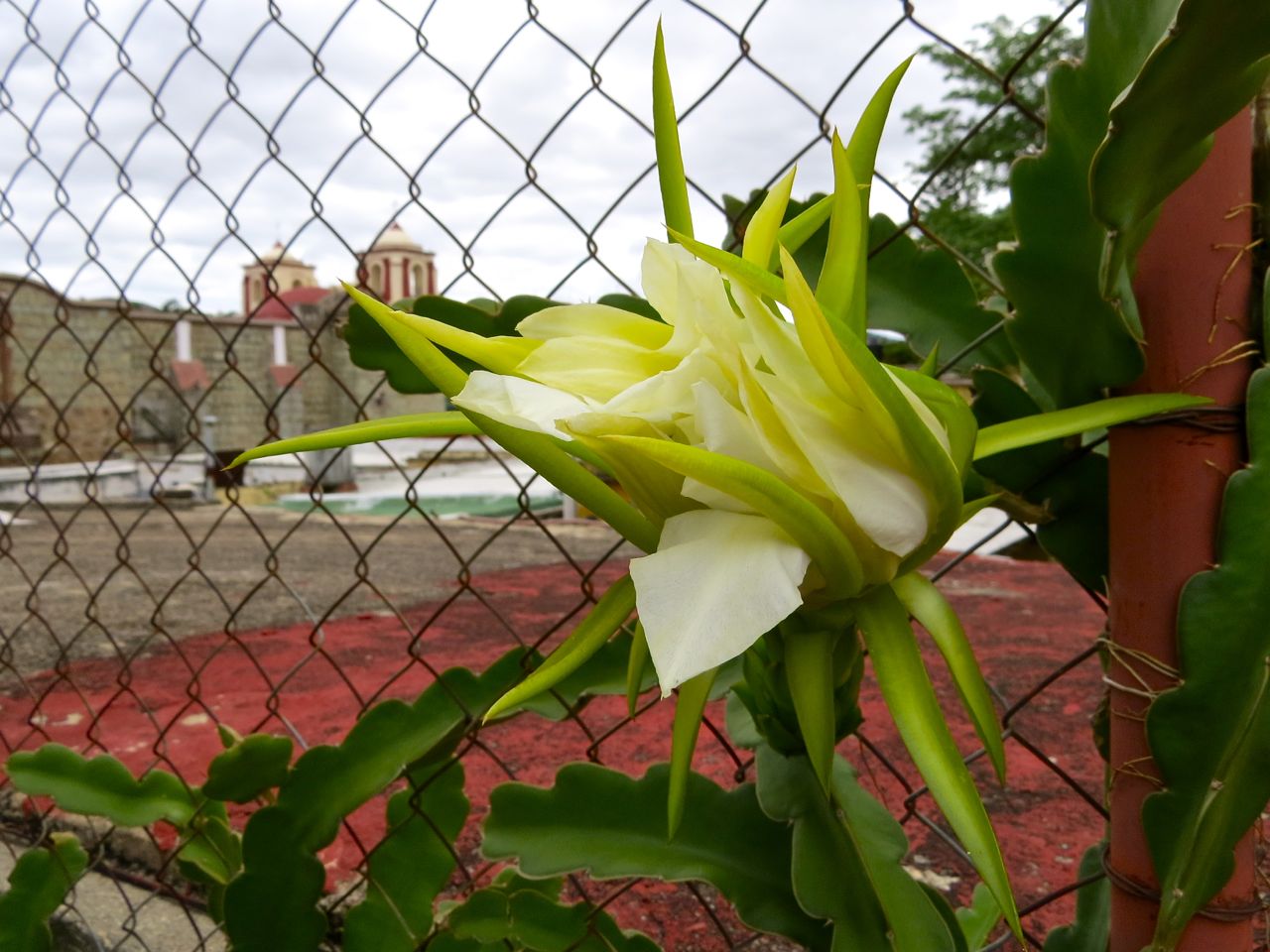
Pitahaya flower

June 2, 2014, 8:40 PM

Pitahaya flower, side view

June 2, 2014, 11:00 PM

By the next day, it had closed, never to reopen again.

Pitahaya flower closed

June 2, 2014, 2:54 PM

However, there will be fruit…

Read Full Post »

Yesterday, a new visitor arrived on the rooftop garden.  Naturally, I wanted to know the name of this tiny guest who seemed to love my sedum.  After searching page by page through my Smithsonian Handbooks:  Butterflies and Moths unsuccessfully, I spent hours this morning combing the web.  I think my new friend is from the family Lycaenidae (Gossamer-winged); subfamily Theclinae (Hairstreaks); tribe Eumaeini; and genus Electrostrymon.  However, for the life of me, I can’t figure out which species — while the markings match, the colors don’t.  Any lepidopterists out there who can help?

Pale green & orange butterfly

As for what he (I’m pretty certain it is male) was doing on the sedum — he was rubbing his wings together.  For this, I did find an answer.  According to the Learn About Butterflies website:

Hairstreaks usually have a pattern of lines or stripes on the underside wings. These, in combination with ocelli ( false eye markings ) and short tails ( false antennae ) act to divert attention away from the head, and towards the outer edge of the hindwings. By oscillating the wings, the tails are made to wiggle like antennae, further increasing the illusion that the butterfly is ‘back to front’. Attacking birds will always aim at the head of a butterfly, but are tricked into aiming at the tail. The butterfly is thus able to escape in the opposite direction unharmed. Another reason for wing-rubbing is that male Hairstreaks have patches of specialised wing scales – ‘androconia’, located on their upperside forewings. Sacs at the base of these scales contain pheromones. Rubbing the wings together helps to disseminate the pheromones, which attract females and induce them to mate.

Maybe there will be some springtime courting on the terrace….

Read Full Post »

On the one hand, headline from today’s New York Times, Viewing U.S in Fear and Dismay.  On the other hand, the view from my balcony.

Red African tulip tree blossom against clear sky.

One of the last African tulip tree blossoms of the season.  Ahhh…

Read Full Post »

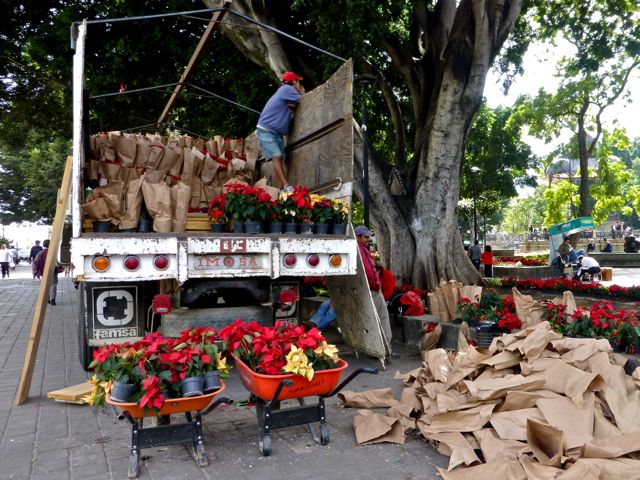
Today, the truck arrived, the wheelbarrows were loaded, and the gardening crew began filling the flower beds of Oaxaca’s zócalo…

Truck filled with poinsettias

Workers with wheelbarrows filled with poinsettias

Worker digging up flower bed, with poinsettias in pots in background

Mass of red and one white poinsettias in flower bed.

Navidad is coming to Oaxaca!

Read Full Post »

Monday morning, I went out onto the terrace to hang the wind chimes back up (too loud for sleeping), pick up spent African tulip tree blossoms (20 to 30), and say buenos días to Argiope (previously mentioned spider).

Hmmm… all was definitely not “as usual” in the spider’s web.  Argiope, what in the world is going on?

Argiope spider with dragonfly caught in her web.

Good grief, she had caught a dragonfly!  It must have been quite a battle, as her web was a mess and now she was trying to wrap it up.

Close-up of dragonfly caught in an Argiope orb weaver spider web.

This was serious business for her and she worked at it most of the day.  However I had to chuckle, as sayings from childhood rose up from the cobwebs in my brain  —  Your eyes bigger than your stomach.  Have you bitten off more than you can chew?  Pick on someone your own size!

Dragonfly hanging by a thread on the web as Argiope spider has moved away from her prey

Monday evening, she finally gave up and let it loose from her clutches.  When I retired for the night, the dragonfly was hanging by a thread.

Argiope spider sitting in middle of web with a wrapped up fly.

By the next morning, the remains of the dragonfly had fallen onto the patio and Argiope was sitting happily in her newly repaired web with a more appropriately sized breakfast.

Mother Nature is amazing!

Read Full Post »

Warning:  If you are an arachnophobe, read no further!

Remember Argiope, one of the orb weaver spiders who hung around Casita Colibrí’s garden from September of last year through January of this year?  When last seen, she was laying eggs on my screen door.  Alas (or perhaps, thank goodness), a workman who was coming in and out of my apartment must have brushed her and her eggs away,  thus relieving me of answering the question, “Do I really want thousands of little spiders beginning to explore the world from my screen door?”

However, I suspect that wasn’t her first attempt at motherhood.   One day this past June, I was surprised to find…

Argiope spider in the center of her web

Argiope’s daughter?  That is what I would like to think!  And she is just as beautiful as her mother…

Close-up of back of Argiope

… both back (above) and front (below).

Close-up of back of Argiope

And, she is just as good as catching her lunch!  I watched as she finished wrapping up the unfortunate fly above.  I guess she needs all that nourishment…

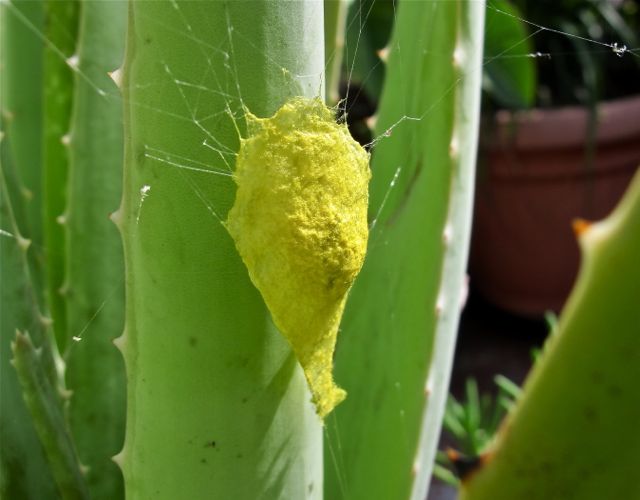
Bright yellow tear-drop shaped egg sack attached to an agave cactus

Another generation of Argiopes in waiting!  And, as I write, the hunting continues…

Close-up of Argiope wrapping up fly

More to come?  La vida may be loca, but on it goes!

Read Full Post »

Late yesterday afternoon; outdoor room (aka: my terrace) with a view.  Ahhhhh….

African Red-orange blossoms of African tulip tree in foreground, San Jose church bell towers, and cloud dotted blue sky in background.

And, despite the clouds above, this morning I can report, no rain for 36 hours!

Read Full Post »

Be it looking down from the windows above, strolling through the gardens on a tour, or peeking through openings in the wall on Reforma or Berriozabal on the way to someplace else, Oaxaca’s Ethnobotanical Garden is always a soothing and uplifting sight.

Looking out from window above Ethnobotanical Garden

Check out this informative and enlightening article by Jeff Spurrier discussing the origins and vision of  Oaxaca’s Ethnobotanical Garden — from the Jan/Feb 2012 issue of Garden Design:

Oaxaca’s Ethnobotanical Garden

“I am not a gardener.” Francisco Toledo is sitting in the courtyard of the graphic art institute he founded in downtown Oaxaca City, Mexico, sipping on a glass of agua de jamaica. His fingers are paint-smudged, and he moves stiffly from a sore back. Toledo, 71, is one of Mexico’s best-known living artists; his paintings, sculptures, and textiles are in galleries and museums around the world. At home in Mexico, he is identified with a fierce and outspoken defense of the indigenous arts and culture of the southern state of Oaxaca. He also, as it turns out, helped to create one of the world’s most original public gardens.

“The professionals are the people who live in the country,” he says. “The campesinos and workers — I don’t have the patience.”

Nearly 20 years ago, the Mexican military moved out of a 16th-century Santo Domingo monastery complex it had used as a base for more than 120 years. Mexico’s president gave the exit order after being lobbied by Toledo and other leading artists and intellectuals belonging to Pro-Oax, an advocacy group urging the promotion and protection of art, culture, and the natural environment in Oaxaca. Soon, a great clamor began: The state government wanted the five-acre parcel in the heart of downtown Oaxaca City to create a hotel, convention center, and parking facility. A restoration team brought in by the National Institute of Anthropology and History wanted to establish a European garden in the 17th-century baroque style. Some of Toledo’s fellow artists wanted to use the grounds for workshops and exhibition space.

n 1993, when Toledo knew the army would be leaving, he asked Alejandro de Ávila B., who had family roots in Oaxaca and training in anthropology, biology, and linguistics, what he and other advocates would propose. De Ávila suggested making the space into a botanic garden — or, more precisely, an ethnobotanic garden, one that would “show the interaction of plants and people.”

I highly recommend reading the Full Article.

h/t  Norma and Roberta

Read Full Post »

Remember Argiope from 2-1/2 weeks ago?

Orb weaver spider on web in Stalpelia gigantea.

Turns out, she isn’t as sweet as she looks.  Today, HE came, HE saw, and SHE conquered!

Female argiope and shell of male hanging above her.

Leaving him a shell of his former self…

Shell of male Argiope suspended above the female in web.

Within a half an hour, she had finished him off… leaving not a trace that he had ever existed.

Female Argiope hanging in web alone.

And, she was alone again, naturally!  Alone, that is, until their offspring hatch…

Read Full Post »
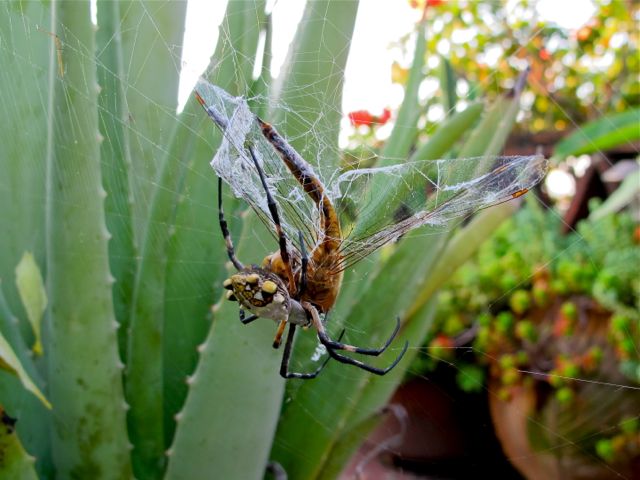
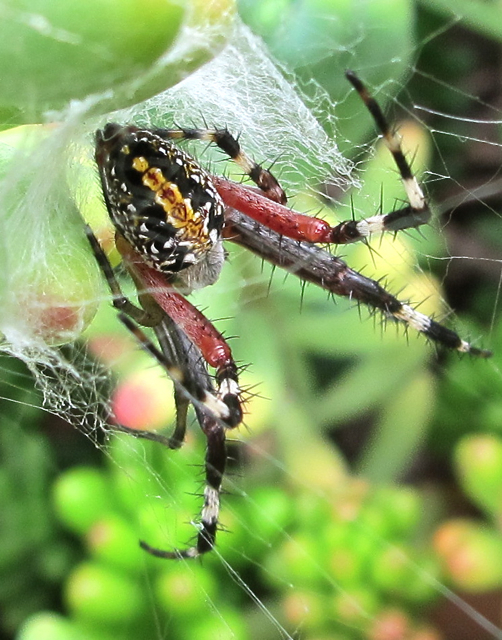
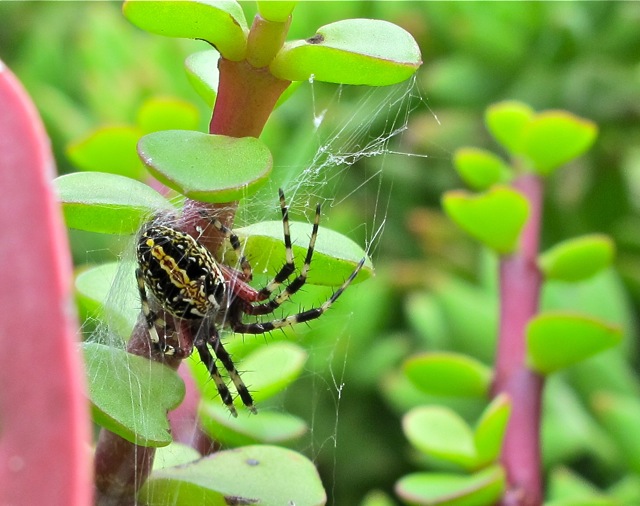
Argiope’s neighbor (of Orb Weavers blog post fame) has returned! Two days ago I spotted the Neoscona oaxacensis (Ms Oaxaca, to her nearest and dearest) nestled among the leaves of a succulent in the pot next to her original home. However, no large round insect catching web was seen.

Neoscona oaxacensis spider nestled in the leaves of a succulent

Apparently, last night Ms Oaxaca must have stayed up pretty late. This morning, when I came out to say, “buenos días,” I found her happily sitting in the middle of a brand new web.

Neoscona oaxacensis spider in the middle of her web.

According to SpidCat, the range of the Neoscona oaxacensis runs from the USA, down to Peru and the Galapagos Islands. They are not only beautiful and harmless, they keep the flying insect population down. So, if you’re lucky enough to have one in your garden, leave her be. If you don’t want to take my word for it, there was the study published in the California Avocado Society Yearbook (1980) that concluded,

…the significance of the orb weaving Neoscona in avocado orchards is probably not that they prevent dramatic population increases in the pest population or control the pests through the year. Instead, the presence of spiders, even in years of low pest populations, may dampen the increases in pest species during the later months of the season and serve as stabilizing agents to restrain the pest outbreaks during the interval between pest population increases and the numerical response of more specific parasites.

Anything that is good for avocados, is okay by me!

(ps) And now for something completely different… The answers to the Name that film quiz are:

  • Birds of America = Vecinos y enemigos
  • Brokeback Mountain = Secreto en la montaña
  • Easy Virtue = Buenas costumbres
  • Midnight Sting = El golpe perfecto
  • People I know = Noche del crimen
  • Tenderness = Asesino intimo
  • That Evening Sun = Una historia de traicion
  • Up in the Air = Amor sin escalas

Sorry, no prizes… just this bonus bizarre title translation my Spanish teacher contributed: Mrs. Doubtfire = Papá por siempre. Definitely a case of, lost in translation!!!

Read Full Post »

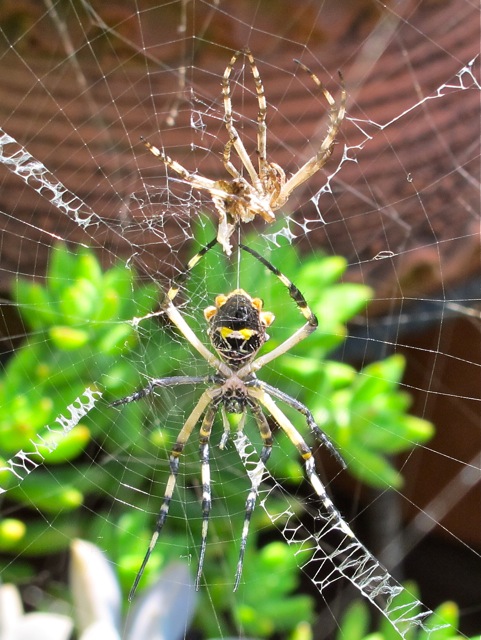
Clothing, tablecloths, and rugs aren’t the only things being woven in Oaxaca.  The terrace has a new resident, an orb weaver spider (family Araneidae).  I think, because of the stabilimentum (the white zigzags on the web), she is in the genus, Argiope.

Orb weaver spider on web in Stalpelia gigantea.

She had a larger orb weaving neighbor in the pot next door…

Alas, after a couple of days, the neighbor disappeared and her carefully crafted web fell into disrepair.  However, that left more food for Argiope.

Orb weaver spider on web with wrapped up green bottle fly

Apparently, green bottle flies are a favorite, because this is one of several she caught in a single day.  She’s chosen the perfect site for her home — in the garden’s previously blogged about, Stinky plant, attracting flies (aka, Stalpelia gigantea).

Read Full Post »

« Newer Posts - Older Posts »