An ofrenda is an offering, an integral part of the Day(s) of the Dead celebration, filled with meaning, a beacon to the departed, an ephemeral work of art, and the sum of its lovingly chosen parts. And so, last night my aforementioned BFF and I constructed our ofrenda.
Día de los Muertos in Oaxaca… so much to show and share with those we love.
My BFF (since age 12 — I won’t say how many decades ago that was) arrived last night from Alaska. It was her first trip to Mexico and it took 22 hours. Of course we talked late into the night, thus the morning unfolded slowly.
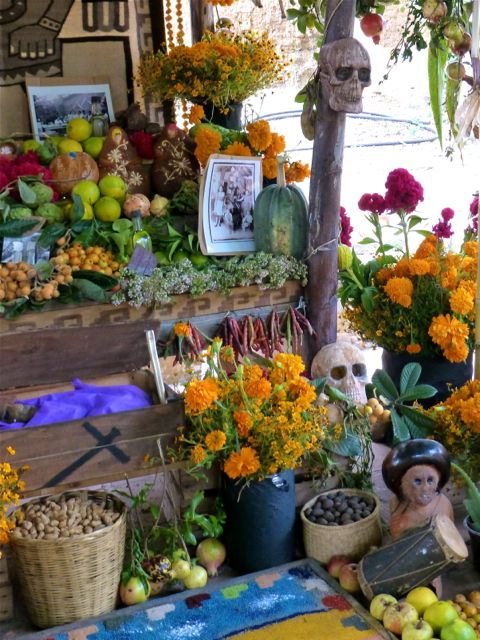
However, eventually we emerged into the hustle and bustle of the temporary muertos stalls near 20 de Noviembre mercado, to begin purchasing the elements for our Día de los Muertos ofrenda: Apples, oranges, and nuts to nourish the spirits, cempasuchitl (marigolds) to guide the spirits, cockscomb to symbolize mourning, and copal incense to draw the spirits home and ward off evil .
As you can see from the above chart, we have much more to buy and bring out of the storage closet. And, the above list doesn’t even mention sugar cane stalks!
h/t Chef Pilar Cabrera for posting the chart on Facebook.
The Y-shaped valley of Oaxaca is about 700 square kilometers, not all that big when compared to California’s Sacramento Valley, which is approximately 2,570 square kilometers. Yet, unlike the “sameness” one encounters in Sacramento Valley towns (sorry, CA), one can’t help but be struck by the unique identity of each of the Zapotec villages that are only kilometers apart. One specializes in red clay pots, another in black pottery, and another in green glazed ceramics. There are villages of woodcarvers near weavers of cotton and others of wool, never mind the fashion trends!
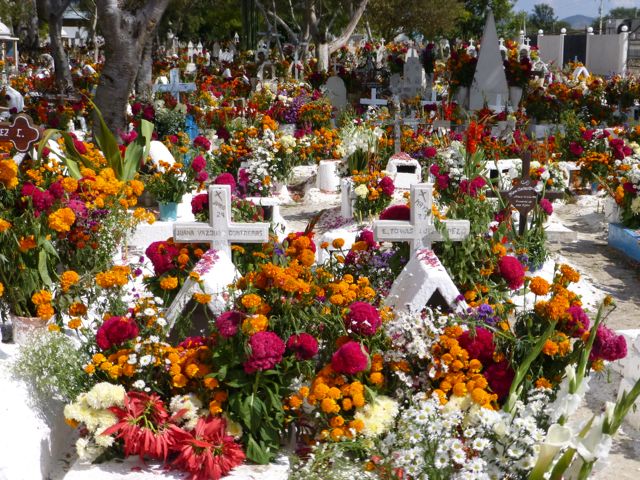
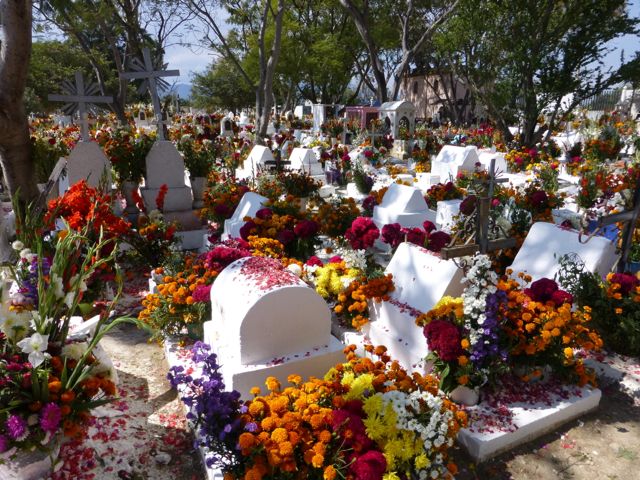
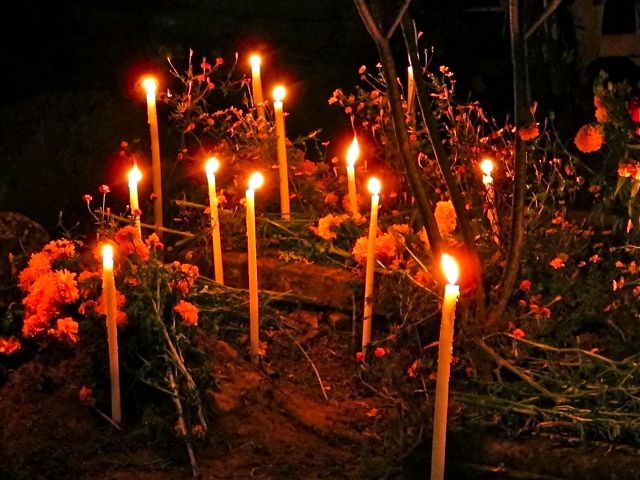
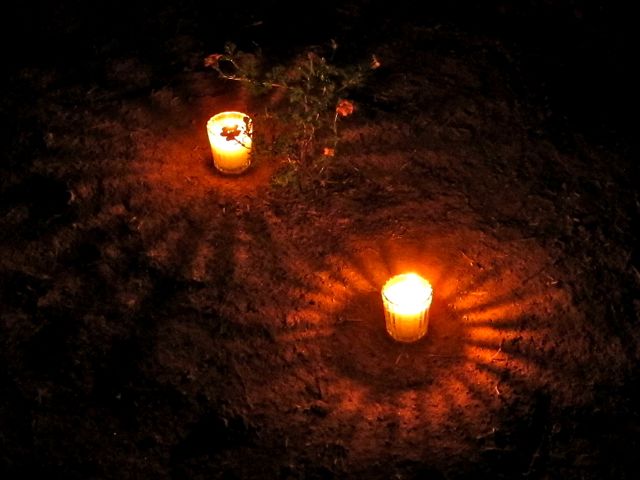
Thus, it should come as no surprise that Day of the Dead celebrations and cemeteries differ, often dramatically, from village to village. And so, from the whitewashed graves of Santiago Apóstol and the candlelight of Santa María Atzompa (today’s earlier post), we came to the carved wooden crosses in the Panteón Municipal of the Villa de Zaachila.
This slideshow requires JavaScript.
Along with livestock, produce, and household goods, wood gathered from the hills surrounding Zaachila is a major part of Zaachila’s weekly Thursday tianguis (open air market). It’s one of my favorites!
With only a couple of days left in November and the Christmas holiday season already making its presence known, it’s now or never to finish sorting through this year’s Día de los Muertos photos — my thoughts and impressions will take the remains of this lifetime, and then some, to process.
To an outsider, especially one whose worldview was shaped by a Judeo-Christian culture, Day of the Dead is often seen through the lens of juxtaposition.
The “unbearable lightness of being” in Santiago Apóstol…
The blurred otherworldly darkness of Santa María Atzompa…
However, light becomes dark becomes light becomes dark, as day becomes night becomes day becomes night, as life becomes death becomes life becomes death… dualism beginning to vanish.
You might well ask, “What is a muerteada?” It is a comparsa (parade) that is part of traditional Día de los Muertos celebrations particular to the state of Oaxaca. According to the book, Day of the Dead: When Two Worlds Meet in Oaxaca, the muerteada allows the dead “to ‘occupy’ a living body, either a muerteada participant or an audience member, for a time, and therefore enjoy the entertainment directly rather than vicariously.”
Like Commedia dell’Arte, there are stock characters — in this case, the happy widow, the dying or dead husband, the father of the widow, a doctor, a priest, a shaman, people dressed like death, devils, and las lloronas (weeping women). However, unlike Commedia dell’Arte, in the muerteada men play all the roles.
Last year we joined the Vista Hermosa, Etla murteado. However, this year blogger buddy Chris decided I was ready for the big time — the “battle of the bands” when the muerteadas of San Agustín Etla and Barrio San José meet — Banda Tromba Sinaloense for San Agustín and MonteVerde Banda for San José. FYI: This is after participants and their bands have danced their way up and down the hills of their respective neighborhoods all night long, stopping at designated houses for food and drink — mezcal and cervesas seemed to be the beverage of choice, especially among the men!
So, early on the Nov. 2, we went in search of the San Agustín contingent, we found them, joined in the merriment, were offered food and drink along the way, and eventually came to the crossroad where mania turned to mayhem, albeit organized mayhem — courtesy of the white-shirted security for San Agustín and red-shirted security for San José. They kept the dancers and supporters from each side apart, leaving the face-off to the two bands. It was wild!!! After 20+ minutes of battling bands, it was over and we and the San Agustín contingent trudged back up the hill.
You may have spotted a tall silver-haired gringo right in the middle of the action in one or two of the photos, that would be Chris. Be sure to check out the video he put together of all the madness.
According to Organizing Committee President, Alfredo Erick Pérez, the muerteada in San Agustín Etla dates back to the 1800s, possibly to the days of Mexican President Porfirio Díaz.
In addition to graveside gatherings and decoration, altars, parades, sugar skulls, sand paintings, marigolds, and Day of the Dead bread, painted faces are another distinctive feature of Día de Muertos celebrations. They are most likely seen hanging around cemeteries and dancing through the streets but, like everything else here, you just never know…
The day of the dead in Mexico is a fascinating mixture of Spanish Catholic and native Aztec traditions and beliefs. Skulls and skeletons were an important part of All Saints Day festivals in medieval Europe, especially since the Black Death ravaged the population of Europe in the 1300s. Across Europe artists, playwrights and poets mused on the theme of ‘memento mori’ (remember death) and the ‘dance of the dead’. Many artworks and books from the time depict dancing skeletons, or portraits with a skull to ‘remember death’.
At the same time, in Mexico, the Aztec culture believed life on earth to be something of an illusion – death was a positive step forward into a higher level of conscience. For the Aztecs skulls were a positive symbol, not only of death but also of rebirth.
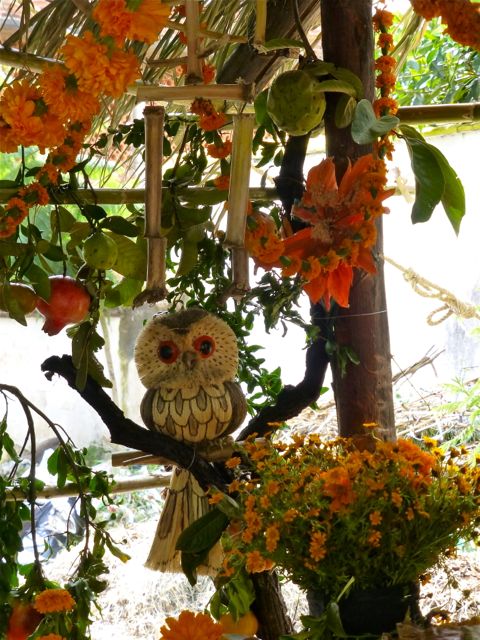
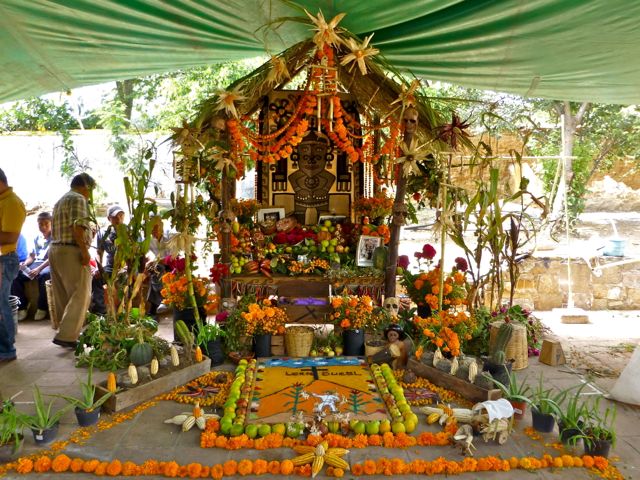
an integral part of the Day(s) of the Dead celebration.
filled with meaning.
a beacon to the departed.
an ephemeral work of art.
the sum of its lovingly chosen parts.
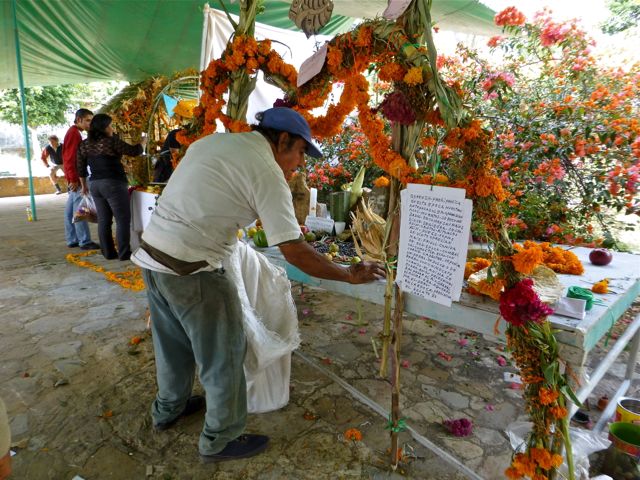
This is another ofrenda from the previously mentioned “altar decorating” competition on the plaza in front of Santo Tomás in Oaxaca’s Xochimilco barrio.
Living and being in Oaxaca during the Días de los Muertos is hard to put into words. There is so much to experience and to think about. Sensory overload challenges the limits of heart and mind and my emotions are running the gamut from extreme exhilaration to a quiet joy to being moved to tears.
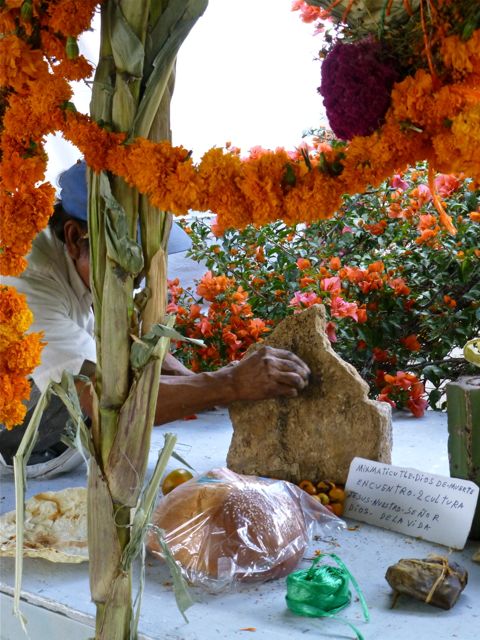
The latter occurred a few days ago, when I walked up to the Templo de Santo Tomás in Oaxaca’s Xochimilco barrio (neighborhood) where an “altar decorating” contest was in progress. Altars were to be judged on authenticity, originality, and creativity. When I arrived, friends and relatives were in the midst of putting the final touches on their altars. Some were elaborate and some exhibited real artistry, but one really touched my heart.
He was alone — no one to help, no playful banter. When I first arrived, he was carefully etching a cross with a piece of charred wood on a stone.
He worked silently and with purpose, pulling items out of a well-worn sugar bag and carefully placing them on his altar.
When the bag was empty, he walked over to a cart and pulled out another one.
Slowly, his vision emerged, with symbology I have only a cursory grasp of and won’t presume to explain.
I don’t know who won the 5000 peso first prize or second or third place purses, and I don’t know if he was doing it for the money (he certainly looked like he could use it).
All I do know is he and his ofrenda moved me deeply.
Last night we went to my favorite panteon (cemetery) at Atzompa, today we visited six villages, and tonight I went with out-of-town guests to the Panteon General here in Oaxaca. First thing tomorrow morning a comparsa (parade) and then probably off to Teotitlán del Valle. I’ve already taken hundreds and hundreds of photos, but there has been no time to even look at them!
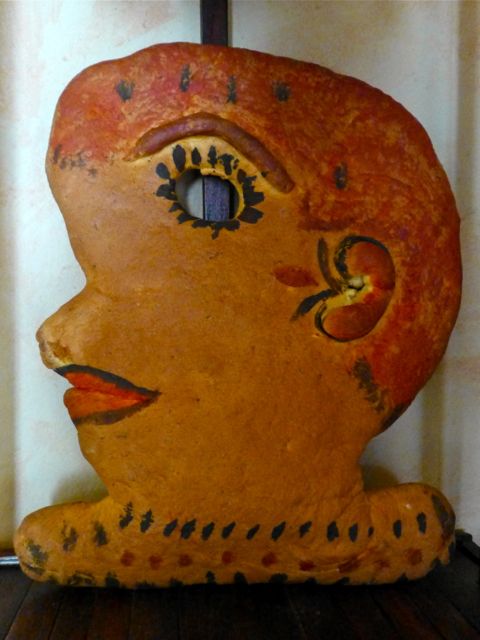
So, in the meantime… My pan de muerto (Day of the Dead bread) from Sunday’s trip to Tlacolula.
Very special pan de muerto from Restaurante La Abeja just a few blocks from Casita Colibrí. This one will eventually get two coats of shellac and join her sister (purchased last year) hanging on the wall.
Last, but not least, my altar where photos of departed family and friends join apples, tangerines, pan de muerto, sugar skulls, candles, and incense of copal.
Lighting, costumes, music, and dance combined to envelop last night’s audience at the Teatro Macedonio Alcalá in an other worldly experience. Catrina is a magical tale where the world of the living converges with the world of the dead and the central theme is the pain of a mother losing her daughter.
This slideshow requires JavaScript.
The show is a celebration of the pre-Columbian traditions and culture of Oaxaca, especially the ritual and meaning surrounding Día de los Muertos. Much of the music was traditional Oaxacan and most performers were Oaxaqueños, including Alejandra Robles, singing the title role.
At 48% (that’s over 1.6 million people), the state of Oaxaca has the second highest indigenous population in Mexico. Perhaps that is why the belief systems of the ancient Mexicans Octavio Paz, cites in The Labyrinth of Solitude, remain strong today. He writes, “Life extended into death, and vice-versa. Death was not the natural end of life but one phase of an infinite cycle.” Healthier, more realistic, and more comforting, I think…
Today is Thanksgiving in los Estados Unidos de América… and besides my wonderful family and friends, I am so grateful to see and experience places like San Antonino Castillo Velasco during los Días de Muertos.
San Antonino Castillo Velasco, a Zapotec community near Ocotlán, is a village known for its flowers. They are, no doubt, the inspiration for beautifully embroidered linens and clothing sold in the mercados and found in museum collections. And, a specialty is the “flor inmortal” (immortal flower), so named because, even when dried, it retains its brilliant colors. They are used to create intricately designed figures on display December 23 in the city of Oaxaca, during Noche de Rábanos and to decorate the graves of loved ones during Días de Muertos in San Antonino.
This slideshow requires JavaScript.
As I’ve previously mentioned, each village seems to have its own unique traditions for the Days of the Dead. Villagers here mix the area’s very fine dirt with water, cover the graves, use a trowel to smooth it, outline designs and religious imagery into the dried coating, and then use flowers (fresh and dried), to paint the scene. Entire families are involved, young and old, and the atmosphere is filled with joy, purpose, and most of all… Love.
For a very special moment, that is a metaphor the two days spent at San Antonino, see Chris’s post, Moments make a life..














 Mexican Peso Converter

 View From Casita Colibrí