Friday we returned for another extraordinary day — the last day of Carnival.
Again, muchisimas gracias to the gracious and generous people of Teotitlán del Valle.
Friday we returned for another extraordinary day — the last day of Carnival.
Again, muchisimas gracias to the gracious and generous people of Teotitlán del Valle.
Posted in Celebrations, Creativity, Culture, Food, Holidays, Religion, Travel & Tourism | Tagged Baile de Los Viejitos, Carnaval, Carnival, Holy Week, Mexico, Oaxaca, photographs, photos, Semana Santa, Teotitlán del Valle | 3 Comments »
Sparrow came by for a late breakfast on the bougainvilla this morning. Guess, like my neighbor, (s)he didn’t realize Mexico “sprung ahead” last night to Daylight Saving Time.
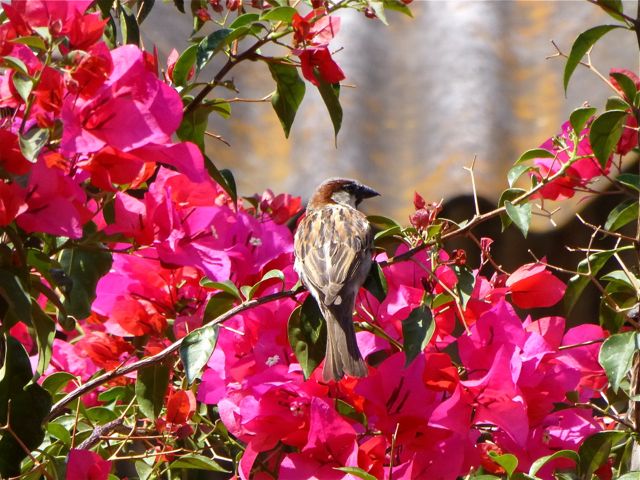
Or, should I say, most of Mexico. Teotitlán del Valle follows the sun and doesn’t set their clocks back. Let the confusion begin!

So, maybe Sparrow is…
Living on Teo Time.
Living on Teo Time.
Gonna set my watch back to it
‘Cause you know that I’ve been through it.
Living on Teo Time.
(With apologies to Daniel W. Flowers, songwriter of Tulsa Time.)
Posted in Animals, Casita Colibrí, Gardens, Science & Nature | Tagged birds, bougainvilla, bougainvillea, Casita Colibrí, daylight saving time, Mexico, Oaxaca, photographs, photos, sparrows, Tulsa Time song | 5 Comments »
I’m playing catch-up with blog posts. After the Good Friday Procession of Silence, I thought life would slow down a little. That’s what’s happened in years past — I caught up on the “to do” list on the home-front, leisurely plowed through the hundreds and hundreds of photos from Semana Santa, did a little research and a lot of thinking about what I’d just seen and experienced, and then crafted a few blog posts.
That was before we found out that Teotitlán del Valle celebrates 5-days of Carnival after Easter, not before Lent! A little levity after the solemnity of Semana Santa and in one of our favorite places was not to be resisted. And so, blogger buddy Chris and I set out on Monday afternoon in search of the house in Sección 1 (the village is divided into 5 geographic areas) that was hosting the daytime fiesta that precedes the evening festivities in the Municipal Plaza.


We returned yesterday for the Sección 5 fiesta, so more to come. Now it’s off to Tlacolula for the Nieve, Mezcal y Gastronomia Festival.
FYI: For a more detailed explanation of this Carnival celebration and photos from last year by a professional photographer, check out Ann Murdy’s website.
Posted in Celebrations, Culture, Holidays, Religion, Travel & Tourism | Tagged Baile de Los Viejitos, Carnaval, Carnival, Holy Week, Mexico, Oaxaca, photographs, photos, Semana Santa, Teotitlán del Valle | 2 Comments »
Was it December? Maybe it was November the last time the city saw rain… until this afternoon. Those specks you see are very welcome raindrops on my window.

It brought thunder and lightning, but fell gently. It only lasted an hour, but cooled and cleansed the air.

I can see clearly now…
Posted in Buildings, Travel & Tourism, Weather | Tagged Basilica de la Soledad, Casita Colibrí, Mexico, Oaxaca, photographs, photos, rain, weather | Leave a Comment »
The Semana Santa poster said the Viernes Santo (Good Friday) Procesión del Silencio was to begin at 6 PM in front of Preciosa Sangre de Cristo. Knowing the drill, I arrived at 4:45 to take photos as contingents and participants arrived — but nobody was there. The old antiwar slogan, “What If They Gave a War and Nobody Came” came to mind.
Of course it was going to happen, it’s just that time isn’t what it seems here. Word on the scene had it that, despite the poster info, it wasn’t to begin until 6:30 PM. No worries! Well, except that Mexico doesn’t begin Daylight Saving Time until next weekend, the light began rapidly fading, and 6:30 PM became 7 PM. Por favor, let Oaxaca’s 27th annual Parade of Silence begin!


And it eventually did — up Macedonio Alcalá, left at the Cruz de Piedra, left again on García Vigil to Independencia, another left, and back up the Alcalá. And so, in darkness and silence the procession returned to the church where it all began. Contingents could be heard late into the night parading through the streets of the city, as they returned the Jesuses and Marías to their respective home churches.
Lots more photos can be seen over at Oaxaca-The Year After.
Posted in Celebrations, Culture, Holidays, Religion, Travel & Tourism | Tagged Christianity, Good Friday, Holy Week. Semana Santa, Mexico, Oaxaca, photo, photographs, photos, popular travel destinations, Procesión del Silencio, Procession of Silence, religion, ritual procession, Viernes Santo | 8 Comments »
In Oaxaca the penitents gathered…

in front of Preciosa Sangre de Cristo on Good Friday…
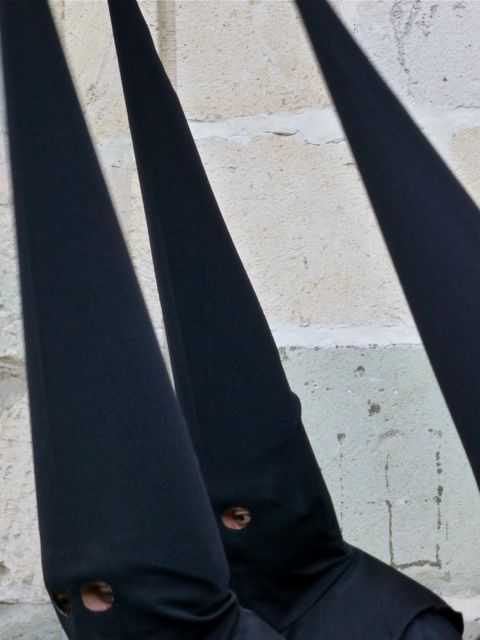
preparing for the Procession of Silence.
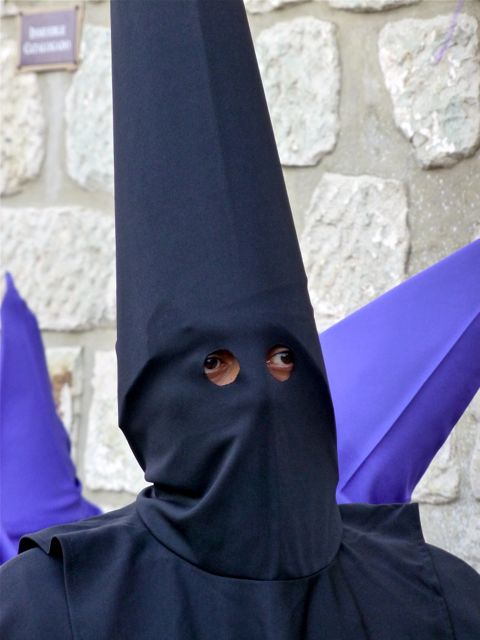
For those who are wondering, “What’s with the hoods (capirotes)?” The answer can be traced back to the Middle Ages. Members of lay religious charitable organizations (cofradías) would don the masks and hoods to guarantee anonymity and promote humility in their service.
From the Holy Week in Seville, Wikipedia page:
At the heart of Semana Santa are the brotherhoods (Hermandades y Cofradías de Penitencia),[1] associations of Catholic laypersons organized for the purpose of performing public acts of religious observance; in this case, related to the Passion and death of Jesus Christ and to perform public penance.
The brotherhoods, besides the day-to-day work in preparation for the processions, also undertake many other self-regulated religious activities, and charitable and community work. Many brotherhoods maintain their own chapel, while others are attached to a regular parish.
The Spanish brought the tradition to Mexico and penitents continue to play a major role in the Viernes Santo, Procesión del Silencio in Oaxaca.
Posted in Celebrations, Culture, Holidays, Religion, Travel & Tourism | Tagged Cofradía, Confraternity, Mexico, Oaxaca, penitents, photographs, photos, popular travel destinations, Procesión del Silencio, Procession of Silence, religion, Semana Santa, Viernes Santo | Leave a Comment »
And so Viernes Santo (Good Friday) began…


Mass said, a Vía Crucis (Stations of the Cross) procession through the streets of my neighborhood.
Posted in Celebrations, Culture, Holidays, Religion, Travel & Tourism | Tagged Easter, Estaciones de la Cruz, Good Friday, Holy Week, Mexico, Oaxaca, photographs, photos, popular travel destinations, ritual procession, Semana Santa, Stations of the Cross, Via Crucis, Viernes Santo | 2 Comments »
It may be Good Friday and the streets of Oaxaca may be blocked while processions marking the Stations of the Cross pass by and Mexico may be overwhelmingly Roman Catholic. BUT, when it comes to politics, the Mexican constitution demands the church must mind its own business.
Two women became the first same-sex couple to marry in the southern Mexican state of Oaxaca after the Supreme Court found the state’s definition of marriage unconstitutional, a gay rights group said Thursday.
Mexico City is the only jurisdiction in the deeply Catholic country that has authorized same-sex marriage.
But in December, the top court ruled that Oaxaca’s civil code, which states that marriage is only between a man and a woman for the purpose “to perpetuate the species,” violates the constitution.
The Oaxaca Front for the Respect and Recognition of Sexual Diversity, which had taken part in the legal challenge, announced Thursday that two women got married on March 22 during a private ceremony.
The two women, along with two other gay couples, had appealed to the Supreme Court after Oaxaca state authorities refused to marry them.
Gay rights groups have voiced hope that the court ruling would pave the way for the legalization of same-sex marriage across Mexico.
Argentina is the only Latin American country to authorize such marriages, while Uruguay is considering a similar law.
Mexico giving the USA a lesson in the separation between church and state. U.S. Supreme Court, are you listening?
Posted in Politics | Tagged gay rights, Human Rights, legalization of same sex marriage, marriage equality, Mexico, Oaxaca, politics, same sex marriage, US Supreme Court, USA | 1 Comment »
La Luna del Gusano rises above the city of Oaxaca.
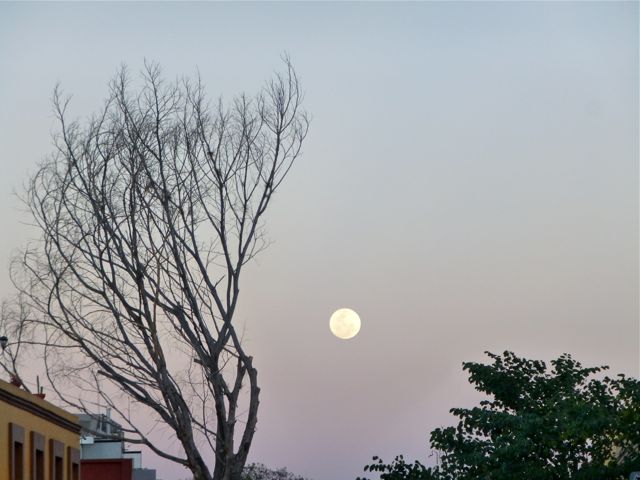


I’ve got to say, “La Luna del Gusano” sounds so much more poetic than, “Worm Moon.” Ahhh, the romance of Spanish.
Posted in Science & Nature, Travel & Tourism | Tagged full moon, La luna del gusano, Mexico, Moon, Oaxaca, photographs, photos, popular travel destinations, Worm Moon | 2 Comments »
Lunes Santo (Holy Monday) in Teotitlán del Valle provided another moving and memorable experience. For some unknown reason, the village re-enacts the 14 stations of the cross on the Monday before Easter. Following a special early morning mass at the Templo de la Preciosa Sangre de Cristo, statues of Jesus and the Virgin Mary are hoisted on platforms and carried from the church to signal the start of the day-long pilgrimage. They are led by a band playing a mournful and dissonant tune as they set off to wind their way through the cobblestone streets of Teotitlán.
“Stations” are set up along the route by designated families — some are decorated with the village’s famous woolen tapetes (rugs). Tamales, non alcoholic beverages (alcohol, even the ubiquitous mezcal, is forbidden during Semana Santa), and nieves (ices) are offered at others. At all, the appropriate prayers are read, incense of copal is burned, and offerings, including of corn and lilies, are made. And, as always, children have important roles to play.
The procession is solemn and dignified and filled with pre-Columbian, along with Catholic, tradition and symbolism. Like all the other ritual celebrations in Teotitlán del Valle, these are not performed for the benefit of tourists — they are some of the strands of the warp and weft that have woven this community together for thousands of years.
Posted in Celebrations, Churches, Culture, Food, Holidays, Religion, Travel & Tourism | Tagged Easter, Estaciones de la Cruz, Lunes Santo, Mexico, Oaxaca, photographs, photos, popular travel destinations, ritual procession, Semana Santa, Stations of the Cross, tapetes, Teotitlán del Valle, Via Crucis | 4 Comments »
In front of Oaxaca’s Cathedral, the Palm weavers from the Mixteca have been practicing their craft with awesome dexterity, creativity, and skill.


All is ready for Domingo de Ramos (Palm Sunday).
Posted in Celebrations, Churches, Creativity, Culture, Holidays, Travel & Tourism | Tagged Catedral de Oaxaca, Cathedral of Oaxaca, Domingo de Ramos, Mexico, Mixteca palm weavers, Oaxaca, Palm Sunday, photographs, photos, popular travel destinations, Semana Santa | 10 Comments »
Do you remember December’s abandoned building that artist Mauricio Cervantes transformed into Hope amidst decay with his El Sueño de Elpis? Bringing together artists, gardeners, and community members, he is again working his magic at Casa del SXIX. Honoring sustainability and reuse, Matria, Jardín Arterapéutico is a year-long multidisciplinary installation that will grow and change with the seasons.
Appropriately, on the first day of Spring — the season of rebirth, resurrection, and renewal — I was invited to wander through the site and watch as life was emerging from the decay.
Primavera, the beginning phase of Matria, Jardín Arterapéutico will be revealed to all on Saturday, March 23 at 2:00 PM. The building can be found at Murguía 103 (between Macedonio Alcalá and 5 de mayo).
Posted in Buildings, Creativity, Culture, Exhibitions, Gardens, People, Travel & Tourism | Tagged abandoned buildings, art, art installation, El Sueño de Elpis, exhibition, Matria Jardín Arterapéutico, Mauricio Cervantes, Mexico, Oaxaca, photographs, photos, Primavera, Seasons, Spring | 3 Comments »
You know Semana Santa is on the horizon when tables, large and small, elaborately or minimally decorated, miraculously appear in doorways, street corners, and the Alcalá. The common denominator is smiling people offering Agua de Jamaica, Horchata, Chilacayota, and even nieves to all passers-by. Día de la Samaritana (Good Samaritan Day) is an only-in-Oaxaca, 4th Friday of Lent, event.
This year, besides experiencing the joyous mob scene on the Alcalá and the small sidewalk stands on side streets, on a tip from a friend, I made the “taking your life in your hands” crossing of Calzado de la República to the picturesque cobblestoned neighborhood of Jalatlaco. Tables of aguas and nieves lined the plaza in front of the Templo de San Matías Jalatlaco and pastor Víctor Hernández was recounting the Biblical story, found in the Book of John, of the woman at the well who offered water to Jesus — the inspiration for Día de la Samaritana. He concluded the story and blessing with the word “¡ataque!” and the masses did, indeed, attack the tables! By the way, pastor Hernández gets around — he was the same priest who performs the yearly blessing of the animals across town at the Templo de Nuestra Señora de la Merced.


It was a hot day and having already had two aguas, as I made my way over to Jalatlaco, I was jonesing for a nieve but, alas, by the time I figured out which table was serving it, the line was too long. So, giving up on the nieve, I accepted another agua and headed towards home. However, in the true spirit of the day, as I was melting in the heat, an older gentleman standing on the sidewalk asked if I would like a nieve and gestured toward a woman standing in the doorway behind a small table. “Sí” I replied and a styrofoam coffee cup filled with Leche Quemada (my favorite) was thrust into my hand. Another sublime day in Oaxaca…
Posted in Beverages, Celebrations, Churches, Culture, Food, Holidays, Religion, Travel & Tourism | Tagged Barrio de Jalatlaco, Chilacayota, Día de la Samaritana, Día de las Aguas, Good Samaritan day, Horchata, Lent, Mexico, nieves, Oaxaca, photographs, photos, popular travel destinations | Leave a Comment »
We are in the middle of the dry season; the mountains surrounding the valleys of Oaxaca are golden. It’s still winter and my African tulip trees remain leafless against the sun and blue sky. However, Mother Nature is hinting that Spring is coming; time for you guys to shave those winter beards. And, this time of year, la madre naturaleza supplies the brushes — the Pseudobombax ellipticum.

According to the Oaxaca Garden and Nature Club website, its common name in English is the Shaving Brush Tree.

As you can see above, the flowers can be red or white.

By the way, one of its common names en español is Cabellos de Ángel.
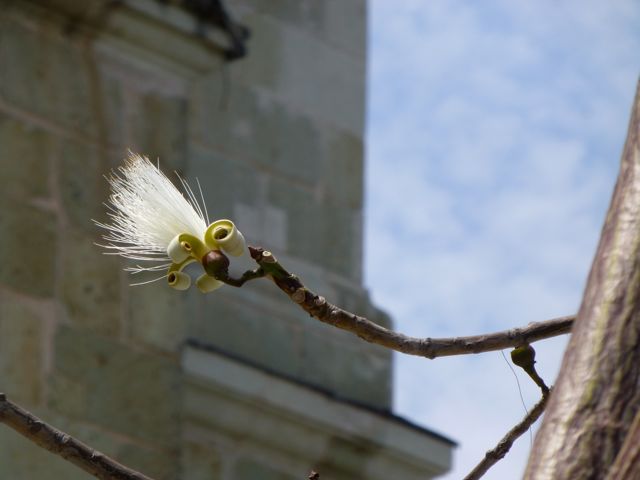
Angel Hair or Shaving Brush? You decide!
Posted in Science & Nature, Travel & Tourism, Weather | Tagged arboles, Cabellos de Ángel, Mexico, Oaxaca, photographs, photos, plants, popular travel destinations, Pseudobombax ellipticum, Shaving Brush Tree, trees | Leave a Comment »
It may be March, but Oaxaca is doing May weather — daytime temperatures in the high 80s/low 90s and the nights are sheets only.
I scream, you scream…
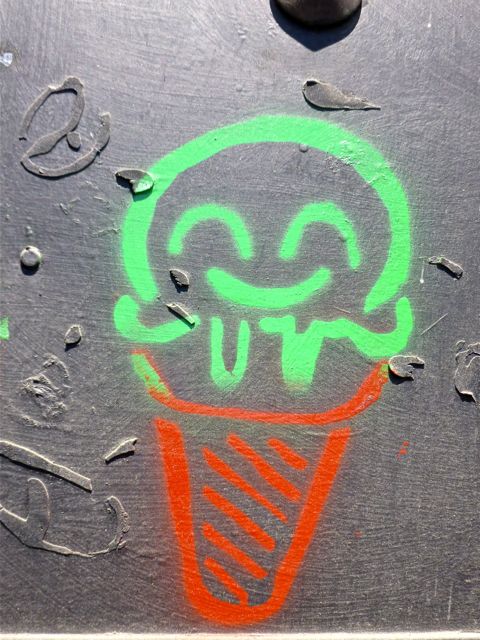
Even the walls scream for ice cream!
Posted in Creativity, Culture, Weather | Tagged graffiti, Mexico, Oaxaca, photographs, photos, street art, urban art, wall art | 4 Comments »


 Mexican Peso Converter
 View From Casita Colibrí