Unknown creatures from the imaginative minds of their creators…
And these masterpieces from this village known for its wood carving…
Carnaval in San Martín Tilcajete also means men dressed as women, a mock wedding, and young men covered in motor oil running through the village with belts of cowbells ringing. Stay tuned…
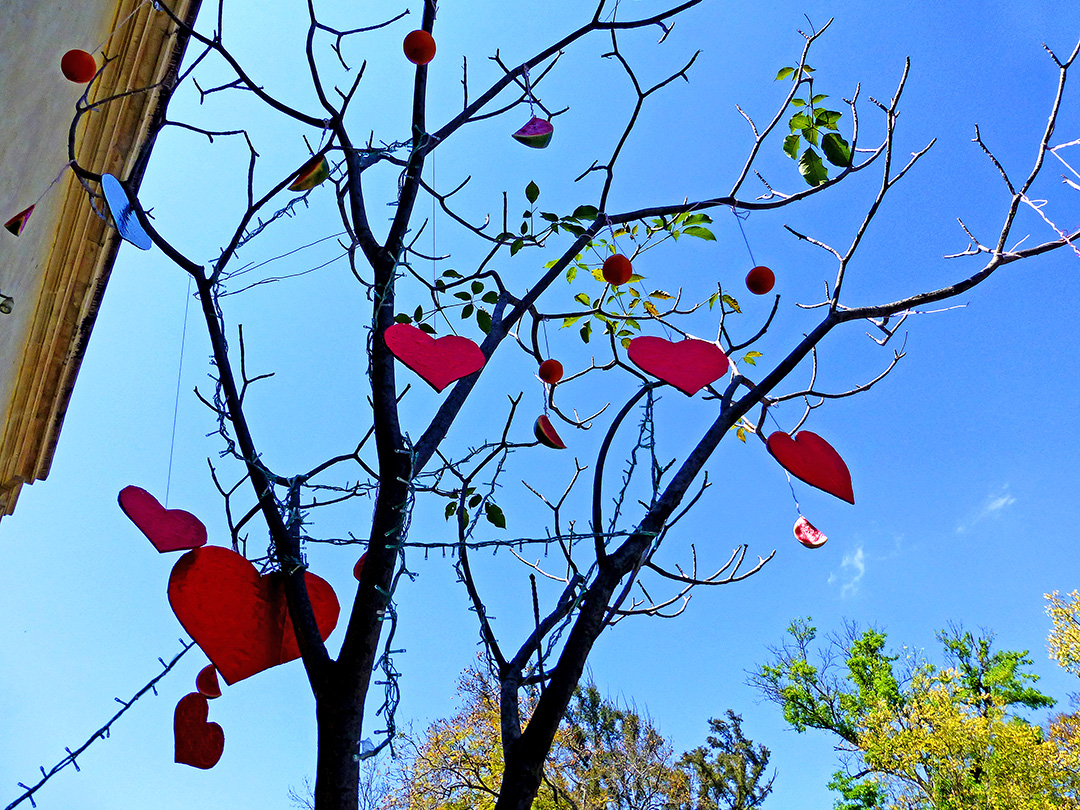
February 14th isn’t just a day for lovers. In Mexico, it is known as the Día del Amor y la Amistad (Day of Love and Friendship). Oaxaca’s balloon, chocolate, and flower vendors do a booming business and restaurants are usually filled to capacity with friends, sweethearts, and families.
I fell in love with Oaxaca the first time I saw her when visiting a friend in 2007. Who wouldn’t when the guitars and harmonies of Trio Santo Domingo drew us to the zócalo on a balmy August evening! Thus, my gift to you on this day of love and friendship:
“La amistad es lluvia de flores preciosas” (Friendship is like a shower of precious flowers) — line from a Nahuatl poem.
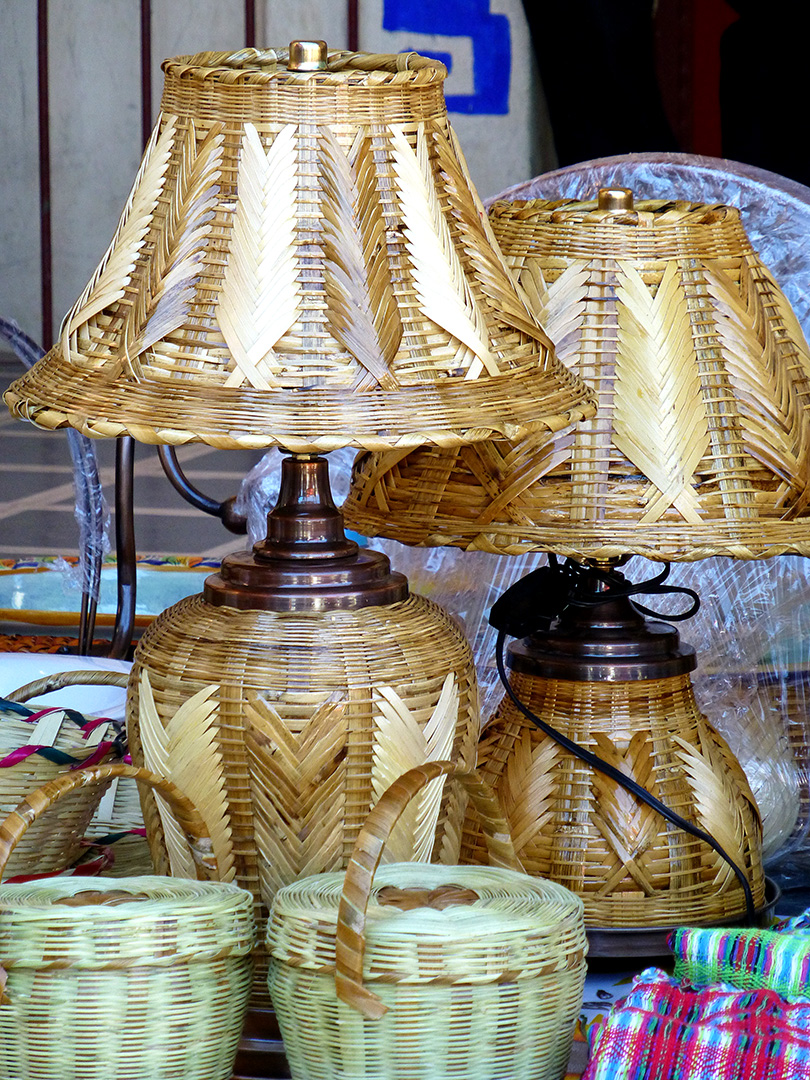
Sunday, we returned to San Juan Guelavía, in search of Teresa, the gal from last week’s post about the Feria del Carrizo. With her address, family name, and measurements in hand, I was hoping to commission her to make a couple of lampshades for me. However, there are no detailed street maps for these small villages, so we had to rely on the tried and true, stopping to ask for directions, method.
Outside the church (which, for some reason, was closed this week) we asked, “Where is calle 5 de mayo?” This is a village with a population of less than 3,000 people, thus the reply, “Who are you looking for?” We said, “Teresa.” He responded, “She makes baskets?” Us, “Yes.” Him, “Hmmm… which family?” Fumbling with my notes, I came up with, “Hipolito!” “Ahhh, sí!”
Then directions rapidly cascaded from his mouth to our ears. They included many derechos, derechas, a puente, and dos tienditas. All of this was in Spanish and we turned to each other and asked, “Did you get all that?” We concurred, probably 80%. Hey, we’re getting better at this. Of course, we made a wrong turn or two, went too far south on 5 de mayo, and had to ask a few more people along the way, but eventually we found it!
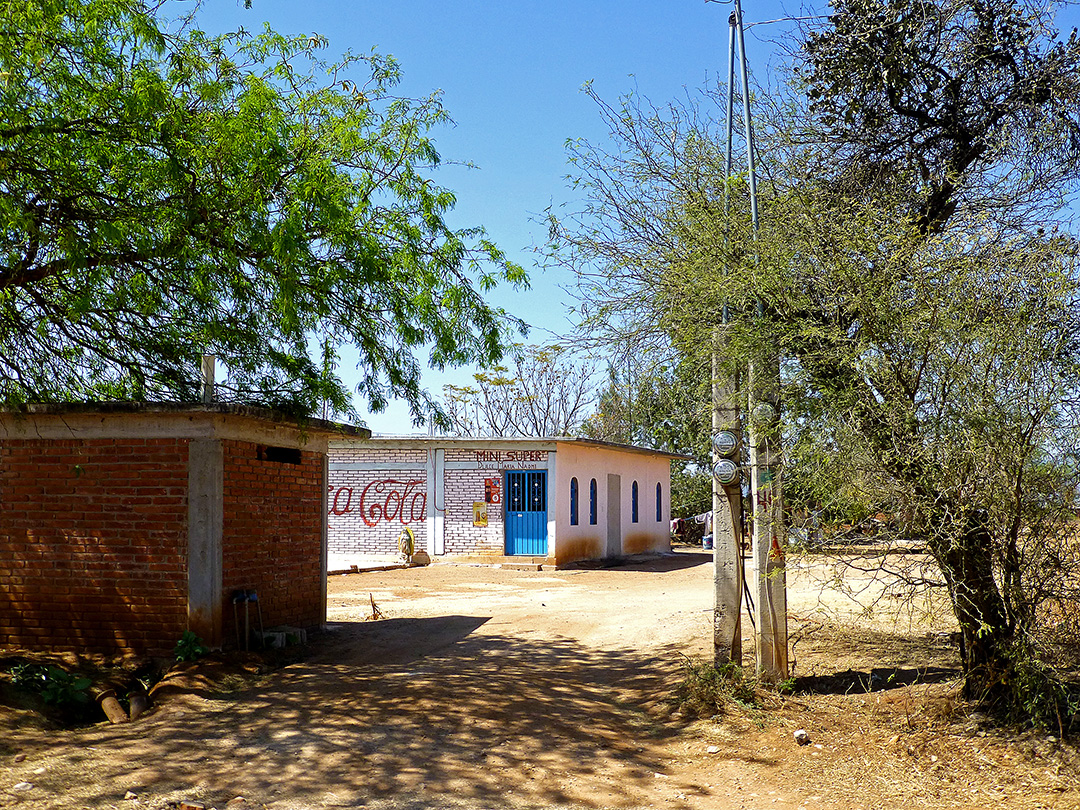
On the right side of the dirt road, heading south, there is a painted number 46 slightly visible on concrete pole. It made sense that #48 might be behind the Mini Super and so we pulled in and began walking to the back.
People began materializing and we kept repeating, “Teresa.” Then, there she was, emerging from sitting under a tree, recognizing us from last week, and smiling broadly! Immediately, two chairs were brought out and placed in the shade for us. The warm and welcoming hospitality of Oaxaqueños is something to behold.
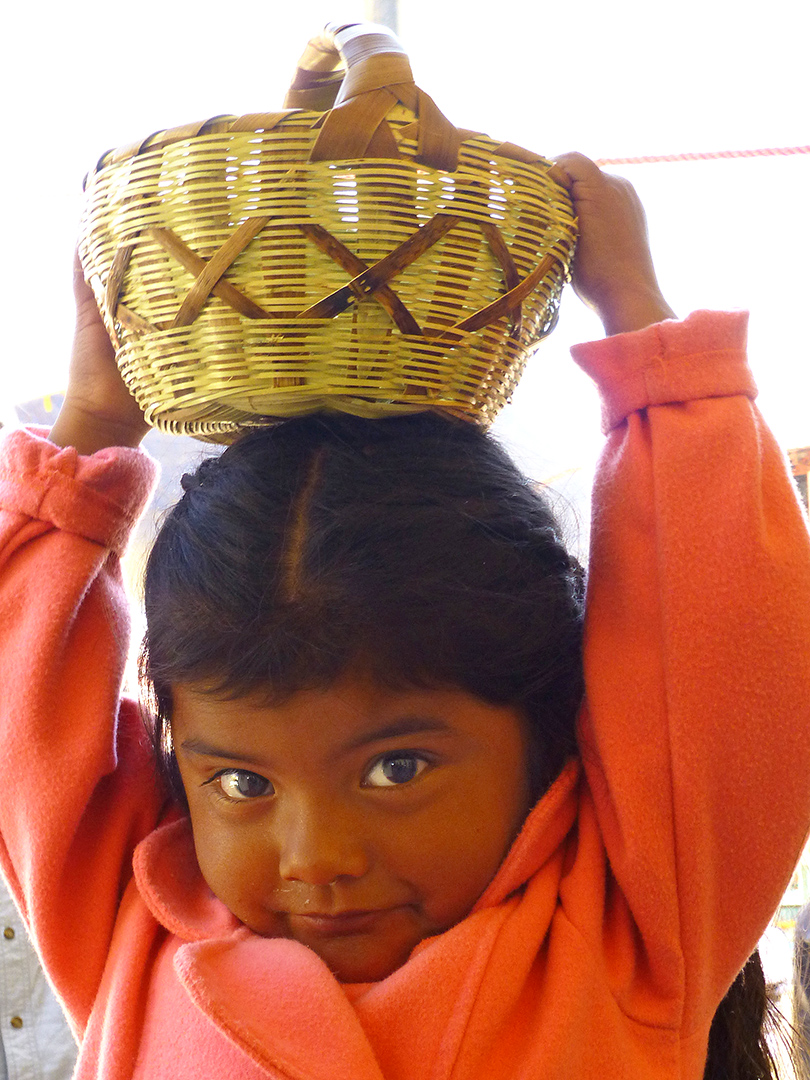
It’s a family business and once Teresa and I had worked out the size and shape for the two lampshades, the littlest guy above, brought out a small basket with a 15 peso price sticker. I asked him if he had made it, and he very proudly nodded “yes.” Needless to say, I couldn’t resist.
We will return in ten days to pick up my new lampshades and, perhaps, make a few other purchases.
Lots of street action around the city these days, and I don’t just mean marches and blockades! They’ve been hard at work on an Andador Semipeatonal (semi-walking street) since ground was broken on November 24, 2014.
Garcia Vigil has been a construction zone from Templo del Carmen Alto up to the Cruz de Piedra. No cars and trucks allowed, but we pedestrians can walk right on through.
The work on this and the four other downtown streets that have been earmarked for “rescue” and “beautification” is mostly done the old-fashioned way. What can I say? I love the sound of hammer and chisel!
According to news reports, the street will be spiffed up with garbage bins, benches, and planters. Ramps for people with limited mobility and signs for the visually impaired are in the plan, though a bike lane is only contemplated.
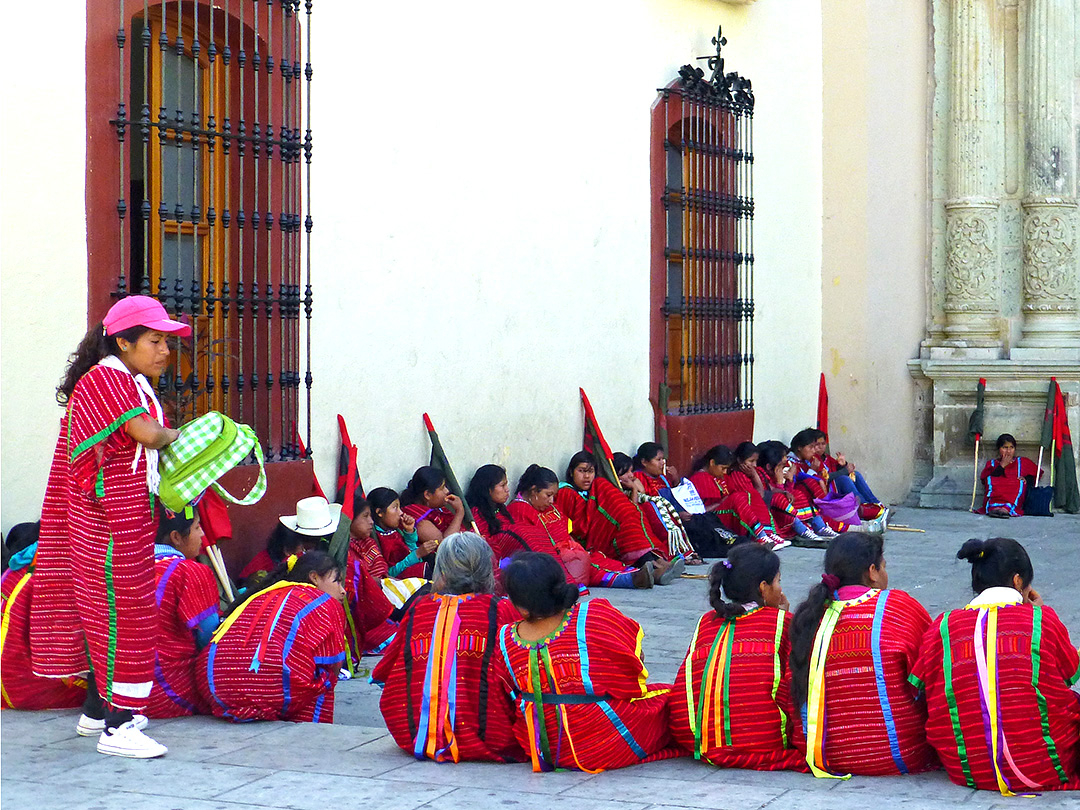
February 2, besides being Groundhog Day in the USA, is Candelaria in Mexico. And so, late Monday morning, I went in search of Niño Díos. None was to be found in the vicinity of the Cathedral. Only the traditional red huipiles of the female Triqui members of MULT caught my eye.
I continued my quest, heading up to Templo de Nuestra Señora de Guadalupe. However, as I walked through Llano park, no one was carrying a Niño Díos, dressed in this year’s finery, to the church to be blessed. Only a giant red horse sculpture by Oaxaqueño artist, Fernando Andriacci (and its red feedbag?) was there to see.
I turned west and headed for home, hoping I might possibly spot a Niño Díos as I passed Templo del Carmen Alto. But no, only a red-shirted water delivery man caught my eye.
Funny, if we allow ourselves to see things as they are and not as how we expect them to be, we can return home with something completely different and delightful from what we had set out to find.
This poster for a Feria del Carrizo arrived in my email inbox a few weeks ago. There are ferias (fairs) for just about everything, so why not, carrizo? Plus, I’d never been to San Juan Guelavía, though I’ve noticed the sign announcing its exit every time I’ve gone to or from Teotitlán del Valle and points south on route 190.
The uninitiated might ask, what is carrizo? As the Wikipedia entry advises, “Carrizo” should not be confused with “chorizo” the pork sausage. Carrizo (aka, Arundo donax, Spanish cane, Giant cane, Wild Cane, and Colorado River weed) is a tall perennial cane that one can easily spot growing along river banks in Oaxaca. (It kind of looks like bamboo.) In fact, if you see a stand of carrizo, you can be almost certain there is a stream nearby. Along with constructing shade structures, window coverings, and mezcal cups, one of its most common uses is in woven basketry.
They range from the simple and utilitarian to the elegant shapes and complex designs that make them a works of art.
And, to those in search of hard-to-find lamps and lampshades, check out the work of Teresa. With measurements of my cast iron standing lamp (in desperate need of a new lampshade) in hand, I plan to pay a visit, muy pronto, to her studio at 5 de mayo, #48 in San Juan Guelavía.
In the meantime, a-tisket, a-tasket I bought a carrizo basket. And, it’s already elicited several compliments!
Of course, when the band played, La Mayordomía, this little girl knew exactly what baskets are for!
Artistry under blue sky and sun, with delicious food, a terrific all-girl band, surrounded by warm and welcoming people. It was a wonderful way to spend a Sunday.
For the past six months, the zócalo has played reluctant host to a game of “now you seem them, now you don’t” by the ambulantes (unlicensed vendors) who are “attached” to Sección 22 of the teachers who have been occupying the zócalo since the summer. During that time, behind-the-scenes negotiations seem to have occurred that has the vendors departing for various “high season (tourist) events. Most recently, a last-minute deal cleared the zócalo and Alameda de León of vendors for Noche de Rabanos.
When I returned two weeks ago, the walkways were still open. However, sometime late Sunday night or early Monday morning the ambulantes returned…
Meanwhile, the real story of the still missing Ayotzinapa 43 has yet to be told, teachers and just about every other sector of Oaxaca’s working class continue to march, occupy, and blockade.
Sheesh, a simple trip out to Etla for lunch on Friday had us coming up to a blockade (this time by state police) just after Santa Rosa. My taxi was forced to turn left and take the “scenic route” down by the Rio Atoyac and then back up to the Carretera 190 at Viguera, where we came up to the massive statue of Benito Juárez (in the middle of the road) that presides over this major intersection, but also with more flashing red and blue lights and state police with automatic weapons than I have ever seen before. This is where I got out; you can pick up the rest of the story on Chris’s blog.
Besides skeletons, my grandson is obsessed with the movie Cars. While I was visiting, catastrophe struck (at least, in the mind of an almost 3-year old) — one of his Lightning McQueen cars disappeared!
Leo, I think I found “Queen” — alive and well and parked on Calle Matamoros.
Ahhh, it feels good to be back in the warm and wonderful Oaxaca. There are the sounds… I awake to church bells, followed by the loudspeaker cry of “Gas de Oaxaca” from the propane vendor. Last night, as I was heading to bed, rockets exploded and, just now, the camote man’s steam whistle sounded, announcing tooth-achingly sweetened hot sweet potatoes and bananas. Then there are the sights…
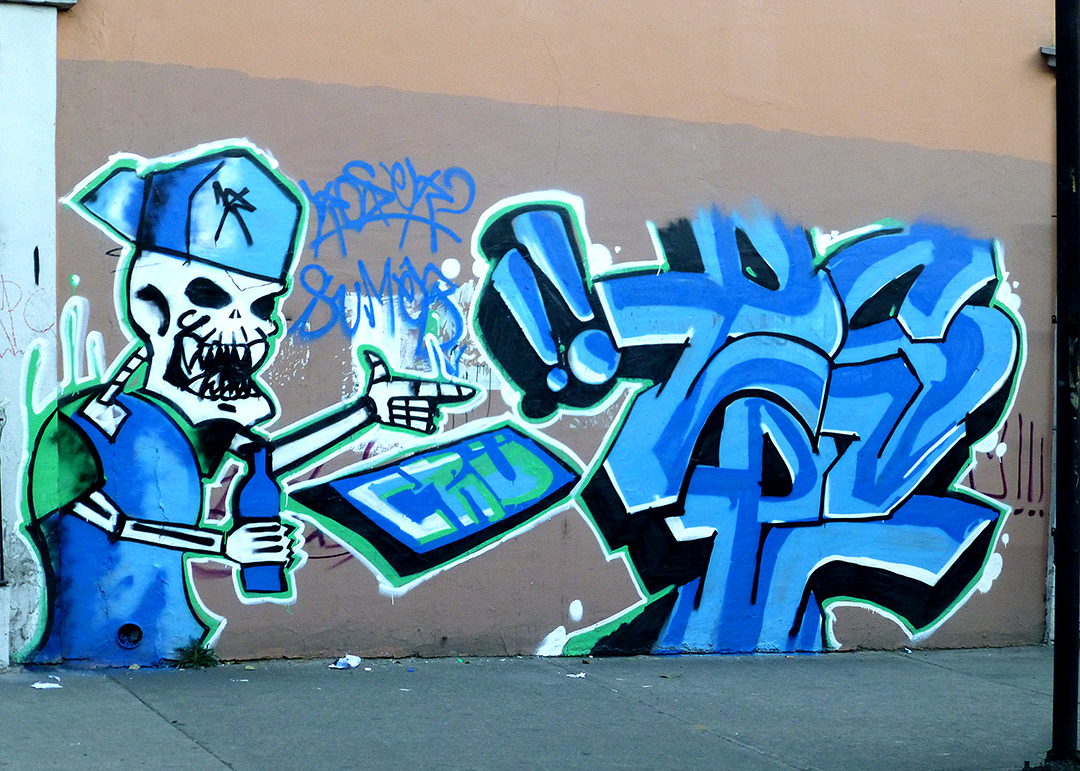
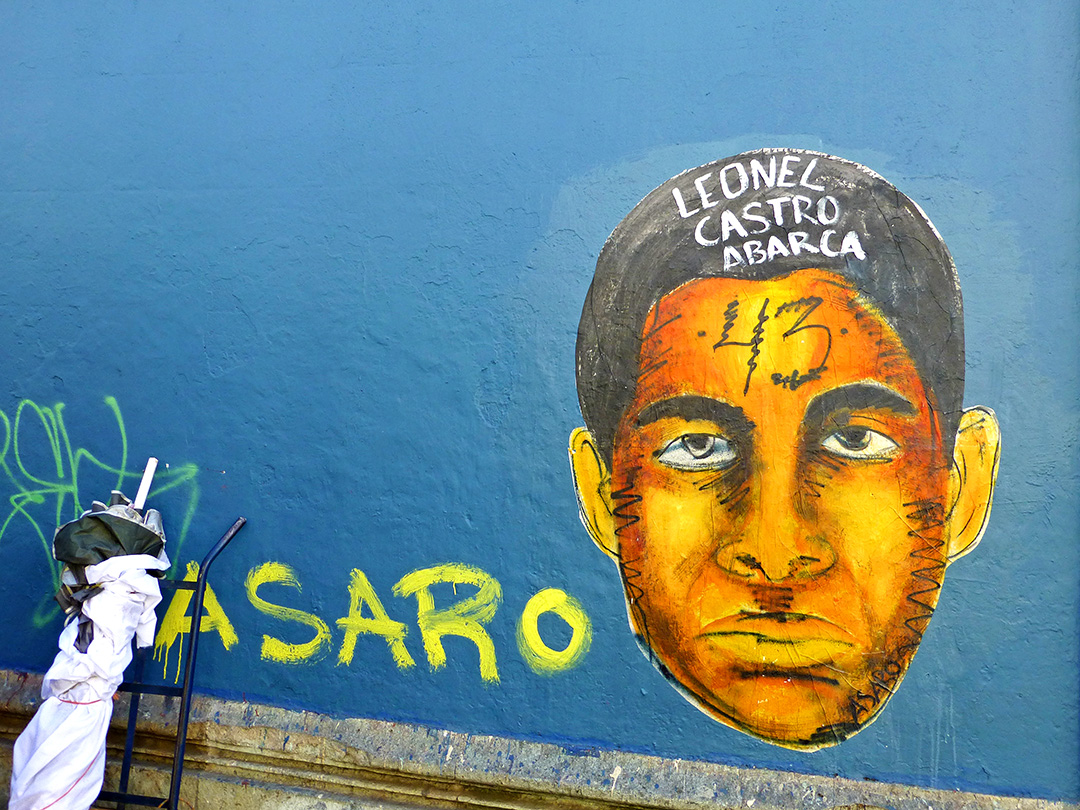
The walls continue to talk… On Thursday, I saw this on Calle Morelos as I walked to the Alcalá and comida with friends. It remembers Leonel Castro Abarca, one of the 43 still-missing students from Escuela Normal Rural Raúl Isidro Burgos teachers’ college in Ayotzinapa, Guerrero.
On the way home from comida, I detoured to see what was to be seen on the zócalo. Teacher tents remain pitched around the bandstand, but the walkways were free of ambulantes, and, as always, the Cathedral presided over the scene.
Thursday, the familiar sounds of protest were irresistible. I grabbed my camera and headed out the front gate to see a massive march by healthcare workers on their way to the Plaza de la Danza. To be honest, tubas and cohetes would have had me out the door, too! It was way too quiet in el norte.
And, what can I say about last night’s sunset from the terrace?
Naturally, a marmota and pair of monos were waiting on the plaza in front of Santo Domingo this afternoon, awaiting a bride and groom to emerge. After all, it is Saturday — wedding day in Oaxaca!
I wonder what my ears will hear and my eyes will see, mañana…
 We looked so fine, baby
 Drinking and dancing

 We used to ride, ride, ride, ride





















 Mexican Peso Converter

 View From Casita Colibrí