Mexico’s favourite singer-songwriter dishes on development, gender, indigenous issues, peace and music. An interview with Lila Downs (in English) from the IFAD social reporting blog:
On the eleventh day of the eleventh month at the eleventh hour, I attended a press conference for the official unveiling of the website for a new play. The play, La [medio] diezmada (the half-decimated), will have its world premiere on December 22 at the Teatro Juárez in Oaxaca.
Cast members: Hugo Alberto Díaz Reyes, Mariela Blanco López, Esmeralda Aragón Zárate, and Fortunato Chávez, with Kurt Hackbarth (middle)
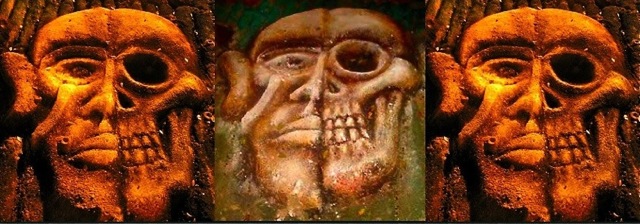
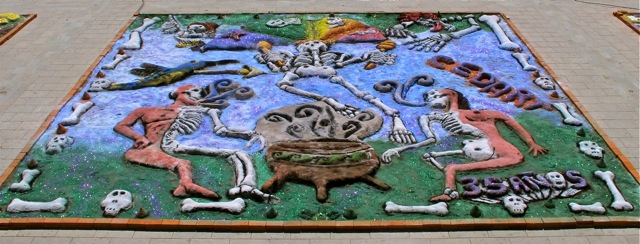
One of the inspirations for writer/director/producer, Kurt Hackbarth, was a photo he had seen of a half-alive/half-dead face in a sand painting. In one of those amazing coincidences, I’d actually photographed the very same tapete de arena laid out on the Alameda in Oaxaca during Los días de muertos in 2009.
Here is my close-up of the half living/half-dead face from the tapete above; the same face that triggered Kurt’s imagination…
… and I cropped and used for the website banner.
If you find yourself in Oaxaca on December 22, I encourage you to attend this world premiere! By the way, it’s a comedy!
Lost in the hoopla re the Morelos movie filming… another strike by taxistas.
Apparently, the issue of unlicensed taxi drivers (see April 6 post), still hasn’t been resolved. And so, on Wednesday, the streets surrounding the Government Palace were blocked by a rainbow of taxis, whose drivers are members of Integrantes de la Unión de Taxistas del Estado de Oaxaca (UTEO).
This slideshow requires JavaScript.
On Thursday, the blockades were withdrawn as negotiations with the governor’s office resumed. Hopefully, the issued will finally be resolved, as taxis play an indispensable role in transporting residents, workers, and tourists from here to there.
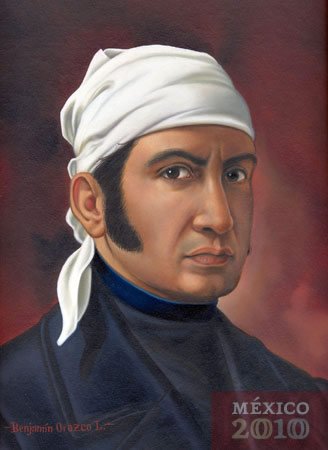
196 years after his execution, Generalísimo José María Morelos y Pavón has returned to Oaxaca. Filming is underway on the film tentatively titled “Morelos,” chronicling the last three years of the life of one of Mexico’s most revered heroes
Costumes hang ready for quick costume changes.
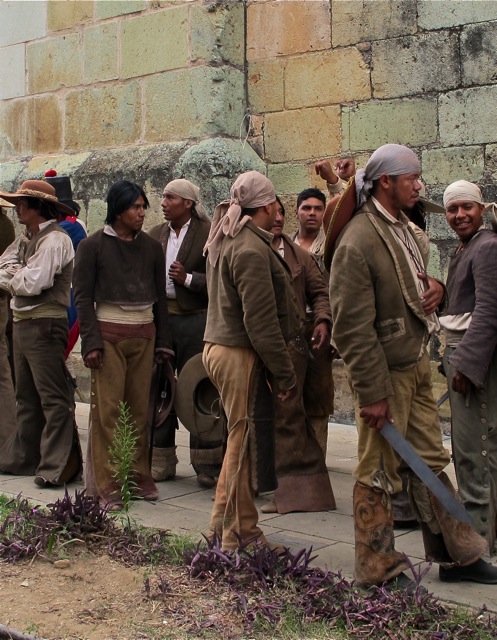
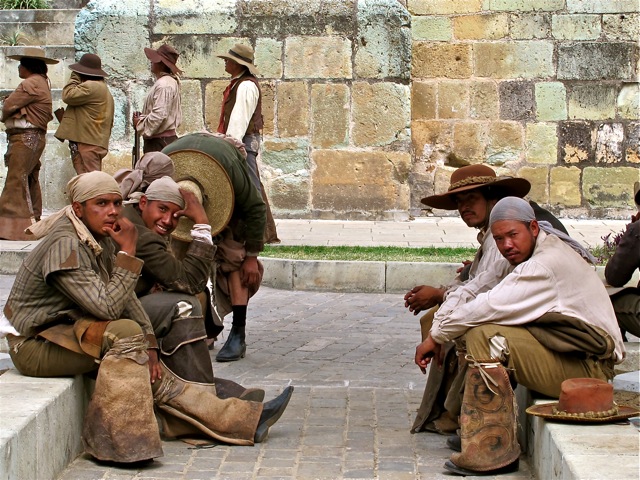
Mexican independence fighter extras await the Spanish language equivalent of ACTION!
Serious cameras are ready to film the action.
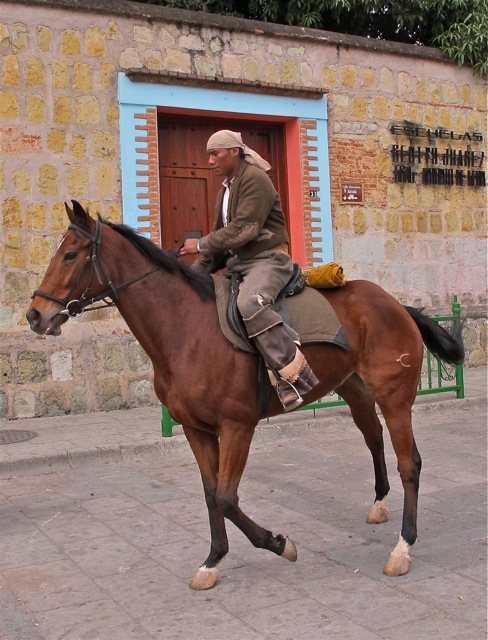
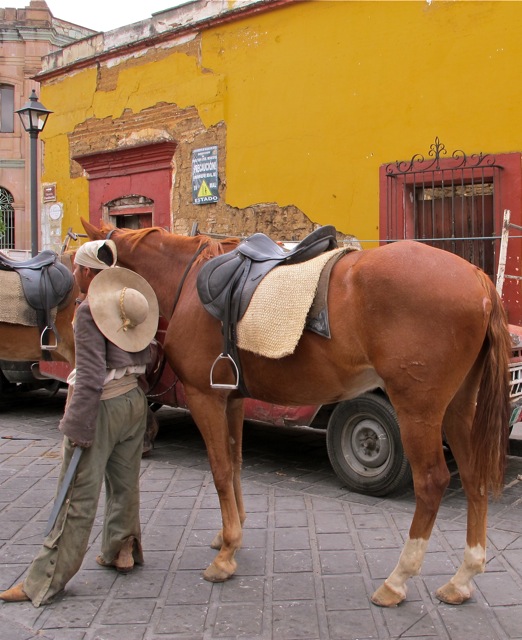
Horses and their riders have taken over the surrounding streets.
Like all movie sets, it’s, hurry-up and wait!
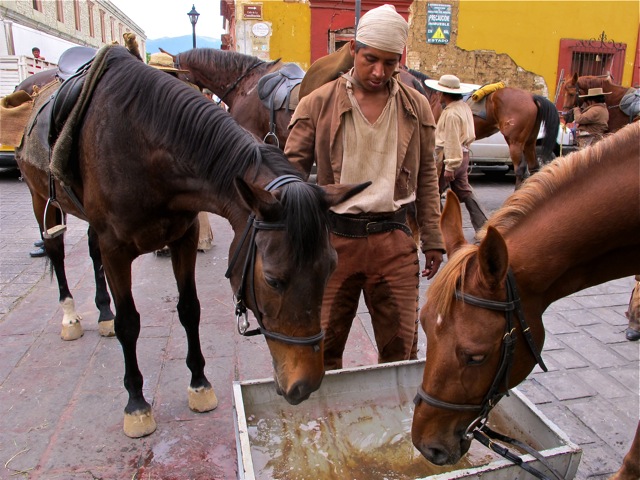
Muy guapo, is all I can say! The horses… the horses…
You can lead a horse to water…
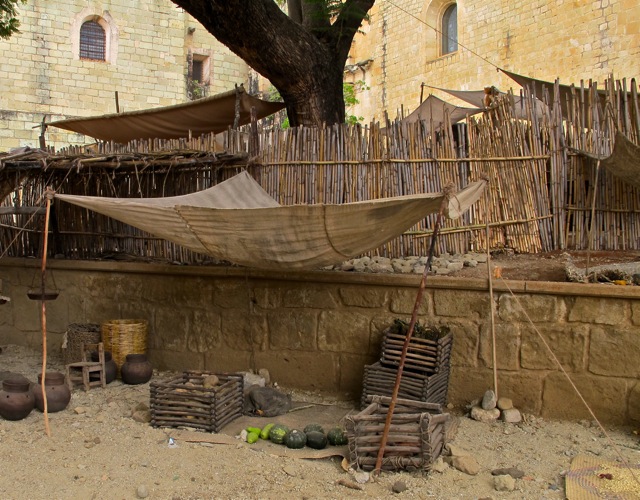
The set designer has taken Constitución back two hundred years…
The newly paved cobblestone street and sidewalks have been covered in dirt and buildings and even trees have been aged.
Though the film covers a time in the life of Morelos that is distinguished more by politics than military action, “dead bodies” line Constitución.
“Morelos” is directed by Antonio Serrano and stars Dagoberto Gama, in the title roll. Filming is also scheduled to take place in Veracruz, Tlaxcala, Puebla, Hidalgo, Morelia (named for Morelos), and Mexico City. It is produced by Luis Urquiza and los Estudios Churubusco, with support from Conaculta, Imcine, and the governments of the states.
I imagine it’s release will be a major event… can’t wait!
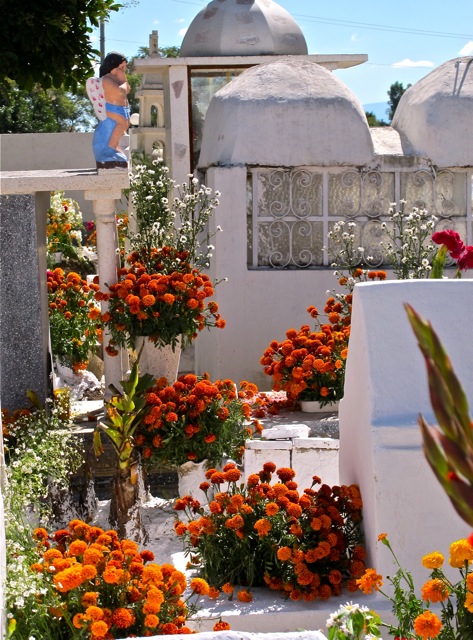
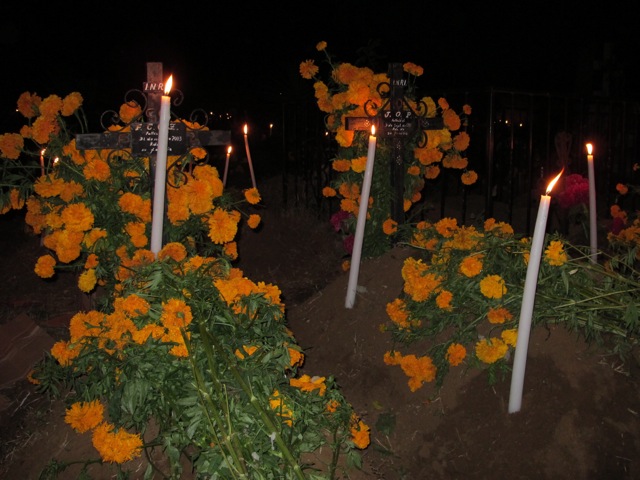
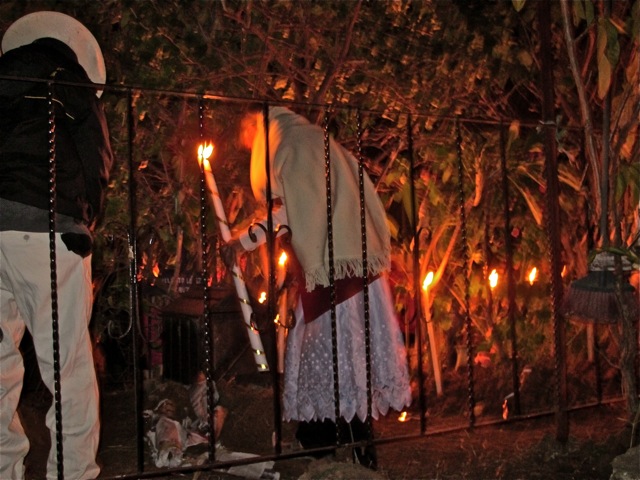
On the road during los Días de muertos led us to Santiago Apóstol in the municipality of Ocotlán de Morelos…
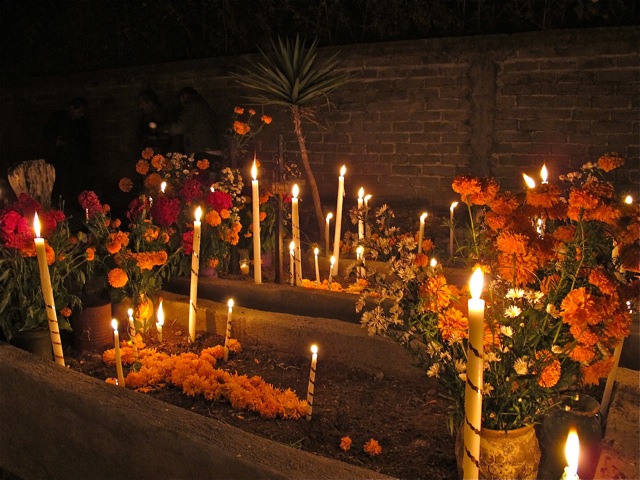
Entering their Panteón, the play of light and shadow and explosion of greens, reds, oranges, yellows, and magentas against whitewashed graves was stunning.
Unique artistry was evident in each of the cemeteries we visited.
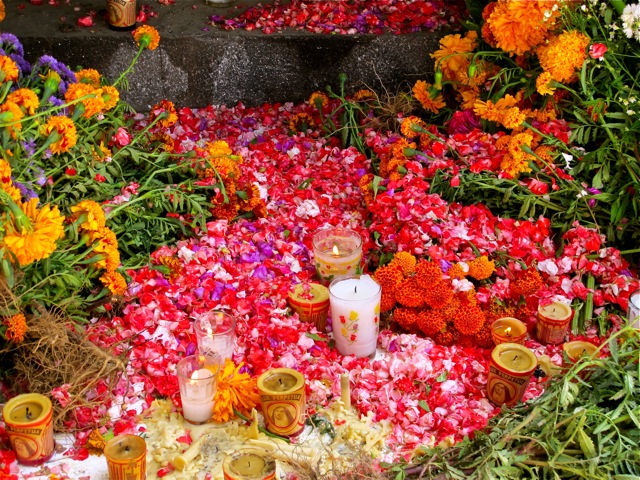
One of the special and fragrant features here was the rose petals scattered atop graves.
Have I mentioned… No matter where one seems to go in Oaxaca, the senses are filled!
What can I say about last night’s Lila Downs concert at the Guelaguetza Auditorium? It was one of those clear, mild and star-filled Oaxaca evenings. The glowing auditorium beckoned and encouraged us as we made the steep walk up the street and then stairs to the hillside site, that overlooks the city.
In true, “hey, it’s Mexico” style, we were unsure of the time… The posters, billboards, and concert’s Facebook page said, 8 PM. However, our tickets (purchased from TicketMaster… ugh!) said 7 PM. Needless to say, we were in line by 6:45. Our, off to the side, front row seats left much to be desired, but once the Afro-Caribbean rhythms of Columbiana, Totó la Momposina and her way hot band began, it didn’t matter.
Although, she initially confused Xalapa with Oaxaca (with the expected laughter and a few catcalls), Totó la Momposina won the crowd over and all were well warmed up for Oaxaca’s favorite daughter. Lila opened with an offering of mezcal and track number one, “Mezcalito,” from her new CD, Pecados y Milagros (Sins and Miracles).
Totó la Momposina joined her on stage, as on the CD, to sing “Zapata Se Queda,” a tribute to the spirit of Mexican revolutionary hero, Emiliano Zapata. Other songs followed, a rebozo (shawl) was added, and the lighting changed…
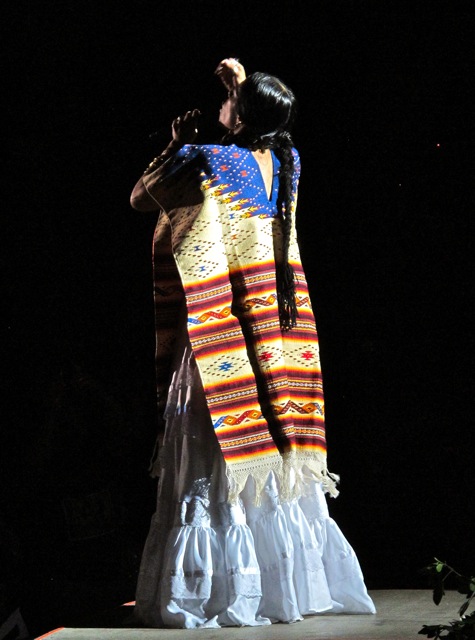
Lila then donned a beautiful serape from one of the master weavers of Teotitlán del Valle to sing, “Fallaste corazón.”
She dedicated, “Palomo’s Comalito,” to all the women who make tortillas in Mexico. A knowing smile crossed our faces. On Wednesday, we had been invited to the home of Emilia and Zacarias Ruiz in Teotitlán del Valle, where we honored the souls of their departed, by savoring Emilia’s delicate tamales and silky smooth and complex mole AND where we were informed by son, Antonio, that Emilia is featured in the music video for “El Palomo del Comalito.” (She’s the woman making tortillas.)
This was my first time seeing Lila Downs live. I’d listened to last year’s free concert, at the Plaza de la Danza, from my terrace, but it doesn’t compare with seeing her in person…
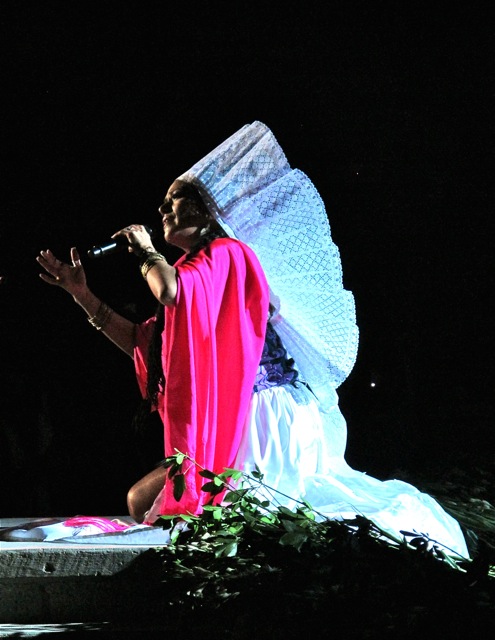
I think this was the costume change for her beautiful and haunting rendition of “La Llorona.” I can’t resist also showing the back of this traditional Isthmus of Tehuantepec headdress, known as a “bidaani quichi.”
A sublime and spectacular evening to close a sublime and magical week… ¡Muchisimas gracias, Oaxaca!
… to the fabulously fabulous and ridiculous; a traditional comparsa on the morning of November 2, 2011. After hiking up to the top of the hill in Vista Hermosa (beautiful view), Etla, following the sound of music, a surreal sight unfolded…
This slideshow requires JavaScript.
We tagged along with the band, dancers, and their friends and neighbors, up and down the hills, navigating steep dirt paths, as they played, danced, drank mezcal, and stopped in front yards for much-needed rest and refreshments of caldo de pollo (chicken soup), pan de muerto (Days of the Dead bread), and mezcal… of course!
By the way, did I mention, these guys and (one) gal, had been playing and dancing all night long?!!
I’m still trying to wrap my mind around the last 48 hours. It’s been a profusion of sensations… sights, sounds, smells, and tastes. Today in Teotitlán del Valle…
Pan de muerto is the traditional Days of the Dead sweet yeast bread. It is decorated and placed on ofrendas (altars), along with candles, flowers, fruit, pictures, mementos, other foodstuffs, and beverages, as offerings to the departed.
This slideshow requires JavaScript.
The intricately decorated pan de muerto are from the Tlacolula Valley, and reference the geometric designs and mosaic fretwork found in the archeological sites in and around Mitla, a photo of which I’m using as browser background on this blog.
The tapetes de arena are finished and cover the stone flooring of the Plaza de la Danza. Always difficult to photograph, the following are an experiment in cropping.
Centro de Educación Artística Miguel Cabrera
Casa de Cultura de Tlacolula de Matamoros
Escuela de Bellas Artes de la Universidad Autónoma Benito Juárez de Oaxaca
Several other organizations participated and among the unsigned are tapetes de arena from Casa de las Artesanías de Oaxaca, Sociedad Civil de Maestros Oaxaqueños del Arte Popular, and Grupo Colectivo Camaleón.
Work on the Días de Muerto tapetes de arena (sand paintings) began this morning…
This slideshow requires JavaScript.
By the way, this year they are in the Plaza de la Danza and, as I write, the music of the Orchestra Infantil Libertad (a children’s orchestra) is serenading the completed tapetes de arena, the audience gathered at the Plaza de la Danza, and yours truly, sitting comfortably at her desk.
Tourists are arriving by planes, buses, and automobiles.
The streets, hotels, restaurants, and shops of Oaxaca are filling for los Días de Muertos. Hopefully, before they depart…
…they will spread a little wealth; and, when they return to their homes, they will sing Oaxaca’s praises. Alas, their comings and goings won’t be by train. Passenger train service is no more and the old railroad station opened as the Museo del Ferrocarril Mexicano del Sur in 2003.
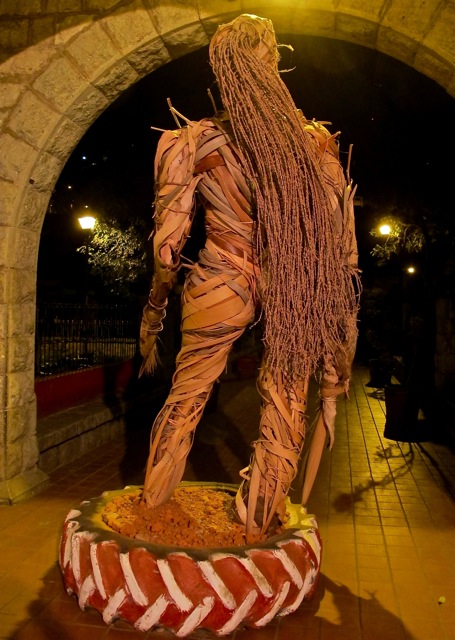
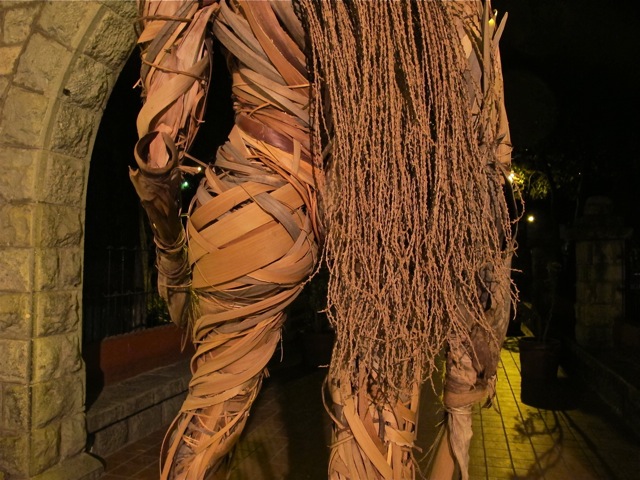
And that is where you will find this shapely resident, as you come and go.
























 Mexican Peso Converter

 View From Casita Colibrí