Feeds:
Posts
Comments

Indignados and plantons

The Occupy movement continues… clashes with the Oakland, CA police on Saturday are making headlines.  And, when I was in Mexico City two weeks ago, an indignado planton (encampment) was firmly established in front of the domed building that houses the Mexican stock mark.  Please note the biblioteca (library).

This slideshow requires JavaScript.

I must admit to feeling right at home, as plantons are an almost ubiquitous part of Oaxaca’s zócalo.  For more on plantons, David Bacon provides a cross border historical context to the planton/occupy movements in his article, Unions and Immigrants Join Occupy Movements,

News of this discovery was posted on Facebook this morning by Sam, my young Zapotec friend from Teotitlán del Valle, who is currently getting his Ph.D. in Sustainable Manufacturing at the University of Liverpool.  A global village, it is!

By the way, Santa María Atzompa (mentioned below) is where I experienced a Magical and Mystical October 31st.  The article and photo are from today’s, Hispanically Speaking News.

1,300 Year Old Kiln Used by Ancient Zapotecs Discovered in Mexico

Mexican archaeologists have discovered in the southern part of the country a kiln used by the ancient Zapotecs to make ceramics more than 1,300 years ago, the National Anthropology and History Institute, or INAH, said.
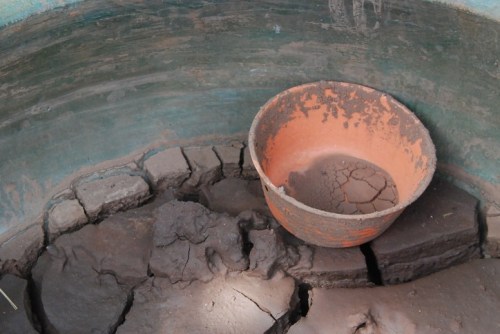
Clay pot in ancient kiln

The pre-Columbian kiln was discovered in the Atzompa Archaeological Zone in Oaxaca state, which will be opened to the public this year, INAH said in a communique.

It added that this is one of the best preserved ceramic kilns ever found in the Zapotec area, and noted Oaxaca’s long tradition in making pottery.

According to Wednesday’s communique, the kiln “is a link between the pre-Columbian pottery tradition and the artisanal ceramics currently made in the community of Santa Maria Atzompa, establishing the connection between today’s inhabitants and their ancestors.”

Archaeologist Jaime Vera, head of the excavation, said the kiln “is thought to date back to the first years of the pre-Columbian settlement of the area, in other words, more than 1,300 years ago, which is deduced from the ceramics found with it.”

Another element that allows the kiln to be dated is the depth at which it was found – 2.2 meters (7 feet 2 1/2 inches) – “far below the layer of stucco that covered it, and which corresponds to that era, the archaeologist said, adding that further studies will be made to confirm its antiquity.

It was in the excavation period between March and December 2011 that the kiln was completely uncovered allowing its principal characteristics to be observed: a cylindrical adobe wall and shelves for placing the objects to be fired.

The kiln consists of a cylindrical adobe wall measuring 2.1 meters (6 feet 11 inches) from the surface to the firing shelves arranged in convergent lines toward the center, and a downdraft vent in the lower part approximately 20 centimeters (8 inches) wide,” Vera said.

He said that “while today’s kilns are not identical in dimensions or shelf arrangement, they do perserve certain basic elements and the function as a space for firing ceramics.”

The Atzompa Archaeological Zone, approximately 4 square kilometers (1 1/2 square miles), existed as a small satellite village of the Zapotec city of Monte Alban during the Late Classic period (650 B.C.to 900 B.C.) when the latter’s growing population expanded beyond its boundaries.

The work to provide the Atzompa Archaeological Zone with the necessary infrastructure will continue, since it is one of the pre-Columbian sites that will be opened to the public this year, INAH said.

Have a seat!

As you may have gathered, one of the things I love about living down here is the pervasiveness of public art.  So, on a recent trip up to Mexico City, it should have come as no surprise to see the city is filled with heroic sculptures and abstract modern pieces, both serious and whimsical, for all to see, contemplate, and enjoy.

Even benches are an excuse to let the creativity flow.  (S)he is ready and willing to talk or just listen…

Vertigris ostrich bench

He will provide shelter from the storm OR scorching sun, as the case may be!

Aluminum bench topped with a whimsical red chair with lounging figure.

When it’s been an upside down kind of day, have a seat here.

Green metal bench with bottom of torso with legs "seated" on top.

Or, on a Sunday, when the Paseo de la Reforma is closed to traffic, you can park your bike and put a song in your heart!

Smiling young woman sitting on a black iron bench with musical notations; her lavender bike in front.

¡Buen día!

The ladybug and the…

The wall art in Oaxaca never ceases to surprise and delight.

Male torso in yellows and reds with a little blue and black

Pretty buff, no?

Dog days

In Mexico City…

Small dog on leash, sitting, wearing pink sweater and gray ruffled skirt.

In Oaxaca…

Large black mangy dog lying on the plaza

Visual rehabilitation…

A clean-looking Oaxaca, brought to you by Oaxaca’s Secretary of Infrastructure.

Sign on street:  "Todos x un Oaxaca + limpio"

According to the state government’s website, a 45 million peso project was launched to “visually rehabilitate” 94,000 buildings in 25 urban communities.   Begun in July in San Bartolo Coyotepec (14 miles south of Oaxaca City), it has now reached my ‘hood.

2 painters with 10+ buckets of paint

Ladders, paint buckets, and painters up and down the block.

2 painters painting a pale blue building

By the way, because this is the Centro Histórico, the colors are selected from a previously approved palette.  Baby blue?  I wonder if the owners of the buildings have any say…

David Bacon, one of the most perceptive labor and immigrant rights writer/photographers, interviews Rufino Dominguez, director of the Oaxacan Institute for Attention to Migrants (in English).  Let’s hope this isn’t another program that is all talk, no action.

Oaxaca’s New Government Calls for Migrant Rights

OAXACA, MEXICO — The Oaxacan Institute for Attention to Migrants, and its director Rufino Dominguez, called for a new era of respect for the rights of migrants, in commorating [sic] the International Day of the Migrant in the Palacio del Gobierno, Oaxaca’s state capitol building. Representing the newly-elected state government, Dominguez paid tribute to the contributions of the braceros, the first of Oaxaca’s migrant workers to travel to the United States. from 1942 to 1964, and to the women who cared for the families they left behind.

Around the balconies of the palacio’s courtyard hung photographs showing the lives of current migrants from Oaxaca, working as farm laborers in California. Migrant rights activists, artisans and public officials spoke about the important role migration continues to play in Oaxaca’s economic, social, political and family life. The state, in southern Mexico, is the source of one of the largest waves of migration from Mexico to the U.S.

Dominguez, the former coordinator of the Binational Front of Indigenous Organizations, which organizes indigenous migrants in both Mexico and the U.S., was appointed director of the IOAM by Oaxaca’s new governor, Gabino Cue Monteagudo. Cue defeated the PRI, the party that governed Oaxaca for the previous 80 years. In an interview with David Bacon, Dominguez described the different road the new government is taking to ensure social justice for Oaxacan migrants today:

We can’t tell the U.S. government, or the governments of California and other states, to respect the rights of our people who are living there, if we ourselves are not respecting the rights of migrants here in Oaxaca. Many migrants passing through Oaxaca from Central America and other places suffer systematic violations of their human rights.

Have we just paid attention to migrants in the U.S. because they send dollars home? Sometimes the problems of migrants within Mexico are even greater than those we have in the U.S.  [Read full article]

Anti SOPA and PIPA in Oaxaca

Vive Oaxaca, one of my favorite websites that covers things cultural in Oaxaca, had the following on their homepage today:

Vive Oaxaca website banner:  No a la censura de la red; S.O.P.A. Stope Online Piracy Act; Internet nació seguirá siendo libre Do not censor the web; S.O.P.A. Stop Online Piracy Act; the Internet was born and will continue being free!

There is a video explanation of S.O.P.A. (in Spanish) and a couple of great posters.

Two posters: #1 listing websites going dark toda; #2 showing a face being gagged.

As the Vive Oaxaca website suggests, these Acts will not just affect access to information in the USA, they have worldwide implications.

For more information and links to other articles opposing SOPA and PIPA, check out Wikipedia’s SOPA and PIPA – Learn more page.

Update:  And to become even more informed, resources from the Progressive Librarians Guild:  Learn more about SOPA, censorship, & piracy:

The Swiss study (2011)…Piracy pays for itself

Protecting migrant workers

I don’t know the details or even if it is all that it is cracked up to be.  However, I can’t help but wonder… Where is the USA?

Ceramic sculptures of immigrants“La Ruta del Migrante” exhibit by Alejandro Santiago, in front of Santo Domingo in Oaxaca de Juárez (more on this exhibit to come)

Oaxaca’s Government and UFCW Canada Sign Agreement to Protect Mexican Migrant Workers in Canada

OAXACA, MEXICO–(Marketwire -01/17/12)- Migrant workers from the Mexican state of Oaxaca traveling to Canada will receive better protection this 2012 season after the signing of an agreement between the Instituto Oaxaqueno de Atencion a Migrantes (IOAM) and UFCW Canada.

On Monday, Wayne Hanley, National President of UFCW Canada, and Rufino Dominguez, Director of the IOAM signed a co-operation agreement to protect and assist Oaxacan migrants working temporarily in Canada. The agreement addresses issues of human rights, labor rights and social security, proposing a framework for transnational cooperation.

“Mexican migrant workers make an enormous contribution to the Canadian society and economy,” says National President Hanley. “This must be acknowledged and we look forward to working with Mexican institutions to improve the living and working conditions of Mexican migrant workers in Canada.”

UFCW Canada and the IOAM will collaborate to increase the level of protection of Oaxacan migrants before, during and after their stay in Canada. From now on, Oaxacan workers will be assisted in Canada through the network of 10 agriculture worker support centers operated by UFCW Canada in association with the Agriculture Workers Alliance (AWA).

The centres offer Spanish-speaking staff who deal with legal support services and training in human rights, labor rights, housing, and health and safety problems. Services also include a toll-free telephone assistance number from anywhere in Canada and Mexico, both for workers and their families.

Meanwhile, the IOAM will benefit from workshops offered by UFCW Canada to insure workers receive proper information about their rights. The plan of action will therefore focus not only on legal assistance, but also on prevention, information, and training of migrant workers. The program will also will help the migrant workers access Canadian legal benefits to which they are entitled.

The IOAM consolidates its commitment to the people of Oaxaca, actively developing policies to protect its citizens abroad. Other actors who have joined this international cooperation strategy with UFCW Canada include the governments of Michoacan, Tlaxcala and Distrito Federal, as well as two of the biggest agricultural workers labour federations. In this spirit of cooperation, the federal temporary worker programs will continue to be an important link for labour between Mexico and Canada, and these cooperation partnerships will strengthen the programs by involving all the strategic partners to ensure the workers’ experience is fair, safe and productive.

Contact:

UFCW Mexico
Andrea Galvez Gonzalez
3300 6144
Cell: 55 31 26 24 21
andrea.galvez@ufcw.mx
www.ufcw.ca

Going forth and multiplying

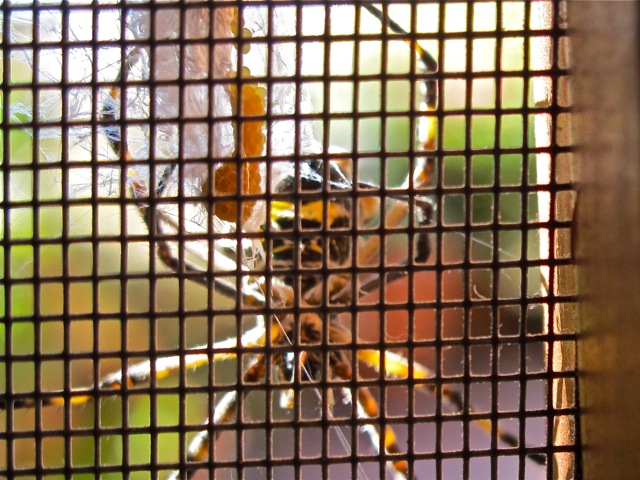
Remember Argiope, from my September 20 and October 8 posts? She has continued to hang around, catch flies, and do all manner of spidery things. However, four days ago, her web was abandoned…

empty web

Apparently, my screen door is the perfect place, in her mind, to lay her eggs!

Argiope laying eggs on screen door

A friend asked, how do I feel about having hundreds of little Argiopes hatch practically INSIDE my apartment?

Argiope and eggs

I’m trying not to think about it, says I.


Día de Reyes wasn’t the only thing happening on Friday; January 6 was also Nurses Day (aka: Día de la Enfermera) and it warms this former RN’s heart.

Banner: U.A.B.J.O.; Facultad de enfermería y obstetricia; "Día de la enfermera"; Festival de la Salud; Celebramos...

Personal hygiene is important; don’t forget the toothpaste and soap!

Banner above a balloon dart board: "Higiene Personal"

Now this had me scratching my head… we never did this in nursing school!

Nurses giving head massages with a battery powered massager

However, when you are stressed, you are not relaxed.

Banner:  Cuando estas estresado no eres tu relajate y consientete

You need to pamper yourself.  Hmmm… wonder if my health insurance covers this?

Nurse giving a back massage

And, for goodness sake, don’t forget to hydrate!

Banner: Los beneficios del agua...

Of kings and babies…

Yesterday, El Día de Reyes (aka, Three Kings Day and Epiphany) was celebrated all over Oaxaca (and the rest of the Hispanic world).  Letters having been written, children went to bed on January 5th in anticipation…

Young girl with face painted

of a visit by los Reyes Magos; though, something tells me they didn’t ask for gold, frankincense, and myrrh.  If these Three Kings are truly wise, they visited the toy department of a local store.

Three teenagers (2 boys and 1 girl) dressed as the Three King.

Yesterday morning, children awoke to find their very own gifts from the Magi.  However, the day’s excitement didn’t end there.  Rosca de Reyes, a wreath of sweet bread had been made or purchased.

Woman putting powdered sugar on top of a Rosca de Reyes

This innocent looking dessert has a secret; a tiny plastic “bebé Jesús.”  Family and friends take turns with a knife, each slicing their own piece, and the one who finds the figurine must host a tamale party on February 2, Día de la Candelaria (Candlemas), for all those gathered.

Rosca de Reyes

However, Laura (my Spanish teacher) and her friend Manuel, just couldn’t leave it at that.  Last night, one by one, guests cut into the above cake and, lo and behold, we all bit into a baby Jesus.  Needless to say, there was much joking about fertility drugs!  It should be some tamale fiesta on February 2nd.

Here and there

Wall art from here…

Multicolor mountain lion wall art.

Wall of 142 Throckmorton theatre on Madrona,  Mill Valley, CA by Zio Ziegler

to there.

Wall of Espacio Zapata on Porfirio Díaz, Oaxaca de Juárez, OAX

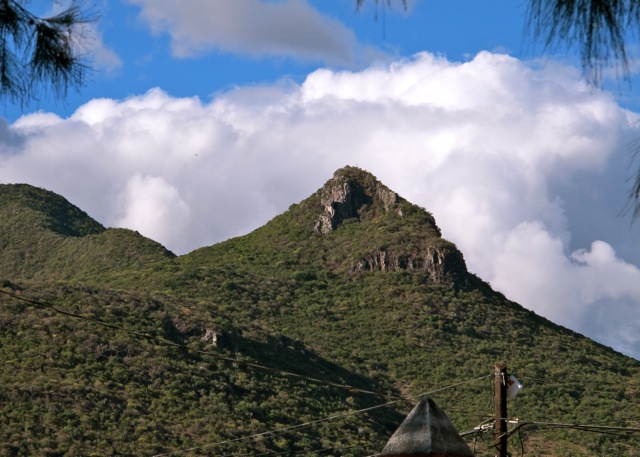
And, sacred mountains from here…

Mt. Tamalpais

to there.

Green rocky top mountain against white cloud and blue sky

Transition time… Mill Valley back to Oaxaca.

Save

¡Prospero año a todos!

A little craziness from the November 2, 2011 comparsa in Vista Hermosa…

Muchisimas gracias to all my readers.  Thank you for stopping by, your perceptive comments, and your encouragement.  Peace and joy in 2012, if not in the world, at least in your heart!

When “progress” isn’t progress; another thought provoking article that discusses what NAFTA hath wrought…

Donkey in corn field

After NAFTA, Mexican farmers sow uncertainty
by:  Mike Wold

Agribusiness and US policy clash with Campesino culture

The donkeys began to sing to each other as it got dark — starting with a honking bray from one far down in the bottom of the valley, then another answering from up on the hillside, then a third from a little way down the dirt road running by Eleazar García’s house. The road itself was empty by now; even earlier it couldn’t have been called busy — a group of schoolgirls in their white uniforms; a pickup truck with empty burlap sacks in the back; a battered van bringing farmers back from Nochixtlán, the market town two hours away.  I’d been in rural Mexico before but never had a chance to watch the light change as the sun sank below the western hills.

<snip>

Supporting small farming in Mexico is a win-win scenario for both the U.S. and Mexico.  But instead, the U.S. has successfully pushed Mexico into an export-oriented agricultural model that assumes depopulation in the rural areas, as large agribusiness replaces small-scale farmers in places like Oaxaca. Many of the displaced farmers will, as a matter of course, migrate north to work in maquiladoras (manufacturing operations) on the border or they will cross to the United States. In other words, the development model the two governments have adopted makes migration inevitable. 

There’s no profit for corporations in helping people stay on the land, where they’re insulated from the ups and downs of the world economy. But, as García put it: “If you really want to combat hunger in the world, it’s in the hands of campesinos. They live on what they grow. It’s important that people begin to understand that.”  [Full article]