Feeds:
Posts
Comments

A good day…

I knew it was going to be a good day when a colibrí greeted me on an early morning stroll up to the weekly organic market.

Black outline of a hummingbird on a white wall.

There were other critters and creatures in plain sight…

Multicolored creature painted on terracotta wall

and peering out from their hiding places.

Multicolored creature painted on wall in back; with bougainvillea in foreground

However, you must proceed with caution because, most dangerous of all…

Pile of torn up street rubble in street, with red sign:  Precaución - Hombres Trabajando

there are men at work!

The look of love…

Valentine’s Day, known here as Day of Love and Friendship, is in full swing.  Hearts, flowers, and balloons are everywhere.  If you forgot to buy your lover or friend a little something, there are always vendors there to remind you.  And, don’t forget to be safe.

This slideshow requires JavaScript.

¡Feliz Día del Amor y la Amistad!

Be it looking down from the windows above, strolling through the gardens on a tour, or peeking through openings in the wall on Reforma or Berriozabal on the way to someplace else, Oaxaca’s Ethnobotanical Garden is always a soothing and uplifting sight.

Looking out from window above Ethnobotanical Garden

Check out this informative and enlightening article by Jeff Spurrier discussing the origins and vision of  Oaxaca’s Ethnobotanical Garden — from the Jan/Feb 2012 issue of Garden Design:

Oaxaca’s Ethnobotanical Garden

“I am not a gardener.” Francisco Toledo is sitting in the courtyard of the graphic art institute he founded in downtown Oaxaca City, Mexico, sipping on a glass of agua de jamaica. His fingers are paint-smudged, and he moves stiffly from a sore back. Toledo, 71, is one of Mexico’s best-known living artists; his paintings, sculptures, and textiles are in galleries and museums around the world. At home in Mexico, he is identified with a fierce and outspoken defense of the indigenous arts and culture of the southern state of Oaxaca. He also, as it turns out, helped to create one of the world’s most original public gardens.

“The professionals are the people who live in the country,” he says. “The campesinos and workers — I don’t have the patience.”

Nearly 20 years ago, the Mexican military moved out of a 16th-century Santo Domingo monastery complex it had used as a base for more than 120 years. Mexico’s president gave the exit order after being lobbied by Toledo and other leading artists and intellectuals belonging to Pro-Oax, an advocacy group urging the promotion and protection of art, culture, and the natural environment in Oaxaca. Soon, a great clamor began: The state government wanted the five-acre parcel in the heart of downtown Oaxaca City to create a hotel, convention center, and parking facility. A restoration team brought in by the National Institute of Anthropology and History wanted to establish a European garden in the 17th-century baroque style. Some of Toledo’s fellow artists wanted to use the grounds for workshops and exhibition space.

n 1993, when Toledo knew the army would be leaving, he asked Alejandro de Ávila B., who had family roots in Oaxaca and training in anthropology, biology, and linguistics, what he and other advocates would propose. De Ávila suggested making the space into a botanic garden — or, more precisely, an ethnobotanic garden, one that would “show the interaction of plants and people.”

I highly recommend reading the Full Article.

h/t  Norma and Roberta

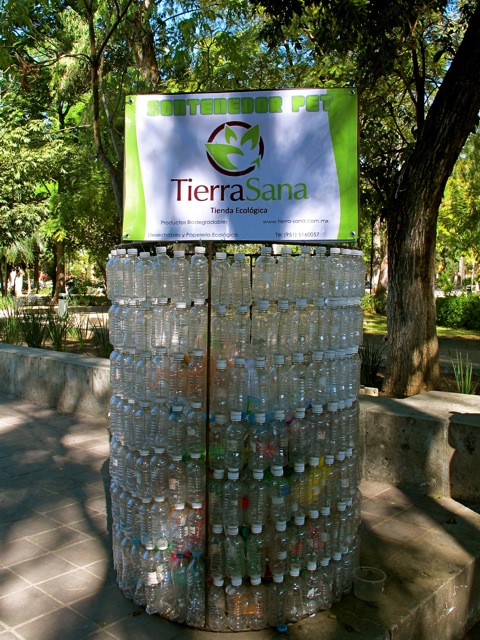
The day before I went up to Mexico City last month, crossing Llano Park, I came across a newly installed waste container encouraging plastic recycling; courtesy of Tierra Sana, a company promoting and selling environmentally friendly products.

Waste basket made from plastic bottles with a Tierra Sana sign on top

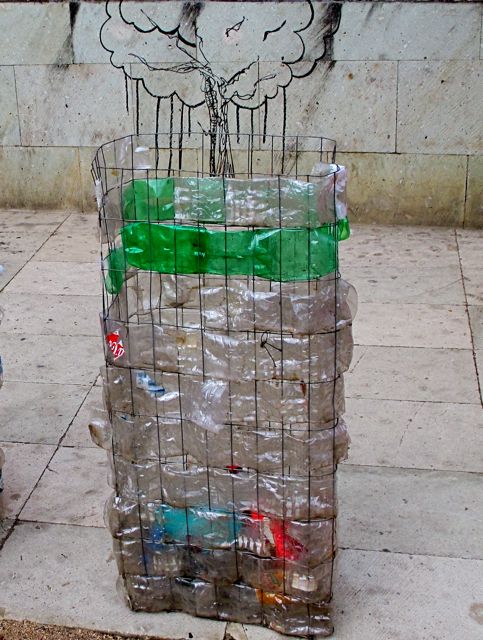
These baskets have cropped up in other parts of the city — this one in the plazuela next to Carmen Alto church.  Please know, the trees will cry if you don’t recycle.

Plastic bottle recycling bin with graffiti drawing of a tree crying in the background.

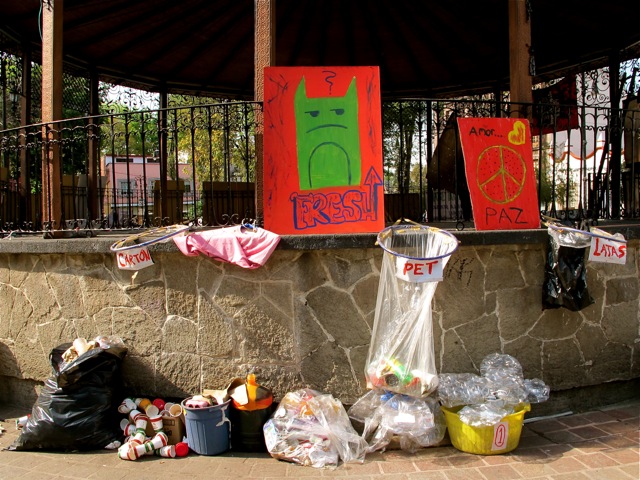
Once up in Mexico City, I noticed Occupy Coyoacán practiced recycling.

Overflowing recycling bags lined up along bandstand.

And then, we were all brought up short by this electric car…

Silver Nissan electric car getting charged at charging station in the street.

These charging stations are not far from the Templo Mayor; an appropriate juxtaposition, I think.  Automobile pollution can’t be good for the Great Temple.

GE charging station

Then there is bike-sharing — 1200 bikes at 90 Ecobici bike stations in Mexico’s capital city.

Red Ecobici bicycles lined up on bike rack.

For more on Mexico City’s Green Plan, check out 10 Highlights of Mexico City’s Climate Action Program.

With a nod to Humphrey Bogart’s character in Casablanca:  Of all the volunteer opportunities, in all of Oaxaca, why did I walk into the Oaxaca Lending Library (OLL)?   For the answer, you will have to check out my newly published (yippeee!) article on volunteering at the Oaxaca Lending Library on the Go Overseas website.

The article mentions the various and sundry activities organized by the OLL.  So, I thought I’d give you a taste:

Volunteering at the OLL has introduced me to an incredibly diverse, knowledgeable, and talented group of people from a wide variety of backgrounds.  Be they native Oaxaqueños, year round ex pat residents, or yearly “snow birds,” many have become part of my community and support system.  A library —  what better place to get your questions answered about the who, what, where, why, and how of living and thriving in an unfamiliar culture?  People and books are there to assist with navigating the challenges, celebrating the differences, and exploring the surroundings.

A couple of weeks ago, I attended a panel discussion at the library commemorating fifty years of the Peace Corps.  Two of the speakers had been among the original Peace Corps volunteers in the 1960s, one to Africa and one to South America. The third speaker is an 85-year-old woman who was a Peace Corps volunteer when she was 60+ years old!  All have been living in Oaxaca for a number of years, and credit their Peace Corps volunteer experiences with broadening their horizons and realizing their power to have a positive impact in the world, even if it is just one person at a time.  All continue to find ways to offer their time, energy, and talents to assist various people and communities of Oaxaca.

According to a recent International Community Foundation report on US retiree trends in Mexico:

• Nearly 60% of respondents volunteer their time to a charitable cause in Mexico and over 29% volunteer at least once a week or on a regular basis. Respondents engage in a wide range of volunteer activities, most prominently with education-focused charities, community projects, and the environment.

• U.S retirees in Mexico volunteer because of their strong sense of social responsibility and desire to make a difference in their adopted communities. Survey respondents reported that their volunteer efforts increase their sense of belonging in Mexico, and contribute to an increased sense of community among local neighbors and friends.

• 42% of American retirees surveyed are actively involved in at least one or two Mexican charities in their adopted communities, while another 11% are affiliated with more than three.

Ten years ago, I never dreamed I would be living an ex pat life in southern Mexico.  Funny how life’s curves can lead to opportunities….

Frangipani, ahhh…

Full moon hiding; overcast tonight.   Sheesh, I’ve been cold all day!  However, my Frangipani is blooming…

Two pink frangipani flowers

In the mood on Constitución

Today Día de la Constitución in Mexico is being observed.  It celebrates the promulgation of the Mexican Constitutions of February 5, 1857 and February 5, 1917.

According to the US Library of Congress website on the history of the Mexican Constitutions, the former “starts out by saying that all men are free and that by merely setting foot on Mexican soil one is set free” thus outlawing slavery many years before it was abolished in the U.S.  And, the latter “came with significant social reforms to labor laws, and provided for equality in treatment without discrimination on the basis of race, creed, social or political condition, among other reforms…. What is also more evident with the most recent Mexican constitutions is a deliberate movement toward secularism.”

Schools, banks, and some businesses are closed but, other than that, not much seems to be happening here in Oaxaca.  So, I will post photos I took a few days ago of the new color changing lights that now illuminate the palm trees along Calle Constitución in Oaxaca — the result of the previously mentioned massive decorative lighting project that began last October.

This slideshow requires JavaScript.

Does that put you, In the Mood?

Niño Dios

Yesterday (February 2) was the Christian holy day, Día de la Candelaria (aka, Candlemas, Presentation of Jesus at the Temple, and Feast of the Purification of the Virgin).  In Mexico, tradition calls for families to bring their figurines of niño Dios (baby Jesus) to the church to be blessed.

Niño Dios comes in all sizes — the ones brought to the Church of Guadalupe (north end of Llano Park in Oaxaca) last night, ranged from four inches up to a foot and a half.   All were dressed with care, creativity, and attention to detail.  They were carried and displayed with obvious pride by both young and old and men and women — though, in truth, mostly women.  Several angelic young girls led the procession into the church, while the priest stood in the doorway sprinkling each niño Dios with holy water.

This slideshow requires JavaScript.

As mentioned in my Of kings and babies… post, the other (very yummy) aspect of Candelaria in Mexico is the tamale party that follows — tamales courtesy of the person who found a tiny baby Jesus figurine in their slice of Rosca de Reyes.  To protect all those who partied hardy after the mass, photos will not be posted of the fiesta I attended.  All I will say is the tamales were delicious and wine, mezcal, and hot chocolate flowed freely.  Muchisimas gracias to all who made it happen!

Indignados and plantons

The Occupy movement continues… clashes with the Oakland, CA police on Saturday are making headlines.  And, when I was in Mexico City two weeks ago, an indignado planton (encampment) was firmly established in front of the domed building that houses the Mexican stock mark.  Please note the biblioteca (library).

This slideshow requires JavaScript.

I must admit to feeling right at home, as plantons are an almost ubiquitous part of Oaxaca’s zócalo.  For more on plantons, David Bacon provides a cross border historical context to the planton/occupy movements in his article, Unions and Immigrants Join Occupy Movements,

News of this discovery was posted on Facebook this morning by Sam, my young Zapotec friend from Teotitlán del Valle, who is currently getting his Ph.D. in Sustainable Manufacturing at the University of Liverpool.  A global village, it is!

By the way, Santa María Atzompa (mentioned below) is where I experienced a Magical and Mystical October 31st.  The article and photo are from today’s, Hispanically Speaking News.

1,300 Year Old Kiln Used by Ancient Zapotecs Discovered in Mexico

Mexican archaeologists have discovered in the southern part of the country a kiln used by the ancient Zapotecs to make ceramics more than 1,300 years ago, the National Anthropology and History Institute, or INAH, said.

Clay pot in ancient kiln

The pre-Columbian kiln was discovered in the Atzompa Archaeological Zone in Oaxaca state, which will be opened to the public this year, INAH said in a communique.

It added that this is one of the best preserved ceramic kilns ever found in the Zapotec area, and noted Oaxaca’s long tradition in making pottery.

According to Wednesday’s communique, the kiln “is a link between the pre-Columbian pottery tradition and the artisanal ceramics currently made in the community of Santa Maria Atzompa, establishing the connection between today’s inhabitants and their ancestors.”

Archaeologist Jaime Vera, head of the excavation, said the kiln “is thought to date back to the first years of the pre-Columbian settlement of the area, in other words, more than 1,300 years ago, which is deduced from the ceramics found with it.”

Another element that allows the kiln to be dated is the depth at which it was found – 2.2 meters (7 feet 2 1/2 inches) – “far below the layer of stucco that covered it, and which corresponds to that era, the archaeologist said, adding that further studies will be made to confirm its antiquity.

It was in the excavation period between March and December 2011 that the kiln was completely uncovered allowing its principal characteristics to be observed: a cylindrical adobe wall and shelves for placing the objects to be fired.

The kiln consists of a cylindrical adobe wall measuring 2.1 meters (6 feet 11 inches) from the surface to the firing shelves arranged in convergent lines toward the center, and a downdraft vent in the lower part approximately 20 centimeters (8 inches) wide,” Vera said.

He said that “while today’s kilns are not identical in dimensions or shelf arrangement, they do perserve certain basic elements and the function as a space for firing ceramics.”

The Atzompa Archaeological Zone, approximately 4 square kilometers (1 1/2 square miles), existed as a small satellite village of the Zapotec city of Monte Alban during the Late Classic period (650 B.C.to 900 B.C.) when the latter’s growing population expanded beyond its boundaries.

The work to provide the Atzompa Archaeological Zone with the necessary infrastructure will continue, since it is one of the pre-Columbian sites that will be opened to the public this year, INAH said.

Have a seat!

As you may have gathered, one of the things I love about living down here is the pervasiveness of public art.  So, on a recent trip up to Mexico City, it should have come as no surprise to see the city is filled with heroic sculptures and abstract modern pieces, both serious and whimsical, for all to see, contemplate, and enjoy.

Even benches are an excuse to let the creativity flow.  (S)he is ready and willing to talk or just listen…

Vertigris ostrich bench

He will provide shelter from the storm OR scorching sun, as the case may be!

Aluminum bench topped with a whimsical red chair with lounging figure.

When it’s been an upside down kind of day, have a seat here.

Green metal bench with bottom of torso with legs "seated" on top.

Or, on a Sunday, when the Paseo de la Reforma is closed to traffic, you can park your bike and put a song in your heart!

Smiling young woman sitting on a black iron bench with musical notations; her lavender bike in front.

¡Buen día!

The ladybug and the…

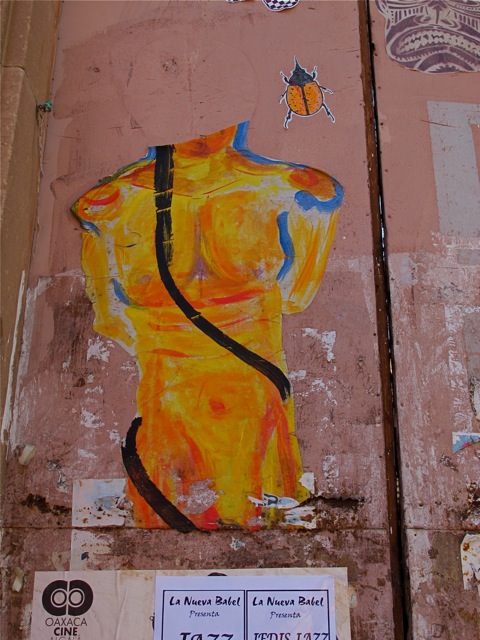
The wall art in Oaxaca never ceases to surprise and delight.

Male torso in yellows and reds with a little blue and black

Pretty buff, no?

Dog days

In Mexico City…

Small dog on leash, sitting, wearing pink sweater and gray ruffled skirt.

In Oaxaca…

Large black mangy dog lying on the plaza

Visual rehabilitation…

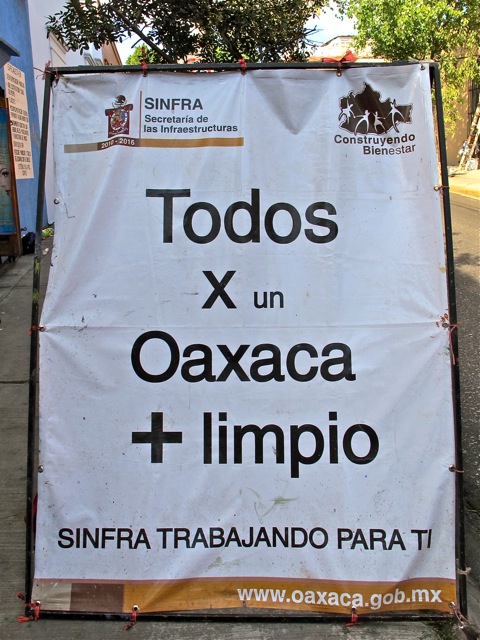
A clean-looking Oaxaca, brought to you by Oaxaca’s Secretary of Infrastructure.

Sign on street:  "Todos x un Oaxaca + limpio"

According to the state government’s website, a 45 million peso project was launched to “visually rehabilitate” 94,000 buildings in 25 urban communities.   Begun in July in San Bartolo Coyotepec (14 miles south of Oaxaca City), it has now reached my ‘hood.

2 painters with 10+ buckets of paint

Ladders, paint buckets, and painters up and down the block.

2 painters painting a pale blue building

By the way, because this is the Centro Histórico, the colors are selected from a previously approved palette.  Baby blue?  I wonder if the owners of the buildings have any say…

David Bacon, one of the most perceptive labor and immigrant rights writer/photographers, interviews Rufino Dominguez, director of the Oaxacan Institute for Attention to Migrants (in English).  Let’s hope this isn’t another program that is all talk, no action.

Oaxaca’s New Government Calls for Migrant Rights

OAXACA, MEXICO The Oaxacan Institute for Attention to Migrants, and its director Rufino Dominguez, called for a new era of respect for the rights of migrants, in commorating [sic] the International Day of the Migrant in the Palacio del Gobierno, Oaxaca’s state capitol building. Representing the newly-elected state government, Dominguez paid tribute to the contributions of the braceros, the first of Oaxaca’s migrant workers to travel to the United States. from 1942 to 1964, and to the women who cared for the families they left behind.

Around the balconies of the palacio’s courtyard hung photographs showing the lives of current migrants from Oaxaca, working as farm laborers in California. Migrant rights activists, artisans and public officials spoke about the important role migration continues to play in Oaxaca’s economic, social, political and family life. The state, in southern Mexico, is the source of one of the largest waves of migration from Mexico to the U.S.

Dominguez, the former coordinator of the Binational Front of Indigenous Organizations, which organizes indigenous migrants in both Mexico and the U.S., was appointed director of the IOAM by Oaxaca’s new governor, Gabino Cue Monteagudo. Cue defeated the PRI, the party that governed Oaxaca for the previous 80 years. In an interview with David Bacon, Dominguez described the different road the new government is taking to ensure social justice for Oaxacan migrants today:

We can’t tell the U.S. government, or the governments of California and other states, to respect the rights of our people who are living there, if we ourselves are not respecting the rights of migrants here in Oaxaca. Many migrants passing through Oaxaca from Central America and other places suffer systematic violations of their human rights.

Have we just paid attention to migrants in the U.S. because they send dollars home? Sometimes the problems of migrants within Mexico are even greater than those we have in the U.S.  [Read full article]