From today’s walk…
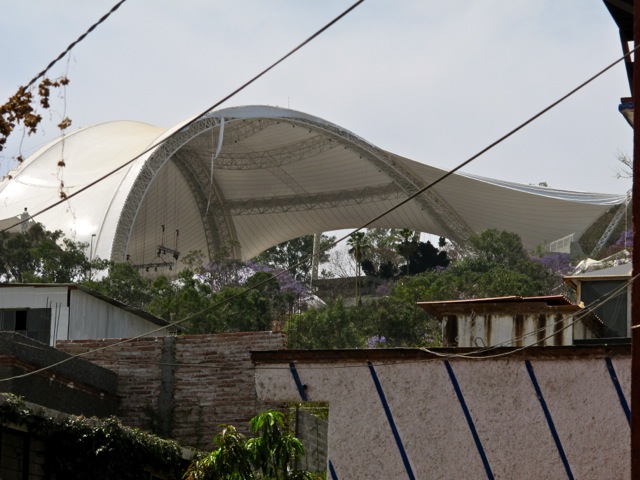
Just a sliver of canvas (or whatever the stingray is made of) left hanging from the missing wing of the Guelaguetza Auditorium.
Chris, over a Oaxaca-The Year After, also has photos. This is big news!
From today’s walk…
Just a sliver of canvas (or whatever the stingray is made of) left hanging from the missing wing of the Guelaguetza Auditorium.
Chris, over a Oaxaca-The Year After, also has photos. This is big news!
Posted in Buildings | Tagged Guelaguetza Auditorium, Mexico, Oaxaca, velaria | Leave a Comment »
Remember the Guelaguetza Auditorium? July 25, 2011…

After moderate winds Friday night, Guelaguetza Auditorium, March 11, 2012…

Something missing here? “Stingray” missing a flap???
According to reports in Sunday’s Noticias, experts at the National Autonomous University of Mexico (UNAM) will conduct an analysis re what happened to cause a part of this controversial and (seemingly) cursed covering to collapse. The report further states, there is a possibility that the warranty will “cover” a replacement and, no matter what the result, the annual July Guelaguetza shows will go on!
A poll on the Vive Oaxaca Facebook page is currently running about 2:1 against replacing the velaria (cover).
Posted in Buildings | Tagged Guelaguetza Auditorium, Mexico, Oaxaca, velaria | 2 Comments »
About two months ago, new street signs began appearing in Oaxaca on each side of each street corner. Eight signs per each 4-way intersection, in Spanish and Braille, are at hand touch and wheelchair eye level, and provide arrows to make it clear if the traffic flows this way…
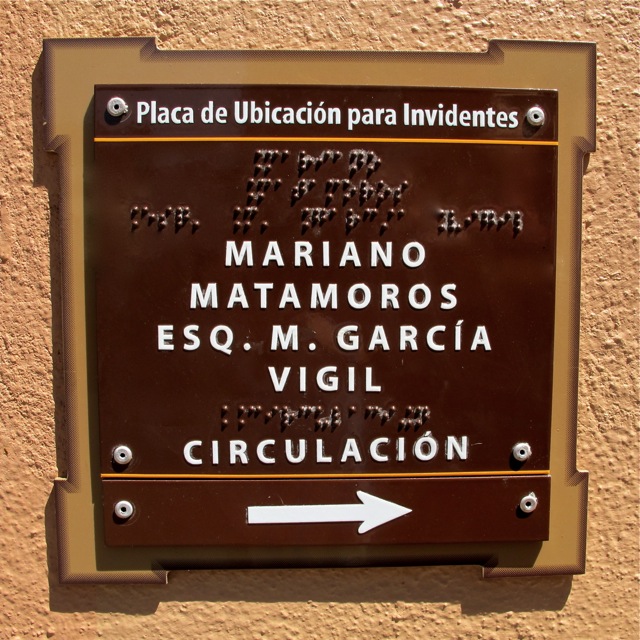
… or that.
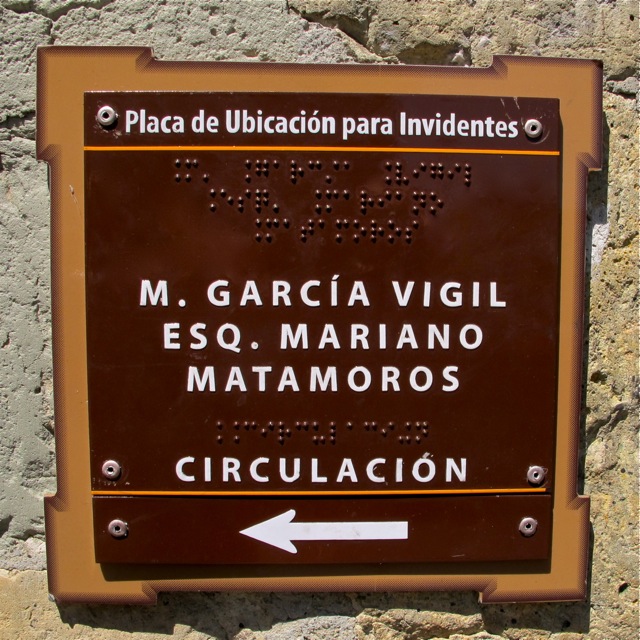
By the way, Oaxaca has a library for the blind and visually impaired — the Biblioteca Jorge Luis Borges, housed in the Biblioteca Infantil in the Barrio de Xochimilco. Named after the blind Argentine writer, the library was founded in 1996 by world-renowned Oaxacan artist, Francisco Toledo. It houses his collection of books in Braille, a permanent workshop teaching Braille, computers with special programs for the blind, and scholarships to outstanding visually impaired students.
Posted in Buildings, Libraries, People, Places, Signs | Tagged Biblioteca Infantil, blind, Braille, Francisco Toledo, Jorge Luis Borges, Mexico, Oaxaca, photographs, photos, street names, street signs, visually impaired | 3 Comments »
Yesterday, having just posted Celebrating the Women of Oaxaca, I set off for my cataloging shift at the Oaxaca Lending Library. As I turned up the Alcalá, I was greeted by bevy of beautiful and colorful women in all shapes, sizes, and lifestyles — Oaxaca’s tribute to women on International Women’s Day. By the way, you can see in the distance in one of the photos, the Migrantes are still here.
Meanwhile, down at the Government Palace, the City Council recognized the history and contribution of 10 women conferring upon each a Distinguished Citizen award; Zapotec women demanded justice for the disappeared and prisoners; and several city workers dismissed over a year ago (according to them, without cause) held a protest demanding reinstatement.
Thus was International Women’s Day in Oaxaca!
Posted in Celebrations, Creativity, Culture, Holidays | Tagged Día de las Mujeres, International Women's Day, Mexico, Oaxaca, public art | 5 Comments »
Today is International Women’s Day, established by V. I. Lenin in 1922, revived by women in the USA in 1968, and recognized by the United Nations in 1975. Here’s to the beautiful, strong, and all around amazing women of Oaxaca!
¡Feliz, Día de la mujer!
The librarian in me can’t help but include a few resources, I put together a few years ago, chronicling the history of International Women’s Day:
Posted in Celebrations, Holidays, Labor, People | Tagged history, International Women's Day, Mexico, Oaxaca, triangle shirtwaist factory | 6 Comments »
Samuel Bautista Lazo is one of the smartest, joyous, and Zen-like people I know.

Sam is my young, previously mentioned, Zapotec friend who is getting his Ph.D. in Sustainable Manufacturing at the University of Liverpool. Sam is from Teotitlán del Valle in Oaxaca, a village watched over by El Picacho, the sacred mountain — whose presence is unmistakable and palpable.

The village is known for its traditional performances of the Danza de la Pluma (about which I’ve posted on numerous occasions) and their skillful and creative weavings with wool. Like a majority of its Zapotec residents, Sam and his family weave — father, Mario Bautista Martínez; mother, Leonor Lazo González; and brother, Celestino Bautista Lazo.

The family was featured last year in an article, The Crafts of Oaxaca, posted on the Lark Crafts website. Like many others, on my first visit in 2007, I couldn’t resist buying a couple of tapetes (rugs), including this one, which now serves as a welcome to all who enter my little casita.

A friend and I returned six months later and had the privilege of climbing to the top of El Picacho with Sam.

And no, I did not join Sam in leaping from one rocky peak to the other!
Looking forward to your return, Sam!
(ps) Here is a Dixza video of Sam from 2008, where he discusses the interpretation of the symbols and patterns woven into Zapotec rugs. You might also want to check out others in his Dixza series from Teotitlán del Valle.
Posted in Creativity, Culture, People | Tagged Celestino Bautista Lazo, Dixza Rugs, El Picacho, Lark Crafts, Leonor Lazo González, Mario Bautista Martínez, Mexico, Oaxaca, rugs, Samuel Bautista Lazo, tapetes, Teotitlán del Valle, The Crafts of Oaxaca, weaving | 5 Comments »
I love going to my little local mercado on Sunday mornings. Steps leading up to it from Independencia are lined with vendors of street food, flowers, religious trinkets, herbs, you name it! Inside, the cavernous building is teeming with more activity than on weekdays. And, these guys are there to entertain diners and shoppers…

I suspect this is a father and his two sons. Marimba playing seems to be a (masculine) family affair.

It isn’t unusual to see these beautiful instruments being carried through the streets and sidewalks of Oaxaca…

… on their way to set up and play traditional “sones” from Oaxaca and/or old pop standards at a fiesta, in front of a shop, or inside a mercado. Muchisimas gracias for a delightful soundtrack!
One of these days, I’m going to shoot video of some of them, but in the meantime, here are a couple from YouTube:
Posted in Culture, Markets, Music | Tagged marimbas, Mercado IV Centenario, mercados, Mexico, Oaxaca | Leave a Comment »
Strolling along Calle Prof. M. Aranda several days ago, I wondered…
maybe this was a case of…

the parts…

being greater…

than their sum.

What do you think?

Urban art by sanez.
Posted in Buildings, Creativity | Tagged Calle Prof. M. Aranda, graffiti, Mexico, Oaxaca, Sanez, street art, wall art | 4 Comments »
Last night I joined a standing-room-only crowd for the book launch of Grandes Maestros del Arte Popular de Oaxaca (Grand Masters of Folk Art of Oaxaca) at the Centro Académico y Cultural San Pablo, in Oaxaca city. This beautiful 340+ page book was the joint effort of the Fundación Alfredo Harp Helú, Fomento Cultural Banamex, the State of Oaxaca, and CONACULTA (National Council for Culture and the Arts).

The press was there in full force, as was governor Gabino Cue, benefactor Alfredo Harp Helu, and a number of other movers and shakers on Oaxaca’s cultural scene. Many of the artisans were also in attendance and several posed for photographs holding their copy of the book at the reception that followed.
One of the artisans who was not there was the late potter, Dolores Porras from Santa María Atzompa, as Parkinson’s disease had claimed her on November 1, 2010. Four pages in the book are devoted to this maestra of pottery and her pioneering work with glazes. Examples of her work can be seen all around Oaxaca, including these scattered in the garden at the hotel, Las Golondrinas.

Her work has inspired imitation, but as is evident in these pieces, her whimsy, creativity, and sense of proportion would be difficult to match.

I want to thank potter Michael Peed for pointing out these hidden treasures…
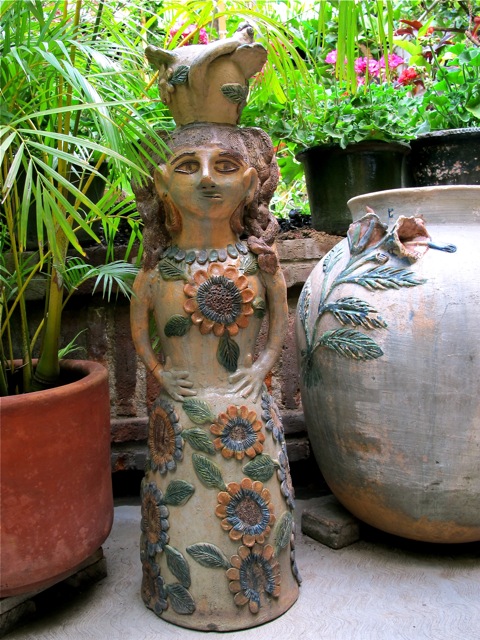
following a showing of his loving documentary, Dolores Porras: Artista Artesana de Barro Santa María Atzompa. (Click here for an excerpt on YouTube.)

And then there is this one, I discovered on my own, the very next day — on a bathroom shelf, no less — at Casa Linda…

Posted in Books, Creativity, Culture, People | Tagged bo, book launch, ceramicist, documentary, Dolores Porras, Grandes Maestros del Arte Popular de Oaxaca, Mexico, Michael Peed, Oaxaca | 1 Comment »
Sunset last night…

as it unfolded.

Sometimes, looking south is the best!
Posted in Nature & Science, Weather | Tagged Mexico, Oaxaca, sunset | Leave a Comment »
Just the thought of introducing genetically modified corn and the chemicals it requires into Oaxaca, where maíz has been cultivated (Just fine, thank you very much!) for thousands of years makes me sad and angry. Education is growing, opposition is mounting, and alternatives to the profits-before-people-and-the-environment Monsantos of this world are being set up. By the way, “agroecology” is a new word for me… and I like it!
From the February 20, 2012 Nation of Change…
By Emilio Godoy
The largely invisible work of small local groups of indigenous farmers in Mexico who are spearheading the defense of their territory and identity and of native seeds is strengthening ecologically sound family farming, experts say.
“For thousands of years, indigenous people have been responsible for developing agricultural biodiversity,” Narciso Barrera, a researcher at the public Autonomous University of Tlaxcala in southern Mexico, told IPS. “However, these efforts remain basically invisible, and they should be highlighted and linked with other local movements.”
Since 2000, Barrera has worked on mapping Mexican political ecology, a discipline that studies the relationships between political, economic and social factors and environmental issues and changes.
<snip>
“Agroecology is the key, because it encompasses social aspects, education, economics and farming practices,” said Barrera, who has published the results of his studies in the Spanish journal Papeles de Relaciones Ecosociales y Cambio Global (Papers on Eco Social Relations and Global Change).
I encourage you to read the full article.
Posted in Agriculture, Environment, Food | Tagged agriculture, Agroecology, Autonomous University of Tlaxcala, corn, cultivation, eco-friendly, family farming, farming, farming practices, indigenous farmers, indigenous peoples, maíz, maize, Mexico, nation of change, native seeds, Oaxaca, organic, political ecology | 1 Comment »
There are only a few more days left to be delighted by “Manos que crean y ojos que leen” (Hands that create and eyes that read), a whimsical exhibition of popular art at the Biblioteca Andrés Henestrosa. The pieces were commissioned by Rosa Blum (who, with Henry Wangeman, owns Oaxaca’s bilingual bookstore Amate Books) to celebrate reading and promote the incredibly creative artisans of Oaxaca who were suffering from a drop in tourism following the social conflict of 2006.
So… If you are in Oaxaca, be sure to see it before it closes at the end of this month. If not, you might want to consider a trip down here (Oaxaca is NOT on the US State Department travel warning list), visit some of these artisans in their villages, see their work up close and personal, and perhaps purchase a few unique treasures from these talented people.
For other pieces in the exhibit, see Chris’s photos over at Oaxaca-The Year After.
Posted in Creativity, Culture, Exhibitions | Tagged Amate Books, Armando Jiménez, artesanias, artisans, Biblioteca Andrés Henestrosa, Concepción Aguilar, Demetrio García Aguilar, Enedina Vásquez, exhibitions, Henry Wangeman, José Hernández, Martín Melchor, Mexico, Miguel Santiago Soriano, Moisés Jiménez, Oaxaca, Raúl López, Rosa Blum | 3 Comments »
LA.com just posted a phone interview with Oaxaca’s own, Lila Downs, where she discusses influences on her musical development, experiences working on the movie Frida, and future projects. The following is the first of eleven questions asked by Paty Elias, in advance of Lila’s Los Angeles performance on Feb. 25, 2012 promoting her album, “Pecados y Milagros.”
From the interview…
LA.COM:: With such a diverse musical background, why did you decide to focus on Ranchera, style music?
Lila Downs: I think that I have been very affected by what has been happening in Mexico. There has been a lot of violence, and I started composing a number of songs that were inspired by retablo, the votive art forms.
It’s about the notion of having a miracle in your life and giving thanks to the sometimes non-visible saints and elements of faith we have in Mexico. I thought it was very fascinating to somehow find the subjects in the songs and then kind of place them in the same way towards showing and giving thanks for the blessings that we have in our life but then also questioning the interpretation of each of these pieces, which are miracles and sins.
Ranchera is really a genre — it’s a form that is kind of about the profane.
There are Rancheras

that are about the celebration of life as well as fertility and perhaps the more Indian elements in our culture.
But I would have to say that the Ranchera is mostly accompanied by tequila or mescal. And I think that’s when we will tell our sins, and that’s why I chose the Rancheras at this point — And of course because its one of the only forms were you can really spill your guts. And I think that’s what we are going through right now. We are in desperate times, and you need something with which you can really express your soul.
For the full interview and a couple of video clips, click HERE.
And for my description and photos from the Nov. 6, 2011 Lila Downs concert at Oaxaca’s Guelaguetza Auditorium, click HERE.
Posted in Culture, Music, People | Tagged LA.com, Lila Downs, Mexico, music, Oaxaca, Paty Elias, Pecados y Milagros, Ranchera | Leave a Comment »
… let us walk together. And we, in Oaxaca city, have been for the past several weeks thanks to Oaxaca born artist Alejandro Santiago.
The streets and sidewalks around Santo Domingo have been peopled with “La Ruta del Migrante – Caminemos Juntos,” his heart wrenching sculptures representing the 2,501 migrantes, men and women, who have left his pueblo of San Pedro Teococuilco almost deserted.
No two sculptures are the same; each is a tribute to the unique individuals who, most certainly with great reluctance, left the homes of their families and ancestors to make their way north in search of jobs. The pain in their contorted bodies, their faces, and their feet causes me to pause every time I pass. I’ll let the images speak for themselves and ask the questions societies all over the world need to answer.
These migrantes on the streets of Oaxaca are scheduled to disappear at the end of the month and I don’t know where they are next headed. However, two documentaries have been made about Santiago’s tribute to migrantes: Twenty Five Hundred & One by Patricia Van Ryker and 2501 Migrants: A Journey directed by Yolanda Cruz.
Posted in Creativity, Culture, Exhibitions, Immigration | Tagged 2501 Migrants, Alejandro Santiago Ramírez, immigration, La Ruta del Migrante, Mexico, migrantes, Oaxaca, public art, San Pedro Teococuilco, Twenty Five Hundred & One | 13 Comments »
… and it never gets old, at least not for me! Thus yesterday, returning from picking up a newly repaired sandal at the zapatero (shoemaker), a parade along the Alcalá had me happily stopping.

Judging by the traje (costume), what is popularly known north of the border as Frida Kahlo style clothing, the elaborate multicolored embroidery on black velvet and the signature starched white lace head pieces, immediately said the Isthmus region of Oaxaca, the area along the Gulf of Tehuantepec.
A banda led off the procession with, of course, the requisite tuba.

A marlin out-of-water followed the band. Actually, a friend and I had a discussion about what kind of fish it was. Marlin (blue and black), sailfish, and swordfish are found in the waters of the Gulf of Tehuantepec. After looking at this website, I’m thinking this guy is a marlin, but who knows???

Once home and photos downloaded, the detective work began; trying to figure out what this was all about. Putting together the information I could glean from the banners and a little research, I think this was a parade by people from San Blas Atempa celebrating a traditional fiesta titular.

Naturally, there weren’t just beautifully dressed adults. Adorable little boys…

and girls kept up the pace on this bright sunny 80+ degree day.

I wasn’t the only one watching… Alejandro Santiago’s growing army of Migrantes stood transfixed. (Well, actually they are literally affixed to the sidewalks and streets with some sort of gooey glue.)

Just another day and another parade in paradise!
Posted in Celebrations, Culture | Tagged 2, 501 Migrants, Alejandro Santiago, calenda, Gulf of Tehuantepec, Isthmus of Tehuantepec, La Ruta del Migrante, marlin, Mexico, Oaxaca, parade, San Blas Atempa, Tehuana | 3 Comments »


 Mexican Peso Converter
 View From Casita Colibrí