Feeds:
Posts
Comments

Archive for the ‘Travel & Tourism’ Category

Crossing the Plaza de la Danza, on my way to the market this morning, I saw stilt people!
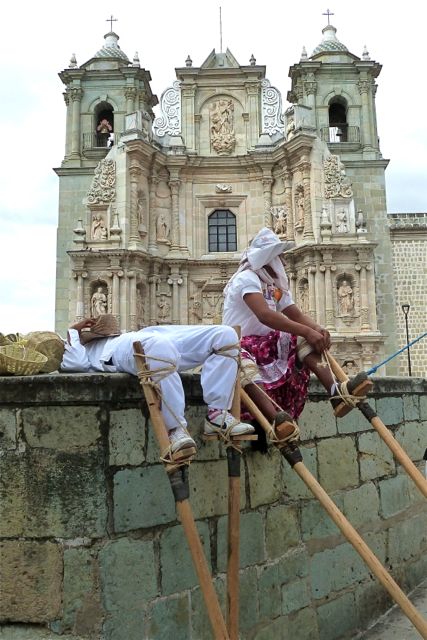
Stilt dancers sitting on ledge, Basilica of Soledad in background

The all-male stilt dancers of Villa de Zaachila were waiting to perform the Danza de los Zancudos at the 22nd conference of the Oaxaca-Centro Alcoholics Anonymous.  Once they took the stage there was much cheering and good-natured catcalls from the 75% male audience

The Dance of the Zancudos originated in the San Pedro neighborhood over 100 years ago and is one of the few places the dance can still be found. The origin of the Dance of the Zancudos is in a promise the inhabitants of Zaachila made to Saint Peter. The story behind it states that an old man encountered an apparition of Saint Peter who asked the community build a church in his name. The apparition appeared each day until it was captured by the local people and enclosed in a small church. Guards were posted at the entrance with rifles and machetes. However, the next day, it was discovered that the saint was no longer there, and he appeared again to the old man who had originally seen him, indicated that God had sent him to protect the village. Eight days remained until the feast of Saint Peter, and the saint asked that the villagers form pairs on stilts to dance. On the feast day, the men danced on stilts while the women surrounded them with candles and incense. The dancers arrived at the foot of a hill where an image of the saint was found, which was brought to the San Pedro neighborhood where a church was constructed for it.  [Wikipedia.  Retrieved, 11/10/2013]

They performed several dances and, to the cries from the audience of, “Otra, otra, otra,” they were ready with an encore.  Baskets that had been tied to their costumes were thrown into the crowd (a la La Guelaguetza) and they exited stage right.  By the way, getting down off the stage on stilts requires a lot of help from your friends.  But once that complexity is navigated, you get to stroll over to a ledge high above everyone’s head, and have a seat.
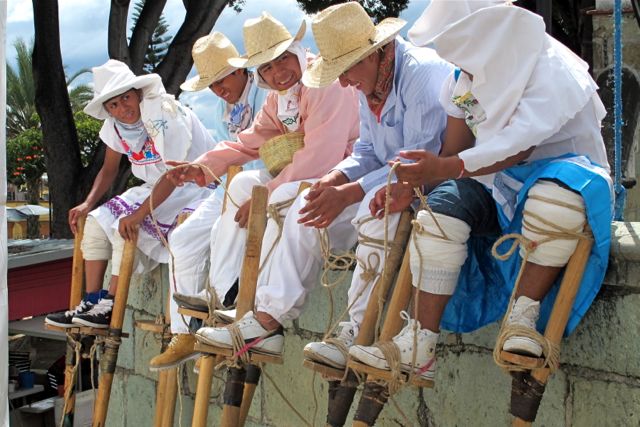
5 stilt dancers sitting on a ledge.

Reason number 521 to never go anywhere in Oaxaca without my camera!

Read Full Post »

The souls  have departed.   And, following 33 hours of travel, my BFF (along with her alebrijes by Alberto Perez and the Xuana family, a traditional black and white rebozo, bottle of Del Maguey mezcal from Chichicapa, several bags of Conchita chocolate, and a fabulous mohair rug woven by Antonio Ruíz Gonzalez), has returned home to the frigid climes of Alaska.  However, gal pal, souls, and the mortals with whom we shared the past, have left warm and lasting memories.  They have also left an exhausted gringa, whose brain feels like one of those overloaded small trucks one (more than occasionally) sees on the roads here.  With every nook and cranny filled, they move at a snail’s pace, be it along a pot-holed dirt road or the carretera, balancing their top-heavy loads.

Our week began on October 29, when the sounds of a band Pied Piper-ed us down the street and around a corner to a comparsa of high school students, who were taking part in a competition of using recycled products for their costumes and floats.  Alas, the rains came and eventually chased us home.

On October 30, delectable dining (lunch at La Biznaga and dinner at Los Danzantes) nourished multiple museum visits and allowed us to join the standing-room-only crowd at the Oaxaca Lending Library (without rumbling stomachs) to watch the wonderful new documentary, La Festividad de los Muertos, chronicling Day of the Dead in Teotitlán del Valle.

Then there was Thursday, the 31st….  A shopping expedition for flowers, sugar skulls, bread (pan de muertos), and two 10-foot long stalks of sugar cane to form the arch over my altar.  I carried them the 10-blocks home on my shoulder (sheesh, they are heavy) and carefully navigating the busy sidewalks.  According to BFF, I provided pedestrians and passengers in buses,cars, and taxis much entertainment.  I didn’t see a thing — I was just trying not to trip, fall, or whack anyone in front, behind, or to the sides of me!

Once the candles, photos, bread, chocolate, beverages (cervesa, mezcal, and water), and meaningful objects to our departed were in place; flowers arranged and cempasuchitl (marigold) petals scattered; and the arching sugar cane affixed to the wall surrounding our ofrenda, we made our way down to the beginning of the CEDART comparsa.

Later in the evening, we drove up to the panteón in Santa María Atzompa.  Passing the bright lights and crush of food, flower, pottery, and other vendors that line the entrance and finally emerging from under the arched gateway, the candlelit ethereal beauty of the cemetery on this night never ceases to take my breath away.  Of course, it wasn’t all exquisite and unearthly enchantment.  This is Mexico and so there was also a (very loud) band and the cervesa and mezcal flowed freely.  I’m sure the difuntos (deceased) enjoyed themselves and partied hardy with the living until the sun rose.  And then all slept.

On the other hand, we left at a reasonable hour, as we were only at the mid-point of our Día de los Muertos marathon.  More to come…

Read Full Post »

It’s been a magnificent Muertos filled with memorable moments and special people, along with a feast for ALL the senses.  An initial pass through the photos has weeded them down to 450.  Yikes!  Lots more weeding and processing to do.  In the meantime, here is a snapshot from the past 5 days.

And the magic continues today, when we return to San Antonino Castillo Velasco.

Read Full Post »

My BFF (since age 12 — I won’t say how many decades ago that was) arrived last night from Alaska.  It was her first trip to Mexico and it took 22 hours.  Of course we talked late into the night, thus the morning unfolded slowly.

However, eventually we emerged into the hustle and bustle of the temporary muertos stalls near 20 de Noviembre mercado, to begin purchasing the elements for our Día de los Muertos ofrenda:  Apples, oranges, and nuts to nourish the spirits, cempasuchitl (marigolds) to guide the spirits, cockscomb to symbolize mourning, and copal incense to draw the spirits home and ward off evil .

Muertos Altar

As you can see from the above chart, we have much more to buy and bring out of the storage closet.  And, the above list doesn’t even mention sugar cane stalks!

h/t Chef Pilar Cabrera for posting the chart on Facebook.

Read Full Post »

Cempasuchitl, catrinas, and comparsas.  El día de los muertos is coming…

Mural at the corner of Aldama and Hidalgo in Barrio de Jalatlaco.

Read Full Post »

Around this time of year, the gringo and Canadian (they are adamant they are NOT gringos) population in Oaxaca begins to grow — an increase that will last for the duration of winter.  Called “snowbirds” by the resident ex-pats, they are an eclectic and interesting crowd.  Among them are a couple of talented people with whom I have become acquainted —  San Francisco Bay Area based writer, Robert Adler (who, along with Jo Ann Wexler, publishes the invaluable, Viva Oaxaca) and Seattle photographer, Tom Feher.

Robert and Tom have embarked on an ambitious project interviewing and photographing undocumented immigrants on their arduous and dangerous journey from Mexico and Central America, en-route to El Norte.  The result is to be a traveling exhibition of 24 to 30 of near life-size images on narrow aluminum sheets designed to be hung from the ceiling and accompanied by a booklet with the biography of each immigrant.  The exhibition will be called, I Have a Name — the title coming from a neighbor of Tom’s, “who, having hired a Latino man to do some work, refused to call him by his right name and referred to him only as “the Mexican”, even though he was from Guatemala. ”

The decision to leave all that is known and loved for distant country and alien culture is not undertaken lightly.  The creators of this project hope, in the words of Robert, that the exhibit, “will convey what we’ve been learning firsthand–that it’s one thing to have a concept such as ‘migrant,’ ‘migrant worker,’ ‘undocumented worker,’ or ‘illegal alien,’ and quite another to know people as individuals with their own names, faces, life stories and dreams.”

This is an expensive project and Robert and Tom need your help to bring I Have a Name to fruition.  They have mounted a fundraising campaign on the crowd-finding site, Indiegogo.  Please consider helping them raise $25,000 before their November 25, 2013 deadline.

Read Full Post »

Young man painting face of another young man

How now, spirit! whither wander you?  — Puck, Midsummer Night’s Dream.

Close-up of face painting

Just another Wednesday walk in Oaxaca.

Read Full Post »

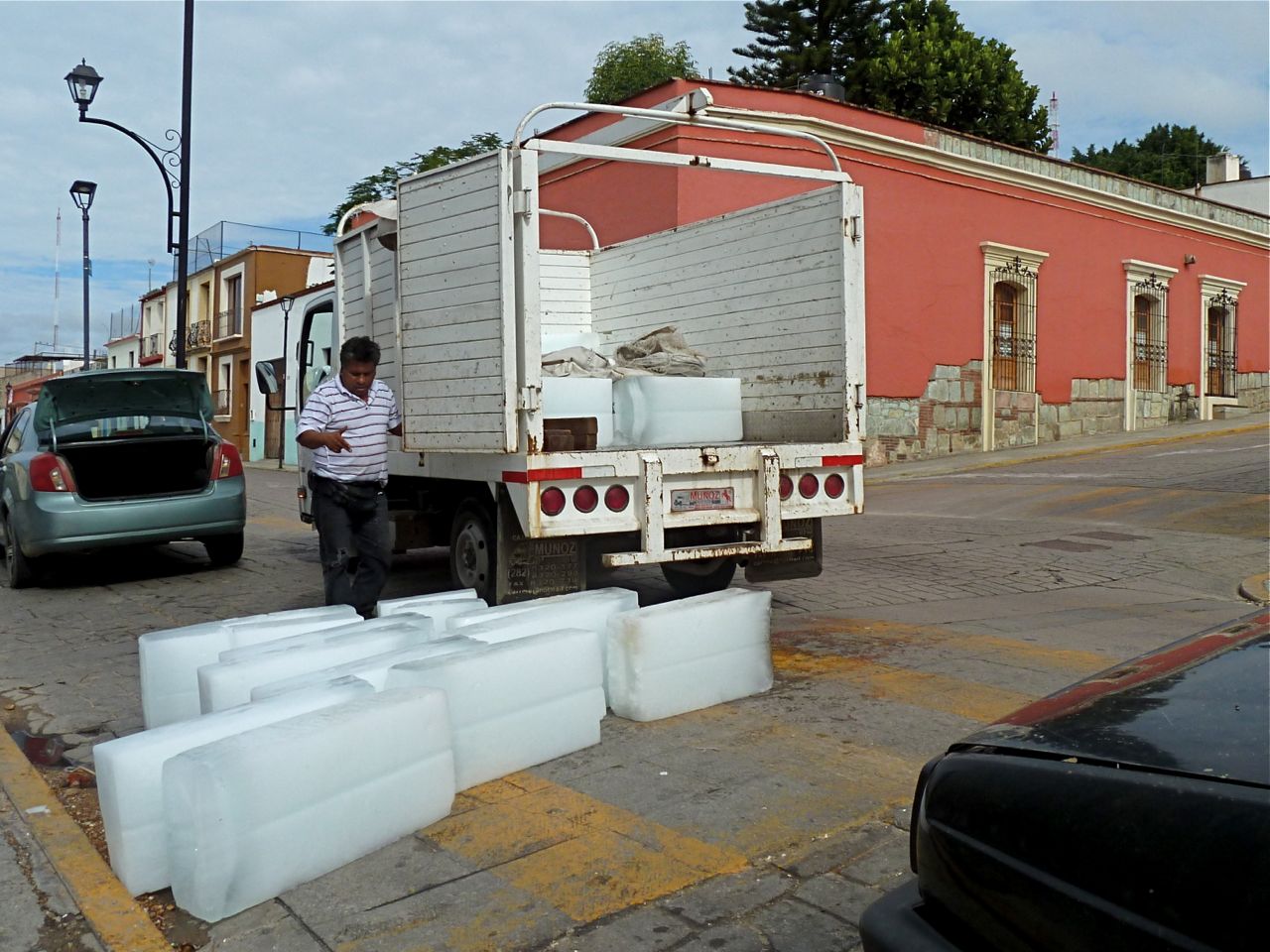
Sunday morning, walking up Avenida Morelos, The Iceman Cometh.

Truck with blocks of ice

Arriving at Mercado IV Centenario, marimba rhythms start to play

2 men playing marimba

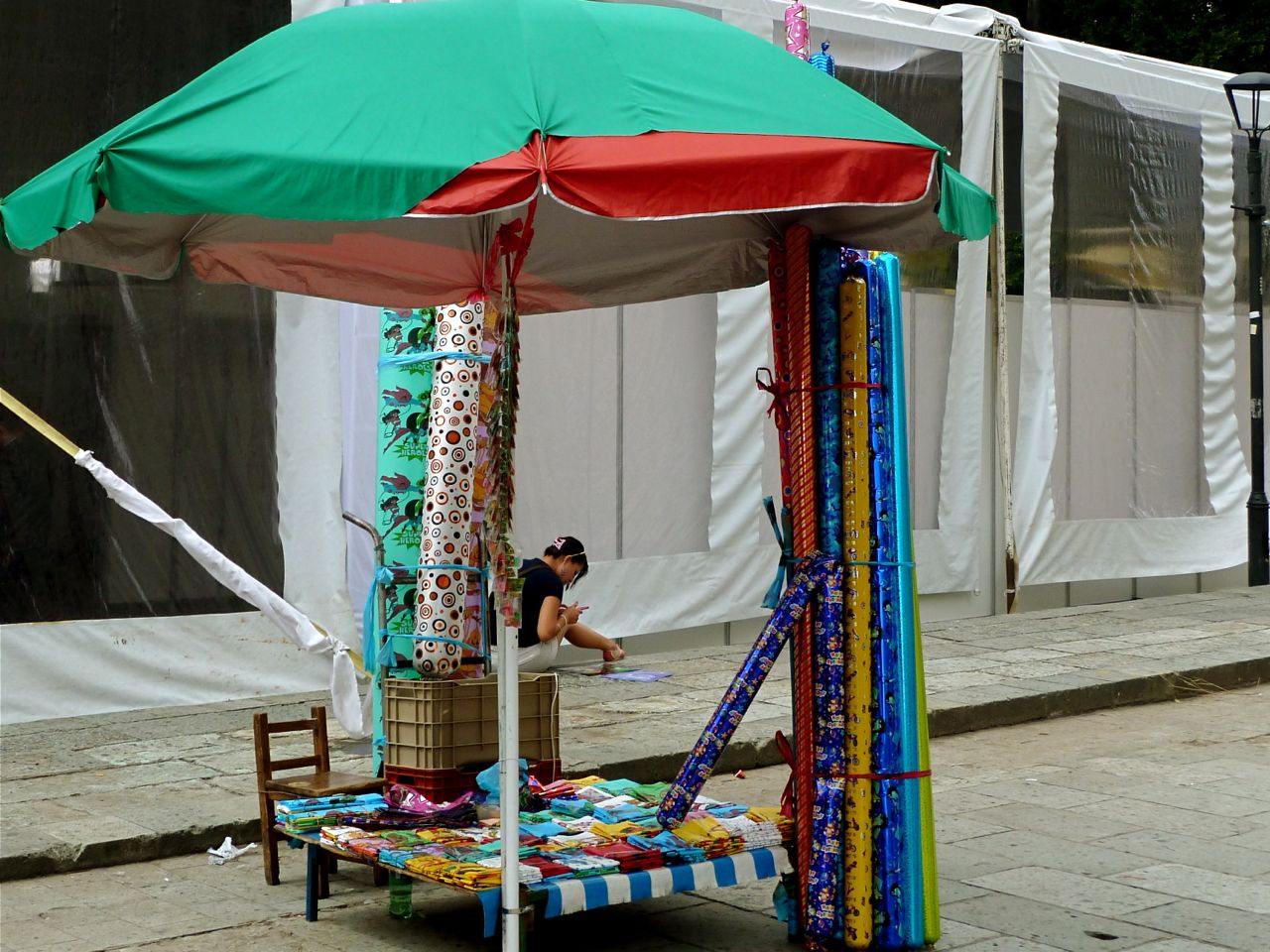
Down to the zócalo.  As Winnie the Pooh said, “Nobody can be uncheered with a balloon.”

P1120103

Sunday morning strolls through the streets of Oaxaca always make me smile.

Read Full Post »

Sometime around 8,000 years ago, corn was first domesticated in the valley where I have the privilege of living.  Botanists have determined that the valley of Oaxaca was the “cradle” of maize evolution.  Maíz became the lifeblood of the Mesoamerican diet and culture and it continues today.

On September 29, Oaxaca celebrated el Día Nacional del Maíz Nativo (National Native Corn Day).  On the zócalo, across from the Government Palace, there were displays showcasing the multiple hues of native corn…

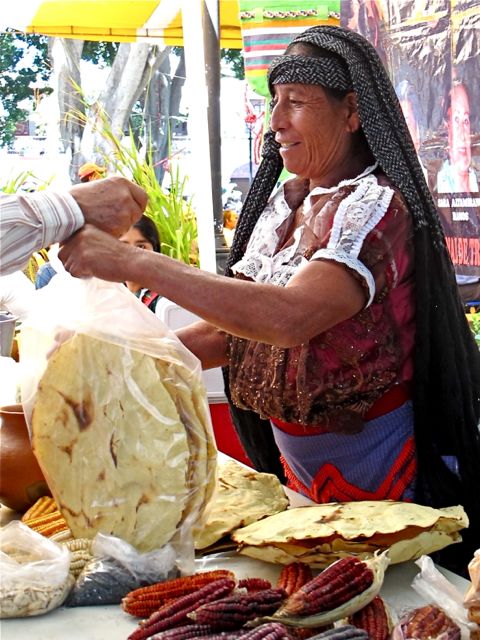
There were tlayudas for sale…

IMG_5627

However, there were also warnings about the dangers of genetically modified corn and the products containing them…

Genetically modified corn is a major issue in Oaxaca.  There is a concern that native plants could become infected with GMOs, which would then contaminate and compromise the genetic diversity of native varieties.  Speakers, at the event, discussed the importance of the community seed banks that have been established to safeguard native varieties and be used in the wake of economic and ecological crisis.  Two weeks after the aforementioned event, there was good news, a Mexico judge has placed an indefinite ban on genetically engineered corn.

And so to celebrate, I am re-posting the Lila Downs video of her song “Palomo del Comalito,” paying homage to maíz, and its “granitos de cristal” (grains of crystal).

And to bring this post full circle, the video was filmed in Teotitlán del Valle, located here in the valley where corn was first cultivated.

Read Full Post »

On the one hand, headline from today’s New York Times, Viewing U.S in Fear and Dismay.  On the other hand, the view from my balcony.

Red African tulip tree blossom against clear sky.

One of the last African tulip tree blossoms of the season.  Ahhh…

Read Full Post »

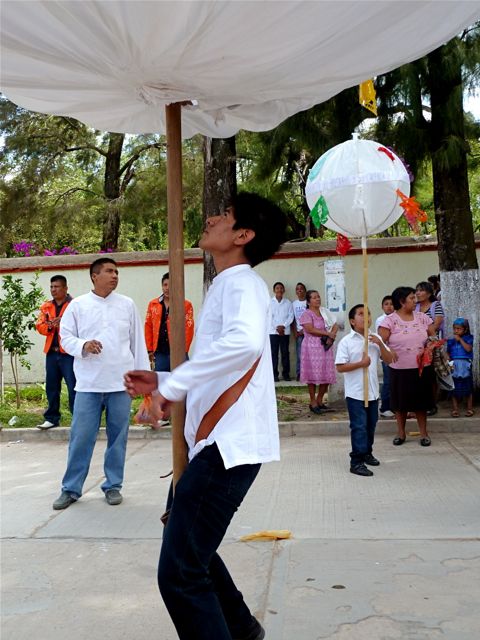
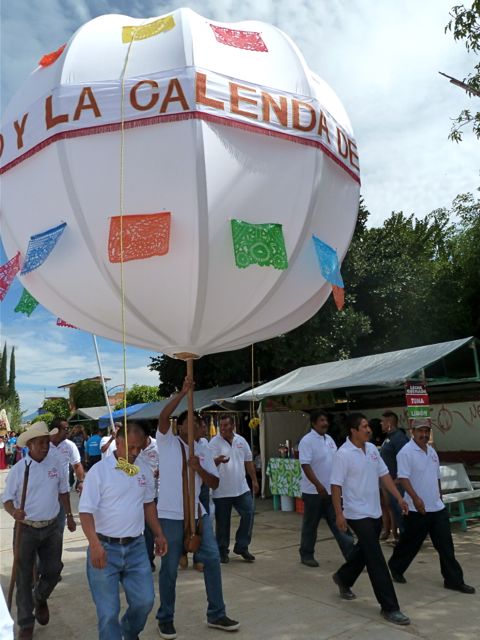
There is a lot of work that goes into getting a marmota ready to go to the dance.  Getting dressed takes a quite a crew and there is a lot of up close and personal last-minute cinching that must be done.   Then there is squeezing (she does weigh over 70 kilos) through the church plaza portal, to make her grand entrance onto the street.  However, once she emerges, she joins with her friends to dance through the streets of Tlacolula de Matamoros late into the night!

This slideshow requires JavaScript.

Calenda in honor of el Señor de Tlacolula, October 11, 2013.  Living history from the valley where corn was first cultivated.

Read Full Post »

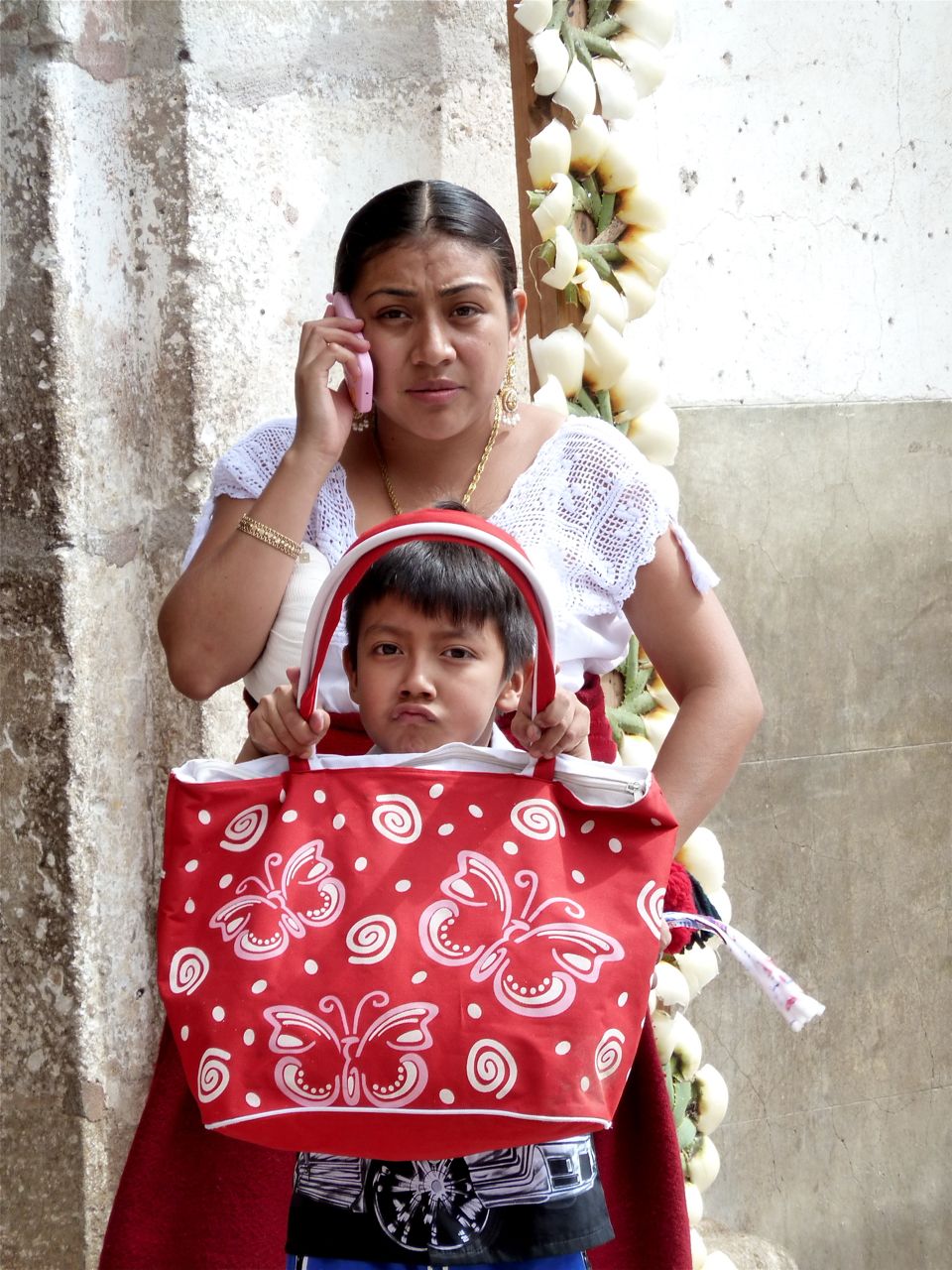
Woman on cell phone & handles of bag framing boy's face boy

Outside Templo de Santa María de la Asunción, Tlacolula de Matamoros, on Friday, waiting for the calenda to begin.

Read Full Post »

Before returning to honor al Señor de Tlacolula this Friday, I figured I’d better finish posting pics from last Friday’s la Virgen del Rosario calenda.

This annual procession slowly winds its way through the streets of Tlacolula de Matamoros.  Participants stop at “stations” throughout the village, where religious ritual is performed, rest breaks are taken, and tamales, sweets, and beverages (yes, including mezcal) await.  This goes on until after midnight.  I don’t know how they do it!

Read Full Post »

Yesterday, we headed about 20 miles southeast of the city to Tlacolula de Matamoros for their calenda (parade) in honor of la Virgen del Rosario (the Virgin of the Rosary).   While we go to Tlacolula often, especially for their Sunday market, and while we’ve been to countless calendas, this particular one was a first — and what fun it was!

I’m always amazed at the variations from one village to another — even those only a few miles apart.  I have to say, one of the most striking features of Tlacolula’s calenda was the masses of marmotas.  No, I’m not talking the groundhog/woodchuck variety.  These, at their most awesome, are ginormous cloth globes on a pole that are carried in every calenda I’ve ever seen down here.

P1110270

Little boys start out with little marmotas — learning how to position it in the holster and becoming comfortable carrying it for several blocks.

The pre-teens graduate to bigger and heavier marmotas and the lesson here is one of balance — learning to find one’s center — and that you get by with a little help from your friends.

Teens refine their moves and their “look.”  Look ma, no hands!  After all, a central part of the calenda is a procession of the unmarried girls and young women of the village!

P1110318

Young men eventually become good-natured and married journeymen…

P1110282

I’m guessing it never ceases being a source of macho pride — enough to tempt one of Tlacolula’s senior citizens into showing, he’s still got it!

P1110350

And then there was the gringo…

P1110280

Check out Oaxaca–The Year After for this hilarious tale in his own words.  (I’m still laughing!)

P1110397

Marmotas on parade —  it was a spectacular sight!

Read Full Post »

Remember the childhood riddle, “What’s black and white and red all over?”

Old answer:  A newspaper.  New answer:  The walls of Oaxaca.

Read Full Post »

« Newer Posts - Older Posts »