Feeds:
Posts
Comments

Archive for the ‘Politics’ Category

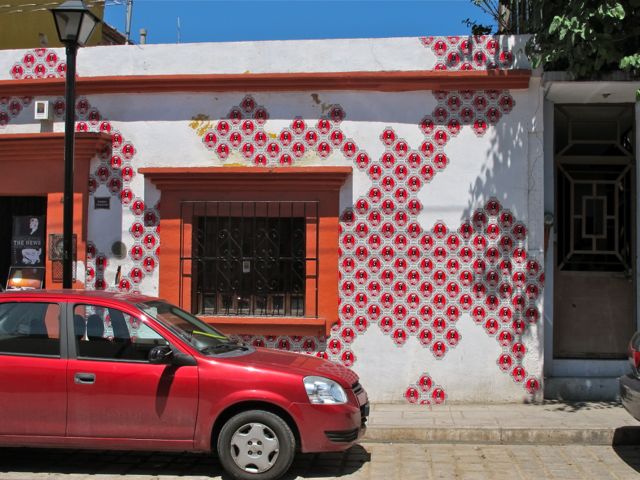
Remember the childhood riddle, “What’s black and white and red all over?”

Old answer:  A newspaper.  New answer:  The walls of Oaxaca.

Read Full Post »

Yesterday, as today’s article in Noticias states, “with great dignity and head held high” the Triqui families from San Juan Copala pulled up stakes and moved to temporary housing in Colonia Reforma.  The 105 displaced families had been occupying the front of the Government Palace for several years, but reached an agreement with the state government to relocate.

Meanwhile, on the east side of the Government Palace, the band played on…  September is “La mes de la patria” (the month of the motherland).  Tomorrow night, governor Gabino Cue will repeat El Grito de Independencia (the Cry of Independence) from the balcony of the Government Palace and Monday, an hours-long patriotic parade will pass in front of the Palace.

Today, the scene has changed.  Members of the Frente Único de Lucha (FUL), the new incarnation of APPO, have taken up positions in front of the Government Palace and vowed to remain until those arrested in clashes with the federal police, on December 1 and yesterday in Mexico City, are released.  Hmmm… I wonder what will happen tomorrow and/or Monday.

Just remember, when you read, hear, or watch the news…  Chiapas, Guerrero, and Oaxaca are the most indigenous and poorest states in Mexico.  And now, the tears of Mother Nature are raining down on Oaxaca.

Read Full Post »

Another revealing article by one of my favorite journalists, David Bacon

What real immigration reform would look like

Clue: It’s Not a New Guest Worker Program

By David Bacon

Oralia Maceda, an immigrant mother from Oaxaca, asked the obvious question recently. At a meeting, talking about the Senate immigration reform bill, she wanted to know why Senators would spend almost $50 billion on more border walls, yet show no interest in why people leave home to cross them.

This Congressional blindness will get worse as immigration reform moves to the House. It condemns U.S. immigration policy to a kind of punitive venality, making rational political decisions virtually impossible. Yet alternatives are often proposed by migrant communities themselves, and reflect a better understanding of global economics and human rights.

Rufino Dominguez, who now works for the Oaxacan state government, describes what Maceda knows from experience: “NAFTA forced the price of corn so low it’s not economically possible to plant a crop anymore. We come to the U.S. to work because there’s no alternative.” The reason for the fall in prices, according to Timothy Wise of the Global Development and Environment Institute, is that corn imports to Mexico from the U.S. rose from 2,014,000 to 10,330,000 tons from 1992 to 2008.

Mexico imported 30,000 tons of pork in 1995, the year NAFTA took effect, and 811, 000 tons in 2010. This primarily benefited one company, Smithfield Foods, which now sells over 25% of all the pork in Mexico. Mexico, however, lost 120,000 hog-farming jobs alone. The World Bank says extreme rural poverty jumped from 35% to 55% after NAFTA took effect due to “the sluggish performance of agriculture, stagnant rural wages, and falling real agricultural prices.”

Read full article HERE.

Read Full Post »

It may be Good Friday and the streets of Oaxaca may be blocked while processions marking the Stations of the Cross pass by and Mexico may be overwhelmingly Roman Catholic.  BUT, when it comes to politics, the Mexican constitution demands the church must mind its own business.

After Mexico court ruling, gay couple weds in Oaxaca

Two women became the first same-sex couple to marry in the southern Mexican state of Oaxaca after the Supreme Court found the state’s definition of marriage unconstitutional, a gay rights group said Thursday.

Mexico City is the only jurisdiction in the deeply Catholic country that has authorized same-sex marriage.

But in December, the top court ruled that Oaxaca’s civil code, which states that marriage is only between a man and a woman for the purpose “to perpetuate the species,” violates the constitution.

The Oaxaca Front for the Respect and Recognition of Sexual Diversity, which had taken part in the legal challenge, announced Thursday that two women got married on March 22 during a private ceremony.

The two women, along with two other gay couples, had appealed to the Supreme Court after Oaxaca state authorities refused to marry them.

Gay rights groups have voiced hope that the court ruling would pave the way for the legalization of same-sex marriage across Mexico.

Argentina is the only Latin American country to authorize such marriages, while Uruguay is considering a similar law.

Mexico giving the USA a lesson in the separation between church and state.  U.S. Supreme Court, are you listening?

Read Full Post »

Old news, I know, but couldn’t resist…  Mitt may have had his “binders of women,” but Oaxaca has her walls of women and they could kick some serious @#$!!!

Liberty  ~  Equality  ~  Respect

Read Full Post »

Yesterday in the United States…

Former Senate Majority Leader Bob Dole (R-Kan.) made a rare Senate appearance this morning, sitting in a wheelchair just off the floor so that members would have to see him as they entered the chamber. Why? Because they were poised to vote on ratification of the U.N. Convention on the Rights of People with Disabilities, and Dole hoped to send a message.

It didn’t work. The Senate killed the treaty this afternoon, with a final vote of 61 to 38, which seems like a lopsided majority, but which fell short of the two-thirds necessary for ratification.  [Link to full article in The Maddow Blog]

Today in Mexico…

Mexico’s Supreme Court issued a unanimous ruling Wednesday striking down a marriage ban in the southern state of Oaxaca. Advocates say the language of the decision could open the door for same-sex marriages throughout the nation. 

The ruling effectively changes Oaxaca’s civil code to state that marriage takes place “between two people,” instead of between a man and woman, reports Spanish-language site AnimalPolitico.

The Court ruled in favor of three same-sex couples who sued the state of Oaxaca for the right to marry. The ruling does not immediately eliminate marriage equality bans in other Mexican states, but it does set a legal precedent to begin challenging statewide marriage bans, according to the blog AfterMarriage.  [Link to full article in The Advocate]

I am not the only gringa and gringo who is speechless re how low US politicians have sunk.  A gal pal (since we were 12) who now lives in Mexico and is confined to a wheelchair due to MS just posted on Facebook that she is “disgusted and, frankly, very upset” and feels “like traveling to Washington and getting in their face.”  And, Chris over at Oaxaca-The Year After asks, Seriously?

Which country do I feel prouder to live in?  ¡Bravo, México!

h/t  Michelle V.

Read Full Post »

November 25, 2012 marks the sixth anniversary of the bloody attack by the Federal Preventive Police on the teachers and members of the Popular Assembly of the Peoples of Oaxaca (APPO) in the zócalo of the city of Oaxaca.  I wasn’t here during the 5-month long struggle, but its repercussions continue to reverberate.

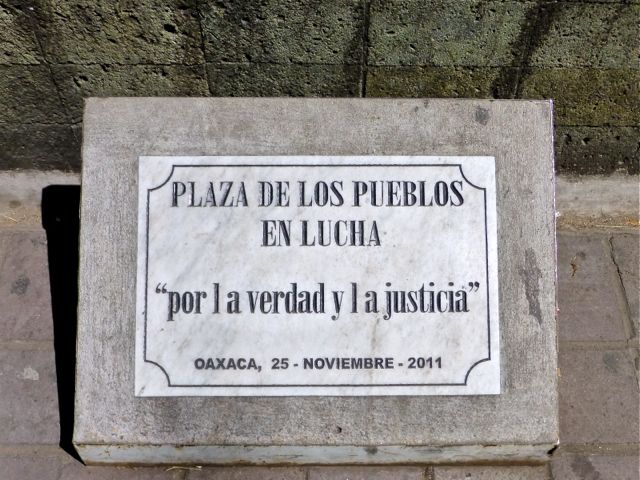
Plaque "Plaza de los pueblos en lucha." "por la verdad y la justicia" Oaxaca, 25 - noviembre - 2011

Last year a plaque was unveiled by organizations representing victims, survivors, human rights, and social activists.  Located where the Alameda de León meets the zócalo, it symbolically renames the zócalo, “Plaza of the peoples in struggle; for truth and justice.”

Man with cap looking at photos

Truth and justice have not been attained, assassins go unpunished, many of the same issues remain, and Oaxaca’s economy still hasn’t rebounded.  Today, the Survivors and Former Political Prisoners of Oaxaca in Defense of Human Rights (SEPODDH) mounted a photo exhibition across from the Government Palace.

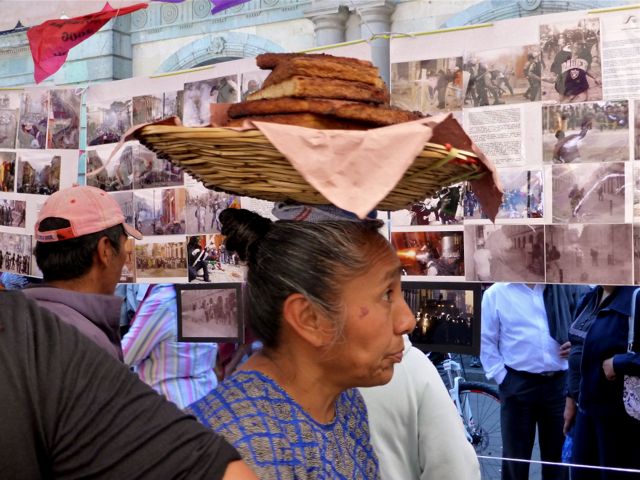
Women looking at photos, with a basket of sliced bread on her head.

Adults, children, and even vendors stopped to look and, for many, remember those days and nights six years ago.

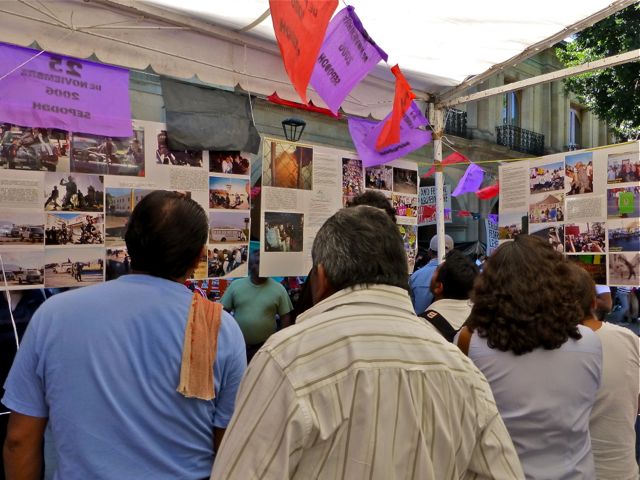
Crowd of people looking at photos

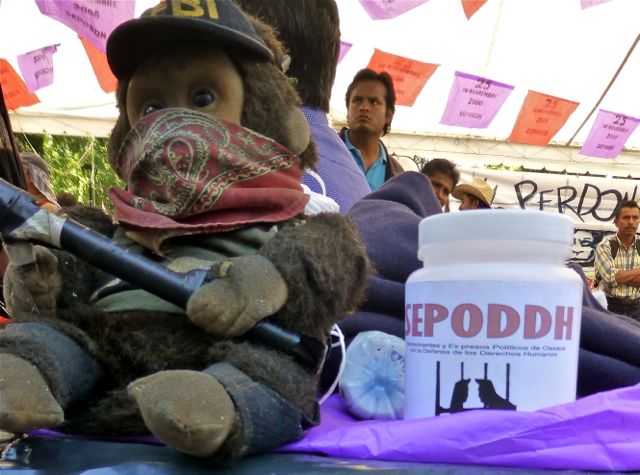
Somber and unsmiling, they stood silently, gazed at the photos, and read the captions.  The only hint of levity was SEPODDH’s mascota, who sat beside a collection bucket.

Plush monkey wearing bandana across his face.

Section 22 of the teachers’ union held another march and rallied in the zócalo, but today these photos spoke much louder than the words coming from the loud-speakers.

Read Full Post »

They say, “politics makes strange bedfellow.”  Rivers do too, as US, Mexico reach pact on Colorado River water sale.  Hopefully, Mexico isn’t getting the short end of the stick, like Southern California’s Imperial Irrigation District is accusing its SoCal neighbor, the Metropolitan Water District, of handing it.

Having grown up and spending most of my life in Northern California and suffering through a couple of major droughts that included water rationing, while water flowed south to fill LA’s swimming pools and water its lawns, the only answer to stave off the upcoming worldwide “water wars,” is the recognition that water is a precious resource that must be conserved and not wasted.

Hmmm… I wonder how these neighbors on the 500 block of Avenida Morelos get along?

Front of Iglesia Evangelica Bautista

Outside of vegetariano Flor de Loto restaurant

Sign on building, Mezcalería In Situ Torrentera

The mezcalería is the newest addition to the ‘hood and for some reason it tickled me that the vegetarian restaurant is the only thing standing between it and the Baptist church.

Read Full Post »

White, one-story building with stickers on front

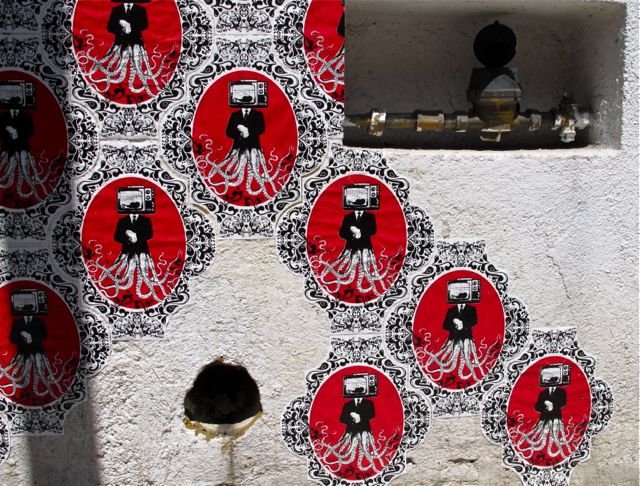
Stickers of a person with a monitor for a head and tentacles for legs, on front of building

Close up of sticker of a person with a monitor for a head and tentacles for legs, on front of building

Graphic in red, black, and white of dead canary in a cage on a TV moniter

Read Full Post »

I’ve been intending to post these photos for six months, but there has been so much going on in Oaxaca, I haven’t gotten around to it — until now.  This morning’s Guardian article, Trotsky’s murder remembered by grandson, 72 years on, caught my eye and I thought, if not today, when?  So, here goes…

When I was in Mexico City in January, I made somewhat of a pilgrimage out to the borough of Coyoacán.  Besides a lovely stroll through the Viveros de Coyoacán, being dazzled by the light and color of the Museo Frida Kahlo, and enjoying a delicious comida on the Plaza Hidalgo, I spent an incredibly moving three hours at the Museo Casa de Trotsky, the home, and now museum, of Russian revolutionary leader Leon Trotsky and his wife Natalia Sedova.  However, before getting to the photos, a very brief bit of context is necessary.

Hounded all over the world by Joseph Stalin and his agents, in 1937 Trotsky and Natalia Sedova were offered asylum by Mexican president Lázaro Cárdenas.  Trotsky’s orphaned grandson, Esteban Volkov (Seva), joined them not long after.  Seva narrowly escaped being murdered in his bed during the first attempt on Trotsky’s life in the Coyoacán house by Mexican muralist, David Alfaro Siqueiros.  It was during this attack that Trotsky guard, Robert Sheldon Harte was killed.

The house at Avenida Viena 19 was further fortified, but Stalinist agent, Ramón Mercader, under an assumed name was able to infiltrate Trotsky’s inner circle and, on August 20, 1940, under the ruse of asking Trotsky to look at something he had written, attacked him with an ice axe.  Trotsky died in hospital a little more than 24 hours later.  His ashes and those of Natalia’s reside in the peaceful garden of the Coyoacán house in a monument, designed by Irish-Mexican painter and architect Juan O’Gorman, that proudly flies a red flag and features the overlapping hammer of the worker and the sickle of the peasant.  The house and furnishings remain much as they were 72 years ago, bullet holes from the first attack and all.

This slideshow requires JavaScript.

The humanity expressed in the words below were felt as I wandered through the house and museum and I must admit, tears welled up as I stood before O’Gorman’s monument.

Trotsky’s Testament, dated 27 February 1940

My high (and still rising) blood pressure is deceiving those near me about my actual condition. I am active and able to work but the outcome is evidently near. These lines will be made public after my death.

I have no need to refute here once again the stupid and vile slanders of Stalin and his agents: there is not a single spot on my revolutionary honour. I have never entered, either directly or indirectly, into any behind-the-scenes agreements or even negotiations with the enemies of the working class. Thousands of Stalin’s opponents have fallen victims of similar false accusations. The new revolutionary generations will rehabilitate their political honour and deal with the Kremlin executioners according to their desserts.

I thank warmly the friends who remained loyal to me through the most difficult hours of my life. I do not name anyone in particular because I cannot name them all.

However, I consider myself justified in making an exception in the case of my companion, Natalia Ivanovna Sedova. In addition to the happiness of being a fighter for the cause of socialism, fate gave me the happiness of being her husband. During the almost forty years of our life together she remained an inexhaustible source of love, magnanimity, and tenderness. She underwent great sufferings, especially in the last period of our lives. But I find some comfort in the fact that she also knew days of happiness.

For forty-three years of my conscious life I have remained a revolutionist: for forty-two of them I have fought under the banner of Marxism. If I had to begin all over again I would of course try to avoid this or that mistake, but the main course of my life would remain unchanged. I shall die a proletarian revolutionary, a Marxist, a dialectical materialist, and, consequently, an irreconcilable atheist. My faith in the communist future of mankind is not less ardent, indeed it is firmer today, than it was in the days of my youth.

Natasha has just come up to the window from the courtyard and opened it wider so that the air may enter more freely into my room. I can see the bright green strip of grass beneath the wall, and the clear blue sky above the wall, and sunlight everywhere. Life is beautiful. Let the future generations cleanse it of all evil, oppression and violence, and enjoy it to the full.

For archives and bibliographies of Trotsky, the following two sites are about as comprehensive as one will find online:

Even if you are not interested in the politics, and especially if you are considering a visit to the museum, I highly recommend reading Barbara Kingsolver’s historical novel, The Lacuna, part of which takes place in Trotsky’s Mexican household and gives a flavor of life there.

By the way, the museum site (appropriately) houses the Instituto del Derecho de Asilo y las Libertades Públicas (Institute for the Right of Asylum and Public Liberties).  I wonder, are they working overtime these days?

Read Full Post »

Saturday night, a spur of the moment invite from my indomitable 86-year-old neighbor had us hailing a taxi at 10:30 PM, en route to attend the 13th Gran Vela and coronation of the queen of Vinnii Gaxhee (Zapotec for “different people” — gente diferente, en español).  Vinnii Gaxhee was born, according to their website, in “July 2000, when a group of people in Oaxaca, whose sexual preferences were different, met and created a group whose members were not afraid to stand up to society and publicly accept their sexual preference or orientation.”  (my loose translation)

The venue, in an area of the city neither of us was familiar with, proved to be unknown to the taxi driver, as well.  After a few blocks, with much conversation back and forth re the location, and a call to his dispatcher, he asked (hopefully) if we would like to find another driver.  Yes, we said and crawled out, hailed another taxi, and successfully headed out to Colonia Primavera Santa Lucía del Camino.

The “suggested” per person entry donation was the purchase of a case of beer.  A case of beer, we asked?  Even though they were small bottles, there was no way the two of us could drink a case, let alone two cases!  Well, the issue was settled when we schlepped our cases over to our assigned (not sure how or why) seating area, where we were relieved of our boxes and where they joined stacks of others.  However, chilled cervesas and food were offered without charge for the duration of the evening — and into the early morning!   Besides, the floor show was worth the price of admission; a banda playing traditional music of the Istmo and hot Latin rhythms had people up and dancing, a runway-style procession of contestants (at least I think that is who they were), a Rockettes-like production number, and the crowning of the queen.  What more could anyone want for about $15 (US)?

This slideshow requires JavaScript.

On a serious note…  A little background on the name of the organization, Vinnii Gaxhee.  Zapotec culture has historically acknowledged a “third” sex.  These are men who from childhood, “consider themselves women and live in a socially sanctioned netherworld between the two genders,” according to a 2008 New York Times article.  This has been traced back to pre-Columbian times, but was mostly wiped out by the Spanish colonists, except in the region around Juchitán de Zaragoza, on the Isthmus of Tehuantepec in Oaxaca.

As Vinnii Gaxhee, explains on its website, “it is as a tribute to all those in the region of the Isthmus, who fought for a place in society, regardless of sexual preference, making this region a place where homosexuality worldwide is accepted without any remark, first by the family after by society.” (my loose translation)

(ps)  I still don’t understand how anyone can walk in those high, high heels!

Read Full Post »

As most of you have gathered, I love the music and people, life and color, and food and ferias, not to mention the year-round sun and warm weather of Oaxaca.  However, as I’ve mentioned before, there is much going on beneath the surface and it isn’t pretty.  So, even though it’s the middle of Guelaguetza (or, maybe because the spotlight is on the music, dance, and costumes of Oaxaca’s indigenous communities), I feel compelled to share today’s article by one of my favorite labor photographers and journalists, David Bacon.

Canadian Mining Goliaths Devastate Mexican Indigenous Communities and Environment

Wednesday, 25 July 2012 00:00 By David Bacon, Truthout | Report Email

An assembly last fall in Oaxaca of the Binational Front of Indigenous Organizations that called for a sustainable development policy that would support farmers as opposed to mega development projects. (Photo: David Bacon)An assembly last fall in Oaxaca of the Binational Front of Indigenous Organizations that called for a sustainable development policy that would support farmers as opposed to mega development projects. (Photo: David Bacon)

Oaxaca, Mexico – For over two decades in many parts of Mexico, large corporations – mostly foreign owned but usually with wealthy Mexican partners – have developed huge projects in rural areas. Called mega-projects, the mines and resource extraction efforts take advantage of economic reforms and trade treaties like the North American Free Trade Agreement.

Emphasizing foreign investment, even at the cost of environmental destruction and the displacement of people, has been the development policy of Mexican administrations since the 1970s. When the National Action Party (PAN) defeated the old governing Party of the Institutionalized Revolution (PRI) in 2000, this economic development model did not change. In fact, the PAN simply took over the administration of this development policy and even accelerated it, while in the Mexican Chamber of Deputies the two parties cooperated to advance its goals.

But while these projects enjoy official patronage at the top, they almost invariably incite local opposition over threatened or actual environmental disaster. Environmental destruction, along with accompanying economic changes, cause the displacement of people. Families in communities affected by the impacts are uprooted and often begin to migrate. Nevertheless, the projects enjoy official support and are defended against rising protests from poor farmers and townspeople by the federal government.  [Please read the full article HERE]

Read Full Post »

Yesterday, I walked down to the zócalo twice; once in mid-morning and again late in the afternoon.  My Spanish teacher had advised her students of the probable presence of army trucks, soldiers, and federal police; but to be assured this was standard operating procedure on election day.  However, all I saw were the normal transit police directing traffic and only 2 federales.  From my terrace, I did watch a helicopter circle the zócalo a few times.  A friend filmed a tussle re lack of ballots about the same time as my helicopter siting.

This slideshow requires JavaScript.

To begin to understand the Mexican electoral system, the Instituto Federal Electoral has a FAQ page, in English, where it answers, 30 Essential Questions.  In addition, readers might be interested in Robert Pastor’s article, 8 things the U.S. election system could learn from Mexico’s.  While I don’t agree with some of his points (his conclusions re the PRI and the issue of voter ID cards in the US; problematic given its troubling history), I think the article is worth a read.  By the way, the Yo Soy 132 movement was present yesterday on the zócalo and vows to continue.

Read Full Post »

Google Mexico doodles today’s election…

Googe doodle with voting booths, Mexican flag...

Click on the Doodle for election news.

Read Full Post »
… and I’m not talking weather!  Today, I headed down to Soriana for a major restocking of the empty larder.  As I was perusing the wine section, a new sign caught my eye.

Sign - "Estimada clientela: Anticipe sus compras de vinos, licores y cervezas ya que el fin de semana habra ley seca por disposicion oficial por motivo de las elecciones federales.

(Translation: Anticipate your purchases of wines, spirits and beer for the weekend. There will be an official prohibition on selling because of federal elections.)

In the event you were unaware, there is a big election in Mexico this weekend; on Sunday, July 1, Mexican voters elect their next president.  In anticipation, the above sign went up and Noticias reported that Oaxaca’s governor, Gabino Cue, announced on Monday that alcohol sales are forbidden from midnight June 30 through midnight  July 1 — the entire 24 hours of election day.  This, he said, was in compliance with the provisions of the Federal Code of Electoral Institutions and Procedures, “thus ensuring the safe and harmonious development of the Federal Election Day on Sunday 1 July.”

I’m confused!  According to an article in NOTIMEX and other sources, the 1915 federal law prohibiting the sale of alcohol 24 hours before the elections and throughout election day (Paragraph 2 of Article 239 of the Código Federal de Instituciones y Procedimientos Electorales (Cofipe) was repealed prior to the 2006 presidential election.  It was a nod to the states with a heavy-duty tourism industry.  No cervezas and no margaritas for 24 hours equals unhappy campers at Mexico’s popular resorts!  Regulation was left up to the individual states.

So I ask, is Oaxaca’s ban a state statute?  Or, has the federal law changed again?  Or, has word of the 2006 change not reached this far south?  Hmmm…

Read Full Post »
« Newer Posts - Older Posts »