Feeds:
Posts
Comments

Archive for the ‘Holidays’ Category

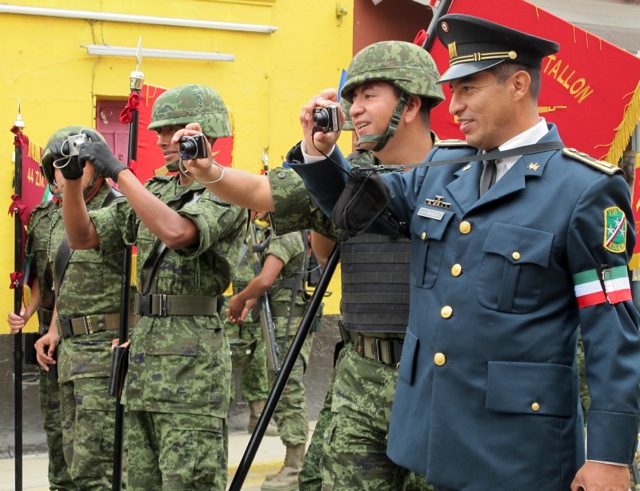
What do the guys do while waiting for an Independence Day parade to begin?

Men in military uniforms taking photos

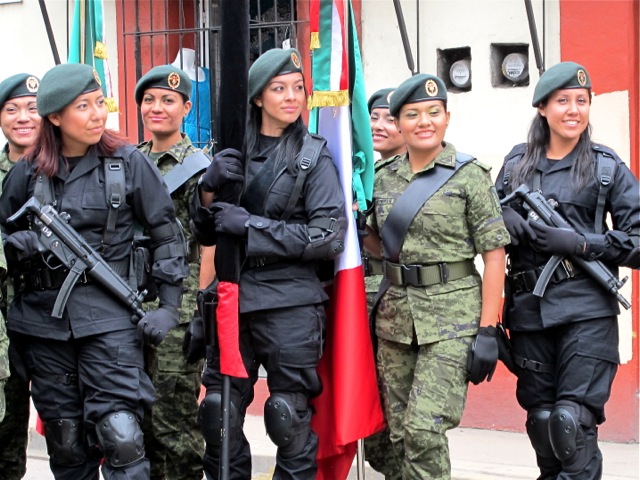
And, what do gals do? Pose for them!

Young women in military uniform posing

A mother takes twenty years to make a man of her boy, and another woman makes a fool of him in twenty minutes.  — Robert Frost

Read Full Post »

At 11 PM tonight, with El Grito de Dolores, also known as El Grito de la Independencia (the Shout of Independence), echoing from government buildings throughout the country, Mexico begins celebrating her long and hard-fought independence from Spain.  Despite the gathering of meteorological and political storm clouds, Oaxaca has gotten her green, white, and red on.

Doors are decorated, bunting is hung, and Mexico’s tricolor appears…

This proud yet faded flag with frayed edges seems a fitting symbol this year.

IMG_5058

In the words of Che Guevara, “La lucha continua.”

Read Full Post »

Yesterday, as today’s article in Noticias states, “with great dignity and head held high” the Triqui families from San Juan Copala pulled up stakes and moved to temporary housing in Colonia Reforma.  The 105 displaced families had been occupying the front of the Government Palace for several years, but reached an agreement with the state government to relocate.

Meanwhile, on the east side of the Government Palace, the band played on…  September is “La mes de la patria” (the month of the motherland).  Tomorrow night, governor Gabino Cue will repeat El Grito de Independencia (the Cry of Independence) from the balcony of the Government Palace and Monday, an hours-long patriotic parade will pass in front of the Palace.

Today, the scene has changed.  Members of the Frente Único de Lucha (FUL), the new incarnation of APPO, have taken up positions in front of the Government Palace and vowed to remain until those arrested in clashes with the federal police, on December 1 and yesterday in Mexico City, are released.  Hmmm… I wonder what will happen tomorrow and/or Monday.

Just remember, when you read, hear, or watch the news…  Chiapas, Guerrero, and Oaxaca are the most indigenous and poorest states in Mexico.  And now, the tears of Mother Nature are raining down on Oaxaca.

Read Full Post »

We returned to Teotitlán del Valle on Tuesday and Wednesday for performances of the Danza de la Pluma, a ritual re-enactment of the battles between the Aztec and Spanish.  According to OaxacaWiki:

The origin of this dance goes back to the spiritual and physical conquest of Mexico by the Spanish – La Guerra de Conquista. The dance originated in the town of Cuilpam de Guerrero where Martin Cortes (son of Cortes) celebrated the first baptism of his child. Martin played the role of his father and the locals played the roles of the conquered indigenous peoples.

The story is told in 41 bailes (dances) and lasts from early afternoon into the night.  Selected years in advance, it is an honor to be a dancer and they perform their roles for 3 years.  This week, during the multi-day fiesta honoring Preciosa Sangre de Nuestro Señor Jesucristo, we saw the first performances by the new cast and they looked great!

Presenting the Cast of Characters

Montezuma

Doña Marina (hat) and Malinche (headdress)

2 Subalternos

16 Danzantes:  Teotiles (2), Capitánes (2), Reyes (4), and Vasallos (8)

They are going to be fun to watch during the next 3 years.   (By the way, the costumes may change from day-to-day, but the cast remains the same.)

Read Full Post »

Monday, we returned to Teotitlán del Valle for the Fiesta titular a la Preciosa Sangre de Nuestro Señor Jesucristo — the pueblo’s most important festival of the year.  While special masses have been celebrated at the Templo de la Preciosa Sangre de Cristo (the village church) since June 30, Monday’s convite (procession) by the unmarried women in the village, kicked off the more public events.

Lovingly decorated canastas (baskets) waited in the church to be reclaimed by their owners, placed on their heads, and carried through the streets.

Crowds gathered in the plaza in front of the church and sidewalks and streets along the route.

And then it began — with solemn drum beats, fireworks, church bells, marmotas (cloth balloons on a pole), and a band.

Little boys (and a few girls) carrying model airplanes (don’t ask me why), paper mache lambs, and turkeys followed.

And then came the neatly organized rows of girls and young women.

For over an hour they wound their way up and down and around the streets of Teotitlán del Valle.  The weather was perfect, no late afternoon thunder showers this year, and it was glorious.

Stay tuned, the festivities continue all week.  And, check out Oaxaca-The Year After this week for blogger buddy Chris’s photos and commentary.

Read Full Post »

Basketball is big in Oaxaca and  was big news to me!

In Teotitlán del Valle, located in the valley Oaxaca, there is a tradition of climbing El Picacho on Día de la Santa Cruz (May 3).  I’d also heard celebrations also included an annual basketball tournament.  Sure enough, the sound of a play-by-play announcer, ref’s whistle, and buzzer occasionally floated up to our perch on the top of the mountain.  When we descended El Picacho via a different route, we came to a basketball court a few blocks from the village center, and an intense game in progress, with other teams waiting in the wings — in this case, the road!

Basketball game with mountain in background

Eight days later, we drove up into the Mixe in Oaxaca’s Sierre Norte for the Fiesta de Mayo in Santa María Tlahuitoltepec.  Once there, we were directed to a basketball court (did we hear correctly?) at the center of town — the mercado off to one side; church on another side; municipal buildings off to another.  We had expected folkloric dancers or ceremonial presentations, but were surprised to find a basketball tournament in progress.  It eventually ended and the expected dancing began.

Partially covered basket ball court.

According to Hoop Dreams in Oaxaca:

Any proper town in Latin America has a church facing a plaza — except the towns of the Sierra Norte region of Mexico, where Jorge Santiago is from.

“In my part of the Sierra, the basketball courts are like the zócalo in the colonial city,” Mr. Santiago said, using a Mexican word for “plaza.” “It’s really the most important part of the town. A respectable town has a church, and a basketball court in front of the church.”

Read full article HERE.

Read Full Post »

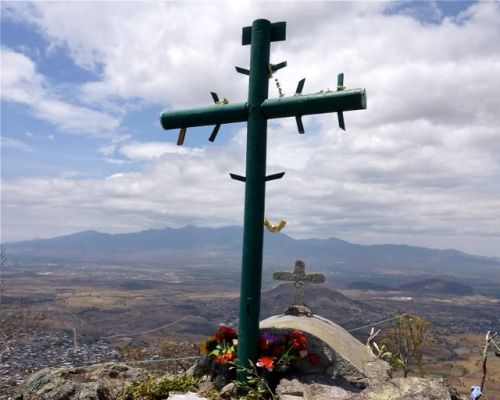
Yesterday (May 3) was Día de la Santa Cruz and in Mexico it is the feast day of construction workers.  Crosses are erected on building sites and decorated.  The tradition has its origins with the guilds during the colonial era.

However, in Teotitlán del Valle, tradition calls for hiking up to the top of El Picacho.  A tall aqua colored wooden cross stands at the top of the peak.
P1080358

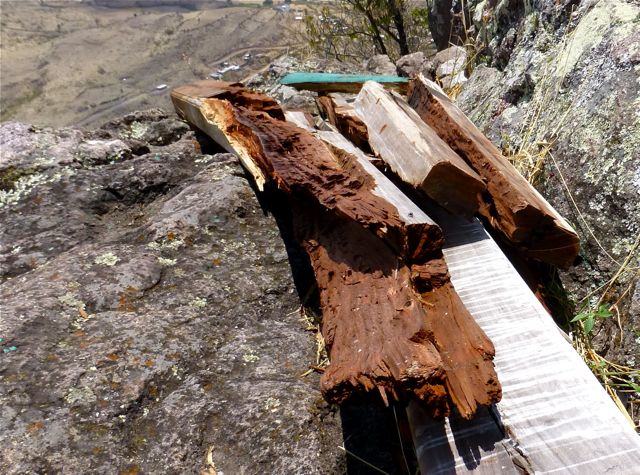
There were two crosses, but apparently one was hit by lightning a week or two ago.  It lies in splintered pieces below where it stood.

P1080369_crop

Mountain and custom beckoned, and so we headed out to Teotitlán yesterday morning to climb the mountain.  The trek began and our eyes were on the prize as we passed by irrigated fields…

P1080325

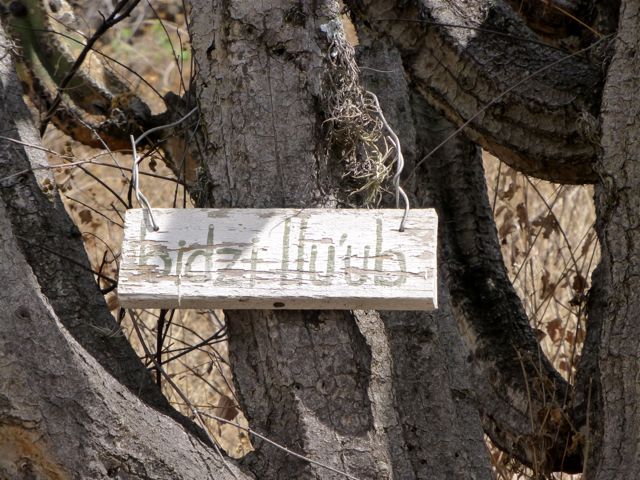
Along the steep and winding trail, there were signs…

P1080338

in Zapoteco.

P1080332

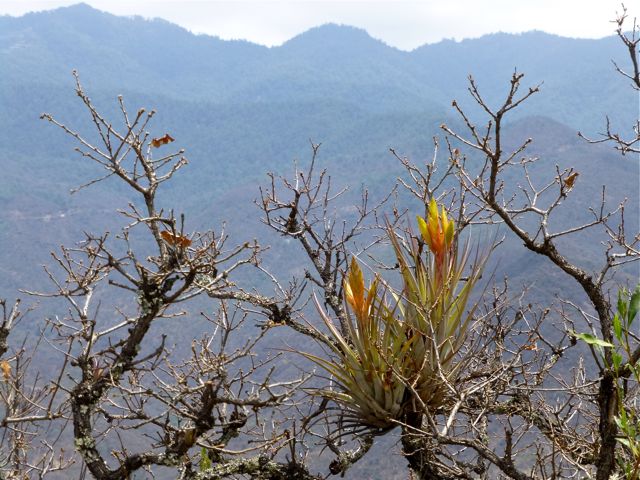
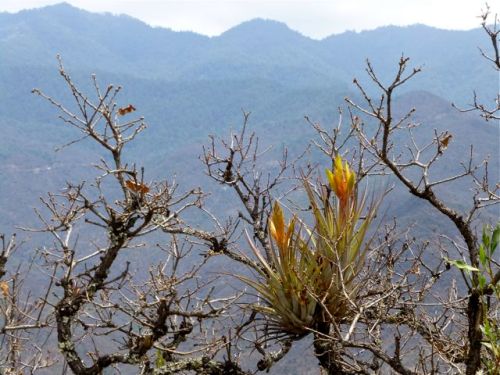
Bromeliads and other epiphytes clung to branches.
P1080352

All along the way, the views were spectacular.

P1080351

As we climbed, grew smaller and smaller.

P1080334

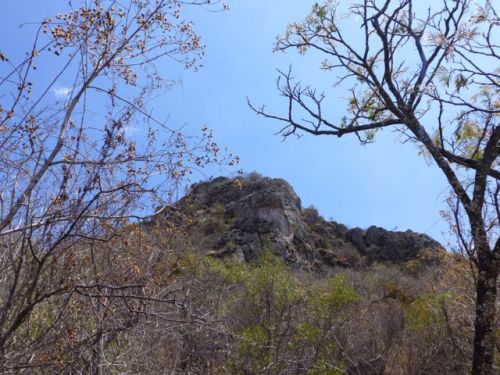
And, our destination grew closer and closer.
P1080350

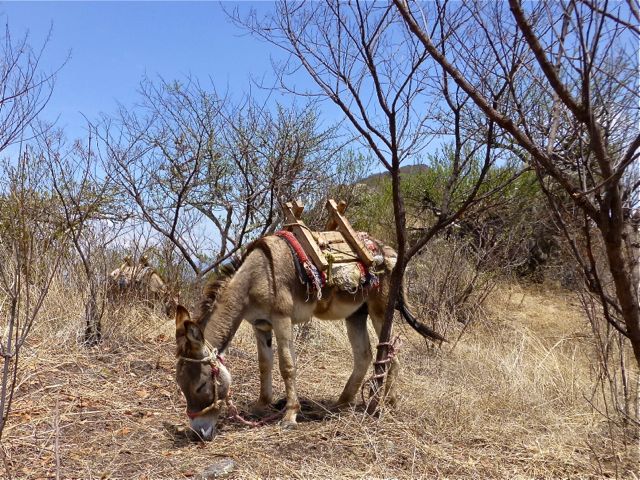
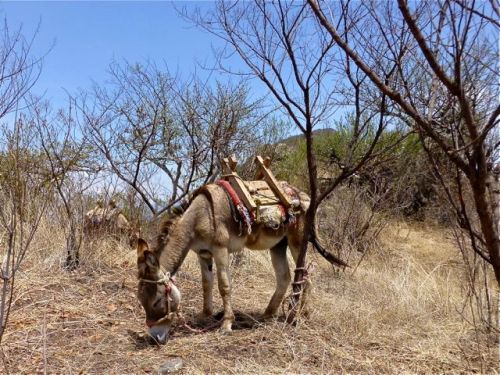
Almost two hours later (we stopped a lot!), we encountered the tethered burros that brought the tamales, aguas, and cervesas that awaited us at the top.
P1080354

Besides sustenance, there were fireworks…

P1080377

and expansive and even more spectacular views.

P1080356

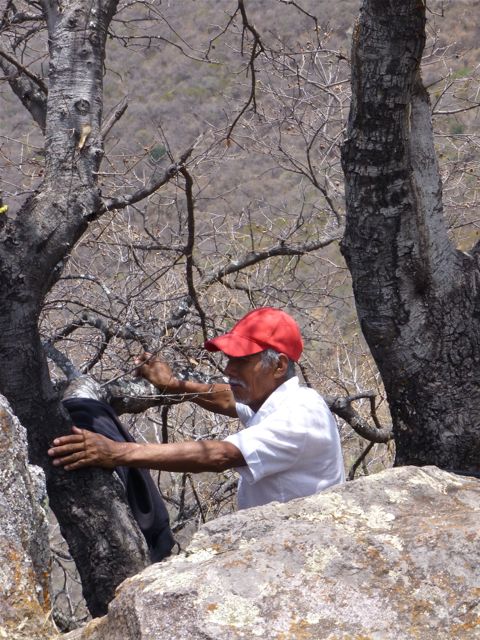
There were parents, teens, toddlers, abuelos…
P1080385

and abuelas.

P1080390

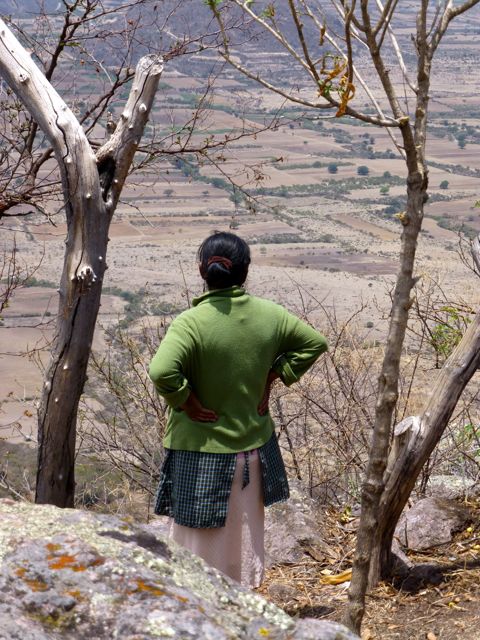
Muchisimas gracias to the people of Teotitlán del Valle, who never fail to warmly welcome us and, again, generously offered us food and drink.
P1080384

They are very special people who live in a very special place.

FYI:  The trip down took less than an hour, I returned home exhausted, sore, sunburned (even though I’d slathered on sunscreen), and thoroughly exhilarated.

Read Full Post »

Today is Día de los Niños (Children’s Day) and it’s a big deal here.  Oaxaca began her celebrations days ago.  The 6th Festival of Children’s Story Telling opened on Saturday, yesterday an exibition of traditional toys (Colección Hanni Sager Juguete tradicional) had its inauguration at the Museo del Palacio, and Friday, the Guelaguetza Infantil calenda filled the streets from Santo Domingo to the Basilica de la Soledad.

As several bands played, the children from Oaxaca’s preschools wearing the traditional costumes from the 8 regions of the state of Oaxaca waited, posed, walked, danced, and threw candy to the appreciative crowds gathered on the sidewalks along the ten-block long route.  (Note, some of the little girls already practicing holding canastas (baskets) on their heads!)

This slideshow requires JavaScript.

Parents and teachers, many also wearing traje from the Cañada, Costa, Istmo, Mixteca, Papaloapan, Sierra Norte, Sierra Sur, and the Valles Centrales regions, proudly walked alongside the children.  Vive Oaxaca concluded their article,

With such events from the early years of life are taught to love our Oaxacan culture, traditions, music and preserve the best legacy we have: our roots. Congratulations to the teachers and parent to correctly perform with great momentum this holiday culture.  [Google translation]

Read Full Post »

Sometimes color seems like a distraction, so an experiment in de-saturation from the last day of Carnaval in Teotitlán del Valle.

For some outstanding up-close and full color photos, head over to Oaxaca-The Year After.

Read Full Post »

Friday we returned for another extraordinary day — the last day of Carnival.

This slideshow requires JavaScript.

Again, muchisimas gracias to the gracious and generous people of Teotitlán del Valle.

Read Full Post »

I’m playing catch-up with blog posts.  After the Good Friday Procession of Silence, I thought life would slow down a little.  That’s what’s happened in years past — I caught up on the “to do” list on the home-front, leisurely plowed through the hundreds and hundreds of photos from Semana Santa, did a little research and a lot of thinking about what I’d just seen and experienced, and then crafted a few blog posts.

That was before we found out that Teotitlán del Valle celebrates 5-days of Carnival after Easter, not before Lent!  A little levity after the solemnity of Semana Santa and in one of our favorite places was not to be resisted.  And so, blogger buddy Chris and I set out on Monday afternoon in search of the house in Sección 1 (the village is divided into 5 geographic areas) that was hosting the daytime fiesta that precedes the evening festivities in the Municipal Plaza.

We returned yesterday for the Sección 5 fiesta, so more to come.  Now it’s off to Tlacolula for the Nieve, Mezcal y Gastronomia Festival.

FYI:  For a more detailed explanation of this Carnival celebration and photos from last year by a professional photographer, check out Ann Murdy’s website.

Read Full Post »

The Semana Santa poster said the Viernes Santo (Good Friday) Procesión del Silencio was to begin at 6 PM in front of .  Knowing the drill, I arrived at 4:45 to take photos as contingents and participants arrived — but nobody was there.  The old antiwar slogan, “What If They Gave a War and Nobody Came” came to mind.

Of course it was going to happen, it’s just that time isn’t what it seems here. Word on the scene had it that, despite the poster info, it wasn’t to begin until 6:30 PM.  No worries!  Well, except that Mexico doesn’t begin Daylight Saving Time until next weekend, the light began rapidly fading, and 6:30 PM became 7 PM.  Por favor, let Oaxaca’s 27th annual Parade of Silence begin!

And it eventually did — up Macedonio Alcalá, left at the Cruz de Piedra, left again on García Vigil to Independencia, another left, and back up the Alcalá.  And so, in darkness and silence the procession returned to the church where it all began.  Contingents could be heard late into the night parading through the streets of the city, as they returned the Jesuses and Marías to their respective home churches.

Lots more photos can be seen over at Oaxaca-The Year After.

Read Full Post »

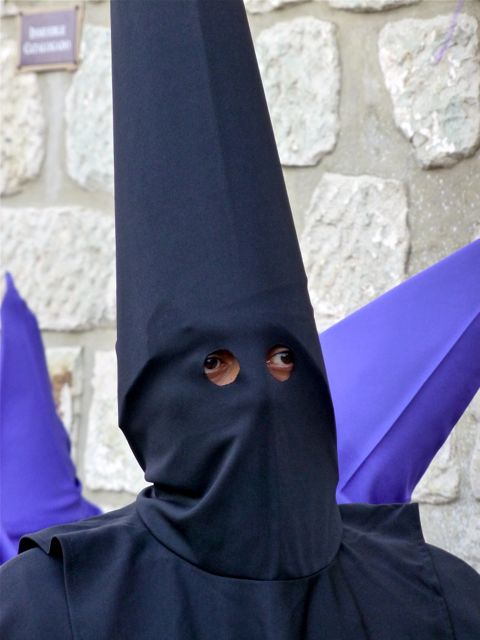
In Oaxaca the penitents gathered…

Purple hooded penitent

in front of Preciosa Sangre de Cristo on Good Friday…

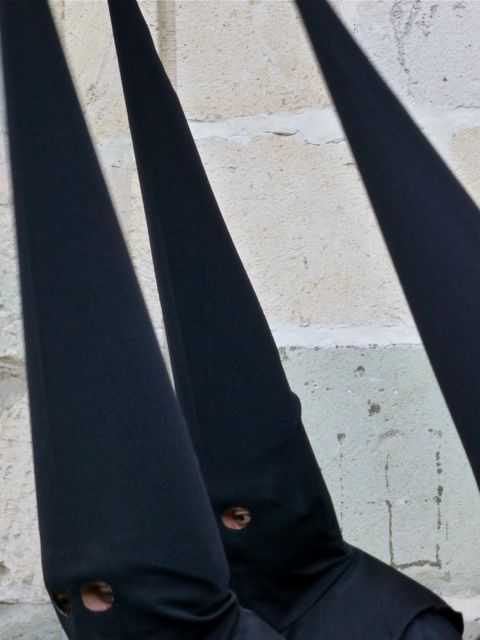
3 black hooded penitents

preparing for the Procession of Silence.

Purple hoods behind black hooded penitent

For those who are wondering, “What’s with the hoods (capirotes)?”  The answer can be traced back to the Middle Ages.  Members of lay religious charitable organizations (cofradías) would don the masks and hoods to guarantee anonymity and promote humility in their service.

From the Holy Week in Seville, Wikipedia page:

At the heart of Semana Santa are the brotherhoods (Hermandades y Cofradías de Penitencia),[1] associations of Catholic laypersons organized for the purpose of performing public acts of religious observance; in this case, related to the Passion and death of Jesus Christ and to perform public penance.

The brotherhoods, besides the day-to-day work in preparation for the processions, also undertake many other self-regulated religious activities, and charitable and community work. Many brotherhoods maintain their own chapel, while others are attached to a regular parish.

The Spanish brought the tradition to Mexico and penitents continue to play a major role in the Viernes Santo, Procesión del Silencio in Oaxaca.

Read Full Post »

And so Viernes Santo (Good Friday) began…

Mass said, a Vía Crucis (Stations of the Cross) procession through the streets of my neighborhood.

Read Full Post »

Lunes Santo (Holy Monday) in Teotitlán del Valle provided another moving and memorable experience.  For some unknown reason, the village re-enacts the 14 stations of the cross on the Monday before Easter.  Following a special early morning mass at the Templo de la Preciosa Sangre de Cristo, statues of Jesus and the Virgin Mary are hoisted on platforms and carried from the church to signal the start of the day-long pilgrimage.  They are led by a band playing a mournful and dissonant tune as they set off to wind their way through the cobblestone streets of Teotitlán.

“Stations” are set up along the route by designated families — some are decorated with the village’s famous woolen tapetes (rugs).  Tamales, non alcoholic beverages (alcohol, even the ubiquitous mezcal, is forbidden during Semana Santa), and nieves (ices) are offered at others.  At all, the appropriate prayers are read, incense of copal is burned, and offerings, including of corn and lilies, are made.  And, as always, children have important roles to play.

This slideshow requires JavaScript.

The procession is solemn and dignified and filled with pre-Columbian, along with Catholic, tradition and symbolism.  Like all the other ritual celebrations in Teotitlán del Valle, these are not performed for the benefit of tourists — they are some of the strands of the warp and weft that have woven this community together for thousands of years.

Read Full Post »

« Newer Posts - Older Posts »