Feeds:
Posts
Comments

Archive for the ‘Creativity’ Category


Concrete trough, coming out from stone wall. On the trough: an encircled cross with the word "Think" written under the cross.

Read Full Post »

Carlos Fuentes, one of Mexico’s most revered writers, died yesterday at the age of 83.

It was the California connection that allowed for my introduction to the writings of Fuentes.  The acquaintance came through The Old Gringo, a fictionalized story of  the disappearance in Mexico, during the Mexican Revolution, of real life writer and US Civil War veteran, Ambrose Bierce.  Following the Civil War, Bierce wound up in California, where he was a contributor to the literary journal, The Argonaut, founded and edited by one of my relatives, about whom, Bierce wrote a typically acerbic epitaphHere lies Frank Pixley — as usual.  So, in my ongoing attempt to unravel some of the mysteries surrounding living and being in Mexico, reading the The Old Gringo was a no-brainer.  As The Guardian’s obituary of Carlos Fuentes concludes,

Throughout his life, wherever he lived, Mexico was the centre of Fuentes’s artistic preoccupations. In his late 70s, he provided a typically graphic description of the attraction he felt for his own land: “It’s a very enigmatic country, and that’s a good thing because it keeps us alert, makes us constantly try to decipher the enigma of Mexico, the mystery of Mexico, to understand a country that is very, very baroque, very complicated and full of surprises.”

Carlos Fuentes is not uncontroversial, but you should see for yourself.  If you are not familiar with his writings, you might want to visit your local library and checkout a book or two.  For those in Oaxaca, the Oaxaca Lending Library has the following titles:

Fiction
Adan en Eden
Baroque Concerto
Burnt Water
Cuerpos y Ofrendas
Campaign
Cantar de Ciegos/To Sing of the Blind
Change of Skin
Christopher Unborn
Constancia: y Otras Novelas para Vírgenes
Constancia and Other Stories for Virgins
Crystal Frontier
Diana the Goddess Who Hunts: The Goddess Who Hunts Alone
The Death of Artemio Crus:  A Novel
Destiny and Desire:  A Novel
Diana o la Cazadora Solitaría
Distant Relations
The Eagle’s Throne
Good Conscience
Gringo Viejo
Hydra Head
Muerte de Artemio Cruz
El Naranjo
Old Gringo
The Orange Tree
La Region Mas Transparente
Terra Nostra
Where the Air Is Clear
Years with Laura Diaz Fuentes
Cabeza de la Hidra
Vida Está en Otra Parte

Non Fiction
Aura
The Buried Mirror: Reflections on Spain and the New World
En Esto Creo
Latin America at War with the Past
Mexico:  Una Vision de Altura:  Un Recorrido Aereo de Pasado Al Presente
Myself with Others
This I Believe
Todos los Gatos Son Pardos
The Diary of Frida Kahlo:  An Intimate Self-Portrait
New Time for Mexico

Read Full Post »

My mom was a folk dancer.  She had studied ballet, tap, and acrobatic dancing when she was young and brought that training and muscle memory along with her when she took up folk dancing in her mid thirties.  I spent many hours over the years watching her dance; the Kamarinskaya from Russia, Swedish Hambo, Fandango from Portugal, Mexico’s Jarabe Tapatio, and so many more.  In addition to being a talented dancer, she made her own costumes.  A dressmaker’s dummy was a permanent fixture in her bedroom, yards of colorful cotton fabric and braid were piled next to the sewing machine, and in the evenings her hands and eyes were often occupied embroidering pieces for a new costume.

Mom died in 1989, but not a day goes by that I don’t think of her.  So, on this Mother’s Day, this is for you mom…

Multicolored huipil with peacock design

Guatemala

Jewel toned embroidered huipil with peacock design

Zinacatán, Chiapas, Mexico

Black skirt embroidered on the diagonal with flowers

Zinacatán, Chiapas, Mexico

Black dress with gold-tone embroidery on sleeve and bodice.

San Antonino Castillo Velasco, Oaxaca, Mexico

Geometric yellow and red embroidery on purple skirt with lace bottom

Tehuantepec, Oaxaca, Mexico

Close up of the back of a brightly embroidered huipil on black velvet

Tehuantepec, Oaxaca, Mexico

Read Full Post »

As the promotional material for Ma (yo) en Oaxaca, Mujer (es) Arte y Cultura explains (loose translation), like a skilled weaver, women create the fabric of life… part of the history of humanity, intelligence that moves, the look that looks, which is regarded in the construction of better horizons of life for her and those who are around her.  And so, from May 3rd through 13th, the women of Oaxaca are being celebrated with workshops, exhibitions, lectures, and concerts.

Last night, under the supermoon, one of the accomplished women of Oaxaca, Alejandra Robles, gave a free concert, just a block away, in the Plaza de la Danza…

Ma (yo) en Oaxaca is a party for all of the principles of inclusion and participation to make possible the knowledge and appreciation of the cultural richness of groups which, for various reasons, have been marginalized.

¡Viva las mujeres!

Read Full Post »
…fighting in Oaxaca.

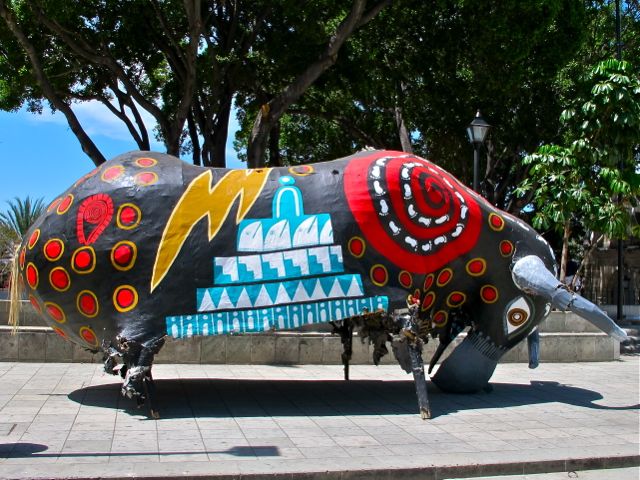
Colorful gigantic papermache bull

Corrida de Toros, as it is known in Mexico, was outlawed by, then governor of Oaxaca, Benito Juárez.  The ban was instituted throughout Mexico in 1867 by Juárez during his presidency.  Some say it was to “civilize” Mexico, but others contend it was for nationalistic reasons, as bullfighting had been a legacy of the Spanish conquest.  I tend to think the latter tipped the scales.

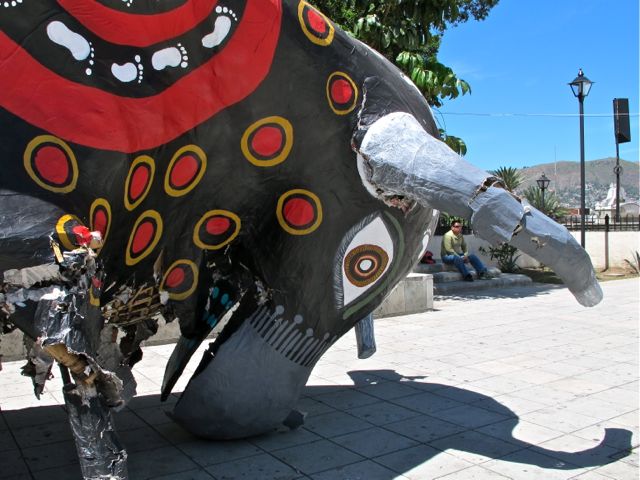
Close-up of the head of a colorful giant papermache bull

However, Porfirio Díaz reinstated it during his presidency, but the ban remained in Oaxaca in honor of her favorite son.  And thus, on the Plaza de la Danza, we have only a paper mache bull ready to charge at his shadow…

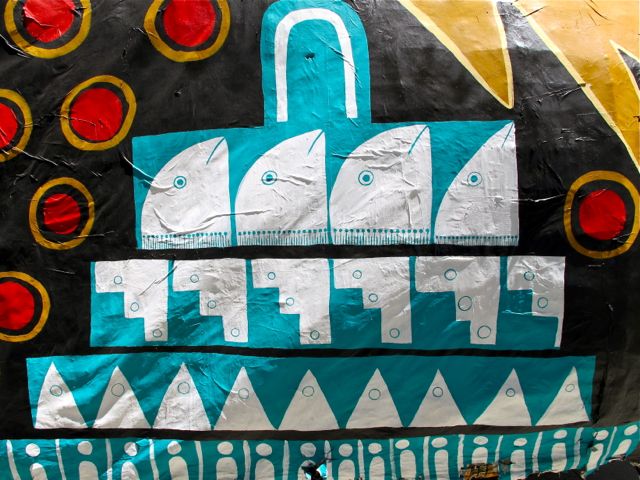
Design of fish heads, Mitla frets, triangular mountains, etc.

and serve as a canvas for imagery, ancient and contemporary.

Read Full Post »

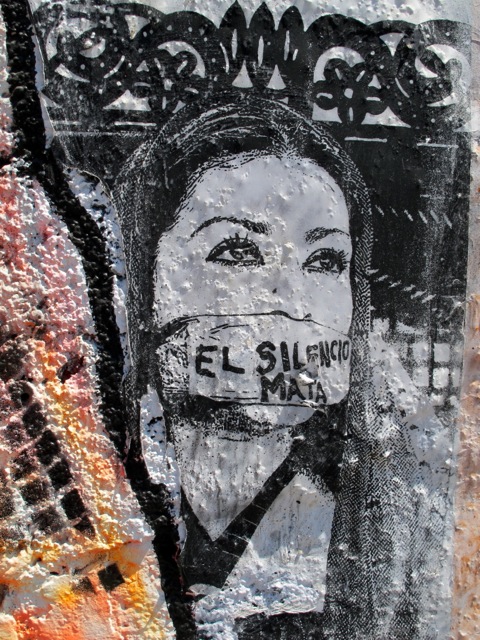
Hip hop is probably not the first thing that pops to mind when you think of Oaxaca.  However, I can assure you, there is more to Oaxaca than colonial architecture, religious processions, colorful traje (costume), and traditional music.  As repeated blockades and occupations attest, and the El Silencio Mata posters illustrate, there are voices struggling to be heard.

For one of those voices, check out this trailer from the documentary film, Cuando Una Mujer Avanza (When a Woman Takes a Step Forward), about “Mare” a young Zapotec hip hop artist from Oaxaca.  As the promo states, her unique life experience is a rarely heard perspective on life and community liberation.  As an up and coming MC in a state known for popular and indigenous rebellion, Mare’s life and experience has been channeled into very powerful and conscious rapping and singing.

Update:  Check out the article, Mare Is a Rapper Hell-Bent on Equality for Women in Mexico.

Read Full Post »

Carved wood woman sitting -- back curved into chair.

“It’s not what you look at that matters, it’s what you see.”  — Henry David Thoreau

Read Full Post »
In Coyoacán, Federal District of Mexico City

Magenta numbers 104 against bright yellow wall

San Cristóbal de las Casas, Chiapas…

Wooden number 40 against white patch on tan rock wall with terracotta geometric design

And Oaxaca…

Black Art Deco 502 against white wall

The zeros have it!

Read Full Post »

Oaxaca bound!

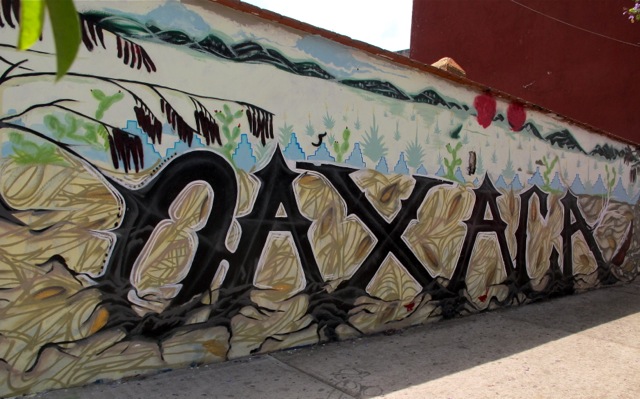
After a delightful, but cold and wet (4-6″ of hail!) textile intensive 6-day visit to Chiapas, I’m homeward (as in, Oaxaca) bound!

Wall art spelling OAXACA

I promise not to ever again complain about Oaxaca’s sun-filled dry season!

Read Full Post »

For a whole variety of reasons, this is so appropriate not just here, but…

all over the world…

And, given the current war on women’s hard won reproductive rights, it’s especially pertinent during this “election” season in the USA.

Silence does indeed kill!

Read Full Post »

Yesterday, having just posted Celebrating the Women of Oaxaca, I set off for my cataloging shift at the Oaxaca Lending Library.  As I turned up the Alcalá, I was greeted by bevy of beautiful and colorful women in all shapes, sizes, and lifestyles — Oaxaca’s tribute to women on International Women’s Day.  By the way, you can see in the distance in one of the photos, the Migrantes are still here.

This slideshow requires JavaScript.

Meanwhile, down at the Government Palace, the City Council recognized the history and contribution of 10 women conferring upon each a Distinguished Citizen award; Zapotec women demanded justice for the disappeared and prisoners; and several city workers dismissed over a year ago (according to them, without cause) held a protest demanding reinstatement.

Thus was International Women’s Day in Oaxaca!

Read Full Post »

Samuel Bautista Lazo is one of the smartest, joyous, and Zen-like people I know.

Sam sitting cross-legged in a natural alcove in the mountain

Sam is my young, previously mentioned, Zapotec friend who is getting his Ph.D. in Sustainable Manufacturing at the University of Liverpool.  Sam is from Teotitlán del Valle in Oaxaca, a village watched over by El Picacho, the sacred mountain — whose presence is unmistakable and palpable.

El Picacho

The village is known for its traditional performances of the Danza de la Pluma (about which I’ve posted on numerous occasions) and their skillful and creative weavings with wool.  Like a majority of its Zapotec residents, Sam and his family weave — father, Mario Bautista Martínez; mother, Leonor Lazo González; and brother, Celestino Bautista Lazo.

Sam and his family pose in their yard

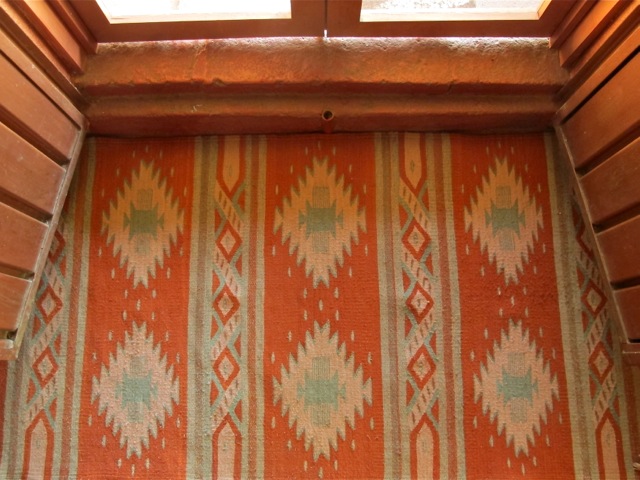
The family was featured last year in an article, The Crafts of Oaxaca, posted on the Lark Crafts website.  Like many others, on my first visit in 2007, I couldn’t resist buying a couple of tapetes (rugs), including this one, which now serves as a welcome to all who enter my little casita.

Tapete on floor: geometric patterns in rust, beige, agua

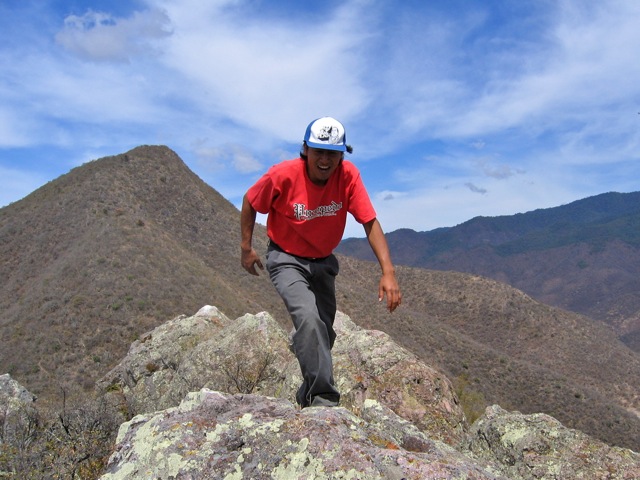
A friend and I returned six months later and had the privilege of climbing to the top of El Picacho with Sam.

Sam on top of El Picacho

And no, I did not join Sam in leaping from one rocky peak to the other!

Looking forward to your return, Sam!

(ps)  Here is a Dixza video of  Sam from 2008, where he discusses the interpretation of the symbols and patterns woven into Zapotec rugs.  You might also want to check out others in his Dixza series from Teotitlán del Valle.

Read Full Post »

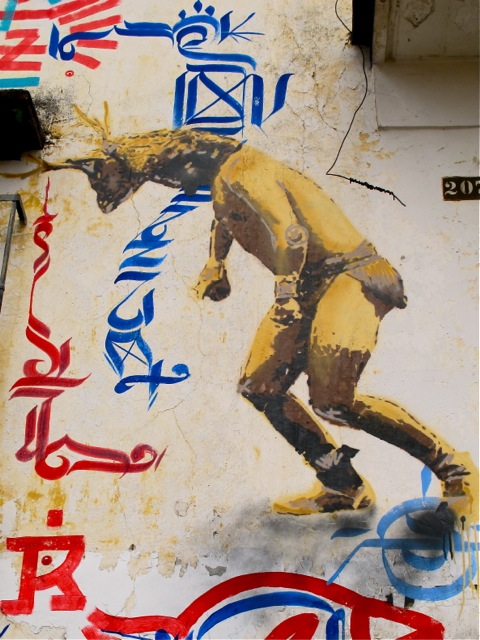
Strolling along Calle Prof. M. Aranda several days ago, I wondered…

maybe this was a case of…

the parts…

being greater…

than their sum.

What do you think?

Urban art by sanez.

Read Full Post »

Last night I joined a standing-room-only crowd for the book launch of Grandes Maestros del Arte Popular de Oaxaca (Grand Masters of Folk Art of Oaxaca) at the Centro Académico y Cultural San Pablo, in Oaxaca city.  This beautiful 340+ page book was the joint effort of the Fundación Alfredo Harp Helú, Fomento Cultural Banamex, the State of Oaxaca, and CONACULTA (National Council for Culture and the Arts).

Cover of the book

The press was there in full force, as was governor Gabino Cue, benefactor Alfredo Harp Helu, and a number of other movers and shakers on Oaxaca’s cultural scene.  Many of the artisans were also in attendance and several posed for photographs holding their copy of the book at the reception that followed.

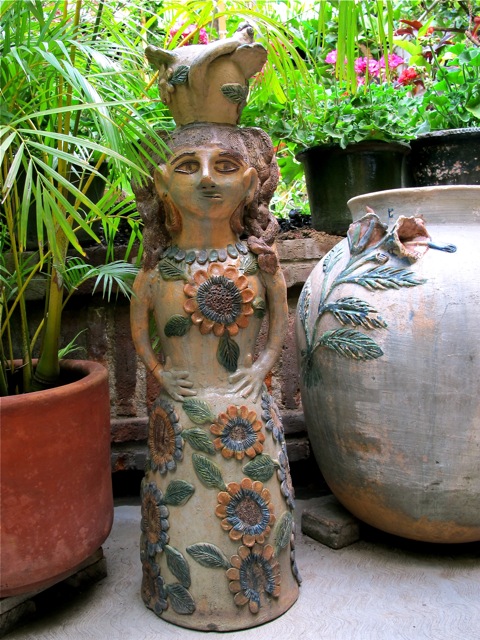
One of the artisans who was not there was the late potter, Dolores Porras from Santa María Atzompa, as Parkinson’s disease had claimed her on November 1, 2010.  Four pages in the book are devoted to this maestra of pottery and her pioneering work with glazes.  Examples of her work can be seen all around Oaxaca, including these scattered in the garden at the hotel, Las Golondrinas.

Vase in the shape of a woman's face and rounded body

Her work has inspired imitation, but as is evident in these pieces, her whimsy, creativity, and sense of proportion would be difficult to match.

Urn with the face of a woman.

I want to thank potter Michael Peed for pointing out these hidden treasures…

Tall vase in the shape of a woman.

following a showing of his loving documentary, Dolores Porras: Artista Artesana de Barro Santa María Atzompa.  (Click here for an excerpt on YouTube.)

DVD front and back covers

And then there is this one, I discovered on my own, the very next day — on a bathroom shelf, no less — at Casa Linda

Vase with image of a woman, with pointy breasts.

Read Full Post »
There are only a few more days left to be delighted by “Manos que crean y ojos que leen” (Hands that create and eyes that read), a whimsical exhibition of popular art at the Biblioteca Andrés Henestrosa.  The pieces were commissioned by Rosa Blum (who, with Henry Wangeman, owns Oaxaca’s bilingual bookstore Amate Books) to celebrate reading and promote the incredibly creative artisans of Oaxaca who were suffering from a drop in tourism following the social conflict of 2006.

This slideshow requires JavaScript.

So…  If you are in Oaxaca, be sure to see it before it closes at the end of this month.  If not, you might want to consider a trip down here (Oaxaca is NOT on the US State Department travel warning list), visit some of these artisans in their villages, see their work up close and personal, and perhaps purchase a few unique treasures from these talented people.

For other pieces in the exhibit, see Chris’s photos over at Oaxaca-The Year After.

Read Full Post »

« Newer Posts - Older Posts »