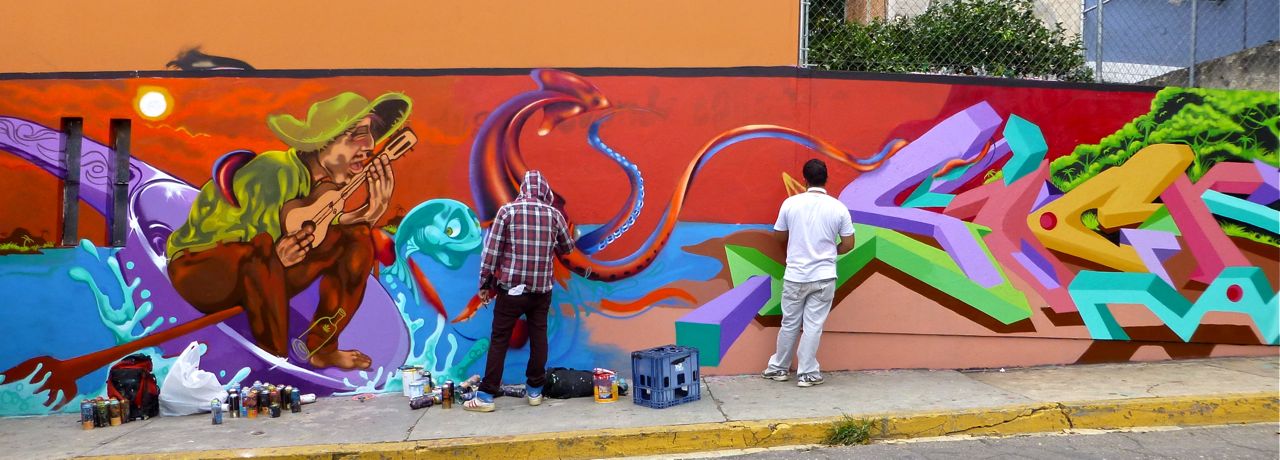
Feeds:
Posts
Comments

Archive for the ‘Creativity’ Category

As we have done in previous years, we returned to San Antonino Castillo Velasco on November 1 to watch families begin the preparation of the graves of their loved ones for Día de los Muertos.  In a process unique to this pueblo known for the cultivation of flowers, family members mix the area’s very fine dirt with water; spread it on the top and sides of the grave; smooth it with a trowel, as if they were getting ready to lay tile; using a nail, they outline designs and religious imagery into the mud coating; and then use flowers (fresh and dried), to “paint” the scene.  

This year’s late rainy season brought torrential rains on November 2 and it must have interrupted the decorating, because when we returned on November 3, at the same time as usual, there was still much work to be done.  However, no one seemed the least perturbed; peace, tranquility, and quiet joy prevailed and, as always, it enveloped us.

(Music: Marimba band performing, “Díos Nunca Muere,” written by Oaxaqueño composer and violinist Macedonio Alcalá.)

Read Full Post »

Crossing the Plaza de la Danza, on my way to the market this morning, I saw stilt people!

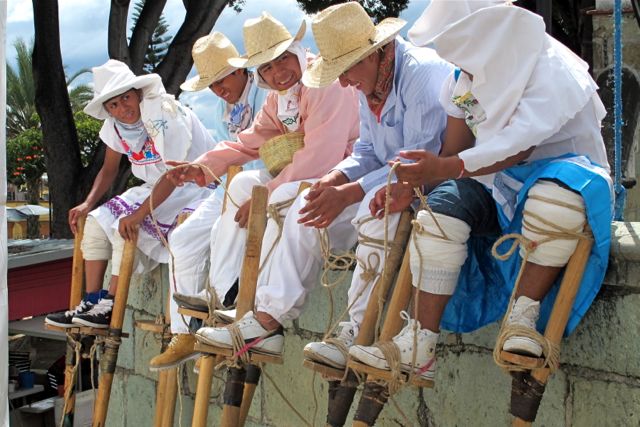
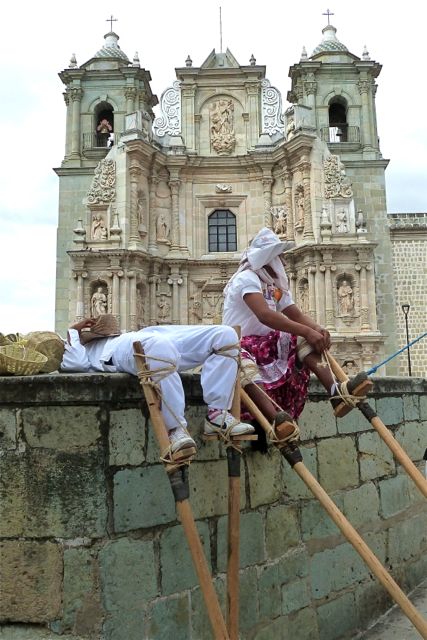
Stilt dancers sitting on ledge, Basilica of Soledad in background

The all-male stilt dancers of Villa de Zaachila were waiting to perform the Danza de los Zancudos at the 22nd conference of the Oaxaca-Centro Alcoholics Anonymous.  Once they took the stage there was much cheering and good-natured catcalls from the 75% male audience

The Dance of the Zancudos originated in the San Pedro neighborhood over 100 years ago and is one of the few places the dance can still be found. The origin of the Dance of the Zancudos is in a promise the inhabitants of Zaachila made to Saint Peter. The story behind it states that an old man encountered an apparition of Saint Peter who asked the community build a church in his name. The apparition appeared each day until it was captured by the local people and enclosed in a small church. Guards were posted at the entrance with rifles and machetes. However, the next day, it was discovered that the saint was no longer there, and he appeared again to the old man who had originally seen him, indicated that God had sent him to protect the village. Eight days remained until the feast of Saint Peter, and the saint asked that the villagers form pairs on stilts to dance. On the feast day, the men danced on stilts while the women surrounded them with candles and incense. The dancers arrived at the foot of a hill where an image of the saint was found, which was brought to the San Pedro neighborhood where a church was constructed for it.  [Wikipedia.  Retrieved, 11/10/2013]

They performed several dances and, to the cries from the audience of, “Otra, otra, otra,” they were ready with an encore.  Baskets that had been tied to their costumes were thrown into the crowd (a la La Guelaguetza) and they exited stage right.  By the way, getting down off the stage on stilts requires a lot of help from your friends.  But once that complexity is navigated, you get to stroll over to a ledge high above everyone’s head, and have a seat.

5 stilt dancers sitting on a ledge.

Reason number 521 to never go anywhere in Oaxaca without my camera!

Read Full Post »

The souls  have departed.   And, following 33 hours of travel, my BFF (along with her alebrijes by Alberto Perez and the Xuana family, a traditional black and white rebozo, bottle of Del Maguey mezcal from Chichicapa, several bags of Conchita chocolate, and a fabulous mohair rug woven by Antonio Ruíz Gonzalez), has returned home to the frigid climes of Alaska.  However, gal pal, souls, and the mortals with whom we shared the past, have left warm and lasting memories.  They have also left an exhausted gringa, whose brain feels like one of those overloaded small trucks one (more than occasionally) sees on the roads here.  With every nook and cranny filled, they move at a snail’s pace, be it along a pot-holed dirt road or the carretera, balancing their top-heavy loads.

Our week began on October 29, when the sounds of a band Pied Piper-ed us down the street and around a corner to a comparsa of high school students, who were taking part in a competition of using recycled products for their costumes and floats.  Alas, the rains came and eventually chased us home.

On October 30, delectable dining (lunch at La Biznaga and dinner at Los Danzantes) nourished multiple museum visits and allowed us to join the standing-room-only crowd at the Oaxaca Lending Library (without rumbling stomachs) to watch the wonderful new documentary, La Festividad de los Muertos, chronicling Day of the Dead in Teotitlán del Valle.

Then there was Thursday, the 31st….  A shopping expedition for flowers, sugar skulls, bread (pan de muertos), and two 10-foot long stalks of sugar cane to form the arch over my altar.  I carried them the 10-blocks home on my shoulder (sheesh, they are heavy) and carefully navigating the busy sidewalks.  According to BFF, I provided pedestrians and passengers in buses,cars, and taxis much entertainment.  I didn’t see a thing — I was just trying not to trip, fall, or whack anyone in front, behind, or to the sides of me!

Once the candles, photos, bread, chocolate, beverages (cervesa, mezcal, and water), and meaningful objects to our departed were in place; flowers arranged and cempasuchitl (marigold) petals scattered; and the arching sugar cane affixed to the wall surrounding our ofrenda, we made our way down to the beginning of the CEDART comparsa.

Later in the evening, we drove up to the panteón in Santa María Atzompa.  Passing the bright lights and crush of food, flower, pottery, and other vendors that line the entrance and finally emerging from under the arched gateway, the candlelit ethereal beauty of the cemetery on this night never ceases to take my breath away.  Of course, it wasn’t all exquisite and unearthly enchantment.  This is Mexico and so there was also a (very loud) band and the cervesa and mezcal flowed freely.  I’m sure the difuntos (deceased) enjoyed themselves and partied hardy with the living until the sun rose.  And then all slept.

On the other hand, we left at a reasonable hour, as we were only at the mid-point of our Día de los Muertos marathon.  More to come…

Read Full Post »
It’s been a magnificent Muertos filled with memorable moments and special people, along with a feast for ALL the senses.  An initial pass through the photos has weeded them down to 450.  Yikes!  Lots more weeding and processing to do.  In the meantime, here is a snapshot from the past 5 days.

And the magic continues today, when we return to San Antonino Castillo Velasco.

Read Full Post »

An ofrenda is an offering, an integral part of the Day(s) of the Dead celebration, filled with meaning, a beacon to the departed, an ephemeral work of art, and the sum of its lovingly chosen parts.  And so, last night my aforementioned BFF and I constructed our ofrenda.

Día de los Muertos in Oaxaca… so much to show and share with those we love.

Read Full Post »

Around this time of year, the gringo and Canadian (they are adamant they are NOT gringos) population in Oaxaca begins to grow — an increase that will last for the duration of winter.  Called “snowbirds” by the resident ex-pats, they are an eclectic and interesting crowd.  Among them are a couple of talented people with whom I have become acquainted —  San Francisco Bay Area based writer, Robert Adler (who, along with Jo Ann Wexler, publishes the invaluable, Viva Oaxaca) and Seattle photographer, Tom Feher.

Robert and Tom have embarked on an ambitious project interviewing and photographing undocumented immigrants on their arduous and dangerous journey from Mexico and Central America, en-route to El Norte.  The result is to be a traveling exhibition of 24 to 30 of near life-size images on narrow aluminum sheets designed to be hung from the ceiling and accompanied by a booklet with the biography of each immigrant.  The exhibition will be called, I Have a Name — the title coming from a neighbor of Tom’s, “who, having hired a Latino man to do some work, refused to call him by his right name and referred to him only as “the Mexican”, even though he was from Guatemala. ”

The decision to leave all that is known and loved for distant country and alien culture is not undertaken lightly.  The creators of this project hope, in the words of Robert, that the exhibit, “will convey what we’ve been learning firsthand–that it’s one thing to have a concept such as ‘migrant,’ ‘migrant worker,’ ‘undocumented worker,’ or ‘illegal alien,’ and quite another to know people as individuals with their own names, faces, life stories and dreams.”

This is an expensive project and Robert and Tom need your help to bring I Have a Name to fruition.  They have mounted a fundraising campaign on the crowd-finding site, Indiegogo.  Please consider helping them raise $25,000 before their November 25, 2013 deadline.

Read Full Post »

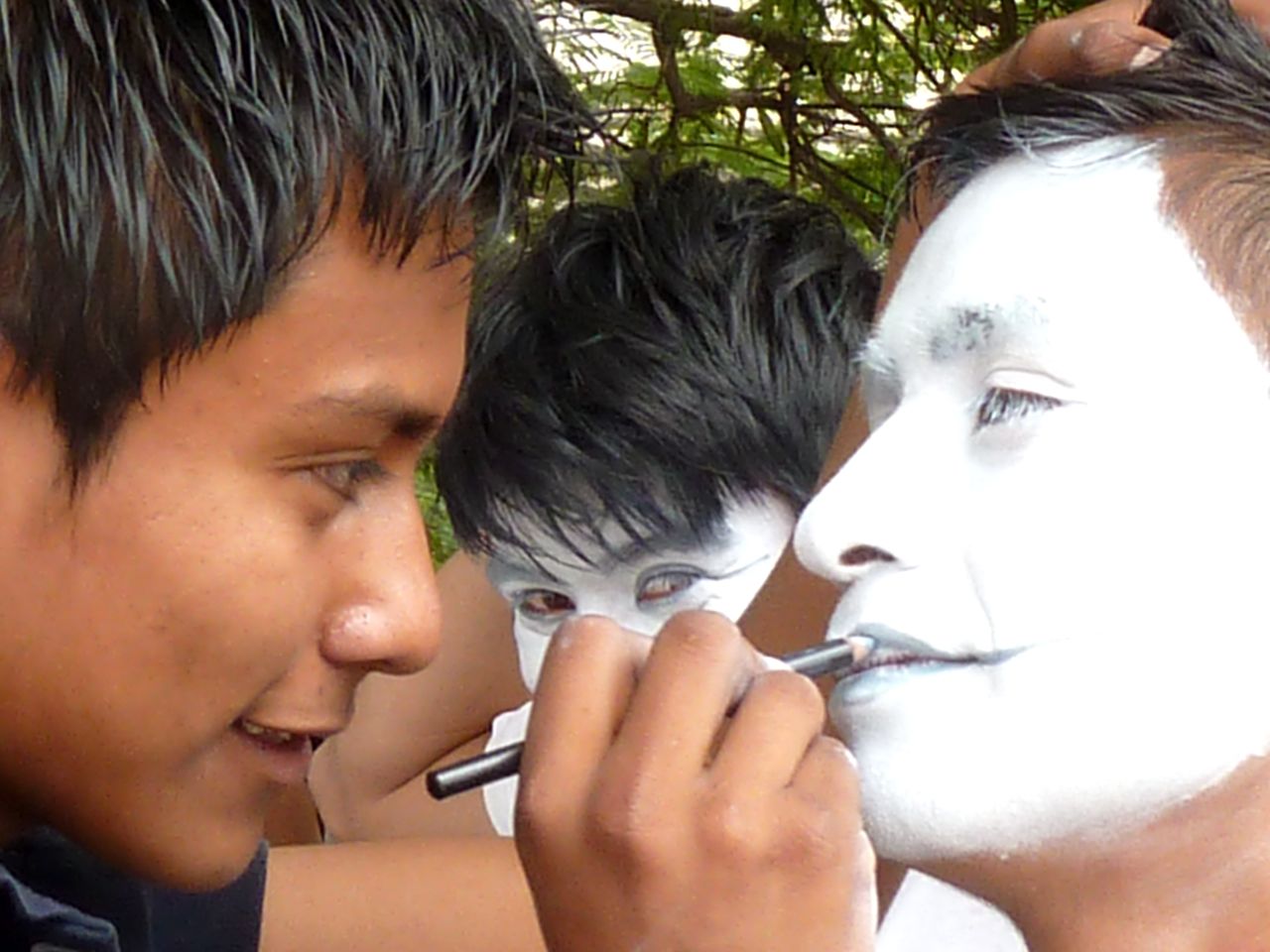
Young man painting face of another young man

How now, spirit! whither wander you?  — Puck, Midsummer Night’s Dream.

Close-up of face painting

Just another Wednesday walk in Oaxaca.

Read Full Post »

There is a lot of work that goes into getting a marmota ready to go to the dance.  Getting dressed takes a quite a crew and there is a lot of up close and personal last-minute cinching that must be done.   Then there is squeezing (she does weigh over 70 kilos) through the church plaza portal, to make her grand entrance onto the street.  However, once she emerges, she joins with her friends to dance through the streets of Tlacolula de Matamoros late into the night!

This slideshow requires JavaScript.

Calenda in honor of el Señor de Tlacolula, October 11, 2013.  Living history from the valley where corn was first cultivated.

Read Full Post »

Remember the childhood riddle, “What’s black and white and red all over?”

Old answer:  A newspaper.  New answer:  The walls of Oaxaca.

Read Full Post »

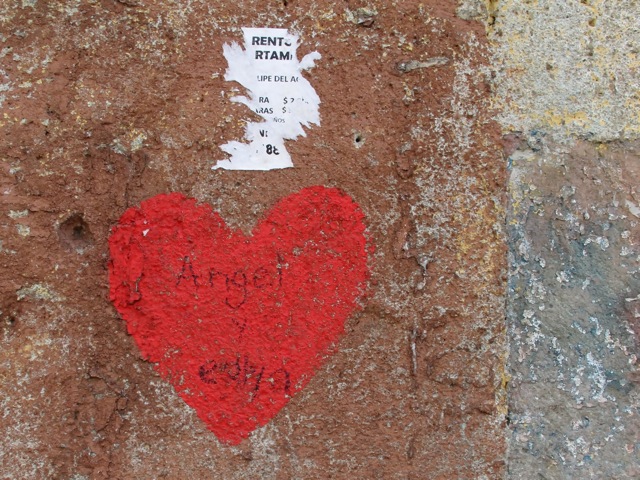
Ahh, young love…  On the walls of Oaxaca, among the extraordinary art and pithy political statements, there are declarations of love.

In red heart on wall: Angel y Edna

People speak of love don’t know what they’re thinking of
Wait around for the one who fits just like a glove
Speak in terms of belief and belonging
Try to fit some name to their longing
People speak of love

—  In the Shape of a Heart by Jackson Browne

Read Full Post »

Today the Oaxaca Lending Library played host to Oaxaca FilmFest4 founder and artistic director, Ramiz Adeeb Azar.  He and 4 members of the festival staff came to the library to “pitch” the festival, which opens September 21 and runs through the 28th.  (Note:  it has moved from November to September).  It wasn’t a hard sell, as many of us have been following it since it began in 2010.  And, I’ve got to say, it’s come a long way in a short amount of time.  According to Ramiz, it has…

  • Grown to be one of the Largest International Film Festivals in Latin America
  • Discovered over a dozen films that have gone onto commercial success
  • Created a highly competitive Script Writing Competition.
  • Created “Pitch It”; a unique platform that allows screenwriters to sell their scripts to industry executives around the globe
  • Conducted the longest University Rally ever (10 days throughout the entire state!)
  • Rolled out Academia; a five-day training program designed to enhance Festival Attendees’ self-distribution skills
  •  Developed Academia Exchange; a unique exchange between filmmakers and students

  • Gained membership of the Mexican Film Festival Association (La Red Mexicana de Festivales Cinematográficos) and in 2013 was the host of their national conference
  • Gained recognition as an official IMDB Film Festival

The festival has already set up shop in Plaza San Jerónimo (on Macedonio Alcalá) where staff and volunteers are hard at work and, like last year, the site will serve as the festival’s Hospitality and Information Center.

If you love film, but have never been to a film festival, I highly encourage you to give it a try.  Prior to relocating to Oaxaca, for 7 years, one of the highlights of my calendar year was volunteering at the Mill Valley Film Festival.  Besides being a lot of fun (never forget, on my hands and knees mopping up spilled red wine at the feet of Katherine Ross and Sam Elliot), I had the opportunity to see some truly wonderful films — especially shorts and documentaries that are rarely shown in the big chain multiplexes.  The MVFF was one of the things I missed most (along with crusty sourdough bread and being able to flush toilet paper down the toilet) when I moved down here.

However, along came the Oaxaca FilmFest and, though it didn’t satisfy my craving for sourdough bread or cause new plumbing to be installed in Oaxaca, it does come with a well-considered, eclectic, and always creative selection of films (feature-length and shorts) from all over the world.

Last year, El último hielero (The Last Ice Merchant) a touching documentary from Equador was a favorite of mine, as was The Cart, a humorous short from Russia.  And, if the two short films Ramiz showed today —  the animated, Sleight of Hand and the very moving, Part of the Change — were any indication, the selectors did a terrific job again this year.  So, if you are in Oaxaca, get thee to the Oaxaca FilmFest4 information center at Plaza San Jerónimo and pick up your festival schedule or download it from the festival website.

FYI:  All screenings are public and free (except Cinemex and Foundation Nights) and every film is projected in its original language, with Spanish, English, or dual subtitles.

Read Full Post »

The Danza de la Pluma penachos (headdresses), capes, and leggings are spectacular and unique to Teotitlán del Valle.  The feathered designs on the penachos are more intricate and varied than in other pueblos; and the capes and leggings are hand-woven in this village that is internationally known for its weaving.  However, while the Danza de la Pluma is a crowd-pleaser during the annual July Guelaguetza on Cerro del Fortín in Oaxaca, folkloric groups from other villages are usually chosen to perform it, as Teotitlán’s costumes are not considered “authentic.”

IMG_4828

However, performing for tourists is not why Teotitlán del Valle tells this story through music and dance several times a year.  It is performed on the church plaza, not the municipal plaza, because it is an integral part of the annual major religious celebrations of the village:  Fiesta titular a la Preciosa Sangre de Nuestro Señor Jesucristo in July, Fiesta a la Natividad de la Virgen María in September, Fiesta a el Rosario de la Virgen María in October, and Fiesta a la Virgen de Guadalupe in December.

Penachos from the Fiesta a la Natividad de la Virgen María on Sunday…

Capes from Sunday’s Fiesta a la Natividad de la Virgen María and July’s Preciosa Sangre de Nuestro Señor Jesucristo festival.

Leggings from both festivals…

The various elements of the costumes do not come cheap and dancers must appeal to their extended families to assist in commissioning each of the pieces.  Thus, as annual festivals come and go during a dancer’s 3-year commitment, the costumes may evolve.

With their performances, the dancers honor the rituals of their church and community.  And, with their magnificent costumes, they pay homage to the creativity, talent, and tradition of Teotitlán del Valle’s weavers and feather artists.

Read Full Post »

More from the Hecho en Oaxaca exhibit…

P1100004

The courtyard at the Museo de Arte Contemporáneo de Oaxaca (MACO)…

P1100060

Art is the tree of life.  — William Blake


Read Full Post »

Work in progress on Tinoco y Palacios by Jorel and the Rhu Crew…

P1080919

Up close and personal…

All finished!

P1100148

Read Full Post »

Another wall, courtesy of the Hecho en Oaxaca urban art project of the Museo de Arte Contemporáneo de Oaxaca (MACO).  It reminds me of the John Mayer song,

Waiting on the World To Change

Me and all my friends
We’re all misunderstood
They say we stand for nothing and
There’s no way we ever could

Now we see everything that’s going wrong
With the world and those who lead it
We just feel like we don’t have the means
To rise above and beat it

Wall art of boy sitting

So we keep waiting
Waiting on the world to change
We keep on waiting
Waiting on the world to change

It’s hard to beat the system
When we’re standing at a distance
So we keep waiting
Waiting on the world to change

Now if we had the power
To bring our neighbors home from war
They would have never missed a Christmas
No more ribbons on their door
And when you trust your television
What you get is what you got
Cause when they own the information, oh
They can bend it all they want

That’s why we’re waiting
Waiting on the world to change
We keep on waiting
Waiting on the world to change

It’s not that we don’t care,
We just know that the fight ain’t fair
So we keep on waiting
Waiting on the world to change

And we’re still waiting
Waiting on the world to change
We keep on waiting waiting on the world to change
One day our generation
Is gonna rule the population
So we keep on waiting
Waiting on the world to change

We keep on waiting
Waiting on the world to change

~~~

But, then again, maybe he’s waiting to join the struggle to make the change…

Read Full Post »

« Newer Posts - Older Posts »