Feeds:
Posts
Comments

Archive for the ‘Celebrations’ Category

Last night we went to my favorite panteon (cemetery) at Atzompa, today we visited six villages, and tonight I went with out-of-town guests to the Panteon General here in Oaxaca.   First thing tomorrow morning a comparsa (parade) and then probably off to Teotitlán del Valle.  I’ve already taken hundreds and hundreds of photos, but there has been no time to even look at them!

So, in the meantime…  My pan de muerto (Day of the Dead bread) from Sunday’s trip to Tlacolula.

Four small loaves of decorated bread

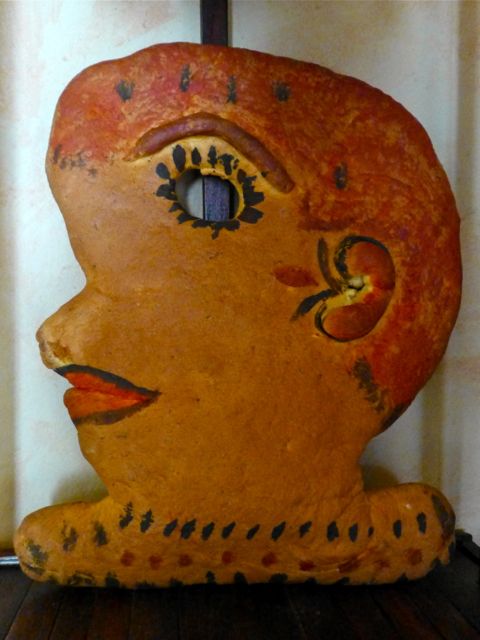
Very special pan de muerto from Restaurante La Abeja just a few blocks from Casita Colibrí.  This one will eventually get two coats of shellac and join her sister (purchased last year) hanging on the wall.

Bread in the shape of the profile of a woman's face

Last, but not least, my altar where photos of departed family and friends join apples, tangerines, pan de muerto, sugar skulls, candles, and incense of copal.

Day of Dead home altar with fruit, candles, bread, calaveras, sugar skulls, etc.

This is a magical time to be in Oaxaca.

Read Full Post »

Lighting, costumes, music, and dance combined to envelop last night’s audience at the Teatro Macedonio Alcalá in an other worldly experience.  Catrina is a magical tale where the world of the living converges with the world of the dead and the central theme is the pain of a mother losing her daughter.

This slideshow requires JavaScript.

The show is a celebration of the pre-Columbian traditions and culture of Oaxaca, especially the ritual and meaning surrounding Día de los Muertos.  Much of the music was traditional Oaxacan and most performers were Oaxaqueños, including Alejandra Robles, singing the title role.

At 48% (that’s over 1.6 million people), the state of Oaxaca has the second highest indigenous population in Mexico.  Perhaps that is why the belief systems of the ancient Mexicans Octavio Paz, cites in The Labyrinth of Solitude, remain strong today.  He writes, “Life extended into death, and vice-versa.  Death was not the natural end of life but one phase of an infinite cycle.”  Healthier, more realistic, and more comforting, I think…

Read Full Post »

Sunday, blogger buddy Chris and I drove out to Tlacolula for market day.  It didn’t take long to realize this wasn’t your usual Sunday market — there seemed to be twice the number vendors and twice as many shoppers.  It was the Sunday before the Días de los Muertos and this mega mercado was providing those who live in the surrounding area with everything they could possible need for their ofrendas (Day of the Dead altars).

Mounds of apples, tangerines, and other fruit.

mounds of bananas and tangerines

Rows upon rows of pan de muerto (the special Day of the Dead bread).

Pan de muerto

Wheelbarrows full of peanuts and pecans.

Wheelbarrow full of nuts

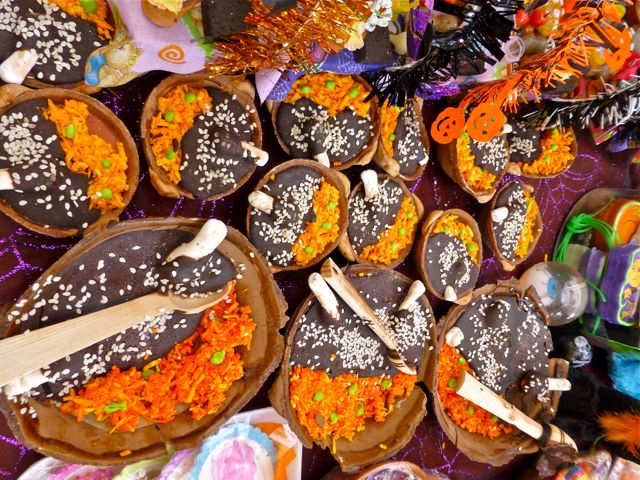
And, in the city of Oaxaca, special Muertos vendor stalls have been set up between the Benito Juárez Mercado and 5 de Mayo Mercado for city dwellers to stock up.  Intricately decorated sugar and chocolate skulls (calaveras) to satisfy the sweet tooth of Mictlantecuhtli (Goddess of Death).

Shelves of sweet calaveras

Decorated clay incense burners…

Clay three-legged incense burners

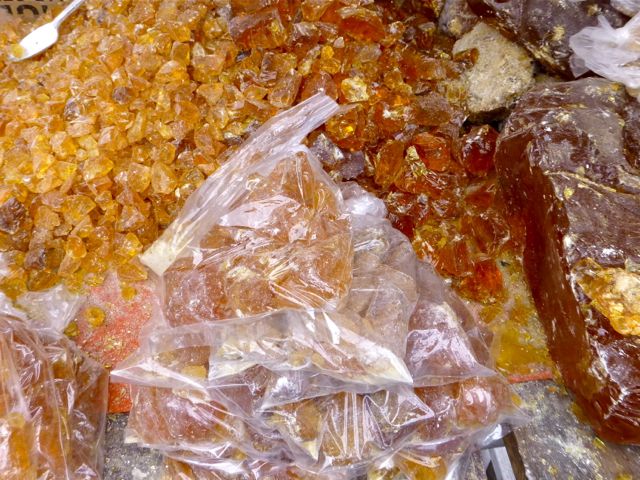
waited to burn copal resin and perfume the air with its wonderful, and now familiar, scent.

Bags and piles of copal resin

Doll house size tables were filled with miniature clay food and beverages (favorites of the departed) …

Tiny tables with miniature clay foods and beverages

and included these diminutive plates of mole and arroz (rice) — which I couldn’t resist buying for my altar!

Tiny plates of ceramic mole and arroz

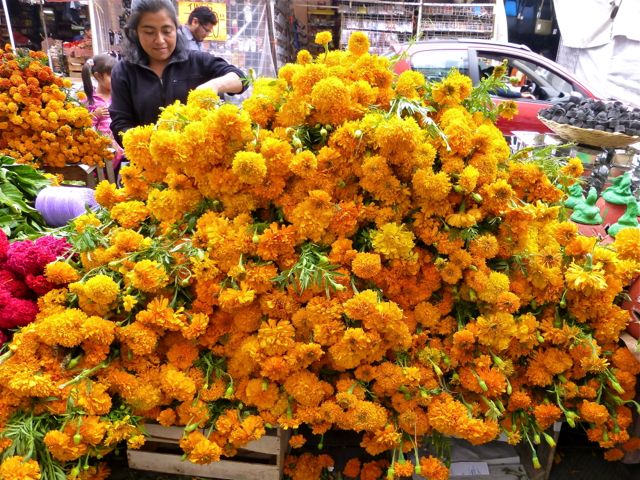
And, of course, there were mounds and mounds of Cempazuchitl (marigolds), the flower of the dead, that grows wild in Oaxaca at this time of year.

Pile of marigolds

All the necessary purchases have been made, now to build my ofrenda.

Read Full Post »

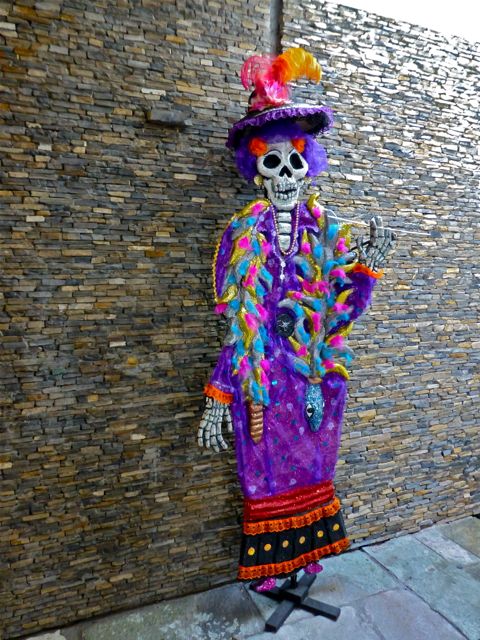
This Catrina arrived styling and ready to party.

Stylish Catrina posing in front of stone wall

Manicured fingers and toes, flower in her hair, and umbrella drink in hand, all she needs is a guy (or gal).

Seated Catrina in Tehuana traje holding cocktail glass with umbrellas.

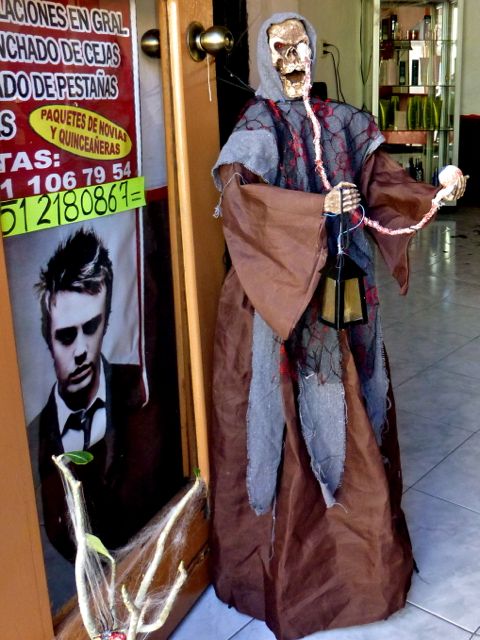
Young man beware — she has her eye on you!

Ghoulish Catrina standing next to head shot of handsome young man

Read Full Post »

And, guess who’s coming to dinner?  Catrinas, pinkies up!

Catrina in lavender dress sitting at table

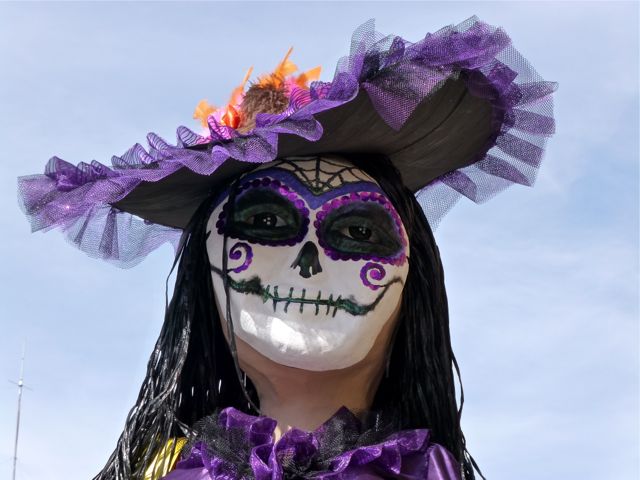
Dahling, don’t start the party without me!

Close-up of face of a Catrina with lavender hat

Lo siento mis amigas, sending regrets from Juchitán.

Close-up of Tehuana Catrina with hand raised

Decisions, decisions, decisions… Shall I take the Jetta, Crossfox, Suburban, or Express Van???

Close-up of face of Catrina standing next to a sign with a list of autos

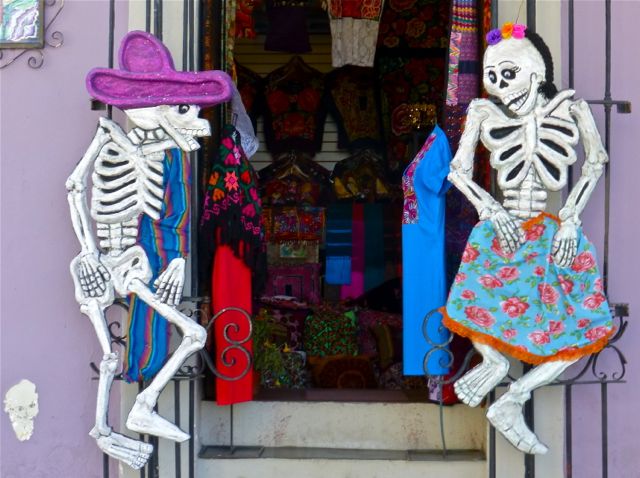
As for these two…

Male calavera and female calavera facing each other in a doorway

I’m not sure they are coming.

Male calavera and female calavera facing away from each other in a doorway

Hmmm… a lover’s quarrel?  Sheesh, even in the afterlife??!!!

Read Full Post »

The announcement came at midnight with the ringing of the Cathedral’s bells and explosions of cohetes (rockets).  Today el Señor del Rayo is having his day!  Like Guelaguetza, Noche de Rabanós (Night of the Radishes), and Día de la Samaritana (Good Samaritan Day), this is an “only in Oaxaca” celebration.

Señor del Rayo crucifix surrounded by lilies.

The carving of Christ on the Cross was brought to Oaxaca during the 16th century and was placed in the temple of San Juan de Dios, a church which had adobe walls and a straw (or possibly wood) roof.  Legend has it that lightning struck the church and everything was destroyed, save for this figurine.  Un milagro!  It was christened Señor del Rayo (Lord of Lightning), was given its own chapel in the newly built cathedral, and has been much venerated ever since.

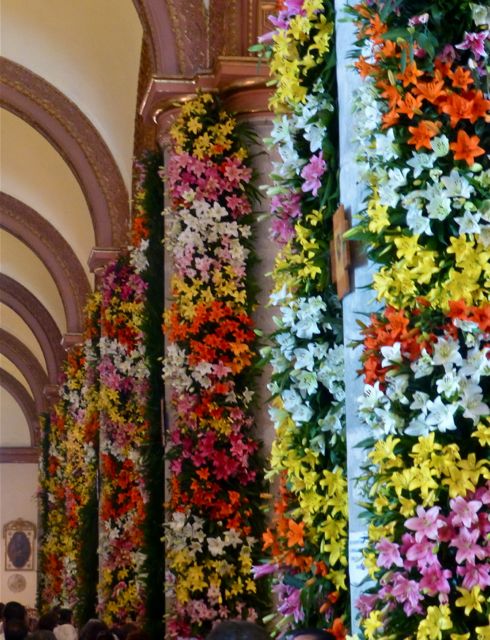
Pillars covered in multicolored lilies

On Sunday, October 21, el Señor del Rayo is moved from his capilla (last chapel on the left) to the main altar.  The cathedral fills with lilies (the scent “breathtaking”), and the faithful flock to pray before Señor del Rayo.  When one inhales the fragrance, one exhales a heavenly, “ahhhh…”

Close-up of orange, yellow, and lavender lilies covering a pillar

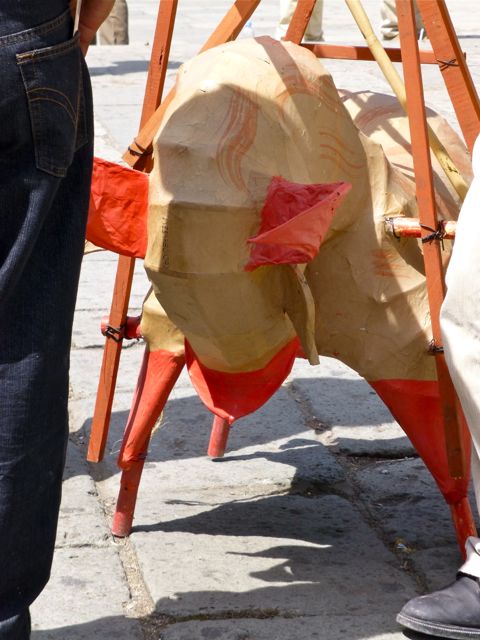
Like all good Mexican celebrations, be they religious or secular, there will be pirotécnicos tonight.  Toritos de luces (little paper-mache bulls wired with fireworks) have begun gathering.

Papermache bull (tornito)

And, as I write, the frame of the castillo below has been raised to its “upright and locked position,” its various spinning appendages have been affixed, and gunpowder tracks are waiting to be lit.

Main structure of a "castillo" laying on its side.

Alas, the action doesn’t begin until around 10:00 PM.  The spirit is willing, but it’s been a busy day, and this “too too solid flesh” is looking forward to melting into her bed.  Think I’ll just watch the fireworks from the terrace.  I know, what a wimp!!!

Read Full Post »

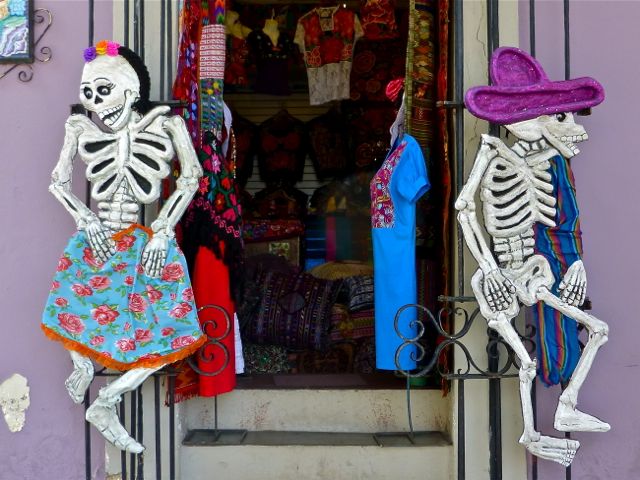
I’ve got my eye on you…

Decorated skeleton on top of building.

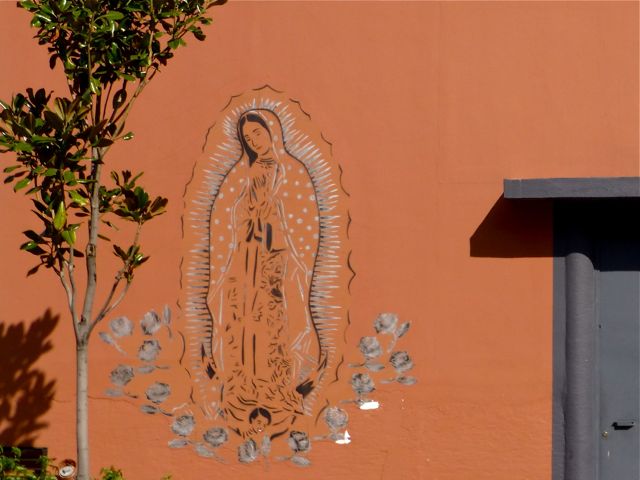
I’m praying for you…

Virgin of Guadalupe image stenciled on a wall

You just never know who might be looking over your shoulder.

Skeleton perched on rooftop above a stencil of the Virgen of Guadalupe

Días de los Muertos are coming…

Read Full Post »

It’s that time of year, again.  Daylight doesn’t last quite as long, the large red-orange blossoms of the African tulip trees have mostly fallen (onto my terrace!), and the hummingbirds have mostly departed, leaving the airspace to the dragonflies and butterflies.

Decorated canasta with religious scene.

However, the season of yellow marigolds (cempazuchitl) and the yellows, oranges, and purples of flor inmortal (immortal flower) has begun and that means Días de los Muertos and Noche de Rabanos  can’t be far behind.

Decorated canasta with image of Virgin Mary.

In the meantime, during the past week, Teotitlán del Valle celebrated La Santísima Virgen del Rosario and early Friday evening, the unmarried girls and women gathered with their canastas for the traditional convite (holy procession).

Decorated canasta with image of bandaged head of Jesus.

And, given the season, flor inmortal played a prominent role in the decorations of many of the canastas.Flor inmortal surround a crucifixion scene on a canasta.

And, as always, I’m amazed and captivated by the girls and women who, with arms raised, balance these sizable baskets on their head, as they navigate the sacred route along the cobbled (and, this day, rain-slicked) streets of Teotitlán del Valle — for almost an hour!Young women wearing dark red wool wrap skirts and embroidered white blouses, carry large canastas on their heads

It’s a scene that I never tire of — of course, I’m not carrying a canasta on my head!

More photos and commentary over at Oaxaca-The Year After.

Read Full Post »

El Grito not only heralds green, white, and red decorations, clothing, and Mexican flags.  It is also the season to savor the multi-layered, delicate flavors of Chiles en Nogada and delight in its colorful, patriotic presentation.  Legend has it, the dish was created in 1821 by nuns in Puebla to honor a visit by Mexican General Augustín de Iturbide, that pretty much signaled the end of the eleven-year long Mexican War of Independence.

There are probably as many recipes for Chiles en Nogada as there are chefs and abuelas, but the basics include green poblano chiles stuffed with a picadillo of meats, fruits, nuts, herbs and spices; served with a creamy white cheese and walnut sauce; and topped with a garnish of red pomegranate seeds, walnuts, and the green of chopped parsley.

Serving of Chiles en Nogada on a white plate.

This was my lunch of Chiles en Nogada today at La Popular, a delightful new restaurant in Oaxaca (Garcia Vigil 519, Centro).  Yummm….

(ps)  Chris just posted this video of Lina Fernandez making Chiles en Nogada.  She makes it look almost doable!

Read Full Post »

Revolutionaries behind bars.

Boy and girl figures, seen through window bars in shop display dressed in traditional revolutionary clothing

Couldn’t resist just one more El Grito window display!

Read Full Post »

The word "ASK" written on white wall with light green trim on left

Where else have you seen El Grito decorations?

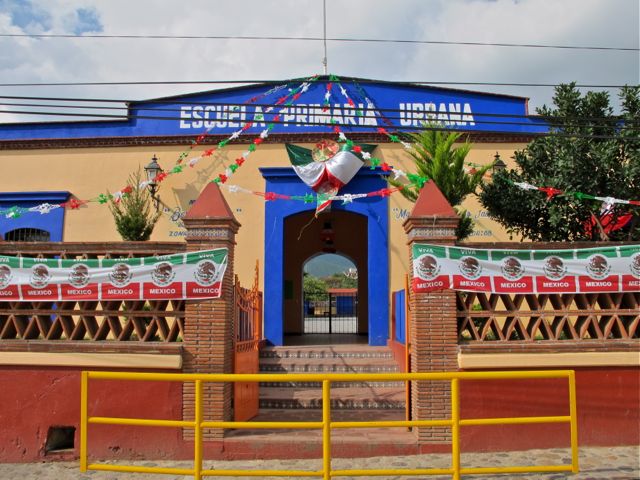
Blue and peach colored school decorated with Mexican flag banners and drapes

Schools, of course!  This one in Teotitlán del Valle.

People standing in front of newsstand decorated with a green, white, and red garland.

And, how about newsstands?  You can’t miss the green, white, and red — it’s everywhere!

Read Full Post »

Waiting for the convite… Fiesta a la Natividad de la Virgen María.

Cloudy sky; young girl surrounded by plastic covered canastas; Cerro Picacho in background.

September 8 was a rainy day in Teotitlán del Valle.

Read Full Post »

El Grito is coming, El Grito is coming!!!  Green, white and red is on display all over the city, including clothing stores, as tradition calls for wearing the colors.

Are you in the market for a traditional look?

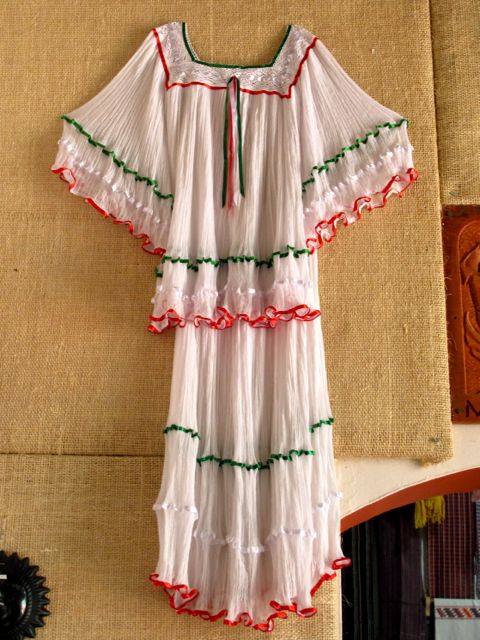
White blouse and skirt with green and red trim.

A huipil and rebozo?

Green, white, and red dresses and shawls hanging on wall.

Or, are you leaning toward an updated mix and match style?

Green, white, and red dresses, skirs, blouses, and sash.

Do you need a sweater for going down to the zócalo on the evening of September 15?

Green, white, and red sweaters hanging on display hooks.

By all means, don’t forget to accessorize!

Green purse and red shoes.

On a more serious note:  Despite its current challenges (which are many and serious), Mexicans are extremely proud of being Mexicanos.  And, in my humble opinion, they have every right be!  They can trace their history back to ancient and highly developed civilizations, their national cuisine has been placed on the World Heritage List by UNESCO, and Mexico is considered one of the most geographically and biologically diverse countries in the world.  Plus, when was the last time you heard Mexico had invaded another country?

Read Full Post »

… and fish and turtles and ducks.  On August 31, as the rain fell, all of the above and more, assembled at Templo de Nuestra Señora de la Merced for the annual Bendición de los Animales.  Animals and their human keepers were there to celebrate the feast day of San Ramón de Nonato, patron saint of women in labor, persons falsely accused, and keeper of animals.

There were some familiar faces, both human and animal, from last year’s blessing.  However, this year the dogs were extremely vocal and, on occasion, tested the strength of the human at the other end of their leash — perhaps it was in anticipation of the evening’s “blue moon” or maybe being restrained and made to just sit or stand in the rain made them grouchy.

This slideshow requires JavaScript.

This morning’s article in Noticias covering the blessing, led off  with this quote from Benito Juárez García:

La protección de los animales forma parte esencial de la moral y de la cultura de los pueblos civilizados.  (The protection of animals is an essential part of morality and culture of civilized people.)

For more on this year’s Blessing of the Animals, head over to Oaxaca-The Year After.

Read Full Post »

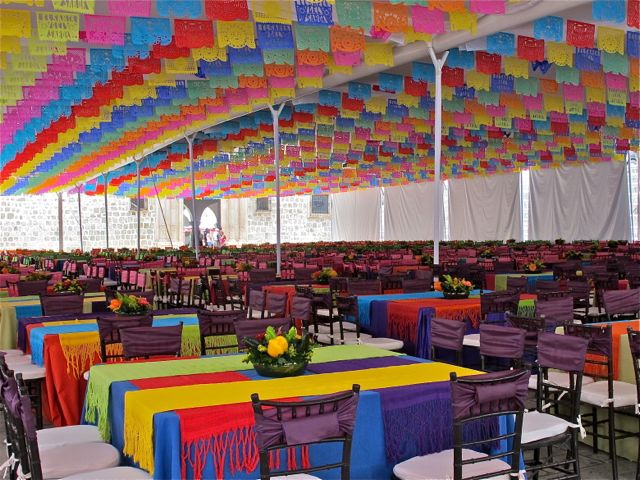
Thursday night was the kickoff event for the 5th annual El Saber Del Sabor (literally, the knowledge of flavor) Festival Gastronómico Oaxaca 2012.  Early in the day, the Plaza de la Danza had been tented and turned into a colorful banquet hall.
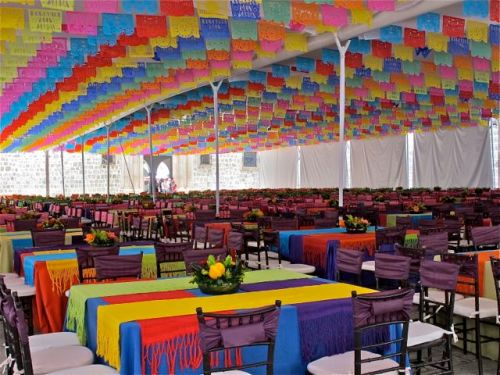
Interior of large tent decorated with multicolor tableclothes and papel picado on ceiling

A couple of the evening’s chefs arrived early and were cooling their heels, waiting to begin doing what they do best.  Hmmm… what’s with the bricks on top of the cantera?  (Stay tuned!)

2 chefs sitting behind brick platform

By 9:30 PM the tables had filled and cooking was well underway.

Young man in chef's toque sauteeing bananas.

Casa Oaxaca chef and event host, Alejandro Ruiz Olmedo circulated, greeted old friends and fans, and was interviewed by a crush of press.  Cameras and microphones were omnipresent — good for publicity, bad for navigating the aisles en route to food!
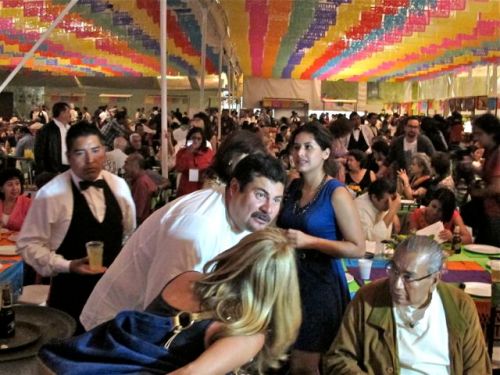
Chef Alejandro Ruiz Olmedo talking to a table filled with people.

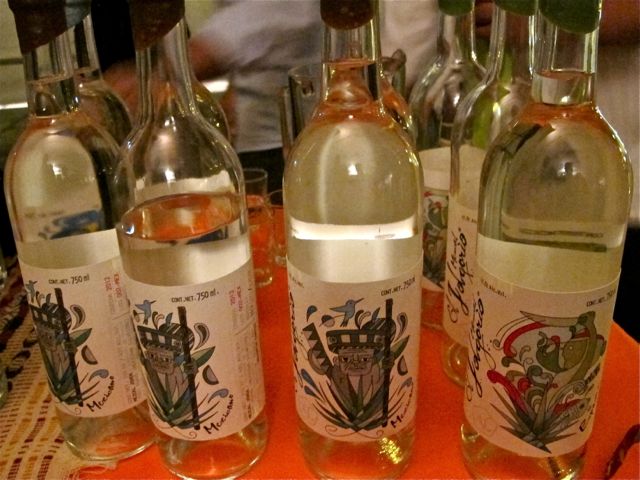
To begin the evening and ready the palate, wines, beers, aguas, and (of course!) mezcals were offered.  We sampled a couple of mezcals from El Jolgorio and all I can say is, Wow!  (BTW, that’s a good, “Wow!”)

Bottles of El Jolgorio Mezcal on a table.

The festival seeks to promote and protect Oaxaca’s traditional cuisine and to inspire innovation.  For this evening’s event, we were invited to sample an incredible range of appetizers, side dishes, main courses, and desserts from 23 cooks, representing the 8 regions of Oaxaca.

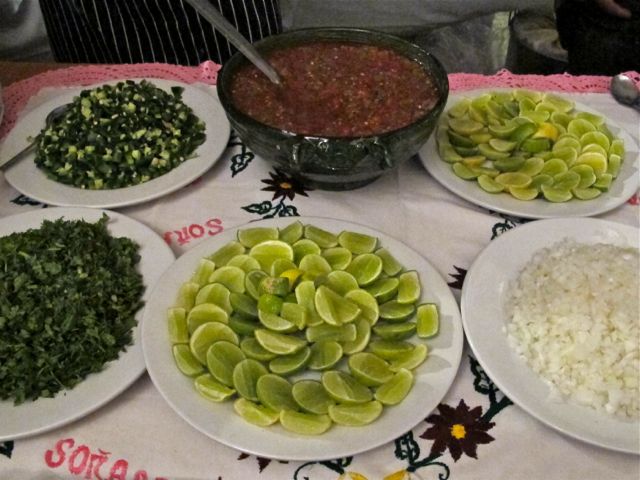
A bowl of a stew surrounded by platters of limes, rice, cilantro, and onions.

I think I must have tasted at least 30 dishes — and this was late at night.  Needless to say, no breakfast for me the next morning.
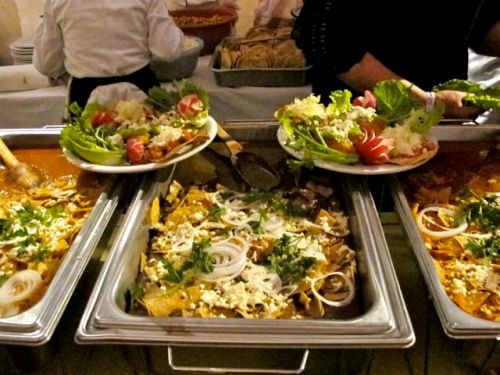
Serving pans of food.

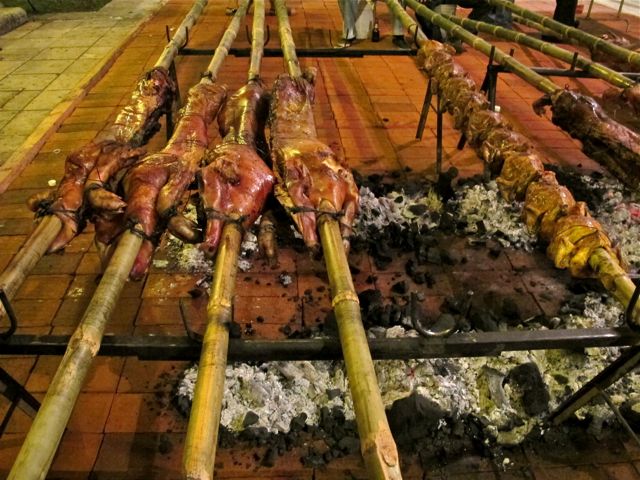
And, remember the bricks?   My favorite sight of the evening were the little piggies roasting on bamboo skewers over red and white-hot coals.  The tag line for the festival is, “tierra, fuego y cocina” (earth, fire, and kitchen).  Yes!!!

Roasting pigs on bamboo skewers over hot coals.

From the Plaza de la Danza, the festival moves to restaurants throughout the city, where 36 renowned chefs from all over Mexico have come to prepare innovative cuisine that pays homage to Oaxaqueño foodstuffs and traditions.

A big “thank you” to Henry and Rosa (Amate Books) for inviting me to share such a delightful and delicious evening!

Read Full Post »

« Newer Posts - Older Posts »