Feeds:
Posts
Comments

Archive for the ‘Celebrations’ Category

The dead don’t arrive in the valley of Oaxaca all at once.  The cosmic difunto air traffic controller has scheduled their arrival at different times on different days, from October 31 through November 3, to avoid celestial congestion.

Santa María Atzompa’s departed are among the first to return, arriving on the night of October 31.  Flower and food vendors line the walkway leading to the panteón as grandparents, parents, teens, and small children stream in with arms full of flowers, candles, buckets, and brooms.  Because is built on a slope and there are almost no paths, footing can be treacherous, especially in the dark when only candles on the graves light the way.  At one time, perhaps tombs were positioned on a grid, but no more and it seems to be filled to capacity.  I guess that’s why one side of the panteón has been opened up (one of the walls removed), the field beyond leveled, and a new wall around the field, connected to the old, constructed.  (You can click on images for a larger view.)

On November 1, in the early afternoon, it has become our custom to visit the cemetery in Tlacolula de Matamoros, before bringing pan de muerto and mezcal to the home of friends in Teotitlán del Valle.  In contrast to the higgledy-piggledy of Atzompa, the panteón in Tlacolula emanates a sense of order and serenity.  I wonder, could the tranquility come from the 500 year old ahuehuete trees (hijos of el Tule, we were told) that reign over the tombs of the departed and make for an amazing play of light and shadow throughout?

On November 2, we returned to Teotitlán, but I will save that for another blog post.  However, that was not the end of the road.  In the category of, no rest for the living, the following day we drove south to San Antonino Castillo Velasco.  This is the village known for their beautiful flowers and exquisite floral embroidery.  And, it is said that because the living are so busy providing flowers to other parts of the valley, the departed wait until November 3 to return. (See the book, Day of the Dead: When Two Worlds Meet in Oaxaca by Shawn D. Haley and Curt Fukuda.)  I’m sure, like we, the difuntos are dazzled by the intricacy of floral designs that family members have created to decorate their tombs in welcome.

Octavio Paz writes in The Labyrinth of Solitude, “Life extended into death, and vice-versa.  Death was not the natural end of life but one phase of an infinite cycle.”

Read Full Post »

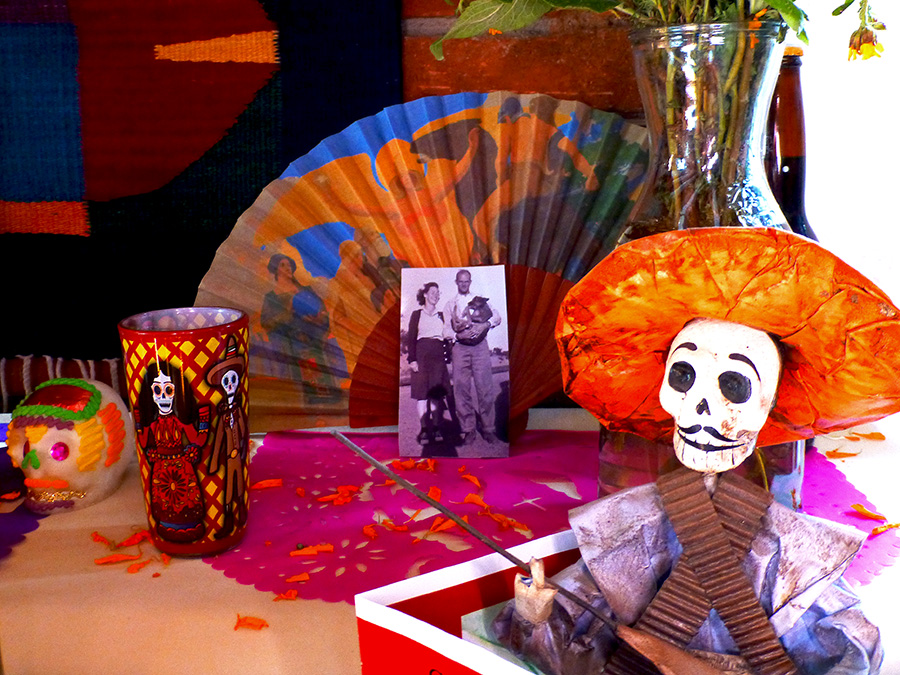
Poco a poco (little by little) my ofrenda has been constructed and composed.  A yellow (the color of death in prehispanic southern Mexico) cloth covers two chests and papel picado, signifying the union between life and death, has been added.

p1230011_crop

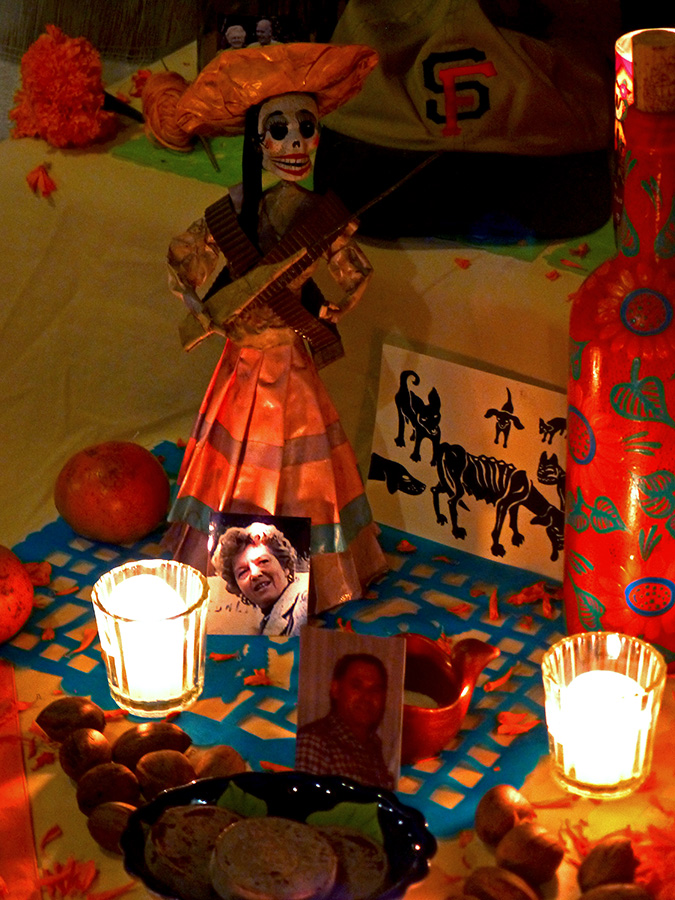
Photos of departed loved ones have been placed, along with apples, oranges, and nuts to nourish the difuntos, sal to make sure the souls stay pure, cempasúchitl and veruche (domesticated and wild marigolds) — their scent to guide the spirits, cockscomb to symbolize mourning, the previously mentioned flor de muerto from the mountains above Díaz Ordaz, and copal incense to draw the spirits home and ward off evil.

p1220899_crop

Sugar skulls, catrinas, and a few of the favorite things of my parents, grandparents, and in-laws have also been added.  Lest the spirits become thirsty, there is water, mezcal, cervesa, and a bottle of port (for my mom) to drink.

p1230015_crop

Last night, the candles and copal incense were lit to guide my loved ones to my Oaxaca home and, just to make sure, I sprinkled some cempasúchitl petals outside to help them find their way.

img_2246_crop

It may not be the house where they lived, but I’m hoping they too believe, When you live in your heart, you are always home.

Read Full Post »

October 30, 2016, around and about the valley of Oaxaca, preparations were underway for Día de Muertos.  Bread, fruit, chocolate, nuts, and flowers for sale spilled from mercados into the streets; the difuntos must be fed… and only the best!

Our first stop was Villa Díaz Ordaz for their first Expo Festival del Pan de Muerto.  It was day two of the 3-day festival and, of course, we were there early (around noon), but everyone was so warm and welcoming.  Hopefully, it will continue to grow in future years, as this is a sweet village in a picturesque setting at the base of the mountains.

p1220852

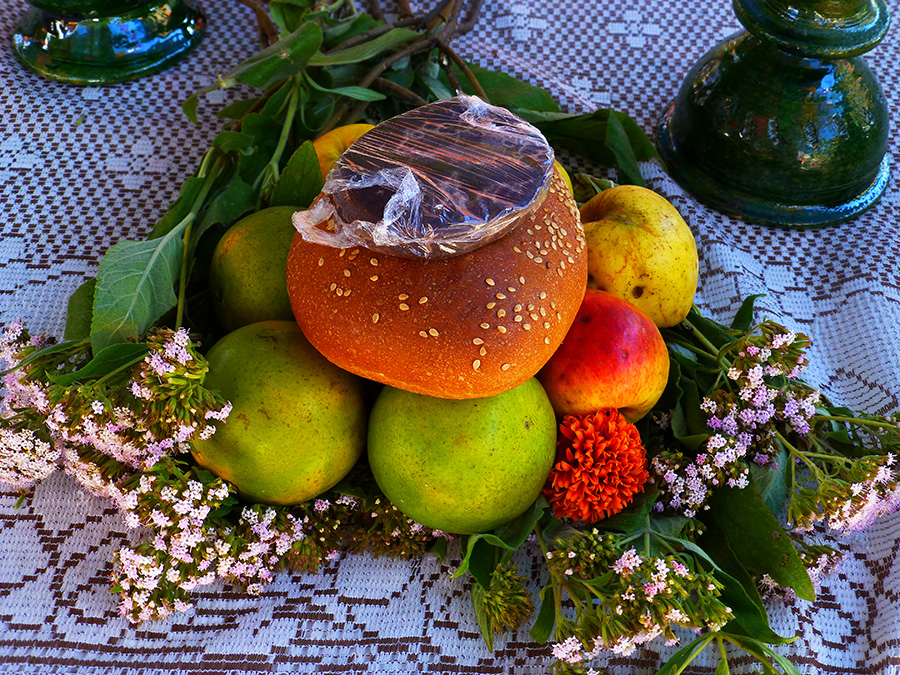
In Díaz Ordaz, they call these tiny, spicy-scented, lavender flowers “flor de muerto” and we were informed that they are even more important than cempasuchil (marigolds).

p1220847

After buying some surprisingly flavorful (whole grain!) pan de muerto for my ofrenda, we headed off to San Pablo Villa de Mitla.  Mitla has the most beautiful pan de muerto and two years ago we stumbled on their Pan de Muertos festival and competition.  A dazzling display of intricately decorated breads lined the sidewalks under the portales.  Alas, the festival was not continued, as their bread is in such demand, the bakers were too busy to take time out for an expo and competition.  So, like last year, we just enjoyed the sights and aromas of their bustling mercado.

p1220868

Have you ever seen so many varieties of bananas???  And, now for the famous  pan de muertos…

p1220861

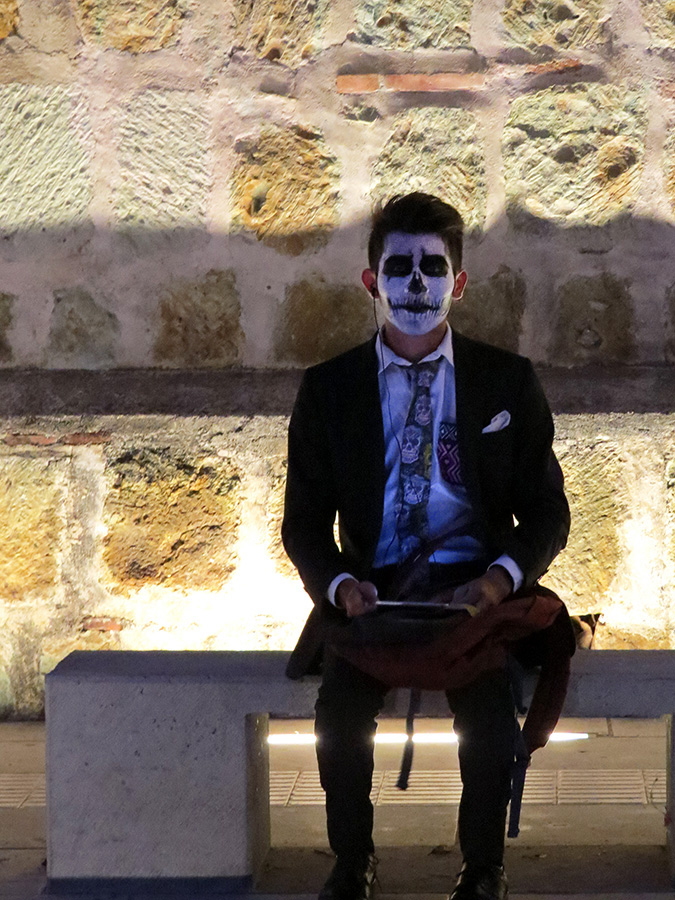
Returning home, I added the bread and flor de muerto to my ofrenda.  Following a siesta, I ventured out into the streets of the city in search of a comparsa.  I never found it, but, as you could see from my previous post, the city was teeming with people and activity.  However, amid the merriment and mayhem, there were scenes of tranquility.

img_2135

A catrin ejecutivo?

img_2172

The copal incense beckoned the difuntos…  They began arriving this morning, seconds after midnight.

Save

Save

Save

Read Full Post »

Beautiful Oaxaca tonight on Macedonio Alcalá…

img_2145

In the words of the song, “Oaxaca vives en mí” (Oaxaca, you live in me).

Read Full Post »

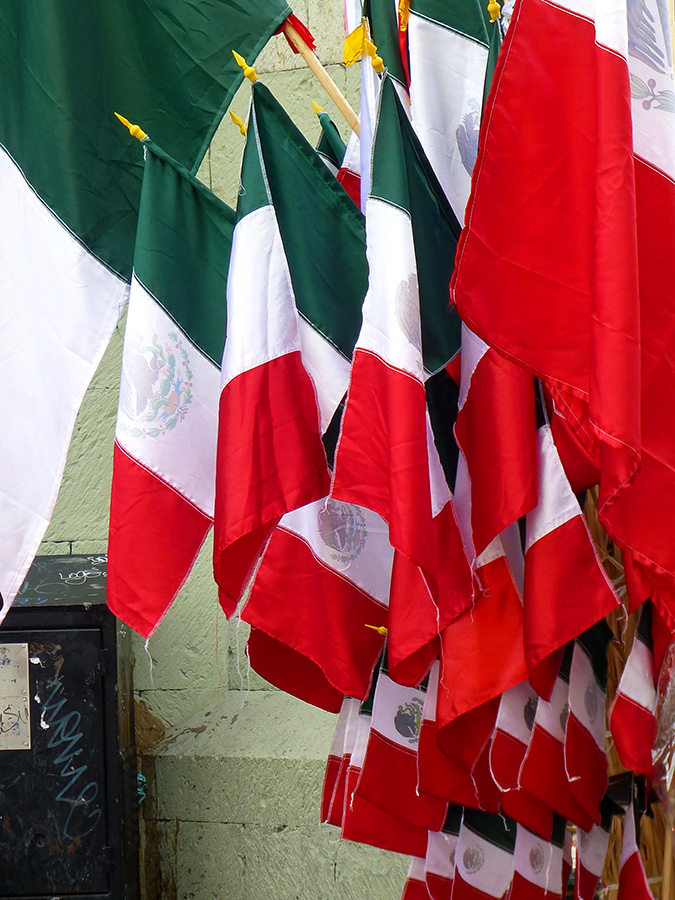
Mexico’s El Mes de la Patria (the month of the homeland) is upon us and overnight, as August turned to September, the streets erupted in green, white, and red.

p1210919

Mexico celebrates September 16, 1810 as the beginning of its fight for independence from Spain.

p1220023

Flags are flying everywhere and are for sale on every other street corner, along with all manner of patriotic tchotkes.

p1220025

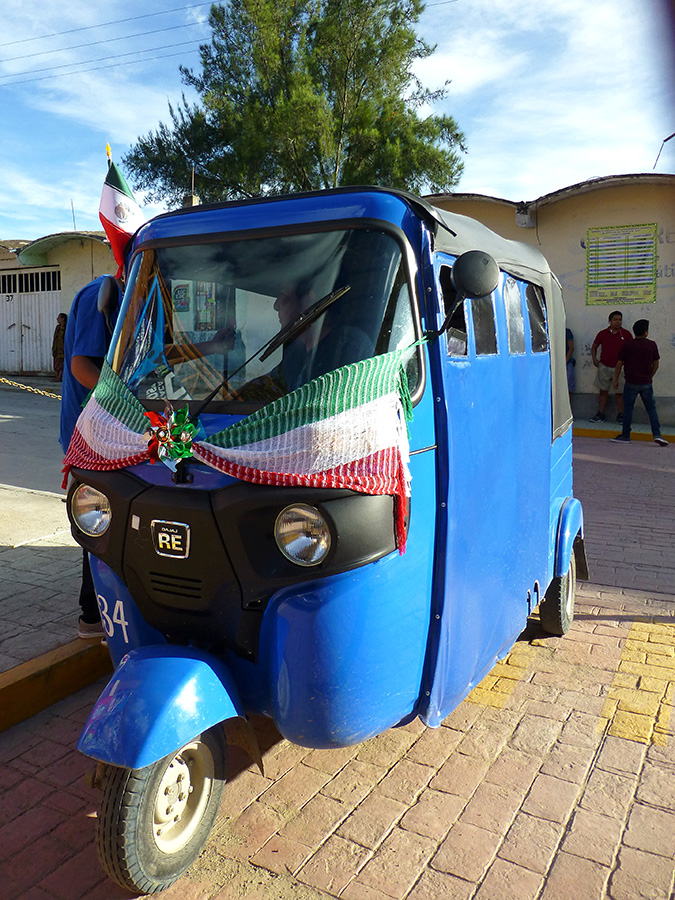
From buses in the city to moto-taxis in the villages, everything is decked out in the green, white, and red of the Mexican flag.

p1220066

As for Oaxaca?  The five-month renovation project at Mercado Benito Juárez has been completed and vendors have moved from their temporary stalls on the surrounding streets back into the market; Sección 22 teachers have returned to their classrooms and 80% of the encampment in the zócalo has been disassembled; the governor will give his final Grito de DoloresGrito de Dolores at 11:00 PM on September 15th; and the annual patriotic parade will fill the streets of the Historic District with participants and observers on the 16th.

Save

Read Full Post »

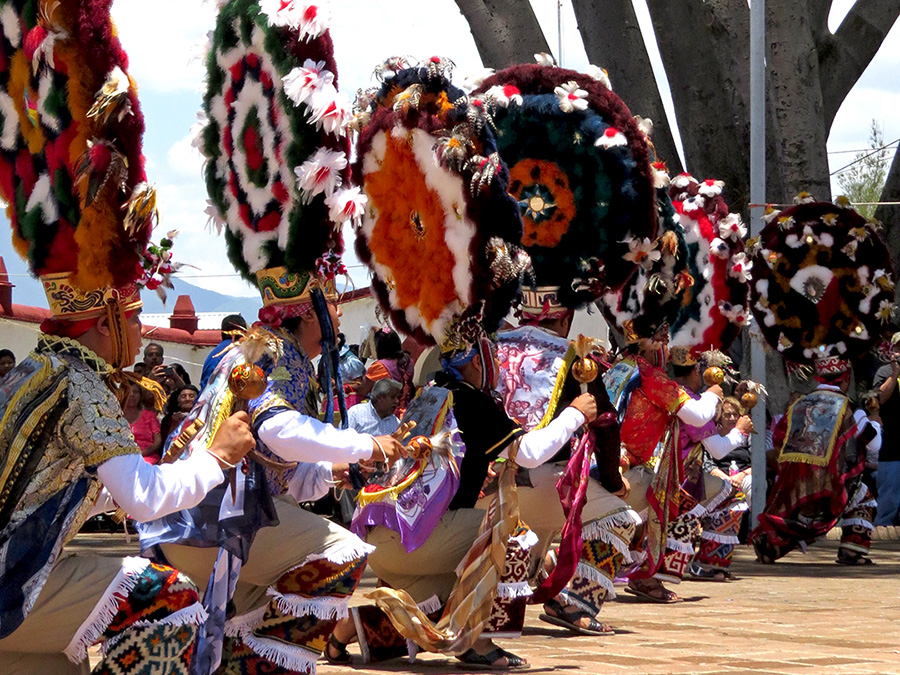
While waiting for yesterday’s convite to begin, the Danza de la Pluma subalternos, Florentino Martínez Ruiz and Juan Bautista Ruiz, knew how to keep young, old, all those in between, and the photographers entertained.

p1220053

A little “splendor in the grass” for Juan?

p1220055

And, the fun didn’t stop there, once the convite began, Florentino snatched a marmota from one of the little boys to give it a try.

img_2036

And, everyone laughed, especially the boy!  That’s entertainment, Teotitlán del Valle style!

Read Full Post »

Five days ago, Norma Schafer blogger at Oaxaca Cultural Navigator and moderator of the Facebook group, Mexico Travel Photography, issued a 5-day “Mexico Colors” photo challenge to the Facebook group — one photo a day for five consecutive days.  I think she was giving us a gentle prod, because up until then, most of us had been pretty lax about posting photos.  However, with her challenge, the floodgates opened.  Unsurprisingly, my five entries were all about the colors of Oaxaca.

P1210349_day1

Day 1:  Naturally dyed yarn hanging to dry at the family home of Porfirio Gutiérrez and his sister, Juana Gutiérrez Contreras.

P1090252_day2

Day 2:  My empty wine bottles hand painted by Isabel in San Antonio Arrazola, Oaxaca — waiting to be filled with mezcal!

IMG_1305_day3

Day 3:  Danza de la Pluma in Teotitlán del Valle, Oaxaca — during this year’s patronal festival honoring Preciosa Sangre de Cristo.

P1170253_day4

Day 4:  The “only in Oaxaca” celebration of Día de la Samaritana in Oaxaca city.

P1200734_day5

Day 5:  Flor de Piña dancers from San Juan Bautista Tuxtepec at this year’s second Guelaguetza desfile in Oaxaca city.

Norma has hinted that there may be more challenges to come.  We shall see!


Read Full Post »

The morning of August 12:  Almost continuous explosions of cohetes (rockets), shrill incessant traffic whistles, honking horns, and the distant sounds of a band (or two or three).  What in the world?  I had errands to run, so out into the cacophony to confront the unknown, I went.  It only took walking to the end of my block to realize what I’d forgotten.

IMG_2335

It’s Día del Taxista, the day when cab drivers and their families decorate their taxicabs and process en mass through the streets of the city, accompanied by bands, monos, and pirotecnicos (hence the booms and bangs).

IMG_2333

I not only forgot what day it was, but I also forgot my never-leave-home-without-it little Lumix, so the above were taken with my iPhone — something I almost never do and which explains the “creative” image below.

IMG_2326

I have NO idea how it happened, but I’ve got to say, it does illustrate what riding in a taxi in Oaxaca often feels like!

Save

Read Full Post »

Unlike last Saturday, there was no rain on yesterday’s Guelaguetza parade.  There was music, mezcal, and tepache. (Click on photos for full image.)

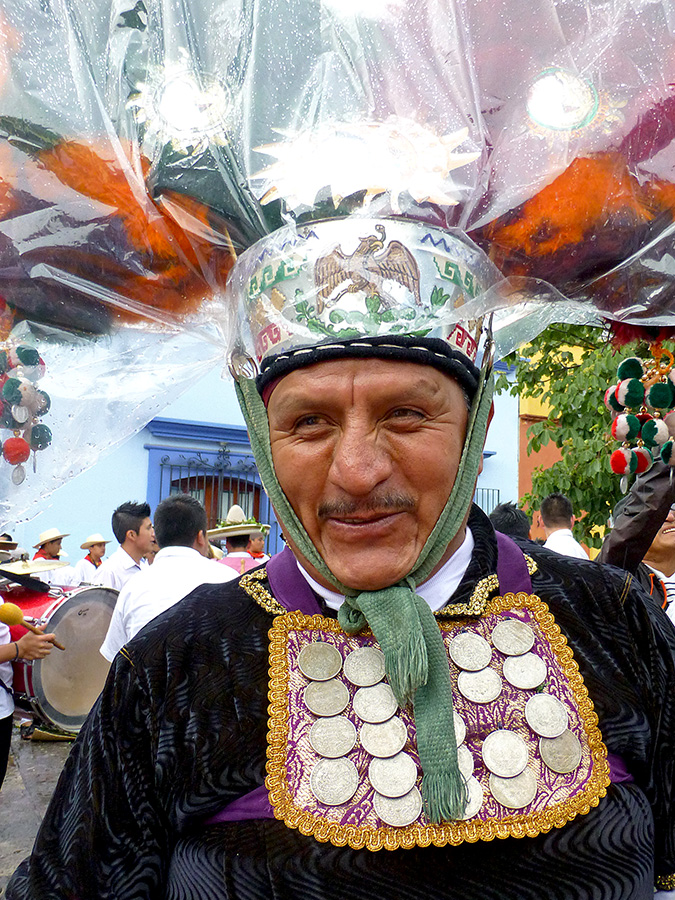
There were headdresses and bling.

There was awesome pride and joy.

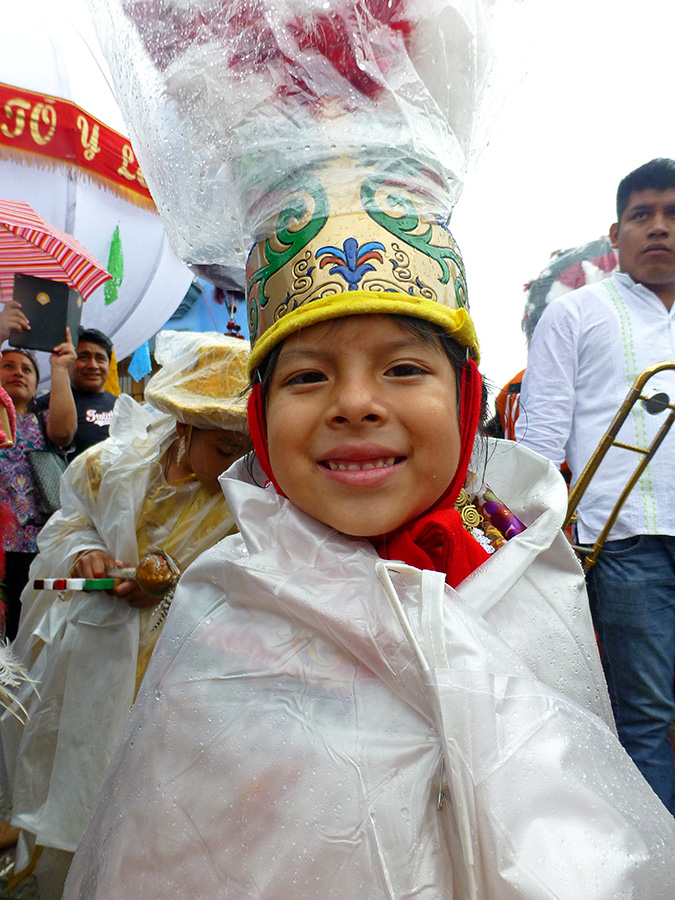
And, there were kids to carry on the traditions.

Muchisimas gracias to the extended family of Hotel Casa Catrina who allowed me to seek shelter from last Monday’s rain and yesterday, saw me across the street and invited me for a shot of mezcal and to watch the desfile with them.  That’s Oaxaca — warm, welcoming, and wonderful!!!

Read Full Post »

As regular readers know, I have a huge soft spot in my heart for the people and cultural traditions of the Zapotec village, Teotitlán del Valle.  Blogger buddy Chris and I go out there often, especially for their major festivals where the Danza de la Pluma is performed.  Earlier this month, a new group of danzantes de promesa assumed the sacred 3-year commitment to perform the Danza de la Pluma and, for the first time in recent memory, they were selected to dance in this year’s official Guelaguetza.  As you can see from the Vive Oaxaca video below, their 17-minute performance Monday evening was spectacular!

¡Felicidades! to the band, Los Reformistas, led by Maestro Antonio Servando Bautista González; to the breathtaking dancing of Sergio Gutiérrez Bautista (Moctezuma), who was front and center and flawless during the entire performance; and to all the Danzantes, who impressively executed the complicated and visually stunning choreography of Maestro Javier Gutiérrez Hernandez.  While I may only be a (albeit, frequent) visitor to Teotitlán del Valle, I couldn’t help but feel incredibly proud of the dancers and the way they represented their strong, vibrant, and historic community.

Read Full Post »

Yesterday, two friends and I hailed a taxi and headed out of the city.  We disembarked at the Viguera crucero, where we crowded into blogger buddy Chris’s car enroute to the intimate Guelaguetza in Las Peñitas Reyes Etla.

The day was overcast and there were a few light sprinkles, but the welcome we received on this grey day warmed our hearts.

As they have in past years, for three and a half hours, the members of the folkloric dance group, Danza Balachi, danced, changed costumes, danced, changed costumes, and danced some more.

The sun eventually made an appearance and our day ended with very yummy estofado at our favorite restaurant, Comedor Colón in Villa de Etla.  It was a great day!

Read Full Post »

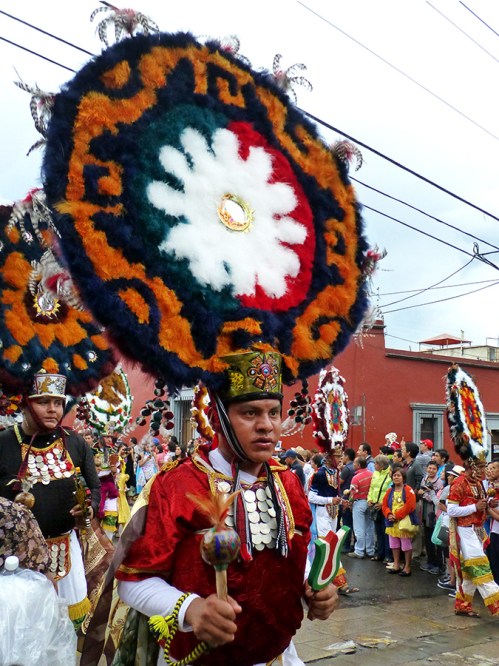
Yesterday, as the Guelaguetza dancers gathered at the Cruz de Piedra and Conzatti Park waiting for the desfile (parade) of delegations to begin, the sky darkened, thunder rumbled, lightening flashed, the wind picked up, and the rain began falling.  While they may be making their first appearance (in recent memory) at the Guelaguetza, the Grupo de Danza de Pluma Promesa from Teotitlán del Valle came prepared.

P1200728

They donned rain ponchos and covered their penachos (headdresses) with clear and specially sized plastic bags.

P1200730

They were good to go!

P1200731

Dance master and choreographer extraordinaire, Javier Gutiérrez Hernandez, must have hauled his old costume out of storage to fill in for one of the danzantes.  But he looked stoked!

P1200733

I’m not sure which Subalterno this is.  Florentino Martínez Ruiz is that you?  Or, is it Juan Bautista Ruiz?  Before and during the desfile, both clowned around a little and assisted the danzantes a lot.

P1200735

There is something about kids and rain…  Five year old, Quetzali del Rayo Santiago Ruiz (Malinche) looked happy as a clam.

P1200742

Perhaps there was a little trepidation among the danzantes at the conditions and concern if the desfile was really going to happen.

P1200835

However, at almost exactly 6 PM, police sirens sounded, the leading band struck up, and the parade of Guelaguetza delegations began dancing their way through the city’s rain slicked streets.

P1200840

Not long after it began, the torrential downpour subsided and the plastic began coming off the danzantes penachos.

P1200922

After 35 minutes of dancing through, what became, a light drizzle, they reached the intersection of Crespo and Morelos, only a half a block from the parade’s end at the Plaza de la Danza.  Next on their dance card, Monday evening’s Guelaguetza performance!  I’ll be watching on the local CORTV station.  However, if you are not in Oaxaca, CORTV will also be streaming the 10 AM and  5 PM Guelaguetza performances live, this week and next.

Read Full Post »

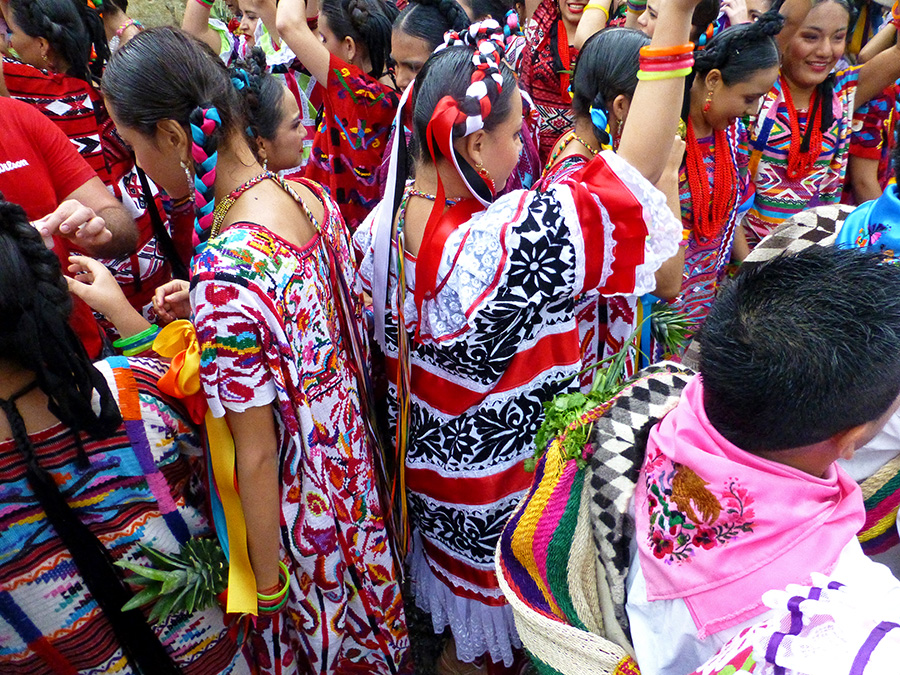
Orgullo is the Spanish word for pride and you hear it a lot in Oaxaca.  But, rather than just the personal, it encompasses the dignity, honor, and respect felt for one’s community’s history and cultural heritage.  Remember, there are 16 indigenous groups in the state of Oaxaca – each with its own language, dress, culinary traditions, music and dance, celebrations, and crafts.  While the modern Guelaguetza is an invention to attract tourism, it doesn’t detract from the pride expressed by its participants in their unique contributions to what makes Oaxaca.  Thus, a few scenes from Friday…

Fresh handmade tortillas accompanied the mole at the Festival de los Moles luncheon. Chefs from all over the state, presented their moles — I lost count at twenty different kinds — which were served by culinary students from the Universidad Tecnológica de los Valles Centrales de Oaxaca.


Diosa Centéotl (Corn Goddess) competition to reign over the Guelaguetza.  Young women representing the regions of Oaxaca showcased and explained the costumes and traditions of their communities, as well as, speak a few lines of their materna lengua (mother tongue).


Calenda (procession) on the Alcalá by people from the Gulf of Tehuantepec region.  They were heading toward Santo Domingo — and yes there were a few Muxes among the participants.


During Guelaguetza, orgullo wraps you in its presence.

Read Full Post »

July is the month of the Guelaguetza.  It has its origin in pre-Hispanic corn festivals — a time when maíz seeds were (and continue to be) sown in many of the villages in the valley of Oaxaca and people gathered to exchange seeds and celebrate.  The annual festival was resurrected in 1951 by the city’s leaders to encourage tourism — and it has worked.  Ancillary activities, in the form of fairs, festivals, and cultural presentations have been added over the years to attract and entertain even more domestic and international tourists.

And so, despite the continuing and contentious issues regarding education/labor forms, the show must go on!  Calendas (parades) are already occurring on the city’s streets and banners advertising Guelaguetza events are hanging from street lights on the major calles.  Below is the official Guelaguetza 2016 program of events and a selection of some of the addition activities happening this month.  (Click each poster for a larger and more readable image.)

programa de actividades guelaguetza 2016

guela2016

If you are in Oaxaca, there is no reason to be bored.  ¡Disfruta!  Enjoy!

Save

Save

Save

Read Full Post »

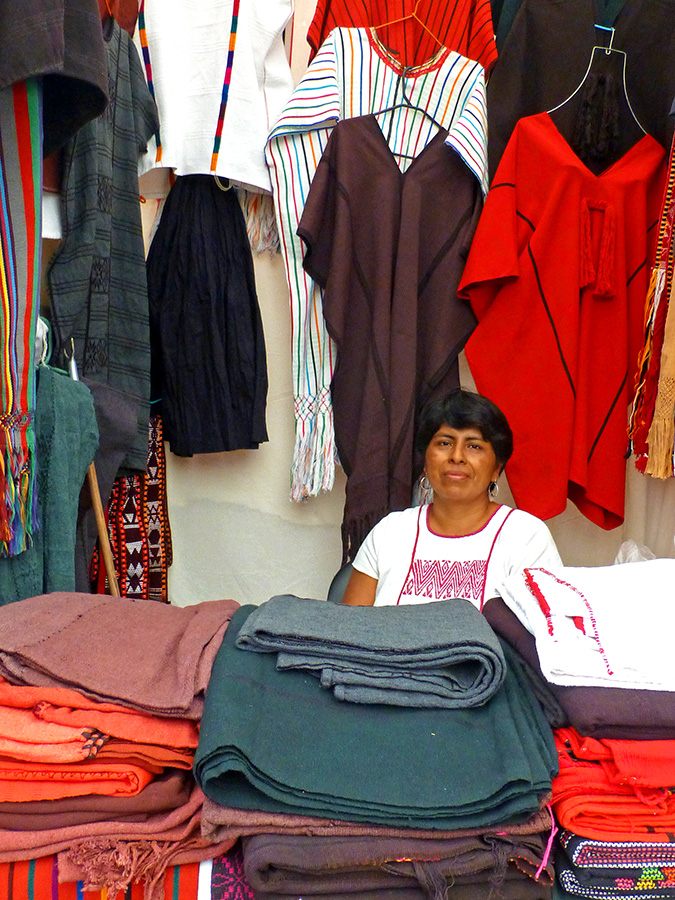
Artisans from the eight regions of Oaxaca have moved their hand-crafted textiles, pottery, wood carvings, jewelry, and more into the previously mentioned booths near the top of the Andador Turístico (Alcalá/walking street) and Paseo Juárez el Llano (Llano Park).  Not all the signs are in place, but the artisan vendors are.  The exposition and sale will run through the last Guelaguetza performance (August 1), so today’s mission was just to do an initial reconnaissance — to check out new vendors, see what I absolutely cannot live without, and connect with some of my favorite vendors.

Samuel Bautista Lazo

First up were the artisans in Llano Park, where I rendezvoused (stall #70) with my old (though he’s young) friend, Samuel Bautista Lazo, from Teotitlán del Valle.  As I’ve mentioned before, I met Sam and his family during my first visit to Oaxaca in 2007 and (of course) bought two tapetes to bring back to the San Francisco Bay Area.  The rugs returned to Oaxaca with me when I moved here in 2009.  Between then and now, Sam has gotten his Ph.D. in Sustainable Manufacturing at the University of Liverpool (yes, England!), returned to Oaxaca, and is currently helping his family market and manage Dixza Rugs & Organic Farm — their weaving and Bed & Breakfast business.

Daughter of Amalia Martínez Casas

At one of the stalls along the Alcalá, I spotted the unmistakable work of Amalia Martínez Casas from Tamazulápam del Espíritu Santo, a mountain village in the Mixe.  Alas, it was her daughter staffing the booth.  She assured me that Amalia’s health was okay, but that she’s getting old and had decided not to make the tiring journey down from the mountains into the city.  I have several huipiles and a serape of Amalia’s but I must admit, I am very tempted to add another piece to my oft-worn collection.

Honorina Goméz Martínez

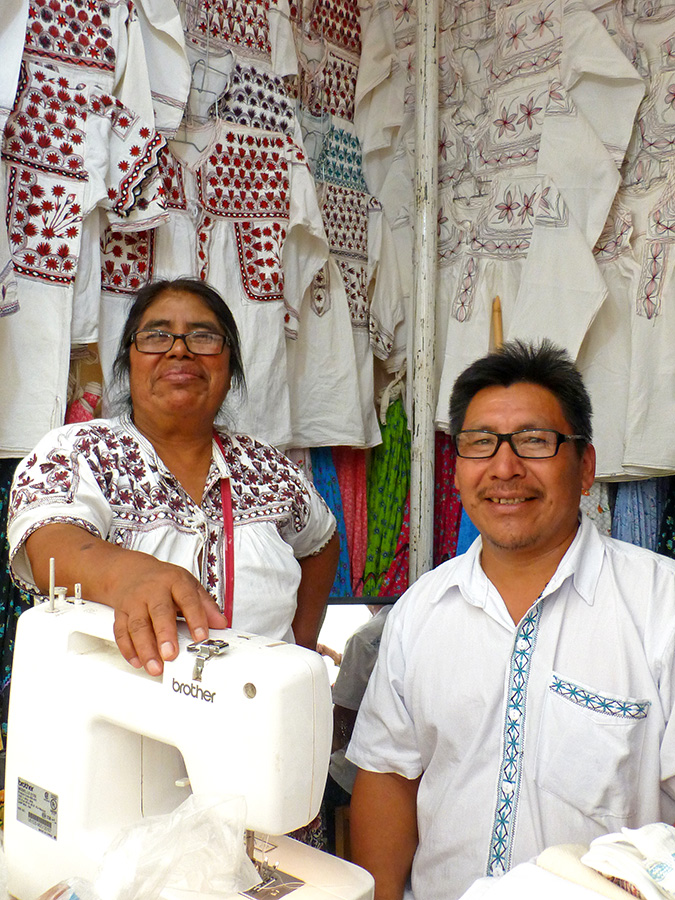
Lastly, I stopped by to greet Honorina Gómez Martínez and Pablo Martínez Martínez from Santa María Tlahuitoltepec, also in the Mixe, and just a few miles up the mountain from Tamazulapam.  It never ceases to amaze me how clothing styles vary dramatically in Oaxaca, not only from region to region, but also from village to village, within the same region.  You may remember, Doña Honorina Gómez was a leading spokesperson in the plagiarism dispute with a couple of French designers, which the embroiderers of Tlahuitoltepec eventually won and which prompted Oaxaca’s congress to declare indigenous costume and language as part of the state’s “Intangible Cultural Heritage.”

However, a new charge of plagiarism is being reported— this time, against Argentine designer Rhapsodia — for copying designs from San Antonino Castillo Velasco.  When I return to the expoventa in the next couple of days, I will have to ask one of the artisans from San Antonino about it.  Besides, I’ve always coveted a dress from San Antonino.

Save

Save

Read Full Post »

« Newer Posts - Older Posts »