Feeds:
Posts
Comments

Posts Tagged ‘Teotitlán del Valle’

Adiós to 2014.  It was another year filled with the always amazing and often surprising sights and sounds of Oaxaca.

January – The new year began with a Quinceañera at Iglesia Sangre de Cristo on the Macedonio Alcalá.

P1010351

February – Most of the month was spent in California and New York, but returned to Oaxaca sun, blue sky, and buildings with character.

P1020141

March – Ahhh… the flowers, the boys, and the girls of the “only in Oaxaca” Paseo de los Viernes de Cuaresma.IMG_2401

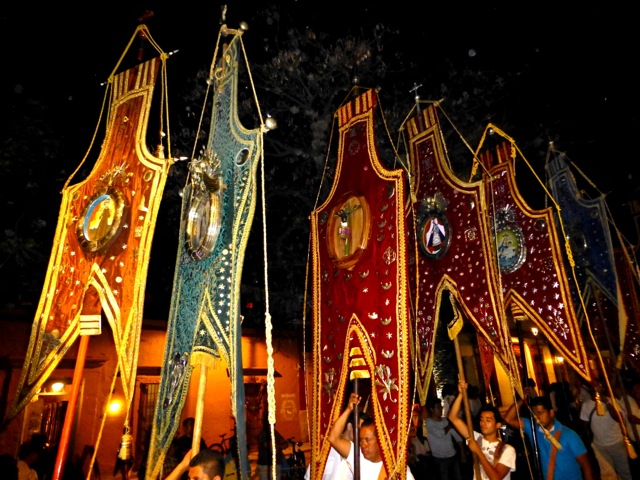
April – The banners of the Procesión del Silencio (Procession of Silence) on Good Friday during Semana Santa (Holy Week).

P1030659

May – Karen and Jasen Willenbrink exhibition at Gorilla Gallery.

P1040160

June – Pretty in pink, a protest by tuk-tuks (moto-taxis) on the zócalo.

P1000095

July – Up into the Sierra Norte for the Feria Regional de Hongos Silvestres (Wild mushrooms fair) in San Antonio Cuajimoloyas.

P1010605

August – Mini Guelaguetza sponsored by the Instituto Mexicano del Seguro Social (IMSS) on the Plaza de la Danza.

P1010911

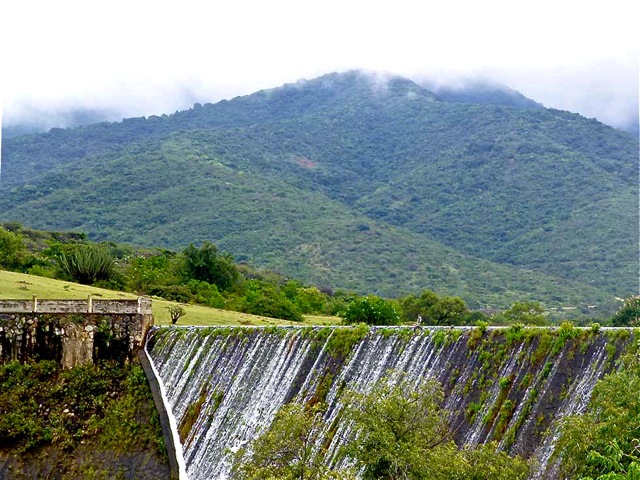
September – A rainy morning walk up to the presa (dam), Piedra Azul in Teotitlán del Valle.

P1020497_crop

October – Day of the Dead tapetes de arena in progress on the Plaza de la Danza.

IMG_6471

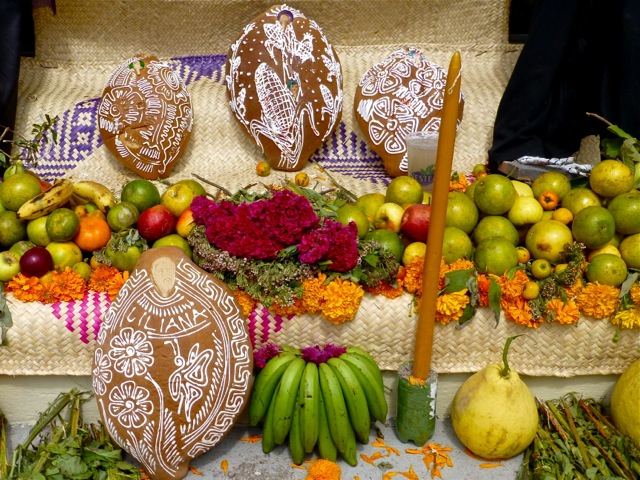
November – Ofrenda in San Pablo Villa de Mitla with the village’s traditional and intricately decorated pan de muerto.

P1030349

December – Nochebuenas (poinsettias) for sale at mercado Sánchez Pascuas.

P1050949

Muchisimas gracias to all my wonderful 2014 blog readers! I am blown away that people from 125 countries have stopped by View from Casita Colibrí this year.  Your presence, comments, and encouragement have been SO very much appreciated.

¡Feliz año nuevo a tod@s!  I can’t wait to see what 2015 will bring.

Read Full Post »

As a background to the December 12, Fiesta a la Virgen de Guadalupe performance of the Danza de la Pluma in Teotitlán del Valle, mañana (Dec. 10, 2014) at 5:00 PM at the Oaxaca Lending Library, Chris (of Oaxaca-The Year After fame) and I are doing a presentation about the Danza de la Pluma in Teotitlán del Valle.

DanzantesP1090841

From the library’s description of the talk, “The Danza de la Pluma or Dance of the Conquistadors is one of the most famous dances performed in Oaxaca.  Join Shannon and Chris for a presentation filled with photos and video of their many times observing and chronicling this beautiful dance.”

Alas, it’s not free.  Besides memberships, presentations like this are what keeps the library afloat.  The cost is 70 pesos for OLL members and 100 pesos for non-members.  Hope to see you there!

Read Full Post »

When it seems as if we are surrounded by fear, hatred, and violence, it’s good to step back, look around, and remind ourselves that there is also generosity, love, and beauty in this world.  And so I give you my exquisite new mohair tapete (rug), custom woven for me by Antonio Ruiz Gonzalez.  It turned out even more beautiful than I imagined!

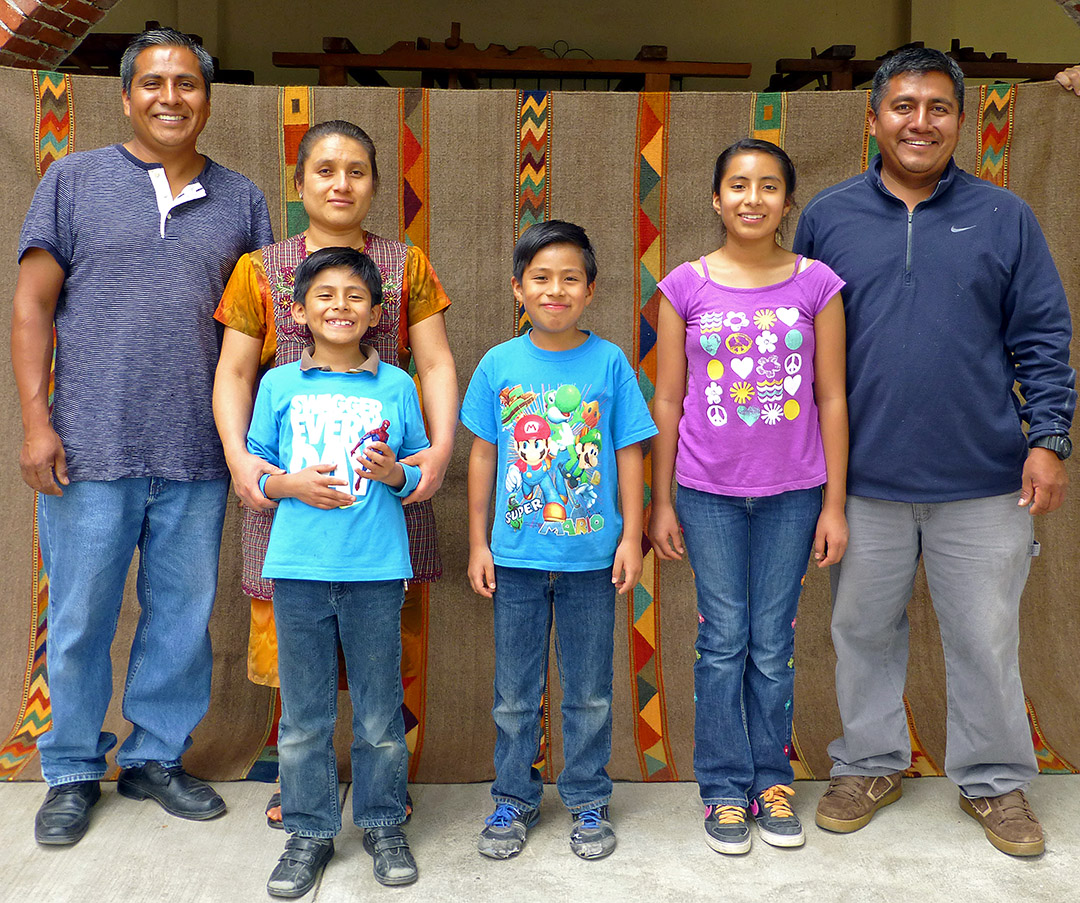
Antonio Ruiz Glz. and family standing in front of rug

Here is Antonio (on the left) in front of my new rug with his delightful family, including his brother Sergio (on the right) — from whom I’ve bought several small tapetes.  More about the latter, later!  Should you find yourself in Teotitlán del Valle, do stop by the family workshop (Av. Juárez No. 107), where Antonio, Sergio, and their father Zacarías weave their magic.

Read Full Post »

Los disfuntos (the departed) are returning in less than a week.  I’m sorting through photos for a friend who is giving a presentation at the Oaxaca Lending Library, on Día de los Muertos in Teotitlán del Valle, and realized I never got around to posting these…

Bells of  Templo de la Preciosa Sangre de Cristo ringing over the village.

Bells of Templo de la Preciosa Sangre de Cristo ring over the village during Muertos.

IMG_9557 copy 2

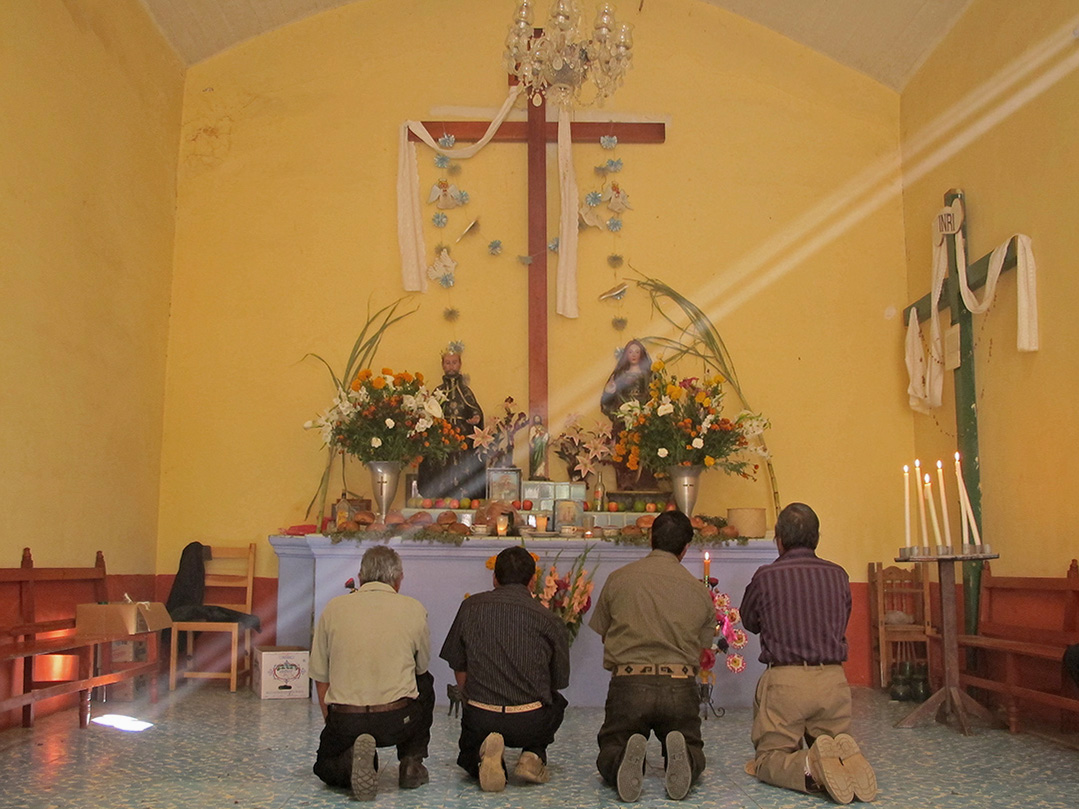
Chanting in the chapel of the panteón in Teotitlán del Valle.

P1130011 copy 2

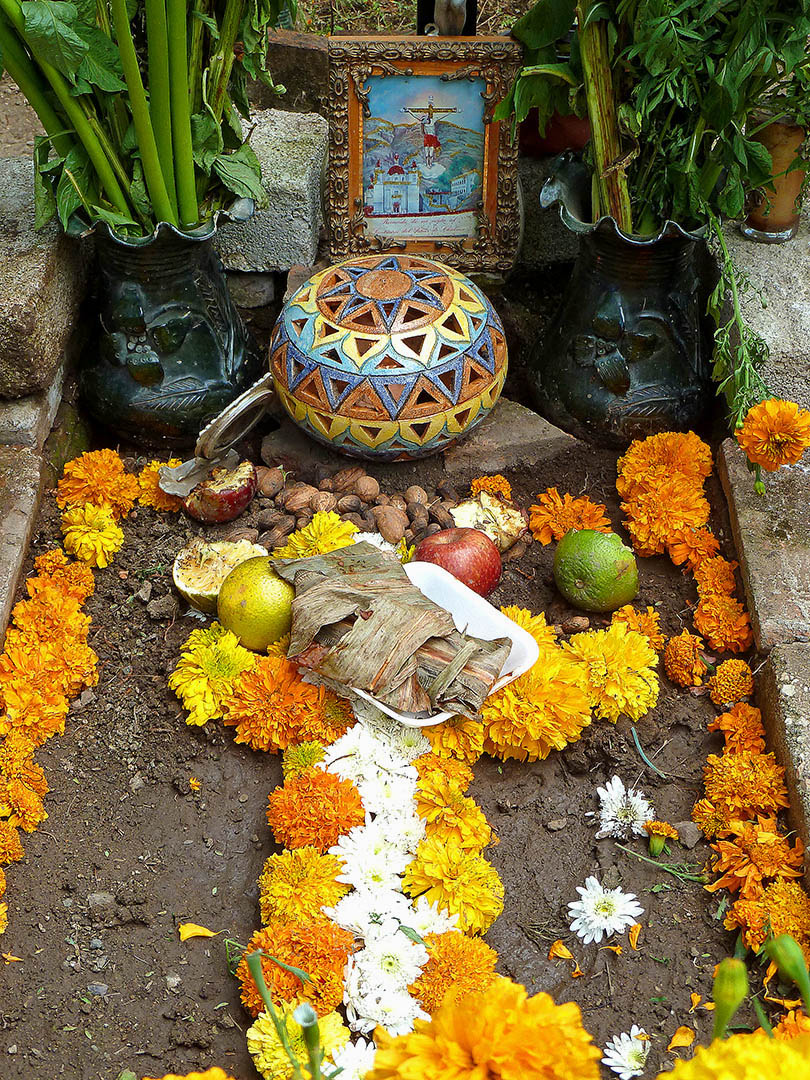
Food for the departed.

Serenading the departed.

Serenading the departed in the panteón.

P1130004_copy copy

Descansa en paz / rest in peace.

Home altar with loaves of pan de muerto

Home altar with loaves of pan de muerto.

Bowl of black mole

Mole negro, 2 de noviembre, at the home of a friend in Teotitlán del Valle.

Read Full Post »

From this morning’s walk in Teotitlán del Valle…

Blue flower surrounded by green leaves

White blossom

Yellow flowers

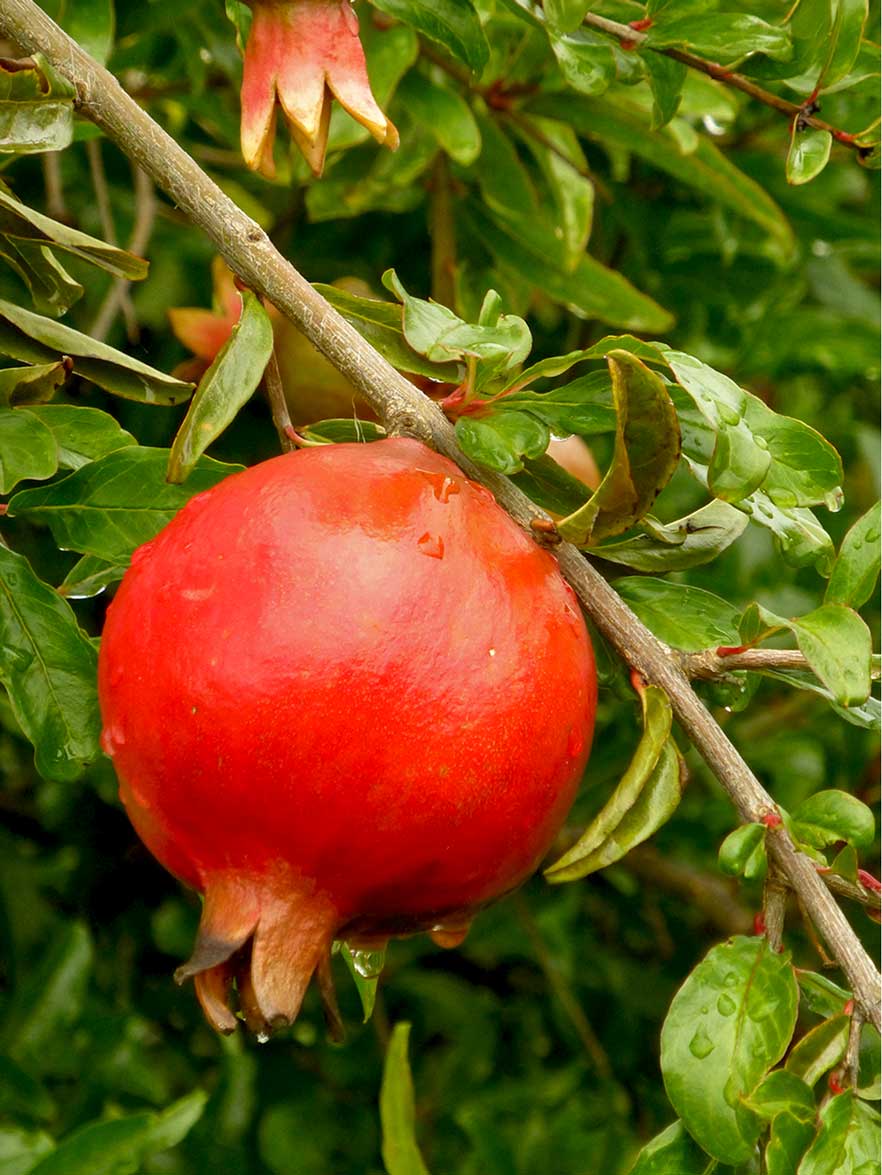
Pomegranate on branch

Splashes of color on a gray, rainy season, Sunday.

Read Full Post »

After a visit to Centro Fotográfico Manuel Álvarez Bravo, I’m seeing the color of Oaxaca in black and white…

“To see in color is a delight for the eye but to see in black and white is a delight for the soul.” – Andri Cauldwell


Read Full Post »

During the aforementioned convites, you will find the boys of Teotitlán del Valle, Standing On the Corner watching all the girls go by.  Not much has changed since The Four Lads had a hit with that song!

From my friend Samuel Bautista Lazo, who grew up in Teotitlán del Valle, “It’s funny to see boys with their cameras taking pictures and videos of the girls they like, often they watch the procession at one corner once they have seen everything, they run (or bike) as fast as they can to the other good spot to see all the girls again.”  And, he knows from personal experience!

Like Sam, I wonder how many couples have gotten together???  Perhaps meeting at the fireworks a night later…

Read Full Post »

Defining the terms…

According to Harrap’s Spanish and English Pocket Dictionary, convite means reception.  However, if I drag my weighty Larousse Standard Diccionario down from the shelf, convite translates to “invitation” or “banquet.”  And, if one turns to Google or Bing translation programs, a convite is a “treat.”

All pretty much agree, the English translation for cochinilla is cochineal.  As Wikipedia explains, “Cochineal is probably from French cochenille, Spanish cochinilla, Latin coccinus, meaning ‘scarlet-colored,’ and Latin coccum, meaning ‘berry (actually an insect) yielding scarlet dye.'”  It has been called, A Perfect Red and was much sought after by Europeans.  Home to said insect is the nopal cactus and guess who and where it was probably first cultivated?  In the valley of Oaxaca by her indigenous people, long before the Spanish set foot on the continent.

Which brings us to last Saturday (September 6) in Teotitlán del Valle, under the watchful eye of el Picacho, the sacred brother/sister mountain, for the convite that precedes the Virgen de la Natividad (Nativity of Mary) festival day, held annually on September 8…

This slideshow requires JavaScript.

It is the custom in this Zapotec village for the unmarried women of the village to process through the streets two days before this (and a couple of other) important religious festivals, elegantly balancing handmade canastas (baskets), decorated with Catholic and Zapotec imagery, on their heads.  They wear brightly embroidered blusas (blouses) and, in this village known worldwide for its weaving, enredos, hand-woven red wool wrap skirts — the yarn dyed red with cochinilla.  They are accompanied by bands, men carrying enormous (and heavy!) marmotas (cloth globes), little boys carrying poles topped with miniature marmotas, sheep, and airplanes (the significance of the latter is a mystery to me), fearless pirotécnicas announcing the convite’s progress by shooting thunderous rockets into the air, and the dancers who will be performing the Danza de la Pluma in the church courtyard during the following two days’ of festivities.

Borrowing from the definitions above of convite, I would like to think of these processions as a lovely treat, an invitation to the impending fiestas/feast (banquet) days for the saints venerated by the village.  The beauty of the welcoming faces of the young, old, male, and female in the convite provide a warm reception to villagers, visitors, Catholic saints, and Zapotec ancestors, alike.

Read Full Post »

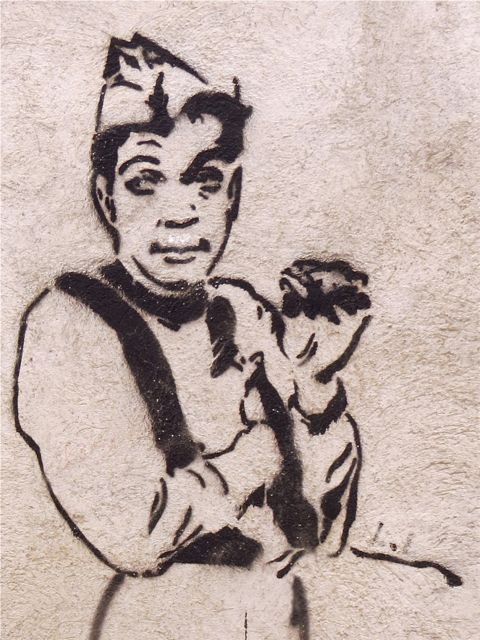
Feliz cumpleaños to Cantinflas.  Today, the beloved Mexican actor, comedian, writer, and producer, born Fortino Mario Alfonso Moreno Reyes, would have turned 103.  I’ll be waiting in line to the movie, Cantinflas, based on his life, when it opens in Mexico on September 19, 2014.  For those in the USA, you get first crack, as it is scheduled to open on August 29, 2014.

Cantinflas on a wall in Teotitlán del Valle

Image of Cantinflas on a wall in Teotitlán del Valle — painted by the lovely and multi-talented, Luvia Lazo.

I would also like to say RIP, Robin Williams, another actor with the gift of combining humor and pathos.  How blessed we are to have shared this planet with both and to continue to have the opportunity to experience their creative genius.

Read Full Post »

We returned to Teotitlán del Valle on Tuesday and Wednesday the Danza de la Pluma — more of the multi-day fiesta honoring Preciosa Sangre de Nuestro Señor Jesucristo.

Moctezuma and Danzantes

An airborne Moctezuma and the Danzantes

The Danza de la Pluma is a ritual re-enactment of the Spanish conquest.  The story is told in 41 bailes (dances) and lasts from early afternoon into the night.  It is an honor to be a participant — the Danzantes, Moctezuma, the Subalternos, Malinche, and Doña Marina are selected years in advance and make a promise to the church and community to perform their roles for 3 years.

Dance of Malinche and Doña Marina

Dance of Malinche and Doña Marina

All is not completely serious — the Subalternos provide a little levity along the way.

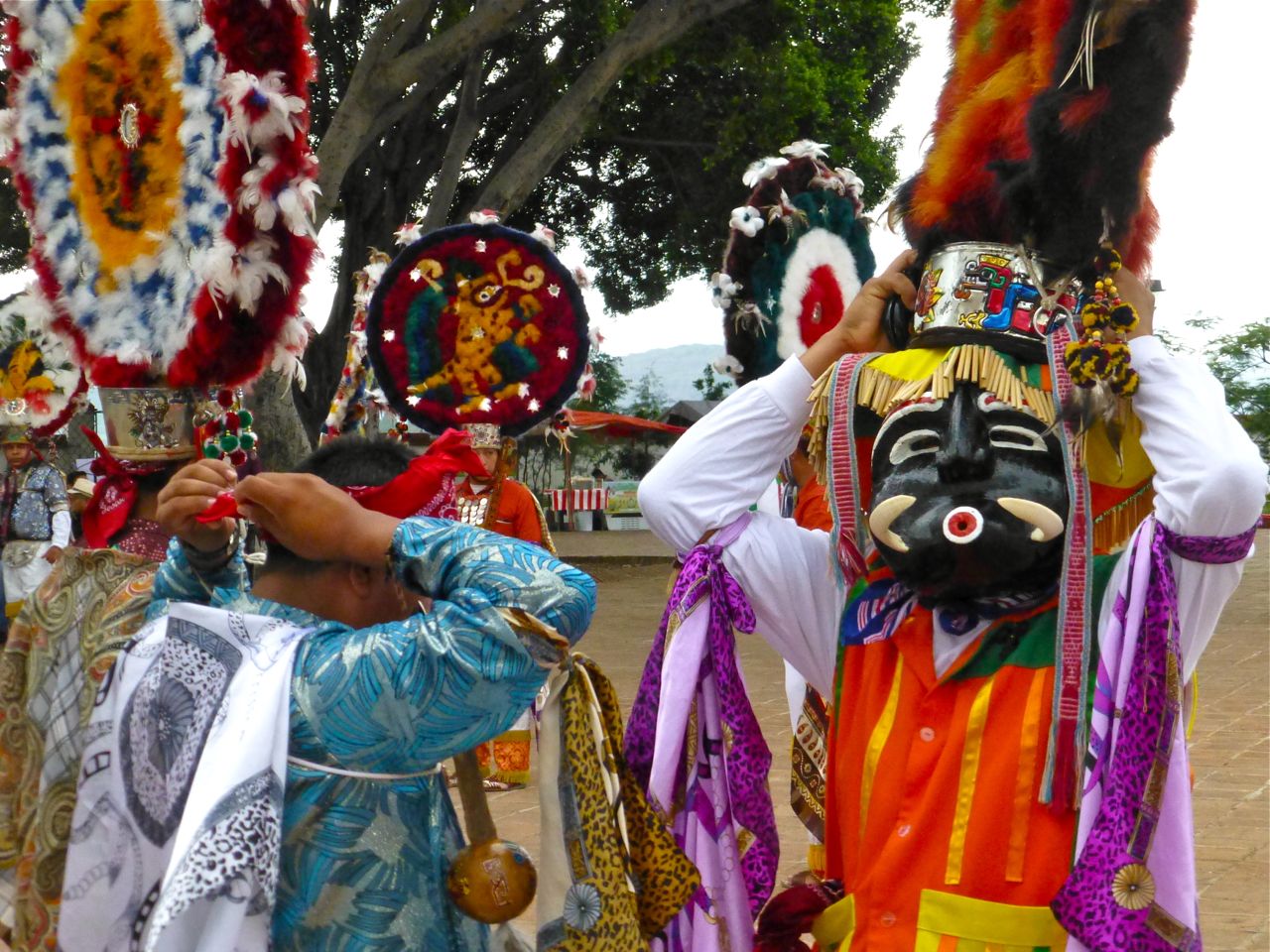
Subalterno trying on the Penacho of a Danzante

Subalterno trying on the Penacho of a Danzante

The subtext and “hidden” narratives of the danza are multiple and complex and after 5 years, I’m only in the infant stages of understanding.  I will leave it to the two scholarly articles listed below to attempt interpretation.

Danzantes with El Picacho in background

References:

Cohen, Jeffrey.  Danza de la Pluma:  Symbols of submission and separation in a Mexican Fiesta.  Anthropological Quarterly, Jul 93, Vol. 66 Issue 3, p. 149-158.

Harris, Max. The Return of Moctezuma.  The Drama Review, Sp 97, Vol. 41 Issue 1, p. 106, 29 p.

Read Full Post »

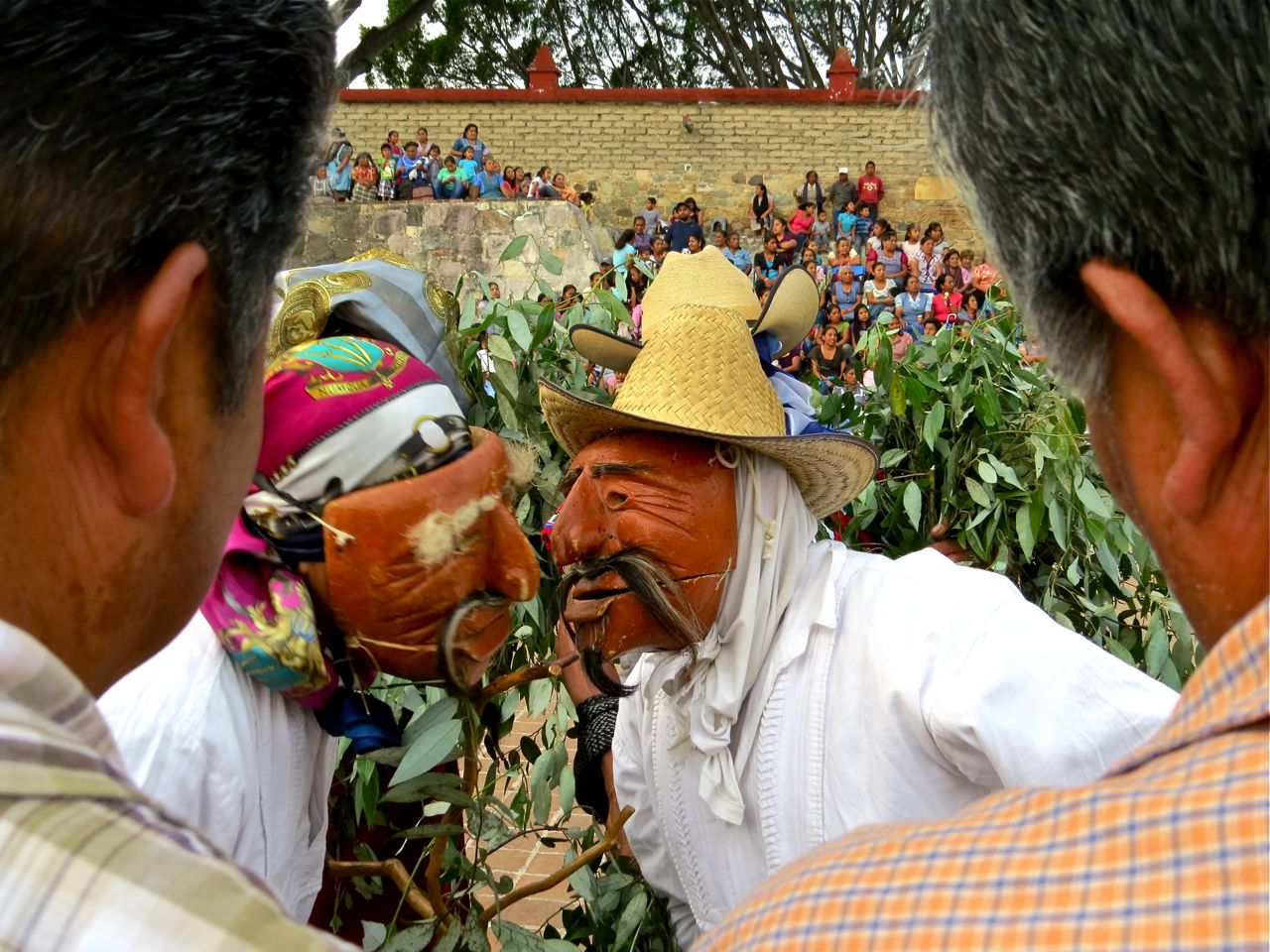
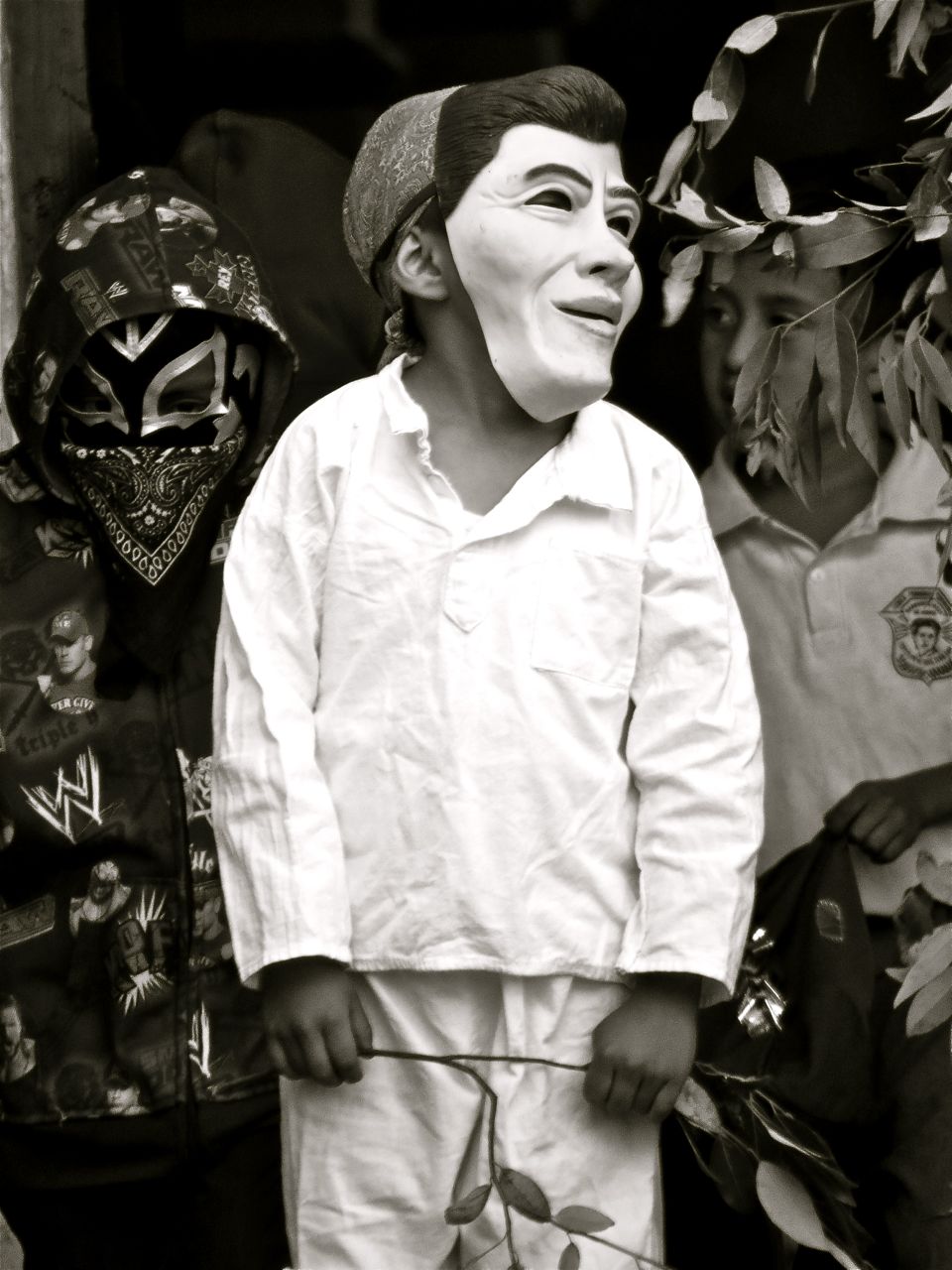
2 viejitos, nose to nose

Tête-à-tête between Viejitos (I know, I’m mixing languages), seen between the shoulders of two municipal leaders, on the Municipal Plaza in Teotitlán del Valle during this year’s previously mentioned Carnaval.

Read Full Post »

True confession:  I’m not in Oaxaca!  I arrived in the San Francisco Bay Area a week ago for a 3-week visit.  While I love seeing family, friends, “my” mountain (Mt. Tamalpais), and the Pacific Ocean, it also means bone-chilling summer fog, driving instead of walking most everywhere, and the absence of my regular blog fodder — no calendas, ferias, festivals, saints days, bandas, and urban art.  (Though, I will probably head to San Francisco for the latter!)

However, this break-in-the-action gives me time to look back through thousands of photos and create posts that had been put on the back-burner when something bigger, better, or more timely cropped up.

3 viejitos

So, here we go, back to Friday, April 24, 2014 — the last of five days of Carnaval in Teotitlán del Valle.

Chihuahua

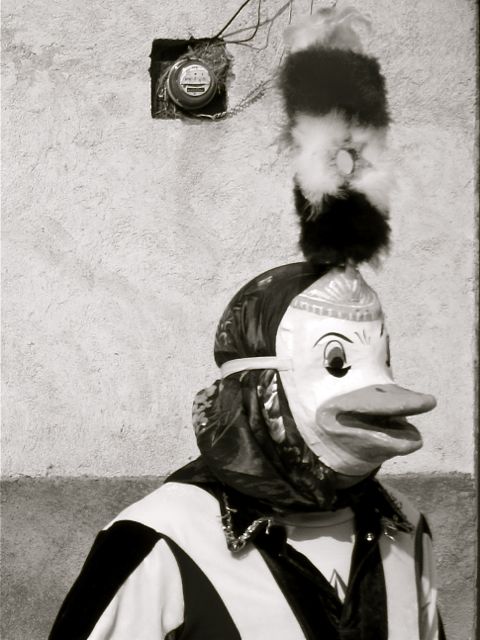
While there are masks, costumes, men dressed as women, and merriment, this is not your Christian pre-Lenten Fat Tuesday/Mardi Gras Carnival.

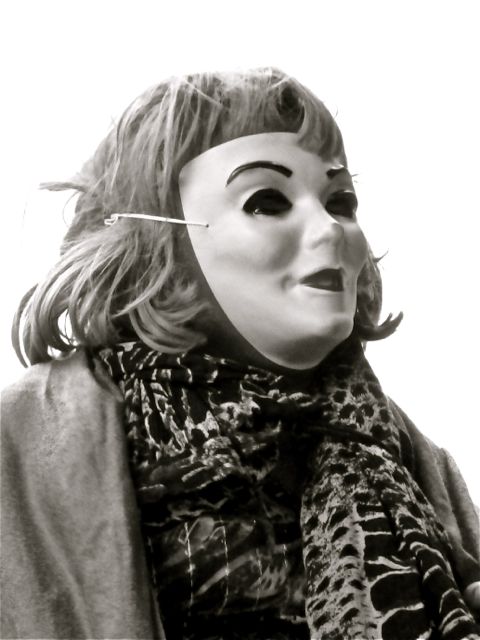
Man wearing female mask, wig, and clothing

This is a pre-Hispanic celebration that happens the Monday through Friday after Easter, not before Lent.

Close-up of viejito

Via El Baile de Los Viejitos (the Dance of the Old Men), it brings the community and elected leadership together to remind each of their social contract — in an extremely humorous way.

Young viejito

A procession, gathering participants along the way, leads to the Municipal Plaza, where it seems as if the entire village assembles.

2 elderly women watching Dance of the Old Men

And, of course, the dance and ritual continue late into the night…

Read Full Post »

Yesterday, we returned to Teotitlán del Valle to join in their annual Día de la Santa Cruz hike up El Picacho, the sacred mountain that watches over this incredibly special pueblo.  This year, instead taking the route up the mountain directly from downtown like we did last year (and it kicked our a$$), we drove to the presa (dam) and headed up a surprisingly well-marked trail from there.  A symphony of cicadas (cigarras or chicharras, en español), serenaded us as we climbed, young people passed us, and Templo de la Preciosa Sangre de Cristo, off in the distance, got smaller.  However, after more than an hour, we sighted our first pack burro (they bring up the food and drink) and knew we had almost reached our destination.

We were welcomed at the top by the family hosting the gathering and given cups of agua de jamaica — just what the doctor ordered!  There were even more people than last year, music blared from large speakers the aforementioned burros must have carried up the mountain, a new cross had replaced the one that had been hit by lightning last year, and, of course, the views were breathtaking.

But, with spectacular views in all directions, why was most everyone looking down toward the road from the village to the presa?

A foot race!  From what we could understand, there were 3 classes of runners; one that ran all the way from mercado in the center of Teotitlán and other two “only” ran up from the presa.  Whichever route they took, as one of the runner’s t-shirt says, they were all “chingon!”

And so was this gal, who was on her way up as we were coming down.

Woman carrying basket on head

Muchisimas gracias, yet again, to the people of Teotitlán del Valle for another unforgettable experience.

Read Full Post »

Domingo’s escape from the city out into the countryside of Oaxaca brought back one of my fondest childhood memories:  Sunday drives with my grandparents into the golden hills of northern California.  Two-lane winding roads with only the occasional car or pickup truck; farms, fields, and roadside stands outside my rolled down window always brought a sense of adventure mixed with freedom and serenity.  And, it still does…

Oaxaca city to Teotitlán del Valle, where we yielded to a herd of cattle.

Close-up white bull

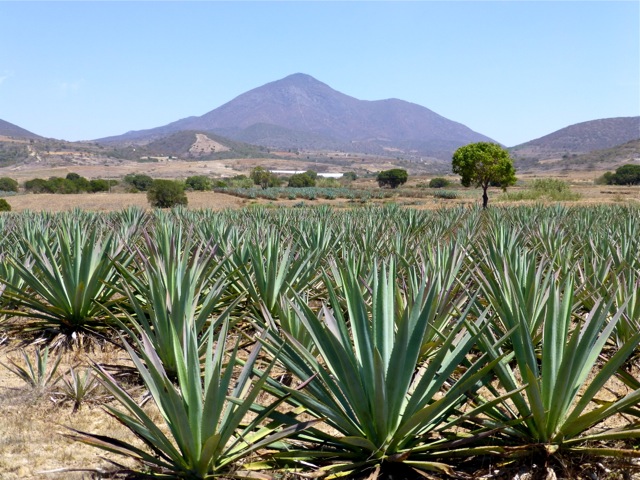
Santiago Matalán past fields of agave to San Baltazar Chichicapam.

Agave fields with mountain in distance

We continued on the mostly deserted road  towards Octotlán de Morelos.

Tile roof lean-to on rocky outcrop

Onto Hwy. 175 and a lunch stop at the roadside restaurant, between Santo Tomás Jalieza and San Martín Tilcajete, from almost two weeks earlier.

Sign for Los Huamuches with tables in background

And this time we noted the name:  Los Huamuches.  Another delicious comida… a perfect way to end our meandering and head for home.

Read Full Post »

Blog post as catharsis…

Saturday was a sad day in Oaxaca.  It brought the completely unexpected death of one of Oaxaca’s most talented artists, Arnulfo Mendoza Ruiz.  He was only 59.  I knew him a little, peripherally through my blogger buddy, Chris, who has known him and his large Zapotec family in Teotitlán del Valle (his sisters are well-known chefs) for many years and with whom he had been collaborating on a project.  Arnulfo had a well-known store and workshop called La Mano Mágica on the walking street here in Oaxaca, which showcased, not only his artistry (paintings, exquisite weavings, metal work, and more), but also the cream of Oaxaca’s artesanía and artist community.  We would occasionally stop by or he would hail us from the doorway — always with twinkling eyes, mischievous smile, and well-worn fedora atop his head.

Black bow above closed doors of La Mano Mágica

Today, the doors are closed.

As I’ve mentioned several times before, ritual and tradition play central roles in all aspects of Zapotec culture and it was amazing to watch it being expressed on Saturday.  Arnulfo died in the morning and by the early afternoon, friends, family, and many of the major artists in Oaxaca, were gathered in La Mano Mágica.  At one point, there was mournful chanting by several men in the gallery where his casket lay, later a band played, people came and went in the main workshop room, and in the room behind, his sisters prepared and served chicken covered in black mole, rice, tortillas, and atole.  The women busied themselves with the ritual of preparing and offering food, but allowed the tears to well up when condolences were given.  However, the men in the family sat or stood in clusters in the other two rooms, and remained stoic.

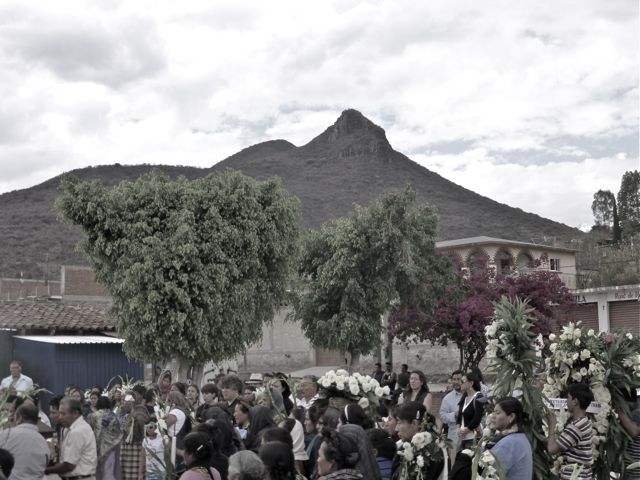
Mourners in church plaza, El Picacho in background

Under the embrace of El Picacho

According to belief, the funeral was held the next day.  As we drove out to Teotitlán del Valle on Sunday, the winter sky’s usual puffy white clouds had turned dark and gray and a few tear drops fell from the heavens.  There is a tradition of dimming the lights on Broadway to honor the death of a prominent member of the theatrical community.  And, yesterday, it felt like Mother Nature desaturated the color of Oaxaca a little in honor of Arnulfo Mendoza Ruiz.
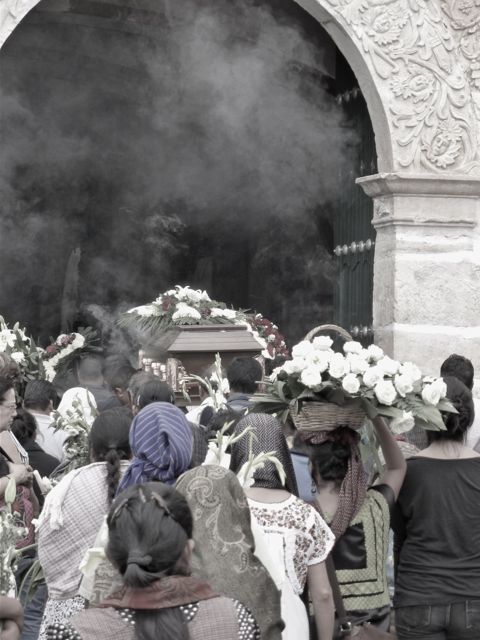
Casket being carried into church

Led by the solemn sounds of a band, pallbearers carried the casket from his home high atop a hill in Teotitlán del Valle, down the steep and winding cobblestone streets, to Templo de la Preciosa Sangre de Cristo where a mass was celebrated.  And then, all processed to the cemetery.  The anguished sobs, as his body was lowered into the earth, were heart-wrenching.  Like laughter, I think grief is contagious, as it reaches into our heart, takes hold, and shakes the continuum of feeling in each of us.  And so, tears welled-up in my eyes.

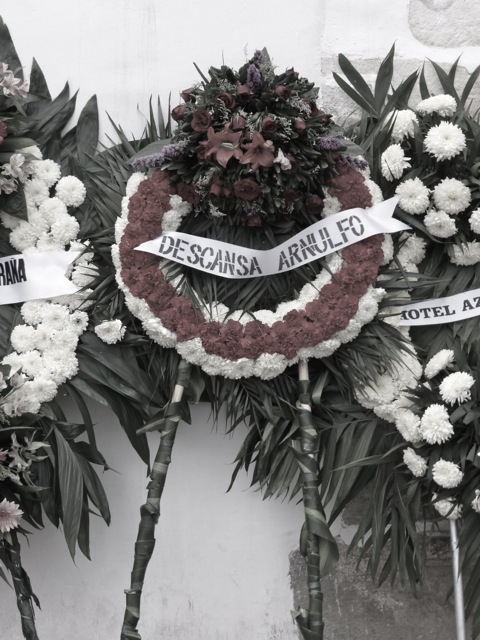
Floral wreath with ribbon reading, "Descansa Arnulfo"

Rest in peace, Arnulfo

Today, I continue to feel drained and very sad.  I didn’t know Arnulfo well, but feel humbled by the fragility of physical life.  I keep reflecting on how each of us tries to bring meaning to this temporal physical existence.  Arnulfo was a flawed man and was chased by demons, but in his creativity and nurturing of the arts, he left the world a little better than he found it.

Chris’s farewell blog posts to his friend are especially touching:   A sad day – Arnulfo Mendoza (1954-2014) and Another sad day – Arnulfo Mendoza (1954-2014).

And, here are two online obituaries (in Spanish):  Adiós a Arnulfo Mendoza and Oaxaca de luto por la muerte de Arnulfo Mendoza.

Read Full Post »

« Newer Posts - Older Posts »