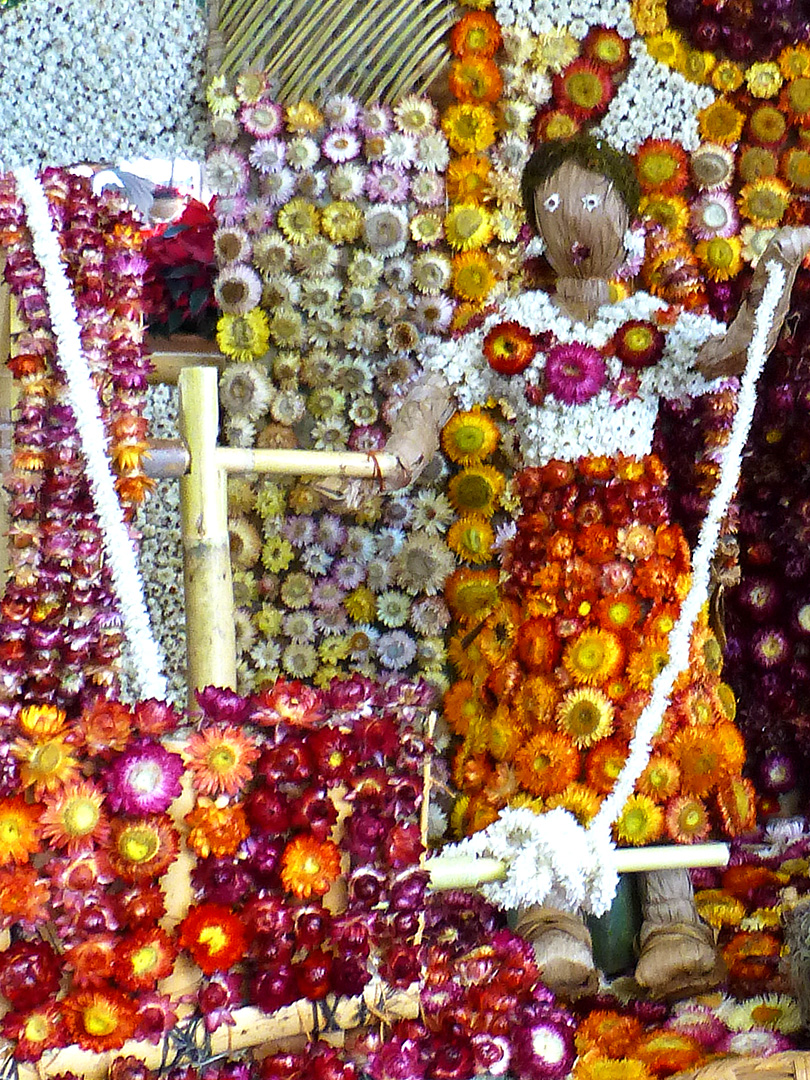
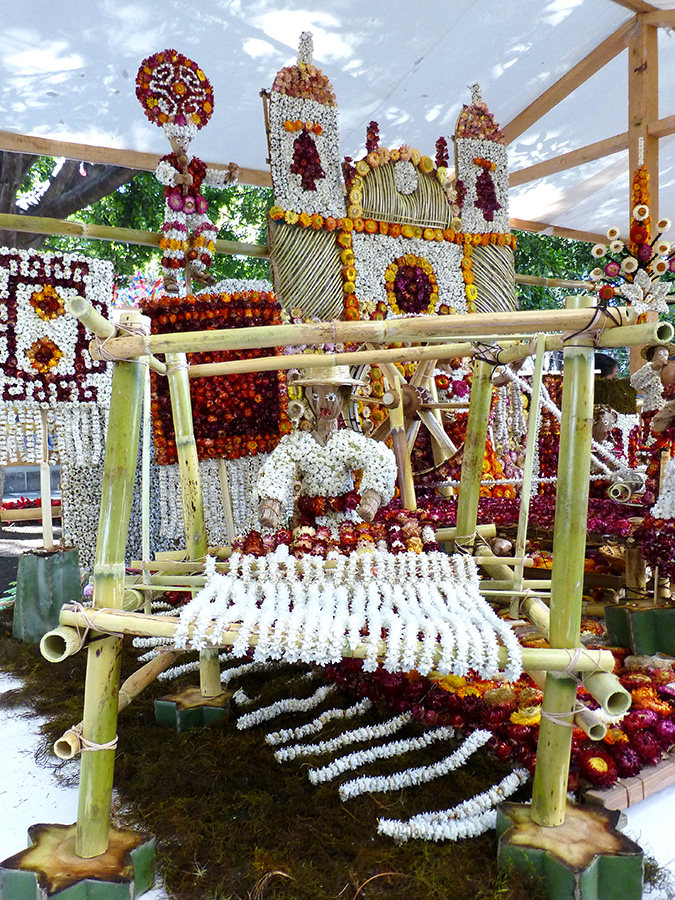
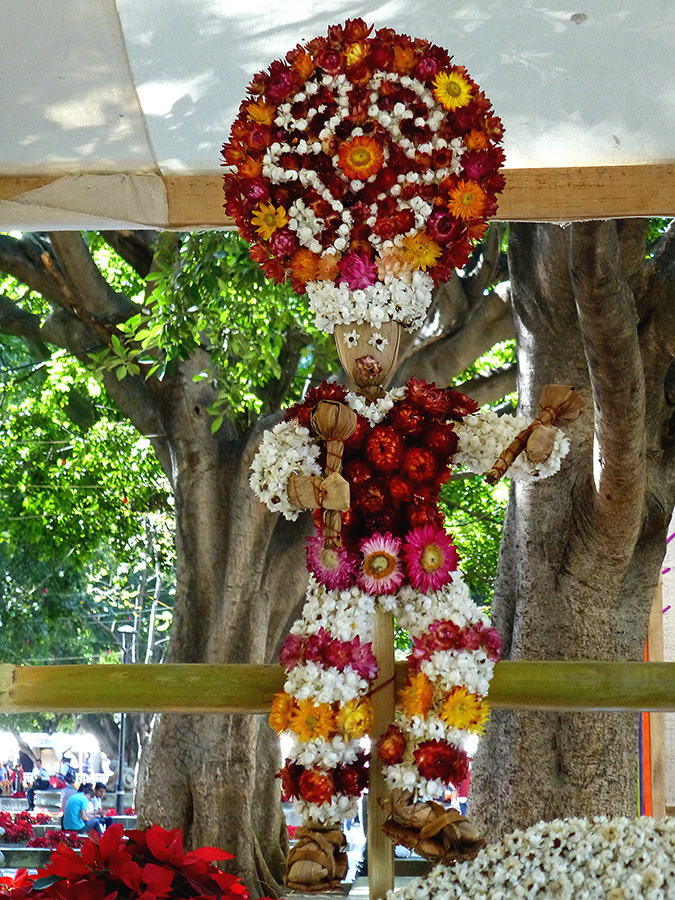
It’s December 23 in Oaxaca and Noche de Rabanos is upon us. The setting-up has begun and the spectators are gathering. Despite its name, it isn’t just about artisans working their creative magic carving radishes. There are three other categories, including the use of Flor Inmortal (a type of dried flower). I will return this evening, but in the meantime, this entry titled, “Elaborando Artesanía, Plasmando Sueños: ‘Teotitlán del Valle, Tierra de Dioses'” by Raymundo Sánchez Monserrat Maricela, is for all my friends in Teotitlán del Valle.
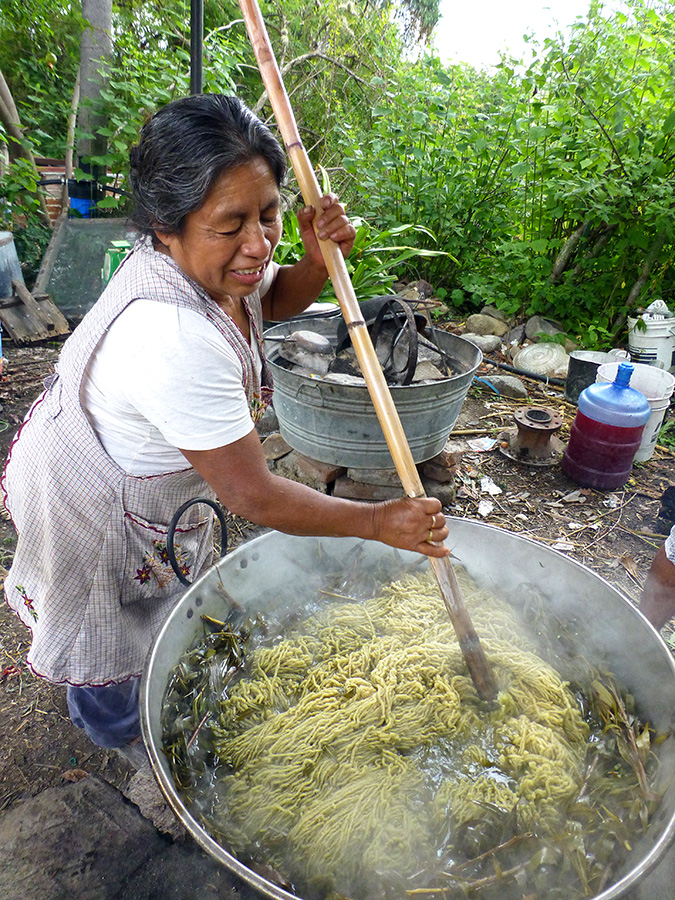
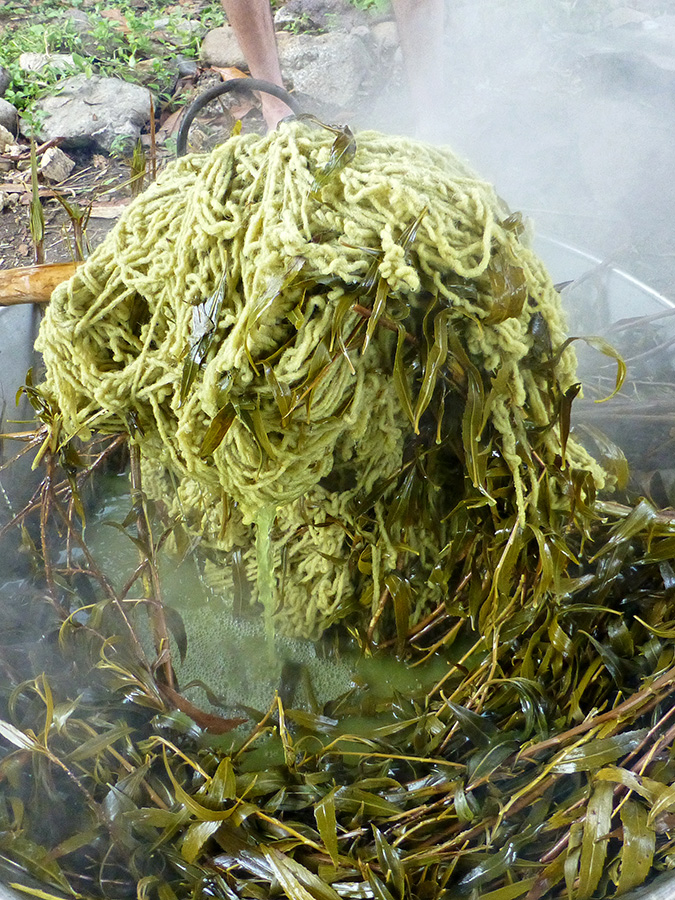
Spinning the wool.
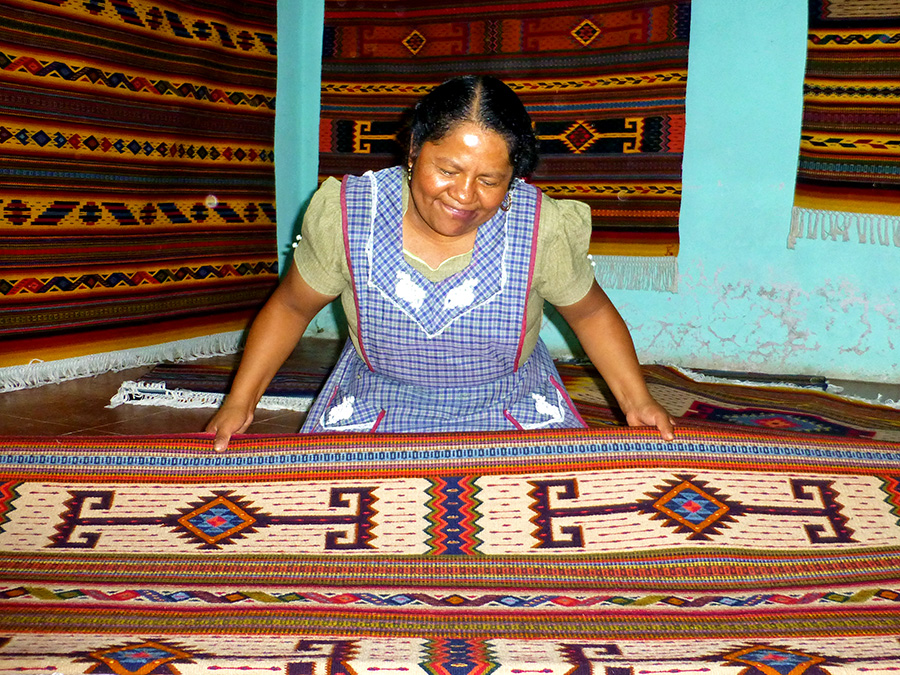
Weaving tapetes from the spun wool.
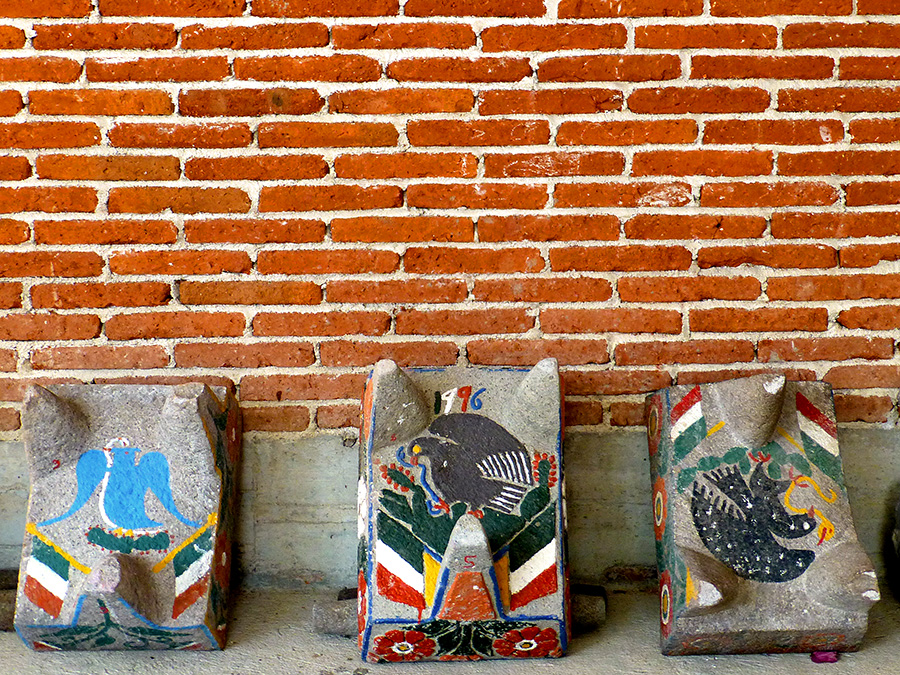
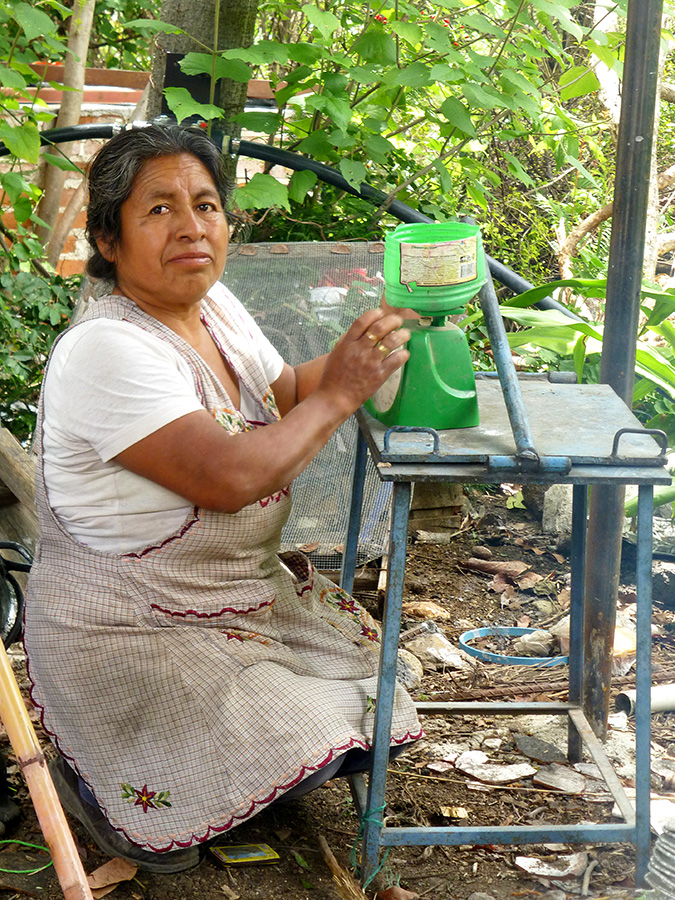
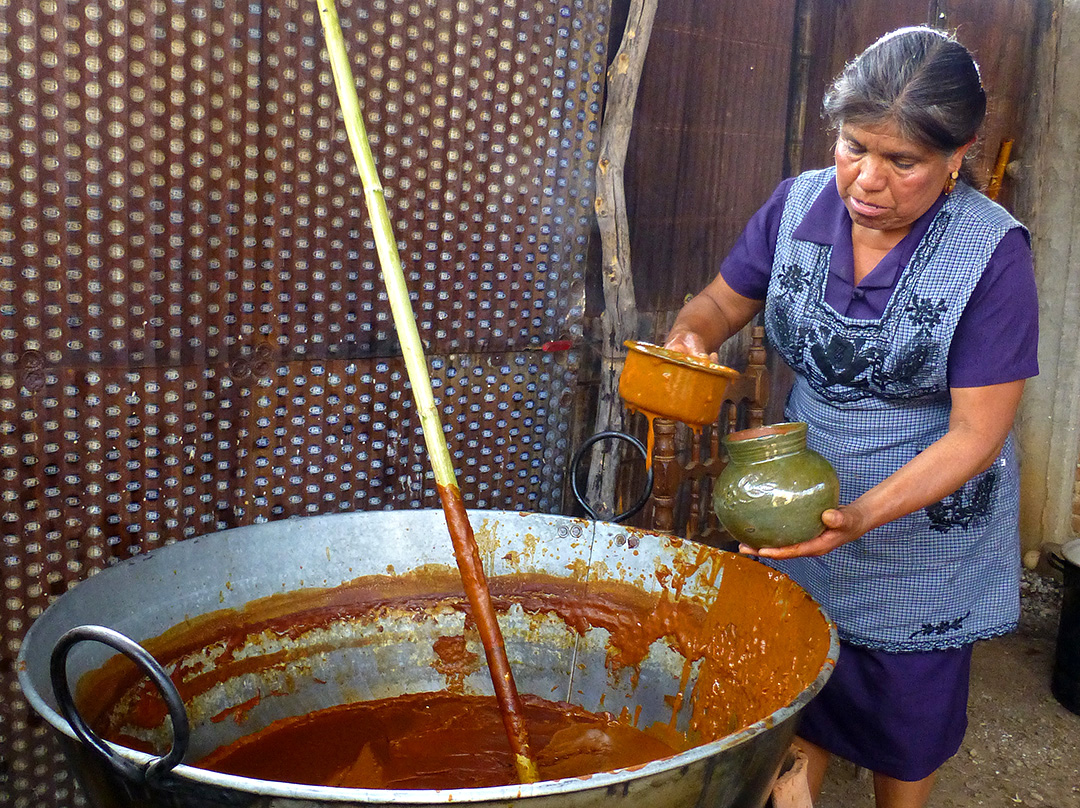
Grinding corn or maybe chocolate OR maybe even cochinilla!
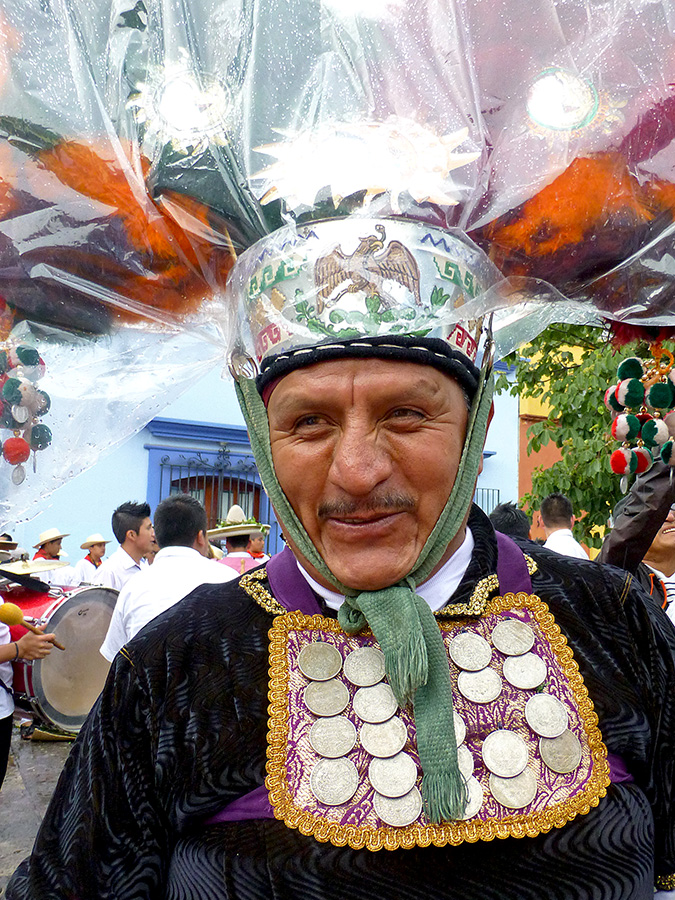
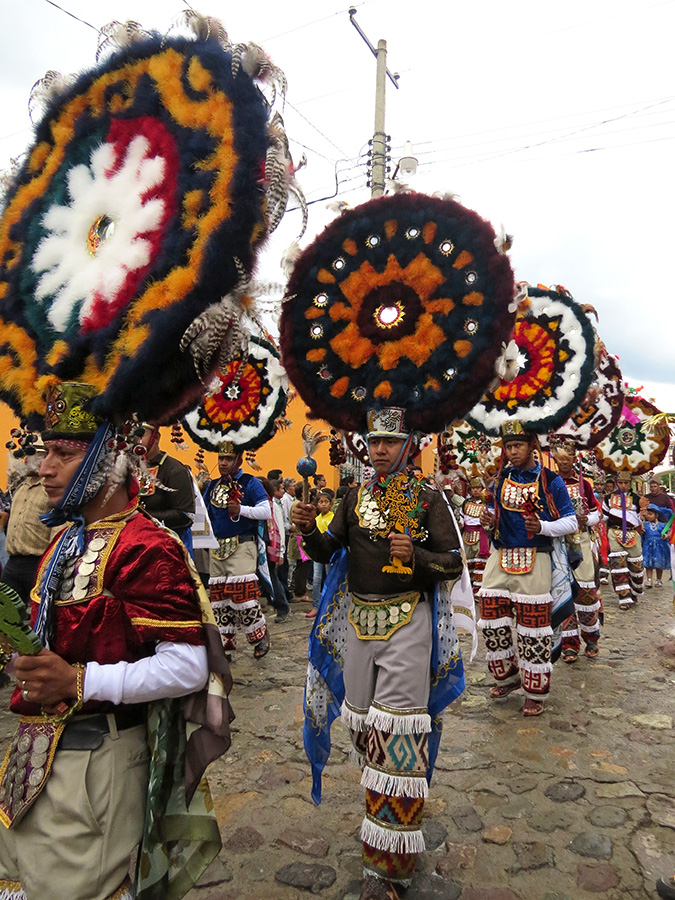
Dancing the Danza de la Pluma…
The danzantes of the Grupo de Danza de Pluma Promesa keeping their promise.
I think Raymundo did a wonderful job capturing the people of Teotitlán del Valle, the Land of the Gods, who make crafts and shape dreams.
And we thought last year’s Día de la Virgen de Guadalupe in Teotitlán del Valle was exceptional! It was, but, for blogger buddy Chris and me, this year brought even more warmth, appreciation, and the intangible of being present in the richness of more layers of being in this special village.
Edgar Daniel Ruiz Ruiz
We are patrons of two of the danzantes of the 2016-18 Grupo de Danza de Pluma Promesa in Teotitlán del Valle — and Edgar Daniel Ruiz Ruiz is one of them. As such, we were invited to the home he shares with his parents, Mario Ruiz Bautista and Victoria Ruiz, to partake in the traditions and observe the responsibilities that accompany taking on the three year commitment to being a member of the Grupo.
Mario Ruiz Bautista (on left) overseeing the offerings
From my albeit limited understanding, as part of the commitment the dancers make during their three years of service, each of their families is tasked with taking a turn hosting one of the four yearly festivals.
Victoria Ruiz watching Edgar’s dance
The day began with a breakfast of traditional breads and hot chocolate and was followed by Mole de Castilla, a mole unique to Teotitlán and served during weddings and the most important festivals. There must have been over 100 people, including Edgar’s extended family, padrinos, danzantes and their families, and band members. They gathered and were served in the courtyard of the Ruiz home, with men seated at one long table, women on the other side of the courtyard at another, and the two gringos seated with the danzantes in the altar room opening onto the courtyard.
Breakfast breads with hot chocolate
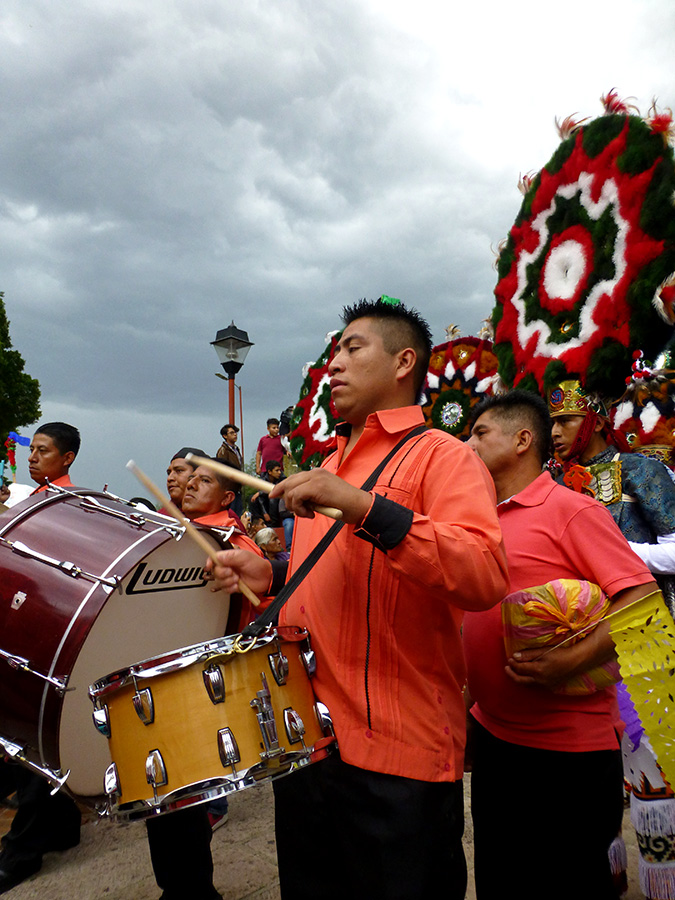
Following the meal, chairs and tables were folded and removed, the danzantes took the floor, the band began to play, and, as the sun streamed down on the courtyard, Edgar began his dance. It was a touching moment to see this young man, whom I’ve known for almost six years, since he was a gangling teenager, and Chris has known since he was a small boy, dance with such confidence and pride.
Following dances by the whole group, with band leading the way, dancers, families, and guests processed down the steep and winding streets from the house to the church.
Edgar Daniel Ruiz Ruiz en route to the church, accompanied by Victoria (his mother) and his nephew.
They filed into the church, where a special mass was celebrated, and then regrouped in the church courtyard to begin the seven hour (más o menos) Danza de la Pluma. Early in the afternoon, while the dance continued, the families and invited guests returned to the Ruiz home, where the families of the other dancers each made formal presentations of baskets of fruit and mezcal or cervesa to Mario and Victoria. This was followed by a comida (lunch) of caldo de pollo. After all were fed, the offerings were loaded into pickup trucks to be taken to the church plaza, to later be shared with the community. At night, after the dance ended, we all again returned to Casa Ruiz for barbecoa de res (beef) in a rich and flavorful sauce, cervesas, mezcal, and soda pop. I can’t even begin to imagine all the work that went into preparing all the food, orchestrating its serving, and then washing all the dishes — by hand in basins set up in the yard across the street.
Edgar Daniel Ruiz Ruiz
It’s been over twenty four hours since Chris and I returned from Teotitlán del Valle and, though we talked continuously on the drive back to the city and have spoken several times since, we are still unable to put into words how meaningful and how honored we were to share this special day with Edgar, his family, and his community. It was a precious gift. ¡Muchisimas gracias a todos!
When you sit down to your turkey dinner tomorrow, you will be following in the footsteps of the original inhabitants of the valley of Oaxaca.
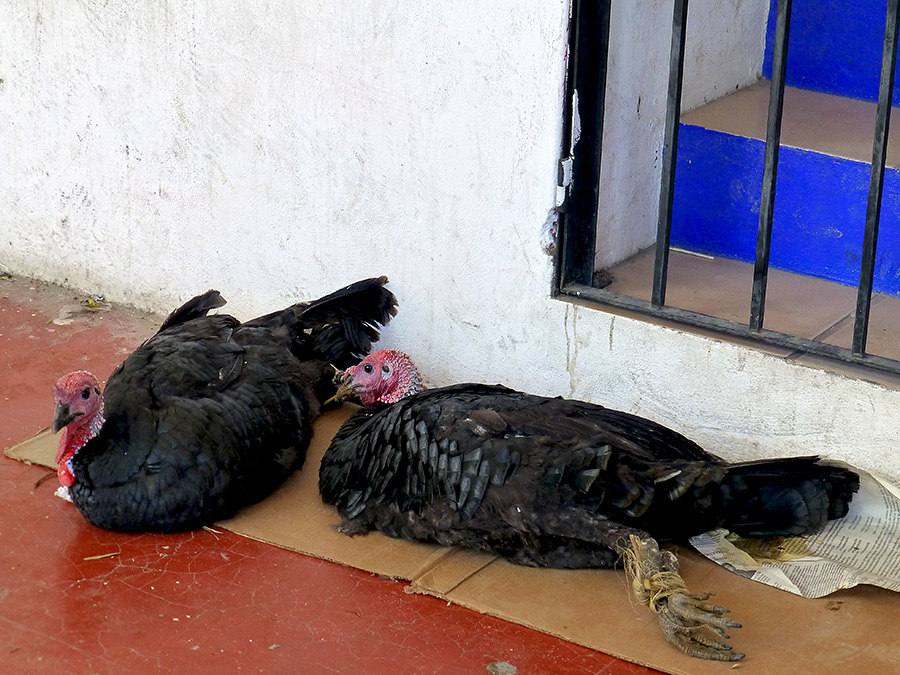
Guajolotes on the doorstep. San Pablo Villa de Mitla, Oaxaca
Archaeologists have discovered evidence of turkey domestication 1,500 years ago in the in the valley of Oaxaca’s Mitla Fortress. And, according to Gary Feinman, Field Museum curator of Mesoamerican anthropology, “It’s a bird very, very similar to what a lot of people are going to eat on Thursday.”
Guajolotes waiting for a ride, Teotitlán del Valle, Oaxaca.
Turkeys, or as they are commonly known in Oaxaca, guajolotes, continue to play a special role in many of Oaxaca’s indigenous communities. Turkey mole is prepared and served during religious festivals and weddings, among other special occasions. They are also given as gifts and the downy feathers under the wings are dyed and used to make penachos (headdresses) for the danzantes of the Danza de la Pluma.
So, to those in el norte, while you are enjoying your Thanksgiving turkey, give a little thanks to the Zapotecs of the valley of Oaxaca. ¡Buen provecho!
After the wretched week that was (RIP Leonard Cohen and Leon Russell, not to mention the USA elections), reviewing my Día de Muerto photos from Teotitlán del Valle was the ideal tonic.
On November 1, as I previously mentioned, after strolling and sitting and contemplating and conversing our way through the panteón in Tlacolula de Matamoros, we drove to the home of friends, Zacarias Ruiz and Emilia Gonzalez, in Teotitlán. Arriving at 3:00 PM, we were just in time to join the family and other guests, as Zac gave words of welcome to the difuntos, who had also just made their appearance.
Our pan de muerto and mezcal joined the other offerings on the altar to provide nourishment to the departed while we, the living, sat down at the long table for a little cervesa, mezcal, and more than a few of the 500+ tamales Emilia had made. After lots of eating and conversation, we walked across the courtyard to give our regards to Antonio Ruiz (weaver of one of my treasured rugs), wife Claudia, and their children (the beautiful Beatriz and her lively brothers, Diego and Antonito), and to see Antonio’s new showroom (Chris has a photo in his Familia blog post) and their altar.
Invited to return to the Ruiz home the following day for Emilia’s famous mole negro, we also stopped at the village panteón to listen for the wind that signals the departure of the difuntos at 3:00 PM on November 2.
We also stopped to pay our respects at the grave of Arnulfo Mendoza, though it took a little searching to find it, as the large tree that stood next to it had fallen, leaving only a stump.
Both days, the drive back to the city was filled with the warmth, peace, and joy that Teotitlán del Valle always seems to impart.
Under the strong and comforting gaze of Picacho, who could ask for a better resting place.
Before I become completely immersed in the myriad of activities related to and surrounding Day of the Dead, I want to write a post about Porfirio Gutiérrez Contreras, another of the talented and creative weavers from Teotitlán del Valle I have come to know.
I first met Porfirio via my blog and we soon became Facebook friends. However, we didn’t actually meet in person until last November’s, Feria Exposición Maestros del Arte in Chapala, Jalisco. I made a beeline for his booth and introduced myself to him and his sister, Juana Gutiérrez Contreras. Porfirio’s recognition and warmth made me feel truly welcome — like we were long-lost friends.
Juana Gutiérrez Contreras, grinding anil (indigo). She cleans wool, spins yarn, gathers herbs, master of natural dyes
Porfirio Gutiérrez, with paddles of nopal cactus housing cochineal from which the dye carmine is derived. He designs, weaves, promotes, educates, demonstrates
Skeins of hand-spun and naturally dyed yarn at the Porfirio Gutiérrez y Familia workshop.
While, as you can see from the video, The Weaver From The Place of Gods, Porfirio is soft-spoken, he is exceedingly passionate about his Zapotec heritage and the preservation of the textile traditions of his village. His knowledge, talent, and dedication led him to be one of four native artists to be chosen to participate in last year’s, Artist Leadership Program sponsored by the Smithsonian Institution’s National Museum of the American Indian.
Vat of the natural dyestuff, bejuco (dodder).
Plants used to produce natural dyes.
Vat of the natural dye, cochinilla (cochineal).
A key component of the Smithsonian program was, following their residency, each artist was charged with returning to their community to share their knowledge, with the goal of preserving the wisdom and techniques refined and handed down from their ancestors. I had the privilege of attending the awarding of certificates and exposition that concluded the 9-day workshop, given in Teotitlán by Porfirio and Juana. The exposition was entitled El Ritual de los Sueños and took as its inspiration the traditional fiber mat, known as the petate. It is on the petate where babies are delivered, dreams occur, and in which bodies are wrapped before being placed their grave.
“When preparing food and drinks, reverence is made before the metate.”
Image of Porfirio and Juana’s parents as they kneel to receive the blessing on their wedding day.
“With the joy or grief of each ritual, life is shared with food as well as the sharing of experiences; to perform such an act the woman sits on the mat.”
The family’s studio is located at Calle Simon Bolivar #6, Teotitlán del Valle and I can assure you, visitors will be warmly welcomed. And, who knows, you may come away with beautiful new, naturally dyed, hand-loomed treasure.
I already have a place on the wall reserved for one of Porfirio’s distinctly designed tapetes and am now saving my pesos.
Returning to Casita Colibrí last Sunday afternoon, I unlocked the door, set down my way-too-heavy backback, and, having been away for a month, I savored the scene my Oaxaca home presented. There was my new Tree of Life tapete hanging on the wall of my dining area looking like it had always been there; on the floor, separating living spaces, the beautiful mohair rug woven for me by Antonio Ruiz Gonzalez presided.
AND (drum roll, please), in front of the sofa, my most recent purchase — a stunning rug from Casa Cruz in Teotitlán del Valle.
Maria Luisa Mendoza, wife and partner of weaver Fidel Cruz Lazo, displaying their wares in their taller in Teotitlán del Valle.
Metates leaning against the wall, waiting to to be used to hand grind the natural dyes.
An array of some of their brilliantly colored naturally dyed yarns.
After much indecision on my part (they were all SO beautiful), Fidel displays my final choice.
My rug in its new home in the living room area of Casita Colibrí.
It wasn’t until I took this photo, that I realized the design on the cover of the book, The Colors of Casa Cruz, is the same as my new rug.
The yarns of my new rug were dyed using indigo, cochinilla, nuez (walnuts), musgo (moss), achiote (annatto), and cempazuchil (marigolds) and the primary design element is the diamond, representing the four cardinal points, and symbolizing the continuity of life.
While waiting for yesterday’s convite to begin, the Danza de la Pluma subalternos, Florentino Martínez Ruiz and Juan Bautista Ruiz, knew how to keep young, old, all those in between, and the photographers entertained.
A little “splendor in the grass” for Juan?
And, the fun didn’t stop there, once the convite began, Florentino snatched a marmota from one of the little boys to give it a try.
And, everyone laughed, especially the boy! That’s entertainment, Teotitlán del Valle style!
It’s here!!! Sam messaged me Saturday night to say that my Tree of Life tapete was finished. So, my trusty blogger buddy Chris (he had an ulterior motive) and I drove out to Teotitlán del Valle to pick it up.
This very unique Tree of Life was designed by Sam Bautista Lazo (above on the left) and I had been immediately drawn to the use of a corn stalk, instead of a tree. After all, this is the valley where corn was thought to be first cultivated. Sam’s father, Mario Bautista Martínez chose the colors and, as I recounted in my Yagshī for my Tree of Life blog post, Sam’s mother Leonor Lazo González (above, second from right) dyed the wool.
The plan had been for Sam’s father to weave the rug, but farm work was taking the bulk of his time, so he turned it over to Jacinto (above left), a weaver in the village who specializes in the Tree of Life. Sam was incredulous that Jacinto didn’t draw the design on the warp and, instead, just did it “free hand” — weaving from a photo of the larger rug Sam had provided. And, if you are wondering, it took 72 hours to complete.
Here it is, up close. As you know, the moss/celery green color came from the yagshī plant. The brown was made from dried granada (pomegranate) skins and the yellow came from bejuco (dodder), a parasitic plant that can be seen draping itself over the branches of the Piru tree in Teotitlán. Añil (indigo) supplied the blue and the reds came from cochinilla (cochineal). While the other dyes can be gathered in the village, these latter two must be purchased and can be quite expensive.
Here it is, hanging in its new home at Casita Colibrí. I am SO grateful to Sam, Leonor, Mario, and Jacinto for their creativity, talent, and hard work in bringing my tapete to fruition and to Mother Nature for the resources she provides Teotitlán del Valle. It takes a village to make a Tree of Life!!!
Today, August 9, is International Day of the World’s Indigenous People, so designated by the United Nations. This year’s focus is on the right to education — a timely and white-hot issue in Oaxaca and several of the other Mexican states with significant indigenous populations. I can think of no better way to honor the day and native peoples worldwide, than to share yesterday’s adventure in the Zapotec village of Teotitlán del Valle.
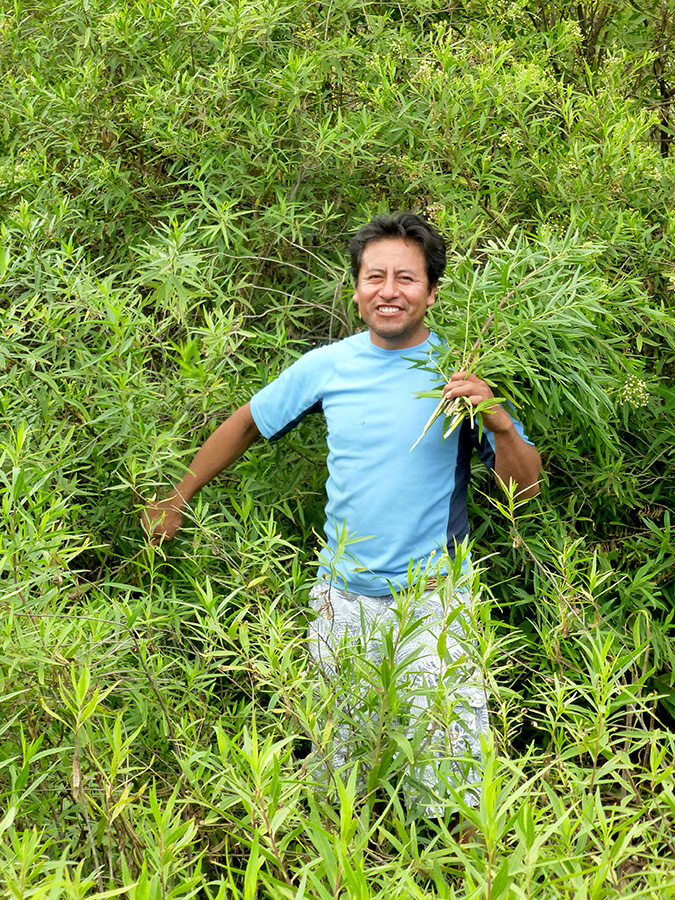
As I previously mentioned, in my endeavor to single-handedly boost the local economy, I commissioned the weaving of a tapete (rug) from my friend, Samuel Bautista Lazo’s family business, Dixza Rugs. The design is a Tree of Life, with a light moss green background. Thus, yesterday, led by Sam, we (a young Aussie fellow staying at the family’s Airbnb, blogger buddy Chris, and I) ventured out near the far end of the village dam to gather yagshī, the plant to be used to dye wool the desired color.
Sam is explaining that his mother wants the young bright green shoots for the dye bath, as she wasn’t at all satisfied with the color the older leaves yielded.
Sam, about to hand off a bundle of yagshī to me to put on our pile.
Into the cauldron of hot water, it went. That’s Sam’s tiny powerhouse mother, Leonor Lazo González. She was making that face because the smoke from the hardwood fire below really stung the eyes.
Like strands of spaghetti, into the yagshī dye bath, the lana (wool) yarn went.
Now you see Sam, now you don’t!
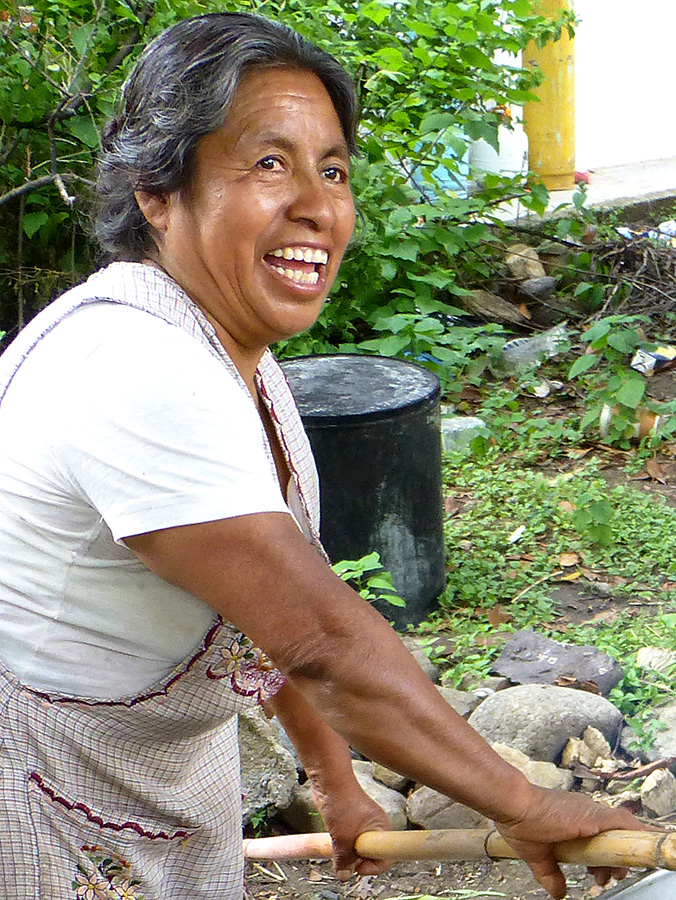
Leonor stirring the pot.
Leonor measuring the weight of the alum mordant to be used to set the dye. Yes, she’s using a tortilla press as a table.
Sam adding the alum (dissolved in water) to the pot.
Pasta al pesto? The yarn will marinate in the dye bath overnight.
Mom knows best and seemed to be pleased with the day’s results!
Sam is a very smart guy and has a Ph.D. in Sustainable Manufacturing from the University of Liverpool. However, being schooled in the traditions, language, and Zapotec way of knowing by his parents, grandparents, and elders of the community is an education that is just as valuable and should never be lost.
As regular readers know, I have a huge soft spot in my heart for the people and cultural traditions of the Zapotec village, Teotitlán del Valle. Blogger buddy Chris and I go out there often, especially for their major festivals where the Danza de la Pluma is performed. Earlier this month, a new group of danzantes de promesa assumed the sacred 3-year commitment to perform the Danza de la Pluma and, for the first time in recent memory, they were selected to dance in this year’s official Guelaguetza. As you can see from the Vive Oaxaca video below, their 17-minute performance Monday evening was spectacular!
¡Felicidades! to the band, Los Reformistas, led by Maestro Antonio Servando Bautista González; to the breathtaking dancing of Sergio Gutiérrez Bautista (Moctezuma), who was front and center and flawless during the entire performance; and to all the Danzantes, who impressively executed the complicated and visually stunning choreography of Maestro Javier Gutiérrez Hernandez. While I may only be a (albeit, frequent) visitor to Teotitlán del Valle, I couldn’t help but feel incredibly proud of the dancers and the way they represented their strong, vibrant, and historic community.
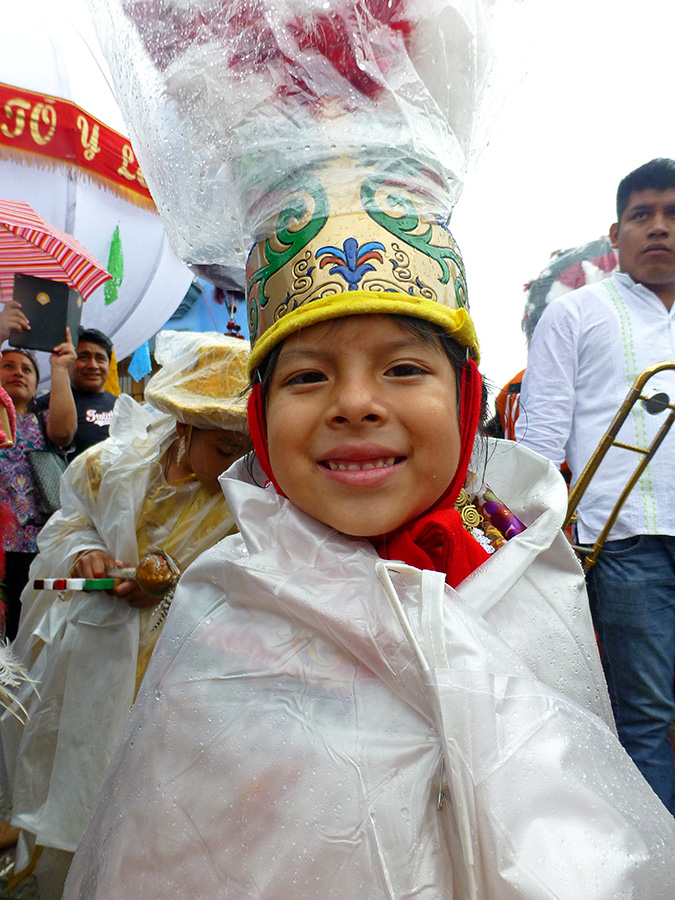
Yesterday, as the Guelaguetza dancers gathered at the Cruz de Piedra and Conzatti Park waiting for the desfile (parade) of delegations to begin, the sky darkened, thunder rumbled, lightening flashed, the wind picked up, and the rain began falling. While they may be making their first appearance (in recent memory) at the Guelaguetza, the Grupo de Danza de Pluma Promesa from Teotitlán del Valle came prepared.
They donned rain ponchos and covered their penachos (headdresses) with clear and specially sized plastic bags.
They were good to go!
Dance master and choreographer extraordinaire, Javier Gutiérrez Hernandez, must have hauled his old costume out of storage to fill in for one of the danzantes. But he looked stoked!
I’m not sure which Subalterno this is. Florentino Martínez Ruiz is that you? Or, is it Juan Bautista Ruiz? Before and during the desfile, both clowned around a little and assisted the danzantes a lot.
There is something about kids and rain… Five year old, Quetzali del Rayo Santiago Ruiz (Malinche) looked happy as a clam.
Perhaps there was a little trepidation among the danzantes at the conditions and concern if the desfile was really going to happen.
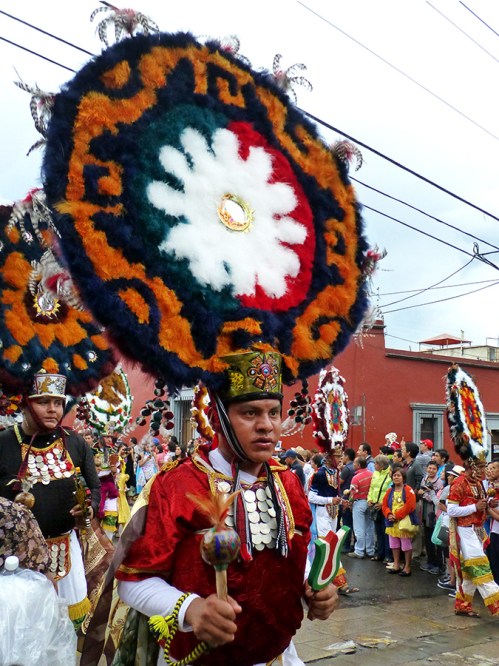
However, at almost exactly 6 PM, police sirens sounded, the leading band struck up, and the parade of Guelaguetza delegations began dancing their way through the city’s rain slicked streets.
Not long after it began, the torrential downpour subsided and the plastic began coming off the danzantes penachos.
After 35 minutes of dancing through, what became, a light drizzle, they reached the intersection of Crespo and Morelos, only a half a block from the parade’s end at the Plaza de la Danza. Next on their dance card, Monday evening’s Guelaguetza performance! I’ll be watching on the local CORTV station. However, if you are not in Oaxaca, CORTV will also be streaming the 10 AM and 5 PM Guelaguetza performances live, this week and next.
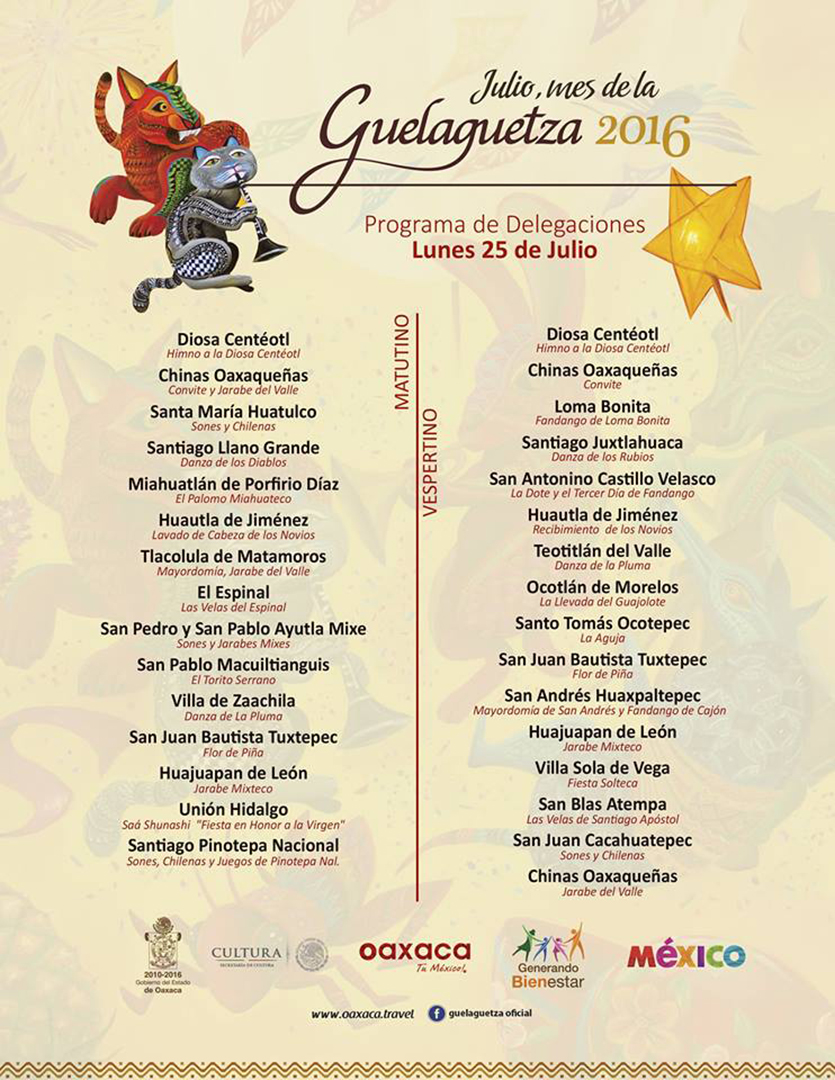
The program of delegations for Guelaguetza 2016 is out and, according to all reports, the show will go on! And, at long last, this year the Danzantes de Promesa from Teotitlán del Valle have been invited to perform. It was the talk of the village this past weekend; the pride in their history and traditions and in this new group of dancers was palpable.
As you can see above, they will be performing on Monday evening, July 25. Though I won’t be there in person, I will be rushing home from the Guelaguetza celebration in Reyes Etla to watch the live TV broadcast. Hopefully, as in past years, both the morning and evening performances on both Mondays will be live-streamed. I will post the link, once I know.
To whet your appetite, here is my short video of the Guelaguetza 2014 performance I attended at the Guelaguetza Auditorium on Cerro del Fortín.
If this tempts you to come, please do! Hotels have experienced a 32% cancellation rate, so you should have no trouble reserving a room. And, the restaurants and artisans could really use your support. While there are only a few reserved seats available through Ticketmaster at the performances up on Cerro del Fortín, local communities in the valley host their own Guelaguezas that are small, free, and provide an up-close and personal view. In addition, the delegations dance their way through the streets of Oaxaca on the two Saturdays prior the performances, there are artisan ferias and food festivals in the city and surrounding villages to experience and enjoy.
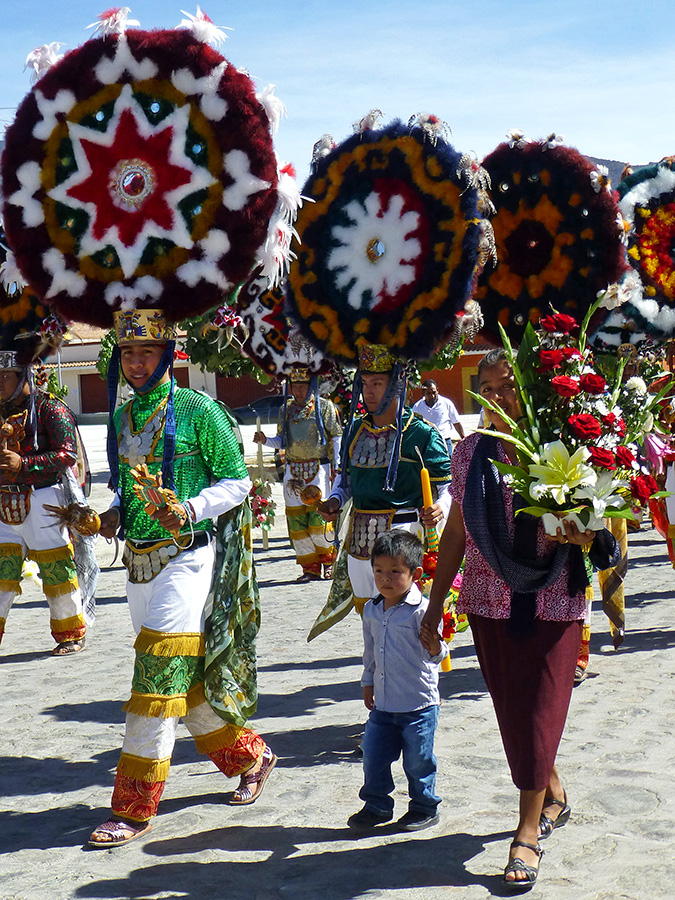
One of the much anticipated features of this year’s Fiesta Titlular a la Preciosa Sangre de Nuestro Señor Jesucristo in Teotitlán del Valle was the debut of the new Grupo de Danza de Pluma Promesa.
Danzantes
Danzantes
Unlike in many of the other villages, where the Danza de la Pluma is danced by folkloric dance troupes, in Teotitlán del Valle nineteen young men and two little girls make a promise to their god and, thus, their community to learn and perform the dance at each of the four annual major religious festivals in the village for three years.
Moctezuma with Malinche and Doña Marina
Danzantes woven wool leggings
This is not a commitment to be taken lightly, as there are 40+ dances that comprise this Zapotec retelling of the story of Moctezuma and the Aztecs battle with Cortes and the Conquistadors. The entire telling of the story takes almost eight hours to perform in the church plaza — in conditions that can vary from brilliant sun with sweltering temperatures to gusty winds to drizzling rain.
Subalterno offering water
Subalterno imitating the danzantes
It’s been almost six months since we first saw the new group at one of their early practice sessions. In jeans, t-shirts, and gym shoes, the guys were at the beginning stages of learning the steps.
Moctezuma, a danzante, and Doña Marina
Moctezuma and the danzantes
They have learned well and it’s going to be an outstanding three years!
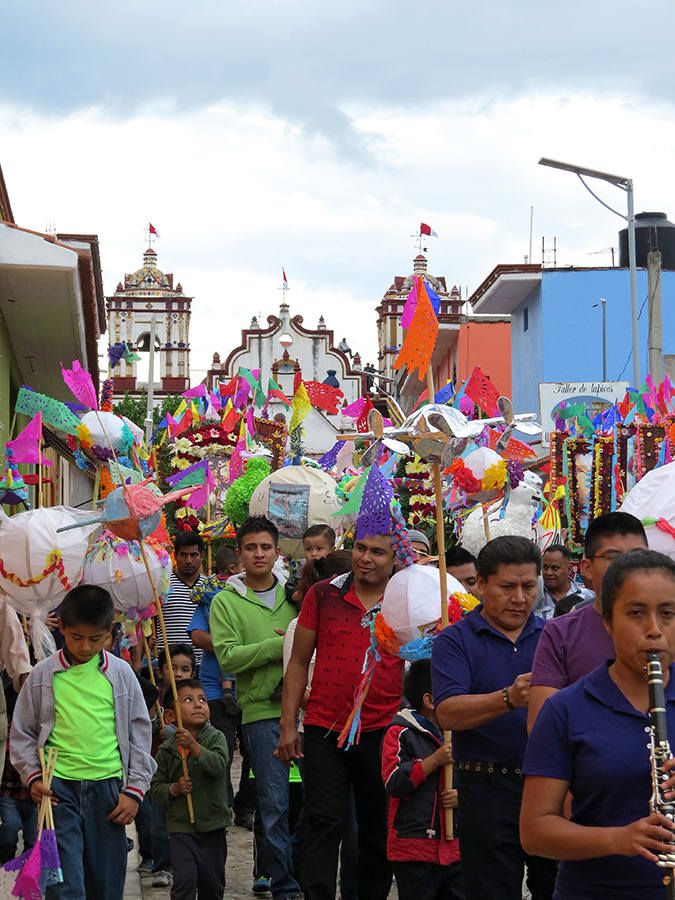
Late yesterday afternoon, under a dark and threatening sky, we gathered in front of Teotitlán del Valle’s church for the first *convite of the Fiesta Titular a la Preciosa Sangre de Nuestro Señor Jesucristo, the village’s patron saint festival.
Templo de la Preciosa Sangre de Cristo
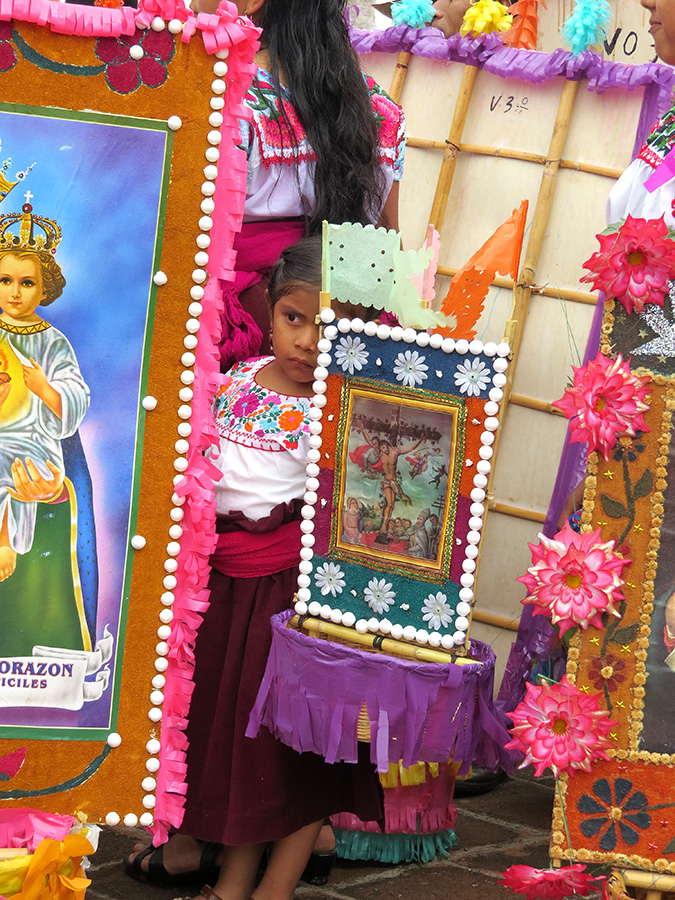
Peeking out from the canastas
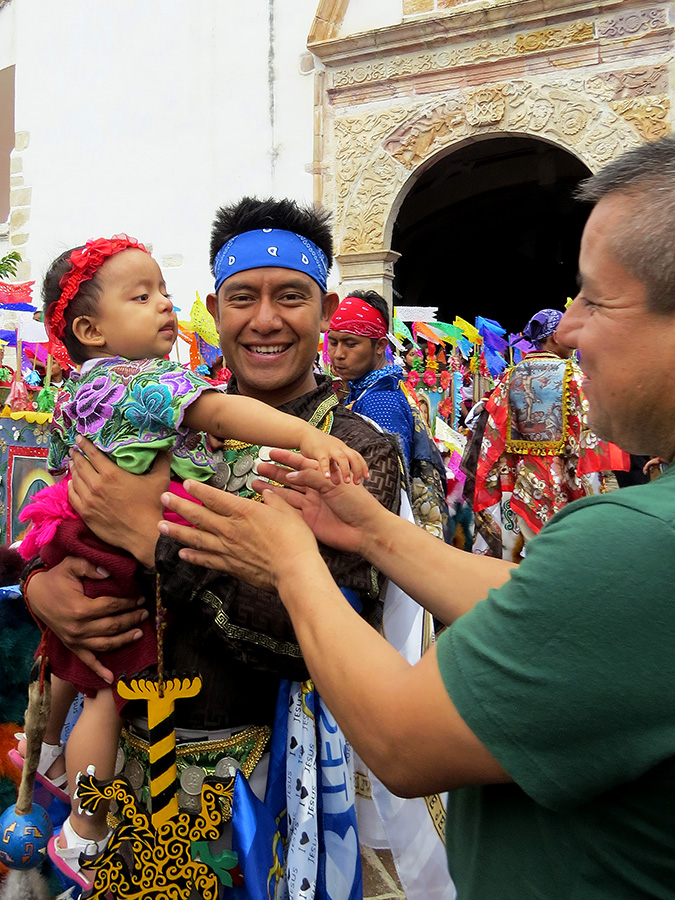
Danzante and daughter
Subalterno entertaining the crowd
Kids in the ‘hood patiently waiting and posing
Leaving the church
Through the streets with one of several marmotas
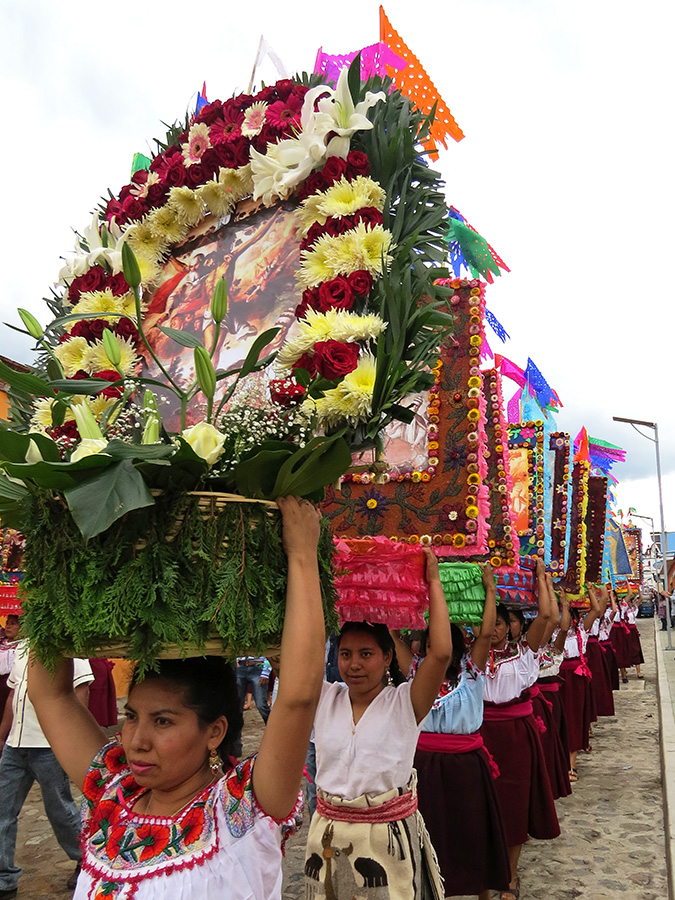
Hundreds of unmarried girls and women parade through the streets
Balancing canastas with dignity and pride
The debut of the new Grupo de Danza de Pluma Promesa (2016-18)
The rain held off, as the procession returned to the church
And, the banda played on…
Major festivities of the Fiesta Titular a la Preciosa Sangre de Nuestro Señor Jesucristo continue through Sunday. We shall return!
* Convite: According to Harrap’s Spanish and English Pocket Dictionary, convite means reception. However, if I drag my weighty Larousse Standard Diccionario down from the shelf, convite translates to “invitation” or “banquet.” And, if one turns to Google or Bing translation programs, a convite is a “treat.” To me, it is all of the above!
The poster announces, Lanii xh’tee búul (La fiesta de los abuelos) — the annual Festival of the Grandparents in Teotitlán del Valle that occurs five days immediately following Easter. Pre-Hispanic in origin, masked “ancients,” in ritualistic, lively, and hilarious fashion, impart their “wisdom” to the village leaders at a grand “Danza de los Abuelos” on the municipal plaza. (If only I could “get” the jokes!)
However, prior to each evening’s merriment, a home in one of the five sections of the village hosts a feast with enough food and drink to feed an army. And, like the world over…
…we know who are the behind-the-scenes heroes of fiestas like this.
It is the abuelas with their hands, hearts, and mouthwatering recipes (like the mole amarillo, above) handed down from their grandmothers.
Even while bouncing nietos (grandchildren) on their knees, with good humor, grace, and their elaborately embroidered aprons, they make certain everyone is fed.
And, they keep a strict accounting of all that is spent!



























 Mexican Peso Converter

 View From Casita Colibrí