Feeds:
Posts
Comments

Posts Tagged ‘Oaxaca’

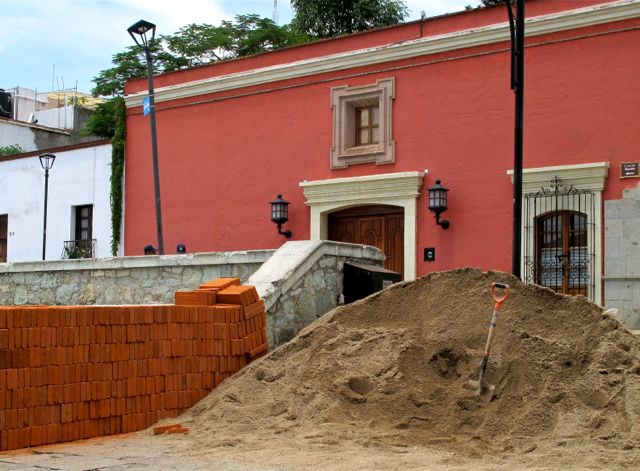
A couple of days ago, above the Plaza de la Danza, a mound of sand and a pile of bricks.

IMG_4953

There were guys doing the heavy lifting — bricks on their shoulders and buckets of sand in hand — carrying load after load down the ramps and stairs to the plaza below.

IMG_4945

The sand was spread and leveled and the bricks were carefully laid in a herringbone pattern.

IMG_4946

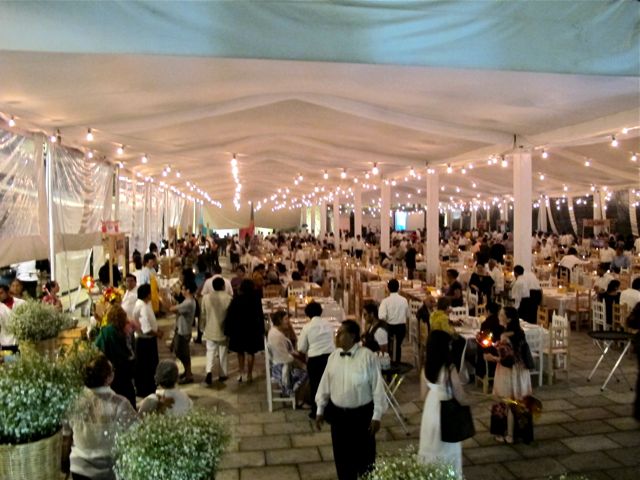
What were they up to?  Preparing a barbecue platform for last night’s gastronomic festival, El Saber del Sabor Oaxaca 2013, opening night buffet.  The entire Plaza de la Danza was tented, tables and chairs were set up, lights were strung, and by yesterday afternoon, all was ready.

IMG_4955

Last year we missed out on the barbecue — spit roasted lamb and pork — it looked and smelled divine, but the line was too long and then it was gone.  This year, we were not to be denied and so our strategy was to be first in line.

IMG_4957

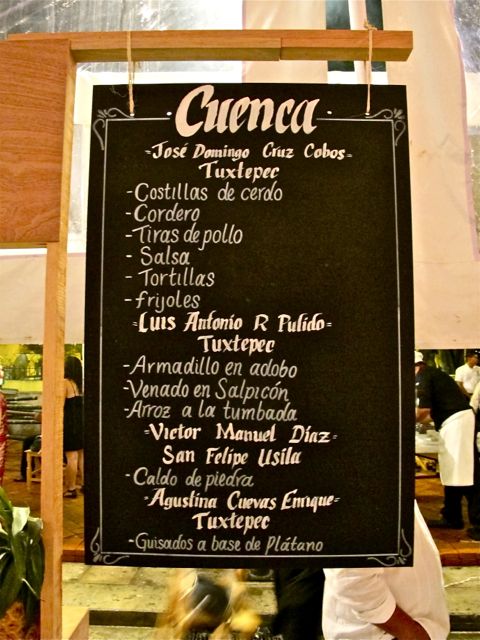
That meant standing for at least 20 minutes in front of the newly constructed barbecue at the Cuenca station, where we had plenty of time to study the menu and salivate, as smoke from the BBQ permeated our clothes and burned our eyes.

IMG_4966

José Domingo Cruz Cobos from Tuxtepec did not disappoint.  I can’t even begin to describe how succulent the meat and how crispy the skin.  It was well worth the wait!

IMG_4999

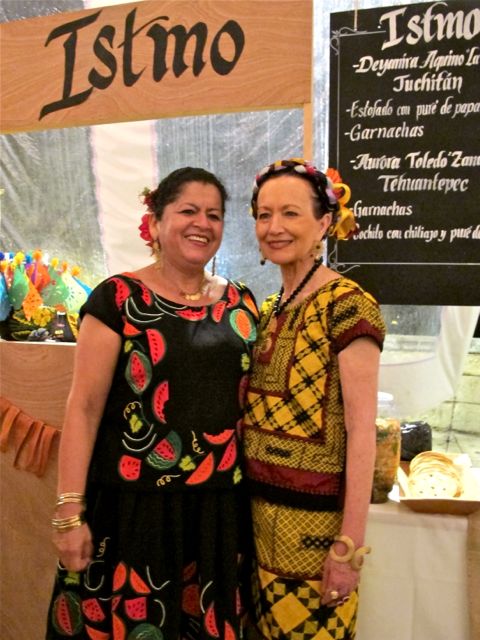
However, this was only the beginning.  Cooks from the other 7 regions of Oaxaca were also there, preparing their signature dishes.

Aurora Toledo of Zandunga restaurant with chef and evening honoree, Patricia Quintana.

Aurora Toledo of Zandunga restaurant with chef, teacher, author, and the evening’s special honoree, Patricia Quintana.

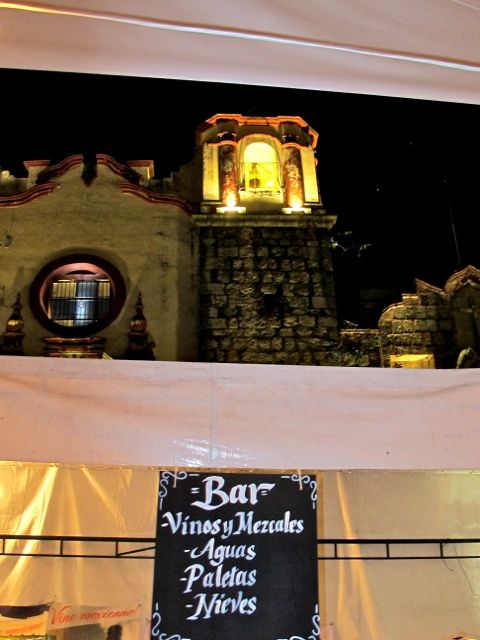
Gluttony makes for a hazy memory, but in addition to the above, I had mole negro and tamalitos from the famed Mendoza sisters of Tlamanalli in Teotitlán del Valle, garnachas from Aurora Toledo of Zandunga in the city, and ???  Oh, and then there was wine, mezcal, and a cajeta flavored paleta for dessert.

IMG_4996

All this, and much, much, much more for only 350 pesos (about $27 US).  It was a lovely and delicious night.

And for those with deeper pockets, multi-course lunches and dinners with wine and mezcal pairings are being prepared by the top chefs from all over Mexico, at select restaurants throughout the city, including Alejandro Ruíz of Casa Oaxaca and Jose Manuel Baños Rodriguez of Pitiona, each recently named to Latin America’s 50 Top Restaurants.

¡Buen provecho!

Read Full Post »

The Danza de la Pluma penachos (headdresses), capes, and leggings are spectacular and unique to Teotitlán del Valle.  The feathered designs on the penachos are more intricate and varied than in other pueblos; and the capes and leggings are hand-woven in this village that is internationally known for its weaving.  However, while the Danza de la Pluma is a crowd-pleaser during the annual July Guelaguetza on Cerro del Fortín in Oaxaca, folkloric groups from other villages are usually chosen to perform it, as Teotitlán’s costumes are not considered “authentic.”

IMG_4828

However, performing for tourists is not why Teotitlán del Valle tells this story through music and dance several times a year.  It is performed on the church plaza, not the municipal plaza, because it is an integral part of the annual major religious celebrations of the village:  Fiesta titular a la Preciosa Sangre de Nuestro Señor Jesucristo in July, Fiesta a la Natividad de la Virgen María in September, Fiesta a el Rosario de la Virgen María in October, and Fiesta a la Virgen de Guadalupe in December.

Penachos from the Fiesta a la Natividad de la Virgen María on Sunday…

Capes from Sunday’s Fiesta a la Natividad de la Virgen María and July’s Preciosa Sangre de Nuestro Señor Jesucristo festival.

Leggings from both festivals…

The various elements of the costumes do not come cheap and dancers must appeal to their extended families to assist in commissioning each of the pieces.  Thus, as annual festivals come and go during a dancer’s 3-year commitment, the costumes may evolve.

With their performances, the dancers honor the rituals of their church and community.  And, with their magnificent costumes, they pay homage to the creativity, talent, and tradition of Teotitlán del Valle’s weavers and feather artists.

Read Full Post »

Yippee, I’m back in Oaxaca!  Last night’s flight was smooth, on-time, and mostly empty.  I have to admit to always getting a goofy grin as the little Embraer comes in over the lights of the city and the smile continues through immigration and baggage claim.  It usually falters and turns to a grimace when I have to hoist my 50 pound suitcase up onto the x-ray conveyor belt.  However, last night the grin returned when I pressed the “to search or not to search” button, got the green light, and was able to proceed directly to the booth to buy my colectivo ticket —  60 pesos for door-to-door service to the historic district ‘hood.  An easy return to home.

Unpacking done, late this morning I walked down to my local mercado to restock the larder with some basics:  2 perfect avocados, 1 pristine white onion, a bunch of unblemished small and sweet bananas, half kilo of quesillo (Oaxacan string cheese), and 6 freshly made tamales (mole, rajas, and verde).  I’d actually asked for 4, but my regular tamale gal threw in 2 extras.  How often does that happen in el norte?   A welcoming return to home.

This afternoon, blogger buddy Chris and I drove out to Teotitlán del Valle for the performance of the Danza de la Pluma.  We stepped up onto the plaza of Templo de la Preciosa Sangre de Cristo and it was like emerging into the middle of a technicolor movie.  We’ve been there countless times, but today we were blown away by the scene.  Mother Nature had conspired to use her enhance wand on the sky, clouds, sun, and costumes.   A spectacular return to home!

The recent trip to California was to sign papers finalizing the sale of the house my grandparent’s built in 1957.  Prior to relocating to Oaxaca, it had been my home for 30 years, where I’d raised my kids and made many wonderful memories.  Needless to say, selling it was an emotionally challenging ordeal and it has engendered a lot of thinking about the notion of “home.”

However, these past 24 hours have reinforced my belief in bumper-sticker wisdom seen many years ago, “When you live in your heart, you are always home.”  It’s good to be home!

Read Full Post »

More from the Hecho en Oaxaca exhibit…

P1100004

The courtyard at the Museo de Arte Contemporáneo de Oaxaca (MACO)…

P1100060

Art is the tree of life.  — William Blake


Read Full Post »

Work in progress on Tinoco y Palacios by Jorel and the Rhu Crew…

P1080919

Up close and personal…

All finished!

P1100148

Read Full Post »

I’m back up in el norte for a brief “taking care of business” trip.   And, sheesh, it’s SO quiet on this western front.  No fireworks.  No clanging chains of the propane tank vendor.  No bands playing in the streets.  No loudspeakers.  And, no shrill sound of the steam whistle heralding the arrival of the camote man.

Camote vendorEvery evening, he wheels his cart through the streets of Oaxaca selling sweet potatoes and plantains sweetened with sugar and drizzled with condensed milk.  They are cooked in a pressure-cooker-like contraption that is heated by a small wood fire in the metal drum below.  The iconic sound comes from the hot steam being released from the cooker.

If you have a sweet tooth, follow the whistle for a yummy dessert treat!

Read Full Post »

Flying into the city of Oaxaca at night, Talea de Castro is one of the countless tiny pockets of light twinkling from the darkness below.  These earthbound clusters of stars mark small pueblos nestled in the treacherous mountains of the Sierra Norte.

The remote terrain of Oaxaca’s Sierra Norte and Sierra Sur has helped to preserve the traditions of these indigenous communities — but at a high price.  It has also hindered access to technology that could benefit residents of these communities and has made it easy for the “powers that be” to ignore the needs of these villages.  Taking matters into their own hands, I love what the people of Talea de Castro have done.

Forgotten by telecoms, Mexico town runs cell service

AFP – Left out by telecom firms like the one owned by billionaire Carlos Slim, a remote Mexican mountain village now runs its own mobile phone network to communicate with the outside world.

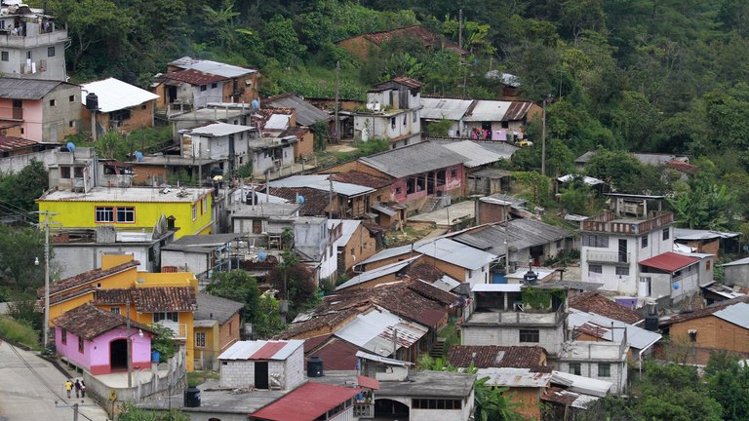
Tucked away in a lush forest in the southern state of Oaxaca, the indigenous village of Villa Talea de Castro, population 2,500, was not seen as a profitable market for companies such as Slim’s America Movil.

Talea de Castro, Oaxaca State, Mexico, taken on August 17, 2013 (AFP Photo/Carlos Salinas)

Talea de Castro, Oaxaca State, Mexico, taken on August 17, 2013
(AFP Photo/Carlos Salinas)

So the village, under an initiative launched by indigenous groups, civil organizations and universities, put up a perch-like antenna on a rooftop, installed radio and computer equipment, and created its own micro provider called Red Celular de Talea (RCT) this year.

Now, restaurant manager Ramiro Perez can call his children and receive food orders on his cellphone at a cheap price in this village dotted by small homes painted in pink and yellow.

The local service costs 15 pesos ($1.2) per month — 13 times cheaper than a big firm’s basic plan in Mexico City — while calls to the United States, where many of the indigenous Zapoteco resident have migrated, charge a few pennies per minute.

“I have two children who live outside the village and I communicate with them at least two or three times per week,” Perez, 60, told AFP.

Before, Perez had to use telephone booths where he paid up to 10 pesos ($0.75) per minute.

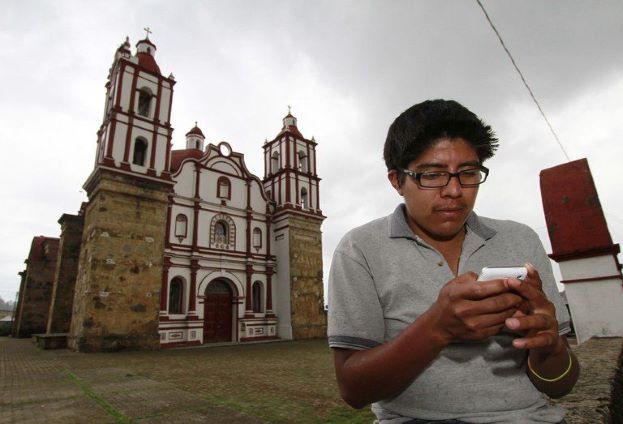
A local resident uses his mobile phone in Talea de Castro, Oaxaca State, Mexico, on August 17, 2013. For considering it to be slightly profitable, the big companies of mobile telephony refused for years to give its services in Talea, but the population -- mostly of indigenous origin -- adopted a novel system and created its own company, the Red Celular de Talea (RCT) (Talea Mobile Network).

A local resident uses his mobile phone in Talea de Castro, Oaxaca State, Mexico, on August 17, 2013. For considering it to be slightly profitable, the big companies of mobile telephony refused for years to give its services in Talea, but the population — mostly of indigenous origin — adopted a novel system and created its own company, the Red Celular de Talea (RCT) (Talea Mobile Network).

The coffee-producing village installed the network with the help of Rhizomatica, a non-profit with US, European and Mexican experts who aim to increase access to mobile telecommunications in communities that lack affordable service.

In a statement, Rhizomatica, a civil group named Redes and a town official said they hoped that a telecom reform pushed through Congress by President Enrique Pena Nieto to open the market will “break the obstacles” that prevent the development of such community-based projects.

“Many indigenous communities have shown interest in participating in this project and we hope that many more can join this scheme,” the statement said.

The equipment used in Talea, which was provided by California-based Range Networks, includes a 900mhz radio network and computer software that routes calls, registers numbers and handles billing. Calls to the United States are channeled via a voice over Internet protocol (VoIP) provider.

The village received a two-year-permit from the Federal Communications Commission to have the right to test the equipment.
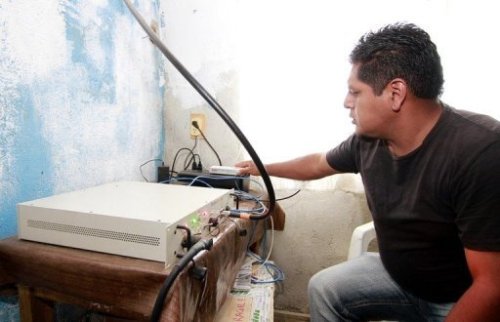
A local resident operates the equipment enabling mobile communications in Talea de Castro, Oaxaca State, Mexico, on August 17, 2013.

A local resident operates the equipment enabling mobile communications in Talea de Castro, Oaxaca State, Mexico, on August 17, 2013.

When a cellphone user arrives in the village, a text message automatically appears saying: “Welcome to the Talea Cellular Network (RTC) — to register, go to the radio with this message.”

There is one catch: phone calls must be limited to a maximum of five minutes to avoid a saturation of lines.

Israel Hernandez, a village resident and one of the volunteers who helped set up the system, said the network uses the radio-electric spectrum that “telephone (service) providers refuse to use because it is financially unviable.”

Slim’s Telcel is part of his America Movil empire, which controls 70 percent of Mexico’s mobile phone market and has 262 million subscribers across Latin America but never made it to Talea.

Alejandro Lopez, a senior town hall official, said the village had approached big telecom firms but that they had required 10,000 potential users as well as the construction of a path where an antenna would be erected and a lengthy power line.

“Despite some technical problems, because we are in a test period, the project has been a success” with 600 villagers signing up since the service opened three months ago, Lopez said.

Buoyed by the system’s success, the village has decided to buy its own equipment that will allow RCT to run 35 lines simultaneously and plans to install in the coming weeks.

The next step, RCT volunteer Hernandez said, is to form cooperatives with other indigenous villages to request concessions from the Mexican government in order to resolve “this lack of free frequencies for cellphone communications in the country’s rural communities.”

New article from the BBC:  The Mexican village that got itself talking.

Read Full Post »
Down to Mercado de Abastos late this morning to catch a colectivo out to Etla.  I’ve actually come to enjoy the 10-block walk through this definitely not-spiffed-up-for-tourist-consumption neighborhood.  However, crossing the Periferico Sur is another story!  Cars, taxis, colectivos, buses, trucks, motorcycles, hand-trucks, and pedestrians all in motion or poised to move.  Did I mention the potholes ready to swallow people and vehicles?  There is a pedestrian bridge a block down the street, but what’s the fun in that?

Needless to say, we all need all the help we can get!  I think my colectivo driver had all his bases covered, invoking Mexico’s “Holy Trinity” — La Virgen de Guadalupe, Jesús crucificado, and patriotismo.

Virgin of Guadalupe, crucifix, 2 Mexican flags on rear view mirror

Of course he had the rear view mirror covered, too!

Read Full Post »

Another wall, courtesy of the Hecho en Oaxaca urban art project of the Museo de Arte Contemporáneo de Oaxaca (MACO).  It reminds me of the John Mayer song,

Waiting on the World To Change

Me and all my friends
We’re all misunderstood
They say we stand for nothing and
There’s no way we ever could

Now we see everything that’s going wrong
With the world and those who lead it
We just feel like we don’t have the means
To rise above and beat it

Wall art of boy sitting

So we keep waiting
Waiting on the world to change
We keep on waiting
Waiting on the world to change

It’s hard to beat the system
When we’re standing at a distance
So we keep waiting
Waiting on the world to change

Now if we had the power
To bring our neighbors home from war
They would have never missed a Christmas
No more ribbons on their door
And when you trust your television
What you get is what you got
Cause when they own the information, oh
They can bend it all they want

That’s why we’re waiting
Waiting on the world to change
We keep on waiting
Waiting on the world to change

It’s not that we don’t care,
We just know that the fight ain’t fair
So we keep on waiting
Waiting on the world to change

And we’re still waiting
Waiting on the world to change
We keep on waiting waiting on the world to change
One day our generation
Is gonna rule the population
So we keep on waiting
Waiting on the world to change

We keep on waiting
Waiting on the world to change

~~~

But, then again, maybe he’s waiting to join the struggle to make the change…

Read Full Post »

Friday, I went Teotitlán del Valle to visit a friend.  N is living out in the campo and it was an adventure just getting there — necessitating a colectivo, bus, moto-taxi, and a fair amount of walking.  However, it was well worth it!  The conversation was non-stop, comida was delicious, and the setting is spectacular.

El Picacho from rooftop terrace.

El Picacho from my friend’s rooftop terrace.

However, a major topic of conversation in the village is the lack of rain.  Granted, I was grateful the creek the 3-wheel moto-taxi and I had to ford only had about six inches of water in it, but looking out from N’s terrace, it was evident the fields are suffering.

Maguey fields in Teotitlán del Valle.

Maguey fields in Teotitlán del Valle.

Acres upon acres of parched earth, with rows upon rows of drooping and stunted corn — the lifeblood of this country.  When the campo suffers, so too the people.

Rows of corn stalks.

Rows of corn stalks.

Word has it that this is the driest rainy season anyone can remember.  In a normal year, afternoon showers irrigate the fields and clean the city’s streets at least four to five times a week from June through September.  This year, nada!  I can probably count on two hands the number of times it’s rained.  Your offerings and prayers to Cocijo would be much appreciated!

Update:  Wow, I have some powerful blog readers — it rained last night!!!  Mil gracias.  

Read Full Post »

“Beauty is whatever gives joy.” — Edna St. Vincent Millay

This slideshow requires JavaScript.

Some of the beautiful women, young and old, of this year’s Guelaguetza desfiles.

Read Full Post »

I kind of have an unwritten rule for this blog of not promoting commercial enterprises.  However, being an alumna of the sixties, I wholeheartedly subscribe to the rule that rules (especially unspoken ones) were made to be broken.  Thus I encourage you to click on the “Behind the Scenes” videos of season 9 of Rick Bayless, Mexico: One Plate at a Time in Oaxaca.  Start with episode 13 and work your way backwards.  These “Behind the Scenes” clips really do give a flavor of the culinary culture, traditions, and scenery of Oaxaca.

If you are in El Norte, watch the shows.  What’s not to like?  Come on down!!!

h/t: Margie B.

Read Full Post »

I think I’ve mentioned several times before, Oaxaca is filled with art — in the streets, museums, and galleries.  New venues crop up regularly and exhibit openings, replete with mezcal, cervesa, and botanas, seem to occur a couple of times a week.  I can’t keep track!

A few days ago, on our way to La Popular for tortas, my friend (and artist) Laurie Fisher and I stopped by the Galería Noel Cayetano Arte Contemporaneo to see the current exhibit, Los Apóstoles (The Apostles).  Male and female, they are all self portraits by Nayarit born sculpture and painter, Vladimir Cora.

Cora dedicated the exhibition to all all those who do their job well have not been corrupted.  “Todos tenemos un apostolado y si lo haces honestamente, esta exposición es para ti.” — Vladimir Cora (Noticias, 10 agosto 2013)

The Cayetano gallery is upstairs at the Plaza Santo Domingo, M. Alcalá 405-30 in Oaxaca city.

Read Full Post »

As a current article says, mezcal seems to have wormed (oh, that’s bad!) its way into the hearts, minds, and media of el norte.  And, all I can say is, it’s about time!  I’m not really much of a drinker; mostly just wine with dinner, the occasional beer on a hot day, and a mixed drink a couple of times a year.  However, I have to say, mezcal has been a pleasant surprise.  The smoky complexity is quite a treat, especially if one ventures beyond the mass-produced brands and into the artisanal varieties.

Here in Oaxaca, mezcal is offered to welcome visitors, served at celebrations of all kinds, plays a role in most traditional ceremonies, and audiences always enthusiastically join in when Lila Downs sings, Mezcalito.  Oaxaqueño families have been harvesting agaves and hand crafting mezcal for generations.  The following photos are from an afternoon spent at one such palenque in San Baltazar Chichicapa(m).

Agave piñas (hearts) are stripped of leaves & roots and placed in a large outdoor pit oven.

P1060398_2

They are covered with agave leaves, fiber, mats and dirt and cooked over red-hot rocks for three to four days.

P1060400

The roasted agave is crushed with a gigantic stone wheel pulled by a horse.

P1060415_2

The roasted and mashed agave is then placed in large wooded vats to ferment.

P1060413_2

The liquid is extracted and twice distilled.  Next it is either bottled, if it is to be sold as blanco (aka, joven), or placed in barrels to age.  Reposado is aged for less than a year and añejo is aged from one to twelve years.  Needless to say, I returned home with my 4 L plastic gas can (no, it had never been used for gas!) filled with reposado made by our host and master mezcalero, Faustino.

P1060432

As the old Oaxaqueño saying goes, “For everything bad, drink mezcal and for everything good, you also should!”

And, please note:  This is a drink to be savored not chugged!

Read Full Post »

Congratulations to one of my favorite weavers, Amalia Martínez Casas from the mountain village of Tamazulápam del Espíritu Santo, winner of the 13th Popular State Art Prize “Benito Juarez” 2013.  The award, presented several days ago by Oaxaca governor Gabino Cue, recognized and honored her work using the backstrap loom, using cotton thread and wool dyed with indigo and banana peel, to weave the traditional costume of Tamazulápam in the Mixe.

Three or four times a year, an artisan fair is held in Llano Park.  Puestos upon puestos of pottery, wood carved alebrije, jewelry, and textiles are on display.  It was here, two years ago, where I first discovered the exquisite work of the tiny and talented weaver, Amalia Martínez Casas.

IMG_4175

I couldn’t resist buying this huipil; a subtle black on charcoal grey that looks both traditional here in Oaxaca and very hip with black leggings and boots in el norte.

And, then the next time, even though the dye was a little uneven, I couldn’t resist buying this short huipil — the color had me at, hola!

Her well-crafted technique and finely drawn designs are sophisticated, be they executed in subdued huipiles or brilliant red serapes.

Every time I wear one of her works of art, people ask, “Where is it from?”  “Who made it?”  “Where can I get one?”  I’ve pointed several friends to her stall in Llano Park during artisan fairs and last week, at the request from a friend in California, I bought this one.  The slight green tint will be perfect with her red hair.  (Yes, this one’s for you, Louise!)

Photos of the award ceremony can be found HERE and video is available HERE.  (Amalia Martínez Casas can be seen beginning at 6:00 minutes.)  And, for more of her creations, check out a blog post Chris did last January.

Read Full Post »

« Newer Posts - Older Posts »