Feeds:
Posts
Comments

Posts Tagged ‘music’

One of the qualities that amazes me about most Oaxaqueños is their patience with waiting in interminable lines.  On the one hand, I think those north of the border could take some much-needed lessons in civil and well-mannered behavior.  However, on the other hand, I think Oaxaqueños deserve much better than having to stand in endless lines, be it the bank, a government agency, or to get tickets to a concert by their favorite daughter, Lila Downs.

Lila Downs with bottle of mezcal

Last year, unable to figure out the hows and wheres of getting a ticket to her free concert during the ten days of the Guelaguetza festivities, I was on the verge of giving up getting tickets to see Lila Downs, when friends coming in from out-of-town(!), offered a couple to me.  Of course, I accepted!

Lila Downs fluttering skirt

This year, after several false leads, on Tuesday morning L and I climbed back up to the Guelaguetza Auditorium to try to score some tickets to this year’s free concert.  The box office was scheduled to open at 9 AM, we got up there at 8:30 AM and found ourselves at the end of a line that stretch halfway to the planetarium AND that continued to grow as the hours ticked by.  Abuelos, niños, moms, dads, and teens lined the pathway, talking on cell phones, eating, talking, and laughing — without a raised voice or harsh word spoken.

Lila Downs with guitar

At almost 10 AM, when the line hadn’t moved an inch, I walked down the hill to the box office to see what was happening.  Nothing, as it turned out!
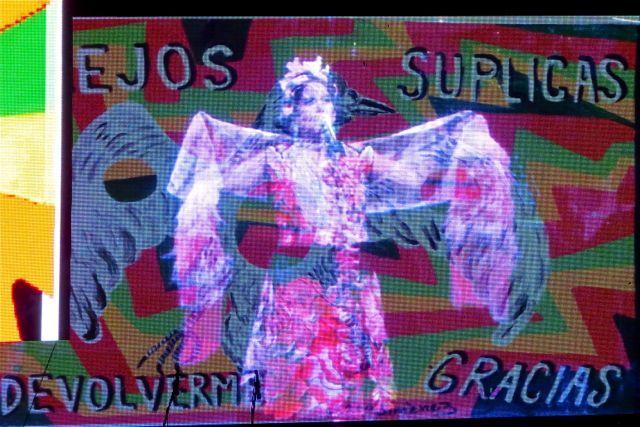
Projected image of Lila Downs

However, good-natured patience finally succumbed to whistles and shouts by those who were in the line of sight of the ticket booth — after all, according to the newspaper they had begun lining up at 4:30 AM!!!

Lila Downs arm raised

I wound my way back up the hill to report my findings to L.  Alas, after another 45 minutes of no movement, impatient gringas that we are, we gave up.  However, to borrow from the musical Sound of Music, “somewhere in [our] youth or childhood, [we] must have done something good,” because 48 hours later, my neighbor presented us with tickets!  And so last night, we climbed back up Cerro Fortín to see Lila Downs.  We were very happy campers.

IMG_5134

She put on another spectacular show — mixing new tunes with old, incorporating several of the Guelaguetza delegations into the production, and generally bringing cheers and sing-a-long voices from the hometown crowd.  By the end, everyone was on their feet.

Read Full Post »

Live streaming of the Guelaguetza performances at the Guelaguetza auditorium atop Cerro del Fortín, July 21 and 28 at 10 AM and 5 PM (Central Daylight Time).

http://new.livestream.com/radical-bits/guelaguetza-2014

Update:  La Guelaguetza 2014 is over, however you can view all the performances on Vive Oaxaca’s YouTube channel.


Read Full Post »

Not only is the previously mentioned Oaxaca FilmFest4 opening tomorrow night, but last night a calenda up Morelos heralded the arrival of the 8th Congreso Nacional de Danzón.  Alas, it was raining, I’m a wimp, and so stayed home.  However, the music coming from the Plaza de la Danza sounded wonderful.  Sigh….

If you are walking around Oaxaca during the next few days, be on the lookout for the guapas y guapos (the guys are all duded up, too) of Danzón.  They are adding a lot of glitz and glamour to the streets of the city.

3 women dressed in glittery dresses

For the uninitiated, Danzón is a very stately dance that originated in Cuba.  However, it seems to be most beloved in Puerto Rico and Mexico.  It has especially flourished in Oaxaca, where one can find dancers young and old dancing under the laurel trees in the Zócalo every Wednesday evening at 6:30.  And, no wonder it has retained its popularity here, according to Wikipedia, “many famous danzones were composed by Oaxacan musicians such as the famous Nereidas and Teléfono de larga distancia, both works of Amador Pérez Dimas, from the town of Zaachila, near Oaxaca city.”

If you aren’t anywhere where Danzón is performed, you can check out the 1991 movie, Danzón:

Julia (Rojo) is a phone operator in Mexico City who divides her time between her job, her daughter and the danzon: a cuban dance very popular in Mexico and Central America. Every wednesday Julia does the danzon with Carmelo (Rergis) in the old “Salon Colonia”. They’ve danced for years but barely know each other. One night Carmelo disappears without a trace. Feeling lonely and sad, Julia takes a train to Veracruz, where she knows Carmelo has a brother. That sudden trip will change Julia’s life forever. IMDB

I haven’t seen the movie, but according to one reviewer, the soundtrack is worth the rental price.  I’m going to try to find it!

Read Full Post »

Wednesday in the Mixteca

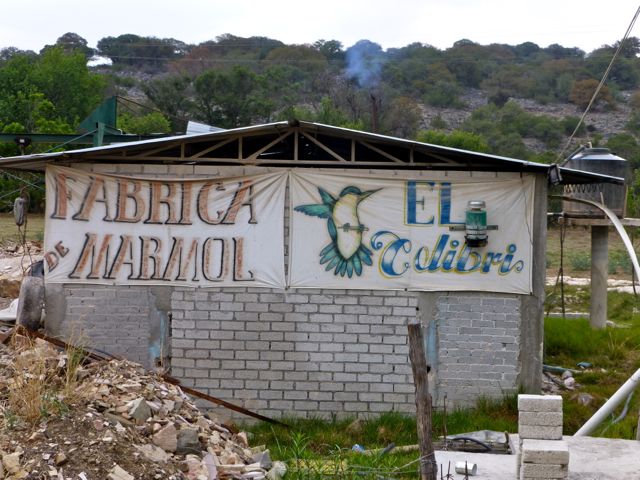
cement block building "Fabrica Marmol" "El Colibrí"

How could I resist?  Photo, yes.  Dining, no.  We had already eaten and so were not tempted to try Restaurant El Colibrí, across the street.  However, still scratching my head about the relationship between marble (marmol) and hummingbird (colibrí).

Concrete block building with sign, Fabrica Marmol, El Colibrí

This librarian couldn’t resist doing a little research.  According to Wikipedia, the hummingbird in Aztec culture was, “emblematic for their vigor, energy, and propensity to do work along with their sharp beaks that mimic instruments of weaponry, bloodletting, penetration, and intimacy.”  Hmmm…  the tools and strength needed by a marble mason.  Now, it’s beginning to make sense.

(Thanks Chris for stopping so I could take the above photos.)

And now a song from the Mixteca, “Chikirriyó’i” (“El Colibrí”) (The Hummingbird):

Read Full Post »

The little Embraer may have touched down in Oaxaca late Saturday night but, in the words of a long ago Buffalo Springfield song, I’m still “flying on the ground.”

Mural on the wall outside Academia de Arte Musical in Oaxaca.

Mural on the wall outside Academia de Arte Musical in Oaxaca.

Moving two days before a California and New York trip…  What was I thinking?

Read Full Post »

Riotous clanging from Soledad’s bell towers at 4:45 AM yesterday rudely interrupted a peaceful sleep.  Explosions of cohetes and other church bells soon joined the morning’s 2-hour long Virgen de Juquila soundtrack.  Chimes, rockets, loudspeakers announcing the presence of the water and gas vendors, fried plantain wagon steam-whistles, horns honking, bus gears grinding, and booming base emanating from open car windows; it’s all part of the cacophony one comes to know and love when living in Mexico.

And, then there is the music…  Looking for signs of Juquila yesterday (with all that noise, I figured there must be something going on), I stumbled upon the Sexto Festival Low-Fi 2012.  (Fyi:  sexto = 6th, in case you were wondering.)

P1020877

There were vendors…

P1020880

This definitely didn’t have anything to do with virgins!

P1020874

This was a music festival that almost didn’t happen.  According to event promoter, Thorvalo Pazos Hoga, they were initially denied a permit, “on the grounds of religious and traditional festivals that are celebrated in the month of December in the city.”  A silly argument, was his response.

P1020876

I arrived in the early afternoon and fanaticos (love that word for fans!) were just beginning to gather at the Plaza del Carmen Alto.  Ska, hip hop, heavy metal, rock, electronic music, and more would be adding to Oaxaca’s soundtrack until 11 PM.

P1020885

Yes, we have no marimbas; the music was not your grandparents’ sones and jarabes.  The bands had names like:  K-OS Party, Cayune, Pichancha, Rekto de Cerdo, Dr. Jekill y Mr. Hyde, Herpes, Coito Violento, Forever, and Survival.  Probably not even your parents’ music!

P1020872

Oaxacan graphic artists designed the stage set.  Love how they re-imagined the traditional Navidad piñata.

Read Full Post »

Felicitaciones to Oaxaca’s favorite daughter, Lila Downs!  Her CD, Pecados y Milagros, won Best Folkloric album at the Latin Grammys on Thursday night.  When the album first came out, her promotional tour brought her to the Guelaguetza Auditorium, just up the hill, and we got to experience the spectacular show she put on in front of the hometown crowd.

And, at the Latin Grammys, she pulled out all the “spectacle” stops when she, Celso Piña, and Totó la Momposina performed, “Zapata Se Queda” from the album.  (Yes, THAT Zapata!)

The thank you by Lila Downs, posted on her website:

¡GRACIAS por creer en el folklor! Gracias por darnos ánimos cuando andamos tristes, por hacer con su cariño y palabras de buena fe que sigamos creyendo en Zapata, en México, en la tradición, en nuestros pueblos… ¡En la magia y la fe interminable de Latinoamérica!

(Thank you for believing in the folklore!  Thank you for giving us courage when we’re sad, to make with love and words of good faith that continue to believe in Zapata, in Mexico, in tradition, in our towns …In magic and the endless faith of Latin America!)

I strongly encourage you to check out the CD, Pecados y Milagros.  It really conveys the life, the love, the history, and the reverence that is the essence of Oaxaca.

Also, there’s a terrific review of her Latin Grammy performance at Examiner.com.

Read Full Post »

You might well ask, “What is a muerteada?”  It is a comparsa (parade) that is part of traditional Día de los Muertos celebrations particular to the state of Oaxaca.  According to the book, Day of the Dead: When Two Worlds Meet in Oaxaca, the muerteada allows the dead “to ‘occupy’ a living body, either a muerteada participant or an audience member, for a time, and therefore enjoy the entertainment directly rather than vicariously.”

Like Commedia dell’Arte, there are stock characters — in this case, the happy widow, the dying or dead husband, the father of the widow, a doctor, a priest, a shaman, people dressed like death, devils, and las lloronas (weeping women).  However, unlike Commedia dell’Arte, in the muerteada men play all the roles.

Last year we joined the Vista Hermosa, Etla murteado.  However, this year blogger buddy Chris decided I was ready for the big time — the “battle of the bands” when the muerteadas of San Agustín Etla and Barrio San José meet — Banda Tromba Sinaloense for San Agustín and MonteVerde Banda for San José.  FYI:  This is after participants and their bands have danced their way up and down the hills of their respective neighborhoods all night long, stopping at designated houses for food and drink — mezcal and cervesas seemed to be the beverage of choice, especially among the men!

So, early on the Nov. 2, we went in search of the San Agustín contingent, we found them, joined in the merriment, were offered food and drink along the way, and eventually came to the crossroad where mania turned to mayhem, albeit organized mayhem — courtesy of the white-shirted security for San Agustín and red-shirted security for San José.  They kept the dancers and supporters from each side apart, leaving the face-off to the two bands.  It was wild!!!  After 20+ minutes of battling bands, it was over and we and the San Agustín contingent trudged back up the hill.

You may have spotted a tall silver-haired gringo right in the middle of the action in one or two of the photos, that would be Chris.  Be sure to check out the video he put together of all the madness.

According to Organizing Committee President, Alfredo Erick Pérez, the muerteada in San Agustín Etla dates back to the 1800s, possibly to the days of Mexican President Porfirio Díaz.

Read Full Post »

On chairs in Reyes Etla.

On a chair: sheet music "Zapateando Istmeño xxx" for tuba

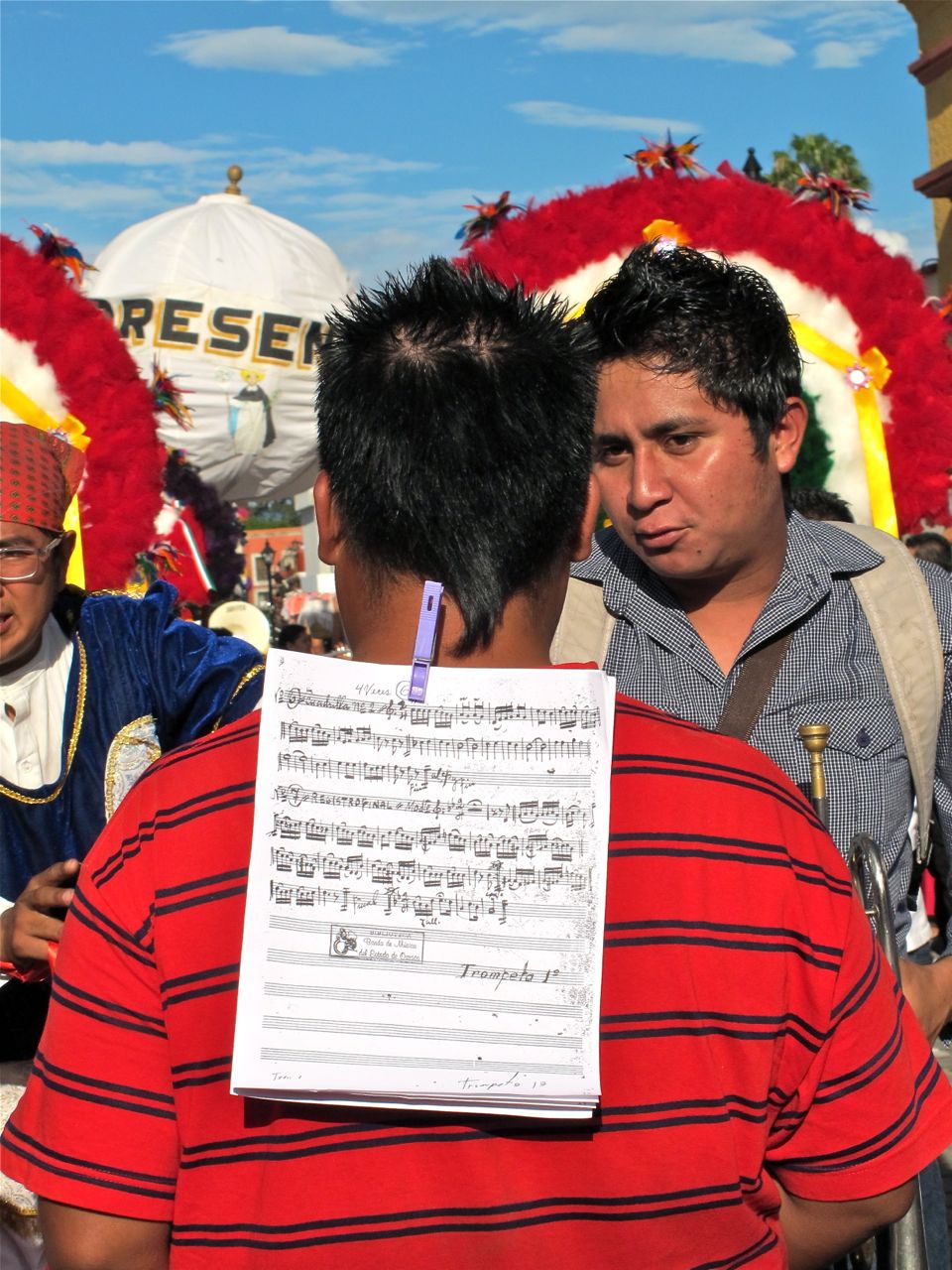
On people’s backs in the city.
"Cuadrilla no. 2" sheet music clipped on the back of a man wearing a red and black striped shirt

Wherever… especially during Guelaguetza!

Read Full Post »

Hip hop is probably not the first thing that pops to mind when you think of Oaxaca.  However, I can assure you, there is more to Oaxaca than colonial architecture, religious processions, colorful traje (costume), and traditional music.  As repeated blockades and occupations attest, and the El Silencio Mata posters illustrate, there are voices struggling to be heard.

For one of those voices, check out this trailer from the documentary film, Cuando Una Mujer Avanza (When a Woman Takes a Step Forward), about “Mare” a young Zapotec hip hop artist from Oaxaca.  As the promo states, her unique life experience is a rarely heard perspective on life and community liberation.  As an up and coming MC in a state known for popular and indigenous rebellion, Mare’s life and experience has been channeled into very powerful and conscious rapping and singing.

Update:  Check out the article, Mare Is a Rapper Hell-Bent on Equality for Women in Mexico.

Read Full Post »

LA.com just posted a phone interview with Oaxaca’s own, Lila Downs,  where she discusses influences on her musical development, experiences working on the movie Frida, and future projects.  The following is the first of eleven questions asked by Paty Elias, in advance of Lila’s Los Angeles performance on Feb. 25, 2012 promoting her album, “Pecados y Milagros.”

From the interview…

LA.COM::  With such a diverse musical background, why did you decide to focus on Ranchera, style music?

Lila Downs:   I think that I have been very affected by what has been happening in Mexico. There has been a lot of violence, and I started composing a number of songs that were inspired by   retablo, the   votive art forms.

It’s about the notion of having a miracle in your life and giving thanks to the sometimes non-visible saints and elements of faith we have in Mexico. I thought it was very fascinating to somehow find the subjects in the songs and then kind of place them in the same way towards showing and giving thanks for the blessings that we have in our life but then also questioning the interpretation of each of these pieces, which are miracles and sins.

Ranchera is really a genre — it’s a form that is kind of about the profane.

There are Rancheras

Lila Downs (LilaDowns.com)

that are about the celebration of life as well as fertility and perhaps the more Indian elements in our culture.

But I would have to say that the Ranchera is mostly accompanied by tequila or mescal. And I think that’s when we will tell our sins, and that’s why I chose the Rancheras at this point — And of course because its one of the only forms were you can really spill your guts. And I think that’s what we are going through right now. We are in desperate times, and you need something with which you can really express your soul.

For the full interview and a couple of video clips, click HERE.

And for my description and photos from the Nov. 6, 2011 Lila Downs concert at Oaxaca’s Guelaguetza Auditorium, click HERE.

Read Full Post »

As promised…

http://www.youtube.com/watch?v=iOSX6wpOnd4&feature=player_embedded

And, there is SO much more!!!

Read Full Post »

In August 2011, Vive Oaxaca launched a campaign to showcase the best of the state through a series of video shorts.  Two have already been released online:

Esto es Zaachila

http://www.youtube.com/watch?v=cGss60-HeNk&feature=youtu.be

and, Esto es Guelaguetza

I’m looking forward to Monday night’s online release of, Esto es Oaxaca de Juárez.  I guess you know what my Tuesday morning blog post will be!

Read Full Post »

Being serenaded on the bus from Zaachila back to Oaxaca…

Two guitarists on bus.

What’s not to love???

Read Full Post »

A musician friend recently told of hearing a young Oaxaqueña singer with a breathtakingly beautiful voice. And, the current front page of the Oaxaca Times announces, Alejandra Robles: the new oaxacan voice. I don’t know if this is who he was referring to, but in the words of the article, “her powerful voice reflects her training in Opera but her style is traditional Mexican with a rhythmic flare.”

Alejandra Robles - photo from Oaxaca Times


Alejandra Robles
is following in the immensely talented and extremely popular steps of Oaxaqueña vocalists, Lila Downs

Lila Downs - photo from Wikipedia

and Susana Harp, who have carved out successful careers celebrating their Oaxacan roots.

Susana Harp - photo from Wikipedia

I haven’t knowingly heard Alejandra Robles sing; I say “knowingly” because music is everywhere and often free… you just never know when and where you will round a corner to find it. This past November, from the comfort of my terrace, I had a ringside seat for a free Lila Downs concert a block away at the Plaza de la Danza. And, the previous May, I wandered down to the zócalo to hear Susana Harp performing (for free) with the Oaxaca State Band under the shade of the laurel trees.

And then there was this unknown singer…

Unknown singer at the Plaza de la Danza

In September, her beautiful clear and powerful voice drew me off the rooftop and over to the Plaza de la Danza where she and her talented band were performing to an audience of less than 100 people… part of events celebrating the Bicentennial. Regretfully, I was too shy to try out my limited Spanish and ask, “¿Quién es?” I searched the local newspapers and cultural calendars, but never was able to figure out who she was. Anyone know?

Update:  She is Natalia Cruz, a proud Zapoteca from Ixtaltepec in the Isthmus of Tehuantepec.  Muchisimas gracias to one of my readers!

Read Full Post »

« Newer Posts