Feeds:
Posts
Comments

Posts Tagged ‘Guelaguetza’

Wading through the 900+ Guelaguetza photos and wondering…  Where do I start?  Where do I stop?  Today, it will be with two delegations from the Jamiltepec District in the Costa Region of the state of Oaxaca.

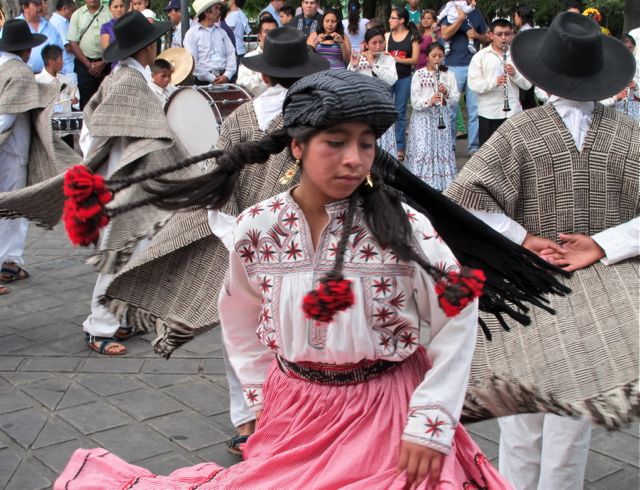
I begin with photos from last Saturday’s desfile of these fierce (and one not-so-fierce) looking guys from San Juan Colorado.

And, I will end this post with San Andrés Huaxpaltepec delegation.

With the crowds that line the parade route and the contingent of family, friends, and aides (providing props and costume repair, along with much-needed water) that accompany each delegation, it was hard to photograph, let alone video, the dancing along the way.  However, click HERE to watch a video of the La Mayordomía de San Andrés Huaxpaltepec from last Monday’s performance at the Guelaguetza Auditorium.  And, you can click HERE for a video I found of the Danza los Chareos of San Juan Colorado.


Read Full Post »

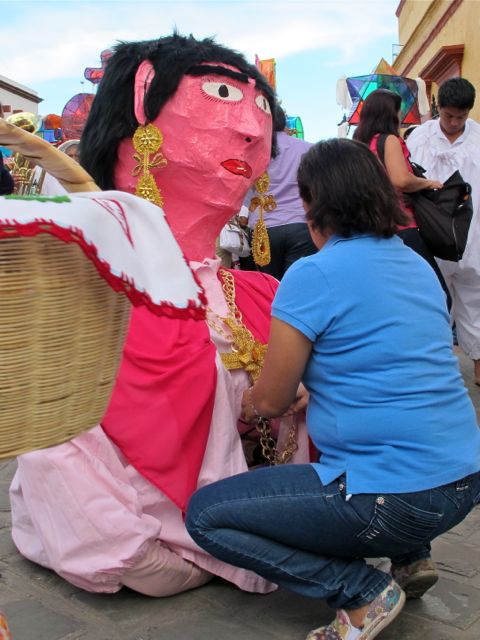
I love arriving early at the assembly site for the Guelaguetza desfile.  There is time to mingle with the delegations as parade participants gather.  Tourists, bloggers, and professionals aren’t the only ones taking photos…

Finishing touches are put on costumes and canastas.

Adjustments are made to sandals and feet are rested before beginning the 3 hour procession through the streets of the city.

We won’t ask what alteration she is making!

IMG_2213

More parade photos to come…


Read Full Post »

And so, Guelaguetza 2013 ended last night in an explosion of fireworks from Cerro del Fortín…

Not a bad view from Casita Colibrí!

Read Full Post »

Some of my closest friends have been (and continue to be) musicians.  And, one of the things I find so appealing about Oaxaca is that music is everywhere and all the time.  Marimbas are set up on sidewalks, accordions are almost ubiquitous, and free concerts occur weekly in the zócalo.  Music is honored and valued as an integral part of the culture — a birthright.

Each of the 8 regions of the state has its own distinctive “sones” and “jarabes” and they are tremendous source of pride.  Within a bar or two of Pinotepa,  Canción Mixteca, or any one of Oaxaca’s regional anthems, the clapping begins, tears may well up, and audiences of all ages begin singing the lyrics.  Thus, a major feature of the modern “Mondays on the Hill” that is Guelaguetza, is the performance of the music and dance of each of the regions.

And, so I give you, some of the musicians who played almost non-stop for 3 hours, while their delegations danced their way through the streets of Oaxaca city during the last two Saturday evening Guelaguetza desfiles (parades).

This slideshow requires JavaScript.

Here’s to the musicians, long may they play!


Read Full Post »

Remember my recent posts from Santa María Tlahuitoltepec up in the mountains of the Mixe?  They are one of the 13 delegations who will be dancing at this morning’s Guelaguetza performance on Cerro Fortín.

Dancers in action from Santa María Tlahuitoltepec

To watch today’s and next Monday’s 10 AM and 5PM performances, click HERE or HERE.   Enjoy!

Read Full Post »

Yesterday, we began the marathon than is Guelaguetza in Oaxaca.  First on the day’s agenda was a morning trip to Reyes Etla.

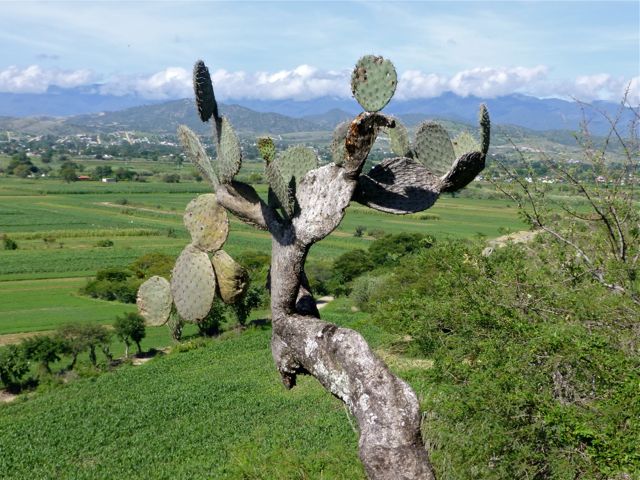
The Señor de las Peñas church sits atop at hill and views of the lush green fields (gracias, rainy season) and the mountains were breathtaking.
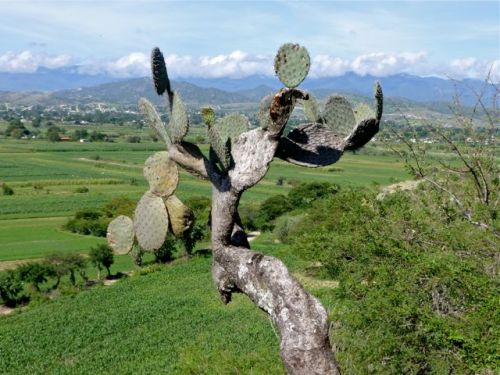
Cactus, farmland, mountains

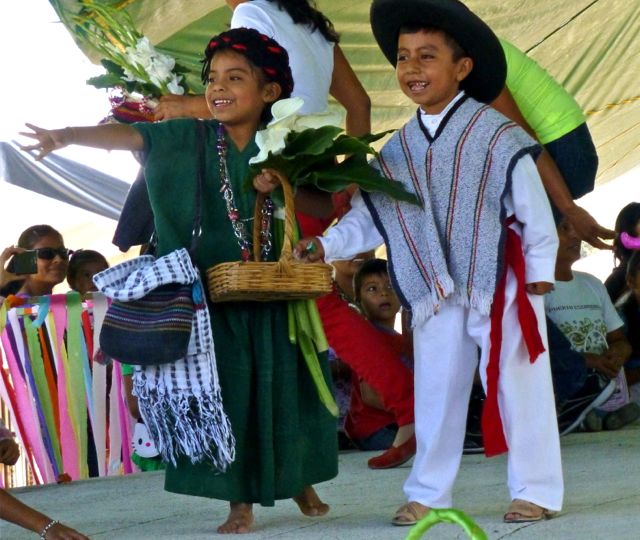
Impossibly adorable children danced and shared, in the spirit of Guelaguetza.
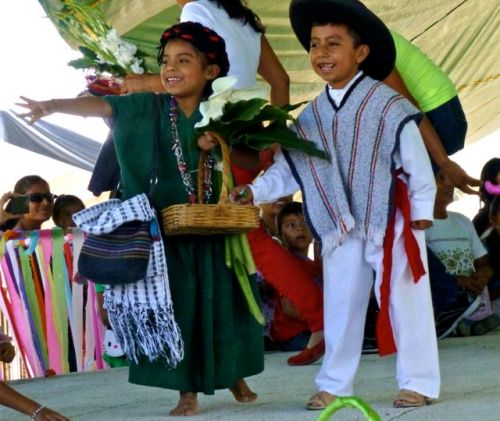
Boy and girl in traje throwing candy to audience

We were in the heartland of Oaxaca cheese country for the crowning of  Jimena Santiago Vasquez, as queen of the third Expo Feria de Queso y Quesillo.
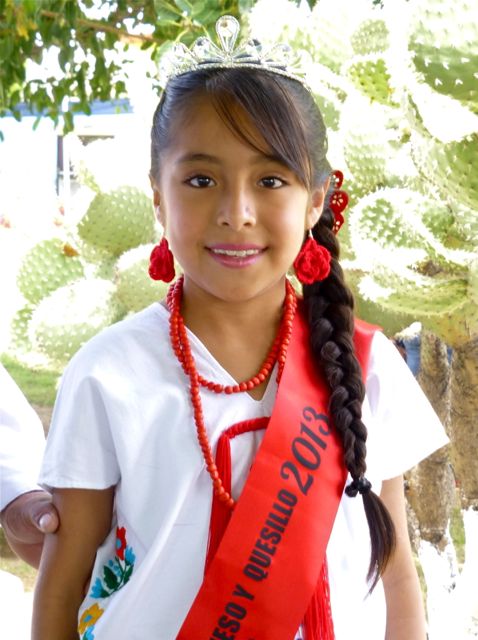
Girl with crown and red sash

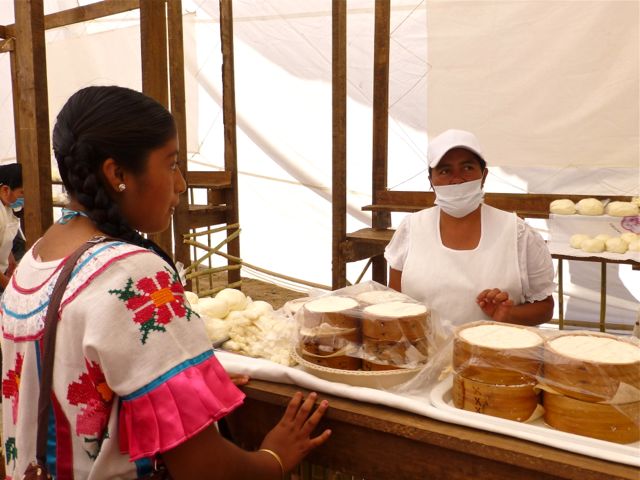
Did I say cheese?  Oh, yes — stalls and stalls of yummy cheese.  The fair runs through Monday and we will be back!

Woman selling cheese

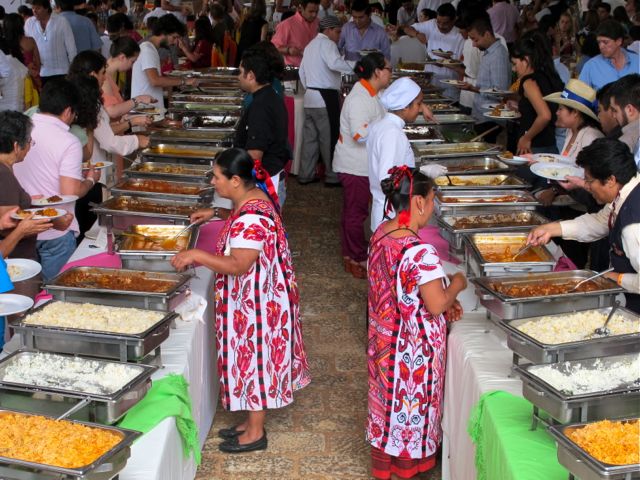
Next on our itinerary was a return to the city for a little (?) gluttony — the Festival de los 7 Moles opening banquet on the grounds of the Jardín Etnobotánico de Oaxaca.  Botanas Oaxaqueña (cheese, chicharrón, chiles rellenos), followed by Sopa de Fandango, 15 (not 7) Moles, 4 Tipos de Arroz, followed by a platter of pastries and scoops of Leche Quemada and Tuna nieves (sorbets).  Oh, and did I mention, cervesas and mezcal?
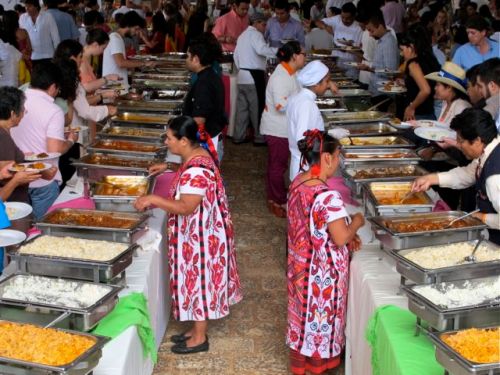
Lines of serving platters and people

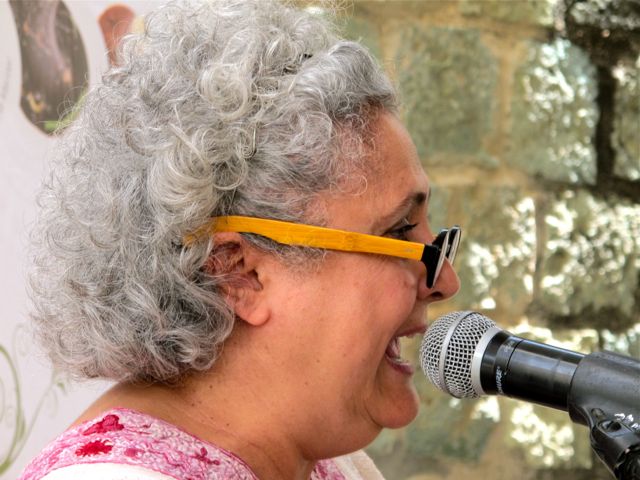
We even got a little culture, as author, Laura Esquivel (Like Water for Chocolate) spoke, though it was a little hard to hear her, with all the eating, drinking, and related conversations!
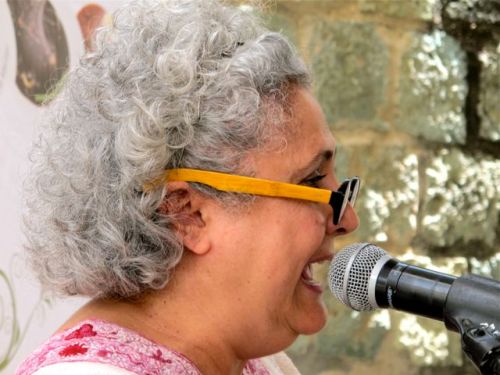
Profile of Laura Esquivel

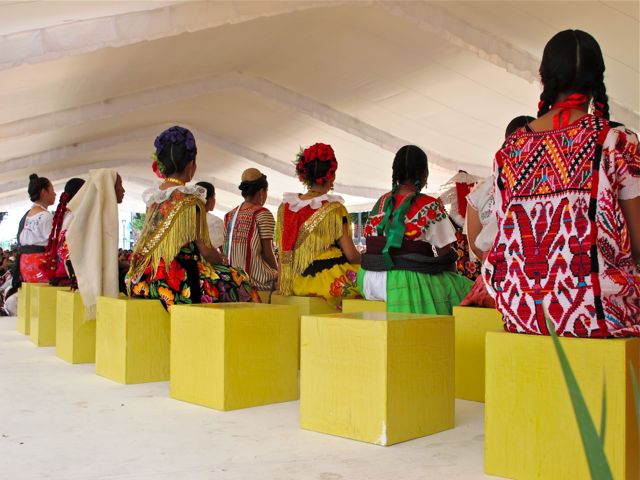
Moving rather slowly, we pushed back from the table and headed down to the Alameda (oh, it felt good to walk!) to take in the last stage of the Diosa Centéotl competition — the chosen “Goddess” presides over Guelaguetza.  However, the area surrounding the tented stage was a mass of people by the time we arrived and the best I could do was see the backs of the magnificent traje.  (See Chris’s blog for close-ups from the stage one competition.)  And, the winner is…  Dulce Yanet Grijalba Martínez, from the Zapotec community of San Pablo Villa de Mitla.
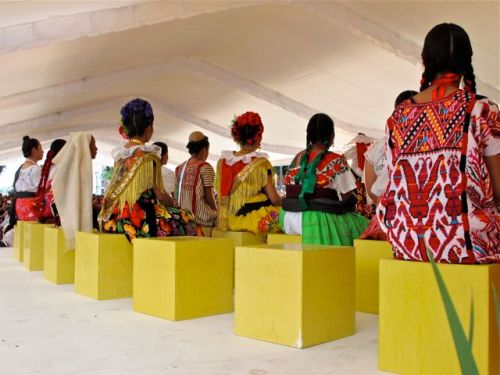
Backs of women sitting in traditional dress

After a brief siesta, I rendezvoused with some young friends and we walked over to the Plaza de la Danza for a free performance by Alejandra Robles, one of my favorite Oaxaqueña singers.  (For video from the last time I saw her, click HERE.)

Alejandra Robles

The night was still young for my young friends and they were off to get a nieve at Jardín Socrates.  I was off to bed, because I’d already had my day’s allowance of nieve AND we’ve only just begun!

Read Full Post »

Oaxaca’s annual Guelaguetza festival honoring the traditions of costume, dance, and sharing of the eight regions of the state of Oaxaca is less than a month away.  There will be competitions leading up to the choosing of Goddess Centeotl to preside over the festival and parades by the delegations through the city on the two Saturdays that precede the July 22 and 29 programs at the Guelaguetza Auditorium on Cerro Fortín.

There will official and alternative celebrations in the city and surrounding villages.  According to yesterday’s press conference, more than 70 events are scheduled and Lila Downs will be the official Guelaguetza 2013 ambassador.  Hmmm… I wonder what that means?  Surprise Lila Downs performances?  It’s Oaxaca, so you just never know!

To get everyone in the spirit, here’s a few photos from another of Oaxaca’s wonderful urban art covered walls.  It celebrates the heritage of Oaxaca and can be found at José López Alavez 1406, in the Xochimilco neighborhood of the city.

By the way, this past Sunday, San Francisco’s North Bay residents got an early and small flavor of Guelaguetza.  Oaxacan dances, dishes and costumes in Santa Rosa entertained over 1,000 spectators and, no doubt, the hearts of the Oaxaqueños participating and in the audience swelled with pride.  If I’d only known about it in advance, I would have gladly extricated myself from the complexities and minutiae of getting my grandparents’ house ready to sell and driven up there for a taste of Oaxaca.  They were even serving tlayudas!

Oh well, this time next month I will be happily back in Oaxaca and, no doubt, be exhausted, exhilarated, and pouring through hundreds of photos from the first week of Guelaguetza activities.

Read Full Post »

Today is Día de los Niños (Children’s Day) and it’s a big deal here.  Oaxaca began her celebrations days ago.  The 6th Festival of Children’s Story Telling opened on Saturday, yesterday an exibition of traditional toys (Colección Hanni Sager Juguete tradicional) had its inauguration at the Museo del Palacio, and Friday, the Guelaguetza Infantil calenda filled the streets from Santo Domingo to the Basilica de la Soledad.

As several bands played, the children from Oaxaca’s preschools wearing the traditional costumes from the 8 regions of the state of Oaxaca waited, posed, walked, danced, and threw candy to the appreciative crowds gathered on the sidewalks along the ten-block long route.  (Note, some of the little girls already practicing holding canastas (baskets) on their heads!)

This slideshow requires JavaScript.

Parents and teachers, many also wearing traje from the Cañada, Costa, Istmo, Mixteca, Papaloapan, Sierra Norte, Sierra Sur, and the Valles Centrales regions, proudly walked alongside the children.  Vive Oaxaca concluded their article,

With such events from the early years of life are taught to love our Oaxacan culture, traditions, music and preserve the best legacy we have: our roots. Congratulations to the teachers and parent to correctly perform with great momentum this holiday culture.  [Google translation]

Read Full Post »

On chairs in Reyes Etla.

On a chair: sheet music "Zapateando Istmeño xxx" for tuba

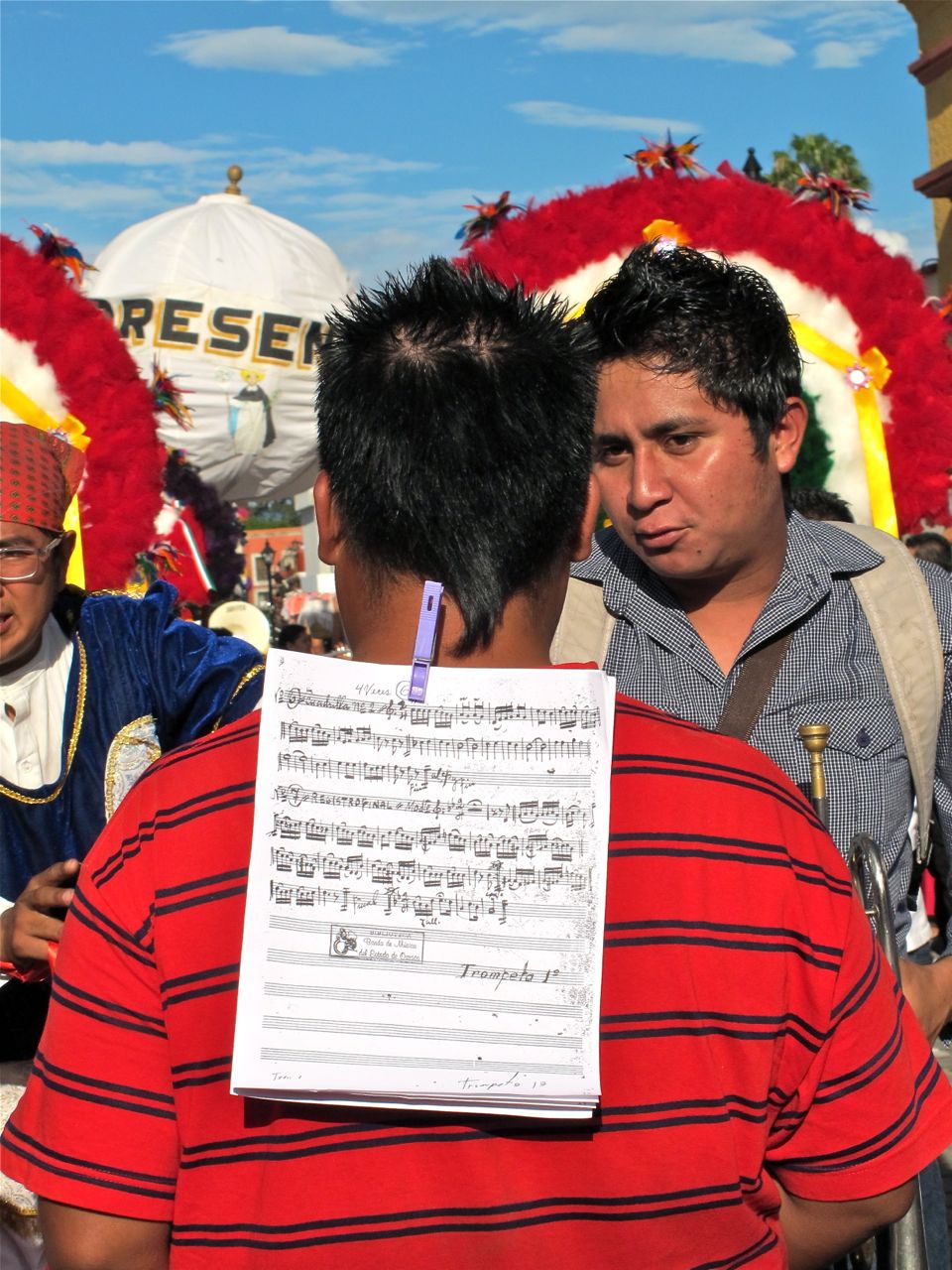
On people’s backs in the city.
"Cuadrilla no. 2" sheet music clipped on the back of a man wearing a red and black striped shirt

Wherever… especially during Guelaguetza!

Read Full Post »

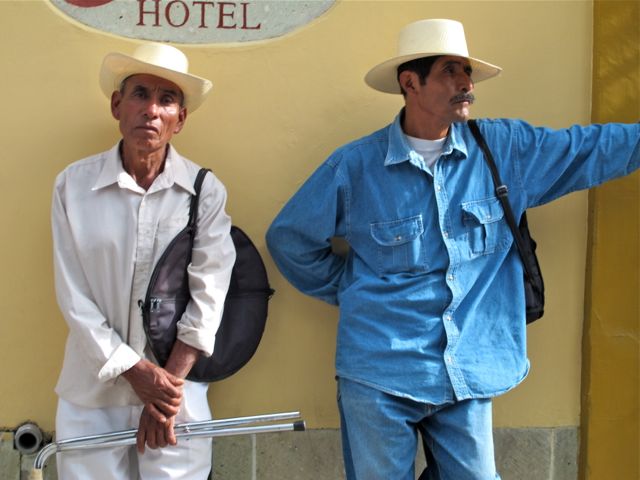
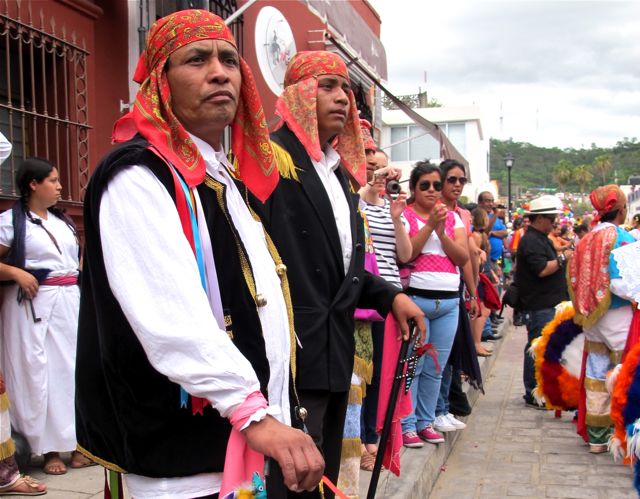
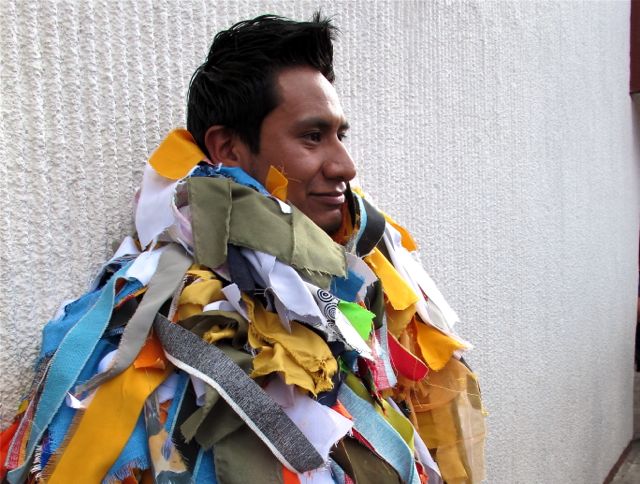
Waiting is a way of life down here and we all do it in our own way.  Right now Oaxaca is waiting for Tropical Storm Ernesto to “break on through to the other side.”  These guys were waiting to “get in step,” before the parade passes by.

Two men leaning against a wall

Two guys wearing red bandanas  on their head in foreground and crowd in background

Guy wearing costume leaning against wall

A peso for his thoughts…

(Mixing The Doors and Barbra Streisand lyrics — what was I thinking???)


Read Full Post »

I’ve got to admit that up until yesterday, I was suffering from Guelaguetza burn-out.  In fact, I still have 1000+ photos that need to be weeded down to a more manageable number.

However, then yesterday happened — “Una Guelaguetza muy especial” presented by the very special people of Los Angeles de Luzy.   Sixteen young people with Down’s Syndrome, from the Yucatan, Campeche, and Oaxaca danced the traditional dances of the eight regions of Oaxaca in the Plaza de la Danza.

This slideshow requires JavaScript.

Part of Oaxaca’s first Down’s Syndrome festival, it was an inspiring, moving, and incredibly joyful experience — and I wouldn’t have missed it for the world.  ¡Muchisimas gracias a Los Angeles de Luzy!

Read Full Post »

Oh those beautiful braids of many of the dancers in Guelaguetza!  How do they do it?  In Reyes Etla, trapped between a yellow caution tape barrier and the folding chairs of the Tuxtepec delegation (the pineapple dancers), the answer was revealed…

Number 1:  You can’t do it yourself!

Woman standing braiding a hair extension into a seated woman's hair.

Number 2:  Hair extensions!  (Who knew???)

Close-up of hands braiding ribbons into hair

Number 3:  Practiced hands.

Hands braiding ribbons into hair.

Number 4:  Patience.

Hands braiding ribbons into hair.

But, it’s well worth the effort!

Hands finishing long braid, with red and blue ribbons, that extends beyond top of chair.

Read Full Post »

The textiles of Oaxaca are currently on center stage, both literally and figuratively, during these 10 days of Guelaguetza festivities.  And perhaps, besides drawing in much-needed tourist pesos, the Guelaguetza plays an important role in the appreciation and preservation of Oaxaca’s textile traditions.

Delegation from San Andrés Huaxpaltepec, District of Jamiltepec, in the Costa region of the state of Oaxaca.

However, the textile traditions of Lebanon have not fared so well.  According to the article, The End of the silk road, by Ana Marie Lucas and posted to Now Lebanon, silk production, which dates back to the Middle Ages, is on death’s doorstep.  Only two artisanal workshops remaining today.  However, along with the Italian Embassy, the Mexican Embassy, Alfredo Harp Helú Foundation, and Textile Museum of Oaxaca are coming to the rescue.

“We wanted to share our experience with the Lebanese,” Mexican Ambassador Jorge Alvarez Fuentes told NOW Extra. “When I saw the House of the Artisan closed and in need of more attention I thought this was the perfect place to exhibit both Mexican and Lebanese items,” he explained.

“Aside from the exhibition, we wanted to organize two conferences and a workshop of how to dye the silk with natural pigments. This way many people will be able to see how the Phoenicians could extract the purple dye from the Murex shell,” he added.

According to Héctor Meneses, head of the Textiles Museum in Oaxaca, there are surprising similarities between the Lebanese and Mexican traditions in terms of pigment extraction. Mexicans extracted the red dye from a species of snail, very similar to the purple dye extracted by the Phoenicians from the Murex shell. “The difference is that in Mexico, this process is still alive and it’s being used,” he said during a conference.  [Read full article HERE]

FYI:   Alfredo Harp Helú is a Mexican businessman who, like his cousin Carlos Slim Helú (world’s richest man), is of Lebanese extraction.  Harp Helú maintains a residence in Oaxaca and, besides his foundation funding the Textile Museum, he and his foundation are involved in several other philanthropic projects in the state of Oaxaca.

h/t to Margie Barclay for the article.

Read Full Post »

Live and direct from Oaxaca’s Guelaguetza Auditorium; see what all the fuss is about!  Watch the July 23 and 30 Guelaguetza performances, along with the July 29 production of the Legend of Donají, stream live on the internet at:

Night shot of colored smoke billowing from Guelaguetza Auditorium.

View from the terrace…  The Guelaguetza Auditorium during last night’s Legend of Donají show.

Read Full Post »

A slideshow from yesterday’s Guelaguetza Parade of Delegations.

This slideshow requires JavaScript.

There is so much going on!

Read Full Post »

« Newer Posts - Older Posts »