Feeds:
Posts
Comments

Posts Tagged ‘flowers’

As we have done in previous years, we returned to San Antonino Castillo Velasco on November 1 to watch families begin the preparation of the graves of their loved ones for Día de los Muertos.  In a process unique to this pueblo known for the cultivation of flowers, family members mix the area’s very fine dirt with water; spread it on the top and sides of the grave; smooth it with a trowel, as if they were getting ready to lay tile; using a nail, they outline designs and religious imagery into the mud coating; and then use flowers (fresh and dried), to “paint” the scene.  

This year’s late rainy season brought torrential rains on November 2 and it must have interrupted the decorating, because when we returned on November 3, at the same time as usual, there was still much work to be done.  However, no one seemed the least perturbed; peace, tranquility, and quiet joy prevailed and, as always, it enveloped us.

(Music: Marimba band performing, “Díos Nunca Muere,” written by Oaxaqueño composer and violinist Macedonio Alcalá.)
Read Full Post »

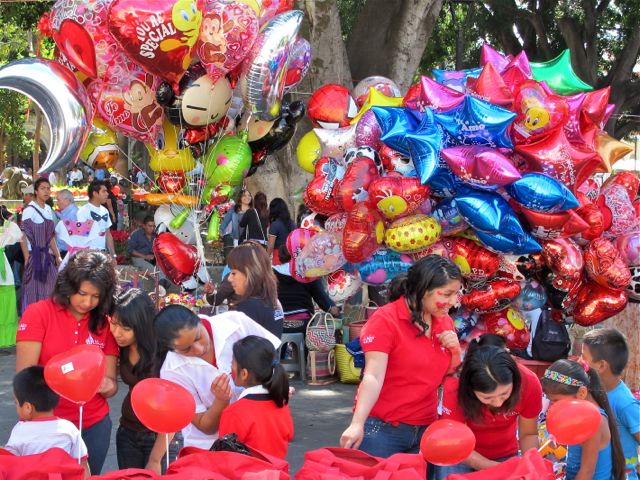
Got your hearts?  Yes!

Bouquets of heart shaped balloons

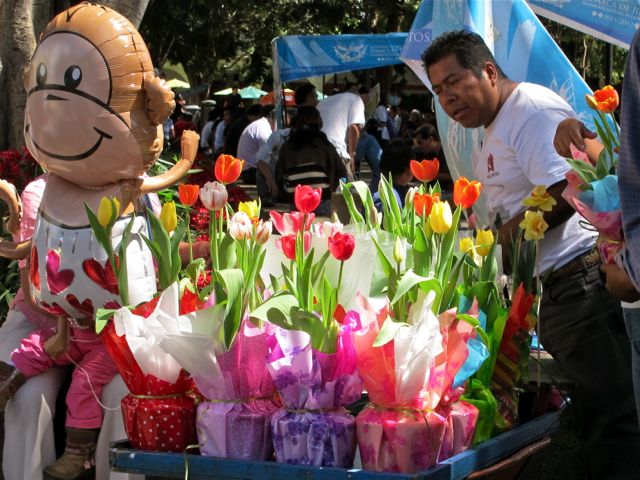
Got your flowers?  Yes!

IMG_2263

Got your candy?  Yes!

Candy display on counter

¡Feliz Día del Amor y la Amistad!  (Happy day of love and friendship!)

(ps)  To expand your linguistic skills, learn Frases de amor y amistad en 7 lenguas indígenas mexicanas — including Mixe, Mixteco, and Zapoteco.

Read Full Post »

Life and death is a family affair…

This slideshow requires JavaScript.

November 1 and 3, 2012 in the panteón municipal, San Antonino Castillo Velasco.

Read Full Post »

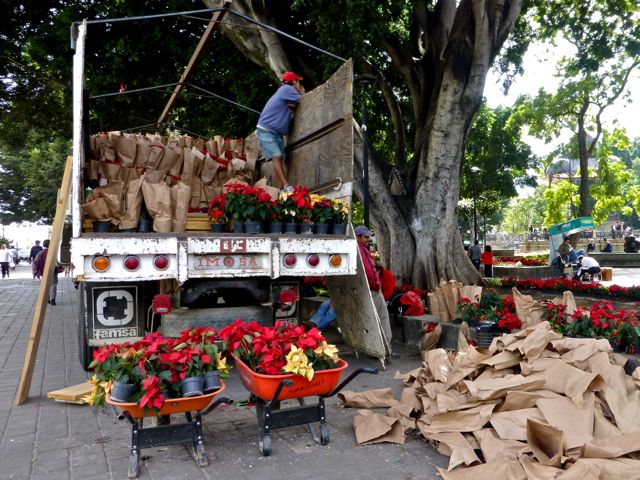
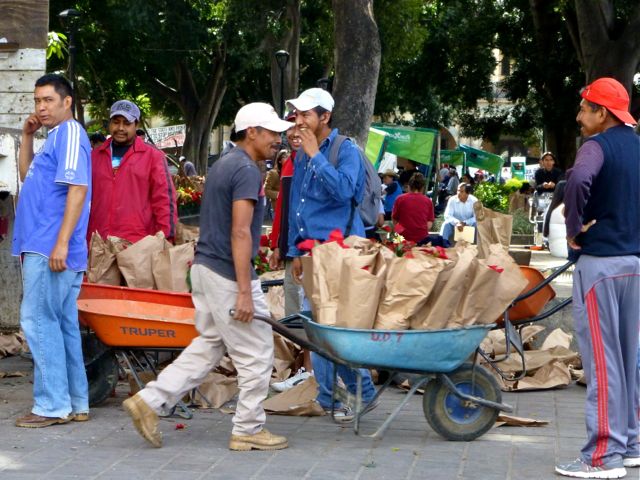
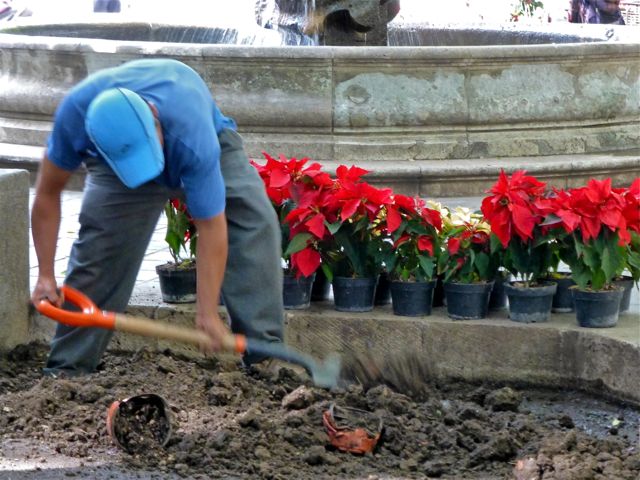
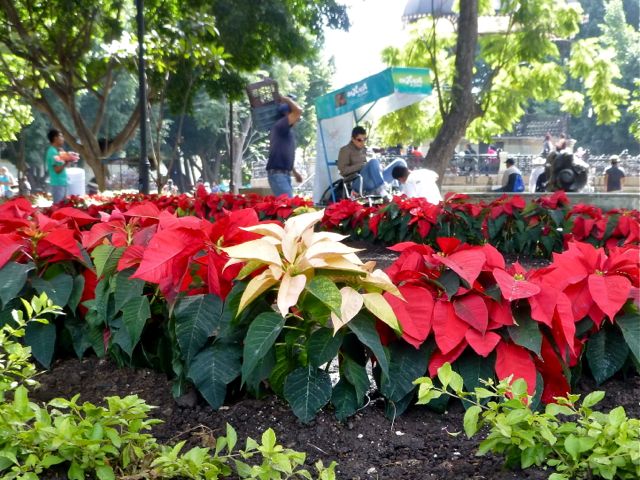
Today, the truck arrived, the wheelbarrows were loaded, and the gardening crew began filling the flower beds of Oaxaca’s zócalo…

Truck filled with poinsettias

Workers with wheelbarrows filled with poinsettias

Worker digging up flower bed, with poinsettias in pots in background

Mass of red and one white poinsettias in flower bed.

Navidad is coming to Oaxaca!

Read Full Post »

Fifteen hundred years may have passed since Monte Albán was in full bloom as the center of Zapotec civilization.  However, the flowering continues…

This slideshow requires JavaScript.

Monte Albán on an early October morning.

Read Full Post »

Full moon hiding; overcast tonight.   Sheesh, I’ve been cold all day!  However, my Frangipani is blooming…

Two pink frangipani flowers

Read Full Post »

Today is Thanksgiving in los Estados Unidos de América… and besides my wonderful family and friends, I am so grateful to see and experience places like San Antonino Castillo Velasco during los Días de Muertos.

This slideshow requires JavaScript.

¡Feliz Acción de Gracias a todos!

Read Full Post »

San Antonino Castillo Velasco, a Zapotec community near Ocotlán, is a village known for its flowers.  They are, no doubt, the inspiration for beautifully embroidered linens and clothing sold in the mercados and found in museum collections.  And, a specialty is the “flor inmortal” (immortal flower), so named because, even when dried, it retains its brilliant colors.  They are used to create intricately designed figures on display December 23 in the city of Oaxaca, during Noche de Rábanos and to decorate the graves of  loved ones during Días de Muertos in San Antonino.

This slideshow requires JavaScript.

As I’ve previously mentioned, each village seems to have its own unique traditions for the Days of the Dead.  Villagers here mix the area’s very fine dirt with water, cover the graves, use a trowel to smooth it, outline designs and religious imagery into the dried coating, and then use flowers (fresh and dried), to paint the scene.  Entire families are involved, young and old, and the atmosphere is filled with joy, purpose, and most of all… Love.

For a very special moment, that is a metaphor the two days spent at San Antonino, see Chris’s post, Moments make a life..

Read Full Post »

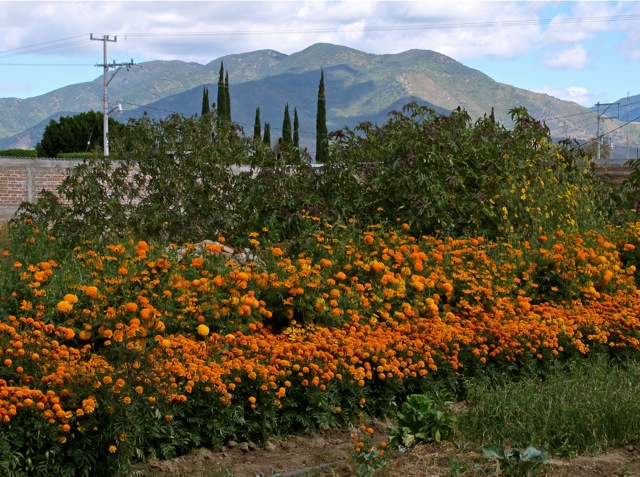
San Antonino Castillo Velasco, to be precise. Young and old converged on the municipal cemetery to decorate the graves with the magenta of cockscomb and yellow to orange to rust of marigolds (cempazúchil or zempoalxochitl) grown in nearby fields.

Field of marigolds with mountains in background

They came by car and truck…

Blue pick-up truck piled high with empty crates and baskets

By horse (note wooden saddle)…

Horse with saddle tied to a tree

By pedal-powered cart…

Green cart powered by a bicycle

By horse-powered cart.

Young girl riding in a horse pulled cart.

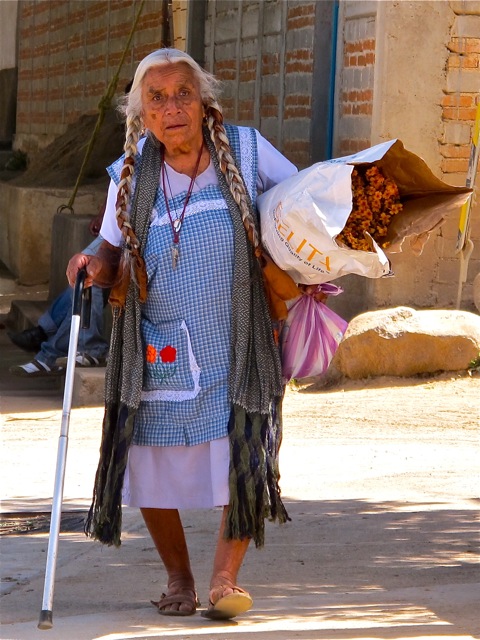
And, on foot…

Elderly woman walking with cane and carrying a bundle of flowers

Laughter, artistry, and pride followed.  Stay tuned for images of their meticulous labors of love.

Read Full Post »

6 AM this morning, I awoke to fireworks and riotously clanging church bells coming from the cathedral, calling my attention to the October 23rd annual fiesta of Señor del Rayo.  Like Guelaguetza, Noche de Rabanós (Night of the Radishes), and Día de la Samaritana (Good Samaritan Day), it is an “only in Oaxaca” celebration.

This image of Christ on the Cross was brought to Oaxaca during the 16th century.  It was placed in the temple of San Juan de Dios, a church which had adobe walls and a straw (or possibly wood) roof.  Legend has it that lightning struck the church and everything was destroyed, save for this statue.  Un milagro!

The statue became known as Señor del Rayo (Lord of Lightning), eventually was moved to his own chapel in the newly built cathedral, and has been much venerated ever since.  However, on October 21, in anticipation of his special day, the statue is moved to the main altar of the cathedral, the cathedral is filled with lilies (the scent “breathtaking”), and the faithful flock to pray before Señor del Rayo.

This slideshow requires JavaScript.

Flowers are daily sprayed with water, to keep them fresh… BUT, as the signs say, please do not uproot and carry them away.

Read Full Post »

« Newer Posts