Palm Sunday also brought us to the village of Santiago Apóstol and one of my favorite painted churches.
This beautiful facade was hidden behind a stage, presumably set up for outdoor masses during Semana Santa.
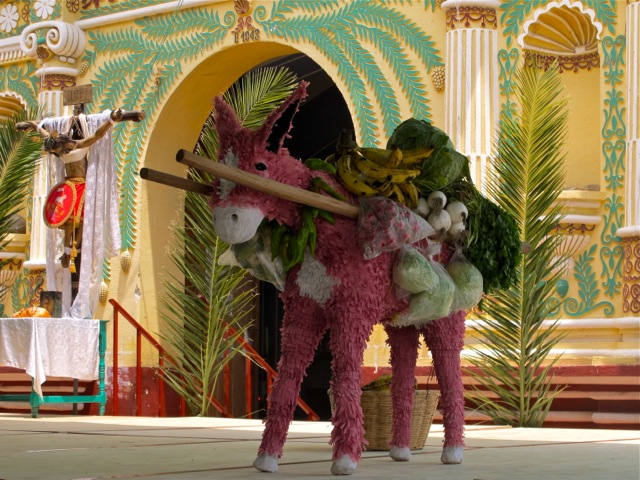
We weren’t the only ones who negotiated the dusty back roads out of San Antonino Castillo Velasco; Señor del Burrito was already there when we arrived. Apparently, he knew a shortcut!
Inside the empty church (pews had been moved outside), amidst the smoky incense filled haze, the ethereal voices of these women transported us…
This wasn’t the first time we had been enchanted in Santiago Apóstol. During Días de muertos, the entire Panteón is whitewashed and filled with an explosion of red, orange, yellow, and magenta flowers.
Yesterday, I spent another magical day with friends in San Antonino Castillo Velasco (about 23 miles/1 hour from the the city). It was Domingo de Palmas (Palm Sunday) and San Antonino celebrates in its own unique, warm, and welcoming way.
Townspeople gather in the cemetery to decorate the “Señor del Burrito” with fruit, vegetables, flowers, and everything they sell or grow during the year. In addition, livestock (goats, chickens, pigs, etc.), more foodstuffs, flowers, etc. are gathered and priced. The pastor of the parish church arrives to bless the “Lord of the Little Burro” and offerings. Palm crosses are distributed, all are invited to help carry the offerings to the church, 10-12 men hoist the burro (now laden up to his neck and weighing who knows what!), and a procession to the church commences, lead by a fast-tempo drum beat and punctuated by shouts warning the men carrying “Señor del Burrito” of upcoming topes (speed bumps) and telephone wires, which must be navigated.
This slideshow requires JavaScript.
At the church, “Señor del Burrito” has an honored place in the courtyard and the offerings are gathered and arranged. Many then attend an hour-long mass inside the church, while others partake in yummy amarillo and pork empanadas, taste mezcal, and browse the wares of the artisan booths. By the way, at least two of the “maestros” from the new, previously mentioned, book, Grandes Maestros del Arte Popular de Oaxaca were present: Familia García Mendoza (ceramics) and Antonina Cornelio, who makes the exquisitely embroidered clothing typical of San Antonino Castillo Velasco (and seen in one or two of the photos above). Following the mass, the offerings are sold, with the proceeds going to an orphanage in the village.
Muchisimas gracias to the people of San Antonino Castillo Velasco for being so gracious and allowing us to share this special day with them.
Mazunte was the first beach on Oaxaca’s coast I visited. The beach is stunningly beautiful and uncrowded and accommodations lean toward the small and environmentally conscious.
In addition to the appeal of the warm clear waters of its beach and digging your feet in the sand as you dine on fresh fish tacos, Mazunte is home to the Natural Cosmetics Cooperative, established by Anita Roddick, founder of the Body Shop. The cooperative’s products (soaps, lotions, oils, mosquito repellent, etc.) are available in the city of Oaxaca at the weekly Friday/Saturday Organic Market in the plaza of Santo Tomás in the Xochimilco neighborhood.
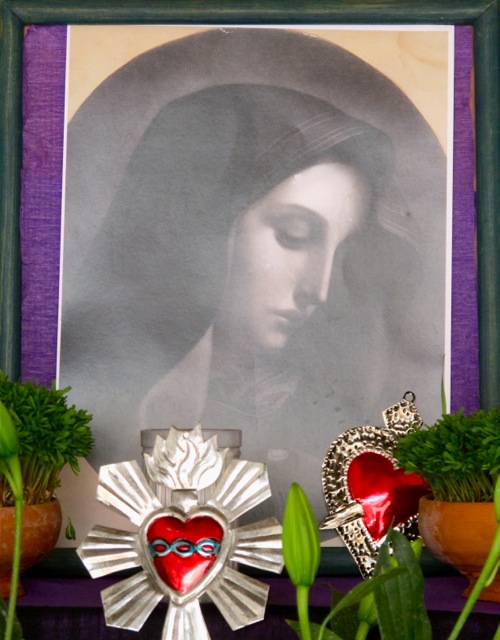
Today, the 6th Friday of Lent, is El Día de la Virgen de Dolores, the Virgin of Sorrows.
Altars have been set-up in courtyards and businesses around town, including this one at Hotel Las Mariposas (butterflies).
It commemorates the pain suffered by the Virgin Mary on the death of her son.
By the way, note the “chia pets.” This is where the US entrepreneur originally got the idea in the late 1970s for the terracotta animal figurines planted with Salvia Hispanica.
Tonight, I’m headed to a special Día de la Virgen de Dolores program, including a concert of sacred music performed by the Coro de la Ciudad (chorus of the city of Oaxaca), at the Templo del Carmen Bajo.
(ps) Ooops! Apparently, the concert is tomorrow night.
As someone who spent most of her life in the San Francisco Bay Area and has experienced a fair share of earthquakes, including the deadly Loma Prieta quake in 1989, I think the Mexican government seems to take warning it’s population more seriously — placing a higher value on preventing the loss of life, in the case of earthquakes, than the powers-that-be in el Norte.
Though I didn’t hear the early warning siren in Oaxaca for Tuesday’s 7.4 earthquake (or, perhaps I wasn’t tuned in to what it was), I did hear it for a couple of aftershocks.
By the way, I arrived in Chiapas yesterday morning, and the talk is about the highly publicized drill that was conducted statewide, with sirens blaring, only minutes before our 7.4 terremoto hit.
Early alerts gave people time to go to safe areas before large quake hit By John Upton, Matt Smith on March 22, 2012 – 5:43 p.m. PDT Alicia Montiel Rodriguez was in an office building in southern Mexico City Tuesday when alarms began to sound, piercing the air with beeping tones and recorded messages…
With all the excitement about yesterday’s earthquake, I didn’t even notice the south wing of the infamous Guelaguetza auditorium velaria (cover) had been removed.
According to an article in yesterday’s Noticias, the central cover will be reinforced and remain through July’s annual Guelaguetza performances. After that??? The fate of the velaria is up in the air. 😉
…under my feet. Well, actually I didn’t feel the 7.4 terremoto (earthquake) about noon today. I heard it! I was walking up the Álcala and the windows on one of the university buildings started rattling and people began pouring into the streets, murmuring “un terremoto, un terremoto!”
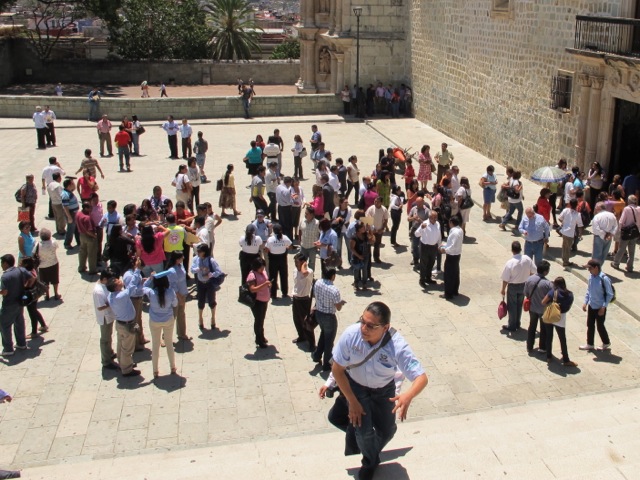
The above photo was taken from above the Plaza de la Danza, outside the Palacio Municipal, about a half an hour after the initial shake and shortly before sirens went off and a 5.0 aftershock struck — which I also didn’t feel!
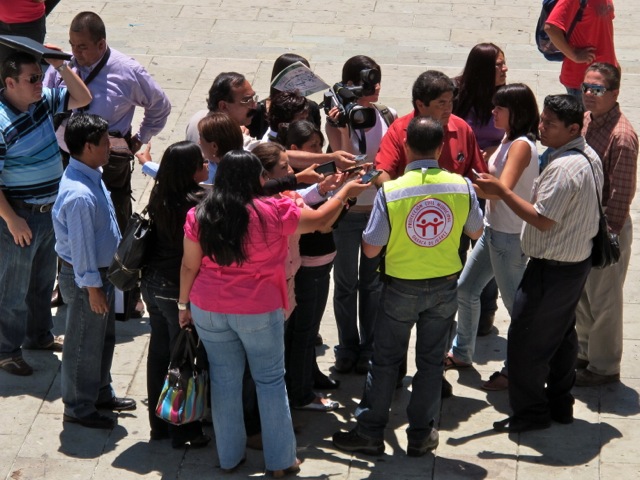
I continued on with my shopping and when I passed by the Palacio Municipal again, the media was all over the place, and more press conferences out on the sidewalk were being conducted. The fellow above is from the Proteccíon Civil Municipal of Oaxaca. The fellow below was speaking about the schools.
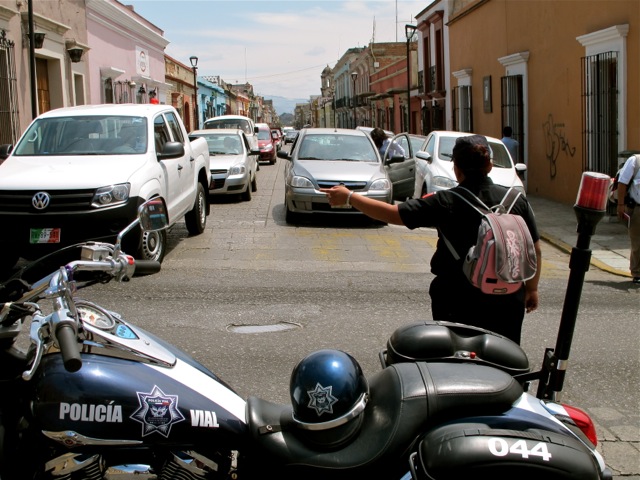
Though there is concern for the rural villages closer to the epicenter, currently all is well in the city. And one of the members of the municipal police force assured me the daughter of “my” president was fine.
Last night, if she is still in town, Malia got to experience one of Oaxaca’s dramatic rain storms. The circulation of high pressure over the Southeast of the country, interacting with moisture from both the Gulf of Mexico and the Pacific Ocean, resulted in a 1-2 hour (I lost track of time) torrential downpour and Mother Nature’s own spectacular sound and light show.
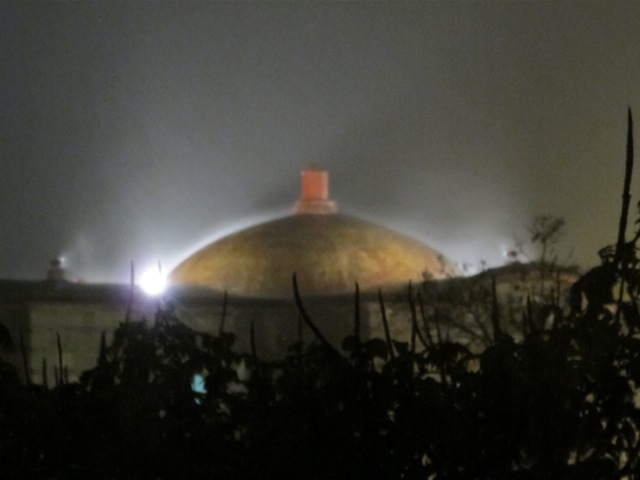
Glowing Templo de San José last night, as sheets of rain bounced off the dome.
This was a welcome relief, as we are in the middle of the dry season, and my rooftop garden is extremely happy. However, along with the usual flooding and sporadic power outages, newspapers are reporting 10 homes were damaged by the heavy winds and rain in Ocotlán and a Jacaranda tree fell on an unoccupied parked car in the city.
Sheesh, what is it about my friend, L??? Last year she arrived for her first visit to Oaxaca on the same day Mexican president Felipe Calderón was in town. This year, she is arriving Tuesday night and… guess who is in town?
Malia Obama, older daughter of U.S. president Barack Obama, is spending spring break here! Along with 12 friends and a 25 person security detail, she arrived Friday night, on the regular United/Continental Houston to Oaxaca flight, that most of the gringos who live here are very familiar with.
photo from Zócalo Saltillo
So that’s why all the federales, various other police forces, and people with cameras on the Álcala, yesterday…
According to reports, in addition to sights around the city, the group will see the famous El Tule (tree), the archaeological sites of Mitla and Monte Alban, the black pottery village of San Bartolo Coyotepec, and the wood carving village of San Martín Tilcajete.
This is exceptionally good news for Oaxaca and I’m not the only gringo blogger living here to be posting this news; most of us are doing it for the same reason — to let our readers know, Oaxaca is SAFE. So, come on down!!!
David Rovics singing “Saint Patrick’s Battalion,” a song celebrating the Irish who deserted and fought alongside the Mexican army against the United States during the Mexican American War, 1846-1848.
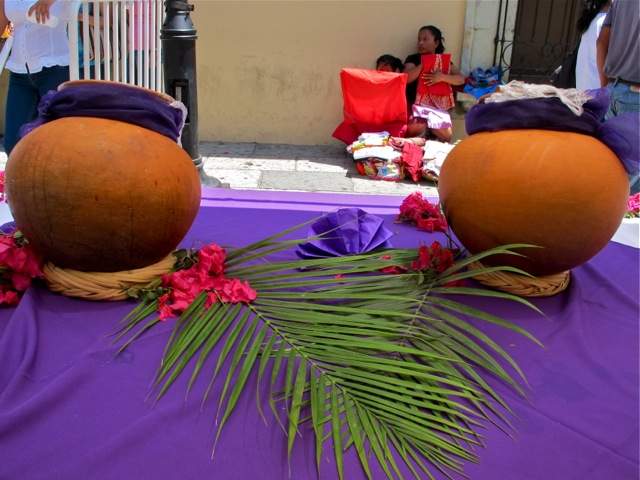
…and, Agua de Jamaica, Horchata, and Chilacayota to drink! Yesterday, the 4th Friday of Lent, was Día de la Samaritana (Good Samaritan Day), an only in Oaxaca tradition.
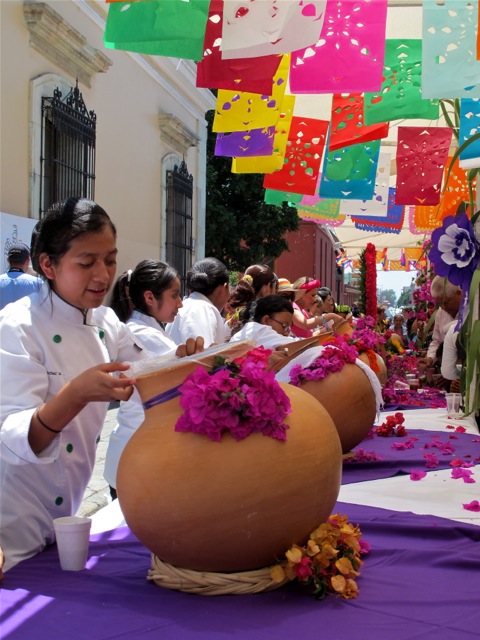
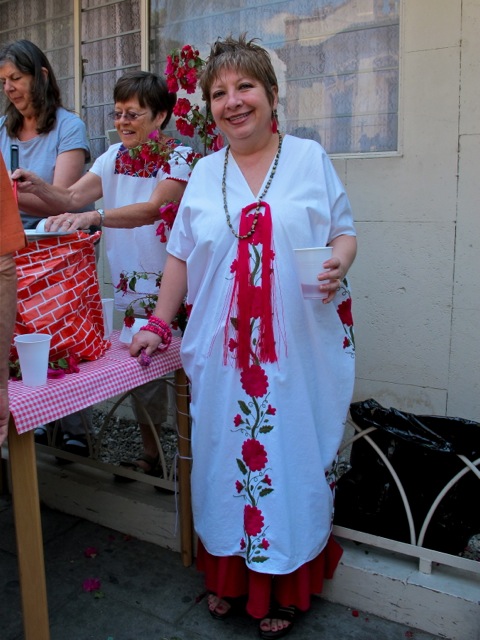
Inspired by the Biblical story, in the Book of John, of the woman at the well who offered water to Jesus, long tables and small stands laden with massive containers and plastic cups are set up on sidewalks throughout the city by schools, churches, and businesses.
These “water stations” are decorated in purple, the color of Lent, symbolizing penance and royalty.
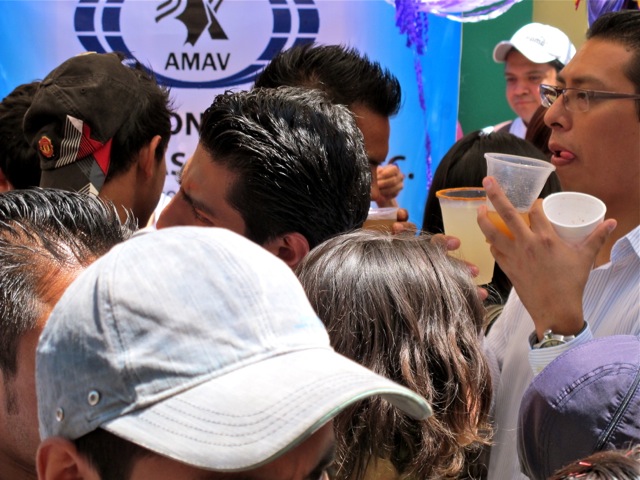
Crowds rapidly gather and wait to be served the agua of their choice and, despite hours of standing, ladling, and replenishing, all are served with a gracious smile and genuine joy.
By early afternoon the Alcalá was a sea of people.
This is definitely NOT a made for the tourist event.
This is Oaxaqueños practicing the sharing and hospitality that informs much of their culture.

















 Mexican Peso Converter

 View From Casita Colibrí