Feeds:
Posts
Comments

She’s baaack…

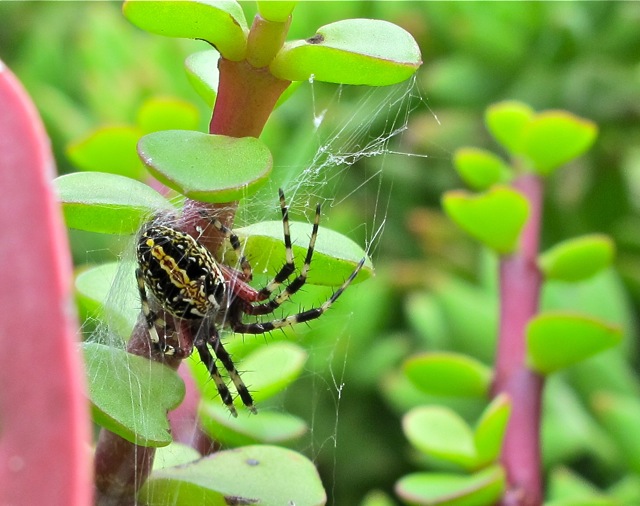
Argiope’s neighbor (of Orb Weavers blog post fame) has returned! Two days ago I spotted the Neoscona oaxacensis (Ms Oaxaca, to her nearest and dearest) nestled among the leaves of a succulent in the pot next to her original home. However, no large round insect catching web was seen.
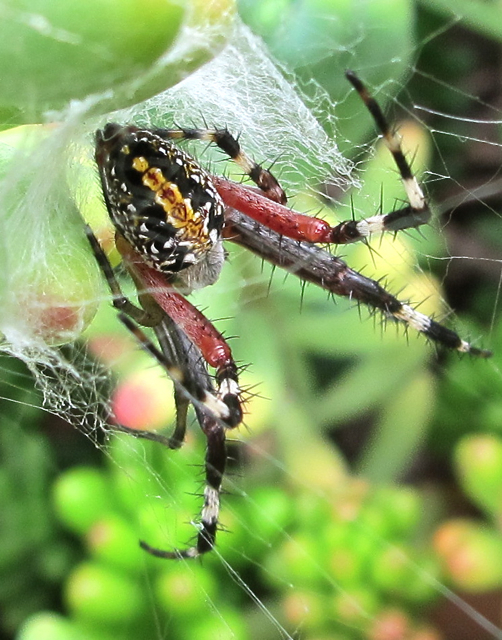
Neoscona oaxacensis spider nestled in the leaves of a succulent

Apparently, last night Ms Oaxaca must have stayed up pretty late. This morning, when I came out to say, “buenos días,” I found her happily sitting in the middle of a brand new web.

Neoscona oaxacensis spider in the middle of her web.

According to SpidCat, the range of the Neoscona oaxacensis runs from the USA, down to Peru and the Galapagos Islands. They are not only beautiful and harmless, they keep the flying insect population down. So, if you’re lucky enough to have one in your garden, leave her be. If you don’t want to take my word for it, there was the study published in the California Avocado Society Yearbook (1980) that concluded,

…the significance of the orb weaving Neoscona in avocado orchards is probably not that they prevent dramatic population increases in the pest population or control the pests through the year. Instead, the presence of spiders, even in years of low pest populations, may dampen the increases in pest species during the later months of the season and serve as stabilizing agents to restrain the pest outbreaks during the interval between pest population increases and the numerical response of more specific parasites.

Anything that is good for avocados, is okay by me!

(ps) And now for something completely different… The answers to the Name that film quiz are:

  • Birds of America = Vecinos y enemigos
  • Brokeback Mountain = Secreto en la montaña
  • Easy Virtue = Buenas costumbres
  • Midnight Sting = El golpe perfecto
  • People I know = Noche del crimen
  • Tenderness = Asesino intimo
  • That Evening Sun = Una historia de traicion
  • Up in the Air = Amor sin escalas

Sorry, no prizes… just this bonus bizarre title translation my Spanish teacher contributed: Mrs. Doubtfire = Papá por siempre. Definitely a case of, lost in translation!!!

Name that film…

Librarians, especially at the reference desk, are often called upon to be detectives.  However, sleuthing goes on behind the scenes, as well.  Lately, I’ve been cataloging DVDs at the Oaxaca Lending Library.  While most of the films are from el norte, they have been purchased in Mexico and thus have been given Spanish language titles.

Can you match these titles with the DVD jackets below?

  • Amor sin escalas
  • Asesino intimo
  • Buenas costumbres
  • El golpe perfecto
  • Una historia de traicion
  • Noche del crimen
  • Vecinos y enemigos
  • Secreto en la montaña

Answers will be revealed at the bottom of the next blog posting.

Ahhh, the exuberance of youth!

What a difference 5 days make…

Early Wednesday evening, the unmistakable sounds of a desfile replaced the usual background noise of commute traffic.  Bands (yes, more than one), cheers, and cohetes (all bang, no bling fireworks) got louder and louder.  I had to come down off the rooftop to see what was happening.

The energy, enthusiasm, creativity, and laughter of thousands of young people filled the street, brightened, what had been a gray day, and provided a stark contrast to the serious military pomp of the Independence Day parade only 5 days before.

This slideshow requires JavaScript.

The occasion was the 30th anniversary of the Colegio de Bachilleres del Estado de Oaxaca (COBAO), an academically rigorous and successful high school system in the state.  In thirty years, this public school has grown from a single campus with 400 students to 64 campuses educating 45,000 students.

Students, faculty, alumni, and dignitaries gathered in the Plaza de la Danza for presentations and speeches.  According to Noticias, it was noted that the event coincided with the approval of two amendments to the Mexican constitution making secondary education mandatory, beginning next year.  Naturally, the event concluded with the requisite fireworks display, which I happily enjoyed from the terrace!

(ps)  Alvin Starkman has written an article in English, Oaxaca Public School Education Targets Student Success: COBAO, about a young girl, from a small village and family of potters, who was recently accepted into COBAO.

Orb weavers

Clothing, tablecloths, and rugs aren’t the only things being woven in Oaxaca.  The terrace has a new resident, an orb weaver spider (family Araneidae).  I think, because of the stabilimentum (the white zigzags on the web), she is in the genus, Argiope.

Orb weaver spider on web in Stalpelia gigantea.

She had a larger orb weaving neighbor in the pot next door…

Alas, after a couple of days, the neighbor disappeared and her carefully crafted web fell into disrepair.  However, that left more food for Argiope.

Orb weaver spider on web with wrapped up green bottle fly

Apparently, green bottle flies are a favorite, because this is one of several she caught in a single day.  She’s chosen the perfect site for her home — in the garden’s previously blogged about, Stinky plant, attracting flies (aka, Stalpelia gigantea).

201 years of independence

On the morning of September 16, the sidewalks of Trujano, leading to Oaxaca’s Zócalo, were lined with people.  Traffic was blocked on Trujano and many of the side streets, as contingents of soldiers, state police, municipal police, transit police, fire fighters (bomberos), paramedics, schools, and charros gathered to participate in the desfile cívico militar (civic and military parade) marking 201 years of independence from Spain.

This slideshow requires JavaScript.

Like most patriotic parades throughout the world, the military component dominated the civic.  And here, even the school contingents march in military fashion.  The use of Mexico’s military is controversial, not to mention the roles played by the state and municipal police in Oaxaca.  Onlookers clapped for various contingents, but I didn’t catch the subtleties of support, other than the big hand the bomberos received.

This was the other side of the green, white, and red fervor, and I’ve spent a lot of time contemplating what I thought of the parade and what I wanted to say.  However, as a guest in this country, I’m going to let the photographs speak and readers may interpret them as they wish.

Mas verde, blanco y rojo

More color from around town this past week…

This slideshow requires JavaScript.

Paz on independence movement

Octavio Paz, writing about the Mexican independence movement in The Labyrinth of Solitude:

The eighteenth century prepared the way for the Independence movement.  In fact, the science and philosophy of the epoch… were necessary intellectual antecedents of the Grito de Dolores.  [p. 118]

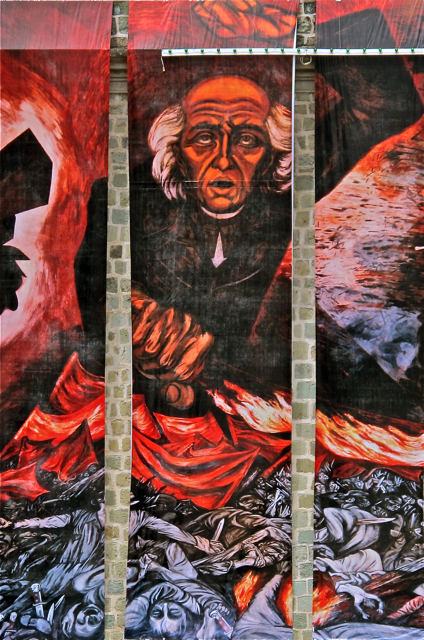
…the insurgents vacillated between Independence (Morelos) and modern forms of autonomy (Hidalgo).  The war began as a protest against the abuses of the metropolis and the Spanish bureaucracy, but it was also, and primarily, a protest against the great native landholders.  It was not a rebellion of the local aristocracy against the metropolis but of the people against the former.  Therefore the revolutionaries gave greater importance to certain social reforms than to Independence itself:  Hidalgo proclaimed the abolition of slavery and Morelos broke up the great estates. 

Banner on Oaxaca's Municipal Building; reproduction of mural by José Clemente Orozco of Miguel Hidalgo y Costilla.

The Revolution of Independence was a class war, and its nature cannot be understood correctly unless we recognize the fact that unlike what happened in South America, it was an agrarian revolt in gestation.  This is why the army (with its criollos like Iturbide), the Church and the great landowners supported the Spanish crown… [p. 123]

Paz, Octavio.  The labyrinth of solitude, the other Mexico; Return of the labyrinth of solitude; Mexico and the United States; The philanthropic ogre.  New York:  Grove Press, 1985

Ready for El Grito

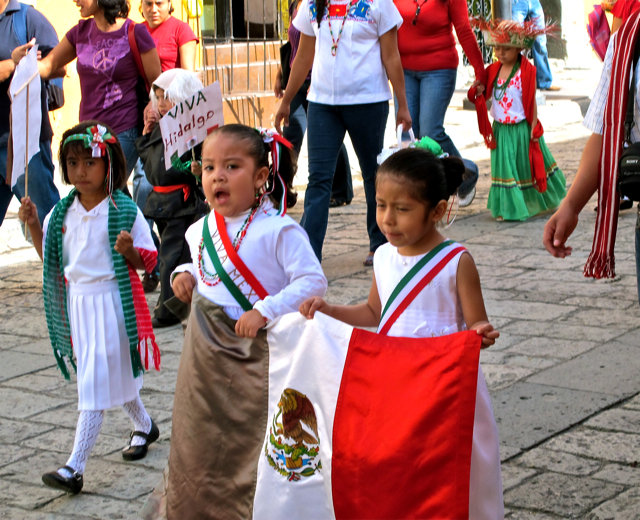
Let the celebrations begin!  This morning, enroute to the library, I ran into a pre-school parade coming down the Alcalá…

Children carrying Mexican flag and Viva Hidalgo sign.

These two were bringing up the rear because they kept pausing for photos, and I couldn’t resist, either!

A little girl holding the hand of an even smaller boy.

Going to the zócalo this afternoon more resembled trying to get to an airport gate, than strolling into a town square.  Security checkpoints, with metal detectors, have been set up at 10 intersections.  According to an article in this morning’s Noticias, security cameras are also in use.

Black clad military with automatic weapons, wearing flak jackets and helmets, at security checkpoint

All is in readiness for tonight’s festivities… another sound and light show projected on the cathedral, fireworks, and the Grito de Dolores from the balcony of the Government Palace.

Government Palace with flags and color portraits of Mexican heroes of Independence.

However, tonight I’ll be eating the traditional Chiles en Nogada,  listening for the bells at 11PM, and then watching the fireworks from my ringside seat on the rooftop.  ¡Viva Mexico!

(ps)  Portrait on the left is of Vicente Guerrero.

In Mexico, from small pueblos (villages) to large ciudades (cities), most all have calles (streets) named Morelos and Hidalgo — some, like Oaxaca, have more than one, which can be very confusing when trying to find an address, to say the least!  The names Vicario and Ortiz de Domínguez aren’t nearly so commonplace.

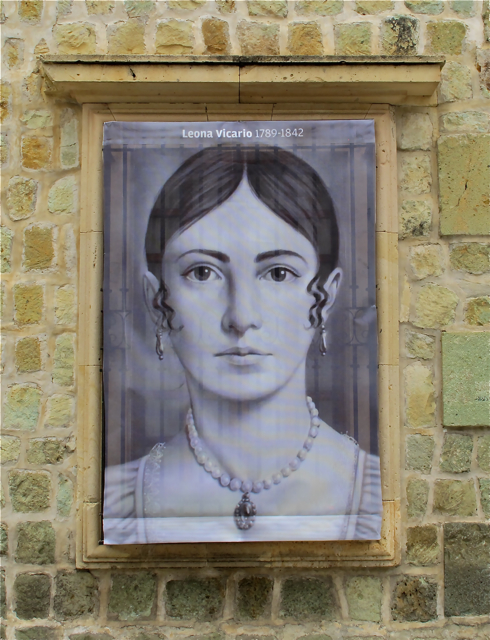
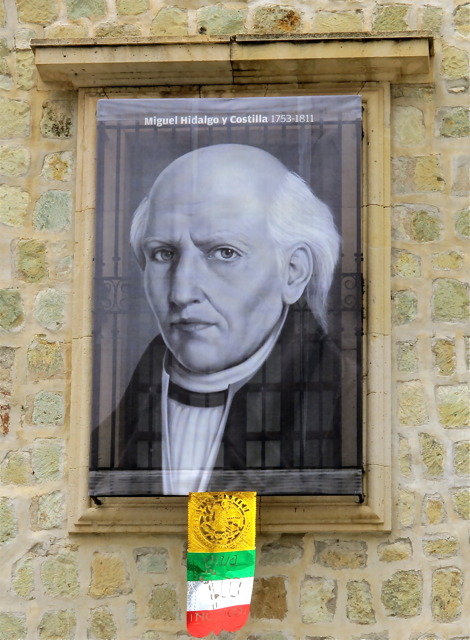
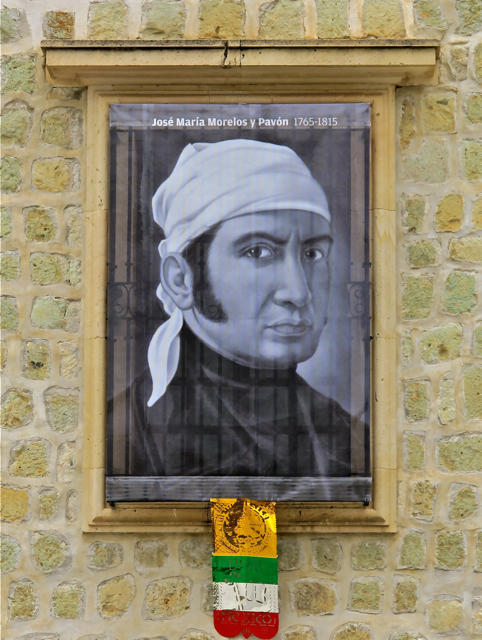
However, two of the women (among countless unsung heroines) who played a major role in the struggle for independence from Spain were Leona Vicario and Josefa Ortiz Domínguez.  In a fitting tribute to their importance to the Independence movement, their giant portraits currently hang on the outside wall of the Municipal Building overlooking the Plaza de la Danza, along with those of Miguel Hidalgo de Costilla and José María Morelos y Pavón.

Portrait of Leona Vicario

Leona Vicario, 1789-1842

Leona Vicario provided money and medical support, helped fugitives, and served as a messenger.  After escaping from prison, she helped her husband, Andrés Quintana Roo, plan strategies on the battle field.

Portrait of Josefa Ortiz de Domínguez

Josefa Ortiz de Domínguez, 1773-1829

Confined to house arrest after a co-conspirator betrayed the upcoming plans for revolt by the Independence movement, Josefa Ortiz de Domínguez was able to smuggle a message out, warning of the betrayal.

Portrait of Miguel Hidalgo y Costilla

Miguel Hidalgo y Costilla, 1753-1811

As a result, in the early morning of September 16, Miguel Hidalgo y Costilla rang the church bells in Dolores, rallying the rebels, and issuing, what has come to be known as Grito de Dolores (Cry of Dolores), the signal to begin the War of Independence from Spain.  It is an event that is recreated all over Mexico at 11 PM on September 15.  (See the link re why it isn’t done in the early morning of September 16.)

Portrait of José María Morelos y Pavón

José María Morelos y Pavón, 1765-1815

The last portrait on the wall is that of José María Morelos y Pavón, of Afro-mestizo heritage, and, like Hidalgo, also a priest.  He was a capable military commander who assumed leadership of the independence movement after Hidalgo was executed.  For a local connection, on November 25, 1812, in what is thought of as a brilliant victory, Morelos, along with the support of Mariano Matamoros and Miguel Bravo, took the city of Oaxaca.  Fittingly, the streets Morelos and Matamoros run parallel and M. Bravo intersects them just a few blocks from the Municipal Building and the Plaza de la Danza.

(ps)  These portraits are painted directly on fine mesh screen… thus, the window bars showing through.

New librarians?

Seen at the Biblioteca Pública Central Margarita Maza de Juárez on Friday…

Heart on the right?  Don’t mess with this librarian!

Shhhh…

Whew!  just part of an eye-catching exhibition at the library.

As I mentioned a few days ago, El Grito and Mexican Independence Day are coming and, besides flags and green, white and red decorations, it also means parades and fuegos artificiales (fireworks).   The latter will, no doubt be grand and, if last year is any indication, the rooftop with have a ringside view.

In anticipation, I thought I’d share a video from the rooftop of the nightly fireworks during July’s Sinfonía de Luz y Sonido throughout this year’s Guelaguetza.

Rain or shine…

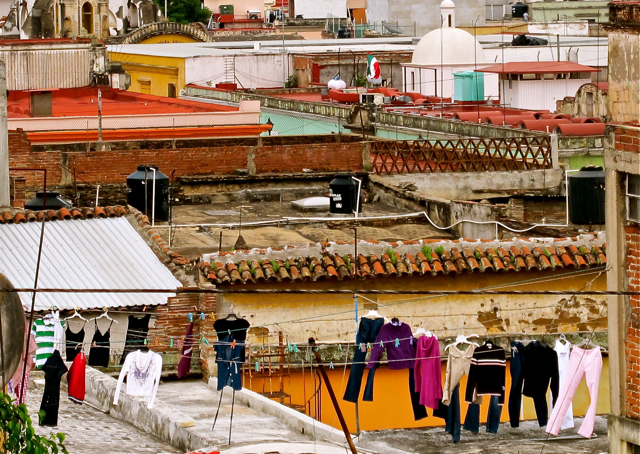
Flags aren’t the only things flying from the rooftops of Oaxaca…

Laundry hanging from rooftop clothesline.

A 2004 report, Measuring Inequality with Asset Indicators [pdf], by McKenzie, confirms very few households in Mexico have clothes dryers.

El Grito de la Independencia is coming!  Vendors of everything green, white, and red have set up their carts on Oaxaca’s busiest street corners and Mexican flags are flying everywhere.

A little slice from yesterday’s grocery shopping trip around town…

This slideshow requires JavaScript.

Definitely more to come!


Sept. comes in with a BANG

Yesterday, the clouds gathered, the sky darkened, and about 5 PM…

And, yes, I did jump!

However, it’s no laughing matter for the farmers and folks who live near rivers.  Río Atoyac, which runs alongside the heart of the city and which one must cross to reach the airport, rapidly reached flood stage and breached its banks in several places (Noticias has video).  In addition, because the ground is already supersaturated, mudslides have already begun to occur in the mountains.

CONAGUA explains that the large area of atmospheric instability over the Gulf of Tehuantepec along with tropical depression 13 in the Gulf of Mexico (that’s the one threatening Louisiana), are the moisture-laden culprits.

Animals and believers

One priest, countless dogs, several birds, a couple of cats, a few fowl, a pair of fish, one white rabbit, numerous cute kids, parents and grandparents, beautiful young women, tough guys and cool teens, multiple media outlets, and spectators (with cameras and cell phones) congregated at 4 PM today in the plaza outside the Templo de Nuestra Señora de la Merced (Temple of Our Lady of Mercy) for the Bendición de los Animales (Blessing of the Animals).

This slideshow requires JavaScript.

This annual event, held on August 31, celebrates the feast day of San Ramón de Nonato, patron saint of women in labor, persons falsely accused, and keeper of animals.  The gathering was muy tranquilo; a Peaceable Kingdom prevailed and Edward Hicks would have felt right at home.

I must say the priest was quite energetic with the holy water and even the non-believers among us got a good sprinkling and came away feeling blessed!

(ps)  Fellow blogger, Chris, caught the priestly action.

(pps)  Noticias has video… the music is priceless!