Feeds:
Posts
Comments

Archive for the ‘History’ Category

El Grito is coming, El Grito is coming!!!  Green, white and red is on display all over the city, including clothing stores, as tradition calls for wearing the colors.

Are you in the market for a traditional look?

White blouse and skirt with green and red trim.

A huipil and rebozo?

Green, white, and red dresses and shawls hanging on wall.

Or, are you leaning toward an updated mix and match style?

Green, white, and red dresses, skirs, blouses, and sash.

Do you need a sweater for going down to the zócalo on the evening of September 15?

Green, white, and red sweaters hanging on display hooks.

By all means, don’t forget to accessorize!

Green purse and red shoes.

On a more serious note:  Despite its current challenges (which are many and serious), Mexicans are extremely proud of being Mexicanos.  And, in my humble opinion, they have every right be!  They can trace their history back to ancient and highly developed civilizations, their national cuisine has been placed on the World Heritage List by UNESCO, and Mexico is considered one of the most geographically and biologically diverse countries in the world.  Plus, when was the last time you heard Mexico had invaded another country?

Read Full Post »

Several days ago, Susan McGlynn of the Insider’s Guide to Oaxaca posted this photo on the Insider’s Facebook page, with the question, “Oaxaca in the 1940s or maybe 50s?. DO YOU KNOW WHICH CORNER OF OAXACA THIS IS???”

Black and white street scene of large baskets and indigenous vendors and shoppers.

The architecture looked very familiar and then there were those trees in the distance…  I was pretty sure I knew which corner this was, so off the camera and I went.

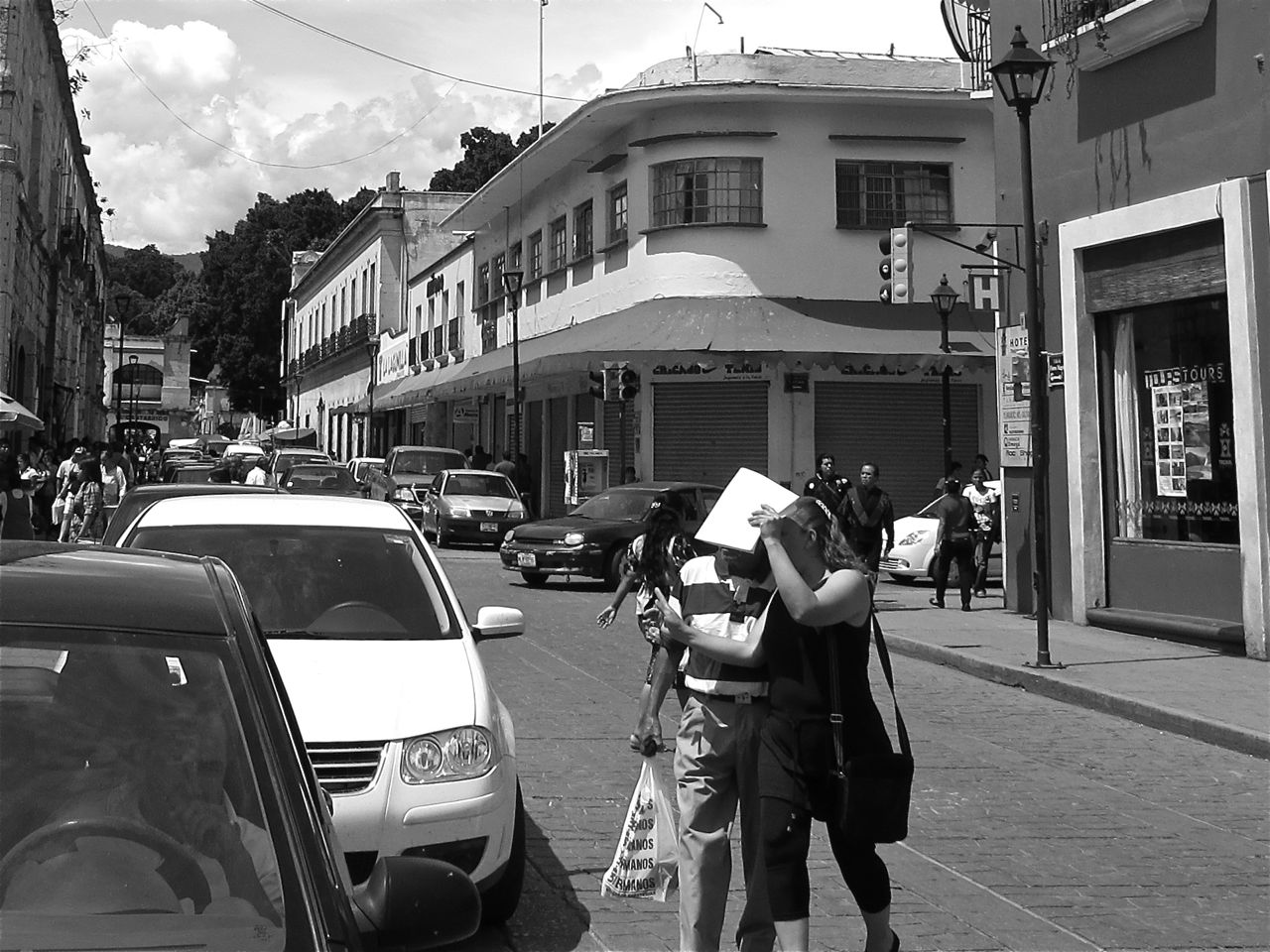
Black and whte street scene filled with automobiles and people on sidewalk and a couple crossing the street

It’s looking north on Flores Magón at the intersection of Las Casas.  That’s the Government Palace in front of the trees of the zócalo at the end of the street.  Outside the shot and to the left of the cars in the foreground is Mercado Benito Juárez.  Perhaps all is a little clearer in color…

Street scene (in color) filled with automobiles and people on sidewalk and a couple crossing the street

That cinnamon colored building in the foreground is the Trebol Hotel and the single-story white building next to the Government Palace is La Lagunilla, which must have been in business when the original photograph was taken, as the sign says it was founded in 1921.

Cars in front of one story white building with blue awning and name, La Lagunilla, painted at the top of the building

This was fun!

Read Full Post »

I’ve been intending to post these photos for six months, but there has been so much going on in Oaxaca, I haven’t gotten around to it — until now.  This morning’s Guardian article, Trotsky’s murder remembered by grandson, 72 years on, caught my eye and I thought, if not today, when?  So, here goes…

When I was in Mexico City in January, I made somewhat of a pilgrimage out to the borough of Coyoacán.  Besides a lovely stroll through the Viveros de Coyoacán, being dazzled by the light and color of the Museo Frida Kahlo, and enjoying a delicious comida on the Plaza Hidalgo, I spent an incredibly moving three hours at the Museo Casa de Trotsky, the home, and now museum, of Russian revolutionary leader Leon Trotsky and his wife Natalia Sedova.  However, before getting to the photos, a very brief bit of context is necessary.

Hounded all over the world by Joseph Stalin and his agents, in 1937 Trotsky and Natalia Sedova were offered asylum by Mexican president Lázaro Cárdenas.  Trotsky’s orphaned grandson, Esteban Volkov (Seva), joined them not long after.  Seva narrowly escaped being murdered in his bed during the first attempt on Trotsky’s life in the Coyoacán house by Mexican muralist, David Alfaro Siqueiros.  It was during this attack that Trotsky guard, Robert Sheldon Harte was killed.

The house at Avenida Viena 19 was further fortified, but Stalinist agent, Ramón Mercader, under an assumed name was able to infiltrate Trotsky’s inner circle and, on August 20, 1940, under the ruse of asking Trotsky to look at something he had written, attacked him with an ice axe.  Trotsky died in hospital a little more than 24 hours later.  His ashes and those of Natalia’s reside in the peaceful garden of the Coyoacán house in a monument, designed by Irish-Mexican painter and architect Juan O’Gorman, that proudly flies a red flag and features the overlapping hammer of the worker and the sickle of the peasant.  The house and furnishings remain much as they were 72 years ago, bullet holes from the first attack and all.

This slideshow requires JavaScript.

The humanity expressed in the words below were felt as I wandered through the house and museum and I must admit, tears welled up as I stood before O’Gorman’s monument.

Trotsky’s Testament, dated 27 February 1940

My high (and still rising) blood pressure is deceiving those near me about my actual condition. I am active and able to work but the outcome is evidently near. These lines will be made public after my death.

I have no need to refute here once again the stupid and vile slanders of Stalin and his agents: there is not a single spot on my revolutionary honour. I have never entered, either directly or indirectly, into any behind-the-scenes agreements or even negotiations with the enemies of the working class. Thousands of Stalin’s opponents have fallen victims of similar false accusations. The new revolutionary generations will rehabilitate their political honour and deal with the Kremlin executioners according to their desserts.

I thank warmly the friends who remained loyal to me through the most difficult hours of my life. I do not name anyone in particular because I cannot name them all.

However, I consider myself justified in making an exception in the case of my companion, Natalia Ivanovna Sedova. In addition to the happiness of being a fighter for the cause of socialism, fate gave me the happiness of being her husband. During the almost forty years of our life together she remained an inexhaustible source of love, magnanimity, and tenderness. She underwent great sufferings, especially in the last period of our lives. But I find some comfort in the fact that she also knew days of happiness.

For forty-three years of my conscious life I have remained a revolutionist: for forty-two of them I have fought under the banner of Marxism. If I had to begin all over again I would of course try to avoid this or that mistake, but the main course of my life would remain unchanged. I shall die a proletarian revolutionary, a Marxist, a dialectical materialist, and, consequently, an irreconcilable atheist. My faith in the communist future of mankind is not less ardent, indeed it is firmer today, than it was in the days of my youth.

Natasha has just come up to the window from the courtyard and opened it wider so that the air may enter more freely into my room. I can see the bright green strip of grass beneath the wall, and the clear blue sky above the wall, and sunlight everywhere. Life is beautiful. Let the future generations cleanse it of all evil, oppression and violence, and enjoy it to the full.

For archives and bibliographies of Trotsky, the following two sites are about as comprehensive as one will find online:

Even if you are not interested in the politics, and especially if you are considering a visit to the museum, I highly recommend reading Barbara Kingsolver’s historical novel, The Lacuna, part of which takes place in Trotsky’s Mexican household and gives a flavor of life there.

By the way, the museum site (appropriately) houses the Instituto del Derecho de Asilo y las Libertades Públicas (Institute for the Right of Asylum and Public Liberties).  I wonder, are they working overtime these days?

Read Full Post »


Buried treasures continue to be found in Oaxaca.  Mexico’s INAH (National Anthropology and History Institute) reported this week another burial chamber has been uncovered at the nearby Santa María Atzompa archaeological zone.

Current findings in the tomb include this urn, which they date to sometime between 650 CE and 850 CE.

Red urn shaped like a human face.

Photo: Red anthropomorphic urn (EFE/INAH)

Here is an English language article that reports on these latest discoveries from the site.

Mexican Archaeologists Discover Ancient Zapotec Tomb

Published at 10:06 pm EST, August 16, 2012

The tomb of a high-ranking member of Zapotec society was found at a 1,200-year-old funerary complex in the southern Mexican state of Oaxaca, the National Anthropology and History Institute, or INAH, said.

Archaeologist in Zapotec tomb

Photo: Burial and offering (INAH)

The funerary complex, which has three burial chambers, was found about three months ago at the Atzompa archaeological zone, the INAH said.

Archaeologists managed to get into the third pre-Columbian burial chamber, which contained human remains that are likely those of a male, INAH archaeology coordinator Nelly Robles Garcia said.

The remains will be analyzed to determine the age, nutrition and health of the individual, as well as whether there are intentional deformities of a cultural nature.

Archaeologists found a fractured skull belonging to another individual next to the remains, leading them to conclude that it may have been an offering.

A small, black tubular pitcher and pieces of a vessel were also found in the burial chamber.

A red urn with a human face on it and other items were found in the grave, archaeologist Eduardo Garcia said.

The vessel, which is estimated to date back to 650 A.D. to 850 A.D., is 50 centimeters (1.6 feet) tall, archaeologists said.

“We are dealing with a building where the remains of people with a very high status were placed. Who they were and what role they played in Zapotec society is still to be determined based on the findings that are being made and their later analysis,” Robles said.

Archaeologists found the building, which was designed exclusively as a burial site, in late April.

The tombs are located one on top of the other and, unlike previous discoveries, are not underground.

One of the burial chambers is decorated with a mural of a ball game, a theme not found before in Zapotec funerary practices.

Atzompa was a small satellite city of Monte Alban, the main center of the Zapotec state that dominated what today is Oaxaca.

“This discovery changes the perception we had in the sense that it was not as similar to Monte Alban as had been thought but, instead, developed its own architectural expressions, such as in the case of tombs and palaces,” Robles said.

For more on the Santa María Atzompa archaelogical zone, take a look at a January 2012 article I reprinted on an Ancient Zapotec kiln discovered there.  The site is scheduled to open sometime this year.

Read Full Post »

Early Saturday morning I was on my way to the doctor’s office, thus walking with purpose.  However, turning onto Constitución, along the south side of Santo Domingo, I had to pause…

Man and woman in stylized Aztec costume in jewel tones.

A photo shoot in progress?  I didn’t actually have a doctor’s appointment, just dropping by for a consultation (common here), so I lingered.

HE was obviously modeling “glamed-up” Aztec.  But SHE…

Woman in stylized Aztec costume in jewel tones.

Hmmm… Japanese???  Of course not!  Comparing it to images found in the codices, it, too, is an extremely stylized expression of  the fashion and hair of some classes of Aztec women.

Close-up of woman wearing purple silk huipil and stylized Aztec hairdo.

¡Muy hermosa!

Update:  I think Sheri is probably correct.  This may be a promotion for, or at least evoke, the annual reenactment of the Donají la leyenda, during Guelaguetza.  It is the legend of Princess Donají, a Zapotec princess who was kidnapped and decapitated by rival Mixtecos.  Her beautiful head was later found intact by a shepherd under a lily.  The body and head were reunited and buried together near, what is now, the city of Oaxaca’s airport.   The face of Donají appears on the official shield of the city of Oaxaca de Juárez.

Official shield of Oaxaca de Juárez.

The elevation and celebration of this story makes me wonder how today’s Mixtecos feel about it…

Read Full Post »

… and I’m not talking weather!  Today, I headed down to Soriana for a major restocking of the empty larder.  As I was perusing the wine section, a new sign caught my eye.

Sign - "Estimada clientela: Anticipe sus compras de vinos, licores y cervezas ya que el fin de semana habra ley seca por disposicion oficial por motivo de las elecciones federales.

(Translation: Anticipate your purchases of wines, spirits and beer for the weekend. There will be an official prohibition on selling because of federal elections.)

In the event you were unaware, there is a big election in Mexico this weekend; on Sunday, July 1, Mexican voters elect their next president.  In anticipation, the above sign went up and Noticias reported that Oaxaca’s governor, Gabino Cue, announced on Monday that alcohol sales are forbidden from midnight June 30 through midnight  July 1 — the entire 24 hours of election day.  This, he said, was in compliance with the provisions of the Federal Code of Electoral Institutions and Procedures, “thus ensuring the safe and harmonious development of the Federal Election Day on Sunday 1 July.”

I’m confused!  According to an article in NOTIMEX and other sources, the 1915 federal law prohibiting the sale of alcohol 24 hours before the elections and throughout election day (Paragraph 2 of Article 239 of the Código Federal de Instituciones y Procedimientos Electorales (Cofipe) was repealed prior to the 2006 presidential election.  It was a nod to the states with a heavy-duty tourism industry.  No cervezas and no margaritas for 24 hours equals unhappy campers at Mexico’s popular resorts!  Regulation was left up to the individual states.

So I ask, is Oaxaca’s ban a state statute?  Or, has the federal law changed again?  Or, has word of the 2006 change not reached this far south?  Hmmm…

Read Full Post »

In the last month, several articles in the US press referencing Oaxaca have been called to my attention.  They aren’t the usual travel features enumerating the “10 must see sites,” “best places to stay,” and “local fare dining.”  Nor do they cater to the ever more popular fear mongering and demonization of Mexico and her citizens.  Instead, these articles provide a window on Oaxaca’s indigenous past and challenging present.
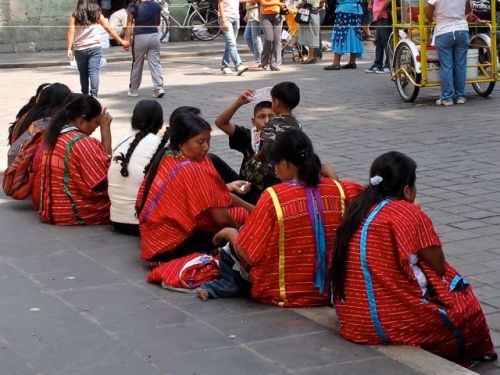
Triqui women sitting on a sidewalk

Triqui women and children in front of the Government Palace in Oaxaca de Juárez

From the June 15, 2012 New York TimesThe Past Has a Presence Here by Edward Rothstein.

OAXACA, Mexico — The past casts a sharp shadow here, wherever you look. You see it on mountaintop plateaus, where the ruins of ancient pyramidal staircases and capital-I-shaped ball fields hint at mysterious rituals that disappeared over a millennium ago.

<snip.

We are not dealing here with imagined reconstructions, but with the past’s palpable presence. And most of these ancient cities and monuments were abandoned some six centuries before the Spaniards plundered the region. After 80 years of archaeological research, their meanings are still unclear, though much has been written about Zapotec social hierarchies, gladiatorial-style games and stone carvings.

What is more clear is that remnants of those worlds also exist in the valley, where the slow-changing cultures of this buffeted but protected region still reflect Zapotec and Mixtec heritages. So here everything is plentiful that in the United States is rare: indigenous ruins, ancient languages, signs of direct lineage. And there is an edge to it all. Centers like Monte Albán are monuments to power and accumulated material wealth; they are also clearly evidence of a large-scale political organization, relics of perhaps the earliest state in the Americas.  [Read full article]

From California’s June 7, 2012 Monterey County Weekly, Native speakers and local missionaries work to save an indigenous Mexican language by Sara Rubin.

Gloria Moreno walks with a slight limp under the weight of the black messenger bag slung over her shoulder. It holds something of a botanical encyclopedia, petals and leaves gathered from the streets of Greenfield, which Moreno says help alleviate any number of ailments – pain, anxiety, weak bones.

Moreno says her collection is part of a medical tradition she began practicing as a teenager in Mexico. It was there, at 15, that she says she was instructed in a dream to take up herbal medicine.

Moreno dreamt her directive in Triqui de la baja, an indigenous language of the Copala region of Oaxaca in southern Mexico.

As native Triqui speakers disperse, leaving behind a notoriously violent region, there’s pressure both to preserve that language, and to leave it behind.

Of an estimated 40,000 Triqui speakers worldwide, about half of them are thought to have migrated away from Oaxaca, and as many as 10 percent live in the Salinas Valley.

<snip>

Moreno hopes for a generation of trilingual children, but many younger Triqui speakers are encouraged to trade their native tongue for English or Spanish, says a Salinas-based interpreter (who asked not to be named for fear of reprisal), because indigenous Mexicans are viewed as inferior. He trekked two hours to school from his childhood home in Oaxaca where he says he was bullied for being different.

“Because of the discrimination, parents don’t want their kids to learn [Triqui],” he says, “but then we lose tradition and culture.”

To reverse that, he hopes to get a grant or some cash to revive a bimonthly Triqui class piloted at the Greenfield Public Library two years ago. It drew about 35 students; of those, only a quarter were native speakers. The rest, mostly service providers, were there to learn Triqui.

“To speak Spanish, I used to think you had more value,” he says. “When I came here, I learned it is not that way. If you know three or four languages, you can explore and learn more.”

View Barbara Hollenbach’s Spanish-Triqui dictionary at www.sil.org/~hollenbachb/Posted.htm  [Read full article]

And finally from the May 28 Los Angeles Times, Epithet that divides Mexicans is banned by Oxnard school district, by Paloma Esquivel.

Rolando Zaragoza, 21, was 15 years old when he came to the United States, enrolled in an Oxnard school and first heard the term “Oaxaquita.” Little Oaxacan, it means — and it was not used kindly.

“Sometimes I didn’t want to go to school,” he said. “Sometimes I stayed to fight.”

“It kind of seemed that being from Oaxaca was something bad,” said Israel Vasquez, 23, who shared the same mocking, “just the way people use ‘Oaxaquita’ to refer to anyone who is short and has dark skin.”

Years later, indigenous leaders are fighting back against an epithet that lingers among immigrants from Mexico, directed at their own compatriots. Earlier this month the Mixteco/Indigena Community Organizing Project in Oxnard launched the “No me llames Oaxaquita” campaign. “Don’t call me little Oaxacan” aims to persuade local school districts to prohibit the words “Oaxaquita” and “indito” (little Indian) from being used on school property, to form committees to combat bullying and to encourage lessons about indigenous Mexican culture and history.

Indigenous Mexicans have come to the U.S. in increasing numbers in the last two decades. Some estimates now put them at 30% of California’s farmworkers. In Ventura County, there are about 20,000 indigenous Mexicans, most of whom are Mixtec from the states of Oaxaca and Guerrero who work in the strawberry industry, according to local organizers.

Many speak little or no Spanish and are frequently subjected to derision and ridicule from other Mexicans. The treatment follows a legacy of discrimination toward indigenous people in Mexico, said William Perez, a professor of education at Claremont Graduate University who has interviewed and surveyed numerous indigenous Mexican students.  [Read full article]

Read Full Post »

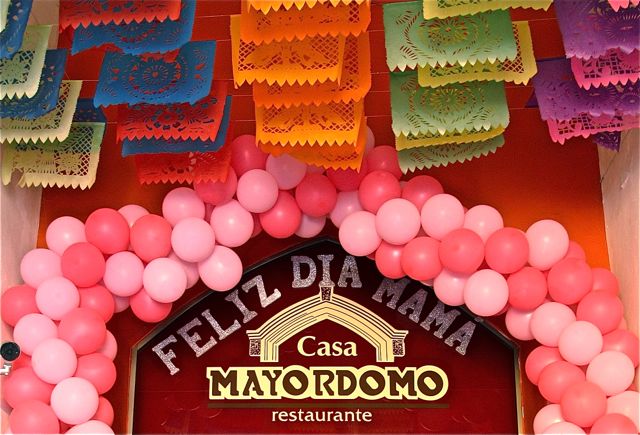
Today, May 10, is Día de la Madre in Mexico and it is celebrated in much the same way as in el norte.

Sign under papel picados at Casa Mayordomo Restaurante: "Feliz dia mama

The celebration migrated south from the USA in the early 20th century and was embraced and promoted by the Catholic Church AND the anticlerical Revolutionaries.  As for their reasons, I will quote from Liza Bakewell’s book, Madre: Perilous Journeys with a Spanish Noun.

… around the 1850s the Liberals… were nervous about women’s growing participation in the public sphere.  Establishing motherhood as venerable and the home as sanctified… would give women a sphere of their own where they could be boss.  Also, it would keep them off the streets and out of the workplace where they had begun to compete with men for jobs.

Under their watch, everyday motherhood became an exalted madre-hood…. The twentieth-century Revolutionaries who succeeded them took the idea and ran with it, adding in 1922 a ritual, Mother’s Day… [p. 84]

Needless to say, the women of Mexico have not stayed home!  As I write, hundreds of women are marching on Mexico City, participating in the March of National Dignity: Mothers Looking for their Sons and Daughters and Searching for Justice.  And, as for the workforce, according to a report citing the 2010 census, 33.3% of women work and this doesn’t even include those working in family operated enterprises.

However distasteful the reasons behind the establishment of Mother’s Day in Mexico, it does nothing to diminish the need to honor these beautiful, hardworking, formidable, and loving women.

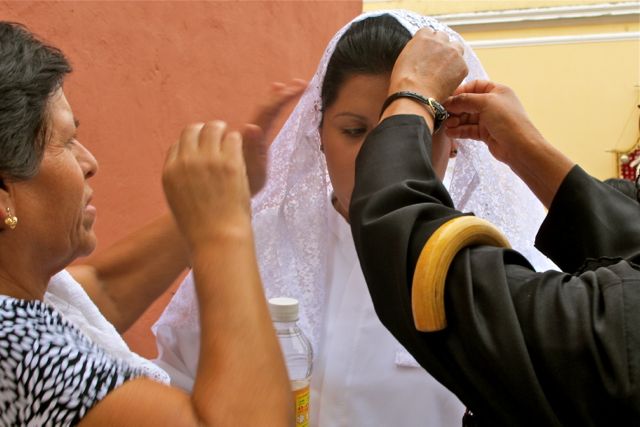
2 women pining veil on young woman

Woman with rebozo on her head, sitting on side of hill with 3 children

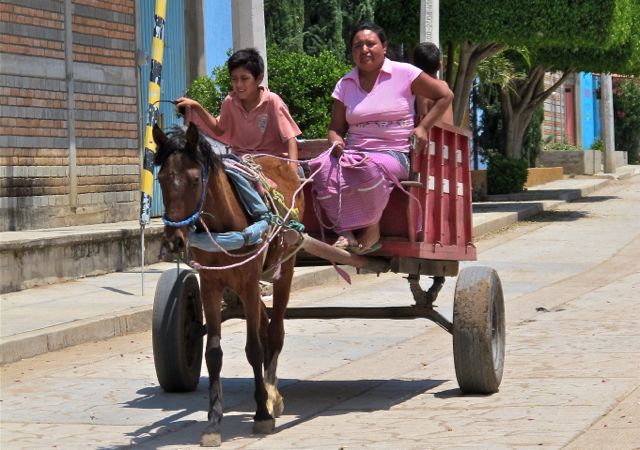
Woman at the reins with 2 boys in a horse drawn cart

Close up of woman holding a baby

¡Feliz Día de la Madre mis compañeras!

Read Full Post »

Tonight, instead of candles…

Fireworks blossom

Fuegos artificiales exploded from the Alameda de León…

Fireworks blossom

As Oaxaca celebrated her 480th birthday!

Fireworks

Read Full Post »

Today is Oaxaca’s 480th birthday as a colonial city .  Of course, among other events, a calenda (parade) marked the date.

This slideshow requires JavaScript.

In 1532 Spanish settlers (their bloody way paved by Hernán Cortés and his conquistadores) successfully petitioned the Queen of Spain for a land grant of 1 square league.  The colonists had already established their own town on the site of Huaxyacac, renamed it Antequera (after an old Roman city  in Spain) and received a Royal Charter from King Charles I of Spain.

However, Cortés had successfully gotten the entire Valley of Oaxaca (hundreds of thousands of acres) declared as his own private marquisate and, his greed knowing no bounds, kept trying to evict the colonial townspeople.  By obtaining the queen’s charter, this end-run around Cortés insured the rights of the townspeople to the land.

Thus, April 25th continues to be celebrated as Oaxaca’s birthday.  ¡Feliz Cumpleaños!

Read Full Post »

…fighting in Oaxaca.

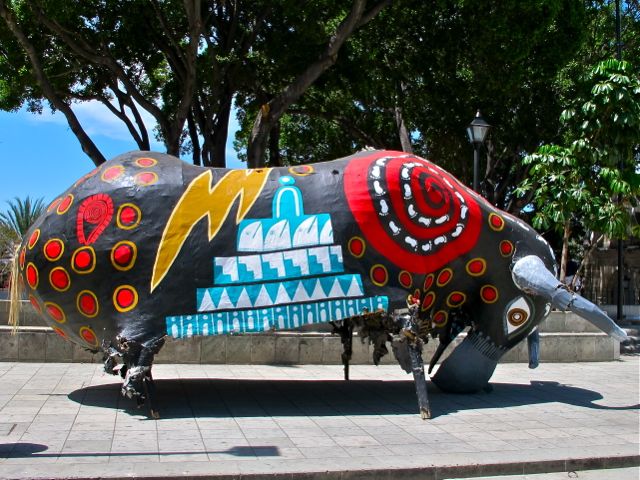
Colorful gigantic papermache bull

Corrida de Toros, as it is known in Mexico, was outlawed by, then governor of Oaxaca, Benito Juárez.  The ban was instituted throughout Mexico in 1867 by Juárez during his presidency.  Some say it was to “civilize” Mexico, but others contend it was for nationalistic reasons, as bullfighting had been a legacy of the Spanish conquest.  I tend to think the latter tipped the scales.

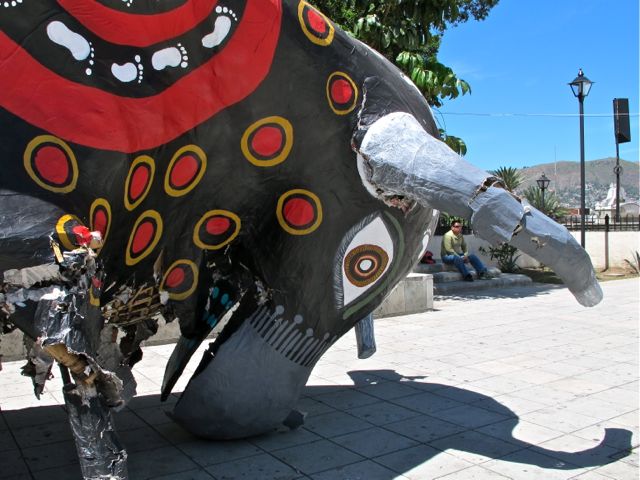
Close-up of the head of a colorful giant papermache bull

However, Porfirio Díaz reinstated it during his presidency, but the ban remained in Oaxaca in honor of her favorite son.  And thus, on the Plaza de la Danza, we have only a paper mache bull ready to charge at his shadow…

Design of fish heads, Mitla frets, triangular mountains, etc.

and serve as a canvas for imagery, ancient and contemporary.

Read Full Post »
Hurray for libraries and librarians everywhere!  Just like Oaxaca, you never know what you will find when you turn a corner in a library or archive. And, whether it’s wandering the streets or roaming the aisles, we can’t help but learn a little more about our world and ourselves. We need more occasions for big, goofy smiles. Don’t let your community cut funding to libraries!  –spixl

Photos on Flickr of Códice de Santa Catarina.

marquettehistory's avatarHistorians@Work

Laura Matthew on the secret life of primary sources and the responsibility historians have to them, and to each other, when documenting the past. 

I have been thinking about how documents are lost, then found.

A week or so ago, my friend and colleague Aims McGuiness from the History department at the University of Wisconsin, Milwaukee (UWM) left me a voice mail message. “There’s this mysterious document at the American Geographical Society Library here at UWM,” he said. “It looks colonial-era, and maybe Mexican. The librarians don’t know what it is, or how they got it. Could you come look at it?”

“Ooh, fun!” I emailed him back (yes, that’s a direct quote). “I can always make time for a lost document.”

Little did I know. A few days later, Jovanka Ristic and Kay Guilden at the AGS Library unrolled in front of me a piece of bark paper on…

View original post 1,015 more words

Read Full Post »
David Rovics singing “Saint Patrick’s Battalion,” a song celebrating the Irish who deserted and fought alongside the Mexican army against the United States during the Mexican American War, 1846-1848.

Want to learn more?

h/t  Dave W.

Read Full Post »

Today Día de la Constitución in Mexico is being observed.  It celebrates the promulgation of the Mexican Constitutions of February 5, 1857 and February 5, 1917.

According to the US Library of Congress website on the history of the Mexican Constitutions, the former “starts out by saying that all men are free and that by merely setting foot on Mexican soil one is set free” thus outlawing slavery many years before it was abolished in the U.S.  And, the latter “came with significant social reforms to labor laws, and provided for equality in treatment without discrimination on the basis of race, creed, social or political condition, among other reforms…. What is also more evident with the most recent Mexican constitutions is a deliberate movement toward secularism.”

Schools, banks, and some businesses are closed but, other than that, not much seems to be happening here in Oaxaca.  So, I will post photos I took a few days ago of the new color changing lights that now illuminate the palm trees along Calle Constitución in Oaxaca — the result of the previously mentioned massive decorative lighting project that began last October.

This slideshow requires JavaScript.

Does that put you, In the Mood?

Read Full Post »

News of this discovery was posted on Facebook this morning by Sam, my young Zapotec friend from Teotitlán del Valle, who is currently getting his Ph.D. in Sustainable Manufacturing at the University of Liverpool.  A global village, it is!

By the way, Santa María Atzompa (mentioned below) is where I experienced a Magical and Mystical October 31st.  The article and photo are from today’s, Hispanically Speaking News.

1,300 Year Old Kiln Used by Ancient Zapotecs Discovered in Mexico

Mexican archaeologists have discovered in the southern part of the country a kiln used by the ancient Zapotecs to make ceramics more than 1,300 years ago, the National Anthropology and History Institute, or INAH, said.

Clay pot in ancient kiln

The pre-Columbian kiln was discovered in the Atzompa Archaeological Zone in Oaxaca state, which will be opened to the public this year, INAH said in a communique.

It added that this is one of the best preserved ceramic kilns ever found in the Zapotec area, and noted Oaxaca’s long tradition in making pottery.

According to Wednesday’s communique, the kiln “is a link between the pre-Columbian pottery tradition and the artisanal ceramics currently made in the community of Santa Maria Atzompa, establishing the connection between today’s inhabitants and their ancestors.”

Archaeologist Jaime Vera, head of the excavation, said the kiln “is thought to date back to the first years of the pre-Columbian settlement of the area, in other words, more than 1,300 years ago, which is deduced from the ceramics found with it.”

Another element that allows the kiln to be dated is the depth at which it was found – 2.2 meters (7 feet 2 1/2 inches) – “far below the layer of stucco that covered it, and which corresponds to that era, the archaeologist said, adding that further studies will be made to confirm its antiquity.

It was in the excavation period between March and December 2011 that the kiln was completely uncovered allowing its principal characteristics to be observed: a cylindrical adobe wall and shelves for placing the objects to be fired.

The kiln consists of a cylindrical adobe wall measuring 2.1 meters (6 feet 11 inches) from the surface to the firing shelves arranged in convergent lines toward the center, and a downdraft vent in the lower part approximately 20 centimeters (8 inches) wide,” Vera said.

He said that “while today’s kilns are not identical in dimensions or shelf arrangement, they do perserve certain basic elements and the function as a space for firing ceramics.”

The Atzompa Archaeological Zone, approximately 4 square kilometers (1 1/2 square miles), existed as a small satellite village of the Zapotec city of Monte Alban during the Late Classic period (650 B.C.to 900 B.C.) when the latter’s growing population expanded beyond its boundaries.

The work to provide the Atzompa Archaeological Zone with the necessary infrastructure will continue, since it is one of the pre-Columbian sites that will be opened to the public this year, INAH said.

Read Full Post »

« Newer Posts - Older Posts »