Feeds:
Posts
Comments

Archive for the ‘History’ Category

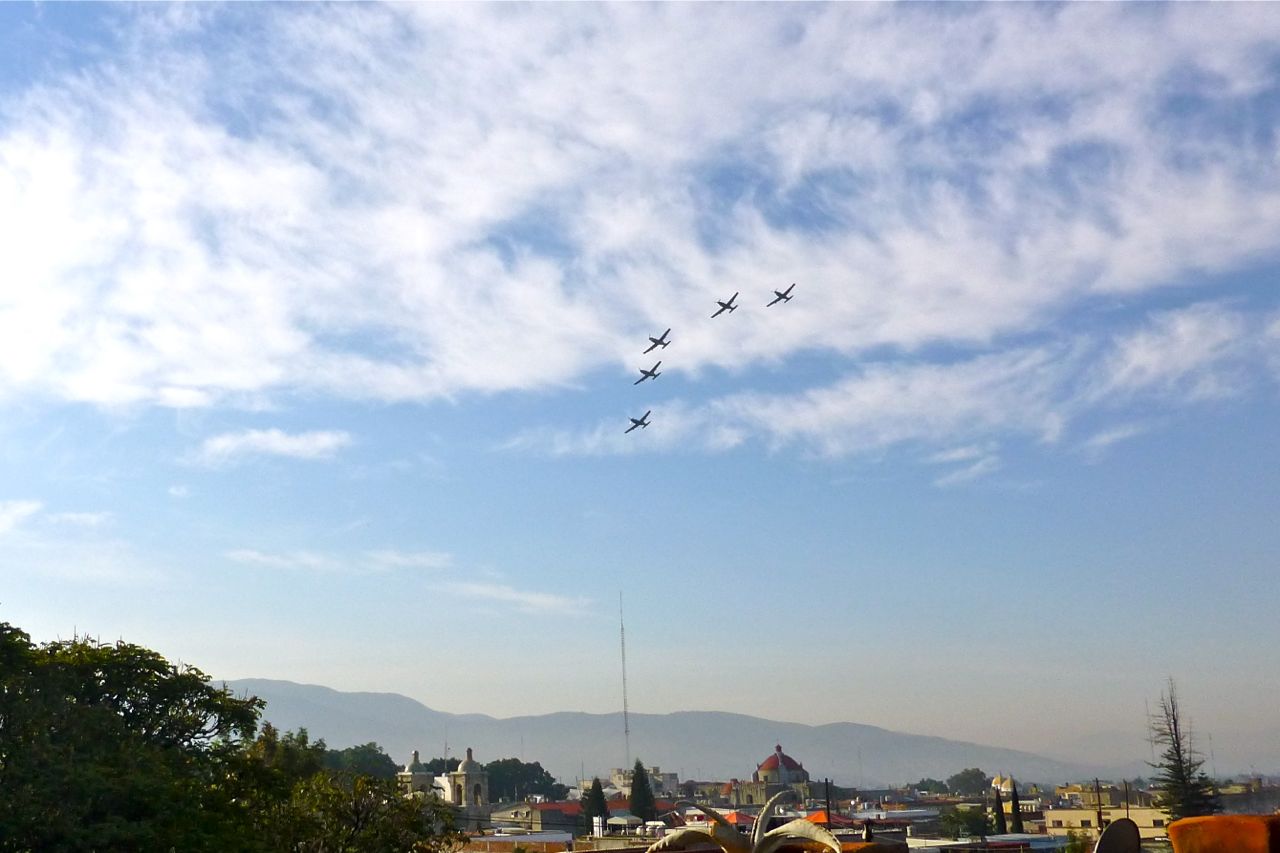
Today the City of Oaxaca celebrates 482 years as a colonial city.  (*** See below for a little history.)  The day began at 6 AM with the ringing of the Cathedral’s bells, the singing of Mañanitas Oaxaqueñas, and marimbas and tamales on the Alameda de León. Alas, that was a little early for me to be up, dressed, and downtown.  However, all I had to do was step out on my terrace to watch the next event of the day.
P1030885

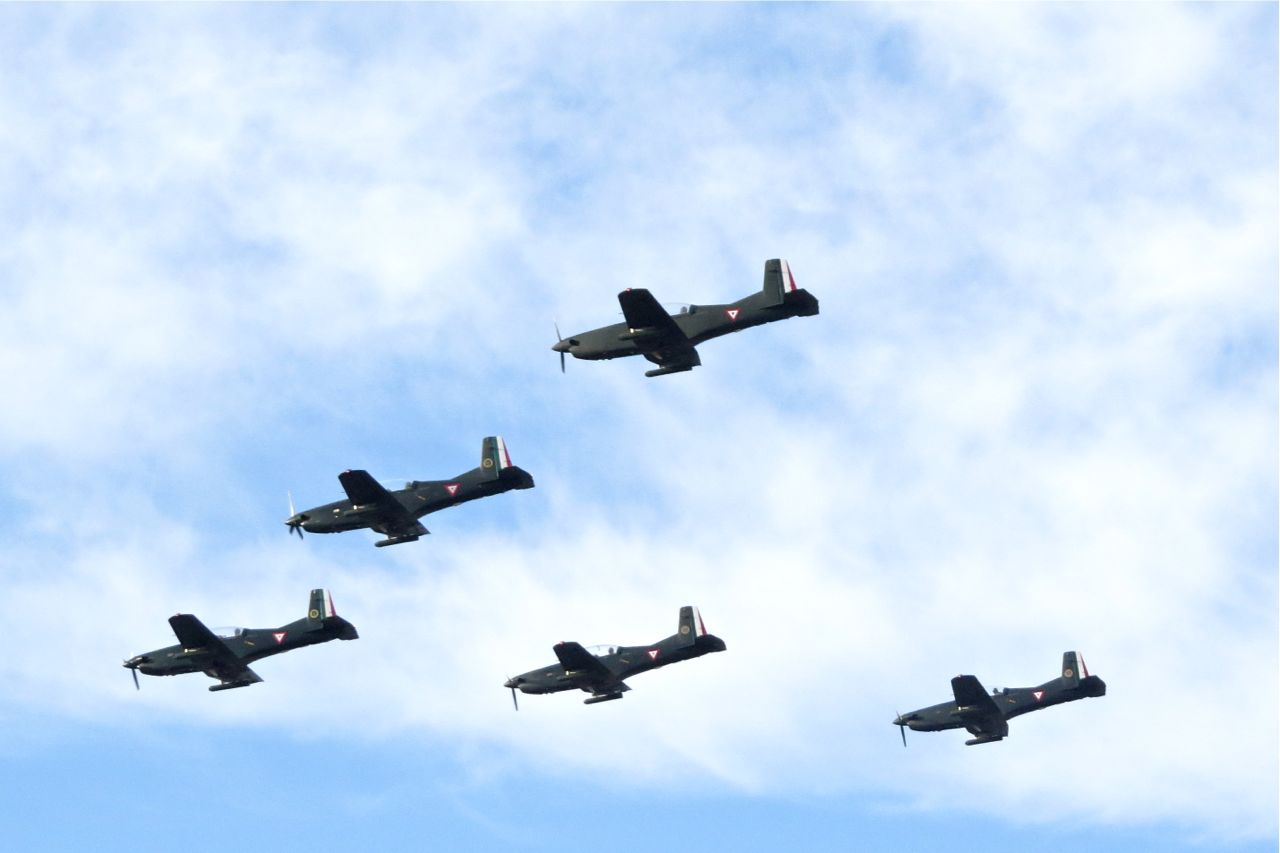
Five Pilatus PC7 Mexican Air Force planes put on a  show over the city.
IMG_3605

They made several passes over the city.

IMG_3577

For their finale, contrails displayed the green, white, and red of the Mexican flag.

P1030892

And then they were gone.  I love how Noticias concludes their report,  “After 45 minutes, the ‘steel birds’ returned to their base, pending a new appeal to challenge gravity.”

IMG_3580

Celebrations continue through May 8 and a schedule of events can be found HERE.

*** In 1532 Spanish settlers (their bloody way paved by Hernán Cortés and his conquistadores) successfully petitioned the Queen of Spain for a land grant of 1 square league.  The colonists had already established their own town on the site of Huaxyacac, renamed it Antequera (after an old Roman city  in Spain) and received a Royal Charter from King Charles I of Spain. However, Cortés had successfully gotten the entire Valley of Oaxaca (hundreds of thousands of acres) declared as his own private marquisate and, his greed knowing no bounds, kept trying to evict the colonial townspeople.  By obtaining the queen’s charter, this end-run around Cortés insured the rights of the townspeople to the land.
Read Full Post »

In Memory of the Irish Soldiers of the Heroic Battalion of Saint Patrick Who Gave Their Lives for the Mexican Cause During the Unjust North American Invasion of 1847.  – plaque in Plaza de San Jacinto, San Ángel, Mexico City

Want to learn more?

Read Full Post »

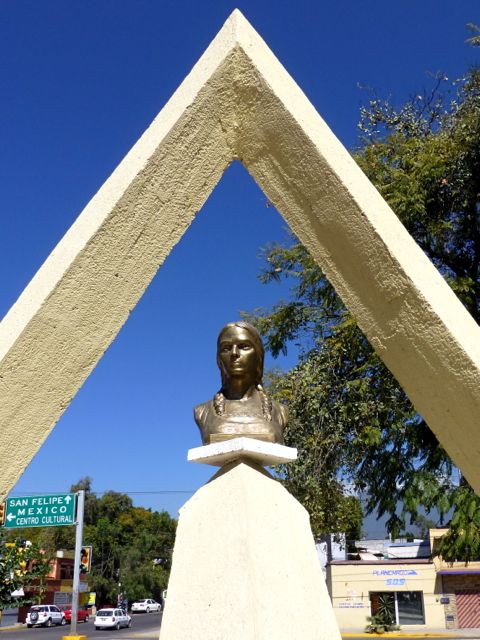
At a busy intersection, on a small concrete island, sits the bust of a woman.  Who is she?

P1010333

This is where Pino Suarez and República both meet Niños Heroes, traffic comes in at “unnatural” angles, and my attention is usually laser focused on attempting to look in the right direction, deciphering which traffic lights do what, and keeping my adrenalin in check as I determine the safest moment to dash across each street.

However, a few days ago, on my return to El Centro, after having walked far up into Colonia Reforma, I decided to take a break and investigate.  Just who is this indigenous woman who presides from her triangular perch.

P1010334Meet Brigida Garcia de Juárez, from the mountain village of Guelatao, Oaxaca — mother of Oaxaca’s beloved favorite son and Mexico’s revered former president, Benito Pablo Juárez García.  She died when he was only three years old.

The plaque that rests at the base of the monument reads, “Madre de Benemérito de America – H. Ayuntamiento – 1984.  Mother of the distinguished national hero of modern Mexico.

Read Full Post »

Today Mexico is celebrating el Día de la Revolución (Revolution Day).  It commemorates the beginning of the bloody revolution that quickly drove dictator/president Porfirio Díaz from his 31-year long reign.  A November 22, 1910 headline in the Palestine [Texas] Daily Herald proclaimed, “Revolution Is Now On In Mexico: The Real Thing is Reported Under Way in State of Chihuahua, Mexico.”  However, the civil war raged on for ten years, as various factions battled for power and the peasantry fought for, in the words of Emiliano Zapata, ¡Tierra y libertad!  (Land and liberty!)  It is estimated to have cost 1.9 to 3.5 million lives.

At least here in Oaxaca, 20 de noviembre is not celebrated with as much pomp, circumstance, and military hardware as September 16th, Independence Day.  However, there were school floats…

The Government Palace was decked out in green, white, and red and the Governor, along with other dignitaries, presided from its balcony.

As always, the bomberos (firefighters) received much applause as they passed by the crowds gathered along the parade route.

Not so much love given to these guys from the Agencia Estatal de Investigaciones, an agency of Oaxaca’s Attorney General’s office.

And then there was this gal, directly across from the Government Palace…

Octavio Paz writes in The Labyrinth of Solitude, “The Revolution began as a demand for truth and honesty in the government…. Gradually the movement found and defined itself, in the midst of battle and later when in power.  Its lack of a set program gave it popular authenticity and originality.  This fact accounts for both its greatness and its weaknesses.” [p. 136, Grove Pr. 1985]

Read Full Post »

Almost a year after our first visit to the newly opened Atzompa archaeological site, yesterday, we returned.  The beautiful paved road up from Santa María Atzompa (elevation 1,580 meters) now brings one to a parking lot right across from the entrance, making for less of a haul up the hill for those less mobile or challenged by the altitude — at the top it is almost 300 meters above the village below — even we were huffing and puffing.

IMG_5525

Atzompa was part of Monte Alban and one of its largest settlements.  At the top of the stairs (above), is the largest (45 meters by 22 meters) of the 6 ball courts found among the Monte Alban communities.

Ball court

Investigations of the Atzompa site first began in 1940 by Jorge R. Acosta, who was part of the Monte Alban Project.  However, in 2007 the National Institute of Anthropology and History began formal explorations using a team of architects, archeologists, topographers, and restorers.

IMG_5555

Though the path is currently difficult to see, make sure to go around to the left of the building above to see the north quadrant.  Informational placards in Spanish and English are now in place throughout the site and most of the facts in this post are taken from them, but, of course, I neglected to take a photo of the placard for the building below!

IMG_5557

Residents from the land cooperatives in the surrounding communities have been hired to do much of the field and lab work.  Not a bad setting to work…

IMG_5556

One can, in the words of The Who, “see for miles and miles and miles and miles and miles…”

Green valley with mountain range in distanceExcept for the birds, insects, lizards, and workers, we had this spectacular setting to ourselves — I think we only saw 3 other visitors the entire time we were there.  Perhaps when the second entrance on the Monte Alban side opens, it will attract more attention.  In the meantime, the peace and tranquility are a gift in these chaotic times.

Oaxaca–The Year After has more from yesterday’s visit.

Read Full Post »

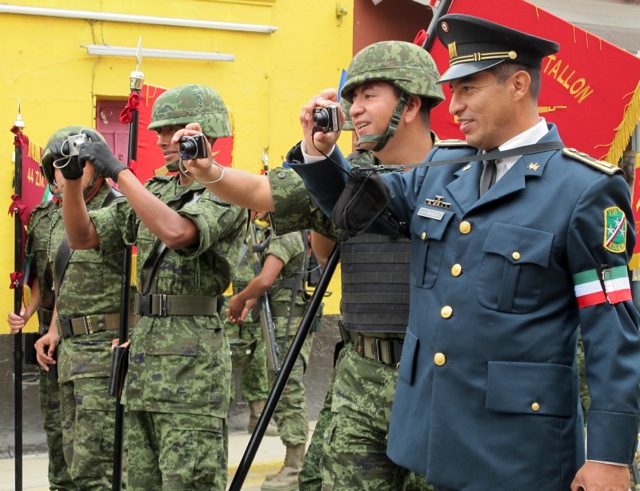
What do the guys do while waiting for an Independence Day parade to begin?

Men in military uniforms taking photos

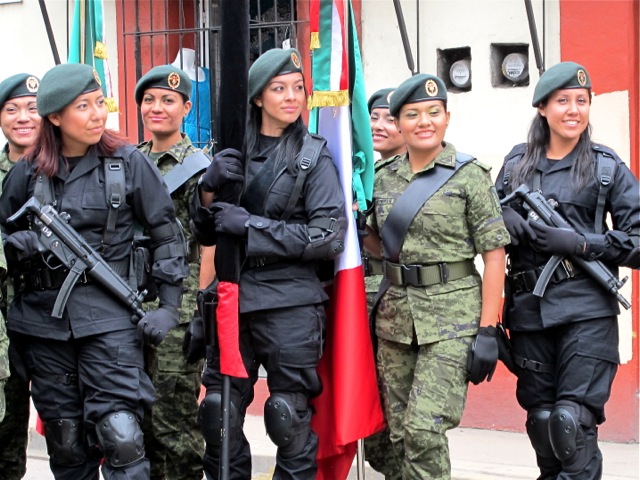
And, what do gals do? Pose for them!

Young women in military uniform posing

A mother takes twenty years to make a man of her boy, and another woman makes a fool of him in twenty minutes.  — Robert Frost

Read Full Post »

At 11 PM tonight, with El Grito de Dolores, also known as El Grito de la Independencia (the Shout of Independence), echoing from government buildings throughout the country, Mexico begins celebrating her long and hard-fought independence from Spain.  Despite the gathering of meteorological and political storm clouds, Oaxaca has gotten her green, white, and red on.

Doors are decorated, bunting is hung, and Mexico’s tricolor appears…

This proud yet faded flag with frayed edges seems a fitting symbol this year.

IMG_5058

In the words of Che Guevara, “La lucha continua.”

Read Full Post »

We returned to Teotitlán del Valle on Tuesday and Wednesday for performances of the Danza de la Pluma, a ritual re-enactment of the battles between the Aztec and Spanish.  According to OaxacaWiki:

The origin of this dance goes back to the spiritual and physical conquest of Mexico by the Spanish – La Guerra de Conquista. The dance originated in the town of Cuilpam de Guerrero where Martin Cortes (son of Cortes) celebrated the first baptism of his child. Martin played the role of his father and the locals played the roles of the conquered indigenous peoples.

The story is told in 41 bailes (dances) and lasts from early afternoon into the night.  Selected years in advance, it is an honor to be a dancer and they perform their roles for 3 years.  This week, during the multi-day fiesta honoring Preciosa Sangre de Nuestro Señor Jesucristo, we saw the first performances by the new cast and they looked great!

Presenting the Cast of Characters

Montezuma

Doña Marina (hat) and Malinche (headdress)

2 Subalternos

16 Danzantes:  Teotiles (2), Capitánes (2), Reyes (4), and Vasallos (8)

They are going to be fun to watch during the next 3 years.   (By the way, the costumes may change from day-to-day, but the cast remains the same.)

Read Full Post »

One of the main roads into and out of Oaxaca is Federal Highway 190.  It is a section of the Pan American Highway (which runs from Prudhoe Bay, Alaska to Ushuaia, at the southernmost tip of Argentina).  I cross the highway several times a month on my way to the Organic Market in Xochimilco or to a restaurant in Colonia Reforma — and the same thought always crosses my mind, “I can’t believe I’m walking across the Pan American Highway!”

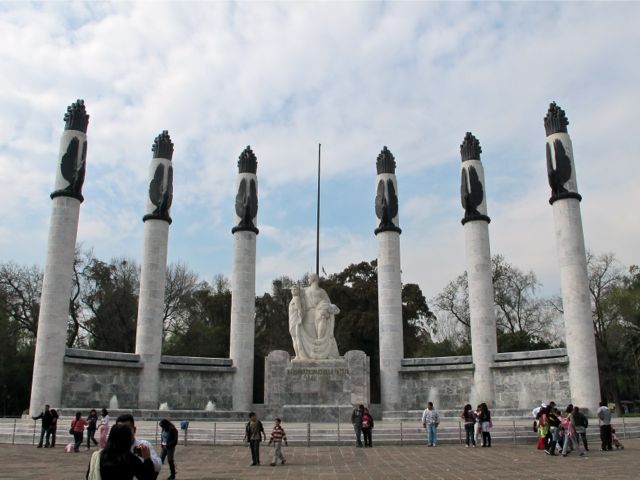
However, the highway has another name, as runs through the city — Calzada Niños Héroes de Chapultepec.  Child heroes of Chapultepec?  Who were they?  If you visit Mexico City, your guidebook or tour guide might direct you to Chapultepec Castle (Castillo de Chapultepec) set high on a hill in the middle of the beautiful 1694 acre Bosque de Chapultepec (Chapultepec Park).  There you will discover that they were young martyrs from what is called the Mexican-American War in the USA and is known here as the Invasion of Mexico.

Monumento a las Niños Heroes,

Monument to the Child Heroes in Chapultepec Park

Penn State historian Amy S. Greenberg calls it, A Wicked War, and her book, by the same name, chronicles a war waged on the basis of a Presidential lie, against a guiltless neighbor, for the express purpose of annexing half its territory.  (Hola, Texas, New Mexico, Colorado, Arizona, Utah, Nevada, and California.)  Then Illinois congressman Abraham Lincoln opposed the war and it spawned the first U.S. anti-war movement.

To discover what your teachers may not have told you about the Invasion of Mexico and its Niños Heroes, take a look at last week’s CBS Sunday Morning segment by Mo Rocca and with Amy Greenberg.

h/t Tim Johnson

Read Full Post »

November 25, 2012 marks the sixth anniversary of the bloody attack by the Federal Preventive Police on the teachers and members of the Popular Assembly of the Peoples of Oaxaca (APPO) in the zócalo of the city of Oaxaca.  I wasn’t here during the 5-month long struggle, but its repercussions continue to reverberate.

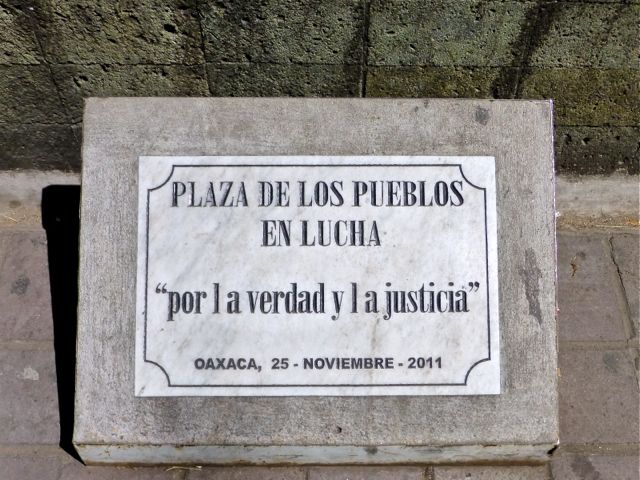
Plaque "Plaza de los pueblos en lucha." "por la verdad y la justicia" Oaxaca, 25 - noviembre - 2011

Last year a plaque was unveiled by organizations representing victims, survivors, human rights, and social activists.  Located where the Alameda de León meets the zócalo, it symbolically renames the zócalo, “Plaza of the peoples in struggle; for truth and justice.”

Man with cap looking at photos

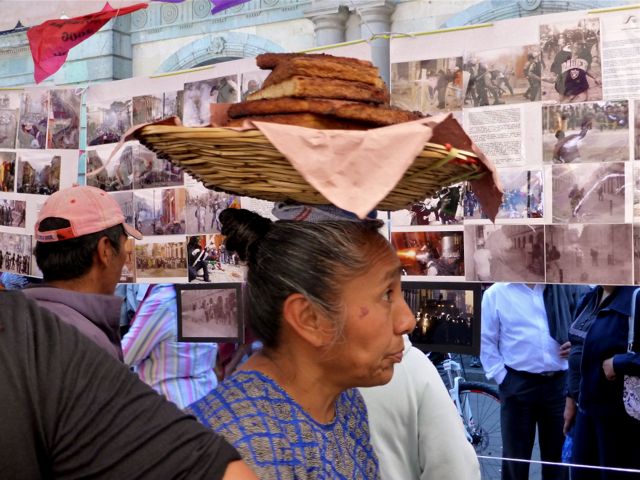
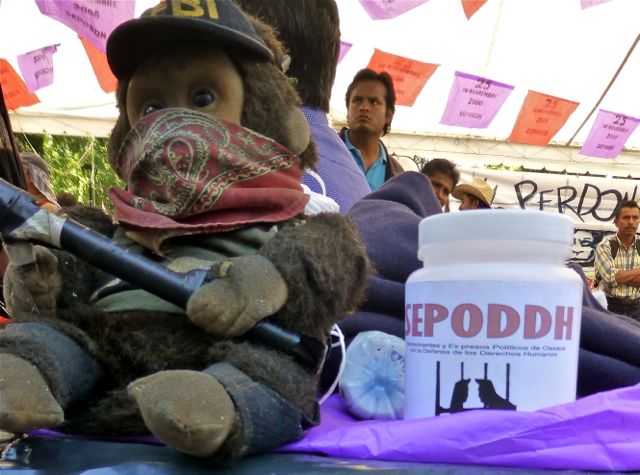
Truth and justice have not been attained, assassins go unpunished, many of the same issues remain, and Oaxaca’s economy still hasn’t rebounded.  Today, the Survivors and Former Political Prisoners of Oaxaca in Defense of Human Rights (SEPODDH) mounted a photo exhibition across from the Government Palace.

Women looking at photos, with a basket of sliced bread on her head.

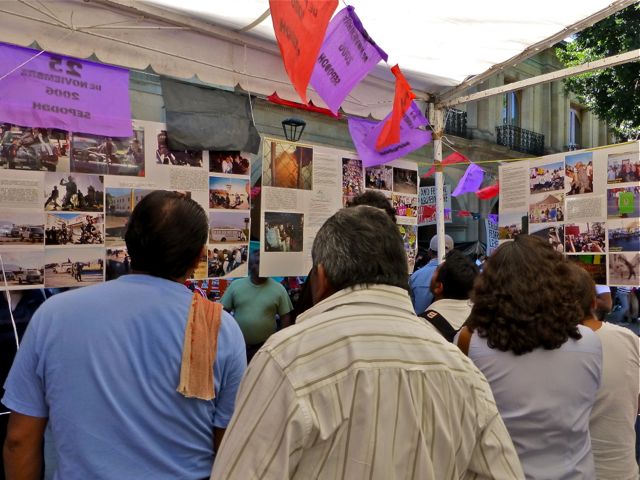
Adults, children, and even vendors stopped to look and, for many, remember those days and nights six years ago.

Crowd of people looking at photos

Somber and unsmiling, they stood silently, gazed at the photos, and read the captions.  The only hint of levity was SEPODDH’s mascota, who sat beside a collection bucket.

Plush monkey wearing bandana across his face.

Section 22 of the teachers’ union held another march and rallied in the zócalo, but today these photos spoke much louder than the words coming from the loud-speakers.

Read Full Post »

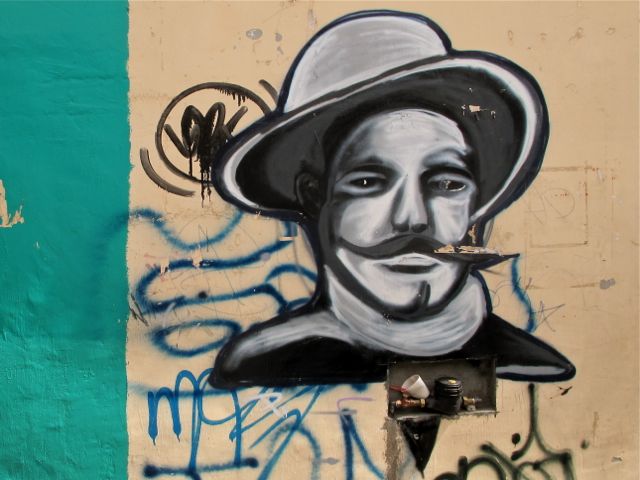
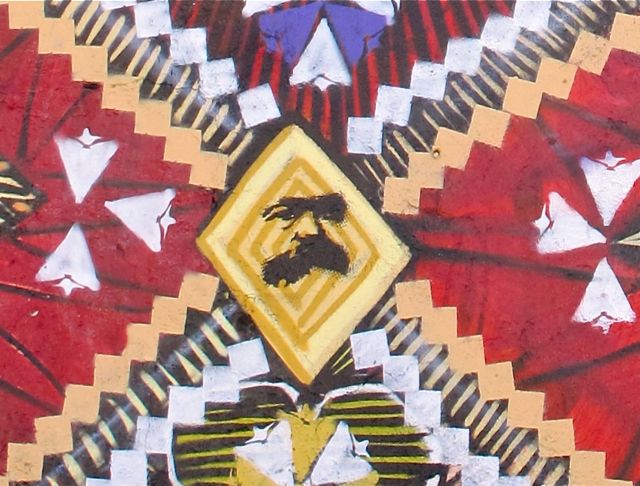
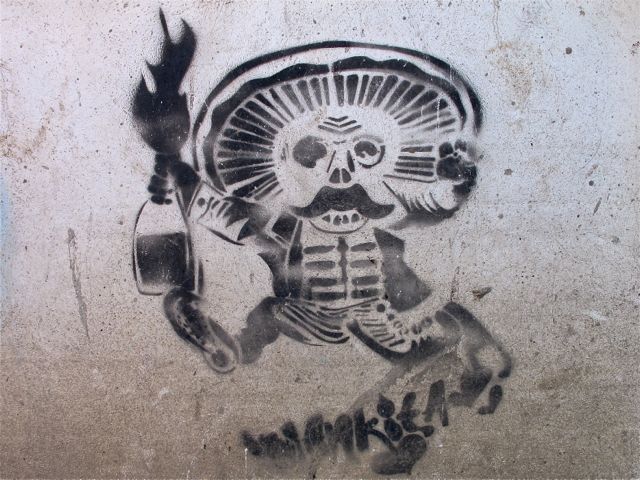
Zapata and Villa live!  Their iconic bigotes (mustaches) have taken on a life of their own on the streets of Oaxaca…

Wall art - Pancho Villa

Wall art tapete with Zapata's face in middle

Black and white skeleton face with mustache

Colorful wall mural of skeleton with mustache with female skeleton

Read Full Post »

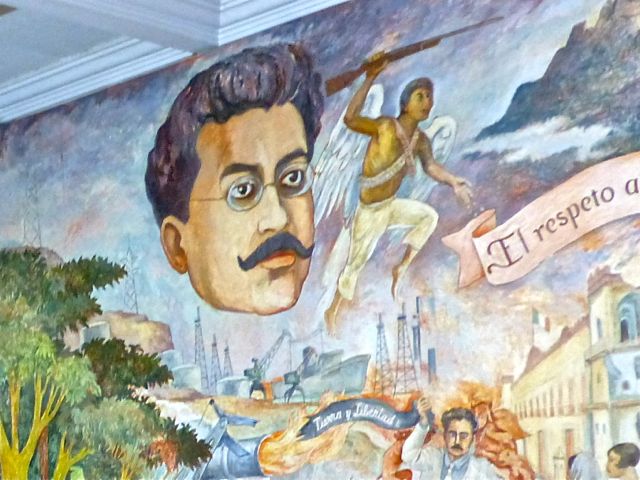
Last night I walked down to Oaxaca’s Palacio de Gobierno at the south end of the zócalo.  This former government palace is now a museum and I was headed up to the second floor to see two more Oaxaca FilmFest3 films.  I was early, the building was mostly empty, and so I took the opportunity to really study the mural that graces the walls of the main staircase.  Painted in 1980 by Arturo García Bustos, the mural depicts the history of Oaxaca.

Coming up the stairs, to the left, the customs and lifestyle of the Mixtecs, Zapotecs, and Aztecs of pre-Hispanic times unfold.

As you ascend further, on the right wall the Spanish conquest is portrayed.

However, it is the center section of the mural that grabs the attention.  Best seen when one reaches the top, here Bustos, pulls out all the stops in representing the one hundred years from the War of Independence through the Reform Movement to the Mexican Revolution.

Featured in the upper right corner of this panel, wearing his signature red bandanna, is War of Independence hero, José María Morelos y Pavón.  He can also be seen in the lower right with a printing press, in his role as publisher of Oaxaca’s first newspaper, El Correo del Sur.  On the upper left is anarchist and Mexican revolutionary hero, Ricardo Flores Magón.  He is also pictured holding a banner reading, Tierra y Libertad (Land and Liberty).  Flores Magón is the namesake of the street that borders the west side of the Government Palace.

However, front and center is Oaxaca’s favorite son, Zapotec, former governor of Oaxaca, and Mexico’s much beloved five-term president, Benito Juárez.  He and his Oaxaqueña wife, Margarita Maza, hover prominently above his Reform Movement cabinet.  The full text of the ribbon is a quote by Juárez, “El respeto al derecho ajeno es la paz” (Respect for the rights of others is peace).  It appears on the State of Oaxaca’s coat of arms.

Juárez is also pictured along with the cabinet and third from his right stands another Oaxaqueño, the young, menacing-looking, and far from beloved by the 99%, Porfirio Díaz, trademark epaulettes and all — a portend of things to come.

Following his death in 1872, the city and municipality of Oaxaca honored Benito Juárez by changing its name to Oaxaca de Juárez.

Save

Read Full Post »

As I write, it is late on September 15, and all over Mexico El Grito de Dolores, also known as El Grito de la Independencia (the Shout of Independence), is echoing from government buildings throughout the country, from the Palacio Nacional in Mexico City to Oaxaca’s Palacio de Gobierno to ayuntamientos (city halls) in small towns.

Mexicans!
Long live the heroes that gave us the Fatherland!
Long live Hidalgo!
Long live Morelos!
Long live Josefa Ortiz de Dominguez!
Long live Allende!
Long live Aldama and Matamoros!
Long live National Independence!
Long Live Mexico! Long Live Mexico! Long Live Mexico!

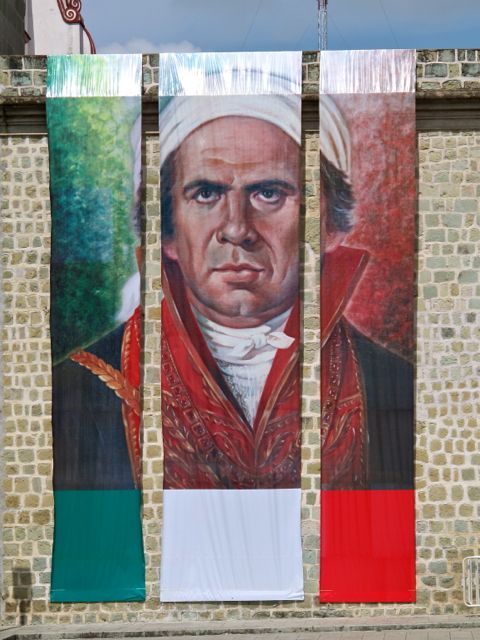
Portraits of the above listed heroes of Mexico’s War of Independence from Spain hang from the Government Palace in Oaxaca, as well as from the Municipal Building facing the Plaza de la Danza.

Massive 3-piece banner portrait of Morelos hanging from wall of Oaxaca's Municipal Building

And, this year, José María Morelos y Pavón is honored with a second massive portrait on the outer wall of the Municipal Building.  Last year, it was a reproduction of Orozco’s dramatic painting of Miguel Hidalgo y Costilla.

Read Full Post »

El Grito not only heralds green, white, and red decorations, clothing, and Mexican flags.  It is also the season to savor the multi-layered, delicate flavors of Chiles en Nogada and delight in its colorful, patriotic presentation.  Legend has it, the dish was created in 1821 by nuns in Puebla to honor a visit by Mexican General Augustín de Iturbide, that pretty much signaled the end of the eleven-year long Mexican War of Independence.

There are probably as many recipes for Chiles en Nogada as there are chefs and abuelas, but the basics include green poblano chiles stuffed with a picadillo of meats, fruits, nuts, herbs and spices; served with a creamy white cheese and walnut sauce; and topped with a garnish of red pomegranate seeds, walnuts, and the green of chopped parsley.

Serving of Chiles en Nogada on a white plate.

This was my lunch of Chiles en Nogada today at La Popular, a delightful new restaurant in Oaxaca (Garcia Vigil 519, Centro).  Yummm….

(ps)  Chris just posted this video of Lina Fernandez making Chiles en Nogada.  She makes it look almost doable!

Read Full Post »

The word "ASK" written on white wall with light green trim on left

Where else have you seen El Grito decorations?

Blue and peach colored school decorated with Mexican flag banners and drapes

Schools, of course!  This one in Teotitlán del Valle.

People standing in front of newsstand decorated with a green, white, and red garland.

And, how about newsstands?  You can’t miss the green, white, and red — it’s everywhere!

Read Full Post »

« Newer Posts - Older Posts »