Feeds:
Posts
Comments

Archive for the ‘Environment’ Category

On this Earth Day, I thought I’d post photos of the Matria, Jardín Arterapéutico project.  These were taken 3 weeks after my previous visit.  Despite 90+° (F) temperatures since the garden was planted, it is thriving and very few plants have been lost.

The key to the garden’s success?  Megan Glore and her team of volunteers are listening to what the plants are telling them and responding accordingly — just as we should all be doing with Mother Earth.

Read Full Post »

Sign in tree "Los arboles son vida cuidalos

Life goes on within you and without you.  – George Harrison

Read Full Post »

No Danza de la Pluma, no convite, no patronal festival.  The Templo de la Preciosa Sangre de Cristo in Teotitlán del Valle on an ordinary day…

P1040237_crop

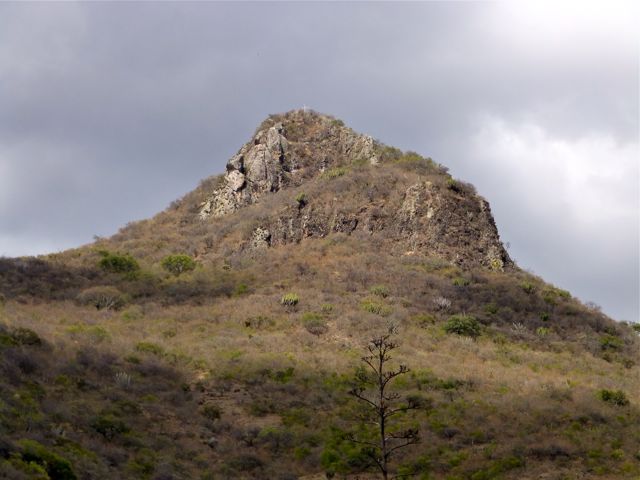
El Picacho up close and personal…

P1040240_enh

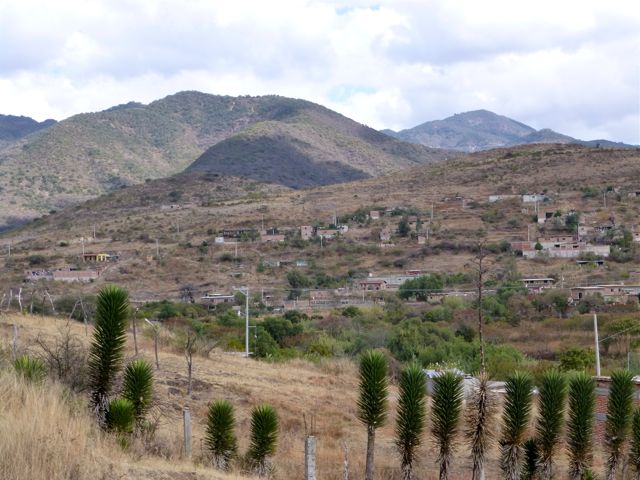
And, the hills where my young Zapotec friend, Sam,  “grew up… looking after [his] crazy goats!”  He is currently finishing a PhD in Sustainable Manufacturing at the University of Liverpool.  I see a connection.

P1040243_enh

Even unplugged, the hills were alive with the sound of music — a banda could be heard in the distance — a Teotitlán del Valle soundtrack.

Read Full Post »

Fifteen hundred years may have passed since Monte Albán was in full bloom as the center of Zapotec civilization.  However, the flowering continues…

This slideshow requires JavaScript.

Monte Albán on an early October morning.

Read Full Post »

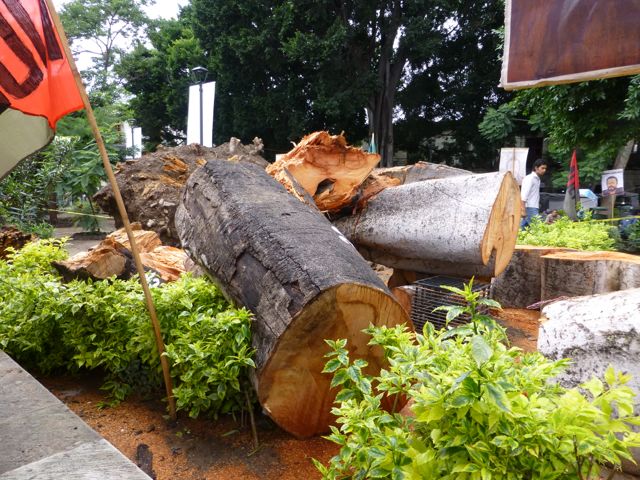
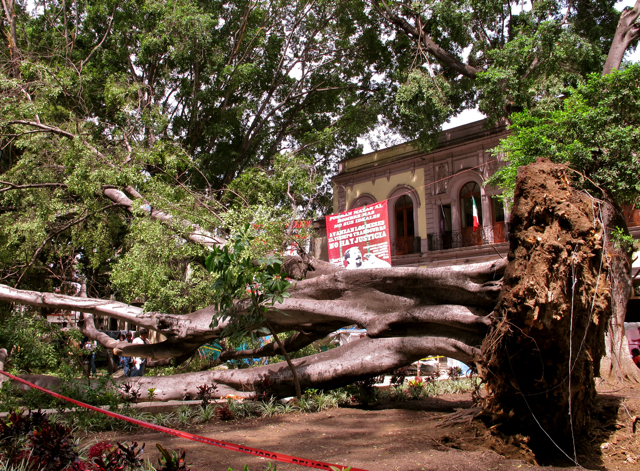
Instead of the coming of age novel, A Tree Grows in Brooklyn, we have the real life drama of a tree falls in Oaxaca.  Heading down to the mercado this morning, I was brought up short by this heartbreaking sight.

Large trunk of tree uprooted from ground.

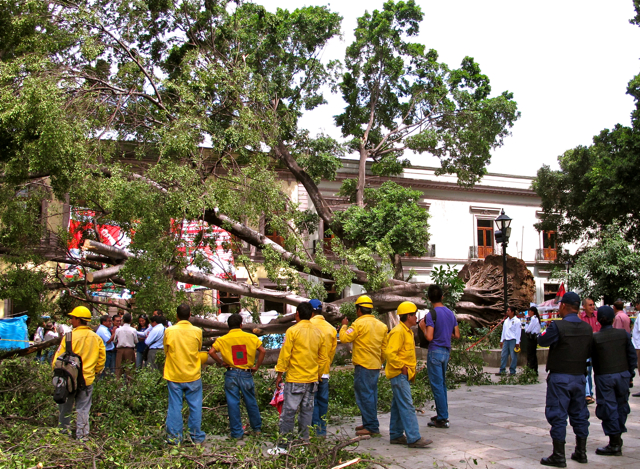
According to reports, there were many present to hear and see one of the grand 130+ year old Indian laurels topple during a storm on Saturday night.  And, worst of all, ten people were injured, two seriously.  Trees in the city, including Indian laurels in the Zócalo, have been plagued by adversity.  A laurel in the Zócalo fell a few years ago, damaging a nearby building, and most recently in May 2011, I wrote about a laurel on the Alameda that toppled.  Resurrection was attempted and guy-wires remain to this day holding it upright.  I guess the experts decided this latest one was beyond rescue.

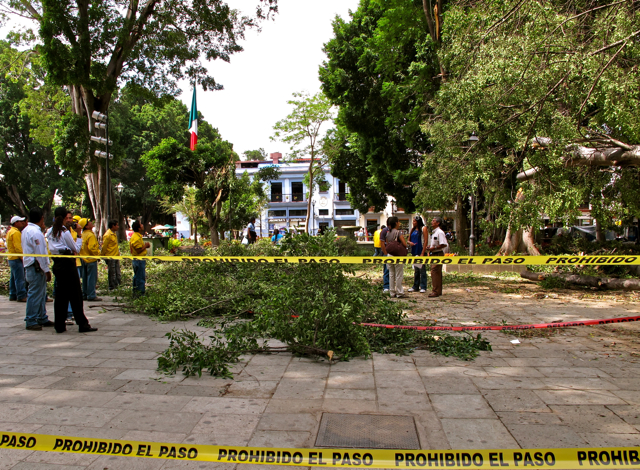
Large tree cut into pieces

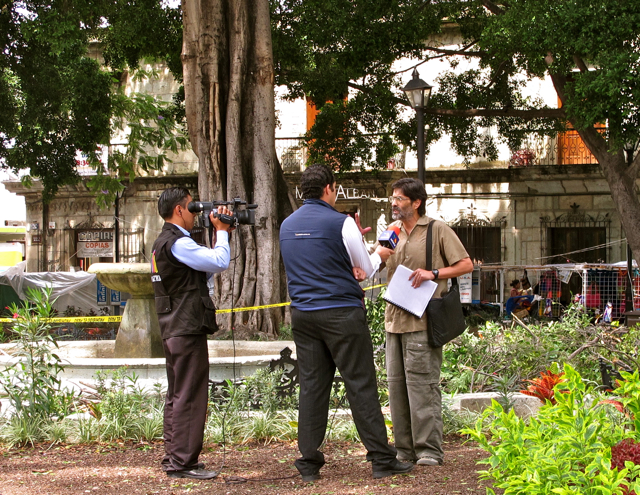
Controversy reigns, as many assert that these trees should be able to withstand the rain and less-than gale force winds.  Thus speculation over the cause runs rampant.  Root rot appears to be the immediate culprit but the big question is, why?

Pile of massive wood logs

And, as Chris sadly noted a couple of months ago, regarding the diseased flamboyant trees in front of Santo Domingo de Guzmán, Any tree is hard to replace.

Read Full Post »

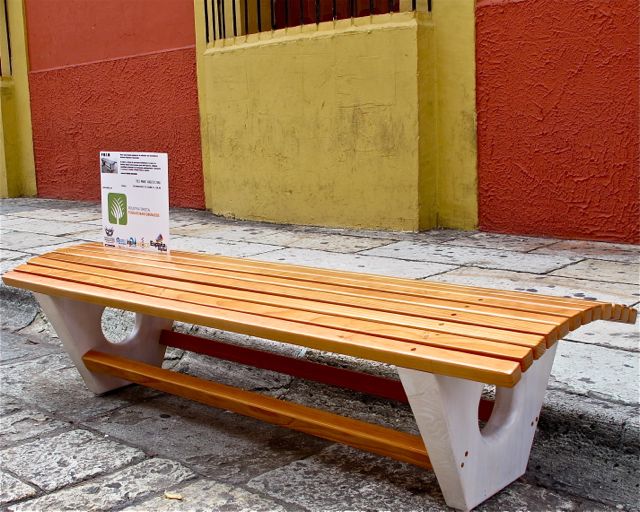
From Sangre de Cristo to Santo Domingo, along the Alcalá, one is now able to “have a seat.”

Wooden bench with a curved seat.

As part of the inauguration of the Me Siento Bien en Oaxaca (I Feel Good in Oaxaca) and to celebrate, International Youth Day, 13 pieces were created by students of the Faculty of Architecture Cinco de Mayo, the Free School of Art and Design, and the Urban Contingency B_root studio.

Slats of curved pieces of wood forming a bench

The theme was Evolution and the young people were charged with using recycled materials and innovative design.

Bench with metal seat with punched design, which is mirrored in the shadow on the paving stones.

I think they succeeded!

Brass looking metal bench reflecting paving stones, building, and lamp

Alas, it is only temporary; August 18 is the last day.


Circular double bench - metal and plastic.

However, according to a newspaper report, as a more permanent part of Me Siento Bien en Oaxaca program, benches “rescued by the City” will be put in public spaces.

Wooden boxes


Read Full Post »

As most of you have gathered, I love the music and people, life and color, and food and ferias, not to mention the year-round sun and warm weather of Oaxaca.  However, as I’ve mentioned before, there is much going on beneath the surface and it isn’t pretty.  So, even though it’s the middle of Guelaguetza (or, maybe because the spotlight is on the music, dance, and costumes of Oaxaca’s indigenous communities), I feel compelled to share today’s article by one of my favorite labor photographers and journalists, David Bacon.

Canadian Mining Goliaths Devastate Mexican Indigenous Communities and Environment

Wednesday, 25 July 2012 00:00 By David Bacon, Truthout | Report Email

An assembly last fall in Oaxaca of the Binational Front of Indigenous Organizations that called for a sustainable development policy that would support farmers as opposed to mega development projects. (Photo: David Bacon)An assembly last fall in Oaxaca of the Binational Front of Indigenous Organizations that called for a sustainable development policy that would support farmers as opposed to mega development projects. (Photo: David Bacon)

Oaxaca, Mexico – For over two decades in many parts of Mexico, large corporations – mostly foreign owned but usually with wealthy Mexican partners – have developed huge projects in rural areas. Called mega-projects, the mines and resource extraction efforts take advantage of economic reforms and trade treaties like the North American Free Trade Agreement.

Emphasizing foreign investment, even at the cost of environmental destruction and the displacement of people, has been the development policy of Mexican administrations since the 1970s. When the National Action Party (PAN) defeated the old governing Party of the Institutionalized Revolution (PRI) in 2000, this economic development model did not change. In fact, the PAN simply took over the administration of this development policy and even accelerated it, while in the Mexican Chamber of Deputies the two parties cooperated to advance its goals.

But while these projects enjoy official patronage at the top, they almost invariably incite local opposition over threatened or actual environmental disaster. Environmental destruction, along with accompanying economic changes, cause the displacement of people. Families in communities affected by the impacts are uprooted and often begin to migrate. Nevertheless, the projects enjoy official support and are defended against rising protests from poor farmers and townspeople by the federal government.  [Please read the full article HERE]

Read Full Post »

Mazunte was the first beach on Oaxaca’s coast I visited.  The beach is stunningly beautiful and uncrowded and accommodations lean toward the small and environmentally conscious.

View of Mazunte beach from hill above.

In addition to the appeal of the warm clear waters of its beach and digging your feet in the sand as you dine on fresh fish tacos, Mazunte is home to the Natural Cosmetics Cooperative, established by Anita Roddick, founder of the Body Shop.  The cooperative’s products (soaps, lotions, oils, mosquito repellent, etc.) are available in the city of Oaxaca at the weekly Friday/Saturday Organic Market in the plaza of Santo Tomás in the Xochimilco neighborhood.

Mazunte also houses the National Mexican Turtle Center, whose successful work is the subject of Tim Johnson’s recent blog post, Turtle Hatchlings Head for the Sea.


Read Full Post »

Just the thought of introducing genetically modified corn and the chemicals it requires into Oaxaca, where maíz has been cultivated (Just fine, thank you very much!) for thousands of years makes me sad and angry.  Education is growing, opposition is mounting, and alternatives to the profits-before-people-and-the-environment Monsantos of this world are being set up.  By the way, “agroecology” is a new word for me… and I like it!

From the February 20, 2012 Nation of Change

Native Farmers in Mexico Help Drive Local Eco-Friendly Farming

By Emilio Godoy

The largely invisible work of small local groups of indigenous farmers in Mexico who are spearheading the defense of their territory and identity and of native seeds is strengthening ecologically sound family farming, experts say.

“For thousands of years, indigenous people have been responsible for developing agricultural biodiversity,” Narciso Barrera, a researcher at the public Autonomous University of Tlaxcala in southern Mexico, told IPS. “However, these efforts remain basically invisible, and they should be highlighted and linked with other local movements.”

Since 2000, Barrera has worked on mapping Mexican political ecology, a discipline that studies the relationships between political, economic and social factors and environmental issues and changes.

<snip>

“Agroecology is the key, because it encompasses social aspects, education, economics and farming practices,” said Barrera, who has published the results of his studies in the Spanish journal Papeles de Relaciones Ecosociales y Cambio Global (Papers on Eco Social Relations and Global Change).

I encourage you to read the full article.

Read Full Post »

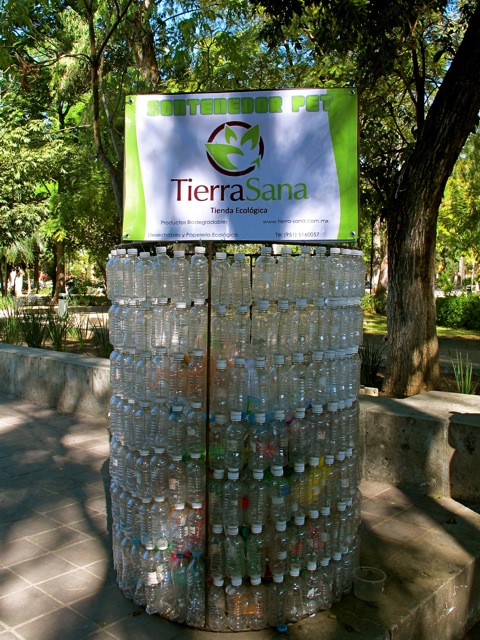
The day before I went up to Mexico City last month, crossing Llano Park, I came across a newly installed waste container encouraging plastic recycling; courtesy of Tierra Sana, a company promoting and selling environmentally friendly products.

Waste basket made from plastic bottles with a Tierra Sana sign on top

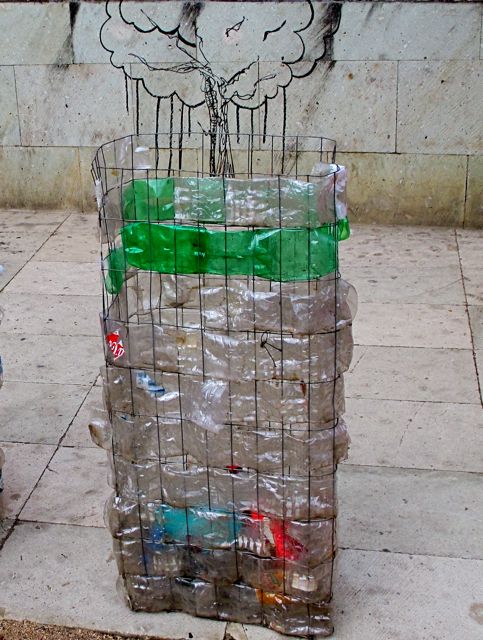
These baskets have cropped up in other parts of the city — this one in the plazuela next to Carmen Alto church.  Please know, the trees will cry if you don’t recycle.

Plastic bottle recycling bin with graffiti drawing of a tree crying in the background.

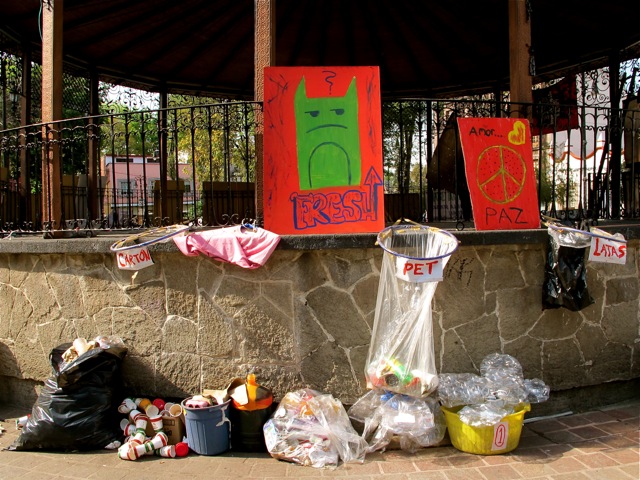
Once up in Mexico City, I noticed Occupy Coyoacán practiced recycling.

Overflowing recycling bags lined up along bandstand.

And then, we were all brought up short by this electric car…

Silver Nissan electric car getting charged at charging station in the street.

These charging stations are not far from the Templo Mayor; an appropriate juxtaposition, I think.  Automobile pollution can’t be good for the Great Temple.

GE charging station

Then there is bike-sharing — 1200 bikes at 90 Ecobici bike stations in Mexico’s capital city.

Red Ecobici bicycles lined up on bike rack.

For more on Mexico City’s Green Plan, check out 10 Highlights of Mexico City’s Climate Action Program.

Read Full Post »

At various times in her past, La Ciudad de Oaxaca has been referred to as the “Emerald City” and “City of Jade,” because of the green cantera stone used to construct her buildings and pave her sidewalks.  On rainy days when sun seems to magically appear, I’m tempted to look behind closed doors for the Wizard of Oz.

Cantera sidewalk

Today a new kind of green is catching on.  No, not money, green technology — though money most certainly figures into the equation.

Several, mostly international, companies have established wind turbine farms in the Isthmus of Tehuantepec over the past several years.  And, anyone who has driven along the carretera (highway) down there, can understand why.  However, I would be remiss not to mention, as a NACLA article explains, La Ventosa is a controversial endeavor.

Wind turbines along the highway on the Isthmus of Tehuantepec

Less controversial, was a two-day conference, billed as the first International Forum on Renewable Energies, held this week in the “City of Jade.”  Organized by the Technological University of the Central Valleys of Oaxaca (UTVC) and the Statistics and Information Center for Development (CIEDD) of the State Government, its main objective was to raise awareness, share knowledge, and promote further research, dissemination, and development.

While panels, discussions, lectures, and workshops were held in the Cultural Center of Santo Domingo, outside, at the intersection of Constitución and 5 de Mayo, exhibits by the university students were set up for conference attendees and passers-by to see.

Small model of a solar thermal house

According to the information posted, above is a prototype solar thermal house, that harnesses the sun’s energy and utilizes “healthy for the environment” building materials of natural fibers to provide durability and thermal-insulation.

And then there was this one… close to this rooftop gardener’s heart:

Composting rectangular box

The project explains vermiculture biotechnology was virtually unknown here until recently.   California red worms were used to convert waste from San Pablo Huixtepec and obtain a dark and rich loam.

Rich soil in composting box

I confess, I coveted it!  However, I really am quite pleased with the results I’m getting by freezing my green kitchen waste for several days and then mixing it with the, less than ideal, soil purchased from a local vivero (nursery).  In a week, the organic matter has completely broken down and I’m left with great potting soil.

Read Full Post »

Oaxaca has been trapped in a low pressure trough that, according to Conagua, stretches from Chihuahua to Oaxaca and is bringing moisture from both the Pacific Ocean and the Gulf of Mexico.  It’s made for dramatic sunsets!

Pink clouds against purplish-blue sky

And, for the past three nights it’s brought spectacular sound and light shows… lightning streaking across the night sky in a 360 degree circle around the city; the rumbling of thunder in the distance and loud cracks when it hits close to home; torrential downpours and hail, even though it’s 80 degrees F (what’s up with that?); and hurricane force winds.

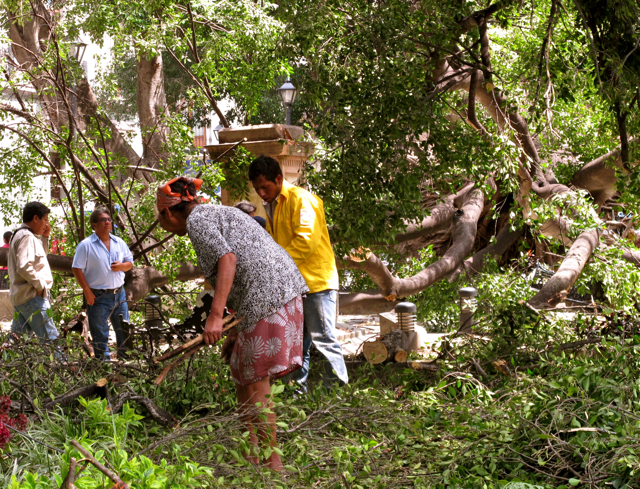
It was all too much for one of the massive 130+ year old Indian Laurel trees on the Alameda…

Trunk of fallen tree

El Instituto Estatal de Protección Civil was on the job, roping off the surrounding area with yellow and red caution tape.

Yellow caution tape blocking off area around fallen tree

Workers gathered to receive their instructions,

Yellow jacketed workers in front of fallen tree

environmentalist and artist Francisco Verástegui was interviewed by TV Azteca Oaxaca,

Man being interviewed by Azteca TV about fallen tree

a rope was placed around one of the limbs,

Rope around fallen tree limb

chain saws revved-up, as scavengers went about their work gathering twigs and small branches…

Man with chain saw and woman gathering small branches of fallen tree

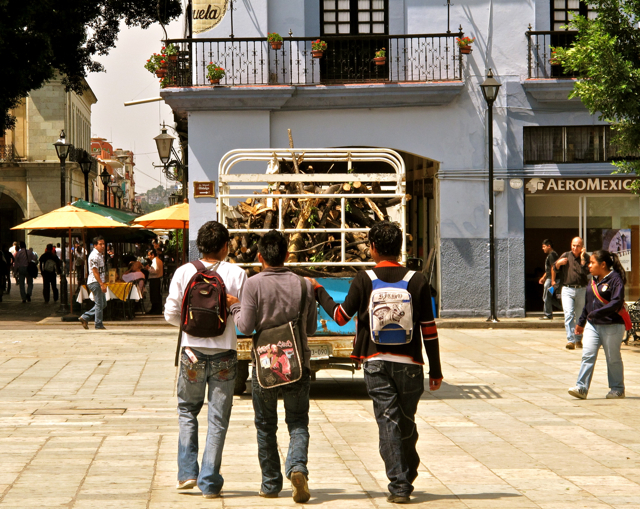
and a truckload of the precious firewood departed the Alameda with a youthful escort.

Truck carrying chopped wood from fallen tree departs Alameda with three boys following behind

According to today’s news, this laurel tree wasn’t the only victim of these storms; other fallen trees crushed cars, power went out, and flooding occurred.   However, as they say, “ojala,” no human casualties have been reported.

Read Full Post »

And now a pause in our Semana Santa coverage…

Yesterday was a momentous day at Casita Colibrí.  I arrived home just in time to watch the removal of my late, previously mentioned, but definitely not lamented, baby-size tinaco and the installation of my gigunda, new, and much wished for, tinaco.  It was a sight to behold!

This slideshow requires JavaScript.

These guys looked so young… but worked efficiently and seemed to know exactly what they were doing.  I sure hope so!

Fingers and toes, but not eyes, are crossed that this will, at long last, solve my every-other-day lack of water problem.

Read Full Post »

Today’s topic on Fresh Air was The Worldwide Thirst for Clean Drinking Water, in which, the program’s website states,  “Investigative reporter Charles Fishman says the past 100 years have been the golden age of water in the developed world — but now that’s about to change.  He profiles communities grappling with water shortages and details the efforts to conserve water in The Big Thirst.”

In the interview, Fishman makes the point that in the USA, “We don’t even take [water] for granted because taking it for granted would suggest we pay attention to it.”  Not so, living in Mexico; water is considered precious and, thus, respected and conserved.  Water deliveries, be they the non-potable I wrote about yesterday, or listening for the vendors of garrafons (1 equals 20 liters) of drinking water shout from their pickup trucks, “¡Agua!… ¡Agua!… ¡Agua!,” are an important part of daily life here.

I highly recommend clicking on, The Worldwide Thirst for Clean Drinking Water to hear Terry Gross’s interview with Charles Fishman, discussing his new book, The Big Thirst: The Secret Life and Turbulent Future of Water.

My garrafon of veggie and fruit washing, drinking, cooking, and teeth brushing water…Garafon of water with plastic pump

Yikes, it’s raining… gotta go put out my buckets to catch rain to store in my garden watering barrel!

Read Full Post »

Gravity fed

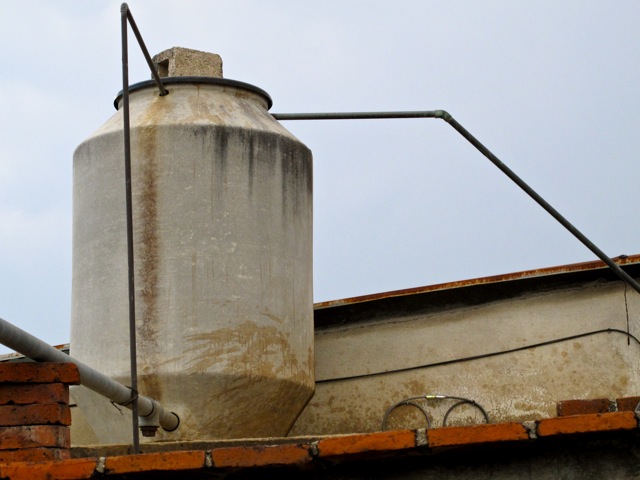
Flying into any airport in Mexico, you see them, Mexico’s ubiquitous rooftop water delivery system, the tinaco.  This is mine…

Tinaco

After living with and cursing it for the past 16 months, word has it I might be getting a newer and larger one.  Even though I’m not superstitious, I’m keeping my fingers crossed!

*** For those of you who are dying to know how the water system here works:  Municipal water is regularly  (or, not so regularly) pumped into an aljibe, a storage tank under our courtyard and driveway; a bomba (pump) is run daily for an hour to bring water from the aljibe up into the tinacos sitting on the various rooftops of the apartment complex.  When we turn on our tap, water flows (or dribbles) from our faucets courtesy of gravity.

I might add,  this is non potable water.  Drinking water is a completely different story…

Read Full Post »

« Newer Posts - Older Posts »