Feeds:
Posts
Comments

Archive for the ‘Education’ Category

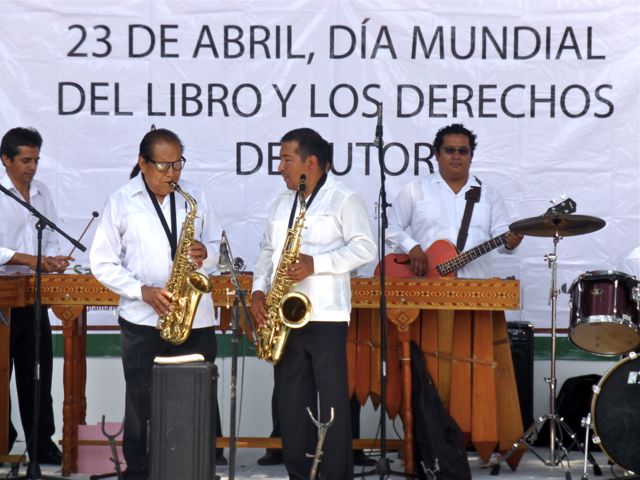
This librarian couldn’t let this go by without a mention… Today is World Book Day and, naturally, Oaxaca celebrates with music!   Under the shade of 130+ year old Indian laurel trees on the zócalo, the State Marimba Band opened the festivities.

P1030861According to the SECULTA website, the celebrations also include storytelling and a marathon of reading aloud from works by Octavio Paz, José Emilio Pacheco, José Revueltas, Julio Cortázar, Efraín Huerta, Juan Gelman, Juan Ramón Jiménez, and by the recently deceased and much revered, Gabriel García Márquez.

While the zócalo and Alcalá are the settings for book fairs several times a year, most of the public libraries are inadequate to fulfill their designated tasks and the price of books (200 to 300 pesos) is way beyond the reach of most of the state’s residents.  Thus, it should surprise no one that reports show Oaxaqueños read an average of only one book per year.   The secretary of Cultures and Arts of Oaxaca ( SECULTA ), Francisco Martínez Neri, acknowledged, “A people with few economic opportunities read little, so it requires the creation of public policies to have books at affordable prices.”  Programs like Libros Para Pueblos, try to fill the gap, but it’s only the proverbial drop in the bucket.

I’ve previously mentioned the controversial “education reform” program of Mexico’s current president, Peña Nieto.  Perhaps, a massive nationwide literacy campaign modeled after the wildly successful, Cuban Literacy Campaign of 1961 would be a good place to start.  Maybe the education reformers should read, Latin lessons: What can we learn from the world’s most ambitious literacy campaign?

Read Full Post »

As I’ve mentioned before, Oaxaca is one of the most indigenous and (no surprise) one of the poorest states in Mexico.  And, the Triqui of the Mixteca region of Oaxaca are some of the state’s poorest residents.  They have recently come to the attention of sports lovers, as a result of the heartwarming story of their youth basketball team, dubbed the Barefoot champions of the mountains.

However, while their success story makes us feel good, it is rare.  Political violence and poverty continue to chase the Triqui out of their beautiful and ancient mountain communities in search of a better future for their families.   And, discrimination continues to follow them into el norte.  To add to the strikes against them wherever they go, Spanish is not their native language — the state of Oaxaca is home to 16 distinct ethnolinguistic groups, with Triqui being one.  And so, the story of Bernadina Hernandez and her grassroots efforts in Hollister, California should be known, appreciated, and celebrated.

A little background information…

Muchisimas gracias a Jody for turning me on to Bernadina’s story.

Read Full Post »

Walking down the Alcalá… on the way home late yesterday afternoon… sounds of a band… I look up towards Santo Domingo… and see a calenda coming down the street.

Universidad La Salle Oaxaca on parade.  Reason # 552 why I love living here!

Read Full Post »

Expats and Mexicans alike, are watching in amazement at the nonsense (as in, making NO sense) taking place in the hallowed halls of Washington DC.  And, since many of the expats are retired, we are holding our collective breath over the possibility social security checks will not be forthcoming in November and a tanking stock market that flushes our nest eggs away.  Of course, Mexico is in the middle of its own mess, “educational reforms” and economic proposals that will hurt Mexico’s working class and rural populations the most.

Wall in Oaxaca city.

Wall in Oaxaca city.

In a New York Times article two days ago, Carlos Puig explains the reality of the material conditions that have forced the teachers of Oaxaca to take the drastic action of abandoning their classrooms to lead massive and extremely disruptive protests in Mexico City against the “No Child Left Behind” style reforms that the Peña Nieto led government has proposed and passed.  (Read a critique of the US education “reform” by Diane Ravitch, former “No Child Left Behind” proponent, here.)

Oaxaca is 500 kilometers from Mexico City, yet the real distance is much bigger. The state’s G.N.P. per capita is one-quarter the average for the country. Oaxaca ranks second-to-last among all states in infrastructure. More than half its population lives in towns of fewer than 2,500 people.

Being a teacher in Oaxaca means sometimes having to travel for an entire day to reach your school in a tiny community, teach for three days — to children of all grades — and travel back home for the weekend. It means having to deal with children who speak more than 20 different dialects.

Being a teacher in Oaxaca means operating in a different universe — and under different rules.

Banner hanging in front of a school in Oaxaca city

Banner hanging in front of a school in Oaxaca city

However, as in the USA, the incomprehensible words coming out of the mouths of the 1% and their elected representatives are mind-boggling in their obliviousness to the adverse consequences their behavior and policies cause.  And, we scratch our heads in amazement…  McClatchy journalist, Tim Johnson, has repeatedly blogged about the exceedingly “bad” behavior exhibited by Mexico City’s rich and powerful directed at those they consider “below” them — most recently, Las Ladies, episode 7.  And, just last week in Oaxaca, most were aghast to read that an indigenous woman, in the advanced stage of labor, was turned away from a hospital and forced to give birth on the hospital lawn.

Daniel Goleman had a revealing piece in the New York Times a few days ago that helps explain where this lack of empathy the ruling elite exhibit, that results in callous social policy, comes from.  He explains in Rich People Just Care Less that, by necessity, “the poor, compared with the wealthy, have keenly attuned interpersonal attention in all directions…”  And that, “A growing body of recent research shows that people with the most social power pay scant attention to those with little such power” and, “In politics, readily dismissing inconvenient people can easily extend to dismissing inconvenient truths about them.”

Okay, now we know why the rich care less, so what are we going to do about it?

Part of a mural on Niños Heroes in Oaxaca city.

Part of a mural on Niños Heroes in Oaxaca city.

Read Full Post »

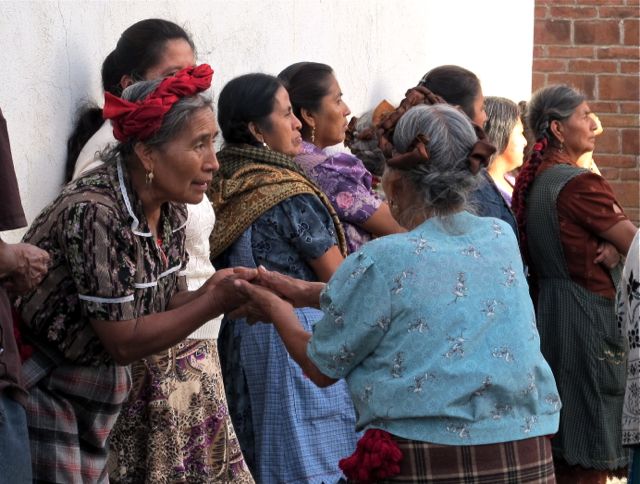
I adored my maternal grandmother.  She was short and plump with a crown of white hair framing a broad round face.  Her life wasn’t easy and years of hard work lined her face, but it was a face dominated by wise and remarkably kind eyes.  I see the same strength and wisdom and loving presence in the abuelas of Oaxaca.  Across years and miles, they bring a little of my grandma back and it makes me smile.

This slideshow requires JavaScript.

And, speaking of Oaxaca’s awesome abuelas…

Mexican grandmother graduates from primary school at age 100

By Luc Cohen

MEXICO CITY | Wed Jun 26, 2013 11:30pm IST

(Reuters) – You’re never too old to learn: Mexican grandmother Manuela Hernandez has finally graduated from primary school – at the age of 100.

Born in the southern Mexican state of Oaxaca in June 1913, the year before World War One began, she left primary school after just a year to help her poor family with household chores.

Hernandez only resumed her studies in October at age 99 at the recommendation of a grandchild, and she was handed her diploma at a celebration on Saturday.

“I liked school very much, but I could not continue studying,” she told Uno TV. “By the next year I could already wash and iron.”

Hernandez will continue her studies in secondary school.

More than half of Oaxaca state residents older than 15 have not completed primary education, the second-highest rate in the country behind neighboring Chiapas, a state education official said. (Reporting by Luc Cohen; Editing by Simon Gardner and Cynthia Osterman)

You might want to also take a look at this brief video of Manuela Hernandez explaining why she had to leave school as a child.

Read Full Post »

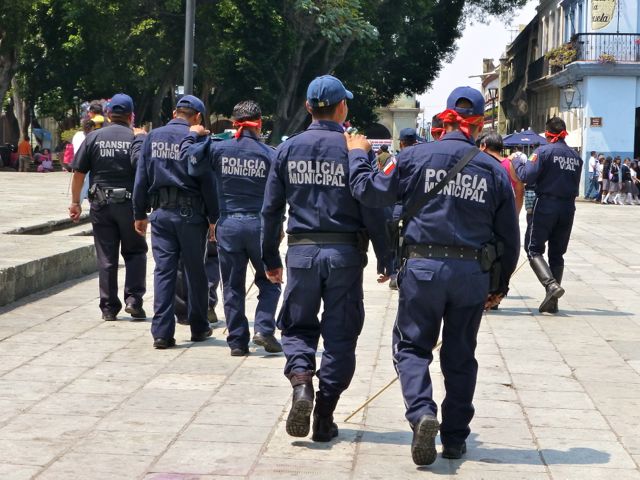
… in their shoes.  A couple of weeks ago, as I crossed the Alameda, I came across the following scene.

Blindfolded Municipal Police

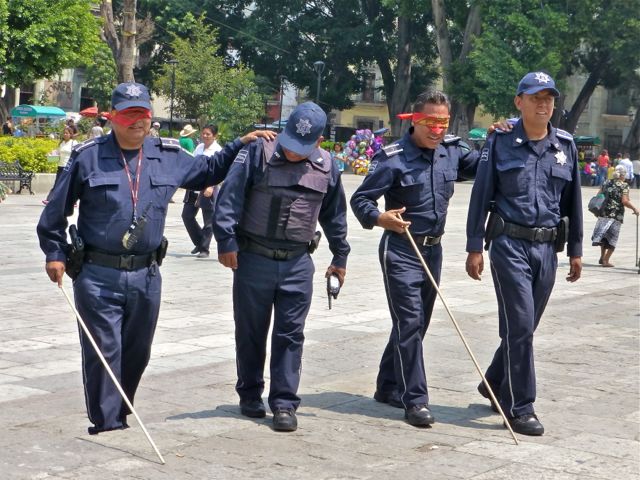
According to this article in Noticias, this is part of the Blind Accessible Tourism 2013 project of the Municipal Tourism Office.  “During the tour, the participants experience the uncertainty that visually impaired people feel when walk the streets, and reflect on the importance of signs with street names written in Braille and audio traffic lights,” said Vladimir Martinez Lopez, who has been blind since age 11 and is the instructor for the course.

I blogged about the Braille street signs and the library for the blind and visually impaired soon after the signs began appearing at the beginning of 2012.  Since then, I’ve seen them used by the sightless and intrigue and stimulate conversation among the sighted.

Blindfolded police walking with white canes

Now if they could just do something about the hazards of crossing the street at the intersections.  Be they cars, buses, trucks, or motorcycles, they do not stop before turning a corner.  Visually impaired or sighted, it’s like playing Russian Roulette!

Read Full Post »

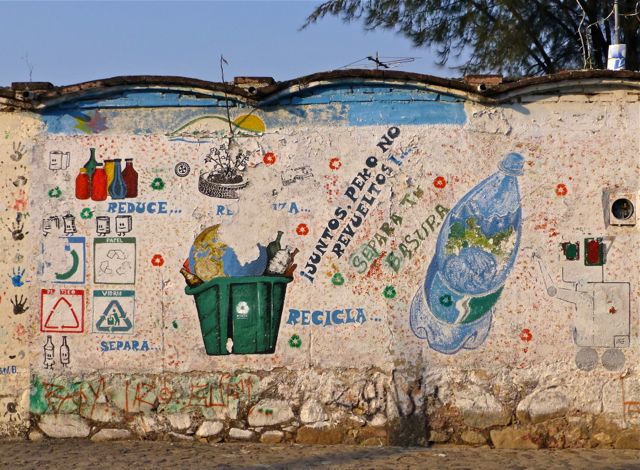
Wall art demonstrating "reduce, separa, recicla"

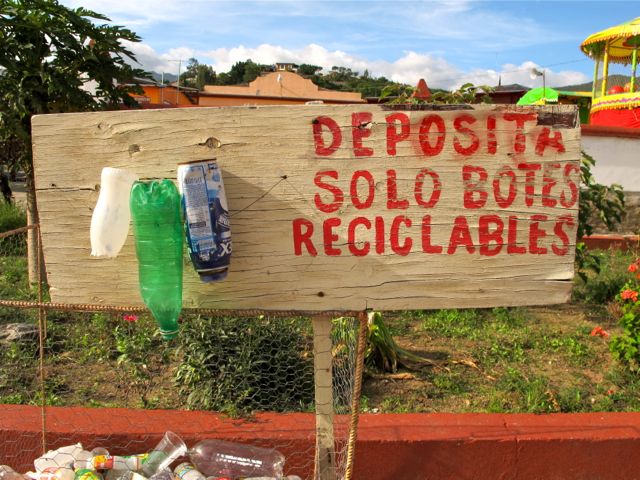
Sign "deposita solo botes reciclables with 3 plastic bottles nailed to it

Sign "deposita solo botes reciclables" and basket 1/3 filled with plastic bottles underneath

Chicken wire bin 1/3 full of plastic bottles

Educating the public in Teotitlán del Valle.


Read Full Post »

In 1999, UNESCO designated February 21 as International Mother Language Day.  Tomorrow, February 20, Oaxaca begins her own celebration of Día Internacional de la Lengua Materna 2013 with a 2-day conference.

dia internacional de la lengua materna oaxaca 2013

The issue of “lenguas maternas” has a particular resonance in Oaxaca, as the state is home to 16 distinct ethnolinguistic groups:  Amuzgos, Chatino, Chinanteco, Chocho, Chontal, Cuicateco, Huave, Ixcateco, Mazateco, Mixe, Mixteco, Náhuatl, Popoloca, Triqui, Zapoteco, and Zoque.  As anyone who has visited the villages of Oaxaca has discovered, sometimes the abuelos and abuelas only speak their native language, not Spanish.

However, as Ernestina Gaitán Cruz notes in an article in sinembargo.mx, most of these indigenous languages lack an alphabet, having been passed from one generation to another through an oral tradition, and because these “Mother Tongues” are not taught in the schools, a significant number of these languages are in danger of becoming extinct.

Oaxaca is not alone.  From the article, Indigenous Youth Step up to Protect their Roots:

UNESCO estimates that every two weeks, one language disappears from the world.

Education systems have historically played a large part in the disappearance of indigenous languages, sometimes even forcing their extinction by severely punishing and shaming children for speaking native tongues or expressing indigenous identity in any way.

<snip>

In some communities where a large portion of the population speaks only the native language, another issue arises: access to important information on topics such as health care, employment opportunities, legal rights and public services.

And, it isn’t just a particular community that suffers, as The Endangered Languages Project explains, The disappearance of a language means the loss of valuable scientific and cultural information.

Zapotec village of Teotitlán del Valle

Zapotec village of Teotitlán del Valle

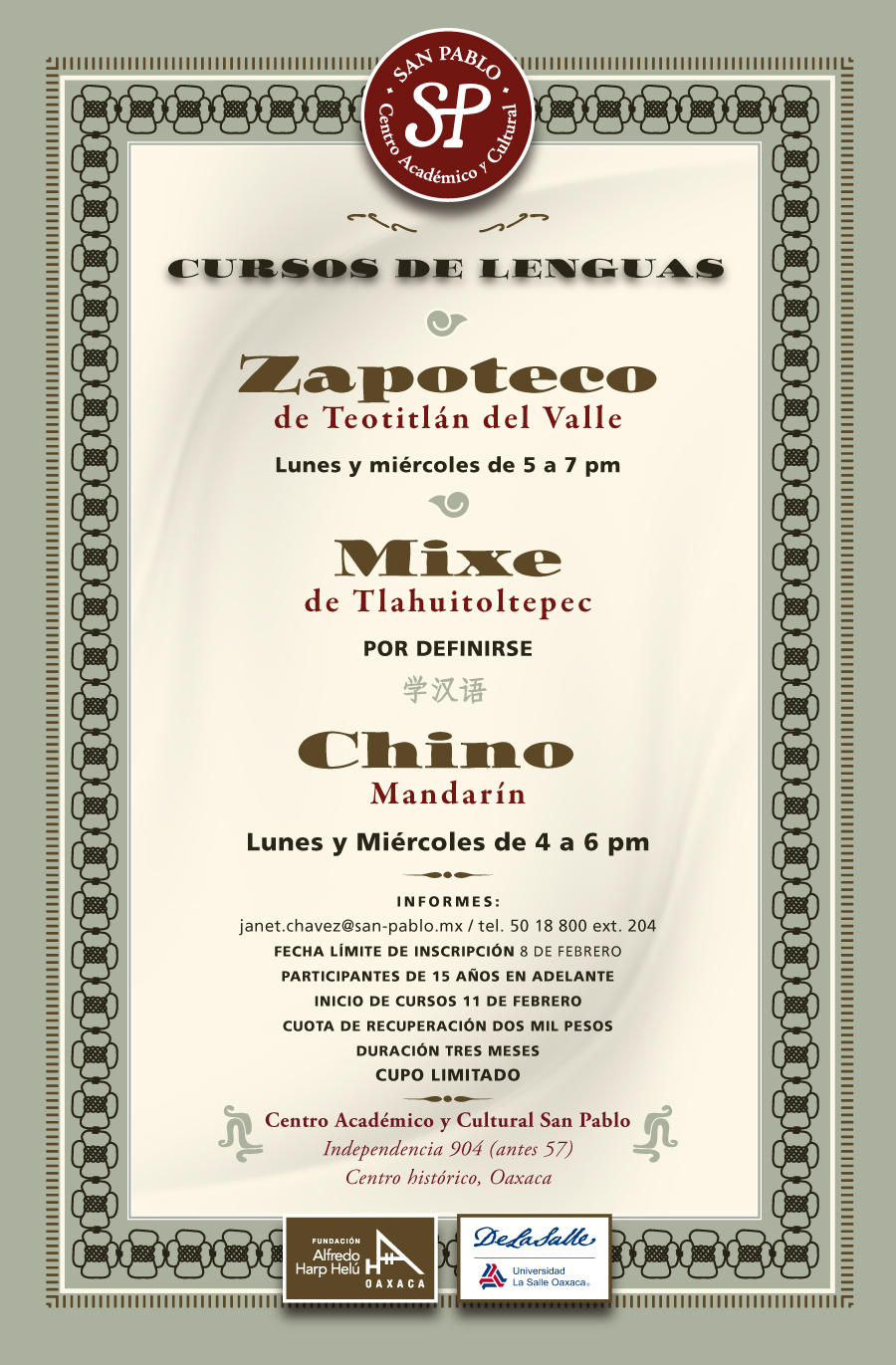
One of the missions of the Centro Académico y Cultural San Pablo in the city of Oaxaca is to document, study, and preserve the indigenous languages of Oaxaca.  The center includes a library, offers language classes, and will be hosting several events during Día Internacional de la Lengua Materna 2013.

Cartel-web-cursos-2013

Read Full Post »

Recently, I was on the US east coast visiting with family.  Most of the time was spent with three teachers; my sister-in-law who retired after 30+ years of teaching in the Massachusetts public school district, my daughter-in-law who, after teaching in a public school in Connecticut, is currently a teacher in New York, and my son who is a college assistant professor.  They, along with all — not most, all — of my teacher friends in the US, decry the damage No Child Left Behind has wrought.  And, even one of its major proponents, Diane Ravitch, has done a 180 and is now leading the charge against it.  If you are interested, take a look at the Terry Gross interview with her in April 2011.

One of the issues the teachers of Oaxaca are protesting is the Alliance for Quality Education (ACE), modeled after No Child Left Behind.  Thus, the following thoughtful post on the Oaxaca Study Action Group website by Nancy Davies, resonated.

personal note re the Section 22 teachers union strike

I applied for a my first teaching job in Boston. First I took the universal teacher evaluation test, by which the highest scoring were first hired for positions. Then I waited.

By October (school began in September) it was clear that although my score for Boston applicants was third from the topmost person, something fishy was happening. I called the school department. All apologies, they assigned me a school the very next day,from which another teacher had just resigned. It was in an all black (pre-integration) neighborhood of all black kids whose school had no new textbooks and few old ones. There were no functioning bathrooms for the kids, at times of the month when adolescent girls seriously wanted a bathroom and a place to get clean, they stayed home. The boys were often recruited by the male teachers to buy dope. The best joke: the kids put a family of newborn rats in the desk drawer of one teacher. Another joke: hang a fellow student out the window over the asphalt yard by holding his ankles.

I survived, the kids maybe survived. I learned a couple of things: 1) hungry badly treated kids don’t study. 2) teacher tests don’t mean shit.

So here I am surely one of few who supports what Section 22 is doing and saying. Yes, I know the union was corrupted by PRI governors and caciques; and abuses, such inheriting a teaching job, are numerous. I also know that for 27 years Section 22 has been pushing for better salaries but simultaneously for shoes, paid-uniforms, books, bathrooms, breakfasts. I visited the current encampment in the zoc and spoke briefly with a newly graduated normal school teacher, a first-job guy who does not speak any indigenous language, and is not moreno (brown-skinned). He was sitting under a tarp playing cel phone games. Bored, I would say, and happy that somebody spoke to him. He’s not specially political and doesn’t know too much about his union’s history either. In 2006 he was an adolescent in secondary school, and rarely came into the capital. His first classroom is primary grade kids.  I asked him if he likes teaching. Yes, he replied, I am learning so much from the kids! He smiled broadly.

Right away in my book he qualifies as a teacher. His Spanish is good; he graduated from a five year university level program where  pedagogy is  emphasized as well as content information. He’s better prepared in 2012 than I was in 1968 with a  Masters degree from Boston College and accreditation in three areas including Spanish which I couldn’t speak. I learned a lot from my students too, and most of it, since I came from a  middle class neighborhood, was initially incomprehensible. One boy was clearly psychopathic. Two were dyslexic but had never been tested, merely promoted. They were wonderful at memorizing everything they couldn’t read. One girl got pregnant during the year and I didn’t have a clue what to say to her, I still grieve over my stupidity and lack of empathy. One girl told me her grandmother was burned up the night before in a home fire. Another’s boyfriend had been shot dead on the street. So I can sum up what I learned from my students as the stuff nightmares were made of, and it probably radicalized me more than any movement of the time. The Section 22 kid who was hired legitimately when he applied,  tested only by his normal school (and why should we assume they pass youngsters who don’t know either their subject or how to teach it?) told me he learned from his kids and he smiled. I wept.

Section 22 has pushed Cue to accept the fact that one size does not fit all, neither for teacher evaluation nor for curriculum. They decline to walk away from the 26 unprosecuted murders of 2006 and the half dozen since. They champion the indigenous protests over mining and land grabs. They understand the word “neoliberalism”. They understand ghost towns, towns where the remaining people live off family remittances from the USA. They understand impunity and corruption, caciques who stole towns’ entire education budgets, governors who ignore an education level now the worst in Mexico. Blame the teachers? Not me. Been there, done that.

No one likes being held hostage to issues they don’t understand. As I walked past a blocked registry office an angry woman turned to me and shrieked, Lazy bunch of bastards! Her frustration undoubtedly was caused not just by being unable to enter a state office, but also I imagine by having kids at home driving her  (and her mother) nuts because there’ve been no classes for two weeks. Maybe she knows that with all public classes open, her kids still may not be able to go to the public university since there are not enough seats, and very likely they will settle for semi-menial jobs. Or maybe there will be no jobs. Maybe they will try to cross the desert in Arizona.  Or maybe her story is entirely different, I don’t know.

I ask myself why in 2006  500,000 adults spontaneously came out to march with these very teachers. Why the PRI was voted out and will not recover this state. Why now, in 2012 what the media publish are photos of blocked access and uncollected garbage. Cue is backing down, item by item on 22’s demands. Good for him. He’s neoliberal, but he’s not stupid. His education department head has resigned, and thus far no tear gas has been launched.

Read Full Post »
Día de Reyes wasn’t the only thing happening on Friday; January 6 was also Nurses Day (aka: Día de la Enfermera) and it warms this former RN’s heart.

Banner: U.A.B.J.O.; Facultad de enfermería y obstetricia; "Día de la enfermera"; Festival de la Salud; Celebramos...

Personal hygiene is important; don’t forget the toothpaste and soap!

Banner above a balloon dart board: "Higiene Personal"

Now this had me scratching my head… we never did this in nursing school!

Nurses giving head massages with a battery powered massager

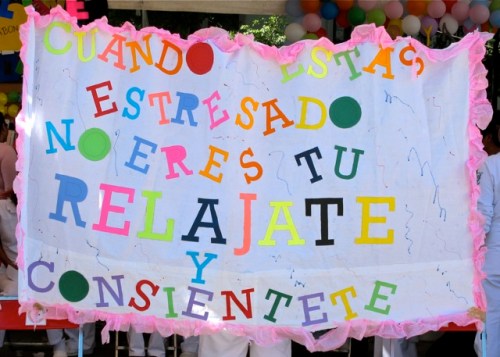
However, when you are stressed, you are not relaxed.

Banner:  Cuando estas estresado no eres tu relajate y consientete

You need to pamper yourself.  Hmmm… wonder if my health insurance covers this?

Nurse giving a back massage

And, for goodness sake, don’t forget to hydrate!

Banner: Los beneficios del agua...

Read Full Post »

What a difference 5 days make…

Early Wednesday evening, the unmistakable sounds of a desfile replaced the usual background noise of commute traffic.  Bands (yes, more than one), cheers, and cohetes (all bang, no bling fireworks) got louder and louder.  I had to come down off the rooftop to see what was happening.

The energy, enthusiasm, creativity, and laughter of thousands of young people filled the street, brightened, what had been a gray day, and provided a stark contrast to the serious military pomp of the Independence Day parade only 5 days before.

This slideshow requires JavaScript.

The occasion was the 30th anniversary of the Colegio de Bachilleres del Estado de Oaxaca (COBAO), an academically rigorous and successful high school system in the state.  In thirty years, this public school has grown from a single campus with 400 students to 64 campuses educating 45,000 students.

Students, faculty, alumni, and dignitaries gathered in the Plaza de la Danza for presentations and speeches.  According to Noticias, it was noted that the event coincided with the approval of two amendments to the Mexican constitution making secondary education mandatory, beginning next year.  Naturally, the event concluded with the requisite fireworks display, which I happily enjoyed from the terrace!

(ps)  Alvin Starkman has written an article in English, Oaxaca Public School Education Targets Student Success: COBAO, about a young girl, from a small village and family of potters, who was recently accepted into COBAO.

Read Full Post »

Op-ed piece from that appeared on Miller-McCune.com.  Grrr… anger-inducing, frustrating, and disappointing to this librarian!

How Google Disrespected Mexican History

Opinion: Anything can happen when Google gets involved in digitizing national treasure troves of archived information, warns a frustrated scholar.

Excerpt from article:

Paper of Record is a Canadian website that boasts of building the world’s largest searchable archive of historical newspapers. It was conceived, appropriately enough, in a Mexican restaurant in Ottawa by R. J. (Bob) Huggins. Paper of Record is, to my knowledge, the most extensive searchable archive of Mexican historical newspapers in the world. There are more than 150 logged newspapers, some dating as far back as the 1840s. Paper of Record became, outside of the National Newspaper Library of Mexico, the single most important resource of its kind for scholars like me working in Mexican history — in Mexico, the United States, anywhere. With an excellent user interface and powerful search engine, Paper of Record made a vast collection of what had been nearly unusable and generally inaccessible primary sources searchable and exploitable, at no charge to users. For some scholars, especially those of us doing commercial, political or economic history, Paper of Record became literally indispensable.

Then Google bought it.  [Read full article]

Link:  National Newspaper Library of Mexico (Hemeroteca Nacional de México) mentioned above.Masthead from Hemeroteca Nacional de México

Read Full Post »

After the two days spent in Teotitlán del Valle last week, I’ve been thinking a lot about the following article, written for the Guardian International Development Journalism competition.

Theme: What stops children in rural areas going to school? sponsored by the David Rattray Memorial Trust

Elena Gonzales folds yarn between her fingers. Her tapestry is woven in an intricate pattern of ochre and indigo, with fibre that has been dyed using moss and bark, fruit and flowers. Here in the hills of Oaxaca, in southern Mexico, indigenous Zapotec communities have been weaving rugs for more than two thousand years. Elena spins the loom and the centuries fall away.

Like many Zapotec children growing up in the 1980s, Elena did not attend school. Faced with a primary curriculum that took no account of Zapotec language or culture, her parents decided that she should be educated by her community. She was taught to weave by her grandmother. Self-sufficiency is the historic norm in Oaxaca, but in recent decades as rural life has become increasingly entretejidos – interwoven – with the modern market economy, Zapotec children who have not gone to school are finding themselves on the wrong side of an urban-rural education divide that excludes them from employment and contributes to deepening poverty.  [Read full article]

Multicolor tapete

Tapete purchased in Teotitlán del Valle by a friend. It was woven by Demetrio Bautista Lazo but was started by his young son.

Read Full Post »

Propping up fallen trees isn’t the only activity on the Alameda… 3 tents under the Indian Laurel trees on the Alameda

Today, Sección 22 del Sindicato Nacional de Trabajadores de la Educación (the teachers’ union) is beginning an occupation of Oaxaca’s zócalo, Alameda, and several side streets.2 tents under the portales of the Governor's Palace According to a report in the Latin American Herald Tribune, Teachers Call for Strike in Southern Mexican State, the teachers are not demanding wage increases, instead focusing on social issues, including “better uniform allowances for students, computers in all of the state’s elementary schools and electricity in all schools.”  Privatization is also an issue.Green banner with text reading:  ¡No a la privatización de la educación!

This annual activity by the teachers’ union is extremely contentious.  Adding bold-face to the lines above will be my only comment on the subject.

However, the teachers aren’t the only people converging on the zócalo today…Poster: Marcha del Color de la Sangre; 23 de Mayo; Zocalo de Oaxaca a la Ciudad de MexicoThe displaced Triqui, who were driven out of their village of San Juan Copala after several years of political violence, have decided to return home, leading a march/caravan from Oaxaca to Mexico City and finally back to San Juan Copala.Triqui women and baby await the arrival of the march/caravan For more information, see the blog posting by Angry White Kid, The displaced decide to return to our community: Caravan of the Color of Blood and for background on their struggle for autonomy, see Repression, Impunity and Resistance in Oaxaca: One Year After the Copala Caravan Ambush.

Read Full Post »

« Newer Posts - Older Posts »