Feeds:
Posts
Comments

Archive for the ‘Economics’ Category

According to the Indigenous Farmworker Study (IFS), there are approximately 165,000 indigenous Mexican farmworkers and their children living  in California — with a significant percentage coming from the state of Oaxaca.  Writer and photographer David Bacon has been photographing and interviewing indigenous Mexican migrants working in California’s agricultural fields for many years.  The following Truthout article is from his photo-documentary project, Living Under the Trees, sponsored by the California Council for the Humanities and California Rural Legal Assistance.

Young, at Work in the Fields

by David Bacon

(Photo: Bacon/After Image)

(Photo: Bacon/After Image)

Most young farm-workers in California are migrants from Mexico, especially the south of the country, where many people share an indigenous culture and language. Ricardo Lopez, living in a van with his grandfather in a store parking lot in Mecca, a tiny farmworker town in the Coachella Valley, says working as a migrant without a formal home was no surprise:

This is how I envisioned it would be working here with my grandpa and sleeping in the van. It’s hot at night, and hard to sleep well. There are a lot of mosquitoes, very few services, and the bathrooms are very dirty. At night there are a lot of people here coming and going. You never know what can happen; it’s a bit dangerous. But my grandfather has a lot of experience and knows how to handle himself. With the money I earn I’m going to help my mother and save the rest. I’ll be attending college in the fall at Arizona Western College—my first year. I want to have a good job, a career. I’m not thinking of working in the fields. Not at all. I look at how hard my grandfather has worked. I don’t want to do field work for the rest of my life because it’s so hard and the pay is so low.

Lopez describes the reality for farmworkers in California in a way that gives tangible meaning to the facts and numbers describing farmworker life. There are about 120,000 indigenous Mexican farmworkers in California. Counting the 45,000 children living with them, that is a total of 165,000 people. They are the most recent migrants from Mexico. They speak twenty-three languages, come from thirteen different Mexican states, and have rich cultures of language, music, dance, and food that bind their communities together.

<snip>  Click HERE to read full article.

This project is therefore a reality check. The idea is to give indigenous migrant communities a vehicle they can use to find support for dealing with the social problems they face, such as housing, low wages, and discrimination. This documentary work is not neutral. Its purpose is to help provide a means for people to organize and win support in a world that, at best, treats them as invisible, and at worst demonizes them. I used to be a union organizer, and this work is very similar. Social documentation not only has to have an engagement with reality, but should try to change it.

Click HERE to read full article.

Read Full Post »

Monday’s headline from the Huffington Post read, “Enrique Peña Nieto’s TIME Cover Sparks Outrage In Mexico.”  The Time Magazine cover (to be published February 24, 2014) shows an imperious looking Peña Nieto, with the bold-face headline, “Saving Mexico.”  Judging from personal conversations, numerous articles, and marches throughout the country, that is definitely not the way most Mexicans see their president.

Mural on wall of giant man holding small Peña Nieto head by his hair

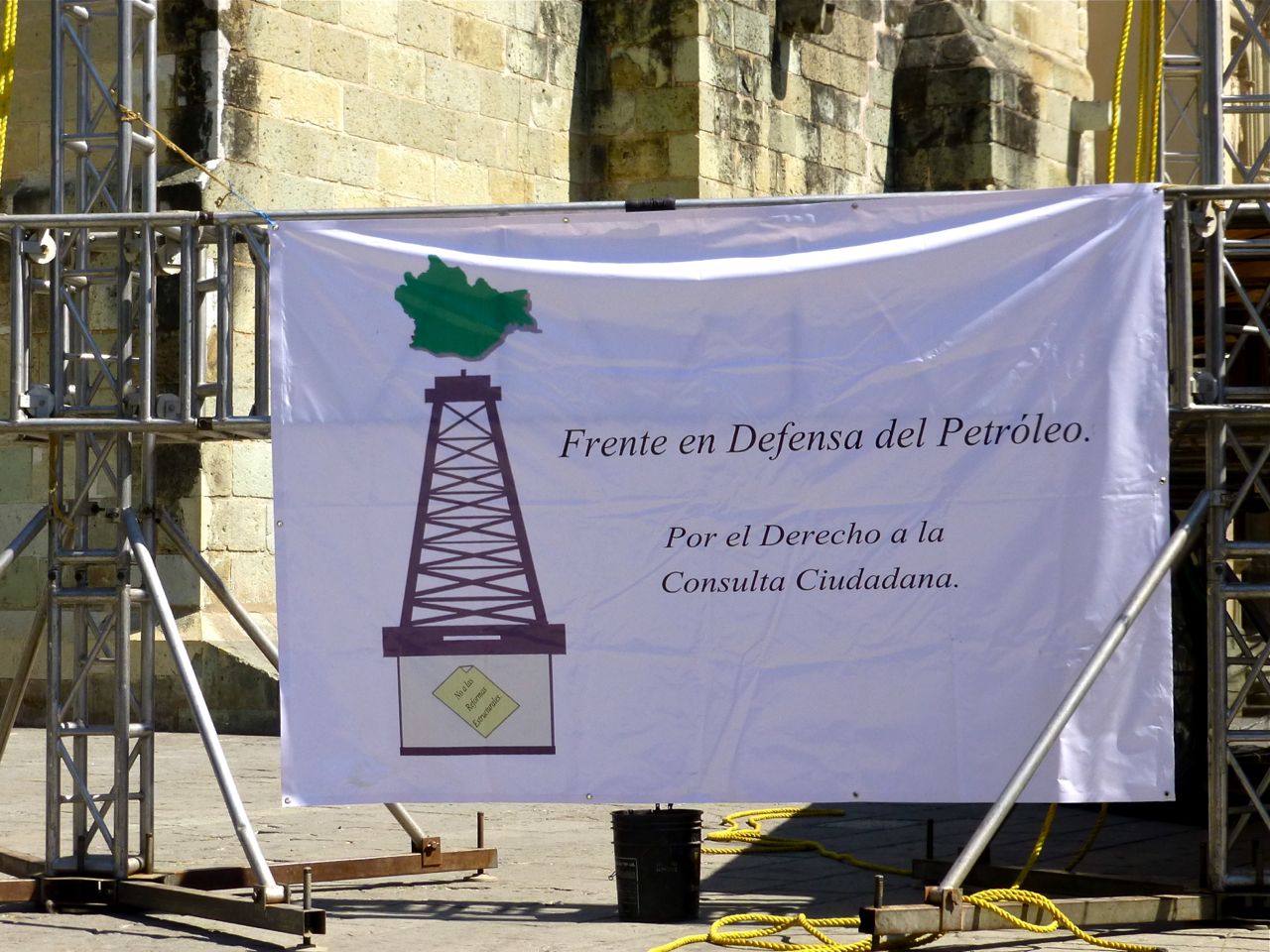
Elected in 2012, Peña Nieto has proposed sweeping reforms, including a previously mentioned education package modeled after the disastrous US, “No Child Left Behind Act.”  These unpopular reforms have citizens marching in the streets and calling for Peña Nieto’s head.  One of the reforms that Mexicans find most egregious is the proposal to open Mexico’s state-run oil industry, PEMEX, to foreign investment.  This is one that strikes at the heart of Mexican pride.

Poster of oil rig spewing oil from on top of a heart

A little background:  In 1938, in support of oil workers striking against foreign-owned oil companies, Mexico’s president, Lázaro Cárdenas, citing the 27th article of the 1917 constitution, expropriated the Mexican facilities of the United States and Anglo–Dutch oil companies, nationalized the oil reserves, and created the state-owned Petróleos Mexicanos (aka, PEMEX).  Mexico now owned and controlled this valuable resource.

Banner, "Frente en defensa del petroleo.  Por el derecho a la consulta ciudadana."

Back to the present:  According to the Huffington Post article, “The energy bill, however, faced massive protests when it passed through Congress in December. Demonstrators shouted ‘The homeland is not for sale!‘ as officials voted to allow private companies to exploit oil and gas reserves in the country, according to the Associated Press.”

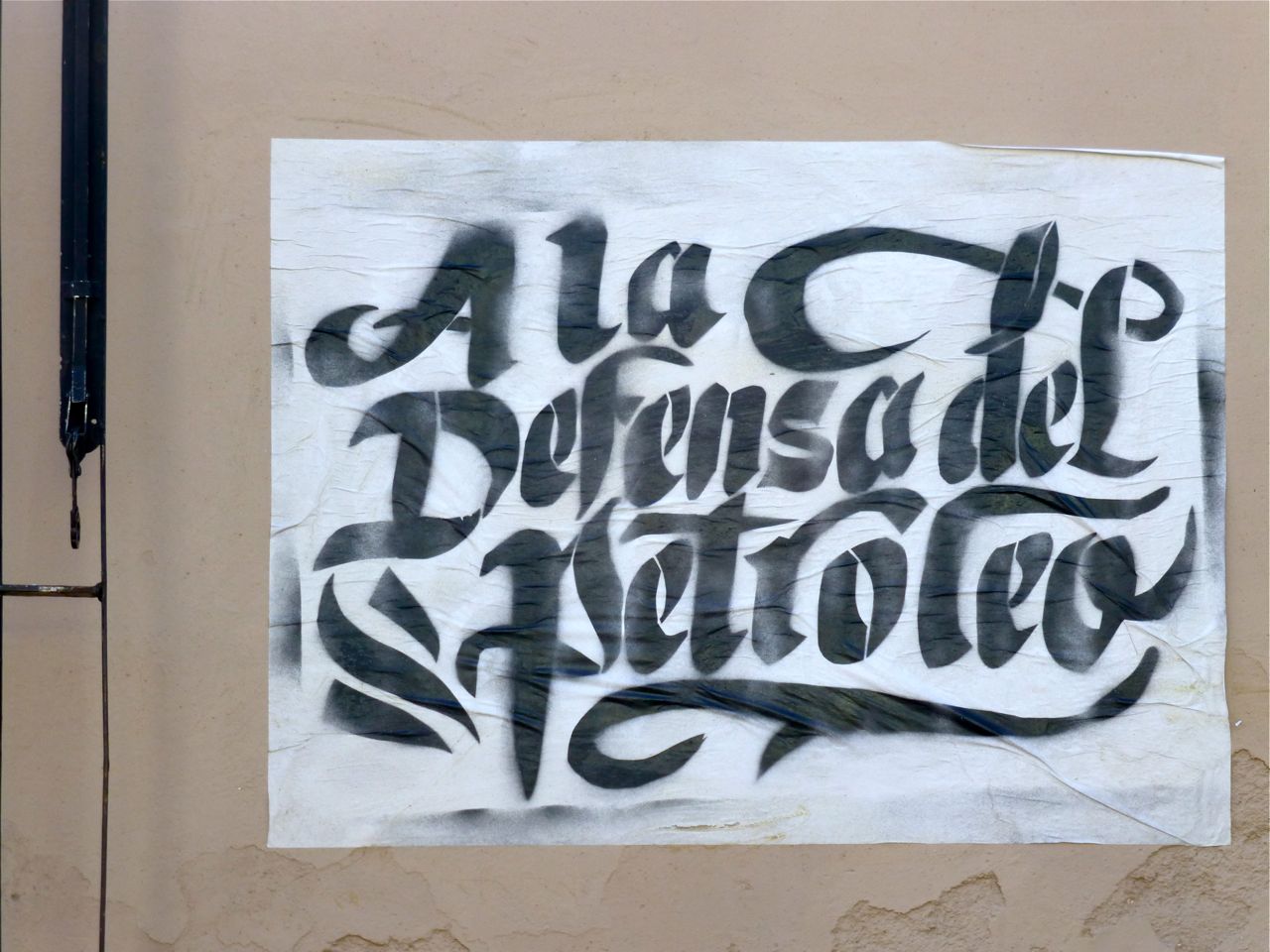
Poster, "A la defensa del petroleo"

In true Oaxacan fashion, marches have been held and banners, posters, and murals have gone up throughout the city to express the outrage and indignation felt by a majority of Mexicans at what they see as an attempt by the Peña Nieto government to sell-off their patrimony.

Of course, as the Time Magazine article illustrates, the US is applauding Peña Nieto and the actions of his ruling party.

Read Full Post »

The XII World Congress of the Organization of World Heritage Cities has ended, its delegates have departed, and the ambulantes, Oaxaca’s heart and soul, have returned.

A joy to behold and the basil the gal in the upper right photo was selling smelled divine!

Read Full Post »

Monte Alban and the historic center of Oaxaca are coming up on the twenty-sixth anniversary of being designated UNESCO World Heritage sites.  And, as I write, the city is hosting the XII World Congress of the Organization of World Heritage Cities, with delegations from 230 other World Heritage cities in town for the 4-day conference.

It is to be expected that any host city would get out the spit and polish to show itself in the best light and Oaxaca is no exception.  The city is being cleaned to the nth degree and, much to driver and passenger delight and relief, the ubiquitous baches (potholes) throughout the city have been patched.

And graffiti?  It’s history, as soon as it appears.

Besides the much-welcome repair of treacherous streets, squeaky clean sidewalks, and pristine building facades, there is something else missing.  Where have all the ambulantes (street vendors) gone?  If you have ever been to Oaxaca, you will no doubt remember the indigenous vendor puestos (across from the Cathedral) that line the Alameda de León from the Post Office to the Hotel Monte Alban.  They are gone, along with the ambulantes in the plaza alongside Carmen Alto.  Even the lovely women from San Antonino Castillo Velasco, who sell their beautiful, intricately hand-embroidered wedding dresses and blouses along Macedonio Alcalá, have been removed from the street.

I later discovered, the latter have been temporarily relocated to the courtyard of the Biblioteca Pública Central.

But what of the other vendors?  Where are they?  Are they being compensated for lost revenue?  According to this article in Proceso, market trader organizations, “agreed to withdraw for six days without compensation.”  Hmmm….

I have to ask, why?  Is it just colonial buildings and archeological sites that warrant a World Heritage site designation?  I don’t think so.  Oaxaca is an incredibly vibrant, living breathing city whose primary value and cultural heritage lies not in her buildings, but with her people, especially her indigenous citizens, who have given and continue to give much of what makes Oaxaca so special — their food, music, artistry, and kind, strong, and gentle presence.  In 2007, on my first visit, it’s what had me at, hola!

According to the UNESCO World Heritage Centre website, regarding Oaxaca and Monte Alban, criterion IV states, “Among some 200 pre-Hispanic archaeological sites inventoried in the valley of Oaxaca, the Monte Alban complex best represents the singular evolution of a region inhabited by a succession of peoples: the Olmecs, Zapotecs and Mixtecs. The City of Oaxaca, with its design as a check board and its iconic architecture, has developed over more than four centuries as evidence of the fusion of two cultures Indian and Spanish.”  [my emphasis]

Read Full Post »

Much like the Mark Twain line, “The report of my death was an exaggeration,” unfortunately, so too the news announcing the death of GMO corn in Mexico.

P1080309_crop

According to the post by Think Mexican, The Fight Continues: GMO Corn Not Yet Banned in Mexico:

Contrary to reports, genetically modified (GMO) corn has not been banned in Mexico. On October 10, a Mexican judge from the Twelfth Federal District Court for Civil Matters in Mexico City issued an injunction suspending field trails of GMO corn, however, a complete ban was not ordered.

Federal Judge Jaime Eduardo Verdugo’s ruling does order the halting of “all activities involving the planting of transgenic corn in [Mexico] and ends the granting of permissions for experimental and pilot commercial plantings.” [Read full article, HERE]

From a large mural on the wall outside the Comisión Nacional para el Desarrollo de los Pueblos Indígenas, Delegación Oaxaca

La lucha continúa…

Read Full Post »

Expats and Mexicans alike, are watching in amazement at the nonsense (as in, making NO sense) taking place in the hallowed halls of Washington DC.  And, since many of the expats are retired, we are holding our collective breath over the possibility social security checks will not be forthcoming in November and a tanking stock market that flushes our nest eggs away.  Of course, Mexico is in the middle of its own mess, “educational reforms” and economic proposals that will hurt Mexico’s working class and rural populations the most.

Wall in Oaxaca city.

Wall in Oaxaca city.

In a New York Times article two days ago, Carlos Puig explains the reality of the material conditions that have forced the teachers of Oaxaca to take the drastic action of abandoning their classrooms to lead massive and extremely disruptive protests in Mexico City against the “No Child Left Behind” style reforms that the Peña Nieto led government has proposed and passed.  (Read a critique of the US education “reform” by Diane Ravitch, former “No Child Left Behind” proponent, here.)

Oaxaca is 500 kilometers from Mexico City, yet the real distance is much bigger. The state’s G.N.P. per capita is one-quarter the average for the country. Oaxaca ranks second-to-last among all states in infrastructure. More than half its population lives in towns of fewer than 2,500 people.

Being a teacher in Oaxaca means sometimes having to travel for an entire day to reach your school in a tiny community, teach for three days — to children of all grades — and travel back home for the weekend. It means having to deal with children who speak more than 20 different dialects.

Being a teacher in Oaxaca means operating in a different universe — and under different rules.

Banner hanging in front of a school in Oaxaca city

Banner hanging in front of a school in Oaxaca city

However, as in the USA, the incomprehensible words coming out of the mouths of the 1% and their elected representatives are mind-boggling in their obliviousness to the adverse consequences their behavior and policies cause.  And, we scratch our heads in amazement…  McClatchy journalist, Tim Johnson, has repeatedly blogged about the exceedingly “bad” behavior exhibited by Mexico City’s rich and powerful directed at those they consider “below” them — most recently, Las Ladies, episode 7.  And, just last week in Oaxaca, most were aghast to read that an indigenous woman, in the advanced stage of labor, was turned away from a hospital and forced to give birth on the hospital lawn.

Daniel Goleman had a revealing piece in the New York Times a few days ago that helps explain where this lack of empathy the ruling elite exhibit, that results in callous social policy, comes from.  He explains in Rich People Just Care Less that, by necessity, “the poor, compared with the wealthy, have keenly attuned interpersonal attention in all directions…”  And that, “A growing body of recent research shows that people with the most social power pay scant attention to those with little such power” and, “In politics, readily dismissing inconvenient people can easily extend to dismissing inconvenient truths about them.”

Okay, now we know why the rich care less, so what are we going to do about it?

Part of a mural on Niños Heroes in Oaxaca city.

Part of a mural on Niños Heroes in Oaxaca city.

Read Full Post »

Flying into the city of Oaxaca at night, Talea de Castro is one of the countless tiny pockets of light twinkling from the darkness below.  These earthbound clusters of stars mark small pueblos nestled in the treacherous mountains of the Sierra Norte.

The remote terrain of Oaxaca’s Sierra Norte and Sierra Sur has helped to preserve the traditions of these indigenous communities — but at a high price.  It has also hindered access to technology that could benefit residents of these communities and has made it easy for the “powers that be” to ignore the needs of these villages.  Taking matters into their own hands, I love what the people of Talea de Castro have done.

Forgotten by telecoms, Mexico town runs cell service

AFP – Left out by telecom firms like the one owned by billionaire Carlos Slim, a remote Mexican mountain village now runs its own mobile phone network to communicate with the outside world.

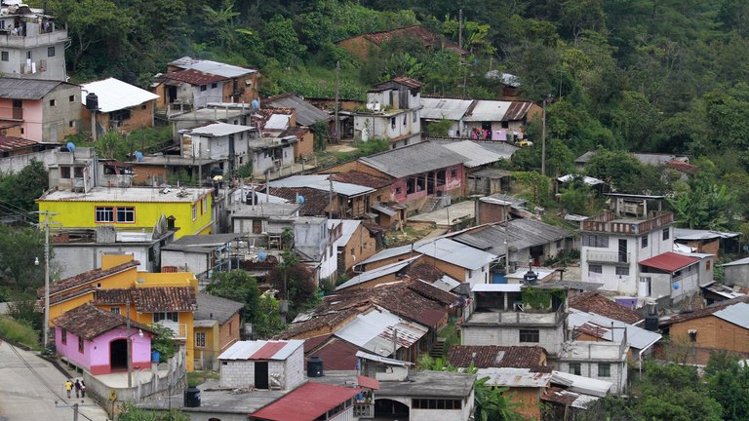
Tucked away in a lush forest in the southern state of Oaxaca, the indigenous village of Villa Talea de Castro, population 2,500, was not seen as a profitable market for companies such as Slim’s America Movil.

Talea de Castro, Oaxaca State, Mexico, taken on August 17, 2013 (AFP Photo/Carlos Salinas)

Talea de Castro, Oaxaca State, Mexico, taken on August 17, 2013
(AFP Photo/Carlos Salinas)

So the village, under an initiative launched by indigenous groups, civil organizations and universities, put up a perch-like antenna on a rooftop, installed radio and computer equipment, and created its own micro provider called Red Celular de Talea (RCT) this year.

Now, restaurant manager Ramiro Perez can call his children and receive food orders on his cellphone at a cheap price in this village dotted by small homes painted in pink and yellow.

The local service costs 15 pesos ($1.2) per month — 13 times cheaper than a big firm’s basic plan in Mexico City — while calls to the United States, where many of the indigenous Zapoteco resident have migrated, charge a few pennies per minute.

“I have two children who live outside the village and I communicate with them at least two or three times per week,” Perez, 60, told AFP.

Before, Perez had to use telephone booths where he paid up to 10 pesos ($0.75) per minute.

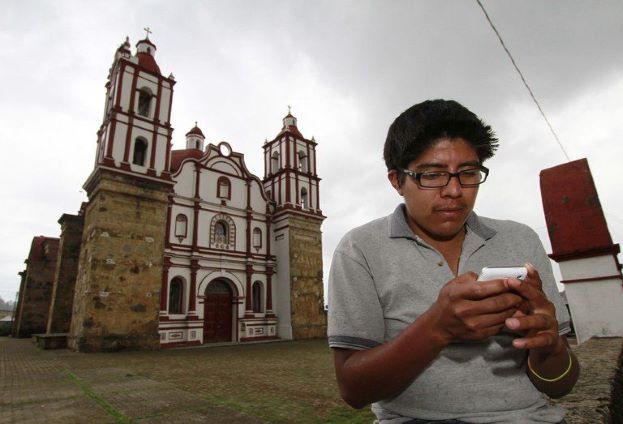
A local resident uses his mobile phone in Talea de Castro, Oaxaca State, Mexico, on August 17, 2013. For considering it to be slightly profitable, the big companies of mobile telephony refused for years to give its services in Talea, but the population -- mostly of indigenous origin -- adopted a novel system and created its own company, the Red Celular de Talea (RCT) (Talea Mobile Network).

A local resident uses his mobile phone in Talea de Castro, Oaxaca State, Mexico, on August 17, 2013. For considering it to be slightly profitable, the big companies of mobile telephony refused for years to give its services in Talea, but the population — mostly of indigenous origin — adopted a novel system and created its own company, the Red Celular de Talea (RCT) (Talea Mobile Network).

The coffee-producing village installed the network with the help of Rhizomatica, a non-profit with US, European and Mexican experts who aim to increase access to mobile telecommunications in communities that lack affordable service.

In a statement, Rhizomatica, a civil group named Redes and a town official said they hoped that a telecom reform pushed through Congress by President Enrique Pena Nieto to open the market will “break the obstacles” that prevent the development of such community-based projects.

“Many indigenous communities have shown interest in participating in this project and we hope that many more can join this scheme,” the statement said.

The equipment used in Talea, which was provided by California-based Range Networks, includes a 900mhz radio network and computer software that routes calls, registers numbers and handles billing. Calls to the United States are channeled via a voice over Internet protocol (VoIP) provider.

The village received a two-year-permit from the Federal Communications Commission to have the right to test the equipment.

A local resident operates the equipment enabling mobile communications in Talea de Castro, Oaxaca State, Mexico, on August 17, 2013.

A local resident operates the equipment enabling mobile communications in Talea de Castro, Oaxaca State, Mexico, on August 17, 2013.

When a cellphone user arrives in the village, a text message automatically appears saying: “Welcome to the Talea Cellular Network (RTC) — to register, go to the radio with this message.”

There is one catch: phone calls must be limited to a maximum of five minutes to avoid a saturation of lines.

Israel Hernandez, a village resident and one of the volunteers who helped set up the system, said the network uses the radio-electric spectrum that “telephone (service) providers refuse to use because it is financially unviable.”

Slim’s Telcel is part of his America Movil empire, which controls 70 percent of Mexico’s mobile phone market and has 262 million subscribers across Latin America but never made it to Talea.

Alejandro Lopez, a senior town hall official, said the village had approached big telecom firms but that they had required 10,000 potential users as well as the construction of a path where an antenna would be erected and a lengthy power line.

“Despite some technical problems, because we are in a test period, the project has been a success” with 600 villagers signing up since the service opened three months ago, Lopez said.

Buoyed by the system’s success, the village has decided to buy its own equipment that will allow RCT to run 35 lines simultaneously and plans to install in the coming weeks.

The next step, RCT volunteer Hernandez said, is to form cooperatives with other indigenous villages to request concessions from the Mexican government in order to resolve “this lack of free frequencies for cellphone communications in the country’s rural communities.”

New article from the BBC:  The Mexican village that got itself talking.

Read Full Post »

Another revealing article by one of my favorite journalists, David Bacon

What real immigration reform would look like

Clue: It’s Not a New Guest Worker Program

By David Bacon

Oralia Maceda, an immigrant mother from Oaxaca, asked the obvious question recently. At a meeting, talking about the Senate immigration reform bill, she wanted to know why Senators would spend almost $50 billion on more border walls, yet show no interest in why people leave home to cross them.

This Congressional blindness will get worse as immigration reform moves to the House. It condemns U.S. immigration policy to a kind of punitive venality, making rational political decisions virtually impossible. Yet alternatives are often proposed by migrant communities themselves, and reflect a better understanding of global economics and human rights.

Rufino Dominguez, who now works for the Oaxacan state government, describes what Maceda knows from experience: “NAFTA forced the price of corn so low it’s not economically possible to plant a crop anymore. We come to the U.S. to work because there’s no alternative.” The reason for the fall in prices, according to Timothy Wise of the Global Development and Environment Institute, is that corn imports to Mexico from the U.S. rose from 2,014,000 to 10,330,000 tons from 1992 to 2008.

Mexico imported 30,000 tons of pork in 1995, the year NAFTA took effect, and 811, 000 tons in 2010. This primarily benefited one company, Smithfield Foods, which now sells over 25% of all the pork in Mexico. Mexico, however, lost 120,000 hog-farming jobs alone. The World Bank says extreme rural poverty jumped from 35% to 55% after NAFTA took effect due to “the sluggish performance of agriculture, stagnant rural wages, and falling real agricultural prices.”

Read full article HERE.

Read Full Post »

Sunny, warm, and dry, Oaxaca’s sidewalks, mercados, restaurants, and zócalo are filled with “snowbirds” (the human variety) escaping the bone-chilling and wet wintry weather of el norte.  Alas, almost immediately after the previously mentioned “big move” next week, I’m heading in the opposite direction — to the bleak gray north for several weeks to visit family and friends in California (it’s not all bikini beaches and blue sky) and then east to celebrate my first grandchild’s first birthday — the best and maybe only reason to visit upstate New York in the dead of winter!  And, if previous return trips to el norte are a predictor, I’ll be missing the warmth and color of Oaxaca almost from the minute I step off the plane.

The “snowbirds” and I have the luxury of coming and going.  Some people do not.  One of my favorite journalists interviews a young Oaxaqueña trying to support her young daughter by working the fields in Madera, California.  As the title suggests, it is a poignant story…

The Only Job I Can Do–A Young Mother’s Farm Work Story

Editor’s Note: Lorena Hernandez is a young farm worker and single mother from Oaxaca, Mexico. Today she lives in Madera, Calif., with her daughter and aunt. She told her story to David Bacon.

hernandez_blueberries.jpg
Lorena Hernandez picking blueberries   [photo by David Bacon]

MADERA, Calif.–To go pick blueberries I have to get up at four in the morning. First I make my lunch to take with me, and then I get dressed for work. For lunch I eat whatever there is in the house, mostly bean tacos. Then the ritero, the person who gives me a ride to work, picks me up at 20 minutes to five.

I work as long as my body can take it, usually until 2:30 in the afternoon. Then the ritero gives me a ride home, and I get there by 3:30 or 4 in the afternoon. By then I’m really tired.

Costs of Rides, Childcare on Little Pay

I pay $8 each way to get to work and back home. Right now they’re paying $6 for each bucket of blueberries you pick, so I have to fill almost three buckets just to cover my daily ride. The contractor I work for, Elias Hernandez, hooks us up with the riteros. He’s the contractor for 50 of us farm workers picking blueberries, and I met him when a friend of my aunt gave me his number.

<snip>

No Vision of My Future

I don’t have friends, just acquaintances from work. They don’t have responsibilities like I do, so they go out on the weekend. They share their stories with me because since I have a daughter, I don’t go out. I just stay at home.

I wash my daughter’s clothes on the weekends because during the week I’m so tired. There isn’t time to clean the house during the week either. That’s what we do on the weekends.

I don’t have a vision of my own future. I don’t really think about it. I know I want to work every day. I don’t think I’ll ever return to school because of my age. My job will be working in the fields. I’m at peace with my current situation. I would love to go back to school, but it’s too late for me. Perhaps one day.

Please read full story HERE.

Read Full Post »

Signs reading, “Buen Fin” began to appear on shop windows around town last week.  How nice, I thought, with a 3-day weekend coming up (Monday, 11/19 was Mexican Revolution commemoration day), the stores are wishing one and all a “Good Weekend.”

Sign on carved wooden door reading, "Buen Fin. El fin de semana mas barato del año."

I’d only glanced and didn’t come close enough to read the smaller and more important print, “Weekend:  Cheapest of the Year.”  What’s it all about?  Last year’s LA Times article, “A ‘Black Friday’ shopping ritual coming to Mexico?” explains it all.

Apparently, I’ve been oblivious or this newest US export has taken a while to make its way all the way down to Oaxaca.  But, make its way down to Oaxaca, it has!  According to Monday’s Noticias, “This weekend hundreds of Oaxacans went to department stores and shops of all kinds in the city, to stock up on essentials and electronic products, mainly taking advantage of ‘Good Weekend’ promotions.”

Depressing, is all I can say…


Read Full Post »

As most of you have gathered, I love the music and people, life and color, and food and ferias, not to mention the year-round sun and warm weather of Oaxaca.  However, as I’ve mentioned before, there is much going on beneath the surface and it isn’t pretty.  So, even though it’s the middle of Guelaguetza (or, maybe because the spotlight is on the music, dance, and costumes of Oaxaca’s indigenous communities), I feel compelled to share today’s article by one of my favorite labor photographers and journalists, David Bacon.

Canadian Mining Goliaths Devastate Mexican Indigenous Communities and Environment

Wednesday, 25 July 2012 00:00 By David Bacon, Truthout | Report Email

An assembly last fall in Oaxaca of the Binational Front of Indigenous Organizations that called for a sustainable development policy that would support farmers as opposed to mega development projects. (Photo: David Bacon)An assembly last fall in Oaxaca of the Binational Front of Indigenous Organizations that called for a sustainable development policy that would support farmers as opposed to mega development projects. (Photo: David Bacon)

Oaxaca, Mexico – For over two decades in many parts of Mexico, large corporations – mostly foreign owned but usually with wealthy Mexican partners – have developed huge projects in rural areas. Called mega-projects, the mines and resource extraction efforts take advantage of economic reforms and trade treaties like the North American Free Trade Agreement.

Emphasizing foreign investment, even at the cost of environmental destruction and the displacement of people, has been the development policy of Mexican administrations since the 1970s. When the National Action Party (PAN) defeated the old governing Party of the Institutionalized Revolution (PRI) in 2000, this economic development model did not change. In fact, the PAN simply took over the administration of this development policy and even accelerated it, while in the Mexican Chamber of Deputies the two parties cooperated to advance its goals.

But while these projects enjoy official patronage at the top, they almost invariably incite local opposition over threatened or actual environmental disaster. Environmental destruction, along with accompanying economic changes, cause the displacement of people. Families in communities affected by the impacts are uprooted and often begin to migrate. Nevertheless, the projects enjoy official support and are defended against rising protests from poor farmers and townspeople by the federal government.  [Please read the full article HERE]

Read Full Post »

Like 80+ countries in the world, International Workers’ Day is a national holiday in Mexico.  Early this morning in Oaxaca, streets were closed as contingents began gathering and then marching toward the city center.   And for hours, they poured into the Zócalo and Alameda for speeches, music, and bottle rockets, all of which will, no doubt, continue for hours more.

This slideshow requires JavaScript.

FYI:  CTM stand for the Confederación de Trabajadores de México, the largest confederation of Mexican labor unions.  Think, AFL-CIO in El Norte (though with some significant differences).

¡Feliz Día Internacional de los Trabajadores!

Update:  For a more nuanced view of yesterday’s march, see the report by longtime resident, Nancy Davies.

Read Full Post »

And now a pause in the Semana Santa coverage…

The following article is part of the cover story project in the April 9 issue of The Christian Science MonitorWeekly magazine.  It’s long, but I encourage you to click on it and read the full article.

Home again in Mexico: Illegal immigration hits net zero

Tiny Tamaula is the new face of rural Mexico: Villagers are home again as the illegal immigration boom drops to net zero

By Sara Miller Llana, Staff writer / April 8, 2012

Tamaula, Mexico – At this time of year in this tiny rural outpost that sits on a mountainside in Guanajuato State, most able-bodied men are gone. They’re off plucking and cutting chicken in processing plants in Georgia or pruning the backyards of Seattle.

But this year, Pedro Laguna and his wife, Silvia Arellano, are clearing rocks from their yard to prepare a field for corn. They’ve returned home to Tamaula, Mexico, with their four young children, after 20 years in the United States working illegally. Pedro’s cousin Jorge Laguna and his brothers are planting garbanzo beans in the plot behind their father’s home. Their next-door neighbor Gregorio Zambrano is also home: One recent morning he badgered a visiting social worker for funds to start a honey=production enterprise.

Since the Monitor last visited here in 2007, a major demographic shift has transformed this dusty village of 230. Migrants have come home, and with them have come other important changes. In 2007, there was no running water, no high school, no paved roads. A simple water pipeline, installed in February, runs to each of the 50-some homes. On a recent day the first high school class, including eight students ages 15 to 40, was finishing up math homework. And now, the main roads are paved.

“We can turn on the water and wash our clothes,” says Pedro’s uncle, Rodolfo Laguna, who spent 12 years working illegally in a chicken plant in Athens, Ga., before returning home in 2010 after both he and his son lost their jobs.

This is the new face of rural Mexico. Villages emptied out in the 1980s and ’90s in one of the largest waves of migration in history. Today there are clear signs that a human tide is returning to towns both small and large across Mexico.

One million Mexicans said they returned from the US between 2005 and 2010, according to a new dem-ographic study of Mexican census data. That’s three times the number who said they’d returned in the previous five-year period.

And they aren’t just home for a visit: One prominent sociologist in the US has counted “net zero” migration for the first time since the 1960s.

Experts say the implications for both nations are enormous – from the draining of a labor pool in the US to the need for a radical shift in policies in Mexico, which has long depended on the billions of dollars in migrant remittances as a social welfare cornerstone.

“The massive return of migrants will have implications at the micro and macro economic levels and will have consequences for the social fabric … especially for the structure of the Mexican family,” says Rodolfo Casillas, a migration expert at the Latin American School of Social Sciences in Mexico City.   [Read full article]


Read Full Post »

The Occupy movement continues… clashes with the Oakland, CA police on Saturday are making headlines.  And, when I was in Mexico City two weeks ago, an indignado planton (encampment) was firmly established in front of the domed building that houses the Mexican stock mark.  Please note the biblioteca (library).

This slideshow requires JavaScript.

I must admit to feeling right at home, as plantons are an almost ubiquitous part of Oaxaca’s zócalo.  For more on plantons, David Bacon provides a cross border historical context to the planton/occupy movements in his article, Unions and Immigrants Join Occupy Movements,

Read Full Post »

David Bacon, one of the most perceptive labor and immigrant rights writer/photographers, interviews Rufino Dominguez, director of the Oaxacan Institute for Attention to Migrants (in English).  Let’s hope this isn’t another program that is all talk, no action.

Oaxaca’s New Government Calls for Migrant Rights

OAXACA, MEXICO The Oaxacan Institute for Attention to Migrants, and its director Rufino Dominguez, called for a new era of respect for the rights of migrants, in commorating [sic] the International Day of the Migrant in the Palacio del Gobierno, Oaxaca’s state capitol building. Representing the newly-elected state government, Dominguez paid tribute to the contributions of the braceros, the first of Oaxaca’s migrant workers to travel to the United States. from 1942 to 1964, and to the women who cared for the families they left behind.

Around the balconies of the palacio’s courtyard hung photographs showing the lives of current migrants from Oaxaca, working as farm laborers in California. Migrant rights activists, artisans and public officials spoke about the important role migration continues to play in Oaxaca’s economic, social, political and family life. The state, in southern Mexico, is the source of one of the largest waves of migration from Mexico to the U.S.

Dominguez, the former coordinator of the Binational Front of Indigenous Organizations, which organizes indigenous migrants in both Mexico and the U.S., was appointed director of the IOAM by Oaxaca’s new governor, Gabino Cue Monteagudo. Cue defeated the PRI, the party that governed Oaxaca for the previous 80 years. In an interview with David Bacon, Dominguez described the different road the new government is taking to ensure social justice for Oaxacan migrants today:

We can’t tell the U.S. government, or the governments of California and other states, to respect the rights of our people who are living there, if we ourselves are not respecting the rights of migrants here in Oaxaca. Many migrants passing through Oaxaca from Central America and other places suffer systematic violations of their human rights.

Have we just paid attention to migrants in the U.S. because they send dollars home? Sometimes the problems of migrants within Mexico are even greater than those we have in the U.S.  [Read full article]

Read Full Post »

« Newer Posts - Older Posts »