As promised…
And, there is SO much more!!!
Posted in Celebrations, Creativity, Culture, Music, Travel & Tourism, tagged celebrations, dance, Mexico, music, Oaxaca, travel, video on December 6, 2011| Leave a Comment »
Posted in Buildings, Culture, Libraries, Renovation, tagged Centro Académico y Cultural San Pablo, cultural center, ex-convento, libraries, Mexico, Oaxaca, research center, San Pablo Academic and Cultural Center on December 5, 2011| 3 Comments »
… in all manner of ways; there’s a lot of that here. Successful meetings between old and new are a matter of debate. The newly renovated Centro Académico y Cultural San Pablo is no exception. It was acquired, designed by architect Mauricio Rocha, renovated, and repurposed by the Alfredo Harp Helú Foundation.
Located in the heart of the historic district, between the Museo Textil and the Teatro Macedonio Alcalá, this former Dominican convent, originally established in 1529, has been one of those ubiquitous crumbling and peligrosos buildings for a long time. In addition, to the features of the original cloister, archeological remains from 2,500 years ago were uncovered and have been preserved.
The buildings will house a research center (including a library), dedicated to the study of the languages and cultures of the indigenous of Oaxaca, serve as a venue for cultural presentations, and provide exhibit space for the philanthropic endeavors of the Alfredo Harp Helú Foundation, which (among several others) includes the Textile Museum, Museum of Philately (stamps), Institute of Oaxacan Historic , and Children’s Library.
The grand opening, with all the requisite fanfare and dignitaries, was November 26. Alas, I missed it! However, the courtyard provided the setting for several performances during the Instrumenta Oaxaca 2011, a 2-week long chamber music festival that ran from November 3rd to the 18th; two of which I attended. I was dazzled by the setting (and the acoustics weren’t bad, either) and was especially gratified that the library, which the seating faced, presented a prominent and dramatic architectural feature.
Written on the wall of the building housing a small collection from the BS: Biblioteca Infantil (Children’s Library), a quote from Dostoyevsky (of all people): Los libros son mi aliento, mi vida y mi futuro. In English: Books are my breath, my life and my future.
For more (in English) about the Centro Académico y Cultural San Pablo, see Norma Hawthorne’s article, Oaxaca Center Promotes Indigenous Language and Culture, Opens November 26, 2011.
Update: Read how this cultural and historical gem, lost in plain sight.
Posted in Celebrations, Churches, Culture, Markets, Music, tagged dance, dancers, Danza de la Pluma, Guelaguetza, Guelaguetza Auditorium, Mexico, music, Oaxaca, Zaachila on December 3, 2011| 2 Comments »
In August 2011, Vive Oaxaca launched a campaign to showcase the best of the state through a series of video shorts. Two have already been released online:
Esto es Zaachila
and, Esto es Guelaguetza
I’m looking forward to Monday night’s online release of, Esto es Oaxaca de Juárez. I guess you know what my Tuesday morning blog post will be!
Posted in Creativity, Culture, Exhibitions, tagged Arte Jaguar, Asaro, Bouler, Espantapájaros, graffiti, Lapiztola, Mexico, Oaxaca, Pan-American Highway, Primer Festival de Artes Visuales Oaxaca 2011, public art, Puntos de Encuentro, Uriel Marín, visual arts, Viyegax on December 1, 2011| 2 Comments »
… equals public art on Calzada Niños Héroes de Chapultepec, a section of the legendary Pan-American Highway in Oaxaca’s capital city.
On October 27, 2011, representatives from the groups Espantapájaros, Asaro, Bouler, Viyegax, Arte Jaguar, Lapiztola, and Uriel Marín set to work transforming a long drab wall into a work of art representing the social, cultural, and political life of Oaxaca and Mexico. The wall of graffiti was part of the Puntos de Encuentro, Primer Festival de Artes Visuales Oaxaca 2011, previously mentioned in my mid-October blog post, Meeting Points….
As of a few days ago, the artwork remains to catch the eye of drivers (yikes!), passengers, and pedestrians.
Posted in Culture, Music, tagged bus, guitarists, guitars, Mexico, music, Oaxaca, transportation, Zaachila on November 29, 2011| Leave a Comment »
Posted in Creativity, Culture, tagged graffiti, Mexico, murals, Oaxaca, wall art, Zaachila, Zimatlán de Lázaro Cárdenas on November 28, 2011| Leave a Comment »
… in Zaachila
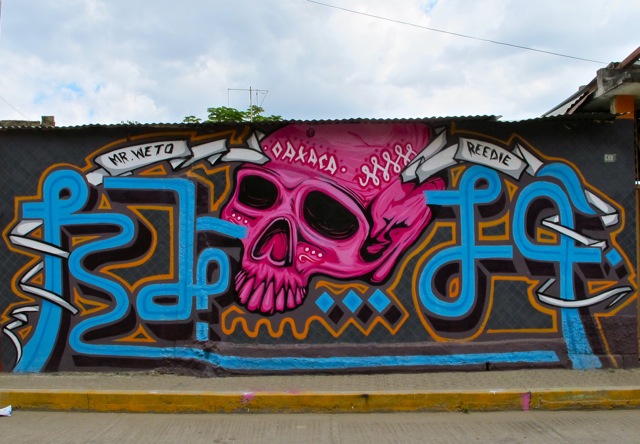
and Zimatlán de Lázaro Cárdenas.
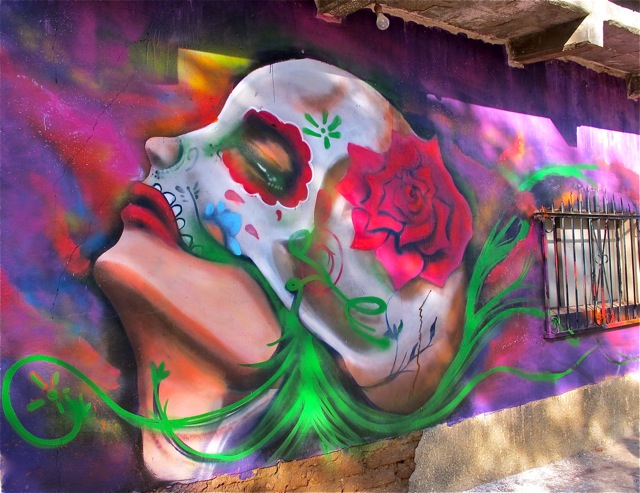
I have no idea what they mean… But, who cares?
Posted in Celebrations, Creativity, Culture, Holidays, Religion, tagged celebrations, cemetery, Day of the Dead, Día de los Muertos, Días de Muerto, flor inmortal, flowers, Mexico, Oaxaca, panteón, San Antonino Castillo Velasco on November 24, 2011| 1 Comment »
Today is Thanksgiving in los Estados Unidos de América… and besides my wonderful family and friends, I am so grateful to see and experience places like San Antonino Castillo Velasco during los Días de Muertos.
¡Feliz Acción de Gracias a todos!
Posted in Celebrations, Creativity, Culture, Holidays, Religion, tagged celebrations, cemetery, Day of the Dead, Día de los Muertos, Días de Muerto, flor inmortal, flowers, Mexico, Oaxaca, panteón, San Antonino Castillo Velasco on November 22, 2011| 2 Comments »
San Antonino Castillo Velasco, a Zapotec community near Ocotlán, is a village known for its flowers. They are, no doubt, the inspiration for beautifully embroidered linens and clothing sold in the mercados and found in museum collections. And, a specialty is the “flor inmortal” (immortal flower), so named because, even when dried, it retains its brilliant colors. They are used to create intricately designed figures on display December 23 in the city of Oaxaca, during Noche de Rábanos and to decorate the graves of loved ones during Días de Muertos in San Antonino.
As I’ve previously mentioned, each village seems to have its own unique traditions for the Days of the Dead. Villagers here mix the area’s very fine dirt with water, cover the graves, use a trowel to smooth it, outline designs and religious imagery into the dried coating, and then use flowers (fresh and dried), to paint the scene. Entire families are involved, young and old, and the atmosphere is filled with joy, purpose, and most of all… Love.
For a very special moment, that is a metaphor the two days spent at San Antonino, see Chris’s post, Moments make a life..
Posted in Animals, Celebrations, Culture, Holidays, tagged cemetery, Day of the Dead, Días de Muerto, flowers, Mexico, Oaxaca, panteón, San Antonino Castillo Velasco on November 21, 2011| Leave a Comment »
San Antonino Castillo Velasco, to be precise. Young and old converged on the municipal cemetery to decorate the graves with the magenta of cockscomb and yellow to orange to rust of marigolds (cempazúchil or zempoalxochitl) grown in nearby fields.
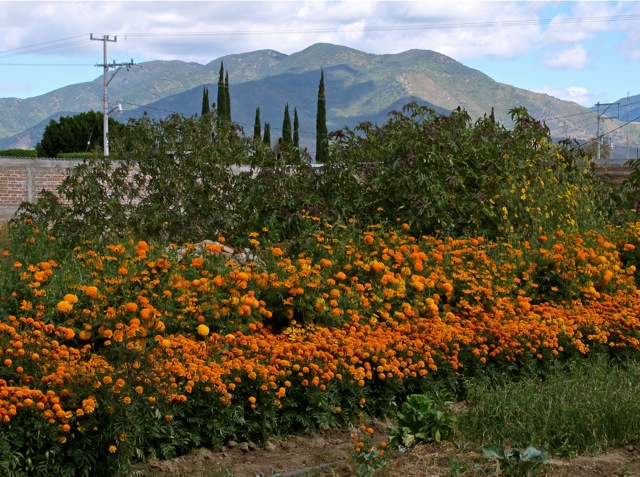
They came by car and truck…
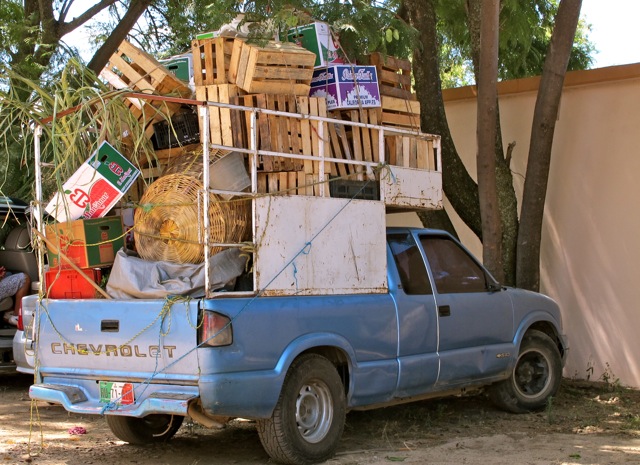
By horse (note wooden saddle)…

By pedal-powered cart…

By horse-powered cart.

And, on foot…
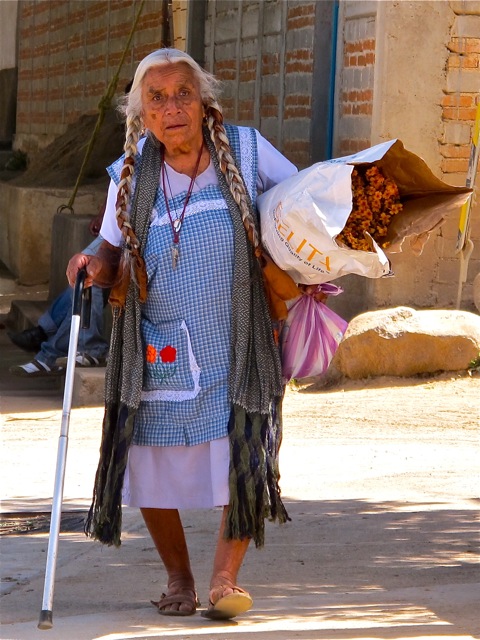
Laughter, artistry, and pride followed. Stay tuned for images of their meticulous labors of love.
Posted in Culture, People, Politics, tagged IFAD, indigenous peoples, International Fund for Agricultural Development, Latin America, Lila Downs, Mexico, Oaxaca on November 15, 2011| 2 Comments »
Mexico’s favourite singer-songwriter dishes on development, gender, indigenous issues, peace and music. An interview with Lila Downs (in English) from the IFAD social reporting blog:
http://blip.tv/ifad/lila-downs-reverence-hope-change-5672813
By the way, Chris, over at Oaxaca-The Year After has posted more from the recent concert at the Guelaguetza Auditorium, covered in my Sublime sounds and spectacle post.
Posted in Celebrations, Culture, tagged Day of the Dead, Día de los Muertos, Días de Muerto, Kurt Hackbarth, La [medio] diezmada, Mexico, Oaxaca, plays, sand paintings, tapetes de arena, theater on November 13, 2011| 6 Comments »
On the eleventh day of the eleventh month at the eleventh hour, I attended a press conference for the official unveiling of the website for a new play. The play, La [medio] diezmada (the half-decimated), will have its world premiere on December 22 at the Teatro Juárez in Oaxaca.

Cast members: Hugo Alberto Díaz Reyes, Mariela Blanco López, Esmeralda Aragón Zárate, and Fortunato Chávez, with Kurt Hackbarth (middle)
One of the inspirations for writer/director/producer, Kurt Hackbarth, was a photo he had seen of a half-alive/half-dead face in a sand painting. In one of those amazing coincidences, I’d actually photographed the very same tapete de arena laid out on the Alameda in Oaxaca during Los días de muertos in 2009.

Here is my close-up of the half living/half-dead face from the tapete above; the same face that triggered Kurt’s imagination…

… and I cropped and used for the website banner.
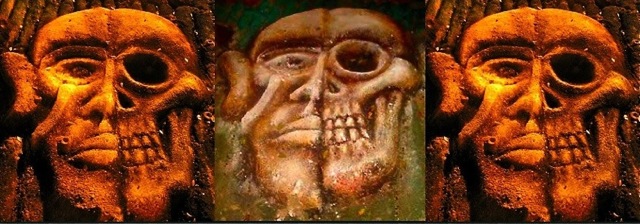
If you find yourself in Oaxaca on December 22, I encourage you to attend this world premiere! By the way, it’s a comedy!
Posted in Culture, History, People, tagged Dagoberto Gama, films, José María Morelos y Pavón, Mexican Independence, Mexican War of Independence, Mexico, movies, Oaxaca on November 10, 2011| 3 Comments »
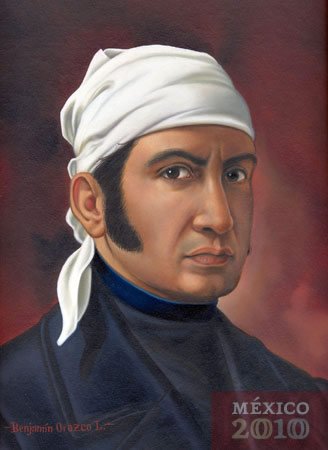
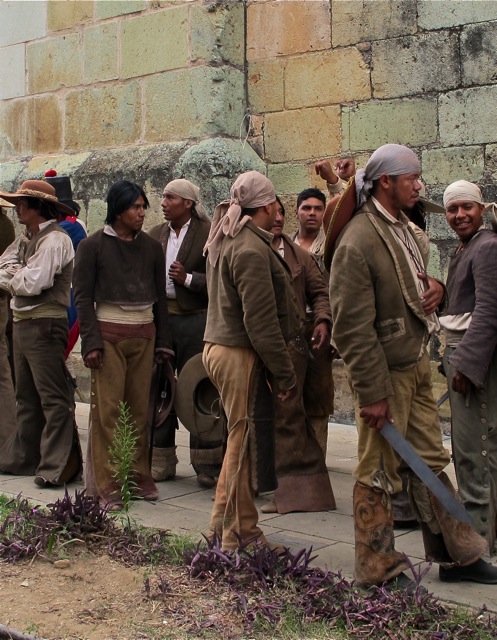
196 years after his execution, Generalísimo José María Morelos y Pavón has returned to Oaxaca. Filming is underway on the film tentatively titled “Morelos,” chronicling the last three years of the life of one of Mexico’s most revered heroes
Costumes hang ready for quick costume changes.

Mexican independence fighter extras await the Spanish language equivalent of ACTION!
Serious cameras are ready to film the action.

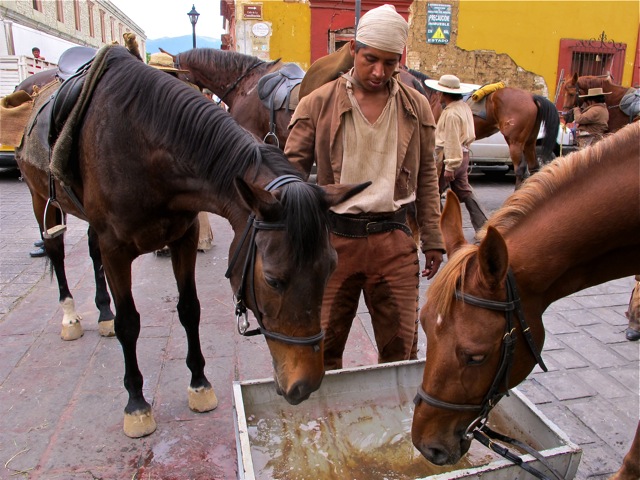
Horses and their riders have taken over the surrounding streets.
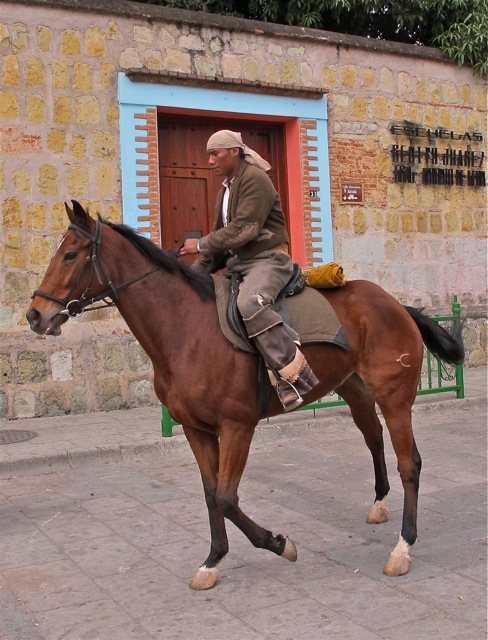
Like all movie sets, it’s, hurry-up and wait!
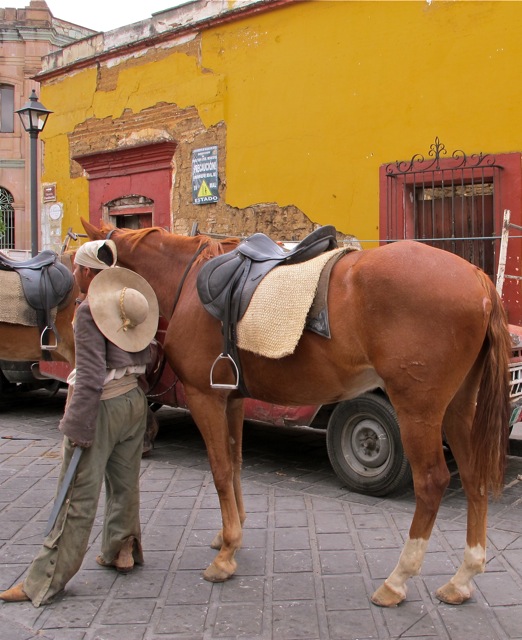
Muy guapo, is all I can say! The horses… the horses…

You can lead a horse to water…
The set designer has taken Constitución back two hundred years…
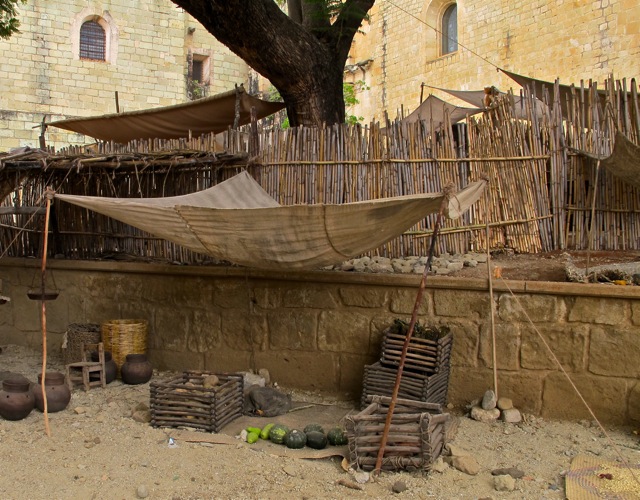
The newly paved cobblestone street and sidewalks have been covered in dirt and buildings and even trees have been aged.

Though the film covers a time in the life of Morelos that is distinguished more by politics than military action, “dead bodies” line Constitución.

“Morelos” is directed by Antonio Serrano and stars Dagoberto Gama, in the title roll. Filming is also scheduled to take place in Veracruz, Tlaxcala, Puebla, Hidalgo, Morelia (named for Morelos), and Mexico City. It is produced by Luis Urquiza and los Estudios Churubusco, with support from Conaculta, Imcine, and the governments of the states.
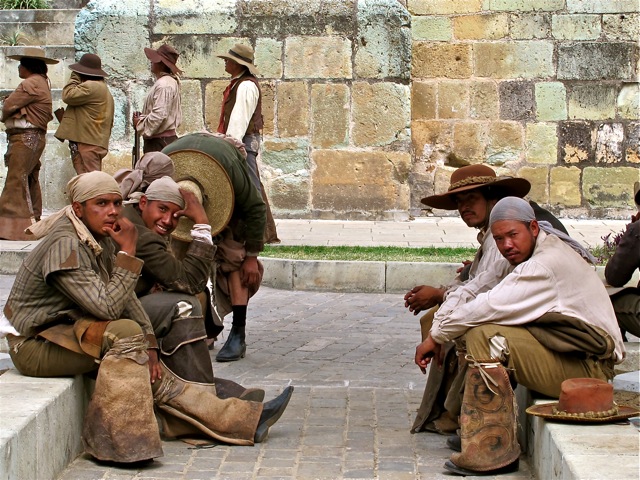
I imagine it’s release will be a major event… can’t wait!
Posted in Celebrations, Culture, Holidays, Religion, tagged cemetery, Day of the Dead, Día de los Muertos, Días de Muerto, Mexico, Oaxaca, panteón, Santiago Apóstol on November 9, 2011| 16 Comments »
On the road during los Días de muertos led us to Santiago Apóstol in the municipality of Ocotlán de Morelos…

Entering their Panteón, the play of light and shadow and explosion of greens, reds, oranges, yellows, and magentas against whitewashed graves was stunning.
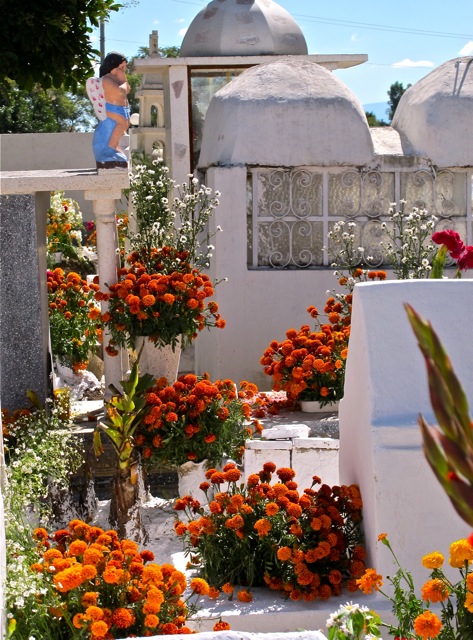
Unique artistry was evident in each of the cemeteries we visited.

One of the special and fragrant features here was the rose petals scattered atop graves.
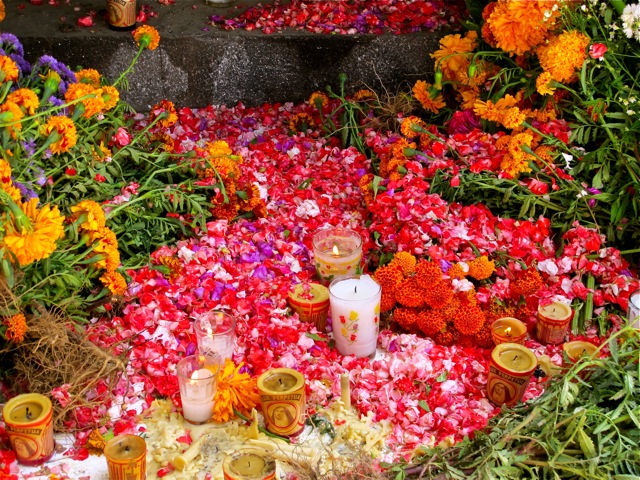
Have I mentioned… No matter where one seems to go in Oaxaca, the senses are filled!

More to come…
Posted in Culture, Music, People, tagged Guelaguetza Auditorium, Lila Downs, Mexico, Oaxaca, Totó la Momposina on November 6, 2011| 6 Comments »
What can I say about last night’s Lila Downs concert at the Guelaguetza Auditorium? It was one of those clear, mild and star-filled Oaxaca evenings. The glowing auditorium beckoned and encouraged us as we made the steep walk up the street and then stairs to the hillside site, that overlooks the city.

In true, “hey, it’s Mexico” style, we were unsure of the time… The posters, billboards, and concert’s Facebook page said, 8 PM. However, our tickets (purchased from TicketMaster… ugh!) said 7 PM. Needless to say, we were in line by 6:45. Our, off to the side, front row seats left much to be desired, but once the Afro-Caribbean rhythms of Columbiana, Totó la Momposina and her way hot band began, it didn’t matter.

Although, she initially confused Xalapa with Oaxaca (with the expected laughter and a few catcalls), Totó la Momposina won the crowd over and all were well warmed up for Oaxaca’s favorite daughter. Lila opened with an offering of mezcal and track number one, “Mezcalito,” from her new CD, Pecados y Milagros (Sins and Miracles).

Totó la Momposina joined her on stage, as on the CD, to sing “Zapata Se Queda,” a tribute to the spirit of Mexican revolutionary hero, Emiliano Zapata. Other songs followed, a rebozo (shawl) was added, and the lighting changed…

Lila then donned a beautiful serape from one of the master weavers of Teotitlán del Valle to sing, “Fallaste corazón.”
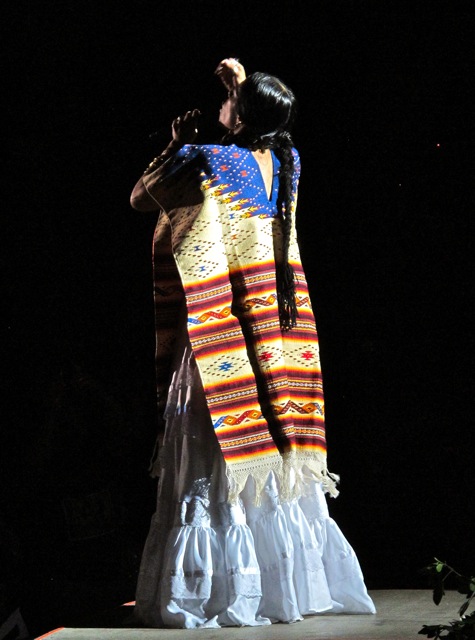
She dedicated, “Palomo’s Comalito,” to all the women who make tortillas in Mexico. A knowing smile crossed our faces. On Wednesday, we had been invited to the home of Emilia and Zacarias Ruiz in Teotitlán del Valle, where we honored the souls of their departed, by savoring Emilia’s delicate tamales and silky smooth and complex mole AND where we were informed by son, Antonio, that Emilia is featured in the music video for “El Palomo del Comalito.” (She’s the woman making tortillas.)
This was my first time seeing Lila Downs live. I’d listened to last year’s free concert, at the Plaza de la Danza, from my terrace, but it doesn’t compare with seeing her in person…
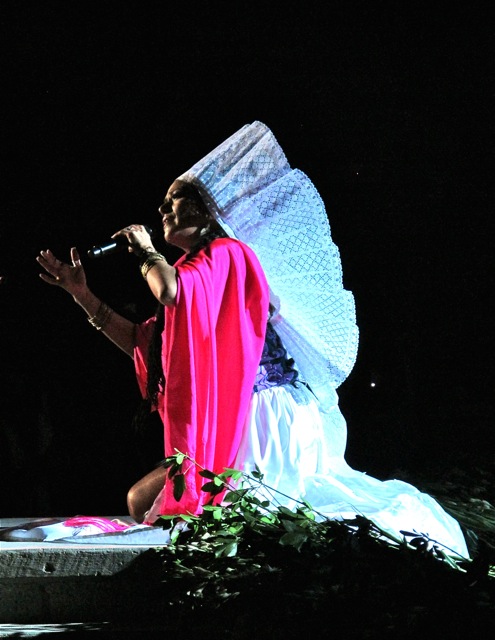
I think this was the costume change for her beautiful and haunting rendition of “La Llorona.” I can’t resist also showing the back of this traditional Isthmus of Tehuantepec headdress, known as a “bidaani quichi.”

A sublime and spectacular evening to close a sublime and magical week… ¡Muchisimas gracias, Oaxaca!
Posted in Celebrations, Culture, Holidays, tagged comparsa, Day of the Dead, Días de Muerto, Etla, Mexico, Oaxaca, parade, Vista Hermosa on November 4, 2011| Leave a Comment »
And then there were the impossibly cute kids taking part in the comparsa…



 Mexican Peso Converter
 View From Casita Colibrí