


Who do you love?
Posted in Creativity, Culture, tagged graffiti, Mexico, Oaxaca, photography, photos on July 14, 2012| 2 Comments »
Posted in Culture, Sports & Recreation, tagged baseball, beisbol, Guerreros de Oaxaca, Linda Oaxaca, Mexico, Oaxaca, photographs, photos, sculpture of baseball players, seventh inning stretch on July 10, 2012| Leave a Comment »
MLB All Star Game is on Cablemas (Lo siento mi maestra, el idioma es el Inglés.) and players from my San Francisco Giants are kicking “you know what!” I’d hoped to take the ferry (a very civilized way to go) to a Giants’ game when I was in the Bay Area last month, but, alas, time got away from me.
Oaxaca has a Minor League team, the Guerreros de Oaxaca, a Triple-A team in the Mexican League and their stadium is within (long) walking distance. Alas, I haven’t been to one of their games this season, either! However, last week I did wander by their office; the door was open and revealed this wonderful sculpture…


By the way, during the seventh inning stretch, fans rise and sing, “Linda Oaxaca” (Beautiful Oaxaca). It always brings a smile and I’ll take it over “God Bless America” every time!
Posted in Celebrations, Churches, Culture, Religion, Travel & Tourism, tagged cargo system, cargosMexico, danzantes, Doña Marina, festivals, fiestas, La Preciosa Sangre de Cristo, Malinche, Oaxaca, patronal festividad, photographs, photos, soldados, Teotitlán del Valle, travel on July 9, 2012| Leave a Comment »
The convite (covered in the Uplifting post) is only one of the traditions of the patronal festival of La Preciosa Sangre de Cristo. During the five days of the celebration, the church is filled with floral arrangements and believers stream in and out clutching flowers; the Danza de la Pluma (with Moctezuma, Cortez, Malinche, Doña Marina, danzantes, and soldados) is performed several times; and the cargo holders of the community preside, are honored, and presented with fresh fruits, vegetables, sacred herbs, and beverages.
Sunday was another amazing day in Teotitlán del Valle. And I haven’t even mentioned the tacos and tamales we devoured during our three visits this past week!
Posted in Celebrations, Culture, Religion, tagged convite, danzantes, El Picacho, festivals, fiestas, La Preciosa Sangre de Cristo, Mexico, Oaxaca, parade, patronal festividad, photographs, photos, sacred mountain, soldados, Teotitlán del Valle, travel on July 7, 2012| 10 Comments »
Late yesterday afternoon, we returned to Teotitlán del Valle for the convite (parade) of unmarried young women and girls, a part of the annual patronal festival of La Preciosa Sangre de Cristo. The sun was shining, the rains of two days before were nowhere to be seen, and the sacred mountain, El Picacho, gracefully, but commandingly, presided as the soldados and danzantes entered the church courtyard.

Bands also arrived to take part…

Canastas (baskets) were lined up, ready to be carried…
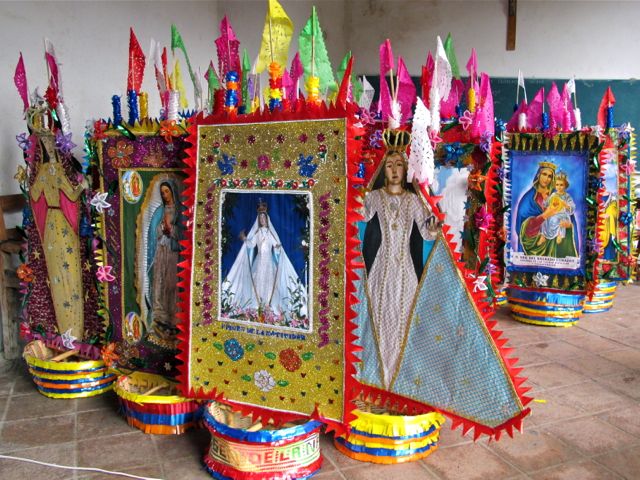
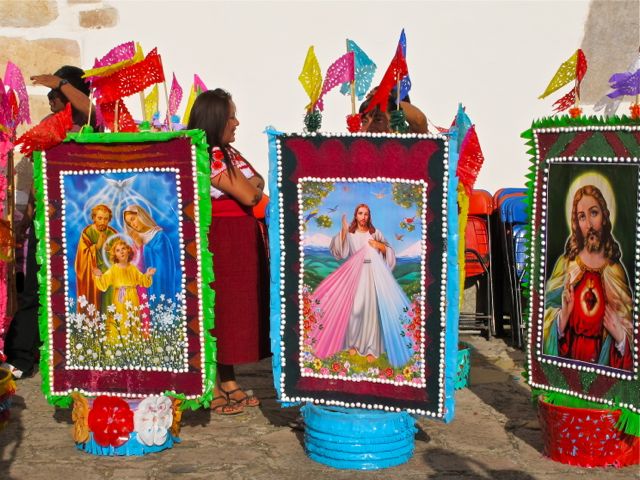

The young men of the village gathered…


Family and friends awaited…

And then the young unmarried women and girls, the stars of the evening, raised the canastas over their heads…


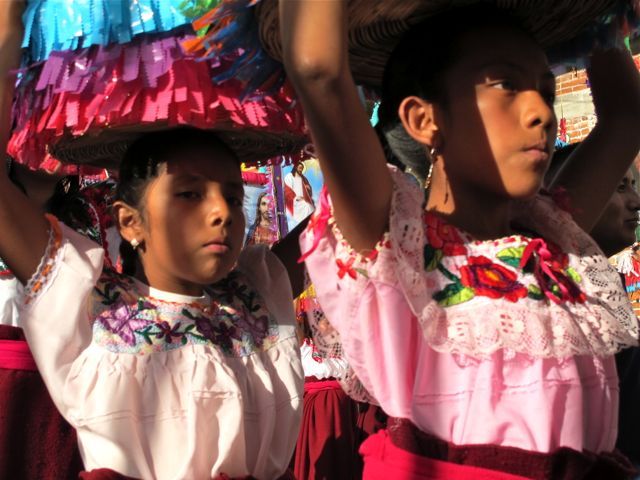
Balancing the canastas, they processed from the courtyard, down several long and cobblestone blocks, turned left, and headed back up another street to where they had begun, to be greeted by proud family and friends, who had gathered to acknowledge and celebrate the young women and girls of Teotitlán del Valle.
For some inexplicable reason, we never cease to feel moved and uplifted by this ritual.
Posted in Celebrations, Culture, Travel & Tourism, tagged festivals, fiestas, La Preciosa Sangre de Cristo, Mexico, Oaxaca, patronal festividad, photographs, photos, Teotitlán del Valle, travel on July 5, 2012| Leave a Comment »
Yesterday, fellow blogger, Chris, and I drove out to Teotitlán del Valle for their yearly patronal festividad de La Preciosa Sangre de Cristo. The rains came and we didn’t stay long. But, as we almost always find, just being out there provides much appreciated food for the soul.

Posted in Culture, History, Immigration, Language, tagged “No me llames Oaxaquita” campaign, California, discrimination, Edward Rothstein, Epithet that divides Mexicans is banned by Oxnard school district, Greenfield, immigrants, indigenous peoples, language, Mexico, Mixtec, Native speakers and local missionaries work to save an indigenous Mexican language, Oaxaca, Oxnard, Paloma Esquivel, Sara Rubin, The Past Has a Presence Here, Triqui, Zapotec on June 25, 2012| Leave a Comment »
In the last month, several articles in the US press referencing Oaxaca have been called to my attention. They aren’t the usual travel features enumerating the “10 must see sites,” “best places to stay,” and “local fare dining.” Nor do they cater to the ever more popular fear mongering and demonization of Mexico and her citizens. Instead, these articles provide a window on Oaxaca’s indigenous past and challenging present.

Triqui women and children in front of the Government Palace in Oaxaca de Juárez
From the June 15, 2012 New York Times: The Past Has a Presence Here by Edward Rothstein.
OAXACA, Mexico — The past casts a sharp shadow here, wherever you look. You see it on mountaintop plateaus, where the ruins of ancient pyramidal staircases and capital-I-shaped ball fields hint at mysterious rituals that disappeared over a millennium ago.
<snip.
We are not dealing here with imagined reconstructions, but with the past’s palpable presence. And most of these ancient cities and monuments were abandoned some six centuries before the Spaniards plundered the region. After 80 years of archaeological research, their meanings are still unclear, though much has been written about Zapotec social hierarchies, gladiatorial-style games and stone carvings.
What is more clear is that remnants of those worlds also exist in the valley, where the slow-changing cultures of this buffeted but protected region still reflect Zapotec and Mixtec heritages. So here everything is plentiful that in the United States is rare: indigenous ruins, ancient languages, signs of direct lineage. And there is an edge to it all. Centers like Monte Albán are monuments to power and accumulated material wealth; they are also clearly evidence of a large-scale political organization, relics of perhaps the earliest state in the Americas. [Read full article]
From California’s June 7, 2012 Monterey County Weekly, Native speakers and local missionaries work to save an indigenous Mexican language by Sara Rubin.
Gloria Moreno walks with a slight limp under the weight of the black messenger bag slung over her shoulder. It holds something of a botanical encyclopedia, petals and leaves gathered from the streets of Greenfield, which Moreno says help alleviate any number of ailments – pain, anxiety, weak bones.
Moreno says her collection is part of a medical tradition she began practicing as a teenager in Mexico. It was there, at 15, that she says she was instructed in a dream to take up herbal medicine.
Moreno dreamt her directive in Triqui de la baja, an indigenous language of the Copala region of Oaxaca in southern Mexico.
As native Triqui speakers disperse, leaving behind a notoriously violent region, there’s pressure both to preserve that language, and to leave it behind.
Of an estimated 40,000 Triqui speakers worldwide, about half of them are thought to have migrated away from Oaxaca, and as many as 10 percent live in the Salinas Valley.
<snip>
Moreno hopes for a generation of trilingual children, but many younger Triqui speakers are encouraged to trade their native tongue for English or Spanish, says a Salinas-based interpreter (who asked not to be named for fear of reprisal), because indigenous Mexicans are viewed as inferior. He trekked two hours to school from his childhood home in Oaxaca where he says he was bullied for being different.
“Because of the discrimination, parents don’t want their kids to learn [Triqui],” he says, “but then we lose tradition and culture.”
To reverse that, he hopes to get a grant or some cash to revive a bimonthly Triqui class piloted at the Greenfield Public Library two years ago. It drew about 35 students; of those, only a quarter were native speakers. The rest, mostly service providers, were there to learn Triqui.
“To speak Spanish, I used to think you had more value,” he says. “When I came here, I learned it is not that way. If you know three or four languages, you can explore and learn more.”
View Barbara Hollenbach’s Spanish-Triqui dictionary at www.sil.org/~hollenbachb/Posted.htm [Read full article]
And finally from the May 28 Los Angeles Times, Epithet that divides Mexicans is banned by Oxnard school district, by Paloma Esquivel.
Rolando Zaragoza, 21, was 15 years old when he came to the United States, enrolled in an Oxnard school and first heard the term “Oaxaquita.” Little Oaxacan, it means — and it was not used kindly.
“Sometimes I didn’t want to go to school,” he said. “Sometimes I stayed to fight.”
“It kind of seemed that being from Oaxaca was something bad,” said Israel Vasquez, 23, who shared the same mocking, “just the way people use ‘Oaxaquita’ to refer to anyone who is short and has dark skin.”
Years later, indigenous leaders are fighting back against an epithet that lingers among immigrants from Mexico, directed at their own compatriots. Earlier this month the Mixteco/Indigena Community Organizing Project in Oxnard launched the “No me llames Oaxaquita” campaign. “Don’t call me little Oaxacan” aims to persuade local school districts to prohibit the words “Oaxaquita” and “indito” (little Indian) from being used on school property, to form committees to combat bullying and to encourage lessons about indigenous Mexican culture and history.
Indigenous Mexicans have come to the U.S. in increasing numbers in the last two decades. Some estimates now put them at 30% of California’s farmworkers. In Ventura County, there are about 20,000 indigenous Mexicans, most of whom are Mixtec from the states of Oaxaca and Guerrero who work in the strawberry industry, according to local organizers.
Many speak little or no Spanish and are frequently subjected to derision and ridicule from other Mexicans. The treatment follows a legacy of discrimination toward indigenous people in Mexico, said William Perez, a professor of education at Claremont Graduate University who has interviewed and surveyed numerous indigenous Mexican students. [Read full article]
Posted in Buildings, Creativity, Culture, tagged 142 Throckmorton, California, first day of summer, graffiti, Mexico, Mill Valley, Oaxaca, photographs, photos, street art, travel, wall art, Zio Ziegler on June 20, 2012| Leave a Comment »
Wanna see me pull a rabbit out of my hat?

Happy first day of summer.
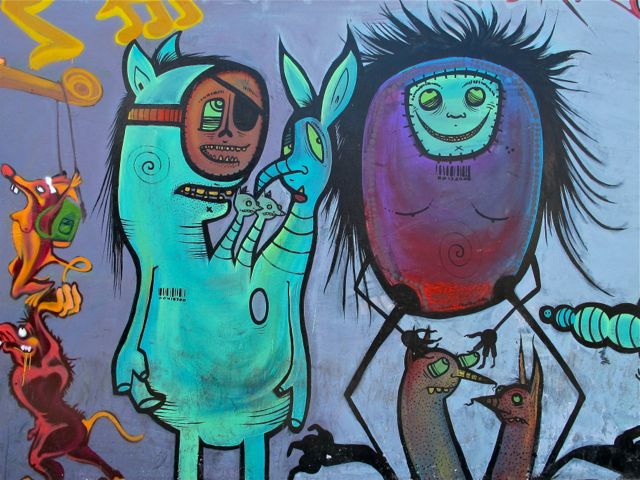
From the walls of Oaxaca…

To the walls of Mill Valley…
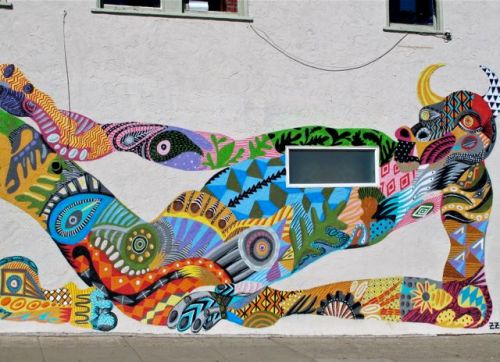
by artist, Zio Zieler
Posted in Creativity, Culture, Exhibitions, Museums, People, Travel & Tourism, tagged Alejandro Santiago Ramírez, Alredo Canseco, Ariel Mendoza Baños, art, arts, exhibitions, Francisco Toledo, Jorge López García, Juan Alxázar Méndez, Justina Fuentes Zárate, Marimar Suárez Peñalva, Mexican consulate, mexican consulate in san francisco, Mexico, Oaxaca, Oaxacan surrealism hits the SF Mexican consulate, photographs, photos, Rubén Leyva, Rufino Tamayo, San Francisco, The Magic Surrealists of Oaxaca, travel on June 15, 2012| 2 Comments »
As hoped, I managed to make my way to the Mexican Consulate in San Francisco for The Magic Surrealists of Oaxaca. It’s the exhibit (I mentioned a few days ago) that celebrates the Zapotec artists of Oaxaca from Rufino Tamayo and Francisco Toledo to those they encouraged and influenced.
On the consulate’s ground floor the scene was a familiar one — signage and conversations en español; the eagle, serpent and green, white, and red of the Mexican flag prominently displayed; waiting room filled with patiently waiting people — a sliver of Mexico in San Francisco. Climbing the two flights of stairs (elevator was broken) up to the third floor, a friend and I found the exhibit…
According to the article, Oaxacan surrealism hits the SF Mexican consulate, the consulate’s cultural affairs attache, Marimar Suárez Peñalva, hopes the gallery and its exhibitions will offer Mexican expats an opportunity to connect with the creativity, not just the bureaucracy (my word), of their culture. However, I don’t know how many of those waiting on the first floor make it up to the third floor; early in the afternoon, we had the gallery to ourselves.
And yes, works by Tamayo and Toledo are included, but I thought I’d feature some of the lesser known artists. By the way, did you notice the name, Alejandro Santiago Ramírez? This is the same Alejandro Santiago of the 2501 Migrantes sculptures that I’ve previously written about.
Posted in Creativity, Culture, tagged AK Crew, Biek, graffiti, Macs, Mexico, Oaxaca, photographs, photos, Ser, Serckas, street art, wall art on June 8, 2012| 2 Comments »
Walking back from grocery shopping, with a lighter than usual load, I took a detour and stumbled on this wall only two blocks from home.
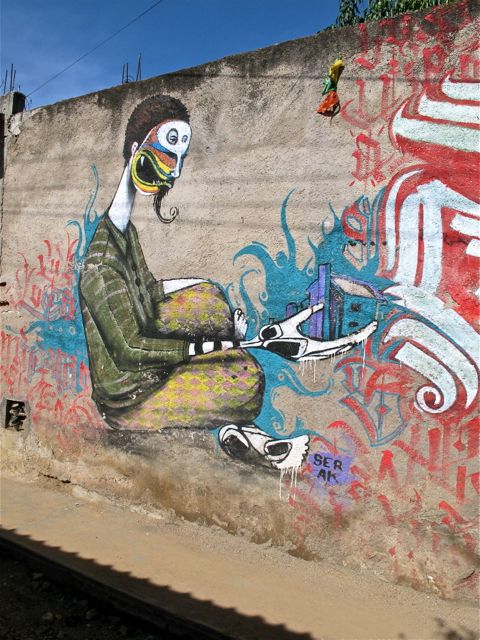
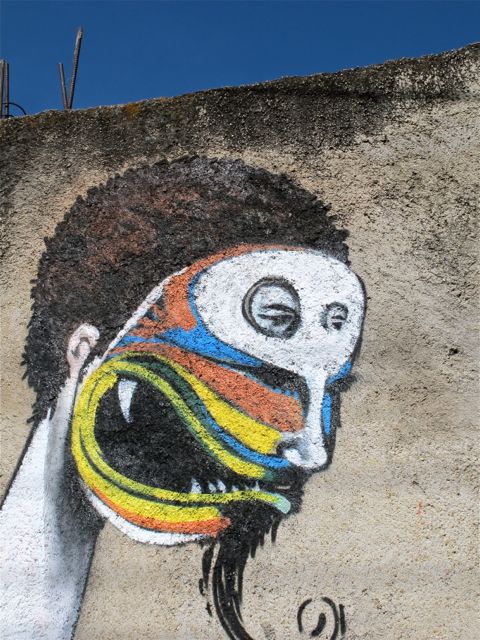
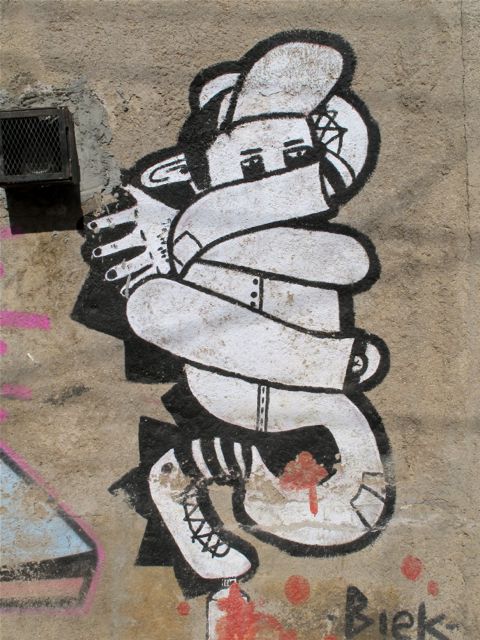
Doing a little research, I found a video of it being painted…
Graphic design, Oaxacan style!
Posted in Creativity, Culture, tagged graffiti, KAD, Mexico, Oaxaca, photographs, photos, street art, wall art on May 26, 2012| Leave a Comment »
Just another day, just another walk.
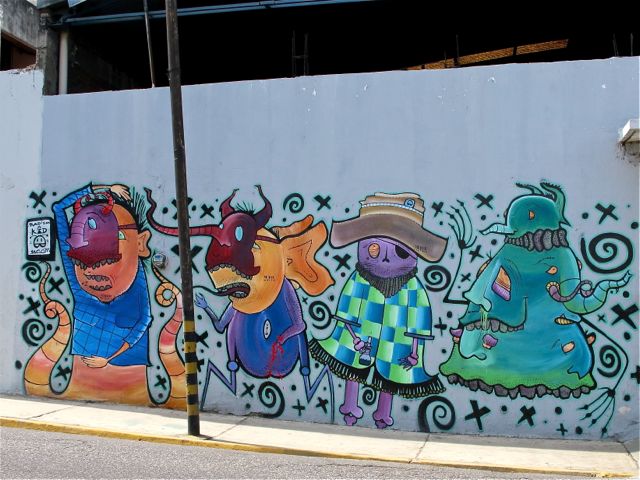
Just another wall of street art.

Just another April Fools Day (2012) mural.
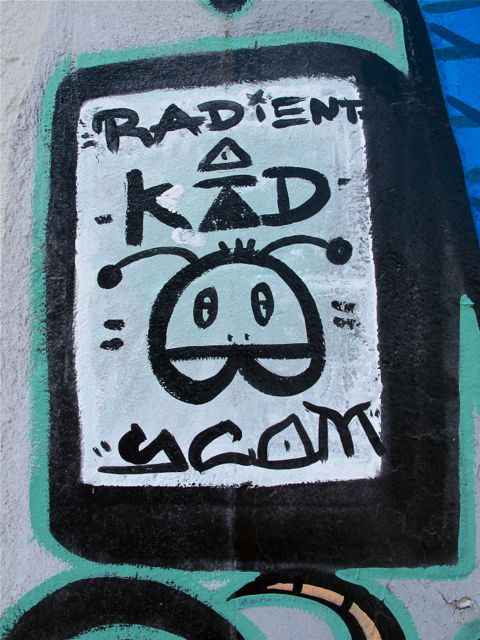
Muchisimas gracias, KAD, for bringing a smile…

and leading us into the void.
Posted in Books, Creativity, Culture, People, tagged Ambrose Bierce, books, Carlos Fuentes, Frank Pixley, Mexico, The Argonaut, The Old Gringo on May 16, 2012| 1 Comment »
Carlos Fuentes, one of Mexico’s most revered writers, died yesterday at the age of 83.
It was the California connection that allowed for my introduction to the writings of Fuentes. The acquaintance came through The Old Gringo, a fictionalized story of the disappearance in Mexico, during the Mexican Revolution, of real life writer and US Civil War veteran, Ambrose Bierce. Following the Civil War, Bierce wound up in California, where he was a contributor to the literary journal, The Argonaut, founded and edited by one of my relatives, about whom, Bierce wrote a typically acerbic epitaph: Here lies Frank Pixley — as usual. So, in my ongoing attempt to unravel some of the mysteries surrounding living and being in Mexico, reading the The Old Gringo was a no-brainer. As The Guardian’s obituary of Carlos Fuentes concludes,
Throughout his life, wherever he lived, Mexico was the centre of Fuentes’s artistic preoccupations. In his late 70s, he provided a typically graphic description of the attraction he felt for his own land: “It’s a very enigmatic country, and that’s a good thing because it keeps us alert, makes us constantly try to decipher the enigma of Mexico, the mystery of Mexico, to understand a country that is very, very baroque, very complicated and full of surprises.”
Carlos Fuentes is not uncontroversial, but you should see for yourself. If you are not familiar with his writings, you might want to visit your local library and checkout a book or two. For those in Oaxaca, the Oaxaca Lending Library has the following titles:
Fiction
Adan en Eden
Baroque Concerto
Burnt Water
Cuerpos y Ofrendas
Campaign
Cantar de Ciegos/To Sing of the Blind
Change of Skin
Christopher Unborn
Constancia: y Otras Novelas para Vírgenes
Constancia and Other Stories for Virgins
Crystal Frontier
Diana the Goddess Who Hunts: The Goddess Who Hunts Alone
The Death of Artemio Crus: A Novel
Destiny and Desire: A Novel
Diana o la Cazadora Solitaría
Distant Relations
The Eagle’s Throne
Good Conscience
Gringo Viejo
Hydra Head
Muerte de Artemio Cruz
El Naranjo
Old Gringo
The Orange Tree
La Region Mas Transparente
Terra Nostra
Where the Air Is Clear
Years with Laura Diaz Fuentes
Cabeza de la Hidra
Vida Está en Otra Parte
Non Fiction
Aura
The Buried Mirror: Reflections on Spain and the New World
En Esto Creo
Latin America at War with the Past
Mexico: Una Vision de Altura: Un Recorrido Aereo de Pasado Al Presente
Myself with Others
This I Believe
Todos los Gatos Son Pardos
The Diary of Frida Kahlo: An Intimate Self-Portrait
New Time for Mexico
Posted in Creativity, Culture, Travel & Tourism, tagged Chiapas, costume, dance, folk dancing, Guatemala, Mexico, mothers, Oaxaca, photographs, photos, San Antonino Castillo Velasco, Tehuana, Tehuantepec, traje, travel, women, Zinacatán tunic on May 13, 2012| Leave a Comment »
My mom was a folk dancer. She had studied ballet, tap, and acrobatic dancing when she was young and brought that training and muscle memory along with her when she took up folk dancing in her mid thirties. I spent many hours over the years watching her dance; the Kamarinskaya from Russia, Swedish Hambo, Fandango from Portugal, Mexico’s Jarabe Tapatio, and so many more. In addition to being a talented dancer, she made her own costumes. A dressmaker’s dummy was a permanent fixture in her bedroom, yards of colorful cotton fabric and braid were piled next to the sewing machine, and in the evenings her hands and eyes were often occupied embroidering pieces for a new costume.
Mom died in 1989, but not a day goes by that I don’t think of her. So, on this Mother’s Day, this is for you mom…

Guatemala

Zinacatán, Chiapas, Mexico

Zinacatán, Chiapas, Mexico

San Antonino Castillo Velasco, Oaxaca, Mexico

Tehuantepec, Oaxaca, Mexico

Tehuantepec, Oaxaca, Mexico
Posted in Celebrations, Culture, History, Holidays, tagged Día de la Madre, Liza Bakewell, Madre: Perilous Journeys With a Spanish Noun, Mexico, Mother's Day, mothers, Oaxaca, photographs, photos, women on May 10, 2012| 3 Comments »
Today, May 10, is Día de la Madre in Mexico and it is celebrated in much the same way as in el norte.
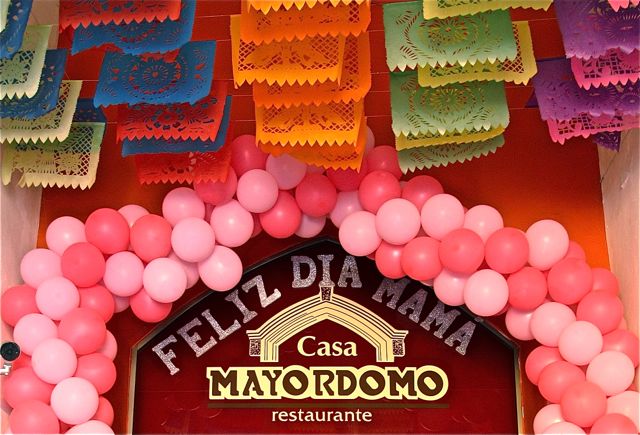
The celebration migrated south from the USA in the early 20th century and was embraced and promoted by the Catholic Church AND the anticlerical Revolutionaries. As for their reasons, I will quote from Liza Bakewell’s book, Madre: Perilous Journeys with a Spanish Noun.
… around the 1850s the Liberals… were nervous about women’s growing participation in the public sphere. Establishing motherhood as venerable and the home as sanctified… would give women a sphere of their own where they could be boss. Also, it would keep them off the streets and out of the workplace where they had begun to compete with men for jobs.
Under their watch, everyday motherhood became an exalted madre-hood…. The twentieth-century Revolutionaries who succeeded them took the idea and ran with it, adding in 1922 a ritual, Mother’s Day… [p. 84]
Needless to say, the women of Mexico have not stayed home! As I write, hundreds of women are marching on Mexico City, participating in the March of National Dignity: Mothers Looking for their Sons and Daughters and Searching for Justice. And, as for the workforce, according to a report citing the 2010 census, 33.3% of women work and this doesn’t even include those working in family operated enterprises.
However distasteful the reasons behind the establishment of Mother’s Day in Mexico, it does nothing to diminish the need to honor these beautiful, hardworking, formidable, and loving women.
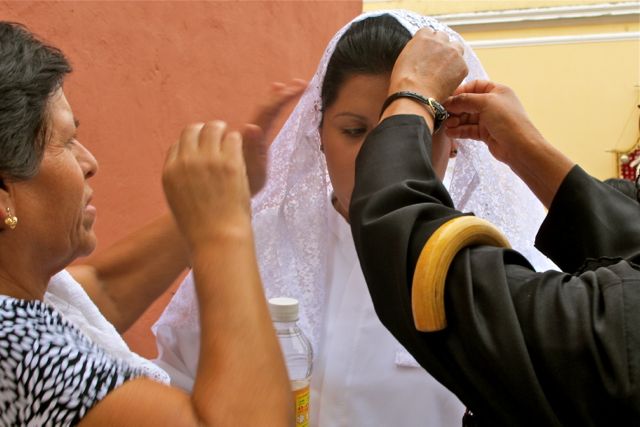

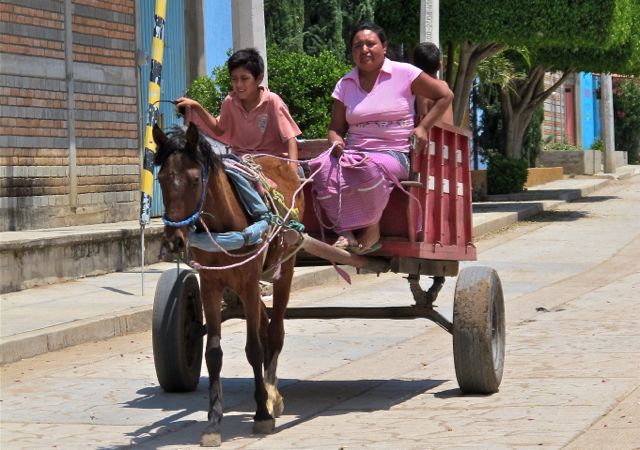
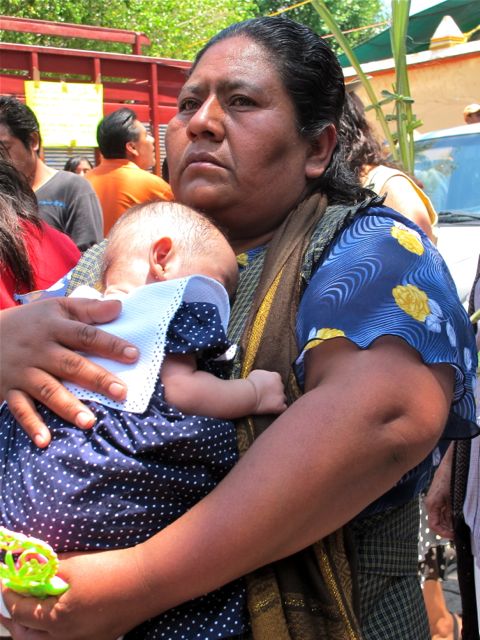
¡Feliz Día de la Madre mis compañeras!
Posted in Archaeology, Culture, tagged ballcourt, Jeffrey Blomster, Mesoamerican ballgame, Mexico, Mixteca, Mixteca Alta, Mixtecs, Monte Albán, Oaxaca on May 8, 2012| Leave a Comment »
At the top of my Oaxaca Yahoo! Alerts today…
GW anthropology professor Jeffrey Blomster’s research featured in PNAS journal
WASHINGTON—George Washington University Professor Jeffrey P. Blomster’s latest research explores the importance of the ballgame to ancient Mesoamerican societies. Dr. Blomster’s findings show how the discovery of a ballplayer figurine in the Mixteca Alta region of Oaxaca demonstrates the early participation of the region in the iconography and ideology of the game, a point that had not been previously documented by other researchers. Dr. Blomster’s paper, Early evidence of the ballgame in Oaxaca, Mexico, is featured in the latest issue of Proceedings in the National Academy of Sciences (PNAS).
Dr. Blomster, GW associate professor of anthropology, has spent 20 years researching the origin of complex societies in Mesoamerica. The participation of early Mixtec societies in ballgame imagery is a new aspect of his research. For the journal publication, Dr. Blomster worked with undergraduate students Izack Nacheman and Joseph DiVirgilio to create artistic renditions of the figurine artifacts found in Mexico.
While early games used a hard rubber ball, the ballgames Dr. Blomster researches bear little resemblance to today’s Major League Baseball. The games and the costumes or uniforms participants wore were tied to themes of life and death, mortals and underworld deities or symbolizing the sun and the moon. In some instances, the ballcourt itself represented a portal to the underworld.
According to Dr. Blomster, “Because the ballgame is associated with the rise of complex societies, understanding its origins also illuminates the evolution of socio-politically complex societies.”
During the Early Horizon period, or roughly between 1400 BCE (Before the Common Era) and 1700 BCE, there was little evidence of ballgame activity in the way of artifacts in the Oaxaca region of Mexico. Dr. Blomster’s findings of a clay figurine garbed in distinctive ballgame costume, similar to both Olmec figurines and monumental sculptures from the Gulf Coast, indicate such engagement did take place in the area.
“Exploring the origins and spread of the ballgame is central to understanding the development of the Mesoamerican civilization,” he said. “We know there were earlier versions of a ballgame prior to the Early Horizon with both a ballcourt and rubber balls found in coastal Chiapas and the Gulf Coast, but the institutionalized version of the ballgame, a hallmark of Mesoamerican civilizations, developed during the Early Horizon. While there has been some limited evidence about the participation of the nearby Valley of Oaxaca in the ballgame, the Mixteca has largely been written off in terms of involvement in the origins of complex society in ancient Mexico. This discovery reemphasizes how the ancient Mixtecs were active participants in larger Mesoamerican phenomenon.”
###
By the way, there was a lot more to these ballgames than mere athletic competitions — think ritual, conflict resolution, sacrifice. Below is the ballcourt just up the hill at Monte Alban.

The stories it could tell…
Posted in Creativity, Culture, Music, Parks & Plazas, People, tagged Alejandra Robles, Ma (yo) en Oaxaca, Mexico, Oaxaca, Plaza de la Danza, singers, video, vocalist, women on May 6, 2012| 2 Comments »
As the promotional material for Ma (yo) en Oaxaca, Mujer (es) Arte y Cultura explains (loose translation), like a skilled weaver, women create the fabric of life… part of the history of humanity, intelligence that moves, the look that looks, which is regarded in the construction of better horizons of life for her and those who are around her. And so, from May 3rd through 13th, the women of Oaxaca are being celebrated with workshops, exhibitions, lectures, and concerts.
Last night, under the supermoon, one of the accomplished women of Oaxaca, Alejandra Robles, gave a free concert, just a block away, in the Plaza de la Danza…
Ma (yo) en Oaxaca is a party for all of the principles of inclusion and participation to make possible the knowledge and appreciation of the cultural richness of groups which, for various reasons, have been marginalized.
¡Viva las mujeres!


 Mexican Peso Converter
 View From Casita Colibrí
