Navigating through traffic in Oaxaca, you just never know what you will see…

¡¡¡Cuidado!!!

Por favor, never come between a boy and his keyboard.
Posted in Culture, Transportation, Travel & Tourism, tagged boys, keyboard, Mexico, musical instruments, Oaxaca, photographs, photos, traffic, transportation on September 28, 2013| Leave a Comment »
Navigating through traffic in Oaxaca, you just never know what you will see…
¡¡¡Cuidado!!!
Por favor, never come between a boy and his keyboard.
Posted in Buildings, Celebrations, Culture, Travel & Tourism, tagged decorative lighting, Dreamer, El Mes de la Patria, Government Palace, José María Morelos y Pavón, Mexican Independence, Mexico, Miguel Hidalgo y Costilla, Oaxaca, Oaxaca Film Festival, Oaxaca FilmFest4, Palacio de Gobierno, photo, photographs, Twenty Million People on September 26, 2013| 3 Comments »
Early Wednesday evening, I walked down to the Palacio de Gobierno to see Dreamer, one of the Oaxaca FilmFest4 offerings. It had been raining on and off all day and so, to lighten my load and make room for my umbrella, I left my camera at home. Why would I need it? I was just going to be sitting in a small dark theater. Sheesh, was I mistaken! It was twilight when I entered the Palace via the side door on Flores Magón, but we were directed to exit through the main front entrance — and I was blown away by the scene before me. The rain-soaked zócalo glistened and glittered, awash with El Mes de la Patria green, white, and red lights.
Needless to say, last night when I returned to watch, Twenty Million People, I took my camera!

Heroes of the independence movement, Hidalgo and Morelos in the spotlight as they gaze down from the Government Palace. I always forget how beautiful the zócalo is at night!
Posted in Archaeology, Culture, History, Travel & Tourism, tagged archaelogical site, archaeological zone, archaeology, Mexico, Oaxaca, photography, photos, popular travel destinations, Santa María Atzompa, Zona Arqueologica de Atzompa on September 24, 2013| 4 Comments »
Almost a year after our first visit to the newly opened Atzompa archaeological site, yesterday, we returned. The beautiful paved road up from Santa María Atzompa (elevation 1,580 meters) now brings one to a parking lot right across from the entrance, making for less of a haul up the hill for those less mobile or challenged by the altitude — at the top it is almost 300 meters above the village below — even we were huffing and puffing.

Atzompa was part of Monte Alban and one of its largest settlements. At the top of the stairs (above), is the largest (45 meters by 22 meters) of the 6 ball courts found among the Monte Alban communities.

Investigations of the Atzompa site first began in 1940 by Jorge R. Acosta, who was part of the Monte Alban Project. However, in 2007 the National Institute of Anthropology and History began formal explorations using a team of architects, archeologists, topographers, and restorers.

Though the path is currently difficult to see, make sure to go around to the left of the building above to see the north quadrant. Informational placards in Spanish and English are now in place throughout the site and most of the facts in this post are taken from them, but, of course, I neglected to take a photo of the placard for the building below!

Residents from the land cooperatives in the surrounding communities have been hired to do much of the field and lab work. Not a bad setting to work…

One can, in the words of The Who, “see for miles and miles and miles and miles and miles…”
 Except for the birds, insects, lizards, and workers, we had this spectacular setting to ourselves — I think we only saw 3 other visitors the entire time we were there. Perhaps when the second entrance on the Monte Alban side opens, it will attract more attention. In the meantime, the peace and tranquility are a gift in these chaotic times.
Oaxaca–The Year After has more from yesterday’s visit.
Posted in Creativity, Culture, Travel & Tourism, tagged graffiti, In the Shape of a Heart, Jackson Browne lyrics, love, Mexico, Oaxaca, photo, photography, street art, urban art, wall art on September 22, 2013| 2 Comments »
Ahh, young love… On the walls of Oaxaca, among the extraordinary art and pithy political statements, there are declarations of love.

People speak of love don’t know what they’re thinking of
Wait around for the one who fits just like a glove
Speak in terms of belief and belonging
Try to fit some name to their longing
People speak of love
— In the Shape of a Heart by Jackson Browne
Posted in Celebrations, Culture, Travel & Tourism, tagged Congreso Nacional de Danzón, dance, Danzón, festivals, Mexico, music, Oaxaca, photographs, photos on September 20, 2013| 2 Comments »
Not only is the previously mentioned Oaxaca FilmFest4 opening tomorrow night, but last night a calenda up Morelos heralded the arrival of the 8th Congreso Nacional de Danzón. Alas, it was raining, I’m a wimp, and so stayed home. However, the music coming from the Plaza de la Danza sounded wonderful. Sigh….
If you are walking around Oaxaca during the next few days, be on the lookout for the guapas y guapos (the guys are all duded up, too) of Danzón. They are adding a lot of glitz and glamour to the streets of the city.

For the uninitiated, Danzón is a very stately dance that originated in Cuba. However, it seems to be most beloved in Puerto Rico and Mexico. It has especially flourished in Oaxaca, where one can find dancers young and old dancing under the laurel trees in the Zócalo every Wednesday evening at 6:30. And, no wonder it has retained its popularity here, according to Wikipedia, “many famous danzones were composed by Oaxacan musicians such as the famous Nereidas and Teléfono de larga distancia, both works of Amador Pérez Dimas, from the town of Zaachila, near Oaxaca city.”
If you aren’t anywhere where Danzón is performed, you can check out the 1991 movie, Danzón:
Julia (Rojo) is a phone operator in Mexico City who divides her time between her job, her daughter and the danzon: a cuban dance very popular in Mexico and Central America. Every wednesday Julia does the danzon with Carmelo (Rergis) in the old “Salon Colonia”. They’ve danced for years but barely know each other. One night Carmelo disappears without a trace. Feeling lonely and sad, Julia takes a train to Veracruz, where she knows Carmelo has a brother. That sudden trip will change Julia’s life forever. — IMDB
I haven’t seen the movie, but according to one reviewer, the soundtrack is worth the rental price. I’m going to try to find it!
Posted in Creativity, Culture, People, Travel & Tourism, tagged entertainment, film, film festivals, international film festivals, Mexico, movies, Oaxaca, Oaxaca Film Festival, Oaxaca FilmFest4, photographs, photos, popular travel destinations, Ramiz Adeeb Azar on September 18, 2013| 1 Comment »
Today the Oaxaca Lending Library played host to Oaxaca FilmFest4 founder and artistic director, Ramiz Adeeb Azar. He and 4 members of the festival staff came to the library to “pitch” the festival, which opens September 21 and runs through the 28th. (Note: it has moved from November to September). It wasn’t a hard sell, as many of us have been following it since it began in 2010. And, I’ve got to say, it’s come a long way in a short amount of time. According to Ramiz, it has…
The festival has already set up shop in Plaza San Jerónimo (on Macedonio Alcalá) where staff and volunteers are hard at work and, like last year, the site will serve as the festival’s Hospitality and Information Center.


If you love film, but have never been to a film festival, I highly encourage you to give it a try. Prior to relocating to Oaxaca, for 7 years, one of the highlights of my calendar year was volunteering at the Mill Valley Film Festival. Besides being a lot of fun (never forget, on my hands and knees mopping up spilled red wine at the feet of Katherine Ross and Sam Elliot), I had the opportunity to see some truly wonderful films — especially shorts and documentaries that are rarely shown in the big chain multiplexes. The MVFF was one of the things I missed most (along with crusty sourdough bread and being able to flush toilet paper down the toilet) when I moved down here.
However, along came the Oaxaca FilmFest and, though it didn’t satisfy my craving for sourdough bread or cause new plumbing to be installed in Oaxaca, it does come with a well-considered, eclectic, and always creative selection of films (feature-length and shorts) from all over the world.


Last year, El último hielero (The Last Ice Merchant) a touching documentary from Equador was a favorite of mine, as was The Cart, a humorous short from Russia. And, if the two short films Ramiz showed today — the animated, Sleight of Hand and the very moving, Part of the Change — were any indication, the selectors did a terrific job again this year. So, if you are in Oaxaca, get thee to the Oaxaca FilmFest4 information center at Plaza San Jerónimo and pick up your festival schedule or download it from the festival website.
FYI: All screenings are public and free (except Cinemex and Foundation Nights) and every film is projected in its original language, with Spanish, English, or dual subtitles.
Posted in Celebrations, Culture, History, Holidays, Travel & Tourism, tagged desfile, holidays, Mexican Independence Day, Mexico, military, Oaxaca, parade, photographs, photos, popular travel destinations, women military on September 16, 2013| 6 Comments »
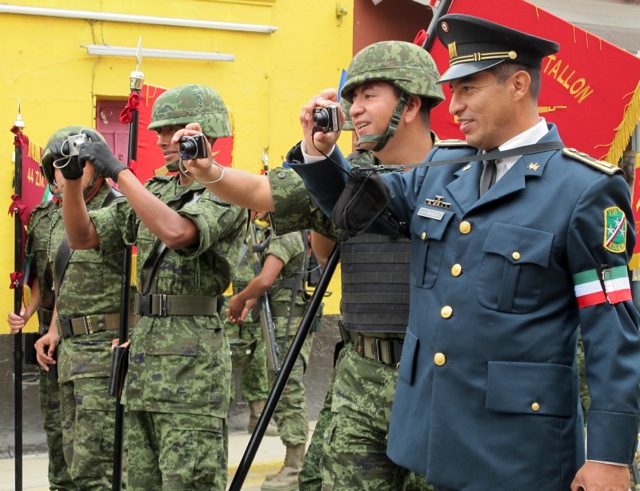
What do the guys do while waiting for an Independence Day parade to begin?
And, what do gals do? Pose for them!
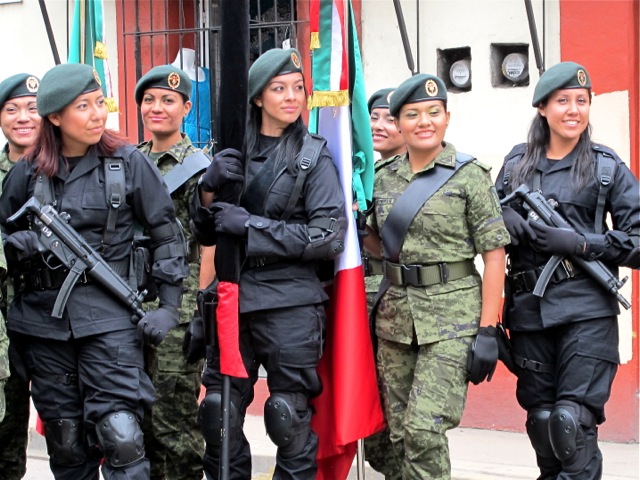
A mother takes twenty years to make a man of her boy, and another woman makes a fool of him in twenty minutes. — Robert Frost
Posted in Culture, Food, Restaurants, Travel & Tourism, tagged Aurora Toledo, barbacoa, barbecue, chefs, cuisine, culinary traditions, dining, El Saber del Sabor, food festival, gastronomic festival, gastronomy, José Domingo Cruz Cobos, laborers, Mexico, Oaxaca, Patricia Quintana, photographs, photos on September 12, 2013| 12 Comments »
A couple of days ago, above the Plaza de la Danza, a mound of sand and a pile of bricks.
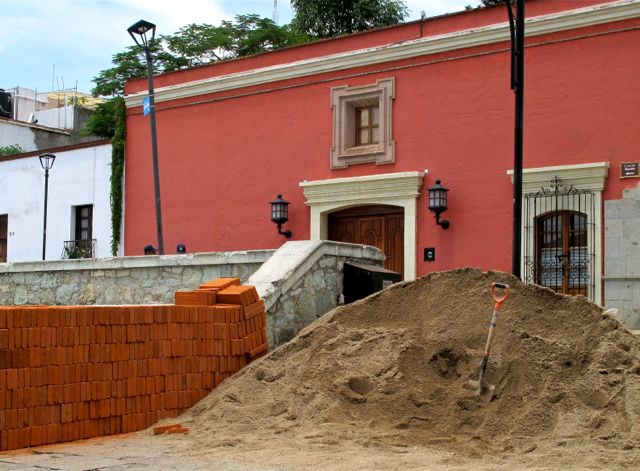
There were guys doing the heavy lifting — bricks on their shoulders and buckets of sand in hand — carrying load after load down the ramps and stairs to the plaza below.

The sand was spread and leveled and the bricks were carefully laid in a herringbone pattern.

What were they up to? Preparing a barbecue platform for last night’s gastronomic festival, El Saber del Sabor Oaxaca 2013, opening night buffet. The entire Plaza de la Danza was tented, tables and chairs were set up, lights were strung, and by yesterday afternoon, all was ready.
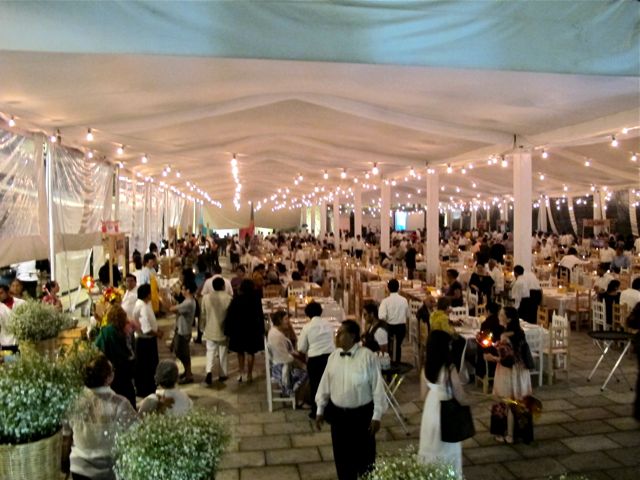
Last year we missed out on the barbecue — spit roasted lamb and pork — it looked and smelled divine, but the line was too long and then it was gone. This year, we were not to be denied and so our strategy was to be first in line.

That meant standing for at least 20 minutes in front of the newly constructed barbecue at the Cuenca station, where we had plenty of time to study the menu and salivate, as smoke from the BBQ permeated our clothes and burned our eyes.
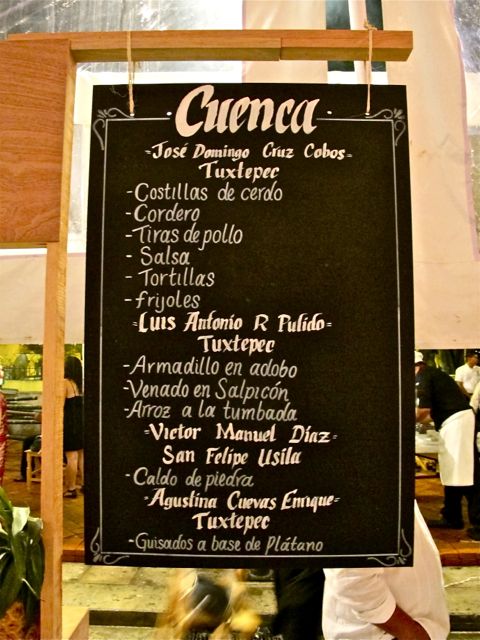
José Domingo Cruz Cobos from Tuxtepec did not disappoint. I can’t even begin to describe how succulent the meat and how crispy the skin. It was well worth the wait!

However, this was only the beginning. Cooks from the other 7 regions of Oaxaca were also there, preparing their signature dishes.
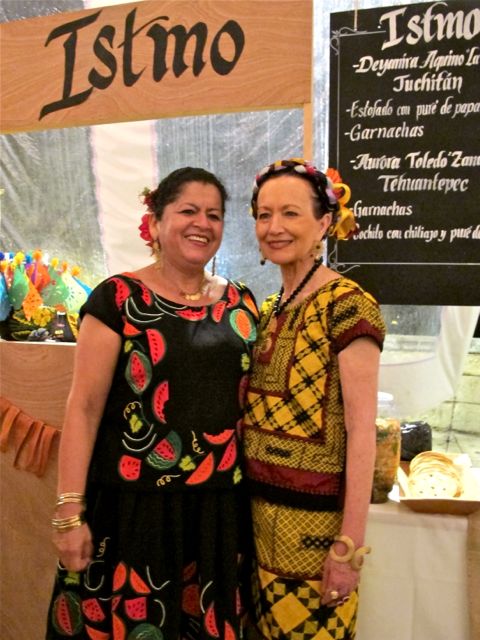
Aurora Toledo of Zandunga restaurant with chef, teacher, author, and the evening’s special honoree, Patricia Quintana.
Gluttony makes for a hazy memory, but in addition to the above, I had mole negro and tamalitos from the famed Mendoza sisters of Tlamanalli in Teotitlán del Valle, garnachas from Aurora Toledo of Zandunga in the city, and ??? Oh, and then there was wine, mezcal, and a cajeta flavored paleta for dessert.
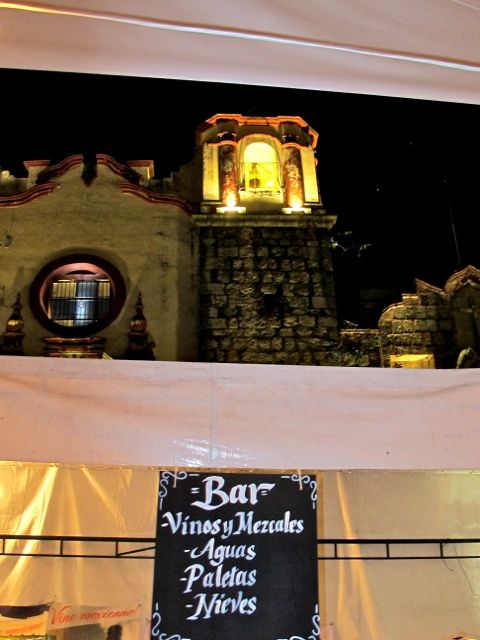
All this, and much, much, much more for only 350 pesos (about $27 US). It was a lovely and delicious night.
And for those with deeper pockets, multi-course lunches and dinners with wine and mezcal pairings are being prepared by the top chefs from all over Mexico, at select restaurants throughout the city, including Alejandro Ruíz of Casa Oaxaca and Jose Manuel Baños Rodriguez of Pitiona, each recently named to Latin America’s 50 Top Restaurants.
¡Buen provecho!
Posted in Celebrations, Creativity, Culture, Travel & Tourism, tagged capes, Danza de la Pluma, feather art, Feather dance, Fiesta a la Natividad de la Virgen María, Fiesta de la Preciosa Sangre de Cristo, leggings, Mexico, Oaxaca, penachos, photographs, photos, Teotitlán del Valle on September 10, 2013| 5 Comments »
The Danza de la Pluma penachos (headdresses), capes, and leggings are spectacular and unique to Teotitlán del Valle. The feathered designs on the penachos are more intricate and varied than in other pueblos; and the capes and leggings are hand-woven in this village that is internationally known for its weaving. However, while the Danza de la Pluma is a crowd-pleaser during the annual July Guelaguetza on Cerro del Fortín in Oaxaca, folkloric groups from other villages are usually chosen to perform it, as Teotitlán’s costumes are not considered “authentic.”

However, performing for tourists is not why Teotitlán del Valle tells this story through music and dance several times a year. It is performed on the church plaza, not the municipal plaza, because it is an integral part of the annual major religious celebrations of the village: Fiesta titular a la Preciosa Sangre de Nuestro Señor Jesucristo in July, Fiesta a la Natividad de la Virgen María in September, Fiesta a el Rosario de la Virgen María in October, and Fiesta a la Virgen de Guadalupe in December.
Penachos from the Fiesta a la Natividad de la Virgen María on Sunday…


Capes from Sunday’s Fiesta a la Natividad de la Virgen María and July’s Preciosa Sangre de Nuestro Señor Jesucristo festival.


Leggings from both festivals…


The various elements of the costumes do not come cheap and dancers must appeal to their extended families to assist in commissioning each of the pieces. Thus, as annual festivals come and go during a dancer’s 3-year commitment, the costumes may evolve.
With their performances, the dancers honor the rituals of their church and community. And, with their magnificent costumes, they pay homage to the creativity, talent, and tradition of Teotitlán del Valle’s weavers and feather artists.
Posted in Celebrations, Culture, Travel & Tourism, tagged Danza de la Pluma, danzantes, Doña Marina, El Picacho, Fiesta a la Natividad de la Virgen María, fiestas, Malinche, Mexico, Oaxaca, penachos, photographs, photos, popular travel destinations, Teotitlán del Valle on September 8, 2013| 2 Comments »
Yippee, I’m back in Oaxaca! Last night’s flight was smooth, on-time, and mostly empty. I have to admit to always getting a goofy grin as the little Embraer comes in over the lights of the city and the smile continues through immigration and baggage claim. It usually falters and turns to a grimace when I have to hoist my 50 pound suitcase up onto the x-ray conveyor belt. However, last night the grin returned when I pressed the “to search or not to search” button, got the green light, and was able to proceed directly to the booth to buy my colectivo ticket — 60 pesos for door-to-door service to the historic district ‘hood. An easy return to home.
Unpacking done, late this morning I walked down to my local mercado to restock the larder with some basics: 2 perfect avocados, 1 pristine white onion, a bunch of unblemished small and sweet bananas, half kilo of quesillo (Oaxacan string cheese), and 6 freshly made tamales (mole, rajas, and verde). I’d actually asked for 4, but my regular tamale gal threw in 2 extras. How often does that happen in el norte? A welcoming return to home.
This afternoon, blogger buddy Chris and I drove out to Teotitlán del Valle for the Fiesta a la Natividad de la Virgen María performance of the Danza de la Pluma. We stepped up onto the plaza of Templo de la Preciosa Sangre de Cristo and it was like emerging into the middle of a technicolor movie. We’ve been there countless times, but today we were blown away by the scene. Mother Nature had conspired to use her enhance wand on the sky, clouds, sun, and costumes. A spectacular return to home!


The recent trip to California was to sign papers finalizing the sale of the house my grandparent’s built in 1957. Prior to relocating to Oaxaca, it had been my home for 30 years, where I’d raised my kids and made many wonderful memories. Needless to say, selling it was an emotionally challenging ordeal and it has engendered a lot of thinking about the notion of “home.”
However, these past 24 hours have reinforced my belief in bumper-sticker wisdom seen many years ago, “When you live in your heart, you are always home.” It’s good to be home!
Posted in Creativity, Culture, Exhibitions, Museums, Science & Nature, Travel & Tourism, tagged arts, Hecho en Oaxaca, MACO, Mexico, Museo de Arte Contemporáneo de Oaxaca, Oaxaca, photographs, photos, street art, trees, urban art, William Blake quote on September 7, 2013| 4 Comments »
More from the Hecho en Oaxaca exhibit…

The courtyard at the Museo de Arte Contemporáneo de Oaxaca (MACO)…

Art is the tree of life. — William Blake
Posted in Creativity, Culture, Travel & Tourism, tagged art, graffiti, Jorel, Mexico, Oaxaca, photographs, photos, Rhu Crew, street art, urban art, wall art on September 4, 2013| 2 Comments »
Work in progress on Tinoco y Palacios by Jorel and the Rhu Crew…
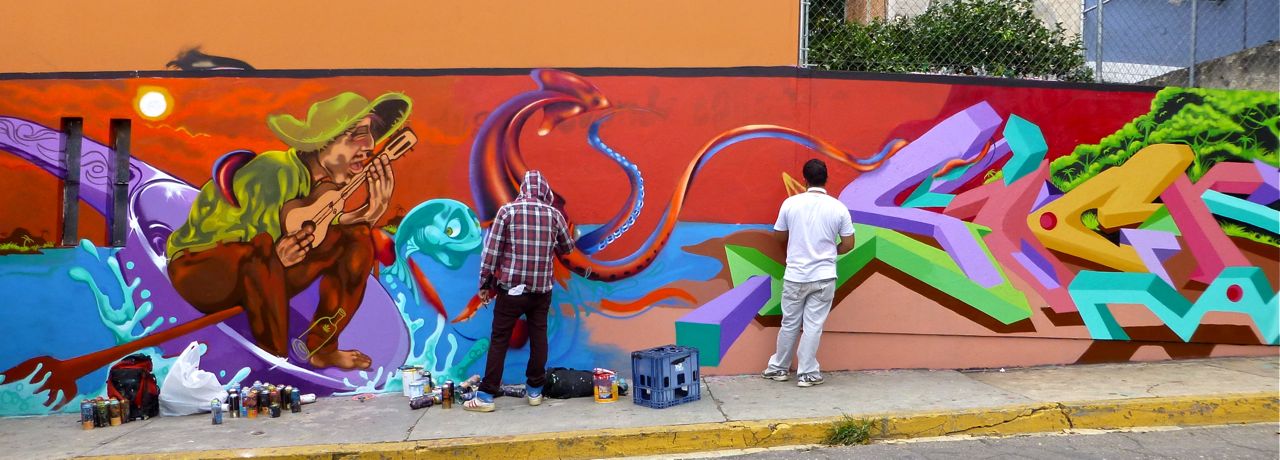
Up close and personal…


All finished!

Posted in Culture, Food, Transportation, Travel & Tourism, tagged camotes, dessert, Mexico, Oaxaca, photographs, photos, plantains, steam whistle, sweet potatoes, vendors on September 1, 2013| Leave a Comment »
I’m back up in el norte for a brief “taking care of business” trip. And, sheesh, it’s SO quiet on this western front. No fireworks. No clanging chains of the propane tank vendor. No bands playing in the streets. No loudspeakers. And, no shrill sound of the steam whistle heralding the arrival of the camote man.
 Every evening, he wheels his cart through the streets of Oaxaca selling sweet potatoes and plantains sweetened with sugar and drizzled with condensed milk. They are cooked in a pressure-cooker-like contraption that is heated by a small wood fire in the metal drum below. The iconic sound comes from the hot steam being released from the cooker.
If you have a sweet tooth, follow the whistle for a yummy dessert treat!
Posted in Culture, Economics, Geography, Technology, Travel & Tourism, tagged cell phones, Mexico, Oaxaca, Red Celular de Talea (RCT), sierra norte, Talea de Castro, technology, telecommunications on August 27, 2013| 6 Comments »
Flying into the city of Oaxaca at night, Talea de Castro is one of the countless tiny pockets of light twinkling from the darkness below. These earthbound clusters of stars mark small pueblos nestled in the treacherous mountains of the Sierra Norte.
The remote terrain of Oaxaca’s Sierra Norte and Sierra Sur has helped to preserve the traditions of these indigenous communities — but at a high price. It has also hindered access to technology that could benefit residents of these communities and has made it easy for the “powers that be” to ignore the needs of these villages. Taking matters into their own hands, I love what the people of Talea de Castro have done.
AFP – Left out by telecom firms like the one owned by billionaire Carlos Slim, a remote Mexican mountain village now runs its own mobile phone network to communicate with the outside world.
Tucked away in a lush forest in the southern state of Oaxaca, the indigenous village of Villa Talea de Castro, population 2,500, was not seen as a profitable market for companies such as Slim’s America Movil.
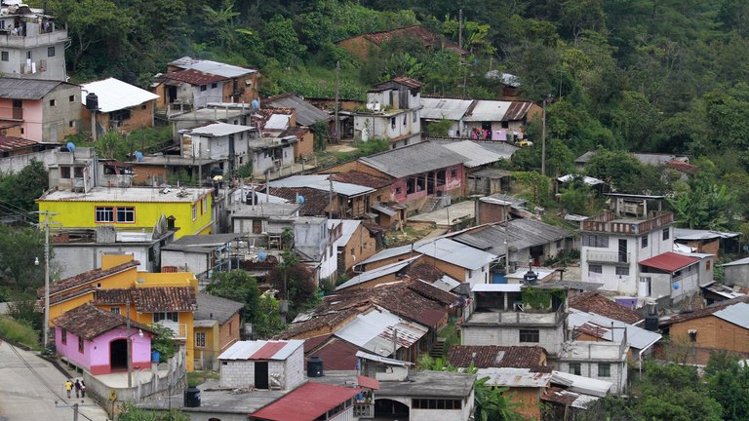
Talea de Castro, Oaxaca State, Mexico, taken on August 17, 2013
(AFP Photo/Carlos Salinas)
So the village, under an initiative launched by indigenous groups, civil organizations and universities, put up a perch-like antenna on a rooftop, installed radio and computer equipment, and created its own micro provider called Red Celular de Talea (RCT) this year.
Now, restaurant manager Ramiro Perez can call his children and receive food orders on his cellphone at a cheap price in this village dotted by small homes painted in pink and yellow.
The local service costs 15 pesos ($1.2) per month — 13 times cheaper than a big firm’s basic plan in Mexico City — while calls to the United States, where many of the indigenous Zapoteco resident have migrated, charge a few pennies per minute.
“I have two children who live outside the village and I communicate with them at least two or three times per week,” Perez, 60, told AFP.
Before, Perez had to use telephone booths where he paid up to 10 pesos ($0.75) per minute.
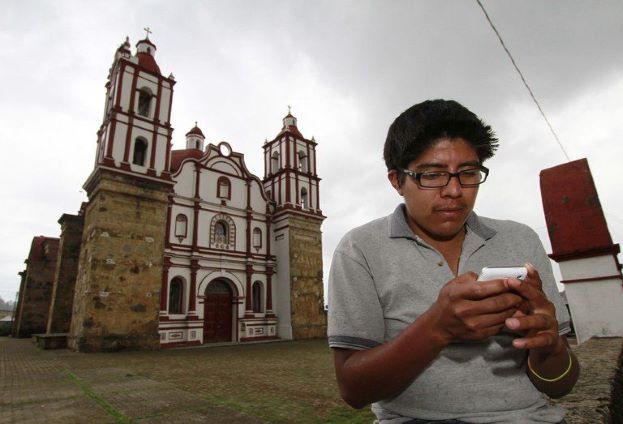
A local resident uses his mobile phone in Talea de Castro, Oaxaca State, Mexico, on August 17, 2013. For considering it to be slightly profitable, the big companies of mobile telephony refused for years to give its services in Talea, but the population — mostly of indigenous origin — adopted a novel system and created its own company, the Red Celular de Talea (RCT) (Talea Mobile Network).
The coffee-producing village installed the network with the help of Rhizomatica, a non-profit with US, European and Mexican experts who aim to increase access to mobile telecommunications in communities that lack affordable service.
In a statement, Rhizomatica, a civil group named Redes and a town official said they hoped that a telecom reform pushed through Congress by President Enrique Pena Nieto to open the market will “break the obstacles” that prevent the development of such community-based projects.
“Many indigenous communities have shown interest in participating in this project and we hope that many more can join this scheme,” the statement said.
The equipment used in Talea, which was provided by California-based Range Networks, includes a 900mhz radio network and computer software that routes calls, registers numbers and handles billing. Calls to the United States are channeled via a voice over Internet protocol (VoIP) provider.
The village received a two-year-permit from the Federal Communications Commission to have the right to test the equipment.

A local resident operates the equipment enabling mobile communications in Talea de Castro, Oaxaca State, Mexico, on August 17, 2013.
When a cellphone user arrives in the village, a text message automatically appears saying: “Welcome to the Talea Cellular Network (RTC) — to register, go to the radio with this message.”
There is one catch: phone calls must be limited to a maximum of five minutes to avoid a saturation of lines.
Israel Hernandez, a village resident and one of the volunteers who helped set up the system, said the network uses the radio-electric spectrum that “telephone (service) providers refuse to use because it is financially unviable.”
Slim’s Telcel is part of his America Movil empire, which controls 70 percent of Mexico’s mobile phone market and has 262 million subscribers across Latin America but never made it to Talea.
Alejandro Lopez, a senior town hall official, said the village had approached big telecom firms but that they had required 10,000 potential users as well as the construction of a path where an antenna would be erected and a lengthy power line.
“Despite some technical problems, because we are in a test period, the project has been a success” with 600 villagers signing up since the service opened three months ago, Lopez said.
Buoyed by the system’s success, the village has decided to buy its own equipment that will allow RCT to run 35 lines simultaneously and plans to install in the coming weeks.
The next step, RCT volunteer Hernandez said, is to form cooperatives with other indigenous villages to request concessions from the Mexican government in order to resolve “this lack of free frequencies for cellphone communications in the country’s rural communities.”
New article from the BBC: The Mexican village that got itself talking.
Posted in Culture, Transportation, Travel & Tourism, tagged colectivos, crucifix, flags, Jesús crucifado, Mexican flag, Mexico, Oaxaca, photographs, photos, popular travel destinations, Virgen de Guadalupe on August 24, 2013| 4 Comments »
Down to Mercado de Abastos late this morning to catch a colectivo out to Etla. I’ve actually come to enjoy the 10-block walk through this definitely not-spiffed-up-for-tourist-consumption neighborhood. However, crossing the Periferico Sur is another story! Cars, taxis, colectivos, buses, trucks, motorcycles, hand-trucks, and pedestrians all in motion or poised to move. Did I mention the potholes ready to swallow people and vehicles? There is a pedestrian bridge a block down the street, but what’s the fun in that?
Needless to say, we all need all the help we can get! I think my colectivo driver had all his bases covered, invoking Mexico’s “Holy Trinity” — La Virgen de Guadalupe, Jesús crucificado, and patriotismo.

Of course he had the rear view mirror covered, too!


 Mexican Peso Converter
 View From Casita Colibrí