And so Viernes Santo (Good Friday) began…


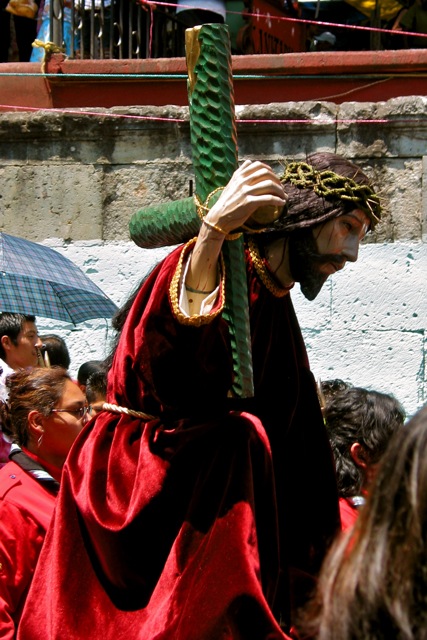
Mass said, a Vía Crucis (Stations of the Cross) procession through the streets of my neighborhood.
Posted in Celebrations, Culture, Holidays, Religion, Travel & Tourism, tagged Easter, Estaciones de la Cruz, Good Friday, Holy Week, Mexico, Oaxaca, photographs, photos, popular travel destinations, ritual procession, Semana Santa, Stations of the Cross, Via Crucis, Viernes Santo on March 30, 2013| 2 Comments »
And so Viernes Santo (Good Friday) began…
Mass said, a Vía Crucis (Stations of the Cross) procession through the streets of my neighborhood.
Posted in Celebrations, Churches, Culture, Food, Holidays, Religion, Travel & Tourism, tagged Easter, Estaciones de la Cruz, Lunes Santo, Mexico, Oaxaca, photographs, photos, popular travel destinations, ritual procession, Semana Santa, Stations of the Cross, tapetes, Teotitlán del Valle, Via Crucis on March 26, 2013| 4 Comments »
Lunes Santo (Holy Monday) in Teotitlán del Valle provided another moving and memorable experience. For some unknown reason, the village re-enacts the 14 stations of the cross on the Monday before Easter. Following a special early morning mass at the Templo de la Preciosa Sangre de Cristo, statues of Jesus and the Virgin Mary are hoisted on platforms and carried from the church to signal the start of the day-long pilgrimage. They are led by a band playing a mournful and dissonant tune as they set off to wind their way through the cobblestone streets of Teotitlán.
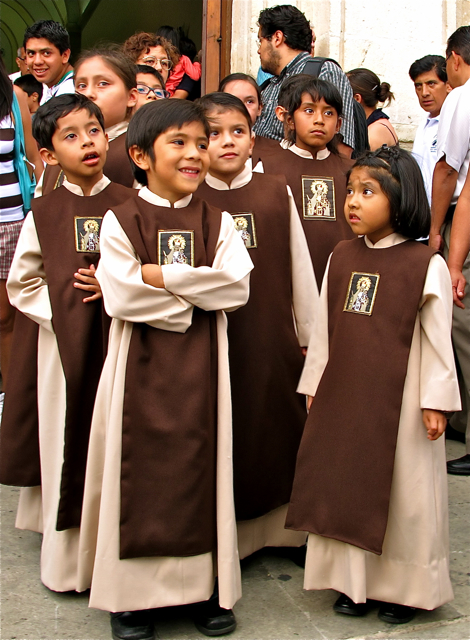
“Stations” are set up along the route by designated families — some are decorated with the village’s famous woolen tapetes (rugs). Tamales, non alcoholic beverages (alcohol, even the ubiquitous mezcal, is forbidden during Semana Santa), and nieves (ices) are offered at others. At all, the appropriate prayers are read, incense of copal is burned, and offerings, including of corn and lilies, are made. And, as always, children have important roles to play.
The procession is solemn and dignified and filled with pre-Columbian, along with Catholic, tradition and symbolism. Like all the other ritual celebrations in Teotitlán del Valle, these are not performed for the benefit of tourists — they are some of the strands of the warp and weft that have woven this community together for thousands of years.
Posted in Celebrations, Churches, Creativity, Culture, Holidays, Travel & Tourism, tagged Catedral de Oaxaca, Cathedral of Oaxaca, Domingo de Ramos, Mexico, Mixteca palm weavers, Oaxaca, Palm Sunday, photographs, photos, popular travel destinations, Semana Santa on March 24, 2013| 10 Comments »
In front of Oaxaca’s Cathedral, the Palm weavers from the Mixteca have been practicing their craft with awesome dexterity, creativity, and skill.


All is ready for Domingo de Ramos (Palm Sunday).
Posted in Celebrations, Churches, Culture, Holidays, Music, Religion, tagged Carmen Alto, castillo, culture, Danza de la Pluma, Easter, fireworks, fuegos artificiales, Mexico, Oaxaca, Pascuas, photo, photographs, Semana Santa, toritos, travel, video on April 16, 2012| Leave a Comment »
It’s been a week since the end of Semana Santa and I’m still sorting through photos and videos and reflecting on impressions and feelings. However, I’m finding that, with too much thinking, the experience slips through the fingers and the magic vanishes.
Thus, I give you the night of Pascuas (Easter) at Carmen Alto…
And then, the hisses, bangs, and brilliant explosions of a castillo…

brought Semana Santa to a spectacular close.
Posted in Buildings, Celebrations, Churches, Holidays, tagged Carmen Abajo, Carmen Alto, Cathedral, Christianity, full moon, Holy Week, Jueves Santo, La catedral de Nuestra Señora de la Asunción, Maundy Thursday, Mexico, Oaxaca, pan bendito, photo, photographs, Preciosa Sangre de Cristo Templo, religion, Santo Domingo, Semana Santa, Templo de la Compañía de Jesus, Templo de San Felipe Neri, Templo de San José on April 6, 2012| 1 Comment »
Yesterday, under a full moon…

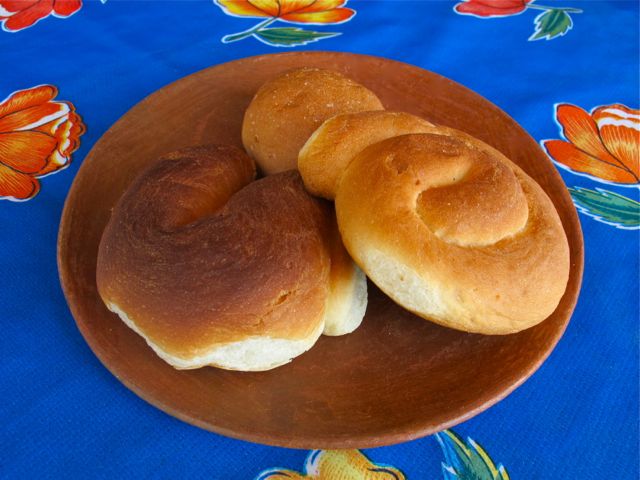
and clutching our “pan bendito” (blessed bread), we began our pilgrimage. Jueves Santo (Holy/Maundy Thursday) tradition calls for visiting 7 churches (la visita de las siete casas) in the city with one’s pan bendito, which must be kept to offer to guests, should any grace our doorstep. This all relates back to Jesus’s Last Supper, which this date commemorates.
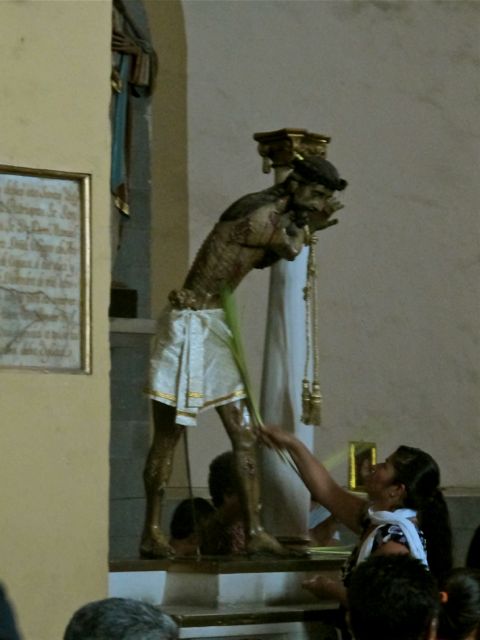
First stop was the nearby Templo de San José, where palm fronds were also distributed and believers used them to brush up and down the statue of Jesus. Hands also ran down his legs and then were used to touch one’s face.
After emerging from the side door of the jam-packed church, we set off for Templo de San Felipe Neri (whose picturesque dome can be seen (left of center) on my blog banner-head).
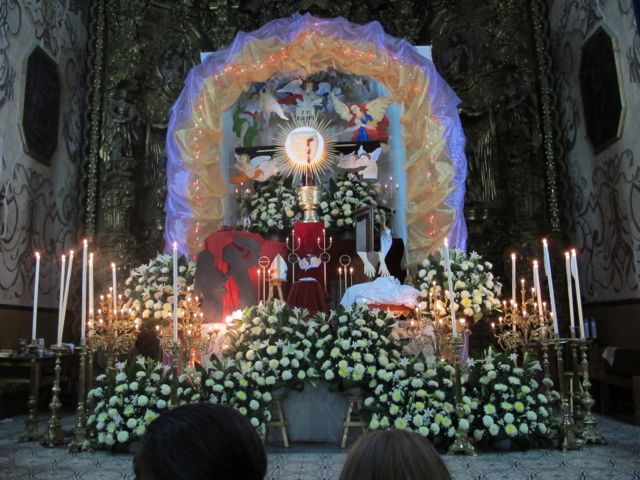
Next stop was Carmen Abajo…

followed by the far right side chapel of the La Catedral de Nuestra Señora de la Asunción. A plaque at the entrance of the chapel read, “El maestro esta aqui y te llama” (The teacher is here and calls you) and the multitude seemed to be heeding the call.

We then strolled across the zócalo to the Jesuit, Templo de la Compañía de Jesus.

We changed direction and headed north up the Álcala. Big mistake! A mosh pit (Chris, this WAS a mosh pit) surrounding a Tuna band that was playing in the middle of the street, causing gridlock and bringing us to an abrupt stop. Eventually, following our blocker (my son, the lineman would be proud), we eventually found light and continued up to Preciosa Sangre de Cristo Templo, where we had earlier spent 1-1/2 hours (and it was still going on when we left!) at a mass where the priest reenacted Jesus washing the feet of his disciples at the Last Supper.
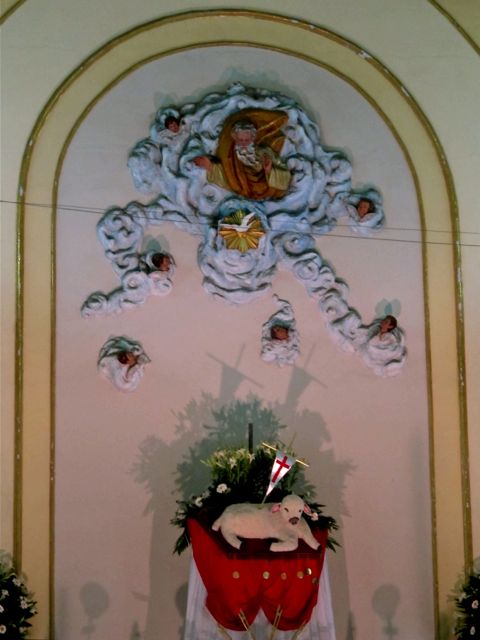
Strolling across the Álcala to Santo Domingo was much less challenging. The aisle to Santo Domingo’s main altar was blocked and we were routed to a side chapel. Hurray, we did it — this made seven churches visited!
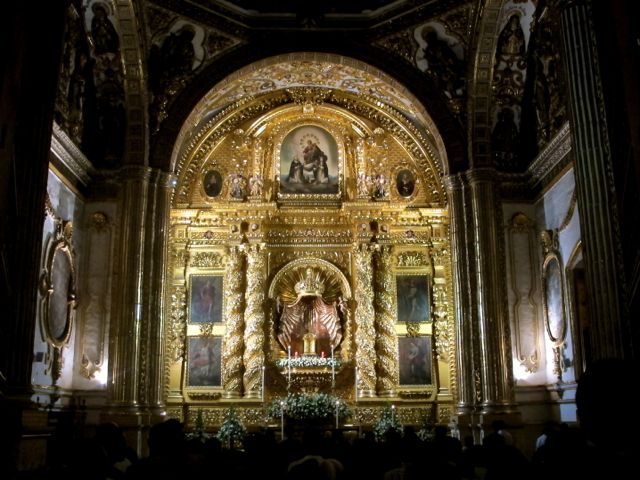
However, though bleary-eyed (as evidenced by the photo below), we opted for just one more, Carmen Alto.

Home beckoned… and sleep came easily under the watch of the moon, now appropriately encircled by a halo.

Posted in Celebrations, Churches, Holidays, tagged culture, Domingo de Palmas, Holy Week, Mexico, Palm Sunday, photo, photographs, religion, Santiago Apóstol, Señor del Burrito, Semana Santa on April 4, 2012| 3 Comments »
Palm Sunday also brought us to the village of Santiago Apóstol and one of my favorite painted churches.

This beautiful facade was hidden behind a stage, presumably set up for outdoor masses during Semana Santa.

We weren’t the only ones who negotiated the dusty back roads out of San Antonino Castillo Velasco; Señor del Burrito was already there when we arrived. Apparently, he knew a shortcut!
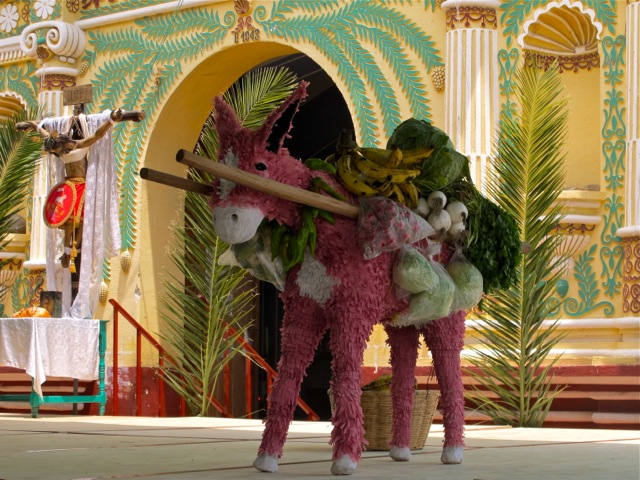
Inside the empty church (pews had been moved outside), amidst the smoky incense filled haze, the ethereal voices of these women transported us…

This wasn’t the first time we had been enchanted in Santiago Apóstol. During Días de muertos, the entire Panteón is whitewashed and filled with an explosion of red, orange, yellow, and magenta flowers.
Posted in Celebrations, Churches, Culture, Holidays, tagged Christianity, culture, Domingo de Palmas, Holy Week, Mexico, offerings, palm crosses, Palm Sunday, photo, photographs, religion, San Antonino Castillo Velasco, Semana Santa on April 2, 2012| 7 Comments »
Yesterday, I spent another magical day with friends in San Antonino Castillo Velasco (about 23 miles/1 hour from the the city). It was Domingo de Palmas (Palm Sunday) and San Antonino celebrates in its own unique, warm, and welcoming way.
Townspeople gather in the cemetery to decorate the “Señor del Burrito” with fruit, vegetables, flowers, and everything they sell or grow during the year. In addition, livestock (goats, chickens, pigs, etc.), more foodstuffs, flowers, etc. are gathered and priced. The pastor of the parish church arrives to bless the “Lord of the Little Burro” and offerings. Palm crosses are distributed, all are invited to help carry the offerings to the church, 10-12 men hoist the burro (now laden up to his neck and weighing who knows what!), and a procession to the church commences, lead by a fast-tempo drum beat and punctuated by shouts warning the men carrying “Señor del Burrito” of upcoming topes (speed bumps) and telephone wires, which must be navigated.
At the church, “Señor del Burrito” has an honored place in the courtyard and the offerings are gathered and arranged. Many then attend an hour-long mass inside the church, while others partake in yummy amarillo and pork empanadas, taste mezcal, and browse the wares of the artisan booths. By the way, at least two of the “maestros” from the new, previously mentioned, book, Grandes Maestros del Arte Popular de Oaxaca were present: Familia García Mendoza (ceramics) and Antonina Cornelio, who makes the exquisitely embroidered clothing typical of San Antonino Castillo Velasco (and seen in one or two of the photos above). Following the mass, the offerings are sold, with the proceeds going to an orphanage in the village.
Muchisimas gracias to the people of San Antonino Castillo Velasco for being so gracious and allowing us to share this special day with them.
Posted in Celebrations, Holidays, tagged Mexico, Oaxaca, Procession of Silence, Semana Santa, video, Viernes Santo on April 24, 2011| Leave a Comment »
The Procesión del Silencio departed from the Iglesia de la Preciosa Sangre de Cristo and proceeded up the Alcalá to Gómez Farias, where it turned left and left again and down García Vigil to Independencia and then back up the Alcalá. Once the procession began, fellow blogger Chris (Oaxaca-The Year After) and I left the masses on the Alcalá and positioned ourselves on a wall overlooking García Vigil, for an unobstructed view.
Posted in Celebrations, Holidays, tagged Good Friday, Mexico, Oaxaca, Procession of Silence, Semana Santa, Viernes Santo on April 23, 2011| Leave a Comment »
Spectators, participants, and the ever-present vendors waiting for the Procesión del Silencio…


More to come…
Posted in Celebrations, Holidays, tagged Estaciones de la Cruz, Good Friday, Holy Week, Mexico, Oaxaca, photographs, photos, popular travel destinations, ritual procession, Semana Santa, Via Crucis, Viernes Santo on April 22, 2011| Leave a Comment »
I opened the front gate this morning to find the sidewalk had morphed into an Estación de la Cruz.
Worshipers prayed, recited the appropriate devotions, and then slowly moved on.
Posted in Celebrations, Holidays, tagged Holy Thursday, Jueves Santo, Maundy Thursday, Mexico, Oaxaca, photographs, photos, Semana Santa on April 21, 2011| Leave a Comment »
Today was Jueves Santo (aka: Holy Thursday or Maundy Thursday).
Believers gathered to commemorate the Last Supper of Jesus. Tables are set up in church doorways selling pan bendito (3 buns for 5 pesos of blessed bread). And, where there are more than ten people, vendors gather….
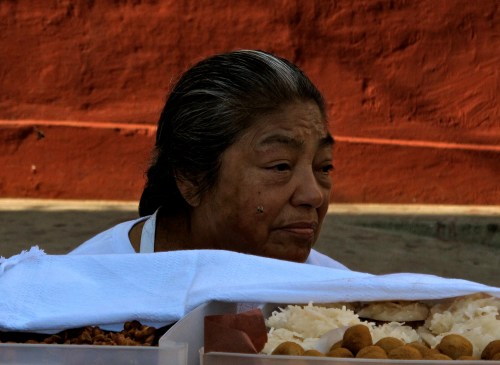
Outside Iglesia de la Preciosa Sangre de Cristo — I suspect her life hasn’t been half as sweet as the dulces she was selling.

A little sweetheart on his best behavior and waiting to process.
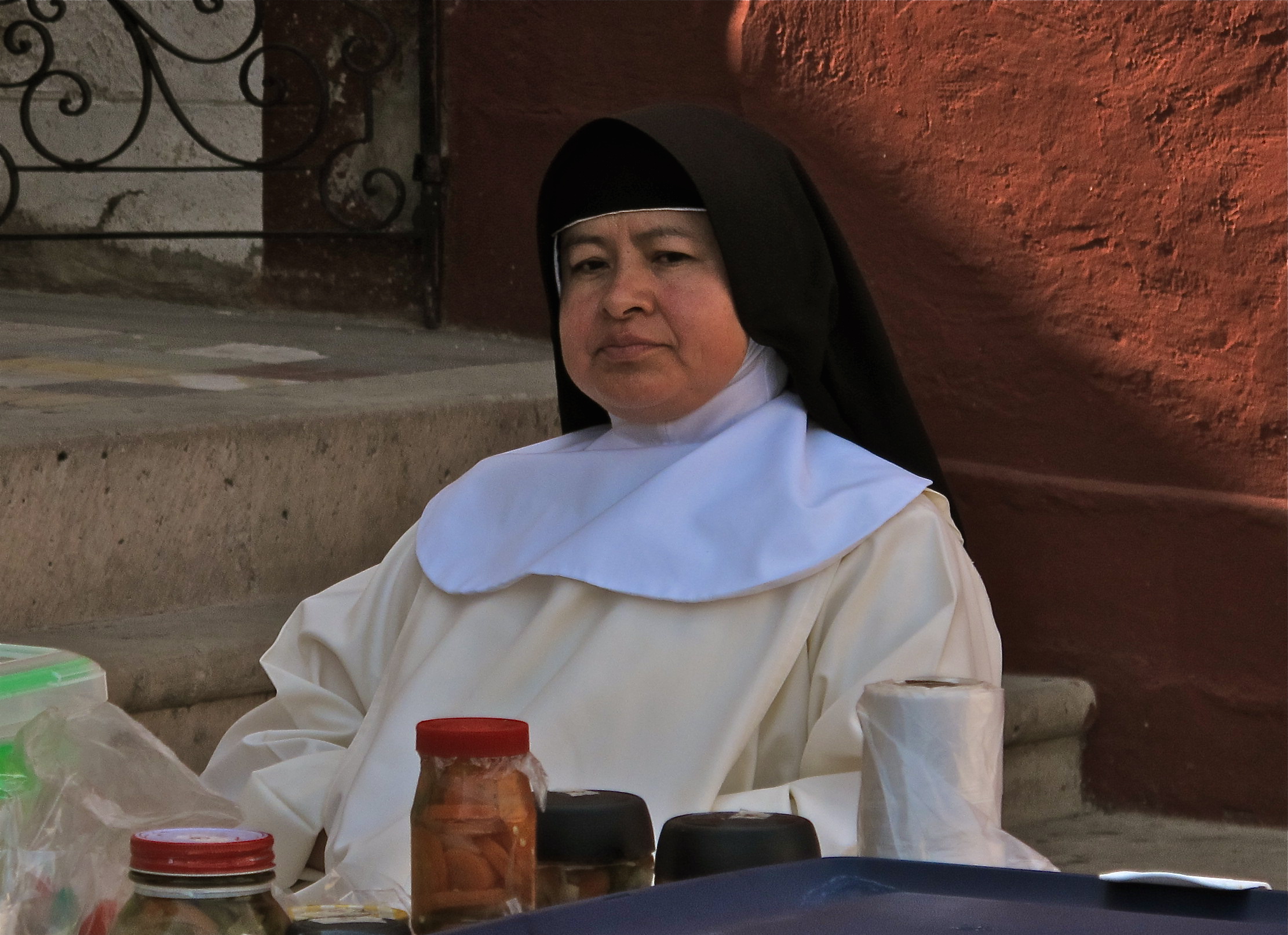
Would you buy pickled carrots or peppers from this woman?

The rains came and the capas del agua vendors miraculously appeared outside Santo Domingo.

After visiting the prescribed 7 churches, I rewarded myself with my (hopefully, not last) supper — a flor de calabaza and quesillo empanada, cooked to order. Yummm….
Posted in Holidays, tagged Basilica de la Soledad, Oaxaca, Palm Sunday, ritual, Semana Santa on April 17, 2011| 4 Comments »
Yesterday, on the stairs leading to the Basilica de la Soledad, I bought my woven palm fronds from these gals. 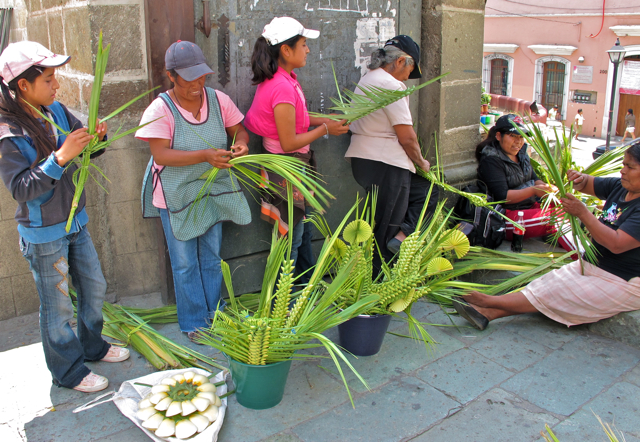
However, this gal insisted I take her picture, too!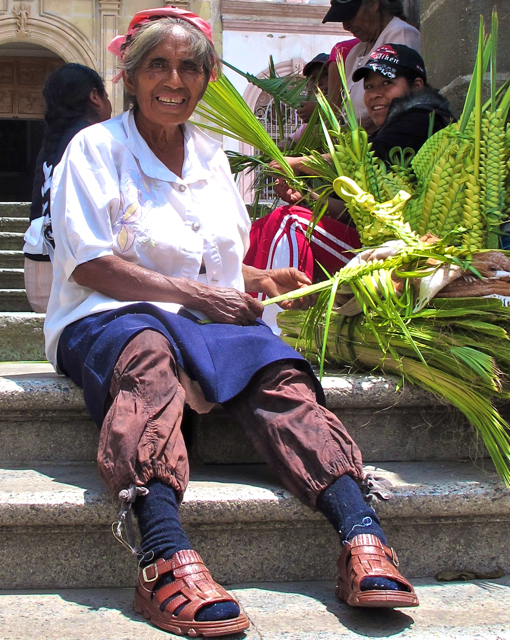
And today, on the plaza in front of the Basilica, the faithful waited for the outdoor mass and the blessing of their palms.
Sisters, perhaps?
Posted in Holidays, tagged Easter, Oaxaca, ritual, Semana Santa, Teachers union on April 8, 2010| Leave a Comment »
Evidence of Semana Santa began days before Palm Sunday; the streets and sidewalk cafés began filling with Mexican and international tourists; street vendors began blanketing the Zócalo, the Alcalá, and any and all gathering places; and the front of the Cathedral was lined with local artisans — the dark faces and strong compact bodies of native craftsmen and women weaving palm fronds into intricate flowers and crucifixes to sell to the faithful (and tourists) for Palm Sunday rituals.

Palm Sunday – I awoke early to the sounds of construction. From my terrace, I could see a giant awning being erected on the Plaza de la Danza next to the Basílica de Nuestra Señora de la Soledad. Following a quick shower and breakfast, I grabbed my camera and woven palm frond and headed over there. Food stalls with hot comals, tables and benches, and a beckoning aroma spilled down the stairs next to the Plaza – squash blossoms, mushrooms, cheese, tortillas, red and green hot sauces — the fixings for empanadas – and I asked myself, “Why did I eat a boring breakfast of cereal?” More artisans weaving and selling palm fronds lined the stairs nearer the Basílica.

Massive sculptures of Jesús, bent under the weight of the cross he is bearing, and Lady Soledad, in her deep purple mantle, gold crown and halo, were set up outside, as was a small stage. La misa was celebrated outside (to accommodate the enormous crowd, I’m guessing); the youthful choir, accompanied by a guitar, sang folky-sounding songs, cheers were chanted to the cadence of “rah, rah, sis boom bah!” and palm fronds were raised and blessed with holy water. I wandered through the crowd (I’ve noticed a degree of fluidity exists among worshippers here, even inside churches, so I wasn’t the only one roaming around), one of only a handful of gringos in this congregation of 600+ mostly indigenous faithful. I had pretty much no idea what was being said but did offer my right hand when it looked like all were to greet their neighbors — and was greeted with startled but warm smiles and handshakes.

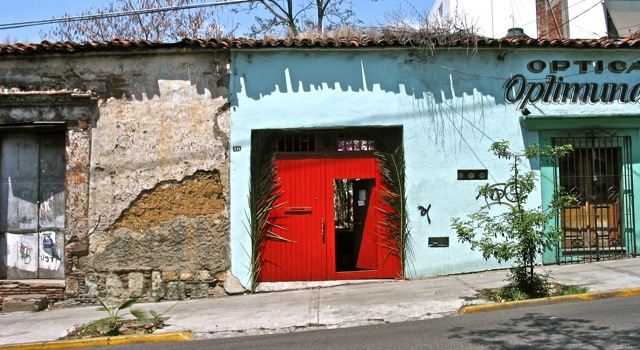
I returned home, but first peeked through the rarely open large red door of the Holy Trinity Anglican Episcopal Church nearby; 15-20 people standing in a circle in a small courtyard. Quite a contrast!
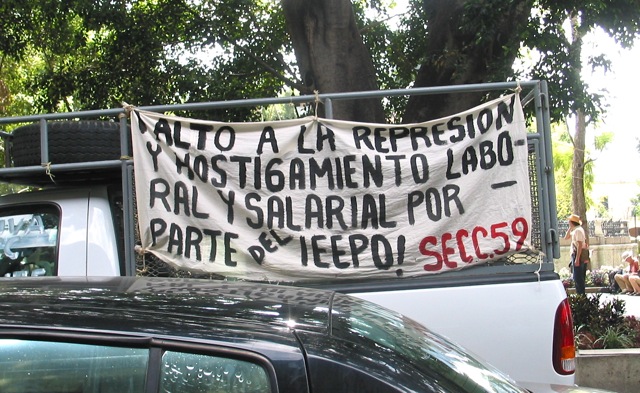
Religious ritual wasn’t the only event of the day; a Secc. 59, teachers’ union car caravan from Juchitán (about 150 from miles away) occupied part of the Zócalo – a peaceful reminder of the ongoing struggle between the teachers’ unions and the government. And, in the evening, sounds of a live (and free!) rock concert blared from the massive stage (I had heard being set up before the crack of dawn) in the Plaza de la Danza. As is routine here, a fireworks display exploded only a few hundred yards above the heads of the concert-goers (and a little above eye level from my terrace, less than 2 blocks away) – all courtesy of one of the opposition political parties – PRD, I think. The color, community, and contrast that is Oaxaca!
Jueves Santo – After a morning spend hand-washing “delicates” and tending to my garden, followed by an afternoon of Spanish lessons and shopping for fruit, veggies, and tortillas, with my portable fan on high (it was in the 90s), I collapsed on my bed for a late afternoon siesta. Unfortunately, that meant missing the 5 pm (give or take) mass and washing of feet apparently at all the churches in the city. However, after a dinner of tacos made with my newly purchased tortillas, aguacate, cilantro, Queso Oaxaca, lechuga, y pollo and washed down with Valle Redondo California Vino Blanco (my new favorite cheap wine), I reluctantly put on long pants (one doesn’t wear shorts in public in the city), grabbed my camera, and emerged from the refuge of Casita Colibrí, unwashed feet and all, to join the people-moving throngs.
Ritual called for visiting 7 churches, though pretty sure I wasn’t going to make it to 7, I figured I’d give it the good old college try. My first stop was San Felipe Neri where, at the entrance, I purchased a bag of Pan Bendito (5 buns for 10 pesos) and the followed the faithful down the aisle toward the altar and out a side door (I didn’t stop to get my Pan Bendito blessed), a traffic pattern that was repeated at the other churches, some with entrance and exit signs tacked on the doors, all in the interest of preventing gridlock that threatened. Clutching my bag of pan, my next stop was at Carmen Abajo, followed by the Cathedral, and Sangre de Cristo.

My plan was to end the evening minutes from my apartment, at the Basílica de La Soledad, where I could reward myself with a “Nieves Oaxaqueñas” (Oaxacan ice cream) of leche quemada (burnt milk) and tuna (not fish! fruit from nopal cactus) at El Jardín de Socrates, next to the church. The Basílica was closed, but some sort of mass was being celebrated in the plaza outside. So my question was, does that count as one of the seven? I pondered this deep theological question as I tried to eat my nieve slowly enough so as not to get the inevitable brain freeze. Last stop was at San José a small church across the Plaza de la Danza from Soledad, and even closer to home.
I’ve come to see Oaxaca as a city of contradictions, and the evening’s ritual was no different — sidewalks jammed with people in a combination of a semi-solemn pilgrimage, street festival, family night at the fair, and date night. A balmy evening; streets teeming with young, old, and everyone in between; loud music blaring from clubs; lively conversations flowing from the open windows of restaurants; every kind of street vendor seemingly doing a booming business; and lots of young April-love canoodling going on!
Viernes Santo – I slept later than usual and slowly went about my morning routine, knowing tonight was THE major event of Semana Santa – the Procesion del Silencio. However, as I was showering, from the open window I heard a slow, solemn drumbeat coming up the street — the unmistakable sound of a somber procession. I rinsed, dried, dressed, brushed my hair, was out the door, and onto Morelos in less than 10 minutes, to see the the backs of the slow moving multitude. Figuring they were headed to the Basílica, I ran down through the Plaza de la Danza and El Jardín de Socrates to the top of the retaining wall beside the stairway leading up from Independencia below, to the church above. Good move!

After about a half an hour, I had a ringside view as the statues of Jesús and Nuestra Señora de la Soledad made their way up the stairs right in front of me.
About 6 PM, I re-emerged from Casita Colibrí and headed up the Alcalá to La Preciosa Sangre de Cristo for the beginning of the Procesion del Silencio. Crowds had already gathered in front of the church, yellow caution tape roped off the street for participants to assemble, and banners were leaning against a nearby building. I joined the tourists (But, hey, I live here!) jockeying for good camera position to snap some pics, then retreated to the curb to sit and wait.


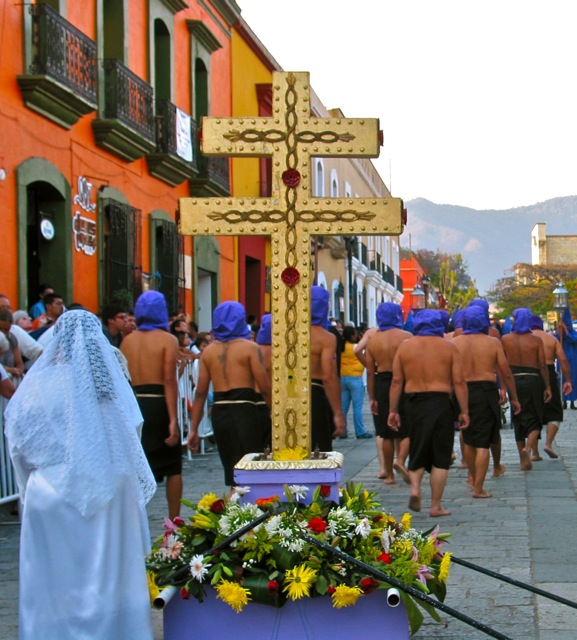
The procession began not long after sunset, but immediately took a left turn – ooops a change in route! The sidewalk populace immediately dispersed and I, pulling out my Spanish teacher’s route instructions (mil gracias!), ran over to 5 de Mayo where, in the darkness, I watched a grim, strangely moving, yet mystifying cortège. Night photos, punctuated by bright white, energy efficient street lights were equally obscure, but Flip video turned out better and I hope, eventually, to edit it into a short video vignette. We shall see…
By Saturday, I was “Semana Santa-ed” out! Perhaps next year I’ll make it to Sabado Santo, the celebration of fire and water. However, though I didn’t leave my rooftop refuge on Domingo de Resurreccion, the sound system of Nuestra Señora de la Soledad afforded me a bedside seat at the morning’s 6 AM outdoor Easter mass — the early hour more egregious because we had “sprung ahead” the previous night! And, no sooner had I finally been lulled back to sleep by the priest’s sonorous sound, than the flinchers (rocket explosions) began and I bolted upright. Bells followed and I gave up on trying to sleep. La misa lasted 2-1/2 hours; a mile high in the Sierra Madre, “He” has risen…




 Mexican Peso Converter
 View From Casita Colibrí