Feeds:
Posts
Comments

Posts Tagged ‘Oaxaca’

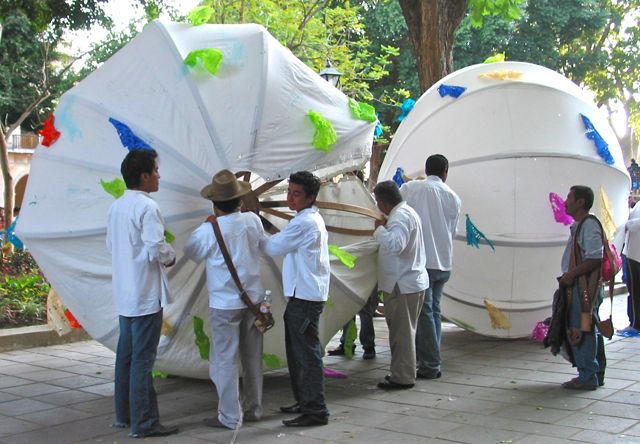
Oaxaca loves Valentine’s Day! Rojo is the color of the day… red tablecloths cover the tables of restaurants under the portales… red shirts, sweaters, skirts, and shoes capture the eye. The Zócalo is teeming with people… young men carefully carrying cone wrapped roses for their sweethearts, girls clutching their regalos… stuffed animals, bouquets of flowers, and balloons.

And speaking of balloons…

This slideshow requires JavaScript.


¡Feliz Día del Amor y la Amistad!

Read Full Post »

A musician friend recently told of hearing a young Oaxaqueña singer with a breathtakingly beautiful voice. And, the current front page of the Oaxaca Times announces, Alejandra Robles: the new oaxacan voice. I don’t know if this is who he was referring to, but in the words of the article, “her powerful voice reflects her training in Opera but her style is traditional Mexican with a rhythmic flare.”

Alejandra Robles - photo from Oaxaca Times


Alejandra Robles
is following in the immensely talented and extremely popular steps of Oaxaqueña vocalists, Lila Downs

Lila Downs - photo from Wikipedia

and Susana Harp, who have carved out successful careers celebrating their Oaxacan roots.

Susana Harp - photo from Wikipedia

I haven’t knowingly heard Alejandra Robles sing; I say “knowingly” because music is everywhere and often free… you just never know when and where you will round a corner to find it. This past November, from the comfort of my terrace, I had a ringside seat for a free Lila Downs concert a block away at the Plaza de la Danza. And, the previous May, I wandered down to the zócalo to hear Susana Harp performing (for free) with the Oaxaca State Band under the shade of the laurel trees.

And then there was this unknown singer…

Unknown singer at the Plaza de la Danza

In September, her beautiful clear and powerful voice drew me off the rooftop and over to the Plaza de la Danza where she and her talented band were performing to an audience of less than 100 people… part of events celebrating the Bicentennial. Regretfully, I was too shy to try out my limited Spanish and ask, “¿Quién es?” I searched the local newspapers and cultural calendars, but never was able to figure out who she was. Anyone know?

Update:  She is Natalia Cruz, a proud Zapoteca from Ixtaltepec in the Isthmus of Tehuantepec.  Muchisimas gracias to one of my readers!

Read Full Post »

Pozole… yummm!

Last night I had the pleasure of introducing a new friend to pozole, Oaxacan style. We walked over to La Gran Torta, my favorite restaurant for this pre-Columbian, hominy based meal in a bowl.

La Gran Torta photo montage

I always order the same dish (Why mess with success?), Pozole “Guerrero,” a caldo verde, with avocado, cabbage, radishes, cilantro, pork, and chicharrón. I push the chicharrón off to the side, but ohhh the flavor it adds! Wash it down with an ice cold Corona and for 70 pesos, you’ve got a perfect dinner on a winter’s night.

Oh, and my friend raved about the caldo rojo Pozole “Especial de la Casa.”

La Gran Torta is located at Porfirio Díaz No. 208 (between Matamoros and Morelos), Centro Histórico, Oaxaca.

Read Full Post »

Another reason I love Oaxaca…

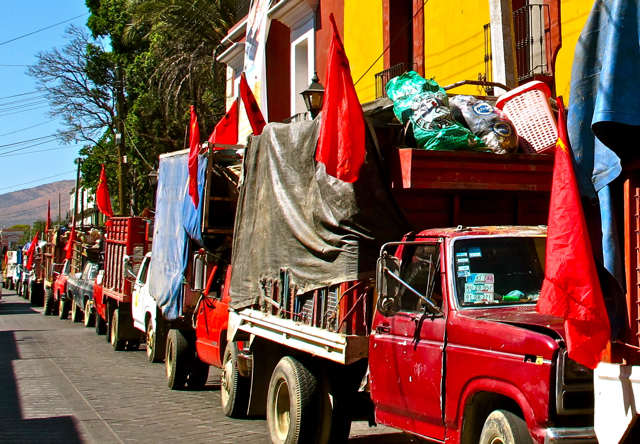
Trash collectors trucks with red flags

Yes, I know street blockades are inconvenient for drivers and I know the trade unions are not immune from the corruption that dominates politics here, but at least workers are not sitting on their hands doing nothing as austerity measures threaten to take away what little they have.

Protest sign with red flags on trash collector's truck.

According to signs posted on various trucks, trash collectors are demanding cancellation of a 300% increase in the cost of using the municipal dump, access to the dump 7 days a week, and the dismissal of the municipal services director.

Last fall massive protests against austerity measures spread across Europe, the Jasmine Revolution in Tunisia earlier this month was sparked by the self-immolation of a young college graduate who couldn’t find a job, and, as I write, hundreds of thousands of students, women, industrial workers, unemployed, and others are marching in Egypt in what is being called “a day of wrath against poverty.”

Workers in the USA should be taking notes…

Read Full Post »

Sunday, in the Plazuela de Carmen Alto, celebrations honoring the Christ of Esquipulas (Black Christ) were in full swing. I was awakened at 6 AM to the sound of fuegos artificiales (fireworks) and eventually drifted off to sleep after 11:30 PM, as fireworks’ explosions resumed.

Festivities lasted all day and I couldn’t resist heading up to the church courtyard to see what was happening.

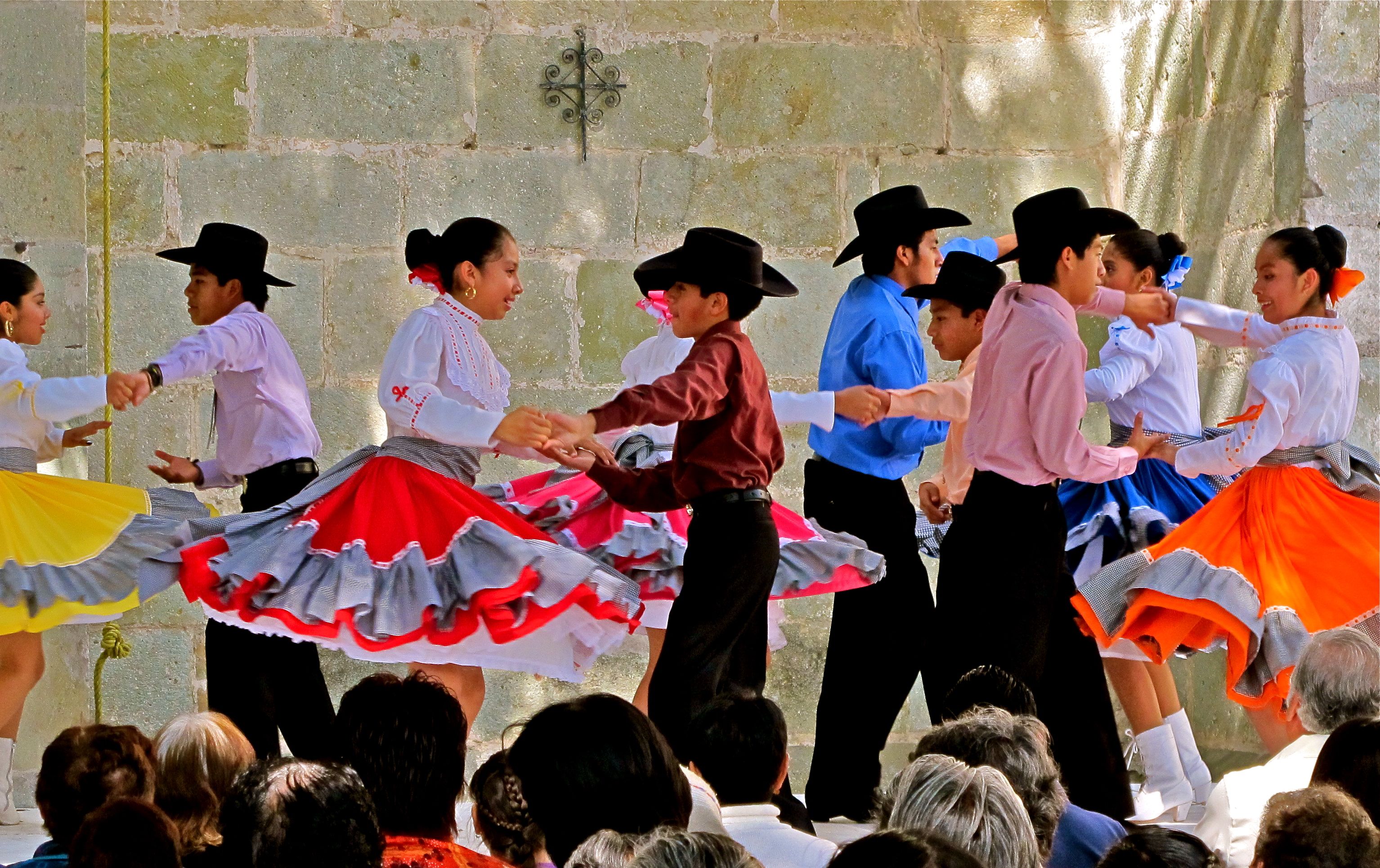
When I arrived, seats in the shade were filled and a small crowd was gathered behind a barricade; a castillo, laying on its side in three parts, was being constructed; a teenage Oaxacan brass band, with the requisite tuba towering over the other instruments and their players, was waiting to play; and young dancers were performing with a combination of earnestness and joy.

Skirts flying

Dance always seems to be an integral part of celebrations both secular and religious, and, in reflecting on my love for this, at times, perplexing and contradictory place, dance is one of the things that resonates the most.

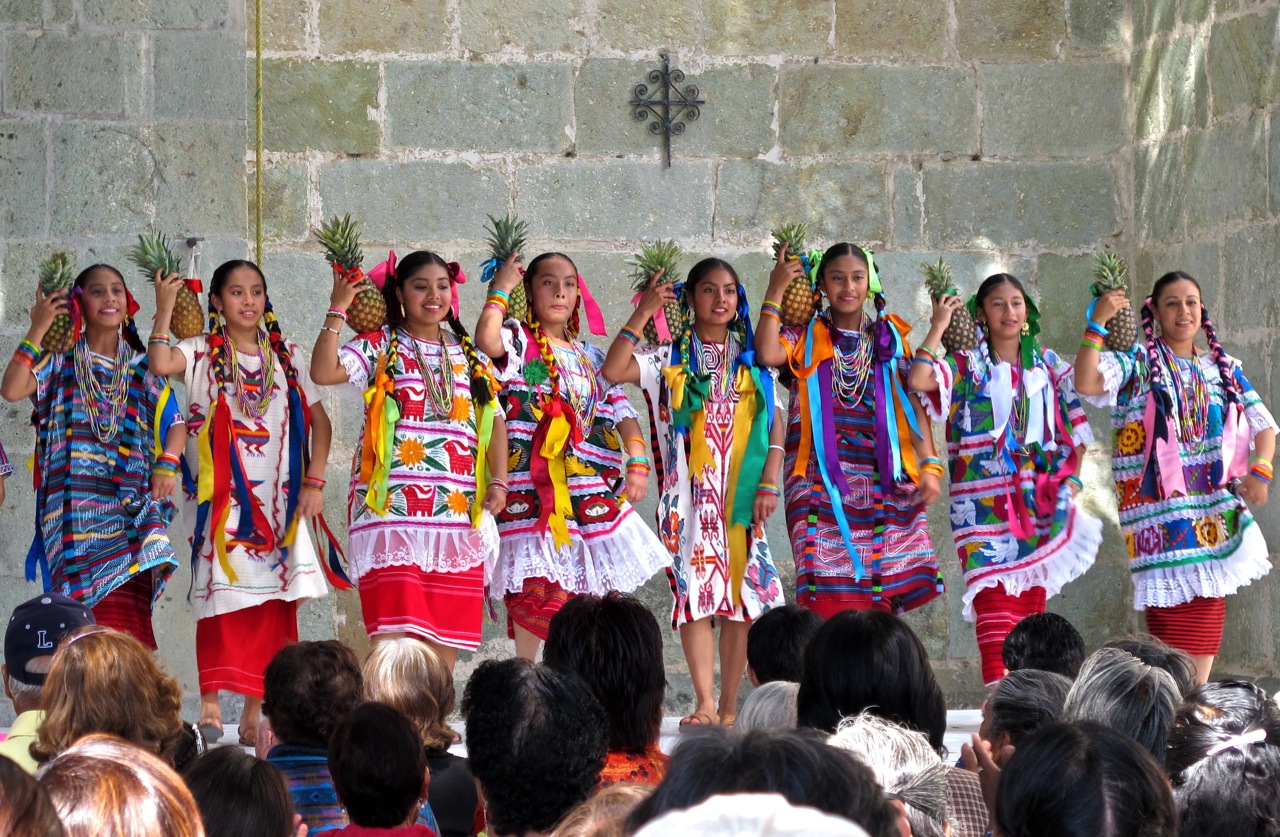
Piña Dancers

A small stage set up under the trees; dancers, their handmade and unique costumes; energetic music; choreographed steps passed down through generations spirited me back to my childhood…

Mom and me

Let’s dance!

Read Full Post »

November 5th was opening day of the inaugural Oaxaca International Independent Film and Video Festival. Having volunteered at the Mill Valley Film Festival for eight years and attending it for many more, I enthusiastically poured over the nine-day schedule and made sure to arrive at the newly reopened Auditorio Ariel for the first film a half an hour early. Of course, the theater wasn’t open, no line had formed, and the only other people not sporting official film festival badges or wearing official volunteer t-shirts, were other gringos. When will I ever learn?!!

Other days and films followed, including the wonderful documentary, Awakening From Sorrow: Buenos Aires 1997. The voices of the now grown children of the disappeared, tortured, and murdered during Argentina’s “dirty war” of the late 1970s and early 1980s, are woven, along with haunting artwork, music and archival film footage into an exquisite “tapestry of remembrance” in their quest for justice. And, come to find out, it screened at last year’s Mill Valley Film Festival.

In addition to the films, the festival also featured an English language and a Spanish language literature competition. The Oaxaca Lending Library, where I volunteer, underwrote the English competition, including bringing the winner, Charles Whipple, to Oaxaca from his home in Japan(!) and hosting a reception on Nov. 11. The evening temperatures were mild, perfect for gathering in the courtyard of the stately 17th century home of the Rufino Tamayo Museo de Arte Prehispanico de Mexico, savoring the delicious canapés created by Jean-Michel Thomas of ¿Donde esta el chef?, and listening to Charles Whipple read his awarding winning story, A Matter of Tea.

The evening closed with the Mexican premiere of, Twenty Five Hundred & One, a documentary chronicling Oaxacan-born artist, Alejandro Santiago’s sculptural tribute to the thousands of men and women who have left his pueblo almost deserted, in their search for jobs. Alejandro Santiago and several of his family members and the crew who help create the 2,501 sculptures were present, as was director, Director, Patricia Van Ryker. It was a lovely way to spend an evening…

Photos from the reception can be found in a photo album on the Oaxaca Lending Library’s website.

Read Full Post »

November has come and now is almost gone. Time accelerated.  Where did it go?  Retired life… I thought it would slow down… apparently not when one lives in Oaxaca. There’s too much to see and experience!

Los Días de Muertos

The month began with Los Días de Muertos. I signed-up to accompany my extraordinarily energetic Spanish teacher, Laura Olachea, on two “field trips.” About 30 of us (her students and their guests) boarded a bus the night of Oct. 31, bound for the old and new cemeteries of Xoxocotlán. Tens of thousands of tourists (overwhelmingly Mexican) seemed to have descended on this small village, the bus was forced to park 8-10 blocks away on a dirt side street, the sky was pitch black, and there were no street lights. Somehow, we all managed to keep up with our tiny maestra as she lead us through the crush of people and vendors (food, drink, sugar skulls, candles, you name it!) to the old cemetery.

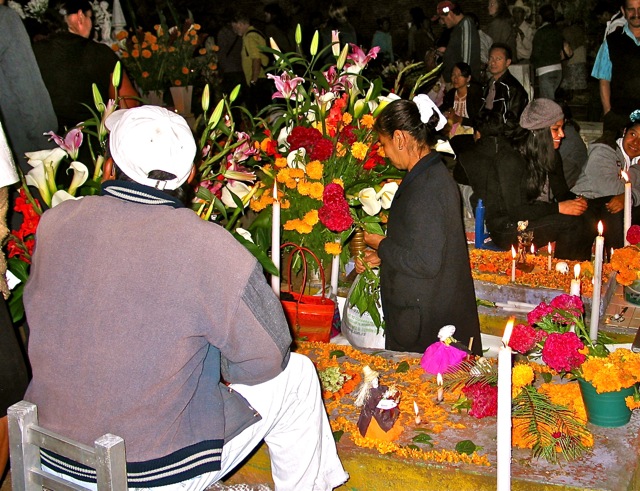
Panteón de Xoxocotlán 2010

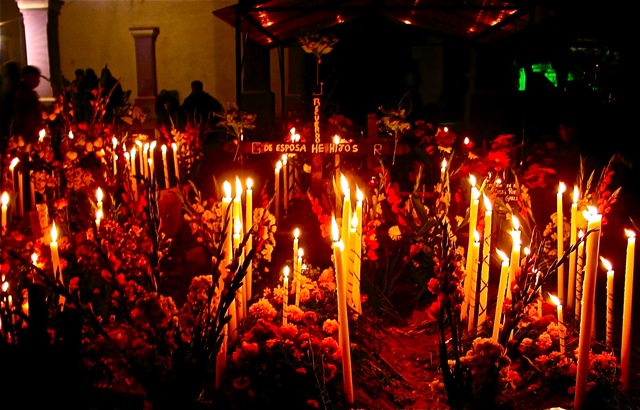
I plunged in. Heeding Laura’s advice to travel in groups of 3-4, I tagged along with a couple, chosen because he was at least 6 feet tall and I figured he would be easy to keep in eye range. The scene was like nothing I’ve ever seen before… a cornucopia of candles, by the thousands, flickering in the darkness; of color from the marigolds, cockscomb, and lilies; and of hundreds of families gathered around lopsided graves, drinking, sitting, laughing, and sharing in a ritual that recognizes that death is part of life. The scene was repeated at the new cemetery, before we stumbled our way back to the bus, which spirited us to the tiny pottery village of Atzompa and its panteón, well after midnight: Stage and dance floor, band playing, couples dancing, flowers, candles glowing in the darkness, families, few tourists, deeply personal, and magical… I felt like an intruder.

Panteón de Atzompa 2010

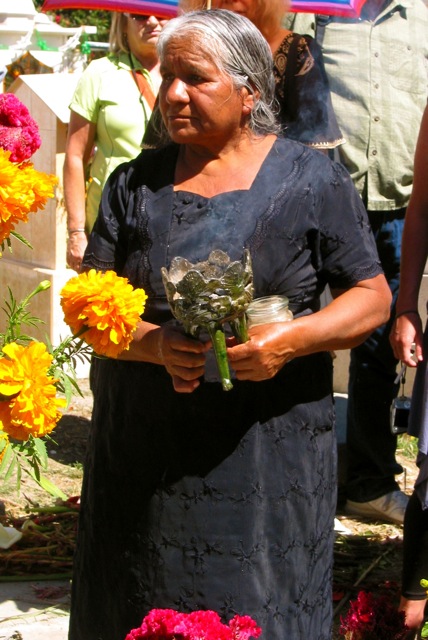
Though it was close to 1:30 AM when the bus dropped me off a block and a half from Casita Colibrí, I was up and back on the bus at 10 AM, for the ride to Mitla with Laura and our gang. We had the privilege of being guests of the García family, invited to participate in their Zapotec Day of the Dead traditions. We were welcomed to their home, a traditional family compound, with rooms surrounding an enormous dirt courtyard, with clotheslines holding newly dyed skeins of yarn (this is a family of weavers). Cervesas were offered, and then, in accordance with age-old custom, we followed the recently widowed family matriarch through the dusty streets to the Panteón Municipal. Here, holding the three-legged incense burner, the sweet and seductive smell of the burning copal perfuming the air, Doña Garcia performed a ceremony with words spoken in Zapotec.

Doña Garcia with copal burner

Mezcal and cigarettes were passed around. Joining the others, I drank the Mezcal and deposited my cigarette on the grave of the departed, where it joined several others — smoked and, like mine, un-smoked. With fireworks erupting periodically, we retraced our steps, following Doña Garcia and the smoke of the copal, as she brought the spirit of her late husband, Rutilio Garcia, back home to share the day with his family.

We returned to the lovingly assembled altar set-up by Doña Garcia. It was here, in front of this colorful altar, laden with flowers and food, including the intricately decorated pan de muertos that echoes the designs of the archeological ruins in Mitla, words were spoken in Zapotec and Spanish and tears traveled down many cheeks. Following this extremely moving ceremony, chairs were set up around several long tables where we joined the family in drinking Oaxacan hot chocolate, feasting on pan de muertos and mole negro, served, of course, with tortillas.

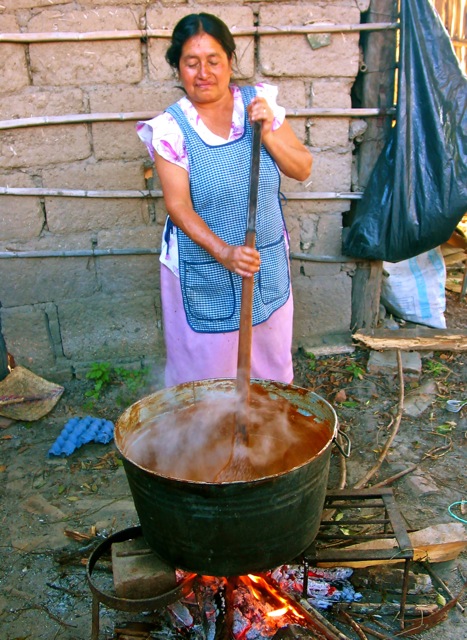
Satiated, it was probably a good thing that we were then led on a walking tour through this City of the Dead, to visit several other altars. Gracious families ushered our group through courtyards. At one, we paused to marvel at a woman, standing over an open fire (on this 80+ degree day), stirring a massive cauldron of mole,

Woman stirring cauldron of mole.

We gathered in modest homes where families “introduced” their departed and proudly explained the significance of items on their altars. Hot, exhausted and deeply moved, a much quieter crowd returned to the García home. We were offered a final shot of mezcal, said our heartfelt thank-yous, and boarded the bus for the trip back to the city.

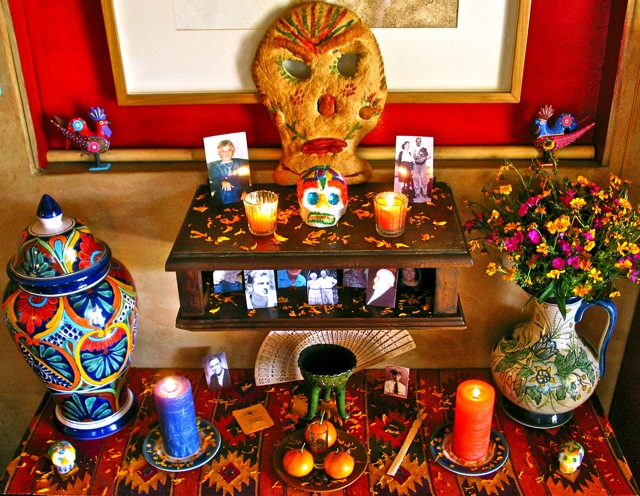
I returned home in time to watch my San Francisco Giants win their first World Series crown since 1954, when they were the New York Giants. After my initial hurrahs, my head couldn’t help but turn from the TV to my small Day of the Dead altar; where, along with photos of my parents, mother and father-in-law, and departed friends, my eyes settled in the center of the altar, to a photo of my grandparents.

They had moved next door to my childhood home in Mill Valley about the same time the Giants moved to San Francisco, and it was then that Grandpa introduced me to baseball. We listened to Russ Hodges and Lon Simmons call the games and I put up a team photo (Willie Mays, Orlando Cepeda, Juan Marichal, Willie McCovey, Felipe Alou, Stu Miller, Mike McCormick, Jose Pagan, Jimmy Davenport, Hobie Landrith…) on the wall of my bedroom; grandfather and granddaughter cheering, agonizing, and bonding. I took my Giants cap off, walked over, and put it on the altar.

Read Full Post »

Tears have  been falling on Oaxaca.  This season has brought historic rainfall courtesy of multiple hurricanes and tropical depressions in the Gulf and Pacific.  Ground is supersaturated, rivers have overflowed, fields and villages are flooded, bridges have collapsed, overpasses are closed and, in the city, water has been pouring down from hills, turning city streets into rushing streams and leaving streets potholed and sidewalks covered with a fine silt.  Twice in the past month a huge hole has opened up just a block away, closing a major bus route.

Hole in the road

The damage has been occurring daily for several months and, watching CNN International, I kept asking, “What about Oaxaca?  Why are they ignoring the unfolding tragedy here that has been devastating the homes and livelihoods of impoverished and mostly indigenous communities?”

Unfortunately, it took a lethal avalanche of mud and boulders tumbling down onto the remote mountain village of Santa María Tlahuitoltepec (50 miles east of Oaxaca City) in the early morning hours of Sept. 28 to bring rain-soaked Oaxaca to the world’s attention.  Thankfully, early estimates of the possible death toll proved to be exaggerated, but the destruction is catastrophic and the communities require an enormous amount of assistance.

Relief efforts have begun, collection stations have been set up throughout the city, and the Oaxaca Lending Library, where I volunteer, is spearheading its own drive to gather supplies and cash.  In addition, the Oaxaca Lending Library Foundation, a US tax exempt 501(c)3, is collecting financial contributions.  Dr. Alberto Zamacona, a Oaxaca Lending Library board member, runs medical missions to the Santa María Tlahuitoltepec area and will be overseeing the purchase and delivery of construction materials to help rebuild this extremely poor Mixe community.  If you would like to donate, please send a check to:

OLLF, c/o James Corrigan, 5443 Drover Drive, San Diego, CA 92115, USA

AND write “Flooding” in the memo portion of the check.  Donations will be transferred to Oaxaca and the Foundation’s treasurer will send you a receipt for tax purposes.  The need is great, so any donation you can make will be much appreciated and put to good use.

Unfortunately, this may have been another human-caused tragedy that could have been avoided.  Corruption And Deforestation Caused Oaxaca’s Mudslide Disaster, an informative and thought-provoking article by Kristen Bricker explores this issue.  And Oaxaca continues to weep….

Read Full Post »

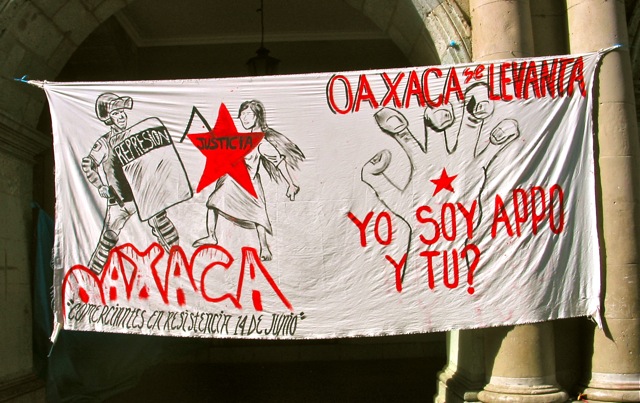
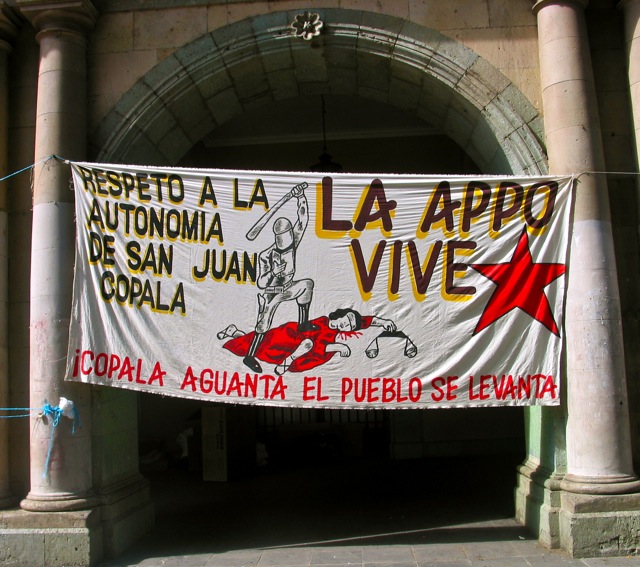
After a delightful but whirlwind (6 days is too short) visit, my stepson and his wife have come and gone; this year’s Guelaguetza festivities are over; life at Casita Colibrí is gradually resuming a more leisurely rhythm; and our current historic rain has gone on hiatus.  A quiet solo Sunday morning walk beckoned, as did the APPO banners, strung along the arches of the Palacio de Gobierno, that I wanted to photograph.

Oaxaca se levanta

The banners are a work of art, but ephemeral — here today, gone tomorrow — and I never seem to have my camera with me when I come across them.

"Respeto a la autonomia de San Juan Copala"

And, more importantly, they are a graphic reminder that behind the vitality, beauty, and quaint cosmetics of “new” cobblestone streets of this UNESCO World Heritage Site facade, class warfare lurks in the shadows.

Oaxaca’s contradictions are mine.  I turn the corner and walk over to puesto 80 at Mercado Juárez to see if they’ve gotten in the chocolate covered coffee beans.  No, maybe tomorrow…  I stop by the temporary pocket market in front of the Jesuit church on the corner and satisfy my sweet tooth by buying a bag of melt-in-your-mouth Merengue Sabor Cafe, instead.

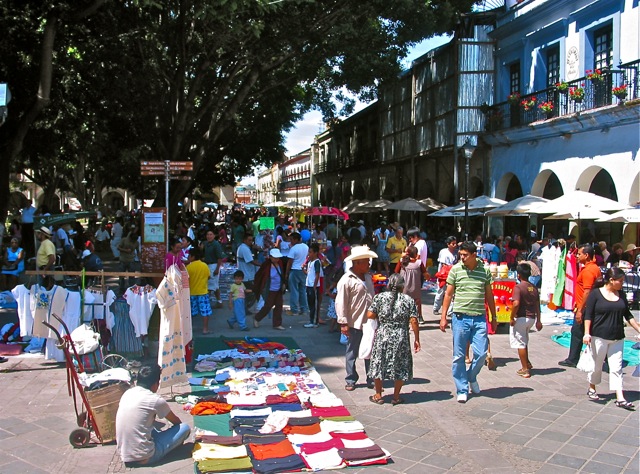
The Zócalo has awakened during my 45 minutes of shopping; young and old strolling arm-in-arm, vendors selling their wares, shoes being shined, outside tables occupied with diners chatting or simple watching the scene before them.

People strolling; vendors selling

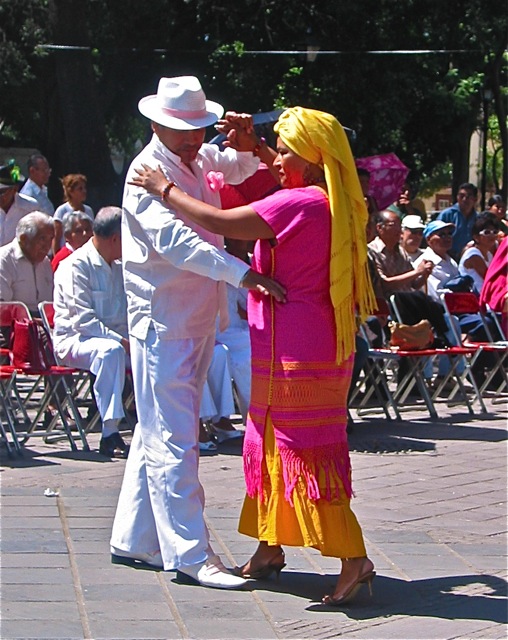
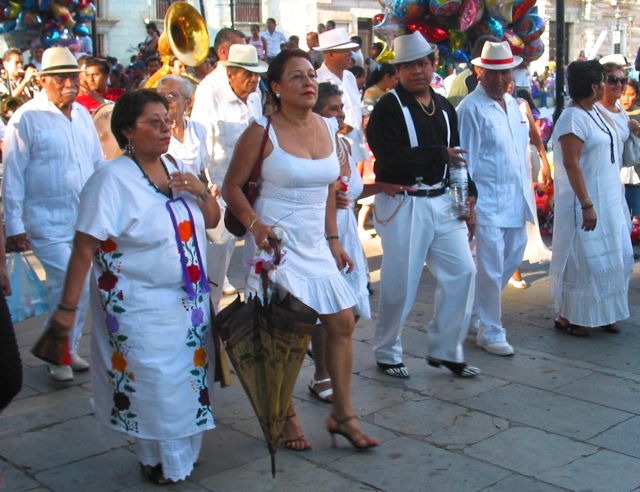
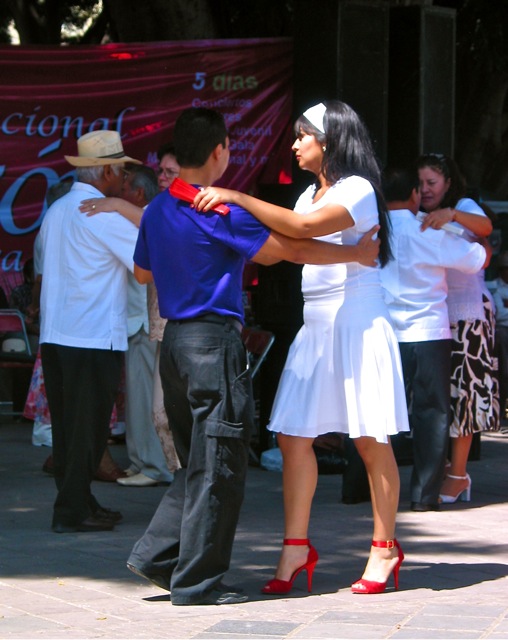
And, there is music — always, there is music — today an orchestra has set up under the laurels for the final day of the Festival Nacional de Danzón.  The dance, with its origins in Cuba, is stately and prescribed, with inexplicable pauses where dancers turn to face the orchestra, women move to the right side of their partners, fan themselves, and then several measures later dancing resumes.

Dancers in traditional Oaxacan dress

I’m captivated by the dancers who are at once, serious and joyful, and by their varied attire — once a costumer, always a costumer!

Dancers - woman in slacks

Most dancers are in the latter third of their life, though there are a few earnest young people.

Young dancers

It’s a prosperous crowd — a dance of the elite — but mesmerizing to watch.

dancers

After an hour of observing this very “civilized” scene under an intense sun, I headed to Independencia, the shady side of the street, and home, only to stop, reel around, and follow the sounds of a calenda coming into the Alameda; band, dancers, fireworks — celebrating Día del Comerciante!

Calinda

I leave feeling conflicted about my three hours on a sunny Sunday.  The lines from the song inspired by the 1912 Lawrence, Massachusetts textile strike come to mind…

As we come marching, marching, unnumbered women dead
Go crying through our singing their ancient cry for bread.
Small art and love and beauty their drudging spirits knew.
Yes, it is bread we fight for — but we fight for roses, too!

Lunch eaten, clouds gather, sky darkens, and Mother Nature reminds us who is in charge.

Read Full Post »

Church bells and scorpions; I must be back in my new home.

My return to Oaxaca was long and bumpy, with thunderstorms populating almost the entire trip.  A rocky ride was had by all.  The pint-size Embraer landed at 11 pm — pretty late for Oaxaca’s little airport.  However, as we alighted from the plane, the land crew provided welcoming umbrellas to protect us from the downpour, as we dashed across the blackened tarmac to the terminal.  With luggage retrieved, green light received, and boleto purchased, I jumped into the waiting and wonderful white airport van.

First to be dropped off, I pulled and dragged my suitcases up the two flights of stairs (trying not to awaken my sure-to-be sleeping neighbors along the way) and into the waiting embrace of Casita Colibrí, only to be greeted by carpenter’s tools strewn about and my bathroom door off its hinges — evidence of a project that was 2/3rds completed when I left six weeks before.  Not a problem, I told myself.  Then, my toilet wouldn’t flush.  No big deal, I told myself.  However (drum roll, please), when I came face-to-face with a scorpion in my bathroom sink, that WAS a problem!

I tried to be a “grownup” but it was my first real live scorpion and it totally freaked me out.   Eventually, I managed to send it on its way to the big alacrán casa in the sky.  I will spare you the details but suffice it to say, among other things, it involved saran wrap and duct tape.  Scorpions tend to carry on their scorpion business at night and, needless to say, sleep has not come easily since my close encounter.  However, like a good former reference librarian, I’ve done my research and discovered that the sting of the local variety of scorpion may be painful but is generally not deadly to healthy adults, lavender is used in France as a repellent, and people in the US Southwest report success using cedar oil to keep these creepy creatures out.  Now to find one or both…   In the interim, I reluctantly purchased and used one of several toxic sprays found on Soriana’s shelves — moderate peace of mind must be achieved if I am to get a good night’s sleep!

It took almost a week, but unpacking has finally been completed, suitcases stored, apartment has been tidied, carpenter has put my bathroom door back on, I’ve  fixed my toilet, and the pantry has been restocked.   I again awake to church bells chiming, geckos chirping, and colibrís zipping across my terrace.  My African Tulip trees are in bloom…

… and tonight I’m going to watch the Guerreros de Oaxaca play the Piratas de Campeche with my best friend in Oaxaca!  It’s good to be home…

Read Full Post »

En route to the U.S. for a 6-week visit with family and friends… sitting in the Houston airport and reflecting on traveling to and from Mexico.  As I’ve mentioned before, Oaxaca is a place of contradictions and this morning was a case in point:  The highly efficient airport shuttle service picked me up promptly at 6:45 am and we arrived at Oaxaca’s little airport 15 minutes later.  To take the shuttle, two days ago I’d walked down to their office just off the Zócalo, showed my flight departure time, paid my money, (48 pesos, approx. $3.75 U.S.), and they informed me what time the driver would pick me up.  It worked like… clockwork!

However, once at the airport, Continental had only 2 clerks working the check-in counter and the line moved excruciatingly slowly.  Apparently, there isn’t a supervisor to call in the event of a problem, and so the clerks patiently explain, check, explain, recheck, and explain again… as long as it takes, while the line gets longer and longer and time gets shorter and shorter.  And then there was my online boarding pass… all was fine with the Continental clerk but the gal at the security gate was thrown for a loop by the look of it and by my explanation that it really was valid and that I printed it at home on my computer.  Come to think of it, that sounds pretty bogus to me, too!   Oaxaca is one of the poorest states in Mexico and owning a personal computer is definitely not a given, let alone the wizardry of internet access.  She sought and received verification from two other security workers that my boarding pass was indeed valid.  But, it didn’t end there, when it came time to board, the Continental ticket taker was also perplexed and got on his walkie talkie to ask, where does one tear a pass without perforations?

I had to stand in line anyway, so I think next time I’ll skip printing my boarding pass!

Read Full Post »

… it must be time to water Casita Colibrí’s growing garden!

Casita Colibri sign

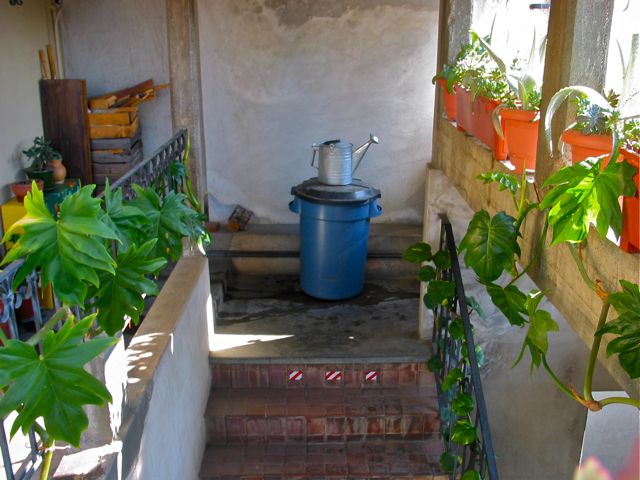
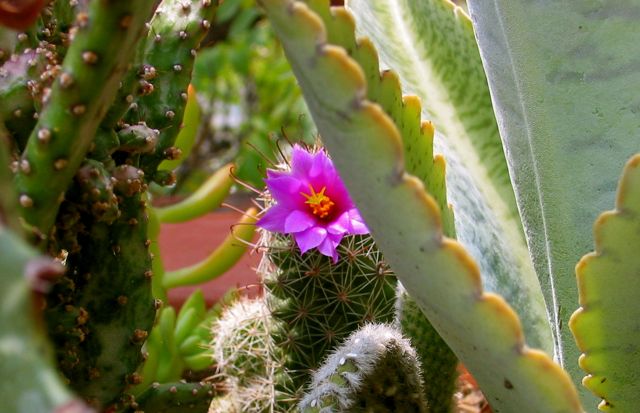
The 112 containers, from 6″ to 24″ pots and 30″ x 8″ x 8″ planter boxes decorating my entry and terrace, are brimming with one to twelve succulents and cacti.  They are watered weekly with gray water — shower water, dish water, and rain water, the latter when and if it ever rains again!  Oh, and then there are the 2 bougainvillea, 1 plumbago, 1 gardenia, 1 geranium, and pot of herbs, which require watering two to three times per week in this 90+ degree heat.  Water is an especially precious resource here in Oaxaca and we tenants must pay for all water deliveries to our compound.  So, in order to nurture my garden, everyday I haul buckets and dish-pans out through the terrace gate to my collecting barrel, a 32-gallon (not so sweet-smelling) plastic garbage can.  The plants don’t seem to mind the hand-me-down, fetid, murky water — in fact, they appear to love it!

Water barrel

With a few exceptions, my original garden was propagated from slips lovingly cultivated by my neighbor G, from his own exuberant and thriving terrace garden — a garden so profuse that there is scarcely room to walk!  When I arrived ten months ago, I was a disbeliever, never imagining that my terrace, too, could become home to a lush riot of greens, grays, magenta, red, yellow, orange, white, and blue.

An added bonus, besides (hopefully) filtering at least some of the exhaust from the diesel buses that race each other up the hill, the vegetation attracts a host of critters — giant friendly bumbling black bumblebees zeroing in on blossoms; geckos skittering across the pottery and terrace walls in the morning and afternoon, catching their breakfast and dinner; large brown crickets that like hang out in my “greens” recycling basket, not minding or even moving when I add more spent flowers and cuttings; and birds, including my home’s namesake colibrí, flitting back and forth across the terrace, chasing insects and sipping nectar from cactus and succulent flowers.

Garden God presiding

My garden never ceases to inspire, reward, and delight.  And… the garden god watches over it all!

Read Full Post »

Oaxaca is old!   As a cursory glance at Mixtec and Zapotec history and their descendants will tell, this valley has been settled for thousands of years.

Dancers

However, yesterday the city celebrated its founding as a colonial city, marking the 478 years since Spanish settlers (their bloody way paved by Hernán Cortés and his conquistadores) successfully petitioned the Queen of Spain for a land grant of 1 square league.  The colonists had already established their own town on the site of Huaxyacac, renamed it Antequera (after an old Roman city  in Spain) and received a Royal Charter from King Charles I of Spain.  However, Cortés had successfully gotten the entire Valley of Oaxaca (hundreds of thousands of acres) declared as his own private marquisate and, his greed knowing no bounds, kept trying to evict the colonial townspeople.  By obtaining the queen’s charter, this end-run around Cortés insured the rights of the townspeople to the land.   Thus, April 25th continues to be celebrated as Oaxaca’s birthday.

City elite

Saturday night I had a ringside seat on my terrace for fuegos artificiales (fireworks) — first emanating from the vicinity of the ex-convento of Santo Domingo (6 blocks to the NE), followed by those sent up into the night sky from La Basílica de Nuestra Señora de la Soledad (AKA:  my backyard).  Sunday morning, I was awakened at 6:05 to the sounds of Lady Soledad’s bells chiming — more musical than the usual clang-clang-clang — for a full 5 minutes, along with the rat-ta-tat-tat of firecrackers, adding exclamation points!

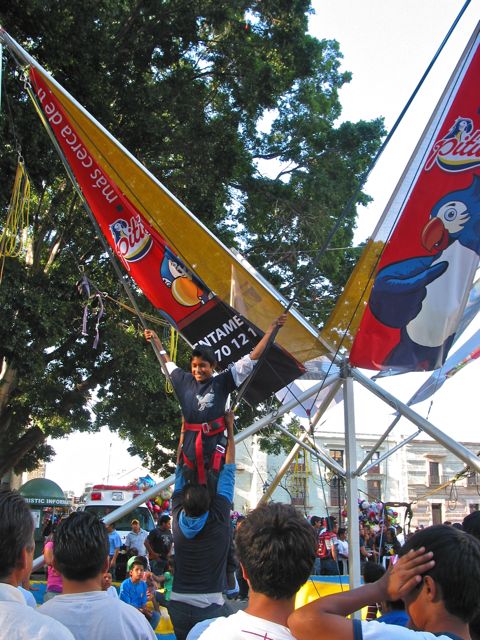
Bungee contraption -- ready for lift off.

I went down to the Zócalo a little before 6pm — the calenda (parade) hadn’t yet arrived, but the place was teeming with people (mostly all Mexican).  Payasos (clowns) were in abundance, but the big hit was a bungee cord contraption suspended above a trampoline.  A guy would harness a kid to the cord, jump up and down on the trampoline with his arms around said kid and once momentum was achieved, let go and send the kid sling-shot-like up into the sky.  Yikes, the way several of the kids were flaying around, I thought someone was going to break a back.

Marmota leading the way

For the 3rd day in a row, temperatures continued to be in the high 90s, unseasonably hot even for Oaxaca so, for the second day in a row, I hit the ice cream shop — this time for a scoop each of peach and banana (in a cup, no cone this time… less messy as it melted) — a great combination!  The calenda eventually arrived with all the usual suspects — several brass bands, municipal honchos, dancers in costume, monos (giant puppets — see above photo), etc.  Did I mention, it was really hot?  There I was, dripping wet, confining myself to the shade of the Zócalo’s 135+ year old towering Indian laurel trees, and eating ice cream when these participants (of all ages, I might add) had walked, played, and danced their way under the blazing sun for 13 blocks from Llano Park!

Little girl dancer

After 13 blocks, she didn't look any worse for wear!

Participants unmasked

Guys unmasked.

Couple drinking water

Feeling the heat... the pause that refreshes!

Disassembling balloons.

That's all folks!

Read Full Post »

Evidence of Semana Santa began days before Palm Sunday; the streets and sidewalk cafés began filling with Mexican and international tourists; street vendors began blanketing the Zócalo, the Alcalá, and any and all gathering places; and the front of the Cathedral was lined with local artisans — the dark faces and strong compact bodies of native craftsmen and women weaving palm fronds into intricate flowers and crucifixes to sell to the faithful (and tourists) for Palm Sunday rituals.

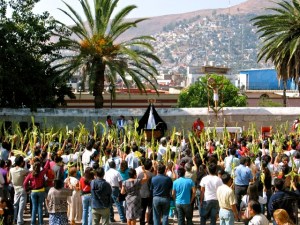
Palm Sunday – I awoke early to the sounds of construction.  From my terrace, I could see a giant awning being erected on the Plaza de la Danza next to the Basílica de Nuestra Señora de la Soledad.  Following a quick shower and breakfast, I grabbed my camera and woven palm frond and headed over there.  Food stalls with hot comals, tables and benches, and a beckoning aroma spilled down the stairs next to the Plaza – squash blossoms, mushrooms, cheese, tortillas, red and green hot sauces — the fixings for empanadas – and I asked myself, “Why did I eat a boring breakfast of cereal?”  More artisans weaving and selling palm fronds lined the stairs nearer the Basílica.

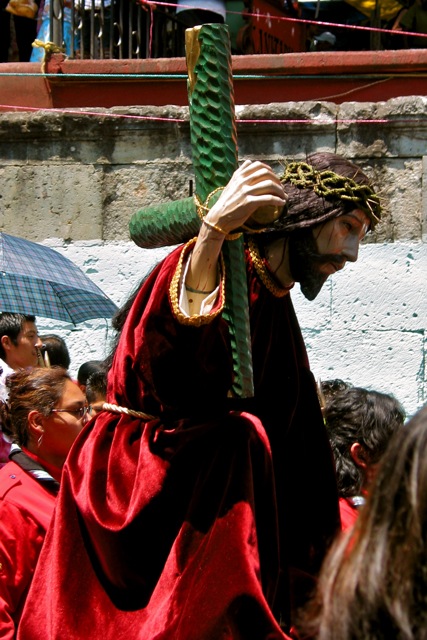
Massive sculptures of Jesús, bent under the weight of the cross he is bearing, and Lady Soledad, in her deep purple mantle, gold crown and halo, were set up outside, as was a small stage.  La misa was celebrated outside (to accommodate the enormous crowd, I’m guessing); the youthful choir, accompanied by a guitar, sang folky-sounding songs, cheers were chanted to the cadence of “rah, rah, sis boom bah!” and palm fronds were raised and blessed with holy water.  I wandered through the crowd (I’ve noticed a degree of fluidity exists among worshippers here, even inside churches, so I wasn’t the only one roaming around), one of only a handful of gringos in this congregation of 600+ mostly indigenous faithful.  I had pretty much no idea what was being said but did offer my right hand when it looked like all were to greet their neighbors — and was greeted with startled but warm smiles and handshakes.
I returned home, but first peeked through the rarely open large red door of the Holy Trinity Anglican Episcopal Church  nearby; 15-20 people standing in a circle in a small courtyard.  Quite a contrast!

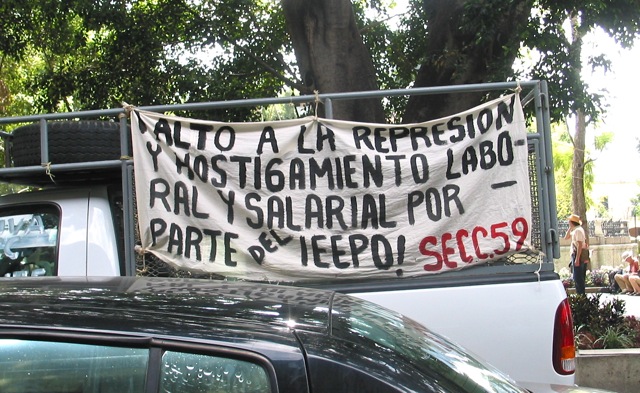
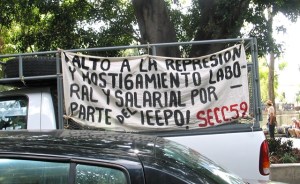
Religious ritual wasn’t the only event of the day; a Secc. 59, teachers’ union car caravan from Juchitán (about 150 from miles away) occupied part of the Zócalo – a peaceful reminder of the ongoing struggle between the teachers’ unions and the government.  And, in the evening, sounds of a live (and free!) rock concert blared from the massive stage (I had heard being set up before the crack of dawn) in the Plaza de la Danza.  As is routine here, a fireworks display exploded only a few hundred yards above the heads of the concert-goers (and a little above eye level from my terrace, less than 2 blocks away) – all courtesy of one of the opposition political parties – PRD, I think.  The color, community, and contrast that is Oaxaca!
Jueves Santo – After a morning spend hand-washing “delicates” and tending to my garden, followed by an afternoon of Spanish lessons and shopping for fruit, veggies, and tortillas, with my portable fan on high (it was in the 90s), I collapsed on my bed for a late afternoon siesta.  Unfortunately, that meant missing the 5 pm (give or take) mass and washing of feet apparently at all the churches in the city.  However, after a dinner of tacos made with my newly purchased tortillas, aguacate, cilantro, Queso Oaxaca, lechuga, y pollo and washed down with Valle Redondo California Vino Blanco (my new favorite cheap wine), I reluctantly put on long pants (one doesn’t wear shorts in public in the city), grabbed my camera, and emerged from the refuge of Casita Colibrí, unwashed feet and all, to join the people-moving throngs.

Ritual called for visiting 7 churches, though pretty sure I wasn’t going to make it to 7, I figured I’d give it the good old college try.  My first stop was San Felipe Neri where, at the entrance, I purchased a bag of Pan Bendito (5 buns for 10 pesos) and the followed the faithful down the aisle toward the altar and out a side door (I didn’t stop to get my Pan Bendito blessed), a traffic pattern that was repeated at the other churches, some with entrance and exit signs tacked on the doors, all in the interest of preventing gridlock that threatened.  Clutching my bag of pan, my next stop was at Carmen Abajo, followed by the Cathedral, and Sangre de Cristo.

My plan was to end the evening minutes from my apartment, at the Basílica de La Soledad, where I could reward myself with a “Nieves Oaxaqueñas” (Oaxacan ice cream) of leche quemada (burnt milk) and tuna (not fish! fruit from nopal cactus) at El Jardín de Socrates, next to the church.  The Basílica was closed, but some sort of mass was being celebrated in the plaza outside.  So my question was, does that count as one of the seven?  I pondered this deep theological question as I tried to eat my nieve slowly enough so as not to get the inevitable brain freeze.  Last stop was at San José a small church across the Plaza de la Danza from Soledad, and even closer to home.

I’ve come to see Oaxaca as a city of contradictions, and the evening’s ritual was no different — sidewalks jammed with people in a combination of a semi-solemn pilgrimage, street festival, family night at the fair, and date night.  A balmy evening; streets teeming with young, old, and everyone in between; loud music blaring from clubs; lively conversations flowing from the open windows of restaurants; every kind of street vendor seemingly doing a booming business; and lots of young April-love canoodling going on!

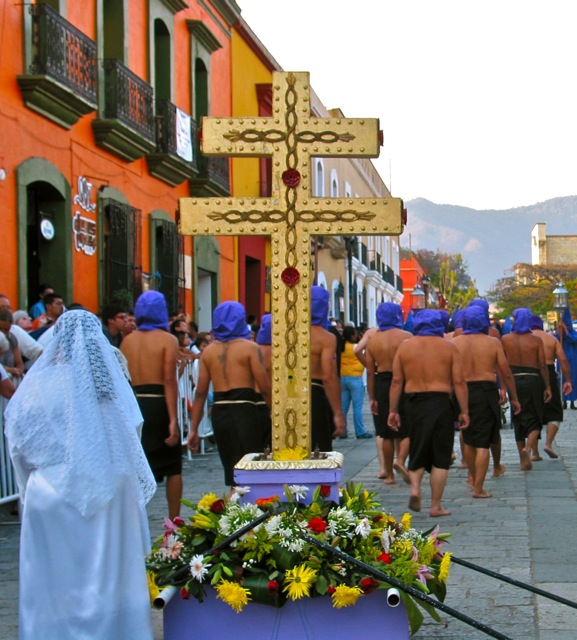
Viernes Santo – I slept later than usual and slowly went about my morning routine, knowing tonight was THE major event of Semana Santa – the Procesion del Silencio.  However, as I was showering, from the open window I heard a slow, solemn drumbeat coming up the street — the unmistakable sound of a somber procession.  I rinsed, dried, dressed, brushed my hair, was out the door, and onto Morelos in less than 10 minutes, to see the the backs of the slow moving multitude.  Figuring they were headed to the Basílica, I ran down through the Plaza de la Danza and El Jardín de Socrates to the top of the retaining wall beside the stairway leading up from Independencia below, to the church above.  Good move!

After about a half an hour, I had a ringside view as the statues of Jesús and Nuestra Señora de la Soledad made their way up the stairs right in front of me.

About 6 PM, I re-emerged from Casita Colibrí and headed up the Alcalá to La Preciosa Sangre de Cristo for the beginning of the Procesion del Silencio.  Crowds had already gathered in front of the church, yellow caution tape roped off the street for participants to assemble, and banners were leaning against a nearby building.  I joined the tourists (But, hey, I live here!) jockeying for good camera position to snap some pics, then retreated to the curb to sit and wait.

The procession began not long after sunset, but immediately took a left turn – ooops a change in route!  The sidewalk populace immediately dispersed and I, pulling out my Spanish teacher’s route instructions (mil gracias!), ran over to 5 de Mayo where, in the darkness, I watched a grim, strangely moving, yet mystifying cortège.  Night photos, punctuated by bright white, energy efficient street lights were equally obscure, but Flip video turned out better and I hope, eventually, to edit it into a short video vignette.  We shall see…

By Saturday, I was “Semana Santa-ed” out!  Perhaps next year I’ll make it to Sabado Santo, the celebration of fire and water.   However, though I didn’t leave my rooftop refuge on Domingo de Resurreccion, the sound system of Nuestra Señora de la Soledad afforded me a bedside seat at the morning’s 6 AM outdoor Easter mass — the early hour more egregious because we had “sprung ahead” the previous night!  And, no sooner had I finally been lulled back to sleep by the priest’s sonorous sound, than the flinchers (rocket explosions) began and I bolted upright.  Bells followed and I gave up on trying to sleep.  La misa lasted 2-1/2 hours; a mile high in the Sierra Madre, “He” has risen…

Read Full Post »

Awake at 4:30 AM

Blogging???  This is what happens when I wake up at 4:30 AM and can’t go back to sleep!  Perhaps it’s part of a natural progression in the nesting process — finally feeling comfortable and at-home in my tiny rooftop studio apartment in my new city.  Maybe it’s another trial balloon in my search for a creative outlet or a project to add structure to my newly retired life.  Then again, with close friends so far away and Skype taking the spontaneity out of phone calls, it could fulfill a need to share my current adventures with whomever cares to read my musings, even if it’s just me.  Whatever the reasons (probably all of the above and then some), here’s hoping I become a little braver in revealing myself, don’t let my perfectionist streak get in the way of posting, and I stick with it!

Read Full Post »
« Newer Posts