One of the things I always notice when in El Norte this time of year is the longer length of the day — and today it’s at its longest. Light came through the curtains to wake me at 5:45 AM and the sun won’t dip behind Mt. Tamalpais and into the Pacific until 8:30 PM. The further north one goes, the longer this day lasts. Of course, the reverse is true in the winter. No wonder the Summer Solstice is such a big deal in the northern latitudes!
As much as I miss Oaxaca, this really has been a spectacular spring in the Bay Area — perfect for strolling along the San Francisco Embarcadero with a Oaxaca buddy.
The City By the Bay at her best!
Posted in Celebrations, Science & Nature, Travel & Tourism | Tagged California, city by the bay, photographs, photos, San Francisco, San Francisco Bay, San Francisco Embarcadero, Summer Solstice | 1 Comment »
This wall in Oaxaca says it all. Have I mentioned, I’m counting the days until my return?!!

Here’s hoping Cameron Conaway is right and this is, “The storm before the calm.” (Caged: Memoirs of a Cage-Fighting Poet)
Posted in Creativity, Culture | Tagged art, graffiti, Mexico, Oaxaca, photographs, photos, quotations, urban art, wall art | 1 Comment »
It’s the annual fathers (and a couple of grandfathers) of Oaxaca slideshow… I never tire of seeing these guys with their hijas and hijos.
This slideshow requires JavaScript.
To loving and responsible fathers everywhere, may you continue to do what you do. And a special shout-out to my son!
Posted in Celebrations, Culture, Travel & Tourism | Tagged Día del Padre, Father's Day, fathers and children, Mexico, Oaxaca, photographs, photos | 6 Comments »
A recent article from California’s Merced Sun-Star addresses an issue many in Oaxaca’s ex-pat community have been discussing.
MERCED — In the small town of Mitla Oaxaca in Mexico, a little girl drew inspiration from her grandmother’s colorful garden more than 10 years ago.
Though the family wasn’t very wealthy, the dinner table was always filled with fresh and nutritious foods.
“When I was young, my grandma always had a garden,” said Xochitl Juarez, now 26. “She was really poor, but she always had fresh fruits and vegetables.”

(photo by BEA AHBECK – bahbeck@mercedsunstar.com) Xochitl Juarez of Mexico planted a 10,000-square-foot garden in the shape of a circle because ‘everything in life is a cycle,’ she said.
After falling in love with agriculture at a young age, Juarez sought to help her community learn new farming techniques to become more sustainable.
“A lot of people that come here are from small towns and they have to grow their own food,” she said. “If they have the opportunity to be sustainable, we’ll have a better life with more healthy foods and better nutrition.”
Juarez left her hometown of about 10,000 people and traveled to the United States for the first time as part of the Multinational Exchange for Sustainable Agriculture program.
[Click HERE for full article]
Posted in Agriculture, Environment, Food, Gardens, People, Science & Nature | Tagged agriculture, articles, California, Exchange student learns sustainable gardening, farming practices, farming techniques, indigenous farmers, Merced, Mexico, Oaxaca, sustainability, sustainable agriculture program, Xochitl Juarez | 1 Comment »
One can see his art all over the city. I’d first been wowed by the scale, symbolism, and style of his work early last year, when walking up Matamoros to meet a friend who was staying at Hotel Azucenas. At Calle Prof. M. Aranda, I was stopped dead in my tracks — the entire front of the building next to the hotel had been transformed. Using a roller, not brush or spray can, the artist known as Sanez turned it into a work of art.
In September 2012, Sanez again worked his magic on this tired old building — this time creating “El Canto del Agua” (The Song of Water). According to the article, Mesoamerican Peoples Express their Solidarity by Jonathan Treat, using “symbols of the Aztec god of rain, fertility and water—Tláloc, and corn, forests, animals, campesinos and campesinos and traditional Oaxaca fiestas… Sánez honors indigenous peoples struggling to defend their territories: [The mural is] ‘Dedicated to the peoples who organize to defend their commons and the common good—Mexico and Canada.’”
Another close encounter with the work of Sanez occurred last month when I ventured across Republica into Barrio de Jalatlaco. Besides its un-city-like tranquility and quaint tree-lined, but treacherous, cobblestone streets, this bucolic neighborhood always has great street art. However, I didn’t expect to find the restaurant, Fuego y Sazón, playing host to the unmistakeable style of Sanez. Wow!
And then… Just a few days before this current trip to California, I was at Gorilla Gallery (Crespo 213) talking to Jason Pfohl (glass artist and guiding spirit behind Gorilla Glass) when Sanez came in. He came to discuss plans for his live painting on glass event at the gallery. Alas, I was already in the US on May 31, when it occurred. However, if you are currently in Oaxaca, you can see the finished piece at the gallery on Thursdays between 2 and 8 PM. Besides the immense glass canvas, the gallery is featuring prints by Sanez — and I’m sure Jason would be happy to discuss the distinctive tattoo work of Sanez.
In addition, you might want to slow down when driving along Constituyentes behind Mercado de Abastos — that giant billboard mural towering above the weeds and refuse is another of Sanez’s masterpieces.
Posted in Creativity, Culture, People, Travel & Tourism | Tagged art, artists, Gorilla Gallery, graffiti artists, Mexico, murals, Oaxaca, photographs, photos, Sanez, street art, urban art | 4 Comments »
I’m in the San Francisco Bay Area for a lengthy stay — a necessary trip to el norte to sell my grandparents house. I’ve only been here for three weeks but I’m missing Oaxaca, already! However, driving up Solano Ave. on my way to Berkeley, a storefront caught my eye. Skeletons, tapetes, a riot of color…
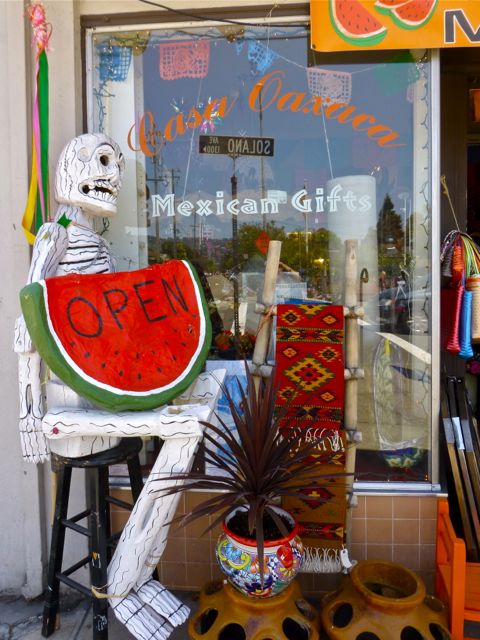
Where am I???
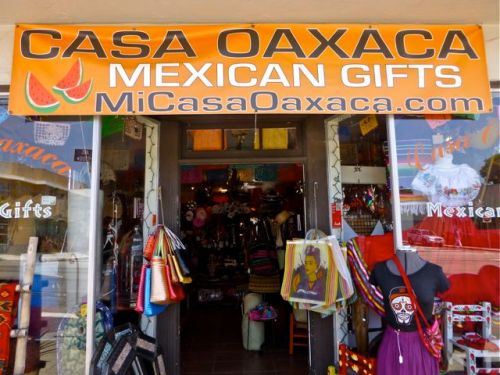
Casa Oaxaca is a gift shop featuring arts and crafts from Southern Mexico. Artesanía from Chiapas, Guerrero, Puebla, and (of course) Oaxaca cram every nook and cranny of the store.
Casa Oaxaca’s delightful owner, Guillermo (“Memo”) Robles, was born and raised in the city of Oaxaca and he returns frequently on buying trips. All items are carefully (and lovingly, I think) bought directly from crafts people and artisan collectives.
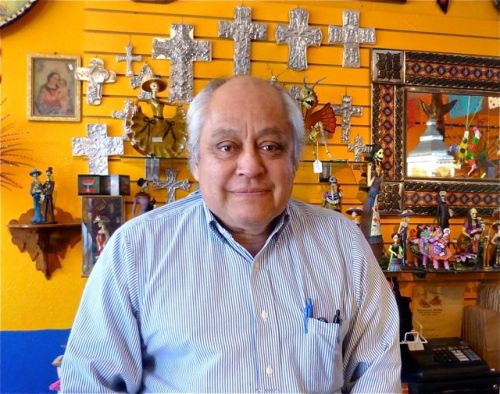
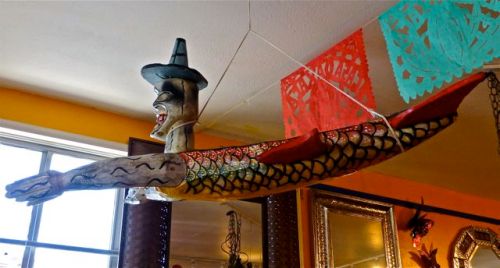
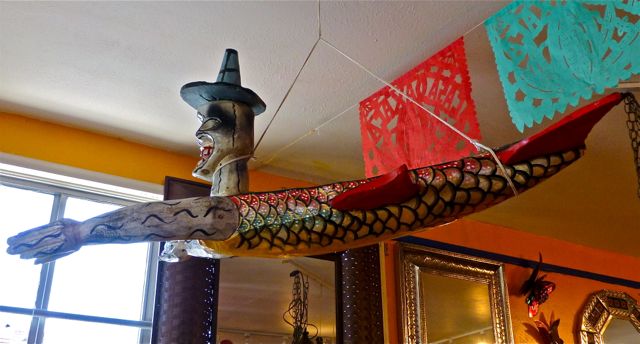
I stood talking with Memo for almost 30 minutes and, surrounded by the artesanía I have come to know and love, it was almost like being back in my adopted city. Ahhh… If you go, don’t forget to look up!
I’ve also discovered Mi Pueblo Food Center in San Rafael, one of a small, privately owned, chain of supermarkets in Northern California. I came home with Tajin seasoning, a bag of still warm tortillas, a whole roast chicken, quesillo, along with fruit, fresh herbs, vegetables, and a case of Modelo Especial (the latter especially for my son, in whose home I’m staying) — all for a better price than the unnamed, but well-known, big chains. On my next visit, I’ve got to try their tamales.
Posted in Creativity, Culture, Food, Markets, People | Tagged artesania, California, Casa Oaxaca, Guillermo Robles, Mi Pueblo Food Center, Oaxaca, photographs, photos, store displays | 12 Comments »
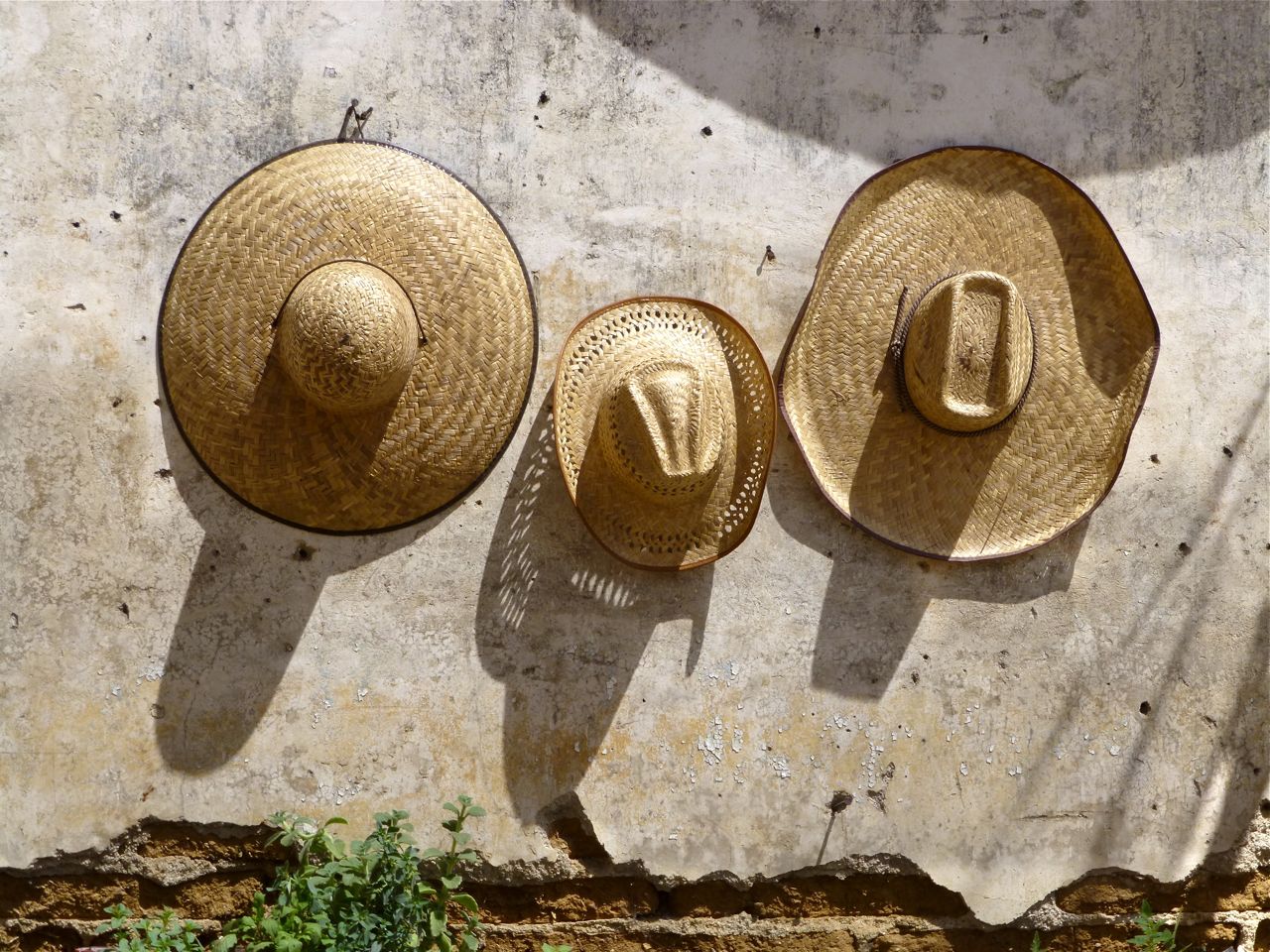
Posted in Buildings, Creativity, Culture, Exhibitions, Gardens, Travel & Tourism | Tagged abandoned buildings, art, art installation, exhibition, hats, Matria Jardín Arterapéutico, Mexico, Oaxaca, photographs, photos, still life, straw hats | Leave a Comment »
Cars in Oaxaca? They range from decrepit VW Beetles held together with duct tape to the latest shiny black tinted windowed SUVs. Most lean toward the former — the cobblestones, potholes, and dirt roads can rapidly speed-up the aging process.
However, like young men worldwide are wont to do, no matter the make and model, Oaxaqueños love to customize their rides. This one caught my eye in San Pedro y San Pablo Teposcolula:
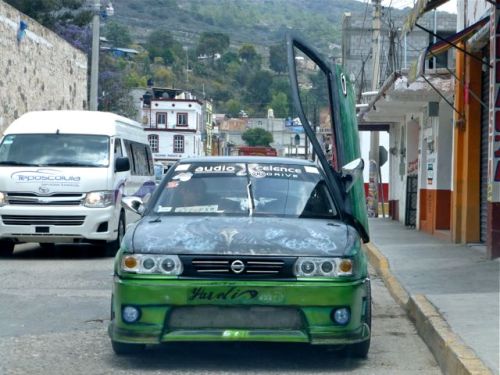
The doors are known as Lambo (after Lamborghini), scissor, butterfly, switchblade, jack-knife and beetle-wing doors. Take your pick! R Kelly song lyrics came to mind:
I believe I can fly
I believe I can touch the sky
I think about it every night and day
Spread my wings and fly away
I believe I can soar
I see me running through that open door
I believe I can fly
By the way, should you too want to install Lambo doors on your car, you can find instructions here. Who knew???
Posted in Creativity, Culture, Travel & Tourism | Tagged automobiles, cars, I Believe I Can Fly, Lambo doors, Mexico, Oaxaca, photographs, photos, San Pedro y San Pablo Teposcolula | 1 Comment »
It’s been two years since he fell asleep at the wheel, slammed into a tree, and was killed instantly. A memorial plaque and flowers soon appeared. There were rumors of intoxication, but that doesn’t lessen a mother’s pain or love. And she continues to come weekly to place fresh flowers at the site where he died.
Though I didn’t know Víctor Damián Díaz González, I too continue to remember him every time I walk down the street.
Posted in People, Tragedy | Tagged memorials, Mexico, Oaxaca, photographs, photos, sidewalk memorial | 4 Comments »
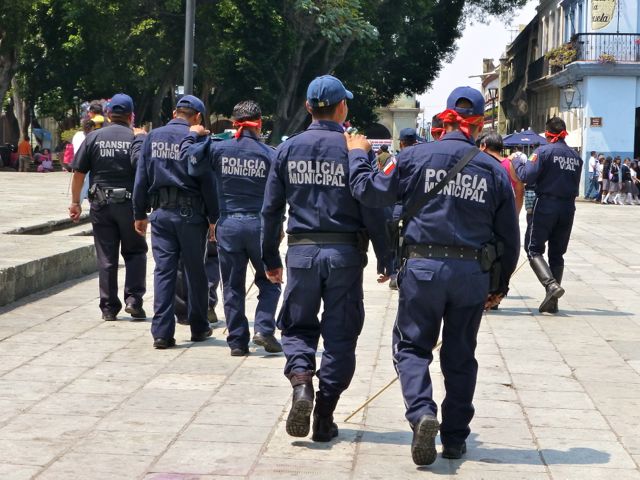
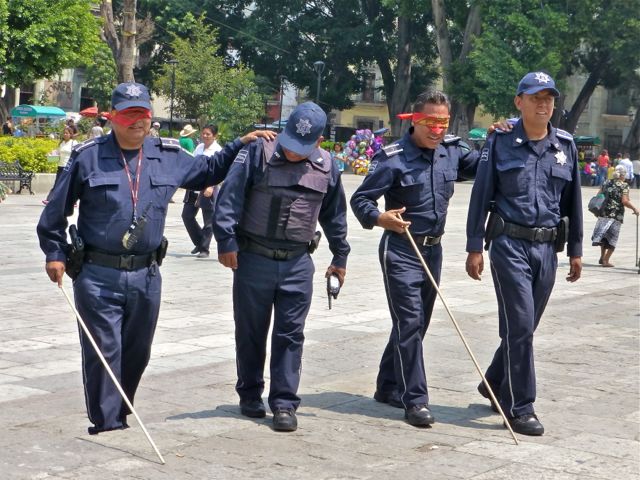
… in their shoes. A couple of weeks ago, as I crossed the Alameda, I came across the following scene.
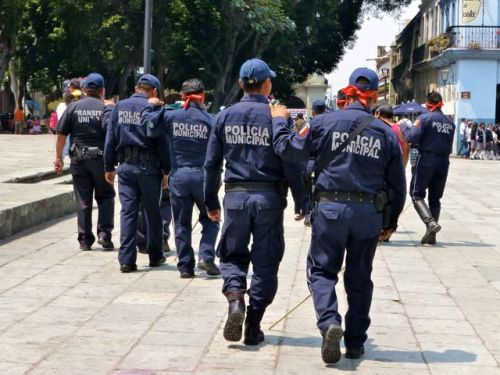
According to this article in Noticias, this is part of the Blind Accessible Tourism 2013 project of the Municipal Tourism Office. “During the tour, the participants experience the uncertainty that visually impaired people feel when walk the streets, and reflect on the importance of signs with street names written in Braille and audio traffic lights,” said Vladimir Martinez Lopez, who has been blind since age 11 and is the instructor for the course.
I blogged about the Braille street signs and the library for the blind and visually impaired soon after the signs began appearing at the beginning of 2012. Since then, I’ve seen them used by the sightless and intrigue and stimulate conversation among the sighted.
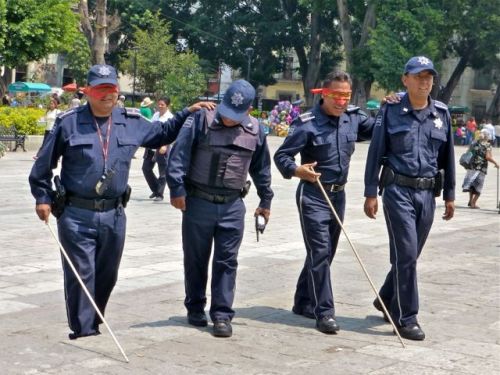
Now if they could just do something about the hazards of crossing the street at the intersections. Be they cars, buses, trucks, or motorcycles, they do not stop before turning a corner. Visually impaired or sighted, it’s like playing Russian Roulette!
Posted in Education, Parks & Plazas, Signs, Travel & Tourism | Tagged accessibility, accessible tourism, blind, Braille, Dirección de Turismo Municipal, Mexico, Oaxaca, photographs, photos, police, popular travel destinations, street names, street signs, tourism, training, Turismo Accesible 2013, visually impaired | 1 Comment »
How about exchanging guns for guitars?


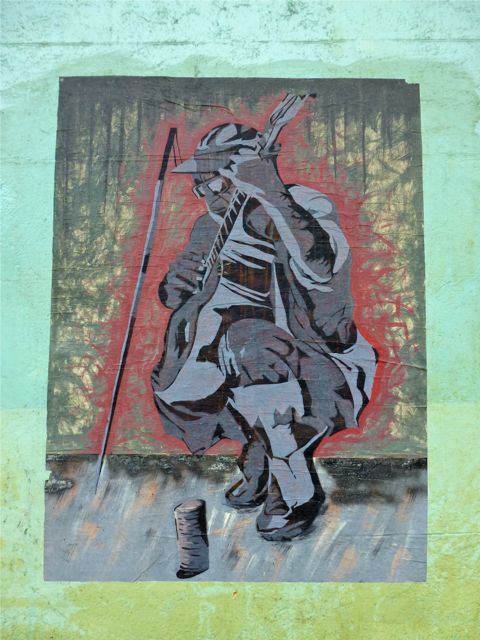
From the walls of Oaxaca.
Posted in Creativity, Culture, Violence | Tagged graffiti, Mexico, Oaxaca, photographs, photos, street art, urban art, wall art | 2 Comments »

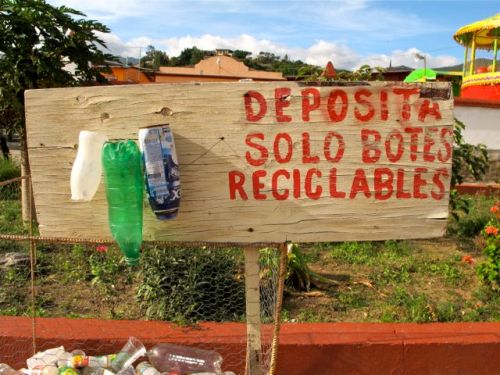


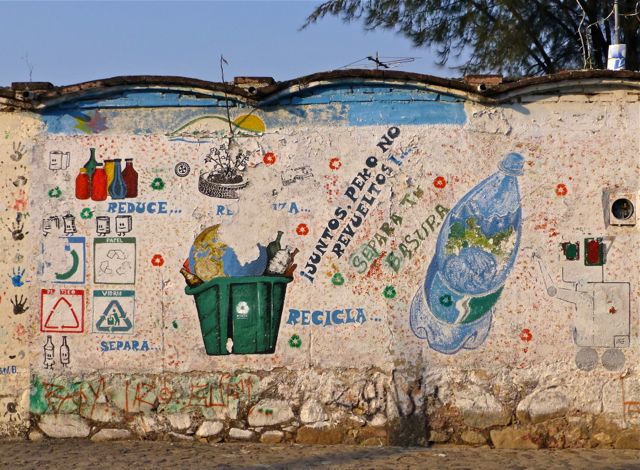
Educating the public in Teotitlán del Valle.
Posted in Education, Environment, Signs | Tagged environmentalism, Mexico, Oaxaca, photographs, photos, popular travel destinations, recycling, street art, Teotitlán del Valle, wall art | 1 Comment »
The Fiesta de Mayo in Santa María Tlahuitoltepec lasted three days, though we were only there for a few hours on day two. There was to be a rodeo that night — a corral had been set up and bulls were arriving as we were leaving.
A timeless quality… but, not to be mistaken for being frozen in time. We are already making plans to return.
Posted in Celebrations, Culture, Travel & Tourism | Tagged Fiesta de Mayo, fiestas, Mexico, Mixe, Oaxaca, photographs, photos, Santa María Tlahuitoltepec, sierra norte | Leave a Comment »
Saturday, we drove up into the Sierra Norte, to the Mixe region of the state of Oaxaca. Our destination was Santa María Tlahuitoltepec and its Fiesta de Mayo. We had been attracted to their unique women’s traje (costume) by the work of one of the vendors at an artesanía feria in the city a couple of months ago. She invited us to the fiesta and so we went.
After winding our way up mountain roads filled with switchbacks and potholes, we turned off on a dirt road for the final ten minutes of our seventy-six mile journey from the city. We had climbed from 5,100 feet to over 7,800 feet above sea level on our three-hour drive up into pines. The name Tlahuitoltepec is made up of two Nahuatl words — Tlahuitol translates as “arched” and Tepec as “hill.” I can attest, Santa María Tlahuitoltepec is definitely built on a (very steep) “arched hill.” This is the same village that, at the end of September 2010, was hit with a devastating landslide that killed 11 residents, following record rainfall. And, as we drove up to the village, engineering work to repair and reinforce the hillside and road was visible and ongoing.
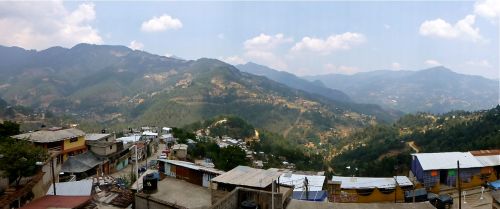
We weren’t exactly sure where we were going, stopped to ask, and were told to follow the signs to “el centro.” Our first indication that we were headed in the right direction was the sound, quickly followed by the sight, of a band playing and walking in the same direction we were. It was one of three youth bands we saw and heard during our brief stay; music is obviously very important in this remote mountain village. The pueblo plays host to the Center for Musical Training and Development of Mixe Culture and according to this article, an estimated 70% of the population can read music and many who can’t, play by ear.
And, along with music comes dance. Santa María Tlahuitoltepec will be participating in this year’s Guelaguetza in July — and its Ceremonia del Tepache is featured in one of the promotional videos. While there, we watched as a youth exhibition group performed three traditional dances to the appreciative crowd that filled the stands of the municipal court.
This slideshow requires JavaScript.
The uniqueness of each village never ceases to delight and impress me. You know when you are there, because you couldn’t be anywhere else.
Check out Oaxaca-The Year After for more photos from Saturday’s excursion.
Posted in Celebrations, Culture, Travel & Tourism | Tagged Ceremonia del Tepache, Fiesta de Mayo, fiestas, Mexico, Mixe, Oaxaca, photographs, photos, Santa María Tlahuitoltepec, sierra norte | 11 Comments »
One of the main roads into and out of Oaxaca is Federal Highway 190. It is a section of the Pan American Highway (which runs from Prudhoe Bay, Alaska to Ushuaia, at the southernmost tip of Argentina). I cross the highway several times a month on my way to the Organic Market in Xochimilco or to a restaurant in Colonia Reforma — and the same thought always crosses my mind, “I can’t believe I’m walking across the Pan American Highway!”
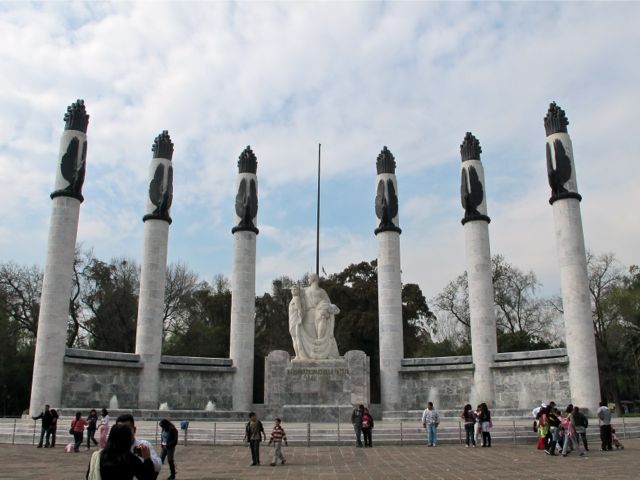
However, the highway has another name, as runs through the city — Calzada Niños Héroes de Chapultepec. Child heroes of Chapultepec? Who were they? If you visit Mexico City, your guidebook or tour guide might direct you to Chapultepec Castle (Castillo de Chapultepec) set high on a hill in the middle of the beautiful 1694 acre Bosque de Chapultepec (Chapultepec Park). There you will discover that they were young martyrs from what is called the Mexican-American War in the USA and is known here as the Invasion of Mexico.

Monument to the Child Heroes in Chapultepec Park
Penn State historian Amy S. Greenberg calls it, A Wicked War, and her book, by the same name, chronicles a war waged on the basis of a Presidential lie, against a guiltless neighbor, for the express purpose of annexing half its territory. (Hola, Texas, New Mexico, Colorado, Arizona, Utah, Nevada, and California.) Then Illinois congressman Abraham Lincoln opposed the war and it spawned the first U.S. anti-war movement.
To discover what your teachers may not have told you about the Invasion of Mexico and its Niños Heroes, take a look at last week’s CBS Sunday Morning segment by Mo Rocca and with Amy Greenberg.
h/t Tim Johnson
Posted in History, Travel & Tourism | Tagged A Wicked War: Polk, Amy S. Greenberg, Clay, history, Invasion of Mexico, Lincoln and the 1846 U.S. Invasion of Mexico, Mexican American War, Mexico, Niños Héroes de Chapultepec, Oaxaca, Pan-American Highway, politics, popular travel destinations | 16 Comments »
« Newer Posts - Older Posts »













 Mexican Peso Converter

 View From Casita Colibrí